PRIVATE
HEALTH
SURVEILLANCE
ON
GUATEMALAN
FARMS1
Werner Ascoli
A simple private program of preventive medicine for working families on Guatemalan farms has shown itself capable of
producing effective results with methods that could be applied in other places. This article indicates the costs and procedures involved in conducting this program on one farm and describes the results achieved.
Introduction
The health problems of populations living and working on Guatemalan farms have generally been neglected. Neverthe- less, many resident farm populations are larger than the populations of some towns and villages that enjoy a health center staffed by a resident physician. Fortunate- ly, there are now signs that in some places, at least, the situation is changing. Quite in contrast to the stereotyped “landowner” image, many farms have been taken over in recent years by strongly motivated younger men of good education who recognize the poor health and living conditions of their workers and are trying to improve them.
Beginning in 1971, the author undertook to establish private programs of preventive medicine on several farms. These have all been financed by the owners, at no expense to the workers or their families. This article describes such a program on one farm, where the size of the population and the cooperation of the owner and workers provided a sound foundation for work of this kind.
Most Guatemalan farms are on the country’s Pacific slope, in terrain which
‘Also appearing in BoZ OfSanit Panam, 1978.
rises from sea level to about 5,000 feet and which contains some of the nation’s richest agricultural land. This area was only slightly affected by the recent earthquake. Its most important products are coffee, sugar, cotton, cattle, and corn. Some other lesser crops are also grown. In order of rising importance, these include essential oils (lemon oil, citronella), rubber, spices (cardamom, allspice, vanilla), sorghum, sesame, and rice.
Most of the land is privately owned and is divided into agricultural farms (fincas) ranging in size from a few dozen acres to several thousand. These farms employ anywhere from a few to several hundred workers. Although some farms produce only one crop, many have become highly diversified. The degree of mechanization varies according to the crop and the slope of the land. Each farm has a permanent group of resident workers, supplemented during harvest time by migrant Indian workers from the central highlands. Gua- temala’s total permanent farm population amounts to about one million people.
Most farms provide resident workers with housing, water, firewood, land to grow their own crops of corns and beans, and in most cases a supplementary ration of corn, beans, sugar, salt, and lime. Never-
theless, the living conditions of these families are harsh. Most of the time the houses consist of one room with walls of wood or bamboo, a roof of tin, tile, or thatch, a lean-to kitchen, and dirt floors. Water must be carried into the house from outlet faucets, wells, or streams up to 100 yards away. Meals are cooked on an open fire. Sewage and garbage disposal systems are nonexistent. Laundering and bathing are accomplished in nearby streams.
Free Government health services are available at various centers, but these are often distant, overcrowded, understaffed, and underequipped. A worker may lose one or two days of work if he must go himself or accompany a member of his family to be treated there. The main health problems of the population are protein-calorie malnu- trition (especially in children under five years of age), acute diarrhea1 disease, res- piratory infections, lack of prenatal and postnatal care, iron deficiency anemia, intestinal parasitism, scabies, conjunctivi- tis, furunculosis, dental caries, periodontal disease, and rheumatic joint pains in older people. Malaria and hookworm disease have been drastically reduced, the former by the National Malaria Eradication Pro- gram, the latter by the widespread use of rubber or plastic footwear. Malnutrition, diarrhea1 disease, and respiratory infec- tions account for the largest number of deaths, producing high infant and second- year mortality. Both from ignorance and because high mortality makes it hard to assure enough survivors to care for the old, people tend to have large families.
Health Problems at Las Futmtes
The farm Las Fuentes, site of the project described here, is in the Department of Retalhuleu on Guatemala’s southwestern Pacific slope, at an average altitude of some 1,750 feet above sea level. It contains
mainly coffee and essential oils. These crops are grown and processed on the farm and are sold for export.
Health work began at Las Fuentes in March 1972. During the first visit a census was taken of the residents of each house, by age and sex. The results are shown in Table 1. Rural mothers in this area usually remembered the ages of their children rather well up to age 15. No age divisions were attempted after age 15, however, because most rural adults have tended not to know their exact age.
Table 1. Population by age and sex at Las Fuentes, March 1972. Age
(years)
Under 1 1-4 5-9 10-14 Over 15
Total
Males Females Total
4 1 5
9 21 30
14 17 31
10 11 21
34 31 65
71 81 152
At the time of this census the population lived in 27 households containing anywhere from one to 10 persons, with an average size of 5.6 persons. All the households were single-family units and contained no other residents. Between March 1972 and Decem- ber 1975, the following population changes occurred: there were 12 births and five deaths, two deaths being caused by neonatal problems, one by congenital abnormality, one by an accident, and one by old age. Also, one new family of five arrived and two families (of four and six members) moved away.
Besides the initial counting of the population, a number of health and sanitary conditions were investigated in accord with previous knowledge of similar population groups. The findings of this investigation were as follows:
Ascoli l HEALTH SURVEILLANCE ON GUATEMALAN FARMS 113
2) The water supply was adequate in quantity and quality, but its availability was poor.
S) No facilities were available for dispos- al of feces.
4) In a sample of 30 people of all ages, 96 per cent were found to be anemic by the INCAPZ standards for age, sex, and altitude above sea level (1). Two adult men had hemoglobin values of 6.5 grn.
5) Of 26 persons tested, 85 per cent were found to be infected with intestinal para- sites (Entamoeba histolytica, Giardia lam- blia, Ascaris lumbricoides, Trichuris tri- chiura, and Strongyloides stercoralis).
6) With a single exception, every house was infested with either lice, bed bugs, or fleas, and some were infested with all three.
7) At least one member of every house- hold save one was infected with scabies.
8) Forty-one children under 10 years of age were judged to be susceptible to whooping cough, in the absence of a previous attack or immunization.
9) Twenty-five children appeared neither to have contracted measles nor to have been immunized against the disease.
The Las Fuentes Program
The author spent a full 24 hours on the farm once a month. Most households were visited to elicit information about existing problems and to continue an ongoing education program of personal hygiene, feces disposal, oral hygiene, infant care and feeding, prenatal care, and family planning. Minor diseases and injuries were treated, and more severe conditions were referred to a Government hospital some I2 kilometers away.
The scabies problem was resolved rapidly by having the people apply benzyl benzoate to all body surfaces for four consecutive
‘The Institute of Nutrition of Central America and Panama.
evenings. The drug was kept on the farm and was made permanently available for use as new cases appeared. Since then, the resulting disappearance of scabies has reduced the incidence of skin infections to practically zero.
The flea, bed bug, and louse problem was resolved with equal ease by spraying all houses with insecticide, and by repeat spraying, as needed, upon reinfestation.
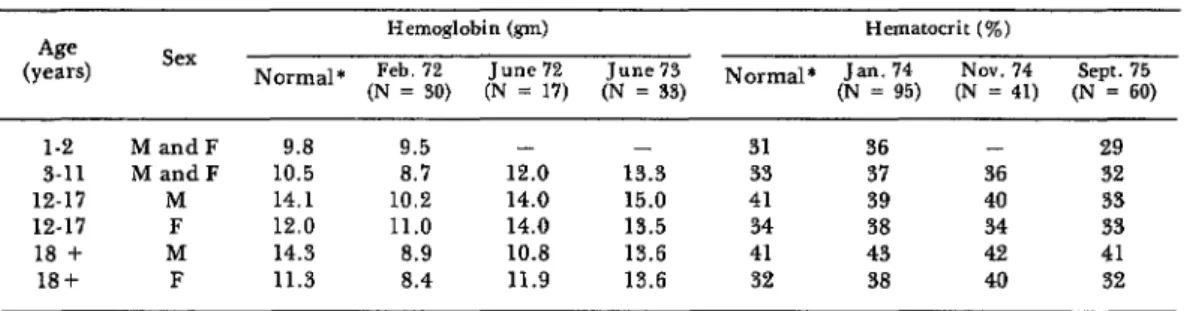
Iron deficiency anemia was treated with ferrous sulfate (600 mg per day for 30 days twice a year). At the beginning hemoglo- bin values were determined by the Sahli method, but after January 1974 micro- hematocrits were used. Determinations were made on a voluntary sample of the population at varying intervals after the ferrous sulfate treatment. Due to occasional local difficulties in acquiring the drug, no definite schedule was followed. Side-effects from administration of the ferrous sulfate have been minimal.
All susceptible children were immunized against whooping cough, tetanus, diphthe- ria, and measles. Newborns were vaccinated when they reached the recommended age.
It was customary for the people in this community to take antihelmintics at the beginning and end of each rainy season. This practice was continued (using pipera- zine citrate) in order to maintain their cooperation. In addition, infections with intestinal protozoa, detected through direct microscopic examination of fecal samples, were treated as they were discovered.
In 1973 one sanitary latrine was installed for every two houses, as part of a plan designed to eventually provide one for each house. Frequent questions and inspections were employed to check on the continued cleanliness and utilization of these latrines. Since 1973 all dogs on the farm have been immunized annually against rabies.
Table 2. Hemoglobin and hematocrit values at Las Fuentes, by age group and sex, 1972-1975.
1-2 MandF 9.8 9.5 - - 31 36 - 29
3-11 MandF 10.5 8.7 12.0 13.3 33 37 36 32
12-17 M 14.1 10.2 14.0 15.0 41 39 40 33
12-17 F 12.0 11.0 14.0 13.5 34 38 34 33
18 + M 14.3 8.9 10.8 13.6 41 43 42 41
18f F 11.3 8.4 11.9 13.6 32 38 40 32
*See reference (I).
tuberculosis were discovered. However, one child was found to have scrofula and was placed under treatment with isoniazid.
better than normal values had been achieved by all groups except males 12 to 17 years of age.
Results
Since the beginning of the program in March 19’72, it has achieved the follow- ing results:
No cases of measles or whooping cough have occurred.
Scabies has disappeared, except for an occasional isolated case. As a consequence, the frequency of skin infections and con- junctivitis has dropped to practically zero.
During 1975 the ferrous sulfate program was interrupted by supply difficulties. This had a strongly apparent effect on the hematocrit values obtained in September
1975. However, ferrous sulfate became available again in February 1976 and was used again in March and September 1976. Hematocrits for November 1976 were almost back to the November 1974 levels.
The flea, bed bug, and louse problems have not been eliminated, but their frequency and severity are much reduced.
The prevalence of intestinal helminths has decreased markedly. Only isolated infections are now demonstrated by routine stool examinations. On the other hand, the frequency of intestinal protozoan infections has remained pretty much unchanged. In addition, several protozoans not previously detected-Balantidium coli, Trichomonas
intestinalis, and Chilomastix mesnili-
appeared during 1974 and 1975.
The effect of ferrous sulfate on anemia has been very dramatic. Table 2 shows treatment results over four years. The most decided improvement occurred with the first series of treatments in March 1972. Improvement continued from June 1972 to
A family planning program introduced in 1974 has been most effective. Four children were born in the last months of 1972, six were born in 1973, two were born in 1974, and none were born in 1975. At the end of 1975, every woman of childbear- ing age with at least two children was participating in the program, and none were expressing any desire to have more children. The contraceptive method em- ployed was a hormone injection (150 mg of Medroxyprogesterone acetate every three months). Side-effects resulting from these injections have been very slight. That is, there have been a few cases of temporary amenorrhea and a few cases of break- through bleeding, none lasting more than six months.
Ascoli l HEALTH SURVEILLANCE ON GUATEMALAN FARMS 115
conclusions, but it appears that the pro- gram did not improve their rate of growth.
The cost of this type of program varies from farm to farm, depending on the size of the population. In the case described, the yearly cost was about US$1,320, which works out to about US$8.80 per person. Major expenses included the physician’s salary, the cost of ferrous sulfate, and the cost of occasional other drugs. Immunizing agents were provided without charge by the national public health service.
Discussion and Conclusions
Obviously, this simple program in pre- ventive medicine for a farm population can be markedly improved at a reasonable price. Many improvements are possible- within the limits of a program that takes care not to initiate changes so rapidly as to create resistance on the part of the popula- tion. Future plans of the present program include increasing the number of sanitary latrines, building showers and adequate washing facilities, introducing electricity into individual dwellings, improving oral health by having a dentist make periodic visits, and improving dietary intake by encouraging the planting of vegetables and fruits and by improving the quality and quantity of the available chickens, ducks, and turkeys.
In examining the results achieved to date, it is important to note various parallel improvements made since the . present owner acquired the farm in 1967.
For it is clear that these improvements have also influenced the population’s physical and social well-being. The improvements observed include the following:
I) Over the last two years (I974 and 1975) wages have more than doubled.
2) At the start of the health program housing was found to be better than aver- age for the area. That was because the old thatched-roof and bamboo-walled houses had been replaced by prefabricated tin- roofed houses at an average cost of US$800 each.
3) A school has been built which present- ly provides education through the third grade. The management covers the teach- er’s saIary and the cost of school materials.
4) A new chapel has been built and a priest visits the farm periodically.
5) Two soccer teams have been trained and outfitted; games are scheduled fre- quently with other farm teams.
6) Every family is alloted two acres of land for growing corn and beans. Interest- free credit is provided for seed and fertilizer.
There is no doubt that this combination of social and biomedical improvements have made Las Fuentes a better place in which to live and work. It has also been instrumental in improving the morale of the population. In this regard, it is worth noting that over time the population’s initial mild feelings of suspicion and resistance toward the physician and his unfamiliar health program have complete- ly disappeared.
SUMMARY
The foregoing account describes a simple All of these problems have been markedly private program of preventive medicine on one reduced by simple and cheap measures-includ- Guatemalan farm-a program that has shown ing administration of ferrous sulfate to prevent itself applicable to other farms under similar anemia, use of benzyl benzoate against scabies, conditions. Major health problems at the start spraying of houses with insecticides, and of the program included iron deficiency anemia, installation of sanitary Iatrines. Immunizations scabies, infestations of fleas, lice, and bed bugs, against measles and whooping cough have intestinal parasitism, skin infections, and con- eliminated those two diseases. All dogs have
planning program has been instituted, and has enlisted the active participation of all women of childbearing age with at least two children. Presumably because of this program, no births occurred in this small community during 1975. Intestinal helminths have been reduced by twice-yearly treatment with piperazine citrate, but intestinal protozoa have not been reduced despite the treatment of cases diagnosed through
microscopic examination.
It is felt that the program has improved the cooperative attitude and the working morale of this population. The approximate cost of the program has been very slight-on the order of US$8.80 per person per year. Future additions and improvements to the basic program, as described in the text, have been projected.
BACKGROUND REFERENCE
(1) Instituto de Nutrition de Centro America Centro America y Panama. Evaluacidn nutri-
y Panama (INCAP), Oficina de Investigaciones cional de la poblacidn de Centro Amhica y