Effect of recovery interval between sets of
isokinetic knee extensions among untrained
young men
Efeito do intervalo de recuperação entre séries de extensões isocinéticas de
joelho em homens jovens destreinados
Celes R1, Bottaro M1, Veloso J1, Ernesto C2, Brown LE3
Abstract
Objective: To assess the effect of two recovery intervals (RIs) between sets of isokinetic knee extension exercises on peak torque (PT) and total work (TW), among untrained young men. Methods: Eighteen men (24.22±2.58 years; 80.42±11.41 kg) performed three sets of ten isokinetic extensions of the right knee, at 60° and 180°/s. The RIs between the sets were one and two minutes long, spread over two test days separated by a minimum of 48 hours. The work-to-recovery ratio was 1:3 and 1:6 for 60°/s, and 1:6 and 1:12 for 180°/s. The subjects had not participated in any resistance training programs within the last six months. The statistical analysis consisted of 2 x 3 repeated-measures ANOVA [RI (one or two minutes) x set (1st, 2nd or 3rd)]. The significance level was α<0.05. Results: Neither one
minute nor two minutes RIs maintained the PT and TW throughout the three sets (p<0.05). However, at 60°/s, two minutes RIs enabled better PT and TW in the second and third sets than one minute RIs (p<0.05). At 180°/s, two minutes RIs were only better (p<0.05) than one minute RIs for TW in the third set. Conclusion: This study indicated that, during an isokinetic training protocol, young men require more than two minutes of RI for full PT recovery at 60°/s and full TW recovery at 60°/s and 180°/s. However, better PT recovery can be attained with a 1:12 work-to-recovery ratio at 180°/s.
Article registered in the Clinical Trials.gov under the number NDT00673998.
Key words: torque; muscle fatigue; quadriceps muscle; knee extension.
Resumo
Objetivo: Avaliar o efeito de dois diferentes Intervalos de Recuperação (IR) entre séries de extensões isocinéticas de joelho no Pico de Torque (PT) e no Trabalho Total (TT) em jovens destreinados. Métodos: Dezoito homens (24,22±2,58 anos; 80,42±11,41 kg) realizaram três séries de 10 extensões isocinéticas com o joelho direito a 60° e 180°/s. O IR entre as séries foram de 1 e 2 minutos, contrabalanceados entre os dois dias de teste, separados por, no mínimo, 48 horas. A taxa de trabalho-recuperação foi de 1:3 e 1:6 para 60°/s e 1:6 e 1:12 para 180°/s. Os voluntários não participavam de programas de treinamento resistido há pelo menos 6 meses. A análise estatística foi a ANOVA de medidas repetidas 2 x 3 [IR (1 e 2 minutos) x série (1ª, 2ª e 3ª)]. O nível de significância foi α<0,05.
Resultados: Tanto 1 como 2 minutos não conseguiram manter o PT e o TT ao longo das três séries (p<0,05). Porém, a 60°/s, 2 minutos de IR possibilitaram um melhor PT e TT na segunda e na terceira série que 1 minuto (p<0,05). Já a 180°/s, 2 minutos só foi superior (p<0,05) a 1 minuto na terceira série para o TT. Conclusão: O estudo indicou que durante um protocolo de treinamento isocinético, homens jovens necessitam mais de 2 minutos para recuperar totalmente o PT a 60°/s, e totalmente o TT a 60° e 180°/s. Entretanto, uma melhor recuperação do PT pode ser alcançada com uma taxa de trabalho-recuperação de 1:12 a 180°/s.
Artigo registrado no Clinical Trials.gov sob o número NDT00673998.
Palavras-chave: torque; fadiga muscular; músculo quadríceps; extensão de joelho.
Received: 31/07/2008 – Revised: 25/11/2008 – Accepted: 10/03/2009
1 School of Physical Education, Universidade de Brasília (UnB), Brasília (DF), Brazil 2 School of Physical Education, Universidade Católica de Brasília (UCB), Brasília (DF), Brazil 3 Department of Kinesiology, California State University Fullerton, Fullerton (CA), USA
Introduction
Muscle strength is recognized in the scientific commu-nity as a necessary physical ability for the maintenance of health, functional ability and quality of life1. Strength train-ing, also known as weight traintrain-ing, resistance training or re-sistance exercise (RE), has become one of the most popular forms of exercise. RE has been often used in rehabilitation2,3 and in the improvement of muscle strength and physical abilities of children, adults and older adults4-6.
To maximize strength and muscle mass gains, the use of multiple sets during a session of RE has shown better results than the use of a single set7. However, the superi-ority of multiple sets is due to the possibility of maintain-ing a certain work volume for several sets8. Therefore, the recovery interval (RI) between the sets can be a decisive factor in maintaining the volume of training sessions or rehabilitation2.
Traditionally, the American College of Sports and Medi-cine (ACSM)1 recommends a training program with mul-tiple sets and a RI of one to two minutes for beginners and intermediate individuals in the RE. However, there is no consensus in the literature that a 1min or 2min RI is ad-equate for maintaining volume during multiple sets in indi-viduals with little or no experience with RE. In opposition to ACSM recommendations1, Rahimi9 and Willardson and Burkett10 observed the superiority of 5min RIs compared to 1min in maintaining volume during sets of squats with trained individuals. Kraemer11 demonstrated that 3min RIs enabled the maintenance of the volume of training in the leg press exercise in subjects with RE experience. In the three studies previously mentioned, the use of 1min RIs did not maintain the volume of training in any of the consid-ered exercises.
Willardson2 points out that the choice of RI depends not only on the training objectives but also on other vari-ables, such as: type of muscle action (i.e. isotonic, isometric or isokinetic), muscle fiber composition, loads, number of repetitions and personal experience. Accordingly, some studies have used the isokinetic dynamometer to evaluate the effect of RI in muscle function, however most of these studies used a muscle strength evaluation protocol (i.e. two sets of three or four repetitions)12,13. Few studies have considered the effect of RI on a training protocol with the use of the isokinetic dynamometer in RE inexperienced individuals14,15. Therefore, the aim of the present study was to investigate the effect of two RIs between sets of isoki-netic, lower-limb exercise on peak torque (PT) and total work (TW), among untrained young men.
Methods
Sample
Eighteen men (24.22±2.58 yrs old; 175.6±5.12 cm; 80.42 ±11.41 kg) who had not participated, in the six months previous to the study, in any resistance training took part in the current study. The exclusion criteria were chronic disease (diabetes, cardiovascular disease and hyperten-sion), changes in neuromuscular parameters (e.g. muscle injuries) which could affect the result of the study, and the use of medication that could affect muscle function. All participants signed the informed consent form, and the present study project was submitted to and approved by the Research Ethics Committee of the School of Health Sciences - FS of Universidade de Brasília - UnB (protocol 148/2007).
Isokinetic evaluation
he PT and TW were measured by the Biodex System 3 Isokinetic Dynamometer (Biodex Medical, Inc., Shirley, NY). Because some studies have shown that strength gain is ve-locity speciic, the movement veve-locity was adjusted to 60°/s and 180°/s16,17. he participants were positioned comfortably on the dynamometer seat with safety belts fastened on the trunk, pelvis and thigh to minimize extra body movements which could afect the PT values18. he lateral epicondyle of the femur was used as a marker to align the knee rotation axis and the instrument rotation axis, allowing free and comfortable knee lexion and extension from 90° lexion to full extension. With the participants positioned on the seat, the following measures were recorded: seat height, backrest inclination, dynamometer height and lever arm length. hese measures were recorded to standardize the test position of each participant individually. Gravity correction was ob-tained by measuring the torque exerted by the lever arm and the participant’s leg at full extension and relaxed. he values of the isokinetic variables were automatically adjusted for gravity with the software Biodex Advantage.
1
260 205 240 230
Peak T
orque (N.m) 220 210 200 190
2 3
Set
60°/s - 1 min 60°/s - 2 min
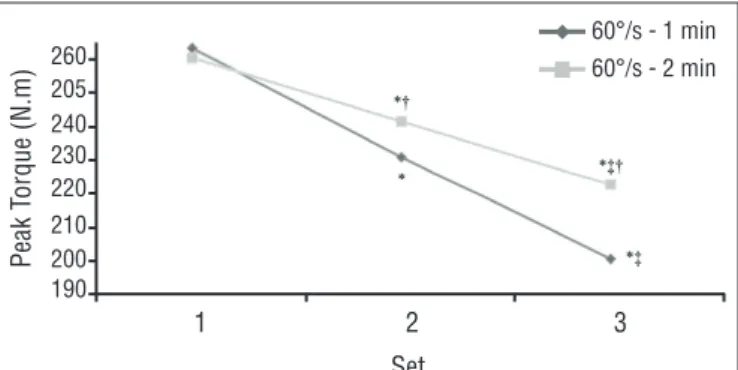
* p<0.05 different from the 1st set (within group comparison); ‡ p<0.05 different from the 2nd set (within group comparison); † p<0.05 between group comparison.
Figure 1. Peak Torque (PT) at 60°/s.
1 2800
2600
2400
2200
T
otal W
ork (J)
2000
1800
1600
2 3
Set
60°/s - 1 min 60°/s - 2 min
* p<0.05 different from the 1st set (within group comparison); ‡ p<0.05 different from the 2nd set (within group comparison); † p<0.05 between group comparison
Figure 2. Total Work (TW) at 60°/s.
Experimental procedure
The participants performed three sets of 10 repetitions at 60°/s and 180°/s after doing 2-3 submaximum repetitions and 2-3 maximum repetitions with the right limb as prepa-ration for the test. The tests were carried out in increasing order according to velocity, and there was a 10min interval between tests at different velocities. The right limb was used to standardize the test as previous studies did not find dif-ferences between dominant and non-dominant lower limbs for isokinetic variables24. The minimum interval between the test days of the different RIs was 48 hours. In accordance with ACSM recommendations1 for strength and power train-ing, we used 1 and 2min RIs and the velocities of 60°/s and 180°/s. Therefore, the work-to-recovery rate generated was 1:3 and 1:6 for 60°/s and 1:6 and 1:12 for 180°/s. In order to counterbalance the order of the experimental protocols, the participants were randomly divided into two groups. After the group division, group 1 carried out the 1min RI in the first evaluation and the 2min RI in the second evaluation. Group 2 carried out the RIs in reverse order.
Statistical analysis
Means and standard deviations were calculated. The Smirnov-Kolmogorov normality test was used to verify data normality. The statistical power (retrospective power) of the present study was set at 0.8 ( ß=0.2) both for PT and TW. After calculating the effect size, it was observed that a mini-mum of 12 individuals would be necessary to avoid the type 2 error for the PT and 14 individuals, for the TW. To evaluate the recovery time for the isokinetic dependent variables, we used a 2 x 3 repeated measures analyses of variance (ANOVA) [recovery interval (1 and 2 minutes) X set (1st, 2nd and 3rd)]. As a post hoc process, we used the multiple comparisons with correction of the confidence interval by the Least-sig-nificant deference (LSD) method. The data were analyzed in a personal computer with the statistical software Statistical Package for Social the Sciences - SPSS (version 13.0). The α level was set at 0.05 for all the analyses.
Results
At the velocity of 60°/s, there was a signiicant reduction in the PT values (Figure 1) over the three sets, regardless of the RI. However, when the RIs were compared, the PT value in the second (p=0.025) and third (p=0.000) sets of the 2min protocol was higher than those of the sets of the 1min protocol.
he same decrease occurred with the TW at the velocity of 60°/s over the three sets, regardless of the RI (Figure 2). he 2min RI allowed a higher TW value at the second and the third sets when compared with the 1min RI (p=0.004 and p=0.000, respectively).
At the velocity of 180°/s, there was a decrease in the PT values over the three sets (Figure 3). However, a signiicant diference (p=0.002) was only observed between the irst and the third sets with 2min RIs. In contrast, with the 1min RI, a signiicant decrease in the PT value was observed between the irst and second sets, between the irst and third sets and be-tween the second and third sets (p=0.019, p=0.001 and p=0.025, respectively). However, there were no signiicant diferences (p≤0.05) between the PT values in these respective sets when comparing the 1min RI with the 1min RI.
he behavior of the TW at 180°/s was similar to the one at 60°/s (i.e., signiicant decrease (p≤0.05) over the three sets) (Figure 4). However, a signiicant diference (p=0.014) was only observed between the third sets when the RIs were compared (1min and 2min).
1
175
170
165
Peak T
orque (N.m) 160
155
150
2 3
Set
180/s - 1 min 180/s - 2 min
* p<0.05 different from the 1st set (within group comparison); ‡ p<0.05 different from the 2nd set (within group comparison).
Figure 3. Peak Torque (PT) at 180°/s.
1 1900
1850 1800 1750
T
otal W
ork (J)
1700 1650 1600
2 3
Set
180/s - 1 min 180/s - 2 min
* p<0.05 different from the 1st set (within group comparison); ‡ p<0.05 different from the 2nd set (within group comparison); † p<0.05 between group comparison.
Figure 4. Total Work (TW) at 180º/s.
Discussion
he aim of the present study was to compare the efect of two RIs (1min and 2min) during lower limb exercise on PT and TW in untrained men. he choice of exercise protocol (i.e., number of sets, number of repetitions and RI) is in ac-cordance with the recommendations of the ACSM1 for begin-ners. he main results were that the 2min RI is better than the 1min RI because it allows a better maintenance of the PT and TW over the three sets of 10 isokinetic knee contractions in untrained men. However, it is important to point out that both 1min and 2min RIs did not provide a complete recovery of the variables over the three sets.
According to Willardson2, the RI must allow sufficient replenishing of the energy sources (adenosine triphosphate [ATP] and phosphocreatine [PC]), enable the elimination of by-products of muscle contraction which lead to fatigue (i.e. H+ ions) and reestablish muscle strength. Usually a very short RI, such as the one used in the present study, is ac-companied by considerable muscle discomfort due to the occlusion of blood flow, lactate production, depletion of the energy sources and decrease in strength production during exercise25. The RIs are important because the performance in subsequent sets is directly related to the recovery time between the sets26. The RI must be controlled not only to al-low muscle recovery, but also to enable specific adaptations. Larson and Potteiger25 and Woods et al.27 reported that a short recovery time between the sets leads to a decrease in strength production, and it is used more often to develop hypertrophy because it does not allow a complete recovery of muscle strength between the sets. In contrast, a long re-covery time between the sets allows a greater replenishing of the energy pathways, and it is more indicated for muscle strength development. These findings corroborate those of the present study; because the longer RI (2min) allowed bet-ter muscle strength recovery than the 1min RI.
Rhea, Alvar and Burkett7 point out that the use of mul-tiple sets is better than the simple set because it can maxi-mize strength and muscle mass gains by allowing a greater volume of training. However, a greater volume is only pos-sible if the RI between the sets is sufficient to restore muscle strength. As demonstrated in the present study, more work is only possible with a longer RI. Nevertheless, experimental studies that manipulated the RI between sets to observe the chronic adaptations in the muscle strength gains showed controversial results. Some studies found that a longer RI enabled a greater volume and consequently a greater mus-cle strength gain8,14,28. In contrast, Garcia-Lopez et al.29 ob-served that a 4min RI enabled 30% more volume of training than the volume obtained with a 1min RI, but there was no
significant difference in muscle strength gain between the two RIs. In a recent study, the authors concluded that great increases in lower limbs muscle strength can be obtained with, at least, a 2min RI, and that a small additional gain can be obtained with a 4min RI between sets30.
In an attempt to better understand the effects of the RI on muscle strength recovery, Pincivero, Lephart and Karunakara15 demonstrated a significant reduction in the PT and TW when a 40sec RI was used between four sets of 10 concentric repetitions of the quadriceps and hamstring muscles at 90°/s in 15 untrained young people (8 men and 7 women). However, when a 160sec RI was used, the au-thors did not find a significant reduction in the variables. Thus, the authors concluded that a 160sec RI at 90°/s, i.e. a work and recovery rate of 1:8, is enough to allow muscle strength recovery, regardless of velocity. However, this result
PT TW
1min 2min 1min 2min
60°/s -24.9% -14.4% -30.8% -18.6%
180°/s -7.3% -4% -12% -5.3%
Table 1. Percentage difference in PT and TW between the 3rd and 1st sets.
1. American College of Sports Medicine. American College of Sports Medicine position stand. Progression models in resistance training for healthy adults. Med Sci Sports Exerc. 2009;41(3):687-708.
2. Willardson JM. A brief review: factors affecting the length of the rest interval between resistance exercise sets. J Strength Cond Res. 2006;20(4): 978-84.
3. Jan MH, Lin JJ, Liau JJ, Lin YF, Lin DH. Investigation of clinical effects of high- and low-resistance training for patients with knee osteoarthritis: a randomized controlled trial. Phys Ther. 2008;88(4):427-36.
4. Norrbrand L, Fluckey JD, Pozzo M, Tesch PA. Resistance training using eccentric overload induces early adaptations in skeletal muscle size. Eur J Appl Physiol. 2008;102(3):271-81.
5. Behm DG, Faigenbaum AD, Falk B, Klentrou P. Canadian society for exercise physiology position paper: resistance training in children and adolescents. Appl Physiol Nutr Metab. 2008;33(3):547-61.
6. Inaba Y, Obuchi S, Arai T, Satake K, Takahira N. The long-term effects of progressive resistance training on health-related quality in older adults. J Physiol Anthropol. 2008;27(2):57-61.
7. Rhea MR, Alvar BA, Burkett LN. Single versus multiple sets for strength: a meta-analysis to address the controversy. Res Q Exerc Sport. 2002;73(4):485-8.
8. Robinson JM, Stone MH, Johnson RL, Penland CM, Warren BJ, Lewis RD. Effects of differents weight training exercise/rest interval on strength, power and high intensity exercise endurance. J Strength Cond Res. 1995;9(4):216-21.
contradicts the present study, as a higher work and recovery rate (1:12 - 2min RI at 180°/s) did not allow the maintenance of muscle strength during the three sets of 10 repetitions.
he diferent results may have occurred because Pincivero, Lephart and Karunakara15 used two independent groups with a heterogeneous sample of men and women in the same group. his can be observed in the diference between the initial means of the quadriceps PT among the groups 1 (~180 Nm) and 2 (~157 Nm) of the Pincivero, Lephart and Karunakara’s study15. In addition, several studies have demonstrated that the female gender is more resistant to fatigue than the male gender31,32. Moreover, the PT and TW means generated by the participants of the Pincivero, Lephart and Karunakara’s study15 (~180 Nm and ~1580 J, respectively) were lower than the PT and TW means of the present study (~260 Nm and ~2.600 J, respec-tively). Studies have shown that individuals who have a greater capacity to produce muscle strength can develop higher levels of fatigue. his can be explained by the fact that stronger men produce greater intramuscular pressure, greater vascular oc-clusion, greater metabolite accumulation, a decrease in oxygen supply to the muscles and premature failure during prolonged contraction tasks31,32.
Touey, Sforzo and McManis33 also evaluated the effect of four RIs (30, 60, 120 and 240sec) during four sets of 10 isokinetic quadriceps and hamstring contractions on PT and TW at 60°/s and 180°/s in 28 men (mean age of 20.3yrs). At 60°/s, the results demonstrated that the PT and TW were lower during 30 and 60sec than during 120 and 240sec RIs. However, the TW value at 60°/s was higher with a 60sec
RI than with the 30sec RI in sets 3 and 4, and the TW de-creased approximately 34% between the first and the fourth sets with the 30sec RI. At 180°/s, there are no data about the quadriceps PT and TW. However, with regard to the ham-strings, the PT and TW values were lower with the 30sec RI than with the 120 and 240sec RIs. However, the performance with the 60sec RI was equivalent to the 120sec RI, but lower than the 240sec RI. The authors concluded that a 2min RI (120 seconds) is sufficient to optimize muscle performance. These results corroborate those of the present study, which found that a 2min RI was better than a 1min RI at maintain-ing PT and TW.
The present study demonstrated the importance of the RI to avoid excessive muscle fatigue during RE. The greater the production of muscle strength, the greater the fatigue will be. Based on that, the use of longer RIs (i.e. more than 2 minutes) is necessary to avoid excessive fatigue. This result can also be applied to traditional (isotonic and isometric) exercise to allow the intervention of physical therapists and physical educators who prescribe RE or use it in muscle strength rehabilitation.
Conclusions
According to the results, a 2min RI allows better PT and TW recovery than the 1min RI. However, it appears that full muscle strength recovery is not reached with a 2min RI in protocols and in populations similar to that of the present study.
9. Rahimi R. Effect of different rest intervals on the exercise volume completed during squat bouts. Journal of Sports Science and Medicine. 2005;4(4):361-6.
10. Willardson JM, Burkett LN. A comparison of 3 different rest intervals on the exercise volume completed during a workout. J Strength Cond Res. 2005;19(1):23-6.
11. Kraemer WJ. A series of studies: the physiological basis for strength training in american football: fact over philosophy. J Strength Cond Res. 1997;11:131-42.
12. Bottaro M, Russo A, Oliveira RJ. The effects of rest interval on quadriceps torque during an isokinetic testing protocol in elderly. Journal of Sports Science and Medicine. 2005;4(3):285-90.
13. Parcell AC, Sawyer RD, Tricoli VA, Chinevere TD. Minimum rest period for strength recovery during a common isokinetic testing protocol. Med Sci Sports Exerc. 2002;34(6):1018-22.
14. Pincivero DM, Lephart SM, Karunakara RG. Effects of rest interval on isokinetic strength and functional performance after short-term high intensity training. Br J Sports Med. 1997;31(3):229-34.
15. Pincivero DM, Lephart SM, Karunakara RG. Effects of intrasession rest interval on strength recovery and reliability during high intensity exercise. J Strength Cond Res. 1998;12(3):152-6.
16. Coburn JW, Housh TJ, Malek MH, Weir JP, Cramer JT, Beck TW, et al. Neuromuscular responses to three days of velocity-specific isokinetic training. J Strength Cond Res. 2006;20(4):892-8.
17. Presvot MC, Nelson AG, Maraj BKV. The effect of tTwo days of velocity-specific isokinetic training on torque production. J Strength Cond Res. 1999;13(1):35-9.
18. Weir JP, Evans SA, Housh ML. The effect of extraneous movements on peak torque and constant joint angle torque-velocity curves. J Orthop Sports Phys Ther. 1996;23(5):302-8.
19. Taylor NA, Sanders RH, Howick EI, Stanley SN. Static and dynamic assessment of the biodex dynamometer. Eur J Appl Physiol Occup Physiol. 1991;62(3):180-8.
20. Stumbo TA, Merriam S, Nies K, Smith A, Spurgeon D, Weir JP. The effect of hand-grip stabilization on isokinetic torque at the knee. J Strength Cond Res. 2001;15(3):372-7.
21. Hald RD, Bottjen EJ. Effect of visual feedback on maximal and submaximal isokinetic test measurements of normal quadriceps and hamstrings. J Orthop Sports Phys Ther. 1987;9(3):86-93.
22. McNair PJ, Depledge J, Brettkelly M, Stanley SN. Verbal encouragement: effects on maximum effort voluntary muscle action. Br J Sports Med. 1996;30(3):243-5.
23. Kim HJ, Kraemer JF. Effectiveness of visual feedback during isokinetic exercise. J Orthop Sports Phys Ther. 1997;26(6):318-23.
24. Davies GJ, Heiderscheit BC, Brinks KF. Test interpretation In: Brown LE, editor. Isokinetics in human performance. Champaign: Human Kinetics; 2003. p. 3-24.
25. Larson GD, Potteiger JA. A comparison of three differents rest intervals between multiple squat bouts. J Strength Cond Res. 1997;11(2):115-8.
26. Willardson JM, Burkett LN. The effect of rest interval length on the sustainability of squat and bench press repetitions. J Strength Cond Res. 2006;20(2):400-3.
27. Woods S, Bridge T, Nelson D, Risse K, Pincivero DM. The effects of rest interval length on ratings of perceived exertion during dynamic knee extension exercise. J Strength Cond Res. 2004;18(3):540-5.
28. Hill-Haas S, Bishop D, Dawson B, Goodman C, Edge J. Effects of rest interval during high-repetition resistance training on strength, aerobic fitness, and repeated-sprint ability. J Sports Sci. 2007;25(6):619-28.
29. García-López D, de Paz JA, Moneo E, Jiménez-Jiménez R, Bresciani G, Izquierdo M. Effects of short vs. long rest period between sets on elbow-flexor muscular endurance during resistance training to failure. J Strength Cond Res. 2007;21(4):1320-4.
30. Willardson JM, Burkett LN. The effect of different rest intervals between sets on volume components and strength gains. J Strength Cond Res. 2008;22(1):146-52.
31. Hunter SK, Critchlow A, Enoka RM. Influence of aging on sex differences in muscle fatigability. J Appl Physiol. 2004;97(5):1723-32.
32. Hunter SK, Critchlow A, Shin IS, Enoka RM. Men are more fatigable than strength-matched women when performing intermittent submaximal contractions. J Appl Physiol. 2004;96(6):2125-32.