Printed in Brazil - ©2005 Sociedade Brasileira de Química 0103 - 5053 $6.00+0.00
Article
* e-mail: [email protected]
Synthesis and Tautomeric Studies of Enamines from 1-(
n
-Hexyl)-3-methyl-2-pyrazolin-5-one
Julio Belmar*,a, Fredy R. Pérezb,Joel Alderetea and Celia Zúñigaa
a
Department of Organic Chemistry, Faculty of Chemical Sciences, Universidad de Concepción. Víctor Lamas, 1290, Casilla 160-C, Concepción, Chile
b
Department of Chemistry, Faculty of Health Sciences, Universidad Privada Antenor Orrego, Av. América Sur, 3145, Monserrate, Trujillo, Perú
1-(n-Hexil)-3-metil-2-pirazolin-5-ona foi acilada com cloretos de acidos e a condensação com aminas primárias forneceu uma série de enaminas. De acordo com os dados de RMN de 1H e 13C, os
derivados acilas têm principamente uma estrutura 4-acilpirazol-5-ol com ligação de hidrogênio intramolecular e os derivados 4-aminometilenos existem predominantemente na forma de enamina estabilizada também por este tipo de interação.
1-(n-Hexyl)-3-methyl-2-pyrazolin-5-one was acylated with acid chlorides. Condensation of acyl derivatives with primary amines afforded enamines. According to the 1H and 13C NMR data, the
acyl derivatives have mainly a 4-acylpyrazol-5-ol structure with intramolecular hydrogen bond, and the 4-aminomethylene derivatives exist predominantly in the enamine form stabilized by the same type of interaction.
Keywords: pyrazolones, alkylpyrazolones, acylation, acylpyrazolones, enamines
Introduction
Transition metals coordination complexes using a variety of polydentate ligands are very important in several fields of science and technology.1-4 They can give a wide
variety of model compounds, to mimic, simulate, or modify biological and physical properties.5,6 An important number
of the ligands that have been reported to date are Schiff bases7-10 or β-ketoenamines11,12 that are usually obtained
from salicylaldehyde or β-dicarbonyl compounds.12,13 Other
reagents have been almost completely neglected. 4-Aminomethylene derivatives of pyrazolin-5-ones (Figure 2D) have been known for almost a century14 and
have been used as ligands to obtain metal complexes.15
They are not as well known as metal complexes of acylpyrazolones though.16 Pyrazolone derivatives usually
reported do not have good solubility in solvents such as hexane, ethyl acetate, chloroform, acetone, tetrahydro-furane and ethanol, because in most cases they have a phenyl ring at N-1. In order to find better applications for these kinds of compounds, solubility must be improved. Attaching an alkyl chain at position 1 rather than an aryl ring would help to overcome this drawback.This approach
faces the facts that very few alkylhydrazines are commercially available and that there is a lack of convenient procedures17 to synthesize them. Despite of
these problems, alkylation of 3-methyl-18 and 3-phenyl-19
pyrazol-5-one has been reported. These 1-alkylpyrazolones underwent acylation,18 benzoylation20 and nitrosation21 in
a similar way to their 1-phenyl homologues. Since little information on 4-aminomethylene derivatives of alkylpyrazolones is available, it was decided to study them. In this paper, besides the synthetic procedures, the structural features that have been found on characterizing these compounds are reported. In order to save time and chemicals, attention was focused on changing the acyl group and the amines, leaving the alkyl chain at N-1 unchanged; this procedure does not restrain the conclusions of this work. Therefore, 4-acyl-(1-n -hexyl)-3-methyl-5-pyrazolones and bidentate, tridentate and tetradentate 4-aminomethylene derivatives, some of them including a chiral center, are reported herein.
Results and Discussion
The synthesis is outlined in Scheme 1. As previously described,18 alkylation of 3-methylpyrazol-5-one (1) takes
-hexyl)-3-methyl-2-pyrazolin-5-one (2). This compound was acylated with acyl halides in alkaline medium22,23 yielding 4-acyl-1-(n
-hexyl)-3-methylpyrazol-5-ol (3). The yields of 4-acyl derivatives 3
were 70% (3a), 68% (3b) and 40 % (3c). Acylation with pivaloyl chloride afforded 1-(n -hexyl)-3-methyl-4-pivaloylpyrazol-5-ol (3d) only in a modest 10%, despite of the prolonged reaction time. Compounds 3 were used to prepare 4-aminomethylene derivatives. Thus, condensation with diamines afforded compounds 4, while condensation with monoamines afforded compounds 5. Compounds 4
are tetradentate ligands and compounds 5 are either tridentate or bidentate. In addition 1,2-diaminopropane and
trans-1,2-diaminocyclohexane are chiral. However, they were used as racemic mixtures. Regarding the monoamines, a variety of them was used. Some of them were aliphatic, aromatics, aminoacids or aminoalcohols. Among them DL-alanine and l-(-)-2-aminobutanol were chiral. Table 1 summarizes reaction times and yields for 4-aminomethylene compounds 4 and 5. As it could be expected, in most cases yields were higher with monoamines than with diamines. It was also observed that yields diminished when the NH2 was bonded to a secondary carbon, for instance 4c and 4e. A sharp reduction in the yield of compound 4 resulted as ramification in the acyl group increased, for example 4a, 4d
and 4f. No aminomethylene product was isolated from pivaloylpyrazolone (3d) under the same conditions. The reaction of compound 3a with o-phenylenediamine afforded compound 5a resulting from the condensation of just one
amino group. The remaining amino group of compound 5a
would become less nucleophilic. Compound 5a was treated with an extra equivalent of 3a, being recovered unchanged. With respect to the yields achieved in reactions with monoamines, they were not only a consequence of the nucleophilicity but of the reagents and products solubility in the reacting medium. When DL-alanine was used, the yield of reaction was very low indeed, probably due to the scarce solubility of the aminoacid in the reaction solvent. Compounds 5b and 5c separated easily as a solid material from the reacting mixture, being recovered in higher yields. The effect of increasing hindrance was also observed in the yields of compounds 5.
Prototropic tautomerism has been widely studied in 1-arylpyrazolones and derivatives24-26 but not in 1-alkyl
homologues. Specifically the tautomerism of 1-aryl-4-acylpyrazolones has been the subject of various studies.27-35
Based upon 1H- and 13C-NMR studies, Kurkovskaya30et
al. concluded that in CDCl3 solution, and at low temperature, 4-acetyl- and 4-benzoyl derivatives are mainly present in the associated OH form (A’) (Figure 1) with a minor portion of NH form (B). They also found that electronegative groups, at position 3 in the heterocycle, favors the free OH form (A).30 In the case of 4-acyl-(1-n
-hexyl)-3-methyl-5-pyrazolones (3), the possible tautomers are the same as those shown in Figure 1. Relevant 1
H-NMR and 13C-NMR chemical shifts of compounds 3a-d
are summarized in Table 2. Data agrees with the existence
Table 2. Selected 1H and 13C NMR chemical shifts of compounds 3a, 3b, 3c and 3d
Compound R δ(1H) δ(13C)
C3-CH3 CH2 1’ OH C1’ C4 C3 C5 C=O
3 a CH3 2.38 3.87 11.14 45.6 102.8 146.3 159.0 195.0
3b CH3CH2 2.13 3.61 12.01 44.9 101.9 145.7 158.7 197.8
3c (CH3)2CH 2.22 3.70 11.53 45.3 100.9 145.4 159.6 201.9
3d (CH3)3C 2.32 3.69 12.71 45.1 100.6 144.8 161.1 204.5
Figure 1. Tautomers of compounds 3.
Table 1. Synthesis of enamines: reaction time and yields.
Amine R-CO-C4 Yield (%) time (h) Compound
CH3CO 7 0 6 4 a
H2NCH2CH2NH2 CH3CH2CO 5 0 7 4d
(CH3)2CHO 1 5 1 0 4 f
H2NCH2CH(CH3)NH2 CH3CO 6 0 6 4b
CH3CO 1 5 1 0 4c
CH3CH2CO 1 2 1 0 4e
CH3CO 5 8 1 0 5 a
CH3CO 7 7 7 5 g
CH3CH2CO 6 0 8 5i
CH3CO 7 1 7 5h
CH3CH2CO 5 5 8 5 j
CH3CO 9 7 8 5c
CH3CH2CO 5 0 8 5 f
HOCH2CH2NH2 CH3COCH3 8 8 6 5b
CH2CO 8 5 8 5e
CH3CH2CH(NH2)CH2OH CH3CO 5 7 8 5d
of mainly one tautomeric form. 13C signals for the carbonyl
carbons (195.0-204.5 ppm),36 clearly correspond to a ketone
structure. These values are very close to those already reported by other authors,30 showing that the
hydroxymethylene form (D, D’, E) can be excluded.
1H NMR chemical shifts for the hydroxyls
(11.14-12.71) and the absence of electronegative groups in the heterocycle rule out the OH free form (A).30 The presence
of a CH form (C) is not likely because it is known that proton transfer between pyrazole C4 and OH or NH is usually slow.30,37 This form requires an additional signal
set (approximately 4 ppm),38 that was not observed.
Consequently, in CDCl3 solution at 28 ºC, 4-acyl-(1-n -hexyl)-3-methyl-5-pyrazolones (3a-d) exist mainly as 4-acylpyrazol-5-ols with intramolecular hydrogen bond (A’), in agreement with other reports.30,31,39,40 Additionally, 1H
and 13C NMR spectra in acetone-d
6 and DMSO-d6 were
obtained for compounds 3a and 3c, observing same pattern as with chloroform solutions.
The information obtained from IR spectroscopy did not provided new evidence to the tautomers structure. However, it is noteworthy that the spectra for neat samples and CHCl3 solutions,for compounds 3, show a broad absorption band around 3150 cm-1, (OH stretching) and a
peak between 1626 and 1619 cm-1 (C=O stretching).
Possible tautomers for compounds 4 and 5 are presentedin Figure 2. It has been shown that, based upon low temperature NMR spectra,14 4-aminomethylene
derivatives of 1-aryl-4-acyl-5-pyrazolones exist predominantly as a D’ structure, that is stabilized by an intramolecular hydrogen bond. Increasing the temperature shifts the equilibrium towards the NH form (B).
1H NMR signals at 11.6 ppm for compounds 4 and 5
can be associated with a NH. This chemical shift value rules out the NH (B) tautomer, since in this case a chemical shift of 6 ppm should be expected.14 In some cases a
splitting due to a coupling between the NH and the α-CH or the αβ-CH2 is observed. For compounds 4c, 5d and 5k a doublet is observed, whereas a multiplet is observed for compound 4b (Table 3). Besides, a doublet around 4.6 ppm is observed for the CH2 α to the NH in compounds 5c,
5f, 5h and 5j, the coupling constant being 3J 6.0-6.1 Hz. A
similar value is reported by Braibante et al.41 for 3-amino
substituted-5,5-dimethylcyclohexen-2-en-1-ones (6b). The behavior of compounds 4 and 5 could be explained if the major tautomer in the solution is an enamine. Further evidence comes from the 15N (INEPT,421J 95 Hz, CDCl
3)
spectrum for compound 4b. Two signals at 247.6 and 261.4 ppm, corresponding to two different NH units, were observed in this spectrum. Therefore, the OH (A, A’) and CH (C) tautomers can be dismissed because they do not have a NH group. Although the splitting for the NH is not well resolved in the other homologues, the same structure should exist because they have the same chemical shifts stated above.
13C spectra for compounds 4 and 5 show four down
Table 3. Selected 1H and 13C NMR chemical shifts of compounds 4b, 4c, 5d and 5k
Compound δ(1H) δ(13C)
C3-CH3 NH JNH-CH C1’ C4 C3 C6 C=O
4b 3.63 11.64 m 43.6 98.5 144.8 164.5 165.3
4c 3.72 11.82 8.9 44.0 99.9 144.7 162.8 166.2
5d 3.71 11.32 8.9 44.0 98.0 145.2 165.2 165.5
5k 3.77 11.57 7.6 44.0 98.7 145.9 164.4 165.4
field signals, namely 166 (C5), 164 (C1), 145 (C3) and 99 (C4) ppm, supporting the idea of one predominant tautomer. The 166 ppm signal can be associated with an amide, implying that C5 is a C=O and, hence, the tautomer is an enamine.
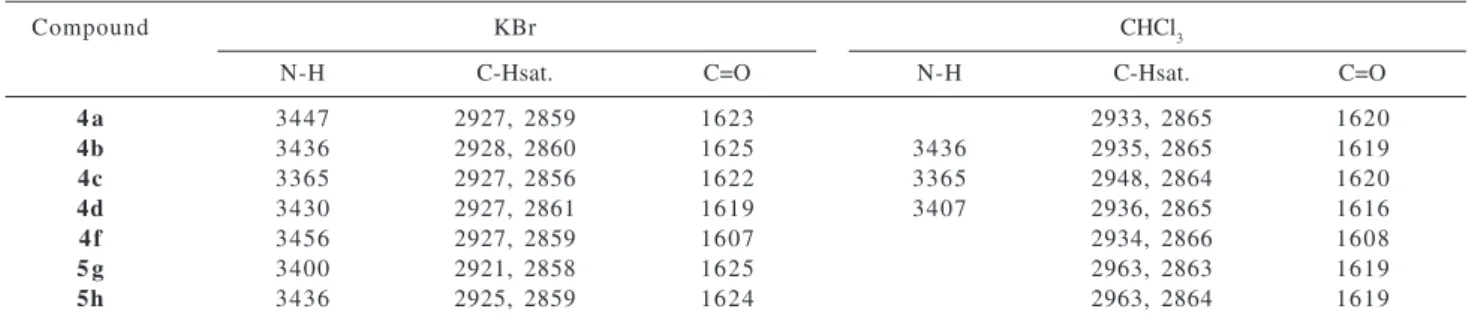
IR spectra for compounds 4 and 5 in KBr discs show broad absorption bands at 3400 cm-1 (N-H stretching43)
and 1620 cm-1 (C=O stretching). Spectra in chloroform
were also recorded, without finding any significant difference between the frequencies. Therefore, it follows that the same tautomer exists in the solid and in the solution (Table 4).
In conclusion, compounds 4 and 5 exist largely as an unique tautomer. This tautomer corresponds to the enamine structure stabilized by an intramolecular hydrogen bond (D’). This result agrees whit the previous report.14,20 Other
tautomeric forms cannot be excluded, since they might be present at very low concentrations, being undetectable by NMR. Even more, a rapid equilibrium between some tautomers might occur, detecting an average signal instead. Theoretical studies are being carried out to explain the preference towards the aminomethylene tautomer.
Experimental
Chemicals were obtained from Merck, Sigma, Aldrich and J. T. Baker. 1,2-Diaminopropane, trans -1,2-diaminocyclohexane and alanine were used as racemic mixtures; an optically pure sample of l-(-)-2-aminobutanol was used. Butyryl chloride44 and 3-methyl-5-pirazolone45
were prepared as usual. Dioxane was purified and dried with sodium by heating to reflux during 14 hours before use. Compounds were characterized by FTIR (Nicolet Magna 550), 13C, 1H and 15N NMR (Bruker AC 250P; 62.9,
250 and 17.8 MHz, respectively, SiMe4 as internal standard, and CH3NO2 for 15N,operating temperature 28ºC). 13C-1H correlation and DEPT spectra were also used to
assign the signals. Melting points were obtained on a Kofler microscope and are uncorrected. To complete characterization C, H, N analyses were obtained (Fisons
EA 1108). The numbering that was followed for signal assignment is shown in Figure 3.
1-(n-Hexyl)-3-methyl-2-pyrazolin-5-one18 (2)
To a stirred solution of 3-methylpyrazol-5-one (1) (9.80 g, 100.0 mmol) in dioxane (300 mL), n-hexylbromide (14 mL, 100.0 mmol) was added and the mixture was heated at reflux for 48 h. The solvent was then evaporated in a rotary evaporator, and water (50 mL) was added. The mixture was neutralized with NaHCO3 and three times extracted with ether. The organic extracts were dried over Na2SO4, filtered and concentrated and the remaining material distillated under reduced pressure (115ºC, 0.15 mm Hg) to give 2 as a pale yellow solid (12.74 g, 70%); IR νmax/cm
-1: 3400, 2929,
2862, 1554 (neat); IR νmax/cm
-1 2938, 2863, 1691 (CHCl 3); 1H NMR (CDCl
3 ) δ 0.88 (t, J 6.6 Hz, 3H, CH3 6’), 1.31 (m,
6H, CH2 3’, 4’, 5’), 1.60 (m, 2H, CH2 2’), 2.10 (s, 3H, CH3),
Figure 3. Numbering used for signal assignment. Table 4. Selected IR values (cm-1) of compounds 4a-4d, 4f, 5g and 5h
Compound KBr CHCl3
N-H C-Hsat. C=O N-H C-Hsat. C=O
4 a 3447 2927, 2859 1623 2933, 2865 1620
4b 3436 2928, 2860 1625 3436 2935, 2865 1619
4c 3365 2927, 2856 1622 3365 2948, 2864 1620
4d 3430 2927, 2861 1619 3407 2936, 2865 1616
4 f 3456 2927, 2859 1607 2934, 2866 1608
5 g 3400 2921, 2858 1625 2963, 2863 1619
3.19 (s, 2H, CH2), 3.61(t, J 7.2 Hz, 2H, CH2); 13C NMR
(CDCl3) δ 13.9 (C6’), 16.9 (C6), 22.5, 26.3, 28.3, 31.4 (C5’, C4’, C2’, C3’), 41.7 (C4), 40.0 (C1’), 155.2 (C3), 172.0 (C=O, C5). Anal. Calc. for C10H18N2O: C, 65.89; H, 9.95%. Found: C, 65.84; H, 10.14%.
Synthesis of compounds 3. General procedure
The literature procedure,18,22,23 with some modifications
in the reaction time and work up, was followed. In a two necked round bottomed flask with magnetic stirrer, a reflux condenser and a dropping funnel, compound 2 (16.60 g, 80.0 mmol) was dissolved in dry dioxane (100 mL), and then Ca(OH)2 (11.90 g, 160.0 mmol) was added. Acid chloride (100.0 mmol) was added dropwise to the stirring mixture. The reaction mixture was heated to reflux and then it was cooled to room temperature. The mixture was treated with 2N HCl (200 mL) and stirred until all the solid material was dissolved, and then transferred to a separating funnel. The organic phase was separated, and the aqueous phase was extracted with ether. The organic extracts were collected and washed with brine until neutral pH and then dried over Na2SO4. The solution was filtered and concentrated and the remaining material distillated under reduced pressure to give 3 as yellow oil.
4-Acetyl-1-(n-hexyl)-3-methylpyrazol-5-ol (3a)
The procedure described above was followed. The reflux time was 30 min. (12.54 g, 70% yield), bp 98-99 ºC (0.10 mm Hg); IR νmax/cm
-1: 3200, 2930, 2863, 1626 (neat);
IR νmax/cm
-1: 3201, 2942, 2864, 1623 (CHCl 3);
1H NMR
(CDCl3) δ 0.87 (t, J 6.7 Hz, 3H, CH3 6’), 1.30 (m, 6H, CH2 3’, 4’, 5’), 1.78 (m, 2H, CH2 2’), 2.38 (s, 6H, 2CH3), 3.87 (t,
J 7.2 Hz, 2H, CH2), 11.14 (s, 1H, OH); 1H NMR
(acetone-d6) δ 0.86 (t, J 6.9 Hz, 3H, CH3 6’), 1.30 (m, 6H, CH2 3’, 4’, 5’), 1.77 (m, 2H, CH2 2’), 2.39 (s, 6H, 2CH3), 3.85 (t, J 7.0 Hz, 2H, CH2), 6.8 (s, 1H, OH); 1H NMR (DMSO-d
6 ) δ 0.86
(t, J 6.8 Hz, 3H, CH3 6’), 1.26 (m, 6H, CH2 3’, 4’, 5’), 1.67 (m, 2H, CH2 2’), 2.34 (s, 6H, 2CH3), 3.76 (t, J 7.0 Hz, 2H, CH2), 6.6 (s, 1H, OH); 13C NMR(CDCl
3) δ 13.8 (C6’), 15.2
(C7), 22.3, 26.0 (C5’, C4’), 27.1 (C8), 28.7, 31.1 (C2’, C3’), 45.6 (C1’), 102.8 (C4), 146.3 (C3), 159.0 (C5), 195.0 (C=O C6); 13C NMR(acetone-d
6) δ 13.1 (C6’), 14.1 (C7), 22.0,
25.7 (C5’, C4’), 26.4 (C8), 28.7, 30.8 (C2’, C3’), 44.8 (C1’), 102.4 (C4), 146.0 (C3), 158.7 (C5), 194.5 (C=O C6); 13C
NMR(DMSO-d6) δ 13.8 (C6’), 14.3 (C7), 21.9, 25.6 (C5’, C4’), 28.2 (C-8), 28.4, 30.7 (C2’, C3’), 43.8 (C1’), 103.9 (C4), 147.1 (C3), 158.3 (C5), 192.5 (C=O C6). Anal. Calc. for C12H20N2O2: C, 64.26; H, 8.99%. Found: C, 64.36; H, 9.10%.
1-(n-Hexyl)-3-methyl-4-propionylpyrazol-5-ol (3b)
The procedure described above was followed. The reflux time was 2 h (12.95 g, 68% yield), bp 120 ºC (0,15 mm Hg); IR νmax/cm
-1: 3147, 2930, 2863, 1623 (neat); 1H
NMR (CDCl3) δ 0.6 (t, J 6.3 Hz, 3H, CH3 6’), 0.91 (t, J 7.3 Hz, 3H, CH3), 1.02 (m, 6H, CH2 3’, 4’, 5’), 1.52 (m, 2H, CH2 2’), 2.13 (s, 3H, CH3), 2.47 (q, J 7.3 Hz, 2H, CH2), 3.61(t, J
7.2 Hz, 2H, CH2), 12.01 (s, 1H, OH); 13C NMR (CDCl 3) δ
7.3 (C9), 13.3 (C6’), 14.7 (C7), 21.9, 25.6, 28.3, 30.7 (C5’, C4’, C2’, C3’), 32.5 (C8), 44.9 (C1’), 101.9 (C4), 145.7 (C3), 158.7 (C5), 197.8 (C=O, C6). Anal. Calc. for C13H22N2O2: C, 65.52; H, 9.30; N, 11.75%. Found: C, 65.86; H, 9.26; N, 11.46%.
1-(n-Hexyl)-4-isobutyryl-3-methylpyrazol-5-ol (3c)
The procedure described above was followed. The reflux time was 12 h. (8.10 g, 40% yield), bp 122 ºC (0,15 mm Hg); IR νmax/cm
-1: 3145, 2931, 2864, 1619 (neat); 1H
NMR (CDCl3 ) δ 0.68 (t, J 6.4 Hz, 3H, CH3 6’), 1.01 (d, J 6.9 Hz, 6H, 2CH3), 1.12 (m, 6H, CH2 3’, 4’, 5’), 1.60 (m, 2H, CH2 2’), 2.22 (s, 3H, CH3), 2.96 ( m, 1H, CH), 3.70 (t, J 7.1 Hz, 2H, CH2), 11.53 (s, 1H, OH); 1H NMR (acetone-d
6) δ
0.87 (t, J 6.6 Hz, 3H, CH3 6’), 1.16 (d, J 6.8 Hz, 6H, 2CH3), 1.30 (m, 6H, CH2 3’, 4’, 5’), 1.75 (m, 2H, CH2 2’), 2.36 (s, 3H, CH3), 3.20 (m, 1H, CH), 3.86 (t, J 7.0 Hz, 2H, CH2), 8.80 (s, 1H, OH); 1H NMR (DMSO-d
6) δ 0.89 (t, J 6.6 Hz,
3H, CH3 6’), 1.05 (d, J 6.8 Hz, 6H, 2CH3), 1.30 (m, 6H, CH2 3’, 4’, 5’), 1.68 (m, 2H, CH2 2’), 2.34 (s, 3H, CH3), 3.57 (m, 1H, CH), 3.80 (t, J 7.1 Hz, 2H, CH2), 6.50 (s, 1H, OH); 13C
NMR (CDCl3) δ 13.6 (C9), 15.0 (C6’), 18.4 (C7), 22.1, 25.8, 28.5, 30.9 (C5’, C4’, C2’, C3’), 36.1 (C8), 45.3 (C1’), 100.9 (C4), 145.4 (C3), 159.6 (C5), 201.9 (C=O, C6); 13C
NMR (acetone-d6) δ 13.3 (C9), 14.4 (C6’), 18.0 (C7), 22.2, 25.9, 28.9, 31.0 (C5’, C4’, C2’, C3’), 36.1 (C8), 45.0 (C1’), 100.9 (C4), 145.5 (C3), 159.6 (C5), 201.7 (C=O, C6); 13C
NMR (DMSO-d6) δ 13.8 (C9), 14.1 (C6’), 18.5 (C7), 21.9, 25.6, 28.2, 30.7 (C5’, C4’, C2’, C3’), 35.7 (C8), 45.0 (C1’), 102.4 (C4), 147.5 (C3), 159.2 (C5), 199.4 (C=O, C6). Anal. Calc. for C14H24N2O2: C, 66.63; H, 9.59; N, 11.10%. Found: C, 66.40; H, 9.47; N, 11.30%.
1-(n-Hexyl)-3-methyl-4-pivaloylpyrazol-5-ol (3d)
The procedure described above was followed. The reflux time was 18 h. (2.13 g, 10% yield), bp 130 ºC (0,15 mm Hg); IR νmax/cm
-1: 3156, 2933, 2866, 1605 (neat); 1H
1H, OH); 13C NMR (CDCl
3) δ 13.6 (C6’), 18.0 (C7), 22.1,
25.9 (C5’, C4’), 26.2 (C9), 28.4, 30.9 (C2’, C3’), 42.0 (C8), 45.1 (C1’), 100.6 (C4), 144.8 (C3), 161.1 (C5), 204.5 (C=O, C6). Anal. Calc. for C15H26N2O2: C, 67.63; H, 9.84; N, 10.52%. Found: C, 67.23; H, 9.90; N, 10.60%.
Synthesis of compounds 4 and 5. General procedure
The reaction was carried out using magnetic stirrer in a flask provided with a Dean Stark to separate the water produced during the reaction. Compound 3 and the corresponding amine were dissolved in toluene and heated to reflux. The solution was then washed with brine until neutral pH and then dried over Na2SO4. After filtration, the solution was concentrated in a rotary evaporator and the remaining material was crystallized, affording the enamines as crystalline solids.
N,N’-Bis-{[1-(n-hexyl)-3-methyl-5-oxo-2-pyrazolin-4-ylethyliden]-1-yl}ethylenediamine (4a)
Compound 3a (20.00 g, 89.3 mmol) and ethylene-diamine (3.0 mL, 44.7 mmol) in toluene (30 mL) were used. Reflux time was 6 h. The crude product was crystallized from a hexane-ethyl acetate mixture to give
4a (14.75 g,70%), mp 144 ºC; IR νmax/cm
-1: 3447, 2927,
2859, 1623 (KBr); IR νmax/cm
-1: 2933, 2865, 1620 (CHCl 3); 1H NMR (CDCl
3) δ 0.87 (t, J 6.6 Hz, 6H, 2CH3 6’), 1.30 (m,
12 H, 2CH2 3’, 2CH2 4’, 2CH2 5’), 1.70 (m, 4H, 2CH2 2’), 2.28, 2.32 (ss, 12 H, 4CH3), 3.74 (m, 8H, 4CH2), 11.62 (s, 2H, 2N-H); 13C NMR (CDCl
3) δ 13.8 (C6’), 15.1, 17.1 (2C7,
2C8), 22.3, 26.3, 28.9, 31.3 (2C5’, 2C4’, 2C2’, 2C3’), 42.7 (2C1’), 43.6 (2C9), 98.9 (2C4), 144.9 (2C3), 164.6 (2C6), 165.4 (2C=O, C5). Anal. Calc. for C26H44N6O2: C, 66.06; H, 9.38%. Found: C, 66.13; H, 9.35%.
N,N’-Bis-{[1-(n-hexyl)-3-methyl-5-oxo-2-pyrazolin-4-ylethyliden]-1-yl}-1,2-diaminopro-pane (4b)
Compound 3a (30.00 g, 134.0 mmol) and 1,2-diaminopropane (5.7 mL, 67.0 mmol) in toluene (70 mL) were used. Reflux time was 6 h. The crude product was crystallized from a hexane-ethyl acetate mixture to give
4b (19.54 g,60%), mp 93 ºC; IR νmax/cm
-1: 3436, 2928,
2860, 1625 (KBr); IR νmax/cm
-1: 3436, 2935, 2865, 1619
(CHCl3); 1H NMR (CDCl
3) δ 0.78 (t, J 6.3 Hz, 6H, 2CH3 6’),
1.19 (m, 12H, 2CH2 3’, 2CH2 4’, 2CH2 5’), 1.34 (d, J 6.4 Hz, 3H, CH3), 1.60 (m, 4H, 2CH2 2’), 2.13 (s, 6H, 2CH3), 2.16, 2.20 (ss, 6H, 2 CH3), 3.46 (m, 2H, CH2), 3.63 (t, J 7.1 Hz, 4H, 2CH2), 3.95 (m, 1H, CH), 11.64 (m, 2H, 2N-H); 13C
NMR (CDCl3) δ 13.8 (2C6’), 15.0, 15.1 (2C8), 17.0 (2C7),
19.0 (C10), 22.3, 26.2, 28.8, 31.2 (8C, 2C5’, 2C4’, 2C2’, 2C3’), 43.6 (2C1’), 48.8, 49.4 (2 C9), 98.5, 98.8 (2C4), 144.8 (2C3), 163.8, 164.5 (2C6), 165.3 (2C=O, C5); 15N
NMR (CDCl3 ) δ 247.6 (HN-CH(CH3)), 261.4 (HN-CH2). Anal. Calc. for C27H46N6O2: C, 66.63; H, 9.53; N, 17.27%. Found: C, 66.40; H, 9.30; N, 17.20%.
N,N’-Bis-{[1-(n-hexyl)-3-methyl-5-oxo-2-pyrazolin-4-ylethyliden]-1-yl}-trans-1,2-diaminocyclohexane (4c)
Compound 3a (24.00 g, 107.1 mmol) and trans -1,2-diaminocyclohexane (6.6 mL, 53.6 mmol) in toluene (35 mL) were used. Reflux time was 10 h. The crude product was crystallized from a hexane-ethyl acetate mixture to give
4c (4.23 g, 15%), mp 140 ºC; IR νmax/cm
-1: 3365, 2927,
2856, 1622 (KBr); IR νmax/cm
-1: 3365, 2948, 2864, 1620
(CHCl3); 1H NMR (CDCl
3) δ 0.86 (t, J 6.5 Hz, 6H, 2CH3 6’),
1.31 (m, 12H, 2CH2 3’, 2CH2 4’, 2CH2 5’), 1.59 (m, 4H, 2CH2 11), 1.71 (m, 4H, 2CH2 2’), 1.90 (m, 4H, 2CH2 10), 2.32 (s, 12H, 4CH3 7, 8), 3.72 (t, J 7.4 Hz, 4H, 2CH2 1’), 3.94 (m, 2H, 2CH 9), 11.82 (d, J 8.9 Hz, 2H, 2N-H); 13C NMR (CDCl
3) δ
13.8 (2C6’), 15.4 (2C8), 17.3 (2C7), 21.9 (2C11), 22.5, 26.6, 29.0 (2C5’, 2C4’, 2C2’), 29.7 (2C10), 31.5 ( 2C3’), 44.0 (2C1’), 53.7 (2C9), 99.9 (2C4), 144.7 (2C3), 162.8 (2C6), 166.2 (2C=O, C5). Anal. Calc. for C30H50N6O2: C, 68.40; H, 9.57; N, 15.95%. Found: C, 68.10; H, 9.60; N, 16.10%.
N,N’-Bis-{[1-(n-hexyl)-3-methyl-5-oxo-2-pyrazolin-4-ylpropyliden]-1-yl}ethylenediamine (4d)
Compound 3b (8.00 g, 33.6 mmol) and ethylene-diamine (1.1 mL, 16.8 mmol) in toluene (20 mL) were used. Reflux time was 7 h. The crude product was crystallized from a hexane-ethyl acetate mixture to give
4d (4.20 g, 50%), mp 95-96 ºC; IR νmax/cm
-1: 3430, 2927,
2861, 1619 (KBr); IR νmax/cm
-1: 3407, 2936, 2865, 1616
(CHCl3); 1H NMR (CDCl
3) δ 0.87 (t, J 6.6 Hz, 6H, 2CH3 6’),
1.31 (m, 18H, 2CH2 3’, 2CH2 4’, 2CH2 5’, 2CH3), 1.71 (m, 4H, 2CH2 2’), 2.31 (s, 6H, 2CH3), 2.68 (q, J 7.7 Hz, 4H, 2CH2), 3.74 (m, 8H, 4CH2), 11.60 (s, 2H, 2N-H); 13C NMR
(CDCl3) δ 12.6 (2C9), 13.9 (2C6’), 16.6 (2C7), 21.7 (2C5’), 22.4 (2C8), 26.4, 29.0, 31.4 (2C4’, 2C2’, 2C3’), 42.4 (2C1’), 43.9 (2C10), 97.8 (2C4), 144.6 (2C3), 166.0 (2C6), 169.7 (2C=O, C5). Anal. Calc. for C28H48N6O2: C, 67.16; H, 9.66; N, 16.78%. Found; C, 66.76; H, 9.70; N, 16.80%.
N,N’-Bis-{[1-(n-hexyl)-3-methyl-5-oxo-2-pyrazolin-4-ylpropyliden]-1-yl}-trans-1,2-diaminocyclohexane (4e)
mL) were used. Reflux time was 10 h. The crude product was crystallized from a hexane-ethyl acetate mixture to give 4e (1.40 g, 12%), mp 200 ºC; IR νmax/cm
-1: 3419, 2933,
2860, 1620 (KBr); 1H NMR (DMSO-d
6) δ 0.94 (t, J 6.3 Hz,
6H, 2CH3 6’), 1.27 (t, J 7.6 Hz, 6H, 2CH3 9), 1.34 (m, 12H, 2CH2 3’, 2CH2 4’, 2CH2 5’), 1.66 (m, 4H, 2CH2 2’), 1.79 (m, 4H, 2CH2 12), 2.00, 2.15 (mm, 4H, 2CH2 11), 2.30 (s, 6H, 2CH3 7), 2.75, 3.05 (mm, 4H, 2CH2 8), 3.67 (t, J 7.0 Hz, 4H, 2CH2 1’), 3.95 (m, 2H, 2CH 10), 11.47 (d, J 10.0 Hz, 2H, 2N-H); 13C NMR (DMSO-d
6) δ 13.0 (2C9), 13.8 (2C6’),
16.4 (2C7), 21.6 (2C8), 22.0 (2C5’), 23.5 (2C12), 25.9, 28.5 (2C4’, 2C2’), 30.9 (2C3’), 32.6 (2C11), 42.7 (2C1’), 53.1 (2C10), 96.8 (2C4), 143.7 (2C3), 165.6 (2C6), 169.9 (2C=O, C5). Anal. Calc. for C32H54N6O2: C, 69.28; H, 9.81; N, 15.15%. Found: C, 68.90; H, 9.90; N, 15.20%.
N,N’-Bis-{[1-(n-hexyl)-3-methyl-5-oxo-2-pyrazolin-4-ylisobutyryliden]-1-yl}ethylenediamine (4f)
Compound 3c (5.00 g, 19.8 mmol) and ethylenediamine (0.7 mL, 10.0 mmol) in toluene (20 mL) were used. Reflux time was 10 h. The crude product was crystallized from a hexane-ethyl acetate mixture to give 4f (0.78 g, 15%), mp 128 ºC; IR νmax/cm
-1: 3456, 2927, 2859, 1607 (KBr); IR ν max/
cm-1: 2934, 2866, 1608 (CHCl 3);
1H NMR (CDCl
3) δ 0.85 (t,
J 6.7 Hz, 6H, 2CH3 6’), 1.30 (m, 12H, 2CH2 3’, 2CH2 4’, 2CH2 5’), 1.40 (d, J 7.4 Hz, 12H, 4CH3), 1.70 (m, 4H, 2CH2 2’), 2.31 (s, 6H, 2CH3), 3.51 (septet, J7.4 Hz, 2H, 2CH), 3.74 (t, J 7.4 Hz, 4H, 2CH2), 3.85 (m, 4H, 2CH2), 11.95 (s, 2H, 2N-H); 13C
NMR (CDCl3) δ 14.0 (2C6’), 17.8 (2C7), 19.2 (4C9), 22.5, 26.5, 29.0 (2C5’, 2C4’, 2C2’), 29.7 (C8), 31.5 (2C3’), 44.0 (2C1’), 44.7 (2C10), 98.0 (2C4), 144.3 (2C3), 166.1 (2C6), 172.6 (2C=O, C5). Anal. Calc. for C30H52N6O2: C, 68.14; H, 9.91; N, 15.89%. Found: C, 67.90; H, 9.90; N, 15.90%.
4-[1-(2-Aminophenyl)aminoethylidene]-1-(n-hexyl)-3-methyl-2-pyrazolin-5-one (5a)
Compound 3a (10.00 g, 44.6 mmol) and o -phenylenediamine (2.40 g, 22.3 mmol) in toluene (40 mL) were used. Reflux time was 10 h. The crude product was crystallized from hexane to give 5a (4.06 g, 58%), mp 115 ºC; IR νmax/cm
-1: 3417, 3326, 3218, 3068, 3033, 2925,
2858, 1625 (KBr); 1H NMR (CDCl
3) δ 0.81 (t, J 6.8 Hz, 3H,
CH3 6’), 1.26 (m, 6H, CH2 3’, 4’, 5’), 1.69 (m, 2H, CH2 2’), 2.19 (s, 3H, CH3), 2.28 (s, 3H, CH3), 3.73 (t, J 7.3 Hz, 2H, CH2), 3,92 (s, 2H, NH2), 6.72-7.08 (m, 4H, C6H4), 12.45 (s, 1H, N-H); 13C NMR (CDCl
3) δ 13.9 (C6’), 16.2 (C8), 17.2
(C7), 22.4, 26.4, 29.0, 31.4 (C5’, C4’, C2’, C3’), 43.8 (C1’), 99.7 (C4), 116.0, 118.2, 122.1, 127.5, 128.9 (2C10, 2C11, C12, phenyl ring), 142.6 (C9), 145.4 (C3), 164.8 (C6),
165.8 (C=O, C5). Anal. Calc. for C18H26N4O: C, 68.76; H, 8.33; N, 17.82%. Found: C, 68.50; H, 8.40; N, 17.80%.
1-(n-Hexyl)-4-[1-(2-hydroxyethyl)aminoethylidene]-3-methyl-2-pyrazolin-5-one (5b)
Compound 3a (1.30 g, 5.8 mmol) and ethanolamine (0.4 mL, 5.8 mmol) in toluene (10 mL) were used. Reflux time was 6 h. The crude product was crystallized from a hexane-ethyl acetate mixture to give 5b (1.36 g, 88%), mp 94 ºC; IR νmax/cm
-1: 3425, 3205, 2926, 2861, 1620 (KBr);
1H NMR (CDCl
3) δ 0.83 (t, J 6.3 Hz, 3H, CH3 6’), 1.26 (m,
6H, CH2 3’, 4’, 5’), 1.66 (m, 2H, CH2 2’), 2.25 (s, 3H, CH3), 2.30 (s, 3H, CH3), 3.53 (t, J 5.0 Hz, 2H, CH2), 3.70 (t, J 7.3 Hz, 2H, CH2), 3.82 (t, J 5.0 Hz, 2H, CH2), 4.80 (s, 1H, O-H), 11.36 (s, 1H, N-H); 13C NMR (CDCl
3 ) δ 14.0 (C6’), 15.7
(C8), 17.3 (C7), 22.5, 26.5, 29.1, 31.5 (C5’, C4’, C2’, C3’), 43.9 (C1’), 45.6 (C9), 60.6 (C10), 98.2 (C4), 145.3 (C3), 165.2 (C6), 165.7 (C=O, C5). Anal. Calc. for C14H25N3O2: C, 62.89; H, 9.42; N, 15.72%. Found: C, 62.49; H, 9.45; N, 15.32%.
4-[1-(2-Furfuryl)aminoethylidene]-1-(n-hexyl)-3-methyl-2-pyrazolin-5-one (5c)
Compound 3a (1.00 g, 4.5 mmol) and furfurylamine (0.4 mL, 4.5 mmol) in toluene (10 mL) were used. Reflux time was 8 h. The crude product was crystallized from hexane to give 5c (1.32 g, 97%), mp 113 ºC; IR νmax/cm
-1:
3400, 3101, 2937, 2860, 1625 (KBr); 1H NMR (CDCl 3) δ
0.84 (t, J 6.5 Hz, 3H, CH3 6’), 1.28 (m, 6H, CH2 3’, 4’, 5’), 1.69 (m, 2H, CH2 2’), 2.31 (s, 3H, CH3 7), 2.41 (s, 3H, CH3 8), 3.73 (t, J 7.4 Hz, 2H, CH2 1’), 4.56 (d, J 6.0 Hz, 2H, CH2 9), 6.32 (m, 2H, C4H3O 11, 12), 7.37 (m, 1H, C4H3O 13), 11.68 (s, 1H, N-H); 13C NMR (CDCl
3) δ 13.9 (C6’), 15.3
(C8), 17.3 (C7), 22.4, 26.4, 29.0, 31.4 (C5’, C4’, C2’, C3’), 40.0 (C9), 43.7 (C1’), 98.8 (C4), 108.1, 110.4, 142.8, 144.9 (C10, C11, C12 y C13, furan ring), 149.2 (C3), 164.2 (C6), 165.5 (C=O, C5). Anal. Calc. for C17H25N3O2: C, 67.30; H, 8.30; N, 13.85%. Found: C, 66.90; H, 8.40; N, 13.90%.
1-(n-Hexyl)-4-[1-(1-hydroxymethylpropyl) amino-ethylidene]-3-methyl-2-pyrazolin-5-one (5d)
Compound 3a (1.00 g, 4.0 mmol) and l -(-)-2-aminobutan-1-ol (0.4 mL, 4.5 mmol) in toluene (10 mL) were used. Reflux time was 8 h. The crude product was crystallized from a hexane-ethyl acetate mixture to give 5d
(0.67 g, 57%), mp 104 ºC; IR νmax/cm
-1: 3418, 3226, 2926,
2861, 1618 (KBr); 1H NMR (CDCl
3) δ 0.83 (t, J 6.5 Hz, 3H,
5’), 1.53 (m, 2H, CH2), 1.60 (m, 2H, CH2 2’), 2.25 (s, 3H, CH3), 2.33 (s, 3H, CH3), 3.71 (m, 5H, 2CH2, CH), 4.51 (s, 1H, O-H), 11.32 (d, J 8.9 Hz, 1H, N-H); 13C NMR (CDCl
3) δ 10.4
(C12), 14.0 (C6’), 16.0 (C7), 17.4 (C8), 22.5 (C5’), 24.8 (C11), 26.5, 29.2, 31.5 (C4’, C2’, C3’), 44.0 (C1’), 57.5 (C9), 65.0 (C10), 98.0 (C4), 145.2 (C3), 165.2 (C6), 165.5 (C=O, C5). Anal. Calc. for C16H29N3O2: C, 65.05; H, 9.89; N, 14.22%. Found: C, 65.30; H, 9.90; N, 14.30%.
1-(n-Hexyl)-4-[1-(2-hydroxyethyl)aminopropylidene]-3-methyl-2-pyrazolin-5-one (5e)
Compound 3b (1.50 g, 6.3 mmol) and ethanolamine (0.4 mL, 6.3 mmol) in toluene (10 mL) were used. Reflux time was 8 h. The crude product was crystallized from a hexane-ethyl acetate mixture to give 5e (1.50 g, 85%), mp 89 ºC; IR νmax/cm
-1: 3269, 2932, 2860, 1620 (KBr); 1H NMR
(CDCl3) δ 0.82 (m, 3H, CH3 6’), 1.22 (m, 9H, CH2 3’, 4’, 5’ and CH3), 1.66 (m, 2H, CH2 2’), 2.26 (s, 3H, CH3), 2.65 (q, J
7.6 Hz, 2H, CH2), 3.53 (m, 2H, CH2), 3.69 (t, J 7.3 Hz, 2H, CH2), 3.82 (m, 2H, CH2), 4.83 (s, 1H, O-H), 11.35 (s, 1H, N-H); 13C NMR (CDCl
3) δ 10.8 (C9), 12.6 (C6’), 15.2 (C7),
20.5 (C8), 21.1, 25.1, 27.7, 30.1 (C5’, C4’, C2’, C3’), 42.6 (C1’), 43.7 (C10), 59.2 (C11), 95.6 (C4), 143.3 (C3), 164.3 (C6), 169.0 (C=O, C5). Anal. Calc. for C15H27N3O2: C, 64.03; H, 9.67; N, 14.93%. Found: C, 63.70; H, 9.70; N, 14.95%.
4-[1-(2-Furfuryl)aminopropylidene]-1-(n-hexyl)-3-methyl-2-pyrazolin-5-one (5f)
Compound 3b (1.50 g, 6.3 mmol) and furfurylamine (0.6 mL, 6.3 mmol) in toluene (10 mL) were used. Reflux time was 8 h. The crude product was crystallized from heptane to give 5f (1.00 g, 50%), mp 60 ºC; IR νmax/cm
-1:
3434, 3121, 2930, 2863, 1618 (KBr); 1H NMR (CDCl 3) δ
0.85 (t, J 6.7 Hz, 3H, CH3 6’), 1.30 (m, 9H, CH2 3’, 4’, 5’ and CH3 9), 1.70 (m, 2H, CH2 2’), 2.32 (s, 3H, CH3 7), 2.76 (q, J
7.7 Hz, 2H, CH2 8), 3.74 (t, J 7.4 Hz, 2H, CH2 1’), 4.58 (d, J
6.1 Hz, 2H, CH2 10), 6.32 (m, 2H, C4H3O 12, 13), 7.38 (m, 1H, C4H3O 14), 11.67 (s, 1H, N-H); 13C NMR (CDCl
3) δ
12.6 (C9), 14.0 (C6’), 16.8 (C7), 21.8 (C8), 22.5, 26.5, 29.1, 31.5 (C5’, C4’, C2’, C3’), 39.7 (C10), 43.9 (C1’), 97.6 (C4), 108.2, 110.6, 142.9, 144.5 (C11, C12, C13, C14, furan ring), 149.2 (C3), 166.1 (C6), 169.2 (C=O, C5). Anal. Calc. for C18H27N3O2: C, 68.11; H, 8.57; N, 13.24%. Found: C, 68.00; H, 8.60; N, 13.30%.
1-(n-Hexyl)-3-methyl-4-[1-phenylaminoethylidene]-2-pyrazolin-5-one (5g)
Compound 3a (10.00 g, 44.6 mmol) and aniline (4.1
mL, 44.6 mmol) in toluene (20 mL) were used. Reflux time was 7 h. The crude product was crystallized from heptane to give 5g (10.27 g, 77%), mp 59 ºC; IR νmax/cm
-1: 3400,
3056, 2921, 2858, 1625 (KBr); IR νmax/cm
-1: 2963, 2863,
1619 (CHCl3); 1H NMR (CDCl
3 ) δ 0.90 (t, J 6.7 Hz, 3H,
CH3 6’), 1.34 (m, 6H, CH2 3’, 4’, 5’), 1.77 (m, 2H, CH2 2’), 2.38 (s, 6H, 2CH3), 3.82 (t, J 7.3 Hz, 2H, CH2), 7.19, 7.33, 7.47 (m, 5H, Ph-H), 13.07 (s, 1H, N-H); 13C NMR (CDCl
3) δ
14.0 (C6’), 16.8, 17.4; (C7, C8), 22.5, 26.5, 29.1, 31.5 (C5’, C4’, C2’, C3’), 43.9 (C1’), 99.8 (C4), 125.5, 127.2, 129.4, 136.9 (phenyl ring), 145.4 (C3), 162.4 (C6), 165.6 (C=O, C5). Anal. Calc. for C18H25N3O: C, 72.21; H, 8.42; N, 14.03%. Found: C, 72.00; H, 8.50; N, 14.00%.
4-[1-Benzylaminoethylidene]-1-(n-hexyl)-3-methyl-2-pyrazolin-5-one (5h)
Compound 3a (11.00 g, 49.1 mmol) and benzylamine (5.4 mL, 49.1 mmol) in toluene (20 mL) were used. Reflux time was 7 h. The crude was crystallized from heptane to give 5h (10.91 g, 71%), mp 81ºC; IR νmax/cm
-1: 3436, 3033,
2925, 2859, 1624 (KBr); IR νmax/cm
-1: 3050, 2963, 2864,
1619 (CHCl3); 1H NMR (CDCl
3) δ 0.84 (t, J 6.7 Hz, 3H,
CH3 6’), 1.29 (m, 6H, CH2 3’, 4’, 5’), 1.70 (m, 2H, CH2 2’), 2.31 (s, 6H, 2CH3 7, 8), 3.74 (t, J 7.4 Hz, 2H, CH2 1’), 4.59 (d, J 6,0 Hz, 2H, CH2 9), 7.33 (m, 5H, Ph-H 11, 12, 13), 11.80 (s, 1H, N-H); 13C NMR (CDCl
3) δ 14.0 (C6’), 15.5,
17.4; (C7, C8), 22.5, 26.5, 29.1, 31.5 (C5’, C4’, C2’, C3’), 43.8 (C1’), 46.9 (C9), 98.7 (C4), 126.9, 127.9, 129.0, 136.1 (phenyl ring), 144.9 (C3), 164.6 (C6), 165.6 (C=O, C5). Anal. Calc. for C19H27N3O: C, 72.81; H, 8.68; N, 13.41%. Found: C, 72.70; H, 8.70; N, 13.10%.
1-(n-Hexyl)-3-methyl-4-[1-phenylaminopropylidene]-2-pyrazolin-5-one (5i)
Compound 3b (1.00 g, 4.2 mmol) and aniline (0.4 mL, 4.2 mmol) in toluene (10 mL) were used. Reflux time was 8 h. The crude product was crystallized from heptane to give 5i (0.79 g, 60%), mp 94 ºC; IR νmax/cm
-1: 3449,
3041, 2923, 2858, 1622 (KBr); 1H NMR (CDCl
3) δ 0.90
(t, J 6.3 Hz, 3H, CH3 6’), 1.20 (m, 3H, CH3), 1.35 (m, 6H, CH2 3’, 4’, 5’), 1.75 (m, 2H, CH2 2’), 2.38 (s, 3H, CH3), 2.70 (q, J 7.6 Hz, 2H, CH2), 3.82 (t, J 7.3 Hz, 2H, CH2), 7.29, 7.38, 7.47 (m, 5H, Ph-H), 13.01 (s, 1H, N-H); 13C
4-[1-Benzylaminopropylidene]-1-(n-hexyl)-3-methyl-2-pyrazolin-5-one (5j)
Compound 3b (1.00 g, 4.2 mmol) and benzylamine (0.5 mL, 4.2 mmol) in toluene (10 mL) were used. Reflux time was 8 h. The crude product was crystallized from heptane to give 5j (0.76 g,55%), mp 71 ºC; IR νmax/cm
-1:
3438, 3026, 2929, 2860, 1611 (KBr); 1H NMR (CDCl 3) δ
0.88 (t, J 6.6 Hz, 3H, CH3 6’), 1.29 (m, 9H, CH2 3’, 4’, 5’ and CH3 9), 1.74 (m, 2H, CH2 2’), 2.35 (s, 3H, CH3 7), 3.72 (q, J
7.7 Hz, 2H, CH2 8), 3.77 (t, J 7.4 Hz, 2H, CH2 1’), 4.64 (d, J
6.1 Hz, 2H, CH2 10), 7.35 (m, 5H, Ph-H), 11.82 (s, 1H, N-H); 13C NMR (CDCl
3) δ 12.5 (C9), 14.0 (C6’), 16.7 (C7),
21.9 (C8), 22.5, 26.5, 29.1, 31.5 (C5’, C4’, C2’, C3’), 43.9 (C1’), 46.5 (C10), 97.5 (C4), 126.9, 128.0, 129.0, 136.2 (phenyl ring), 144.4 (C3), 166.1 (C6), 169.4 (C5, C=O). Anal. Calc. for C20H29N3O: C, 73.36; H, 8.93; N, 12.83%. Found: C, 73.20; H, 8.90; N, 12.80%.
4-[1-(1-Carboxyethyl)aminoethylidene]-1-(n-hexyl)-3-methyl-2-pyrazolin-5-one (5k)
The same procedure was followed but the amino acid was added as a solution containing NaOH (0.60 g, 14.7 mmol) and water (15 mL). Compound 3a (3.30 g, 14.7 mmol) and DL-alanine (1.30 g, 14.7 mmol) in toluene (50 mL) were used. Reflux time was 8 h. The reacting mixture was treated with 3M HCl (10 mL) and CH2Cl2 (20 mL). The aqueous phase was regulated to pH 4 with 5% aqueous NaHCO3. The crude was crystallized from a heptane-ethyl acetate mixture to give 5k (1.08 g, 25%), mp 137 ºC; IR νmax/cm
-1: 3437, 2931, 2861, 1717, 1618 (KBr); 1H NMR
(CDCl3) δ 0.83 (t, J 6.1 Hz, 3H, CH3 6’), 1.25 (m, 6H, CH2 3’, 4’, 5’), 1.60 (d, J 7.0 Hz, 3H, CH3), 1.66 (m, 2H, CH2 2’), 2.30 (s, 3H, CH3), 2.34 (s, 3H, CH3), 3.77 (t, J 7.2 Hz, 2H, CH2), 4.36 (m, 1H, CH), 11.22 (s, 1H, O-H), 11.57 (d, J 7.6 Hz, 1H, N-H); 13C NMR (CDCl
3) δ 14.0 (C6’), 15.9 (C7), 17.0 (C8),
18.7 (C11), 22.5, 26.4, 29.0, 31.4 (C5’, C4’, C2’, C3’), 44.0 (C1’), 52.0 (C9), 98.7 (C4), 145.9 (C3), 164.4 (C6), 165.4 (C=O, C5), 172.0 (COOH, C10). Anal. Calc. for C15H25N3O3: C, 60.99; H, 8.53; N, 16.25%. Found: C, 60.70; H, 8.60; N, 15.85%.
Acknowledgements
This research was supported by Universidad de Concepción through a grant from Dirección de Investigación (PDI 203.023.032-1.0). The graduate scholarship for Mr. Fredy R. Pérez was provided by the MECESUP Program of the Chilean Government.
References
1. Zhou, X-G.; Huang J-S.; Zhou, Z-Y.; Cheung, K-K.; Che, Ch-M.; Inorg. Chim. Acta2002, 331, 194.
2. Boghael, D. M.; Mohebi, S.; J. Mol. Catal. A: Chem. 2002, 179, 41.
3. Pui, A.; Berdan, I.; Morgenstern-Badarau, I.; Gref, A.; Peree-Fauvet, M.; Inorg. Chim. Acta 2001, 320, 167.
4. Kovbasyuk, L. A.; Fritzky, I. O.; Kokozay, V. N.; Iskenderov, T. S.; Polyhedron 1997, 16, 1723.
5. Bermejo, M. R.; Sousa, A.; García-Deibe, A.; Maneiro, M.; Sanmartín, J.; Fondo, M.; Polyhedron1999, 18, 511. 6. Tuna, F.; Patron, L.; Andruh, M.; Inorg. Chem. Commun.
2003, 6, 30.
7. Gill, G. B.; Pattenden, G.; Reynolds, S. J.; J. Chem. Soc., Perkin Trans. 1 1994, 369; Coveney, D. J.; Patel, V. F.;
Pattenden, G.; Thompson, D. M.; J. Chem. Soc., Perkin Trans. 11990, 2721.
8. Irie, R.; Noda, K.; Ito, Y.; Matsumoto, N.; Katsuki, T.; Tetrahedron: Asymmetry1991, 2, 481.
9. Deng, L.; Jacobsen, E. N.; J. Org. Chem. 1992, 57, 4320; Jacobsen, E. N.; Deng, L.; Furukawa, Y.; Martinez, L.E.; Tetrahedron1994, 50, 4323.
10. Imagawa, K.; Negata, T.; Yamada, T.; Mukaiyama, T.; Chem.
Lett. 1994, 527; Bolm, C.; Angew. Chem. 1991, 103, 414; Angew. Chem. Ed. Engl. 1991, 30, 403.
11. Kwiatkowski, E.; Kwiatkowski, M.; Olechnowicz, A.; Inorg. Chim. Acta1984, 90, 145; Kwiatkowski, E.; Kwiatkowski, M.; Inorg. Chim. Acta 1984, 82, 101; Casella, L.; Gullotti, M.; J. Chem. Soc., Dalton Trans. 1984, 1033; Crisci, G.; Hahm, T.; Weaver, G. W.; Winterfeldt, E.; Chem. Ber. 1995, 128, 449. 12. Szydlowska, J.; Krówczynski, A.; Górecka, E.; Pociecha, D.; Inorg. Chem. 2000, 39, 4879; Kascheres, C.; J. Braz. Chem. Soc. 2003, 14, 945; Ferraz, H. M.; Pereira, F. L.; Quim. Nova 2004, 27, 89.
13. Atwood, D. A.; Harvey, M. J.; Chem. Rev. 2001, 101, 37. 14. Kurkovskaya, L. N.; Shapet’ko, N. N.; Kvitko, I. Y.; Koshelev,
Y. N.; Sof’ina, E. M.; Zh. Organ. Khim 1973, 9, 821. 15. Wolfgang, F.; Reiner, R.; Monatsh. Chem.1981, 112, 105;
Nivorozhkin, L. E.; Nivozhkin, A. L.; Korobov, M. S.; Konstantinovsky, L. E.; Minkin, V. I.; Polyhedron1985, 4, 1701; Uraev, A. I.; Nivorozhkin, A. L.; Frenkel, A. S.; Antsishkina, A. S.; Porai-Koshits. M. A.; Konstantinovsky, L. E.; Magomedov, G. K.-I.; Garnovsky, A. D.; J. Organomet. Chem. 1989, 368, 303; Pettinari, C.; Marchetti, F.; Cingolani, A.; Pettinari, R.; Troyanov, S. I.; Drozdov, A.; J. Chem. Soc., Dalton Trans. 2000, 831; Gilchrist, T. L.; J. Chem. Soc., Perkin Trans. 1 2001, 2491.
Leonesi, D.; Mundorff, E.; Rossi, M.; Caruso, F.; J. Organomet. Chem. 1998, 557, 187; Pettinari, C.; Marchetti, F.; Cingolani, A.; Pettinari, R.; Troyanov, S. I.; Drozdov, A.; J. Chem. Soc., Dalton Trans. 2000, 831; Umetani, S.; Kawase, Y.; Le, Q. T. H.; Matsui, M.; J. Chem. Soc., Dalton Trans.2000, 2787; Pettinari, C.; Marchetti, F.; Pettinari, R.; Drozdov, A.; D; Voloshin, A. I.; Shavaleev, N. M.; J. Chem. Soc., Dalton Trans. 2002, 1409.
17. Thiele, J.; Meyer, C.; Ber.1896, 29, 961; Ragnarsson, U. Chem. Soc. Rev.2001, 30, 205.
18. Bartulin, J.; Belmar, J.; Leon, G.; Bol. Soc. Chil. Quím. 1992, 37, 13.
19. Belmar, J.; Alderete, J.; Parra, M.; Zúñiga, C.; Bol. Soc. Chil. Quím. 1999, 44, 367.
20. Belmar, J.; Alderete, J.; Leonardi, F.; Leon, G.; Parra, M.; Zúñiga, C.; Bol. Soc. Chil. Quím. 1997, 42, 355.
21. Bartulin, J.; Belmar, J.; Gallardo, H.; Leon, G.; J. Heterocyclic Chem.1994, 31, 561.
22. Jensen, B. S.; Acta Chem. Scand. 1959, 13, 1668.
23. Thorne, J. R. G.; Rey, J. M.; Denning, R. G.; Watkins, S. E.; Etchells, M.; Green, M.; Christou, V.; J. Phys. Chem. A. 2002, 106, 4014.
24. Elgero, J.; Jacquier, R.; Tarrago, G.; Bull. Soc. Chim. France 1967, 3780.
25. Feeney, J.; Newman, G. A.; Pauwels, P. J. S.; J. Chem. Soc. (C) 1970, 1842.
26. Hawkes, G. E.; Randall, E. W.; Elguero, J.; Marzin, C. J.; J. Chem. Soc., Perkin Trans. 2 1977, 1024.
27. Elguero, J.; Marzin, C.; Katritzky, A. R.; Linda, P.; Adv. Heterocycl. Chem. 1976, Suppl. 1, 313.
28. Elguero, J. In Comprehensive Heterocyclic Chemistry: Pyrazoles and their Benzo Derivatives, Katritzky, A. R.; Rees, C. W., eds., Pergamon Press: Oxford, 1984, pp. 167-344, Vol. 5; Elguero, J. In Comprehensive Heterocyclic Chemistry II: Pyrazoles, Katritzky, A. R.; Rees, C. W., eds., Pergamon Press: Oxford, 1996, pp. 1-75, Vol. 3.
29. O’Connell, M. J.; Ramsay, C. G.; Steel, P. J.; Aust. J. Chem. 1985, 38, 401.
30. Kurkovskaya, L. N.; Shapet’ko, N. N.; Vitvitskaya, A. S.; Kvitko, A. Y.; J. Org. Chem. USSR(Engl. Transl.) 1977, 13, 1618 (Original paper: Zh. Org. Khim1977, 13, 1750).
31. Holzer, W.; Mereiter, K.; Plagens, B.; Heterocycles 1999, 50, 799.
32. Uzoukwu, A. B.; Al-Juaid, S. S.; Hitchcock, P. B.; Smith, J. D.; Polyhedron1993, 12, 1719.
33. Akama, Y.; Shiro, M.; Ueda, T.; Kajitani, M.; Acta Cryst. 1995, C51, 1310.
34. Guard, J. A. M.; Steel, P. J.; Aust. J. Chem. 1994, 47, 1453. 35. Akama, Y.; Tong, A.; Microchem. J. 1996, 53, 34.
36. Kalinowski, H.-O.; Berger, S.; Braun, S.; 13C
NMR-Spektroskopie, Georg Thieme Verlag: Stuttgart, New York, 1984, pp. 174-176.
37. Katritzky, A. R.; Karelson, M.; Harris, P.A.; Heterocycles 1991, 32, 329.
38. Silverstein, R. M.; Webster, F. X.; Spectrometric Identification of Organic Compounds, 6th ed., John Wiley & Sons, Inc.: New
York, 1998, p. 203.
39. Okafor, E. C.; Spectrochim. Acta, Part A1984, 40, 397. 40. Zeigan, D.; Engelhardt, G.; Uhlemann, E.; Z. Chem. 1981, 21,
187.
41. Braibante, H. T. S.; Braibante, M. E. F.; Rosso, G. B. ; Oriques, D. A. ; J. Braz. Chem. Soc. 2003, 14, 994.
42. Braun, S.; Kalinowski, H. O.; Berger, S.; 100 and More NMR Experiments, 1st ed., VCH Publishers: New York, 1996, p.
144.
43. Russell, W. K.; Raymond, E. D.; J. Org. Chem. 1982, 47, 4452.
44. Vogel, A. I.; Textbook of Practical Organic Chemistry, 3rd ed.,
Longmans: Great Britain, 1961, p. 368. 45. Knorr, L.; Ber.1884, 17, 2032.
Received: November 13, 2003