104 Brazilian Journal of Physics, vol. 38, no. 1, March, 2008
An Analytical Solution for the Critical Number of Particles for Stable
Bose-Einstein Condensation under the Influence of an Anisotropic Potential
A. G. de Sousa1,2, V. S. Bagnato1, and A. B. F. da Silva3
1Instituto de F´ısica de S˜ao Carlos, Universidade de S˜ao Paulo, Caixa Postal 369, S˜ao Carlos, SP, 13560-970, Brazil 2 Faculdade Independente do Nordeste, Av. Lu´ıs Eduardo Magalh˜aes 1305,
Candeias, Vit´oria da Conquista, Ba, 45055-030, Brazil
3Instituto de Qu´ımica de S˜ao Carlos, Universidade de S˜ao Paulo,
Caixa Postal 780, S˜ao Carlos, SP, 13560-970, Brazil
Received on 24 July, 2007
We have considered a Bose gas in an anisotropic potential. Applying the the Gross-Pitaevskii Equation (GPE) for a confined dilute atomic gas, we have used the methods of optimized perturbation theory and self-similar root approximants, to obtain an analytical formula for the critical number of particles as a function of the anisotropy parameter for the potential. The spectrum of the GPE is also discussed.
Keywords: Bose gas; Anisotropic potential; Critical number of particles; Optimized perturbation theory and critical coupling parameter
I. INTRODUCTION
The experimental realization of BEC with alkali atoms [1-5] opened a new and exciting field involving quantum atomic fluids. This new field has been launched with many interest-ing theoretical predictions and ideas. When the system is spa-tially confined with atomic interaction effectively attractive, BEC is stable only below a certain critical value. In this case, the zero-point motion of the atoms serves as a kinetic obsta-cle against collapse, allowing a metastable BEC to be formed [6-10]. Above the critical number of particles the colapse is unavoidable.
When the ground-state energy becomes complex, the sys-tem becomes unstable. That is a general way to identify the critical value for the coupling parameter in the system as well as identifying the critical number of particles.
It was shown by Gammal et al [11-12] within the Gross-Pitaevskii formalism, that the critical number of particles for BEC in cylindrical traps can be obtained numerically for the case attractive interactions. It was also calculated in reference [13] the spectrum of the Gross-Pitaevskii Equation (GPE) for a system composed of attractive bosons confined in a har-monic trap through the Controlled Perturbation Theory. In reference [13], the critical number of particles that ensures real values for the energy spectrum was obtained as a function of the potential anisotropic parameter.
The aim of this work is to consider the analytical spec-trum of the Gross-Pitaevskii equation through approxi-mants crossover roots [16] with negative effective interaction strength in a cylindrical symmetry. An analytical formula was derived to analyze the stable critical number of particles, Nc as a function of the anisotropy of the confining potential. Here we used controlled perturbation theory [14] to derive numer-ically the spectrum of the Gross-Pitaevskii equation, and ap-proximants crossover roots [15] to obtain the analytical ex-pression for the spectrum of the Gross-Pitaevskii equation.
In fact, we used controlled perturbation theory instead of standard (ordinary) perturbation theory since the first one uses control functions that optimize the convergence [13].
II. MODEL
Bose system is confined by a trapping potential given by
U=1 2
ω2
xr2x+ω2yr2y+ω2zrz2
(1) The interaction potential is considered as a Fermi contact potential as
Φ(r) =Aδ(r) , where A=4πh2as m0
(2) withasbeing thes-wave scattering length. With the confining potential and the interaction potential, we get the nonlinear Hamiltonian
H(ϕ) =− 2∇2
2m0
+U(r) +NA|ϕ|2. (3) Due to the presence of this confining potential, the spectrum of the stationary Gross-Pitaevskii Equation (GPE) is discrete, being defined by the eigenvalue problem
H[ϕn]ϕn(r) =Enϕn(r). (4) When the confining presents cylindrically symmetric, so that
ωx=ωy=ωr , (5) hence anisotropy parameter is defined as
λ=ωz ωr
. (6)
A. G. de Sousa, V. S. Bagnato, and A. B. F. da Silva 105
lr≡
m0wr
(7)
serves to define the dimensionless cylindrical variables, and
r≡
r2 x+r2y
lr
, z=rz
lr
. (8)
Then one may define the dimensionless coherent wave function
ψ(r,ϕ,z)≡lr3/2ϕ(r)
depending on the cylindrical variables r ∈ (0,∞), ϕ ∈
(0,2π)andz∈(∞,−∞)and the Hamiltonian, H, is defined as
H≡H(ϕ(r))
ωr
The atom-atom coupling parameter can be expressed as
g=4πas lr
N. (9)
Thus we can write the Hamiltonian in the form
ˆ H=−1
2∇ 2+1
2
r2+λz2−g|ψ|2
where
∇2= ∂2 ∂r2+
1 r
∂ ∂r+
1 r2
∂2 ∂ϕ2+
∂2 ∂z2
and the coupling parameter,g, is the perturbed Hamiltonian term.
The eigenproblem (4) takes the form HΨnml=EnmlΨnml, in which n = 0,1,2, ... is radial quantum number, m =
0,±1,±2, ... is the azimuthal quantum number, and l =
0,1,2, ...is the axial quantum number.
The equilibrium Bose-Einstein condensate corresponds to the ground-state solution of the stationary GPE, whenn=m= l=0.
The nonlinear eigenproblem cannot be solved exactly. We can employ the optimized perturbation theory to find the ac-curate expressions for the spectrum of GPE and for arbitrary values of the coupling parameter. This theory has been applied in several physical problems [13-14]. This approach has been used for calculating the critical temperature of Bose-Einsten condensation in a Dilute Bose Gas [14]. The introduction of optimized perturbation theory provides us the control func-tions that are optimal choice and provoke the optimal conver-gence of a calculational procedure [14], this theory was intro-duced by Yukalov [16].
In applying the optimized perturbation theory to the GPE, the spectrum, in first approximation, can be written as:
e(g)≡E(g,u(g),v(g)) with the expression
E(g,u,v) =p 2
u+1
u
+q 4
v+λ
2
v
−1
2 su√λ vp√q (10) wherepandqare defined as
p=2n+|m|+1,q≡2l+1. (11) The related eigenfunction are [17]
Ψ(nml0) (r,ϕ,z) =
2n!u|m|+1 (n+|m|)!
r|m|exp
−1
2ur 2
L|nm|.ur2 eimϕ √
2π
(v/π)1/4
√
2ll! exp
−1
2vz 2
Hl√vz (12)
whereLmn(.)are the Laguerre polynomials andHk(.)are Her-mite polynomials.
The fixed-point conditions are, therefore, obtained from conditions
∂
∂uE(g,u,v) =0, ∂
∂vE(g,u,v) =0 which yield the control function equations
p
1− 1 u2
− s
pλ =0, q
1−λ 2
v2
− s
pλ λq =0 (13) and the effective interaction strength is represented by
s≡2p√qInmlλg . (14)
106 Brazilian Journal of Physics, vol. 38, no. 1, March, 2008
parameterg. The termInmlcan be related with the coefficients anthrough a recursion formula showed in reference [13]. We derive the expressions for the spectrum of GPE and find weak-coupling
limit for the spectrum as
e(g)≈ k
∑
n=0
ansn (s→0) (15)
with the coefficients
a0=p+ qλ
2 , a1=− 1 2p(qλ)1/2
a2=−
p+2qλ
16p3(qλ)2, a3=−
(p+2qλ)2
64p5(qλ)7/2 .
For the strong-coupling limit
e(g) = k
∑
n=0
bnsβn (s→∞) (16)
where the coefficients are given by the equations
b0= 5
4 4b1=2p 2
−(qλ)2,
20b2=−3p4+2p2(qλ)2−2(qλ)4.
and the exponents are
β0=25, β1=−25 β2=−65.
interpolating the asymptotic limits (15) and (16) by means of the self-similar root approximants [17-18], that results in the following approximants crossover roots function
fb∗(g) =a0
...
(1+Ab1s)n1+Ab2s2 n2
+Ab3s3 3
+...+Aksk nk
. (17)
Here, depending on the approximation orderb=1,2, ... we have the values of A and n in the first order
A11=
1.746928 a
2 /5 0
, n11=
2 5;
in the second order
A21=2.533913
2p2+ (qλ)25/6 a250/6 ,
A22=
3.051758 a5
0
n21= 6
5, n22= 1 5; and in the third order
A31=1.405455
8p4+12p2(qλ)2+ (qλ)45/6 a1250 /222p2+ (qλ)25/66
, n31=6
5
A32=6.619620
2p2+ (qλ)210/11 a750/11 ,
n32= 11 10
A33=
5.331202 a150/2 ,
n33= 2 15.
This model was described in several references [16-18].
III. RESULTS
Analysis for the critical number of particles in different traps are performed using an analytical expression from the self-similar root approximants to get an expression for Nc. We need to find the negative value of sc in which the spec-trum (10) become complex. We limit the first order of root approximant,E∗1(g), which is complex fors<sc, with
A. G. de Sousa, V. S. Bagnato, and A. B. F. da Silva 107
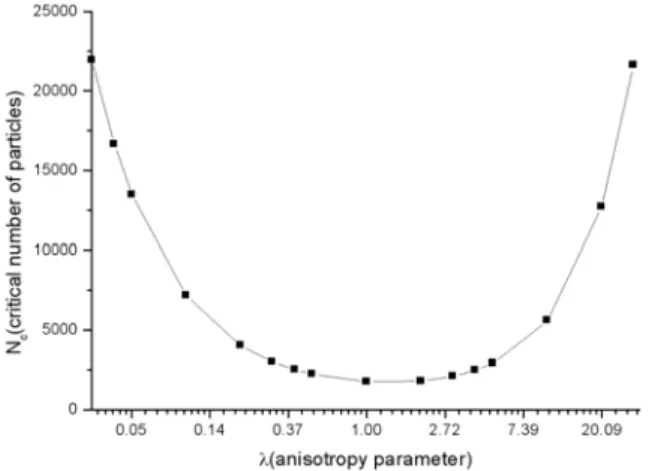
FIG. 1: The behaviour of the critical number of particles in function of several different traps.
Using the eq. (14), we get the equation for the critical cou-pling parameter
gc=−0.05
(2p+qλ)5/2 p√qInm jλ
.
The equation g=4πas
lrN,gives us the expression for the critical number of particles
Nc=
(2p+qλ)5/2 300p√qInm jλ
lr as
. (18)
Using the analytical expression (18) with the values of7Li Condensate [18-19] and considering the ground state, with n=m=l=0, p=l=1 andI000=0.063494,we can obtain Ncin Figure 1.
From these results, we observe that there are two regimes: cigar-shape(λ<<1)and the disc-shape(λ>>1). Both sit-uations increase Nc, while in a spherical-shape Ncreaches its the minimal value. For example, in a cigar-shape trapλ= 0.1and Nc=7157,in a disc-shape trapλ=10and Nc=5586 and in a spherical-shape trapλ=1with Nc=1350.These val-ues are in a good agreement with those in references [11,13].
IV. CONCLUSION
The method of the self-similar root approximants resulted in analytical expressions for the spectrum of energy levels, for the critical coupling parameter and for the critical number of particles. We have analytically studied the behaviour of the critical number of particles as a function of the anisotropy parameter, which introduced a better stability in the system.
Acknowledgments
We are grateful to Yukalov for important contributions and discussion to this work and to CNPQ and CAPES for the fi-nancial support.
[1] M. H. Anderson, J. R. Ensher, M. R. Mathews, C. E. Wieman, and E.A. Cornell, Science269,198 (1995).
[2] K. B. Davis et al., Phys. Rev. Lett.75,3969 (1995). [3] D. G. Fried et al., Phys. Rev. Lett.81,3811 (1998). [4] A. Robert et al., Science292,461 (2001).
[5] C. C. Bradley, C. A. Sackett, J. J. Tollet, and R. G. Hulet, Phys. Rev. Lett.75, 1687 (1995); C. C. Bradley, C. A.Sackett, and R. G. Hulet, ibid.78, 895 (1997).
[6] Y. E. Kim and A.L. Zubarev, Phys. Lett. A246,389 (1998). [7] M. Wadati and T. Tsurumi, Phys. Lett. A247, 287 (1998). [8] M. Ueda and K. Huang, Phys. Rev. A60, 3317 (1999). [9] A. Eleftheriou and K. Huang, Phys. Rev A61, 043601 (2000). [10] M. Ueda and A.J. Leggett, Phys. Rev. Lett.80, 1576 (1998). [11] A. Gammal, T. Frederico, and L. Tomio, Phys. Rev. A 64,
055602 (2001).
[12] A. Gammal, L. Tomio, and T. Frederico, Phys. Rev. A66, 043619 (2002).
[13] A. G. De Sousa, A. B. F. da Silva, G. C. Marques, and V. S. Bagnato, Phys. Rev. A70, 063608 (2004).
[14] V. I. Yukalov, Ann. Physik38, 419 (1981).
[15] F. F. de Souza Cruz, M. B. Pinto, R. O. Ramos, and P. Sena, Phys. Rev. A65, 053613 (2002).
[16] V. I. Yukalov, Theor. Math. Phys28, 652 (1976).
[17] Ph. W. Courteille, V. S. Bagnato, and V. I. Yukalov, Laser Physics, vol. II, no6, 659 (2001).
[18] V. I. Yukalov and E. P. Yukalova, Chaos Solitons Fractals14, 839 (2002).