1284 Brazilian Journal of Physics, vol. 37, no. 4, December, 2007
Structural and Magnetic Properties of the Half-Ferromagnetic Co
2+x+yMn
1−xAl
1−yAlloys
C. Paduani, A. Migliavacca,
DF-UFSC, Florian´opolis, CEP 88040-900, SC, Brazil
J.C. Krause,
DCET-URI, Santo ˆAngelo, CEP 98802-470, RS, Brazil
J.D. Ardisson,
CDTN, Belo Horizonte, CEP 30123-970, MG, Brazil
and M.I. Yoshida
DQ-ICEX-UFMG, Belo Horizonte, CEP 31270-901, MG, Brazil
Received on 2 October, 2007
Co2+x+yMn1−xAl1−yintermetallic compounds have been prepared by arc melting and studied with X-ray
diffraction and magnetization measurements to ascertain the effect of deviations of composition from the stoi-chiometry on the ferromagnetism of this system. Hysteresis loops registered at room temperature show a soft ferromagnetic behavior in excess Co. In off-stoichiometric alloys the saturation magnetization is lower than in Co2MnAl, whereas the Curie temperature TC is higher in all the studied alloys. TC varies substantially with
variations in composition and increases with the Mn content. In the source of this behavior a volume effect is inferred which is expected to lead to strengthened ferromagnetic exchanges.
Keywords: Heusler alloys; Cobalt; Manganese; Aluminum; Half-ferromagnetic materials
I. INTRODUCTION
The Heusler alloys[1] are of great current interest because of their theoretically predicted half metallicity[2–4]. The-oretical studies of the microscopic origin of the magnetic anisotropy energy in some Heusler alloys indicated that the magnetic coupling has an orbital character and is mainly be-tween atoms of the same species. Experimental findings have also shown that the magnetic properties of these ordered com-pounds depend significantly upon degree and type of chemi-cal order[5–8]. The stoichiometric Heusler compound X2YZ
crystallizes in the L21 structure (s.g. Fm3m), which consists
of four interpenetrating fcc sublattices, each one occupied by one sort of atom. The Co-based compounds particularly pos-sess higher Curie temperature than the other potential half-metallic compounds, and in some cases, a large decrease of the resistivity with the increase of the temperature has been observed as well as a moderately enhanced specific-heat coef-ficient and a clear Fermi edge.
A study of the phase stability and magnetic properties of Co2Cr1−xFexAl has shown that the occurrence of two-phase
separation is unavoidable for x<0.4, thus leading to a
de-viation of the saturation magnetic moments from the Slater-Pauling curve[7]. Moreover, it has been reported that the L21 phase becomes stable only for x>0.7, where no
half-metallic behavior is present. In the earlier studies on the Heusler Co2MnAl alloy in order to stabilize the L21structure
was used an annealing of 72 h at 1073 K with a subsequent quenching in water[9, 10]. Reported lattice parameters of the ordered L21 phase are a = 5.754 ˚A[13] and a = 5.749 ˚A[9];
the Curie temperature is 693 K[9]. From electronic structure calculations magnetic moments of 0.745µBand 2.599µBhave
been obtained for Co and Mn atoms, respectively[4]. In the
present investigation we examine the effect of variations in the Mn concentration on the structural and magnetic properties of Co2+x+yMn1−xAl1−y alloys. Since the Mn atoms are
carry-ing the largest magnetic moment in this phase, the intrinsic magnetic properties are expected to be drastically affected as the Mn content is varied. Results of measurements with the experimental techniques of X-ray diffraction, calorimetry and magnetization are discussed in this context.
II. EXPERIMENT
Polycrystalline Co2+x+yMn1−xAl1−yalloys were prepared
by weighing out the required amounts of the constituent ma-terials and arc melting under argon atmosphere in a water-cooled copper crucible. Ingots were then vacuum sealed in quartz tubes and annealed for 3 days at 1273 K, then for more 3 days at 673 K, followed by cooling in the furnace itself. The compositions of the alloys were determined by energy dis-persive X-ray analysis (EDX). Room temperature structural analysis was carried out with conventional X-ray diffractom-etry using Cu-Kα radiation. The magnetic field dependence of the magnetization (M(H)) was registered at room temper-ature (300 K) in fields up to 850 kA/m. For the calorimetric measurements (TGA) the samples were encapsulated in evac-uated quartz glass to avoid oxidation on heating above room temperature up to about 1000 K.
III. RESULTS AND DISCUSSION
For a large variety of Heusler alloys the fully ordered L21
dis-C. Paduani et al. 1285
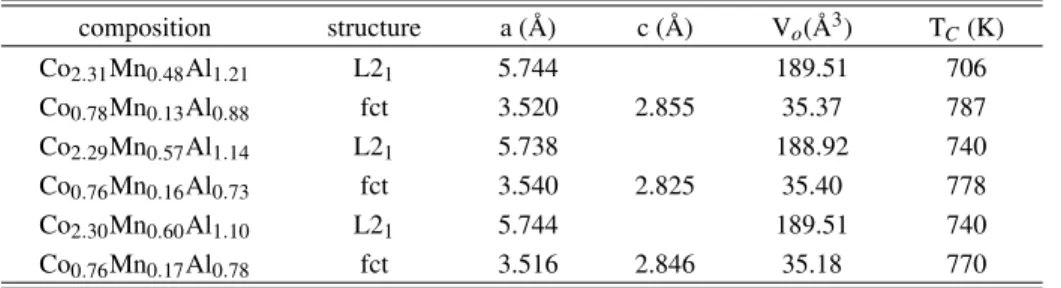
TABLE I: Composition, structure, lattice parameters, Curie temperature and unit cell volume of Co2+x+yMn1−xAl1−yalloys.
composition structure a ( ˚A) c ( ˚A) Vo( ˚A3) TC(K)
Co2.31Mn0.48Al1.21 L21 5.744 189.51 706 Co0.78Mn0.13Al0.88 fct 3.520 2.855 35.37 787 Co2.29Mn0.57Al1.14 L21 5.738 188.92 740 Co0.76Mn0.16Al0.73 fct 3.540 2.825 35.40 778 Co2.30Mn0.60Al1.10 L21 5.744 189.51 740 Co0.76Mn0.17Al0.78 fct 3.516 2.846 35.18 770
ordered B2 phase below about 650 K, where the diffusion kinetics are expected to be slow. In some cases a quench-ing procedure was used to stabilize the B2 phase, whereas in other cases an appropriate annealing followed by furnace cooling (without quenching) was adopted to retain the L21
phase from the B2 phase, as for instance, to obtain the Fe2VAl
alloy[11, 12]. The X-ray diffraction patterns of the studied alloys are shown in Fig. 1. A profile analysis of the diffrac-tograms with the Rietveld technique indicates the presence of two phases in these samples: the ordered L21structure (as the
main phase), and a minority phase with a fct structure (s.g. P4/mmm). Some Bragg reflections may be absent due to tex-turation of the polycrystalline sample. The determined lattice parameters are listed in Table 1, where the indicated composi-tions are those obtained from the EDX analysis. As it can be seen, close values are observed for the lattice parameters of the ordered L21phase in all the studied alloys, in spite of the
smaller atomic radius of the Co atom as compared to those of both Al and Mn atoms. For Co2MnAl, reported values yield
a= 5.754 ˚A[10] and 5.749 ˚A[9]. With the decrease of the Mn concentration down to about half of the stoichiometry the ob-served variation of the lattice parameter is <0.3 %.
How-ever, the unit cell volume of these alloys is larger than that of Co2MnAl. In the fct phase, which is tetragonally compressed
along the cdirection, the cell volume is practically constant and composition independent, despite the variations ofaand c.
In Fig. 2 are shown micrographs of the samples taken with EDX. ¿From these it can be seen clearly that these alloys are indeed composed of two phases, which corroborates the re-sults of the X-ray studies. The black spots are voids caused by the etching during surface preparation. From Fig. 2a the for-mation of two well distinct phases in the Co2.31Mn0.48Al1.21
alloy can be easily identified: the gray region corresponds to the main phase with the L21 structure, while the white
re-gion is associated to the minority fct phase. In the spite of the differences in scale, from top to bottom in Fig. 2 one can see how the secondary phase develops and becomes more ho-mogeneously distributed with the increase of the Mn concen-tration: the white strips tend to proliferate and are becoming shorter in length and more disconnected. One may infer that the morphologies of the two phases appear to be quite differ-ent from each other.
The ferromagnetic Curie temperature TC of the studied
al-loys was obtained with a magnetobalance. The registered traces are shown in Fig. 3. The measuring field was applied
20 30 40 50 60 70 80 90 100 110 L21: Co2.30Mn0.60Al1.10
fct: Co0.76Mn0.17Al0.78
2θ (degs.)
L21: Co2.29Mn0.57Al1.14
fct: Co0.76Mn0.16Al0.73
In
te
n
s
it
y
(
a
rb
.
u
n
it
s
)
(1
1
1
)
(4
2
2
)
(4
2
0
)
(3
3
1
)
(4
0
0
)
(2
2
2
)
(3
1
1
)
(2
2
0
)
(2
0
0
)
L21: Co2.31Mn0.48Al1.21 fct: Co0.78Mn0.13Al0.88
FIG. 1: XRD patterns of Co2+x+yMn1−xAl1−y alloys; the Bragg
reflections of the main phase (L21 ) are displayed for the Co2.31Mn0.48Al1.21 alloy (top); the arrows indicate peaks of the fct phase.
by means of pieces with H.≈0.5 T. The corresponding TC
values are collected in Table 1. For the Co2.31Mn0.48Al1.21
al-loy, which has the higher Co content, TC = 706 K. This result
is higher than the previously reported TC of the
stoichiomet-ric alloy (693 K)[13]. As it can be seen in Table 1, with the increase of the Mn concentration the Curie temperature of the L21 phase is sturdily affected. The unfilled d shells of the
Co atoms overlap with those of their Mn neighbors, and so direct exchange thereby becomes possible, and the additional d-electrons of Co atoms causes the strengthening of the ferro-magnetic exchanges (Co and Mn spin moments are parallel) which increases as the cell volume decreases and inevitably leads to higher TC values. Thus, in the source of the observed
increase of TC as compared to Co2MnAl is a volume effect.
As the excess Co atoms in these alloys occupy the Mn sites, stronger interactions are taking place as a result of the increase of the overlap of thed-orbitals, which in turns increases TC .
On the other hand, note that TC decreases monotonically with
the increase of the Mn concentration in the fct phase. The somewhat high TC values observed for this phase indicates
that large spin moments can also be expected for both Co and Mn atoms. In table 1 it can be also seen that, in both phases, at higher Al contents lower TC values are observed, as one
1286 Brazilian Journal of Physics, vol. 37, no. 4, December, 2007
FIG. 2: Micrographs from EDX analysis: (a) Co2.31Mn0.48Al1.21and Co0.78Mn0.13Al0.88; (b) Co2.29Mn0.57Al1.14 and Co0.76Mn0.16Al0.73, (c) Co2.30Mn0.60Al1.10 and Co0.76Mn0.17Al0.78alloys.
moment. Furthermore, the fct phase in the Co0.76Mn0.16Al0.73 alloy has a lower TC as compared to the Co0.78Mn0.13Al0.88
alloy, thus indicating weaker ferromagnetic exchanges at this composition in this phase. This feature might be associated to the shrink of the lattice along thecdirection at this composi-tion.
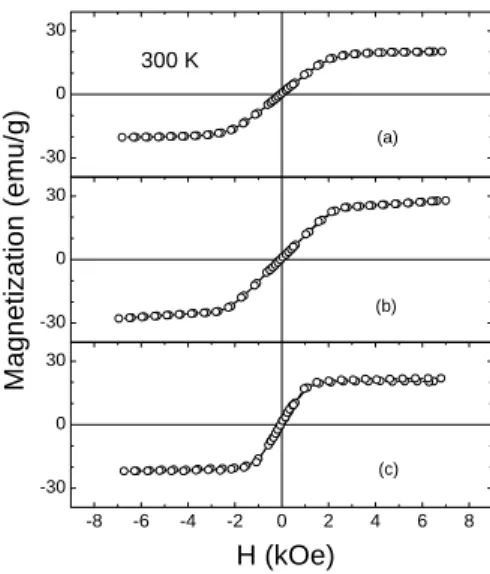
The hysteresis M(H) loops recorded at room temperature are shown in Fig. 4, which reveal the soft ferromagnetic character of these alloys. Neither remanence nor coercive field are observed. Nevertheless, saturation is attained in ap-plied fields up to about 7 kOe for the Co2.31Mn0.48Al1.21and
Co2.30Mn0.60Al1.10 alloys. In the Co2.29Mn0.57Al1.14 alloy,
one sees in Fig. 4 that higher fields are necessary to reach the saturation magnetization, which is higher at this composi-tion. Since any paramagnetic or antiferromagnetic
contribu-300 400 500 600 700 800 900
L21: Co2.30Mn0.60Al1.10 fct: Co0.76Mn0.17Al0.78
770 K 740 K
T (K)
L21: Co2.29Mn0.57Al1.14 fct: Co0.76Mn0.16Al0.73
740 K 778 K
M
a
g
n
e
ti
z
a
ti
o
n
(
a
rb
.u
n
it
s
)
L21: Co2.31Mn0.48Al1.21 fct: Co0.78Mn0.13Al0.88
(fct) 787 K ( L21)
706 K
FIG. 3: Transitions measured with a magnetobalance. The Curie temperatures are indicated; the arrows are indicating the transitions associated to the fct phase.
-30 0 30
-8 -6 -4 -2 0 2 4 6 8
-30 0 30 -30 0 30
(a) 300 K
M
agnetization (em
u
/g)
(c)
H (kOe)
(b)
FIG. 4: Hysteresis loops at room temperature of the stud-ied alloys: (a) Co2.31Mn0.48Al1.21 and Co0.78Mn0.13Al0.88; (b) Co2.29Mn0.57Al1.14and Co0.76Mn0.16Al0.73, (c) Co2.30Mn0.60Al1.10 and Co0.76Mn0.17Al0.78.
tion can be ruled out in this case this feature is then associated to the L21phase, by considering that the relative amount of
the ordered phase is overwhelming in this alloy, as indicated from the X-ray analysis. The reported saturation magnetiza-tion Msat 300 K of Co2MnAl is 104 emu/g[9]. The obtained
Ms results of the Co2+x+yMn1−xAl1−y alloys are below this
al-C. Paduani et al. 1287
loy, the Co spin moment is not affected and so does its orbital moment[4]. The Co moment was found to be mostly induced by the spin-orbit coupling and is insensitive to hybridization with the neighboring sites.
Nevertheless, in the present study the observed behavior of both TC and Ms can not be explained if one considers
that both Co and Mn atoms keep constant moments despite the variations in composition. With the increase of the Mn concentration from Co2.31Mn0.48Al1.21to Co2.29Mn0.57Al1.14,
TC and Ms of the L21 phase increases as a result of the
larger moments carried by Mn atoms. Besides, the unit cell volume decreases. Further, from Co2.29Mn0.57Al1.14 to
Co2.30Mn0.60Al1.10the Al concentration decreases and the Mn
concentration increases. However, TC is unaffected by these
changes although Msdecreases. In the framework of constant
magnetic moments for both Co and Mn atoms, by consider-ing that the Mn atoms are carryconsider-ing the largest moments, there would be no reason for the observed decrease of Ms. No
con-tribution from the fct phase is expected therein, since for these alloys the significative change in composition for this phase is in the Al concentration, which increases. Actually the ob-served trend is indicative that the atomic moments in these
alloys are ruled by a subtle mechanism which is strongly af-fected by changes in composition.
As a conclusion, the results above indicate that with de-viations of composition from the stoichiometry, with excess Co, the ordered L21 structure still can be stabilized in the
Co2+x+yMn1−xAl1−yalloys. However, traces of a secondary
phase are observed, which has a fct structure. A remarkable result is the high TC observed in these alloys for both L21 and
fct phases. In the L21 phase, TC is even higher as compared
with Co2MnAl in all the studied alloys. The saturation
magne-tization at 300 K is higher in the alloy where the unit cell vol-ume is the smallest one. Comparatively, with the variations in the composition of the L21 phase from Co2.31Mn0.48Al1.21to
Co2.29Mn0.57Al1.14the Curie temperature increases from 706
K to 740 K, whereas the saturation magnetization increases and the cell volume decreases. Hence, with the increase of the Co concentration from the stoichiometry one might ex-pect that the Co atoms occupy the Mn sites in the ordered L21
phase. Thereby the magnetization decreases as a consequence of the smaller Co moments, although a strengthening of the ferromagnetic exchanges takes place, as indicated by the in-creased TC values of these alloys.
[1] F. Heusler, Verhandl. d. Deutschen Physik. Gesellsch.12, 219 (1903).
[2] A. Ayuela, J. Enkovaara, K. Ullakko, and R. M. Nieminen, J. Phys. Condens. Matter11, 2017 (1999).
[3] J. Enkovaara, A. Ayuela, L. Nordstr¨om, and R. M. Nieminen, Phys. Rev. B65, 134422 (2002).
[4] I. Galanakis, P. H. Dederichs, and N. Papanikolaou, Phys. Rev. B66, 174429 (2002); I. Galanakis, Phys. Rev. B71, 012413 (2005).
[5] S. Plogmann,et al., Phys. Rev. B60, 6428 (1999).
[6] H. Kubota, J. Nakata, M. Oogane, Y. Ando, H. Kato, A. Sakuma, and T. Miyazaki, J. Appl. Phys.97, 10C913 (2005). [7] K. Kobayashi, R. Y. Umetsu, R. Kainuma, K. Ishida, T.
Oya-mada, A. Fujita, and K. Fukamichi, Appl. Phys. Lett.85, 4684
(2004).
[8] Y. Miura, K. Nagao, and M. Shirai, Phys. Rev. B69, 144413 (2004).
[9] K.H.J. Buschow and P.G. van Engen, J. Magn. Magn. Mat.25, 90 (1981).
[10] R.A. Dunlap and J.F. Jones, Phys. Rev. B26, 6013 (1982). [11] M. Kato, Y. Nishino, U. Mizutani, and S. Asano, J. Phys.:
Cond. Matter.12, 1769 (2000).
[12] S. Lue, Yang Li, J. H. Ross Jr. and G. M. Irwin, Phys. Rev. B
67, 224425 (2003).