1Instituto de Geociências, University of São Paulo - USP, São Paulo (SP), Brasil. E-mail: [email protected], [email protected], [email protected], [email protected]
*Autor correspondente
Manuscript: 20160075. Received on: 06/13/2016. Approved on: 08/09/2016 ABSTRACT: he Monte de Trigo alkaline suite is a SiO2 -undersaturated syenite-gabbroid association from the Serra do Mar alkaline province. Eudialyte-group minerals (EGMs) occur in one nepheline microsyenite dyke, associated with aegirine-augite, wöhlerite, låvenite, magnetite, zircon, titanite, britholite, and pyrochlore. Major compositional variations include Si (25.09– 25.57 apfu), Nb (0.31– 0.76 apfu), Fe (1.40–2.13 apfu), and Mn (1.36– 2.08 apfu). he EGMs also contain relatively high contents of Ca (6.13– 7.10 apfu), moderate enrichment of rare earth elements (0.38–0.67 apfu), and a relatively low Na content (11.02–12.28 apfu), which can be correlated with their transitional agpaitic assemblage. EGM compositions indicate a complex solid solution that includes eudialyte, kentbrooksite, feklichevite, zirsilite-(Ce), georgbarsanovite, and manganoeudialyte components. EGM trace element analyses show low Sr and Ba contents and a negative Eu/Eu* anomaly, which are interpreted as characteristic of the parental magma due to the previous fractionation of plagioclase and/or alkali feldspar. he EGMs from the dyke border have higher contents of Fe, Sr (2,161–2,699 ppm), Mg (1,179–3,582 ppm), and Zn (732– 852 ppm) than those at the dyke center. hese diferences are related to the incorporation of xenoliths and xenocrysts of melatheralitic host rock into the nepheline-syenitic magma followed by crystal-melt difusive exchange. KEYWORDS: mineral chemistry; agpaitic rocks; Serra do Mar al-kaline province.
RESUMO: A suíte alcalina do Monte de Trigo é uma associação sie-nítico-gabroide que pertence à província alcalina da Serra do Mar. Minerais do grupo da eudialita (EGMs) ocorrem em um dique de ne-felina microssienito associados a egirina-augita, wöhlerita, lavenita, magnetita, zircão, titanita, britolita e pirocloro. As principais variações composicionais incluem Si (25,09-25,57 apfu), Nb (0,31-0,76 apfu), Fe (1,40-2,13 apfu) e Mn (1,36-2,08 apfu). Os EGMs também contêm concentrações relativamente altas de Ca (6,13-7,10 apfu), enriquecimen-to moderado de elemenenriquecimen-tos terras raras (0,38-0,67 apfu) e concentrações relativamente baixas de Na (11,02-12,28 apfu), o que pode ser corre-lacionado com uma assembleia agpaítica transicional. As composições dos EGMs indicam uma solução sólida complexa entre os componentes eudialita, kentbrooksita, feklichevita, zirsilita-(Ce), georgbarsanovita e manganoeudialita. Análises de elementos traços das EGMs mostram baixas concentrações de Sr e Ba e anomalia negativa de Eu/Eu*, que são interpretadas como uma característica do magma parental por conta do fracionamento de plagioclásio e/ou feldspato alcalino. Os EGMs da borda do dique possuem concentrações maiores de Fe, Sr (2.161–2.699 ppm), Mg (1.179-3.582 ppm) and Zn (732–852 ppm) que aqueles do cen-tro do dique. Essas diferenças estão relacionadas com a incorporação de xenólitos e xenocristais da rocha encaixante melateralítica no magma nefelina-sienítico seguido de trocas difusivas entre os cristais e o líquido. PALAVRAS-CHAVE: química mineral; rochas agpaíticas, provín-cia alcalina da Serra do Mar.
Eudialyte-group minerals from the Monte
de Trigo alkaline suite, Brazil: composition
and petrological implications
Minerais do grupo da eudialita da suíte alcalina Monte de Trigo,
Brasil: composição e implicações petrológicas
INTRODUCTION
he eudialyte group minerals (EGMs) consist of vari-ous Na-, Ca-, and Zr-rich cyclosilicates with a wide com-positional variation. Signiicant amounts of other elements, such as Fe, Mn, Nb, rare earth elements (REE), Sr, and Cl are reported in EGM compositions (Johnsen & Gault 1997, Johnsen & Grice 1999, Schilling et al. 2011b). According to the International Mineralogical Association (Johnsen et al. 2003), the general formula of the EGMs is Na12[N(4)]3[M(1)]6[M(2)]3[M(3)][M(4)]Zr3(Si24O72) (O,OH,H2O)4X2, in which the common elements assigned to each site are as it follows:
■ Si at M(4);
■ Nb, Si, Ti, and W at M(3);
■ Fe, Mn, Na, Zr, K, and H3O at M(2);
■ Ca, Mn, and Fe at M(1);
■ Na, REE, Sr, K, Ca, Mn, and H3O at N(4);
■ Cl, OH, F, and CO3 at X.
Rastsvetaeva & Chukanov (2012) list 25 known species of EGMs, and recently a new member named Ilyukhinite was described (Chukanov et al. 2015). his great diversity is the result of the compositional and structural complex-ity of the group.
Eudialyte was irst described by Stromeyer (1819) as one of the major constituents of nepheline syenites from the Ilímaussaq Complex, Greenland. Since then, EGMs have been recognized in nearly all occurrences of agpaitic rocks, i.e., peralkaline nepheline syenites (and phono-lites) that contain complex silicates of Zr, Ti, REE, F, and other volatiles (Sørensen 1997, Le Maitre 2002). EGMs have been described in agpaitic rocks from Khibiny and Lovozero, Kola Peninsula (Khomyakov 1995, Johnsen & Gault 1997, Schilling et al. 2011b); Mont Saint-Hilaire, Canada (Johnsen & Gault 1997, Johnsen & Grice 1999, Schilling et al. 2011b); Langesundsjord, Norway (Andersen et al. 2010, Schilling et al. 2011b); Tamazeght, Morocco (Schilling et al. 2009, Schilling et al. 2011b); Poços de Caldas, Brazil (Johnsen & Gault 1997, Ulbrich & Ulbrich 2000, Ulbrich et al. 2005, Schilling et al. 2011b); Cerro Boggiani, Paraguay (Gomes et al. 1996, Carbonin et al. 2005); Pilanesberg, South Africa (Mitchell & Liferovich, 2006, Schilling et al. 2011a); Sushina Hill, India (Mitchell & Chakrabarty, 2012); Agua de Pau volcano, Azores, Portugal (Ridoli et al. 2003); and Kilombe volcano, Kenya Rift Valley (Ridolfi et al. 2006). The typical minerals associated with EGMs include alkali feldspar, nepheline, sodalite, aegirine, arfvedsonite, and several complex Zr-, Nb-, Ti-, and REE-bearing silicates, such as astrophyllite, lamprophyllite, rosenbuschite, rinkite, and wöhlerite (e.g.,
Sørensen 1997, Andersen et al. 2010, Marks et al. 2011, Schilling et al. 2011b).
The present paper reports the occurrence of EGMs from the alkaline suite of Monte de Trigo, a small island (ca. 1 km2) situated near the towns of Sao Paulo and Rio de
Janeiro, at the western border of the Santos Basin (23º53’S, 45º47’W), in southeastern Brazil. hey describes major and trace element analyses of these EGMs, and their composi-tion is discussed in terms of site assignment and possible ideal components. he objectives of the study were to char-acterize the EGMs at Monte de Trigo and to understand how its petrological environment inluences the major and trace element compositions of the EGMs.
MAGMATIC CONTEXT
Several late cretaceous alkaline occurrences and widespread lamprophyre dyke swarms intrude the Neoproterozoic Ribeira belt in southeastern Brazil and constitute the Serra do Mar Alkaline Province (Fig. 1A; Almeida 1983, hompson et al. 1998, Riccomini et al. 2005, Brotzu et al. 2005). his prov-ince is part of an extensive Meso-Cenozoic tholeiitic–alka-line–carbonatitic magmatism that is spread over the central and southeastern regions of the Brazilian Platform (Morbidelli et al. 1995, Peate 1997, Comin-Chiaramonti & Gomes 2005). Syenites and nepheline syenites of miaskitic ainity (i.e., nepheline syenites containing zircon or titanite or molar (Na2O+K2O)/Al2O3 < 1 in bulk-rock composition; Sørensen 1997, Le Maitre 2002) prevail in many occurrences in the Serra do Mar Alkaline Province (Almeida 1983, Brotzu et al. 2005). Maic-ultramaic intrusive lithologies only occur as small, cumulate bodies associated with the syenitic stocks, such as in São Sebastião (Enrich et al. 2005) and Morro de São João (Brotzu et al. 2007), except for the Ponte Nova maic-ul-tramaic massif, where felsic rocks are nearly absent (Azzone et al. 2009). he presence of agpaitic rocks (i.e., nepheline syenites and phonolites with molar (Na2O+K2O)/Al2O3 > 1 and complex silicates of Zr, Ti, REE, and F and others vol-atiles; Sørensen 1997, Le Maitre 2002) is restricted to a few localities in this province, usually in small volumes associated with large miaskitic bodies, as in the Poços de Caldas, Itatiaia, and Passa Quatro massifs (Fig. 1A; Brotzu et al. 1992, Brotzu et al. 1997, Ulbrich & Ulbrich 2000, Enrich et al. 2005, Ulbrich et al. 2005).
cumulate nepheline-bearing olivine melagabbros, melather-alites (i.e., melanocratic nepheline gabbro, Le Maitre 2002) and clinopyroxenites with wide modal variations and lay-ering structures. A leucocratic medium-to-coarse-grained nepheline syenite and nepheline-bearing alkali feldspar syenite intrude the cumulate maic-ultramaic unit and compose most of the area of the suite. Alkali feldspar, hedenbergite, hastingsite, and biotite are early magmatic phases, whereas nepheline and analcime are late-crystal-lized phases. Accessory minerals include apatite, magne-tite, and titanite and characterize a miaskitic association. Miaskitic and agpaitic nepheline microsyenite dykes cut the cumulate maic-ultramaic body and the nepheline syenite
stock and are interpreted as late-stage diferentiates of the nepheline syenite (Enrich et al. 2009).
NEPHELINE MICROSYENITE DYKES
Miaskitic nepheline microsyenites have hypidiomor-phic to allotriomorhypidiomor-phic texture with early crystallized alkali feldspar, hastingsite, titanite, apatite, and magnetite, fol-lowed by aegirine-augite and late-crystallized nepheline and sodalite. Agpaitic nepheline microsyenites are less abun-dant, vary from ine-to-medium-grained inequigranular seriate texture to equigranular aplitic texture, and the origin
Figure 1. (A) Geological map of the Serra do Mar alkaline province and surrounding area in southeastern Brazil,
modiied from Almeida (1983). Inset: simpliied geological map of Monte de Trigo Island (ater Enrich et al. 2009); (B) Field relations of the EGM-bearing nepheline microsyenite dyke of the Monte de Trigo suite; (C) Detail of (B) showing corroded melatheralite xenoliths at the dyke border.
Poços de Caldas
Bom Repouso
Ponte Nova
Sao Paulo City
Passa Quatro
Itaiaia
Morro Redondo
Tinguá
Mendanha
Soarinho N
Rio Bonito Tanguá
Morro de Sao Joao
Cabo Frio
22ºS
Monte
de Trigo Sao Sebastiao Búzios
Vitória Atlantic Ocean
Rio de Janeiro City
24ºS
0 40 80 120 km
45ºW
Cenozoic cover
Cretaceous alkaline rocks
Paleozoic cover
Precambrian crystalline basement Studied
dyke
0.5 0 Miaskitic nepheline syenite stock
Cumulate mafic/
ultramafic rocks 43ºW
km A
of these dykes is interpreted as having crystallized from a more evolved magma fraction than the miaskitic microsy-enites ones. Alkali feldspar, nepheline, aegirine-augite, kato-phorite, magnetite, wöhlerite, hiortdahlite, and apatite are early crystallized phases, whereas sodalite, analcime, låvenite, zircon, zirconolite, baddeleyite, pyrochlore, and britholite are late-crystallized phases. Post-magmatic minerals include luorite, rutile, calcite, and pyrite.
Only one agpaitic nepheline microsyenite dyke contains EGMs (Fig. 1B). his dyke is 50 cm wide and intrudes melatheralites at the northern coast of the island. he dyke exhibits an equigranular aplitic texture, which suggests co-precipitation of most of the phases. Major phases include mesoperthitic alkali feldspar (~45 vol%), nepheline (~35 vol%), and aegirine to aegirine-augite (~10 vol%). EGMs (~2 vol%) are the most abundant accessory phases. hese minerals are colorless, subhedral, hexagonal- to round-shaped, and exhibit low birefringence and moderate relief (Fig. 2). Other accessory phases include Mn-rich magnetite and subhedral wöhlerite, each less than 1 vol%. Interstitial titanite, zircon, and britholite occur as late- to post-magmatic phases. he EGM-bearing nepheline microsyenite is classiied as low agpaitic or transitional agpaitic (Khomyakov 1995, Sørensen 1997) in accordance with its accessory minerals.
Near the border, the EGM-bearing dyke shows an increase in the maic mineral content, locally up to 25 vol%, as well as some maic aggregates (Figs. 1C and 3A). he latter is composed of aegirine-augite and magnetite (Fig. 3B) and is interpreted as corroded and re-equilibrated xenoliths and/ or xenocrysts of the melatheralite host-rock. Accessory min-erals at the dyke border are EGMs and låvenite (Figs. 2C and 3B). Late-magmatic phases include poikilitic titanite, zirconolite, pyrochlore, and apatite.
he melatheralite host rock was transformed into a metaso-matic granofels on a centimeter scale near the contact with the dyke, by its reaction with the alkaline volatile-rich liq-uid. Olivine, augite, and plagioclase from melatheralite were replaced by aegirine-augite, magnesiokatophorite, biotite, magnetite, and potassic feldspar (Fig. 3A). Aegirine-augite is the most abundant mineral within the irst millimeter of the granofels. he granofels also has relict cores of aug-ite with andradaug-ite rims, biotaug-ite, and magnesiokatophoraug-ite pseudomorphs after augite and masses of potassic feldspar after plagioclase (Fig. 3A and 3C).
ANALYTICAL METHODS
Major element analyses of the EGMs were performed on standard carbon-coated thin sections in a Jeol JXA-8600 electron microprobe using a Noran Voyager 4.1 automation
Figure 2. Photomicrographs of the EGMs from the Monte de Trigo alkaline suite. (A) Granular EGM in association with tabular mesoperthitic feldspar, prismatic aegirine-augite and subhedral magnesiokatophorite and nepheline grains (dyke border); (B) Rounded EGM grains with alkali feldspar and nepheline (dyke center); (C) Granular EGMs, anhedral låvenite, and prismatic aegirine-augite with alkali feldspar and nepheline (dyke border). Mineral abbreviations: Ae-aug, aegirine-augite; Afs, alkali feldspar; Eud, eudialyte; Låv, låvenite; Mkt, magnesiokatophorite; Ne, nepheline.
A
B
system at the Geoanalítica USP Core Facility of the University of São Paulo (USP). he analyses of standards and unknown samples were performed according to the electron micro-probe settings of Williams (1996) (accelerating voltage of 25 kV and beam current of 100 nA) to properly quantify REE, HFSE, and other trace elements. he peak counting times were 10-20 s (F, Cl, Na, Si, K, Ca, Mn, Fe, Mg, Ti, and Al) and 40–60 s (La, Ce, Pr, Nd, Gd, Er, Yb, Y, Zr, Hf, Nb, Ta, U, h, and Pb); the background counting times were half of the corresponding peak values. he Na and F contents were measured in the irst minute of the analysis to prevent vola-tilization/migration due to the high probe current. A 30-μm beam diameter was also employed to avoid volatilization/ migration. he small EGM grain size in the studied samples together with the large beam diameter precluded a core-to-rim characterization. A combination of well-characterized natural and synthetic standards was used. he data were processed
using the PROZA procedure (Bastin et al. 1984). Special care was taken in the selection of the peak and background posi-tion to eliminate peak overlap. he detecposi-tion limits were in the range of 0.01–0.03 wt%, except for F (up to 0.15 wt%). After the removal of carbon coating from the thin sec-tions, in situ trace-element analyses were performed on the same grain and as close as possible to the microprobe spot analysis using the laser ablation inductively coupled plasma mass spectrometry (LA-ICP-MS) at the Geoanalítica-USP Facility of the USP. he analytical work utilized a Perkin Elmer Elan 6100 DRC ICP-MS instrument coupled with a neodymium-doped yttrium aluminum garnet (Nd:YAG) laser (New Wave UP 213 AF) operating at a wavelength of 213 nm in a He+Ar atmosphere. Laser ablation was per-formed at 1.5 J/cm2 at a pulse rate of 10 Hz. Due to the
small grain size, and to avoid mineral inclusions, a predeter-mined line raster of 120 µm with a 15-µm beam diameter
Figure 3 – (A) Contact between the EGM-bearing nepheline microsyenite dyke (let) and the melatheralite host rock (right) from Monte de Trigo; (B) Detail of (A) showing aegirine-augite and magnetite maic aggregate near EGM and låvenite grains; (C) Detail of (A) showing the augite relict core with andradite border (top) and part of biotite, magnesiokatophorite, and aegirine-augite pseudomorph ater augite (bottom). Mineral abbreviations: Ae-aug, aegirine-augite; Adr, andradite; Afs, alkali feldspar; Aug, augite; Bt, biotite; Eud, eudialyte; Låv, låvenite; Mkt,
magnesiokatophorite. A
B C
C
at a 2-µm/s scan speed was used. he Glitter 4.4.2 software (Van Achterbergh et al. 2001) was used for data process-ing with National Institute of Standards and Technology (NIST) SRM 610 as the external standard and 42Ca as the
internal standard using values for CaO from the electron microprobe analysis for the minerals. A linear adjustment was selected as the interpolation method for drift control and quantiication. he relative errors (1σ) were in the range of 5–10% for most of the trace elements. Detection limits are usually between 0.1 and 2 ppm, except for Mg and Zn, with values up to 20 ppm. Whenever an element was analyzed with microprobe and LA-ICP-MS (e.g., Hf, Ta, Pb, Mg, and some REE), the more precise data from LA-ICP-MS were preferred.
EGM structural formulae were calculated according to Johnsen & Grice (1999) and Johnsen et al. (2001) based on 29 cations (sum of Si, Al, Zr, Ti, Hf, Nb, W and Ta) and constraining all Fe and Mn to be divalent.
he bulk-rock compositions of major and some trace elements were analyzed in a fused glass disc and pressed powder pellets using a Philips PW 2400 X-ray luorescence spectrometer at the Geoanalítica-USP Facility of the USP using standard methods as described by Mori et al. (1999). Weight loss on ignition (LOI) was evaluated using standard gravimetric techniques. Trace elements and REE were ana-lyzed in a Perkin Elmer Elan 6100 DRC ICP-MS at the Geoanalítica-USP Facility of the USP following the proce-dures delineated in Navarro et al. (2008).
RESULTS
Bulk-rock composition
Bulk-rock data for selected agpaitic dykes from Monte de Trigo are presented in Table 1. hese rocks have SiO2 con-tents varying from 57.6 wt% to 59.9 wt% and Na2O+K2O from 13.2 wt% to 14.4 wt%. All dykes are peralkaline (molar (Na2O+K2O)/Al2O3 > 1) and contain EGMs, wöhlerite, låve-nite, and/or hiortdahlite. Major compositional diferences among the dykes are controlled by the amounts of maic and accessory phases they contain. he least evolved agpaitic vari-ety is EGM-free, aegirine-rich (~7 vol%), has low mg# (molar MgO/(MgO+FeOt) = 0.09), REE (267 ppm) and Zr (969 ppm) contents, and relatively high SiO2 (59.91 wt%) and Fe2O3 (5.38 wt%) contents. he EGM-free evolved variety has high REE contents (569 ppm), which are associated with their relatively high britholite modal content.
he EGM-bearing nepheline microsyenite dyke (per-alkaline index = 1.08) has a sodic character (Na2O/K2O = 2.5), with the lowest K2O content and highest Na2O content
Table 1. Major (wt.%) and trace element (ppm) bulk compositions of the studied EGM-bearing nepheline microsyenite dyke (center), the melatheralite host-rock and representative EGM-free nepheline microsyenite from Monte de Trigo alkaline suite
aEGM-bearing nepheline microsyenite dyke (centre); bEGM-free nepheline microsyenite dyke; cMelatheralite (wall rock of the EGM-bearing nepheline microsyenite dyke); dPeralkaline index: molar (Na2O+K2O)/Al2O3.
Sample mtr01ba mtr04cb mtr01hb mtr01dc
SiO2 57.61 59.91 57.58 40.45
TiO2 0.12 0.28 0.23 2.91
Al2O3 21.09 17.76 21.12 10.9
Fe2O3 4.15 5.38 3.47 14.62
MnO 0.233 0.214 0.213 0.189
MgO 0.04 0.27 0.12 12.79
CaO 0.69 0.94 0.77 15.17
Na2O 10.98 7.8 10.13 0.91
K2O 4.4 5.4 4.86 0.47
P2O5 <0.003 0.029 0.004 0.19
LOI 0.43 0.64 0.60 0.60
Total 99.75 98.63 99.10 99.20
P.I.d 1.08 1.05 1.04 0.18
V 5 5 4 480
Cr <2 <2 <2 561
Co <3 <3 <3 67
Ni 2 <2 2 231
Sc <4 4 <4 34
Zn 130 117 180 78
Sr 18 20 44 669
Ga 59 43 55 18
Rb 297 243 282 11.4
Y 51.3 36.4 73.7 17.9
Zr 2,672 969 2,611 138
Nb 383 182 314 13
Cs 1.62 1 4.29 0.2
Ba 23 21.7 49.6 169
La 86.9 42.6 157 16.5
Ce 210 130 276 39.8
Pr 12.1 12.8 21.8 6.14
Nd 35 46.7 63 28.4
Sm 6.42 8.46 10.4 6.54
Eu 0.4 0.45 1.55 2.04
Gd 6.18 7.32 8.83 6.13
Tb 1.25 1.2 1.69 0.83
Dy 7.8 6.92 10.3 4.31
Ho 1.8 1.45 2.3 0.77
Er 5.59 4.21 7.12 1.86
Tm 0.91 0.62 1.12 0.23
Yb 5.96 4.03 7.27 1.3
Lu 0.93 0.64 1.06 0.19
Hf 57.9 23.7 52.9 4.2
Ta 26.5 12.7 18 1.51
Pb 25.3 05.4 43 01.6
Th 3.54 3.64 43.4 0.95
among the dykes (4.4 wt% and 10.98 wt%, respectively). his dyke has an extremely low mg# (0.02), Ba (23 ppm), and Sr (18 ppm) contents and high Zr (2672 ppm), Nb (383 ppm), Rb (297 ppm), Y (51.3 ppm), and REE (381.2 ppm) con-tents (Table 1). he chondrite-normalized REE pattern exhibits light REE enrichment, with a LaN/YbN ratio of 9.9 and with a negative Eu/Eu* (C1 chondrite-normalized ratio of Eu/(Sm*Gd)1/2) anomaly of 0.20.
he melatheralite host rock has cumulate diopside and olivine crystals and exhibits high MgO (12.79 wt%), Fe2O3 (14.62 wt%), and CaO (15.17 wt%) contents, and low Na2O (0.91 wt%) and K2O (0.47 wt%) contents. Trace elements include high Cr (561 ppm), Ni (231 ppm), and Sr (669 ppm) contents. he REE content is low (∑REE = 115 ppm) and has a low light REE enrichment, with a LaN/YbN ratio of 8.6 and no europium anomaly (Eu/Eu* = 0.98).
EGM compositions
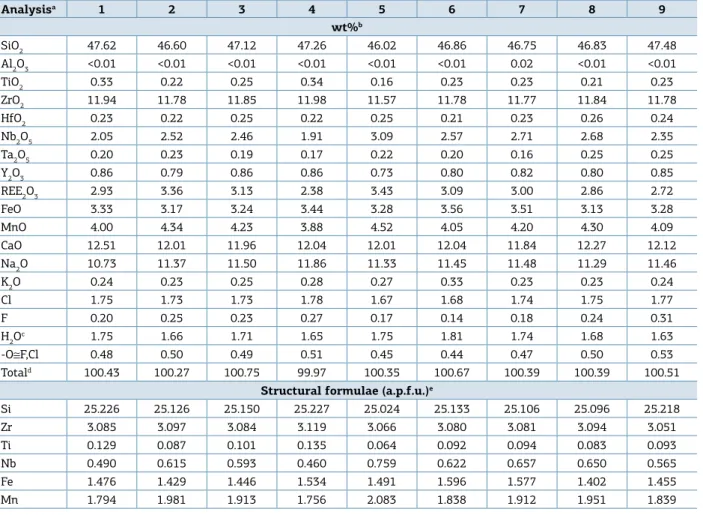
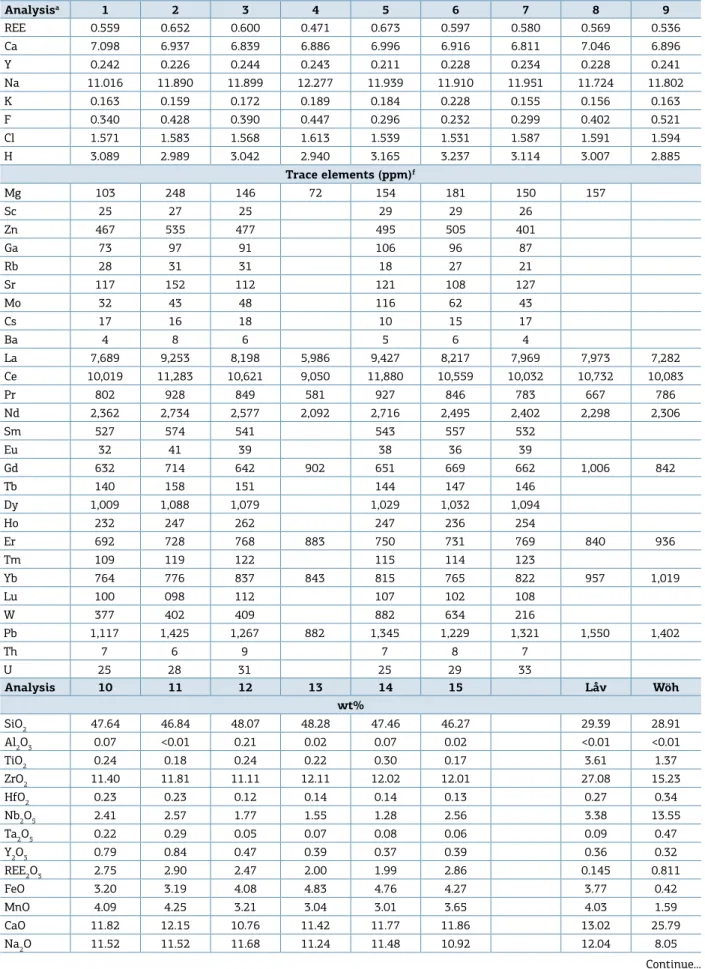
he major and trace element compositions of the EGMs from Monte de Trigo are listed in Table 2. he studied EGMs have
high SiO2 (46.02–48.07 wt%) content with signiicant amounts of ZrO2 (11.11–12.11 wt%), Na2O (10.73–11.86 wt%), and CaO (10.76-12.51 wt%). In addition, they contain nearly equal concentrations of FeO (3.13–4.83 wt%) and MnO (3.01–4.52 wt%). Other major elements include Nb2O5 (1.28–3.09 wt%), REE2O3 (2.00–3.43 wt%), and Cl (1.67–1.85 wt%).
he most signiicant minor and trace element data include TiO2 (0.16–0.34 wt%), HfO2 (0.12–0.26 wt%), Ta2O5 (0.05–0.29 wt%), Y2O3 (0.37–0.86 wt%), PbO (0.09– 0.22 wt%), K2O (0.23–0.50 wt%), F (0.13–0.31 wt%), Mg (60–3582 ppm), Sr (108–2,699 ppm), Zn (401– 852 ppm), and W (216–882 ppm).
Compositions of other accessory phases
Wöhlerite (Na,Ca)8 (Mn,Ca,Fe,Ti)4 (Zr,Nb)4 (Si2O7)4(O,F)8] and låvenite [Na4(Ca,Mn,Fe)8Zr2(Nb,Ti)2(Si2O7)4O4F2(F,O)2], minerals of the cuspidine group (Mellini & Merlino 1979, Mellini 1981, Merlino & Perchiazzi 1988, Chakhmouradian et al. 2008), are the major accessory phases that crystal-lize contemporaneously with EGMs in the studied dyke.
Table 2. Compositions of the EGMs from the Monte de Trigo alkaline suite. Representative analysis of låvenite (Låv) and wöhlerite (Wöh) were also included
Analysisa 1 2 3 4 5 6 7 8 9
wt%b
SiO2 47.62 46.60 47.12 47.26 46.02 46.86 46.75 46.83 47.48
Al2O3 <0.01 <0.01 <0.01 <0.01 <0.01 <0.01 0.02 <0.01 <0.01
TiO2 0.33 0.22 0.25 0.34 0.16 0.23 0.23 0.21 0.23
ZrO2 11.94 11.78 11.85 11.98 11.57 11.78 11.77 11.84 11.78
HfO2 0.23 0.22 0.25 0.22 0.25 0.21 0.23 0.26 0.24
Nb2O5 2.05 2.52 2.46 1.91 3.09 2.57 2.71 2.68 2.35
Ta2O5 0.20 0.23 0.19 0.17 0.22 0.20 0.16 0.25 0.25
Y2O3 0.86 0.79 0.86 0.86 0.73 0.80 0.82 0.80 0.85
REE2O3 2.93 3.36 3.13 2.38 3.43 3.09 3.00 2.86 2.72
FeO 3.33 3.17 3.24 3.44 3.28 3.56 3.51 3.13 3.28
MnO 4.00 4.34 4.23 3.88 4.52 4.05 4.20 4.30 4.09
CaO 12.51 12.01 11.96 12.04 12.01 12.04 11.84 12.27 12.12
Na2O 10.73 11.37 11.50 11.86 11.33 11.45 11.48 11.29 11.46
K2O 0.24 0.23 0.25 0.28 0.27 0.33 0.23 0.23 0.24
Cl 1.75 1.73 1.73 1.78 1.67 1.68 1.74 1.75 1.77
F 0.20 0.25 0.23 0.27 0.17 0.14 0.18 0.24 0.31
H2Oc 1.75 1.66 1.71 1.65 1.75 1.81 1.74 1.68 1.63
-O≅F,Cl 0.48 0.50 0.49 0.51 0.45 0.44 0.47 0.50 0.53
Totald 100.43 100.27 100.75 99.97 100.35 100.67 100.39 100.39 100.51
Structural formulae (a.p.f.u.)e
Si 25.226 25.126 25.150 25.227 25.024 25.133 25.106 25.096 25.218
Zr 3.085 3.097 3.084 3.119 3.066 3.080 3.081 3.094 3.051
Ti 0.129 0.087 0.101 0.135 0.064 0.092 0.094 0.083 0.093
Nb 0.490 0.615 0.593 0.460 0.759 0.622 0.657 0.650 0.565
Fe 1.476 1.429 1.446 1.534 1.491 1.596 1.577 1.402 1.455
Mn 1.794 1.981 1.913 1.756 2.083 1.838 1.912 1.951 1.839
Table 2. Continuation
Analysisa 1 2 3 4 5 6 7 8 9
REE 0.559 0.652 0.600 0.471 0.673 0.597 0.580 0.569 0.536
Ca 7.098 6.937 6.839 6.886 6.996 6.916 6.811 7.046 6.896
Y 0.242 0.226 0.244 0.243 0.211 0.228 0.234 0.228 0.241
Na 11.016 11.890 11.899 12.277 11.939 11.910 11.951 11.724 11.802
K 0.163 0.159 0.172 0.189 0.184 0.228 0.155 0.156 0.163
F 0.340 0.428 0.390 0.447 0.296 0.232 0.299 0.402 0.521
Cl 1.571 1.583 1.568 1.613 1.539 1.531 1.587 1.591 1.594
H 3.089 2.989 3.042 2.940 3.165 3.237 3.114 3.007 2.885
Trace elements (ppm)f
Mg 103 248 146 72 154 181 150 157
Sc 25 27 25 29 29 26
Zn 467 535 477 495 505 401
Ga 73 97 91 106 96 87
Rb 28 31 31 18 27 21
Sr 117 152 112 121 108 127
Mo 32 43 48 116 62 43
Cs 17 16 18 10 15 17
Ba 4 8 6 5 6 4
La 7,689 9,253 8,198 5,986 9,427 8,217 7,969 7,973 7,282
Ce 10,019 11,283 10,621 9,050 11,880 10,559 10,032 10,732 10,083
Pr 802 928 849 581 927 846 783 667 786
Nd 2,362 2,734 2,577 2,092 2,716 2,495 2,402 2,298 2,306
Sm 527 574 541 543 557 532
Eu 32 41 39 38 36 39
Gd 632 714 642 902 651 669 662 1,006 842
Tb 140 158 151 144 147 146
Dy 1,009 1,088 1,079 1,029 1,032 1,094
Ho 232 247 262 247 236 254
Er 692 728 768 883 750 731 769 840 936
Tm 109 119 122 115 114 123
Yb 764 776 837 843 815 765 822 957 1,019
Lu 100 098 112 107 102 108
W 377 402 409 882 634 216
Pb 1,117 1,425 1,267 882 1,345 1,229 1,321 1,550 1,402
Th 7 6 9 7 8 7
U 25 28 31 25 29 33
Analysis 10 11 12 13 14 15 Låv Wöh
wt%
SiO2 47.64 46.84 48.07 48.28 47.46 46.27 29.39 28.91
Al2O3 0.07 <0.01 0.21 0.02 0.07 0.02 <0.01 <0.01
TiO2 0.24 0.18 0.24 0.22 0.30 0.17 3.61 1.37
ZrO2 11.40 11.81 11.11 12.11 12.02 12.01 27.08 15.23
HfO2 0.23 0.23 0.12 0.14 0.14 0.13 0.27 0.34
Nb2O5 2.41 2.57 1.77 1.55 1.28 2.56 3.38 13.55
Ta2O5 0.22 0.29 0.05 0.07 0.08 0.06 0.09 0.47
Y2O3 0.79 0.84 0.47 0.39 0.37 0.39 0.36 0.32
REE2O3 2.75 2.90 2.47 2.00 1.99 2.86 0.145 0.811
FeO 3.20 3.19 4.08 4.83 4.76 4.27 3.77 0.42
MnO 4.09 4.25 3.21 3.04 3.01 3.65 4.03 1.59
CaO 11.82 12.15 10.76 11.42 11.77 11.86 13.02 25.79
Na2O 11.52 11.52 11.68 11.24 11.48 10.92 12.04 8.05
Table 2. Continuation
aThe EGM analyses 1–11 and the wöhlerite are from the dyke center (sample mtr01b); the EGM analyses 12–15 and the låvenite are from the dyke border (sample mtr01a); bmajor element contents (wt.%) were determined by electron probe micro-analyzer (EPMA); cestimated considering Cl+F+OH=5 a.p.f.u; dincludes H
2O and trace elements;
estructural formulae calculated on the basis of 29 cations (Si+Al+Zr+Ti+Hf+Nb+W+Ta), with all Fe and Mn constrained to be divalent; ftrace element (ppm) as well as HfO
2, Ta2O5 and PbO (wt%) were determined by inductively coupled plasma mass spectrometry (ICP-MS), except from analyses 4, 8, 9, 10, 11, and 14, that were only EPMA data are available.
Analysis 10 11 12 13 14 15 Låv Wöh
K2O 0.45 0.25 0.43 0.37 0.50 0.24 <0.01 <0.01
Cl 1.70 1.76 1.75 1.85 1.81 1.80 <0.01 <0.01
F 0.14 0.13 0.15 0.29 0.20 0.18 4.54 3.72
H2Oc 1.82 1.78 1.79 1.64 1.69 1.68
-O≅F,Cl 0.44 0.45 0.46 0.54 0.49 0.48 1.91 1.57
Totald 100.39 100.45 98.87 99.92 99.30 99.58 99.81 99.02
Structural formulae (a.p.f.u.)e
Si 25.306 25.135 25.568 25.401 25.399 25.090
Zr 2.953 3.090 2.881 3.107 3.136 3.175
Ti 0.095 0.073 0.097 0.086 0.120 0.069
Nb 0.579 0.624 0.425 0.369 0.311 0.627
Fe 1.421 1.432 1.814 2.124 2.129 1.937
Mn 1.841 1.930 1.445 1.356 1.366 1.676
REE 0.544 0.574 0.477 0.381 0.394 0.562
Ca 6.728 6.984 6.129 6.434 6.746 6.891
Y 0.222 0.238 0.134 0.108 0.106 0.112
Na 11.858 11.979 12.041 11.463 11.914 11.475
K 0.307 0.169 0.292 0.250 0.339 0.168
F 0.240 0.217 0.252 0.476 0.337 0.309
Cl 1.531 1.599 1.581 1.647 1.640 1.657
H 3.228 3.184 3.167 2.877 3.023 3.034
Trace elements (ppm)
Mg 127 60 1,547 1,179 3,582 1,301 3,819 083
Sc 29 27 25 63 35
Zn 831 732 852 329 27
Ga 76 61 86 <01 23
Rb 121 73 56 <01 <01
Sr 2,161 2,315 2,699 75 12
Mo 41 41 106 18 24
Cs 39 31 27
Ba 3 1 4 <1 <1
La 7,418 7,930 7,967 5,868 5,679 8,993 54 1,018
Ce 10,519 10,912 8,639 7,120 7,539 10,257 120 2,515
Pr 743 803 675 586 675 817 14 304
Nd 2,435 2,452 1,870 1,750 1,938 2,325 56 1,179
Sm 362 343 413 24 304
Eu 27 24 28 3 20
Gd 685 937 402 355 564 427 65 288
Tb 74 64 73 26 64
Dy 465 403 445 251 449
Ho 94 78 94 66 98
Er 944 1,032 234 215 350 238 216 299
Tm 33 34 36 38 47
Yb 755 711 237 226 307 241 294 337
Lu 26 28 27 36 45
W 232 353 576 7 127
Pb 1,439 1,374 1,537 1,644 1,476 2,011 19 52
Th 58 112 130 33 9
Representative analyses of wöhlerite and låvenite are pre-sented in Table 2. hese phases have lower SiO2 and higher ZrO2 contents than EGMs. Wöhlerite has higher Nb2O5 and CaO contents than låvenite does, whereas the latter has high MnO, FeO, and Na2O contents. Both minerals have almost no LILE, but they are enriched to a variable degree in REE. Wöhlerite contains greater amounts of light REE than låvenite does. he LaN/YbN ratios of wöhlerite and låvenite are 2.05 and 0.12, respectively, which are signiicantly lower than the values for EGMs from the dyke center (4.8–8.0), EGMs from the dyke border (12.5–25.0) and the bulk-rock composition (9.9). he Eu/Eu* anomaly is somewhat similar to that observed in the EGMs and bulk-rock analysis. Låvenite also has high contents of Mg (3,819 ppm) and Zn (329 ppm).
DISCUSSION
EGM compositional variation
and molecular components
According to the calculated structural formulae (Table 2), Si contents are suicient to ill 25 tetrahedral positions, whereas the Zr (plus minor content of Hf) and Ca amounts ill the Z
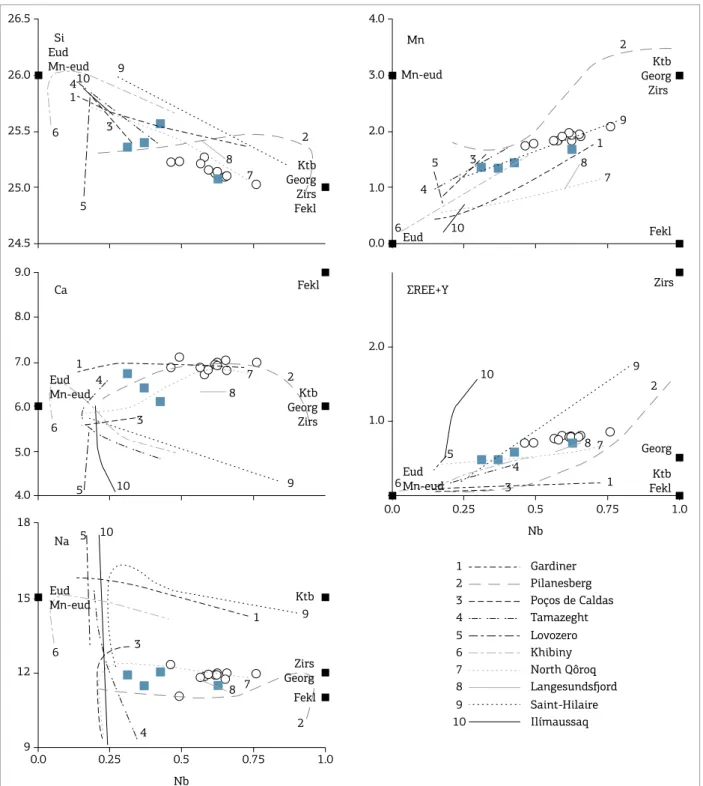
and M(1) positions, respectively. In the X site, Cl prevails over F. he most extensive variation in the EGM composition from Monte de Trigo involves Fe and Mn at the M(2) site and Si and Nb at the M(3,4) site (Fig. 4). Both variations correspond to the solid solution between eudialyte and kent-brooksite components, recognized as the major substitu-tion of the EGMs worldwide by Johnsen et al. (1998) and Johnsen & Grice (1999), although excluding the F and Cl contents. In fact, some analyses present Mn as dominant cation in M(2) site with the X site occupied by Cl, which probably is a mineral still not approved by the International Mineralogical Association. A slight excess of Zr from the Z site could be located with Nb and Si in the M(3,4) site, together with minor to trace contents of Ti, Ta, and W.
Other signiicant major element variations in the EGMs from Monte de Trigo occur at the N(1-5) site. Most of the 15 positions of the N(1-5) sites are illed with Na, which varies from 11.02 to 12.28 apfu. he remaining positions may include other elements, such as REE, Y, Ca, and Mn, probably at the N(4) site (Rastsvetaeva 2007). he sum of the Fe and Mn contents (3.259 to 3.613 apfu) exceeds the three available M(2) positions. his excess suggests that small amounts of the georgbarsanovite component are present in the solid solution, in which Mn is located at the N(4) site (Khomyakov et al. 2005, Rastsvetaeva 2007). Similarly, the Ca content (6.129 to 7.098 apfu) exceeds the required amount to fulill the six positions of the M(1) site (Fig. 4),
with the surplus Ca most likely located at the N(4) site, composing the feklichevite member (Pekov et al. 2001).
he N(4) site also includes REE (0.381 to 0.673 apfu) and Y (0.106 to 0.244 apfu), which indicates the presence of a zirsilite-(Ce) component (Khomyakov et al. 2003). Light REE enrichment is observed in the C1 chondrite-normal-ized REE diagram (Fig. 5A), with LaN/SmN ratios ranging from 9.1 to 13.7 and GdN/LuN ratios ranging from 0.71 to 1.95. A clearly marked negative Eu/Eu* anomaly is present, with values varying from 0.17 to 0.23.
hus, the EGMs from Monte de Trigo are best represented by a complex solid solution involving eudialyte, feklichevite, zirsilite-(Ce), georgbarsanovite, and kentbrooksite components (Fig. 4). Part of the Mn content of the EGMs may be responsible for the formation of minor quantities of the manganoeudialyte member (Nomura et al. 2010) rather than kentbrooksite to com-pensate for the Nb deiciency, assuming all of the Nb-bearing components are present. he EGMs from the dyke border are more enriched in the eudialyte component, whereas the EGMs from the dyke center are more enriched in the feklichevite, zir-silite-(Ce) and kentbrooksite components (Fig. 4).
he trace element contents normalized according to the bulk composition of the host dyke are shown in Figure 5B. he EGMs from the dyke border have signiicantly higher contents of Sr, h, Zn, and Mg and signiicantly lower contents of Hf, Ta, and heavy REE than those from the dyke center. he low K, Rb, and Ba EGM/bulk-rock ratios suggest an incompatible behavior, i.e., they are not incorporated in the EGM structure. hus, the andrianovite component, an EGM similar to kentbrooksite and zirsi-lite-(Ce), but with K located at the N(4) site (Khomyakov et al. 2008), is irrelevant in the composition of the EGMs from Monte de Trigo, despite the high K and Rb contents of the bulk rock (Table 1). his inding suggests that K and Rb prefer other minerals, such as alkali feldspar. he con-tents of Mg, Zn, Ga, Sr, h, and U in EGMs are slightly higher than the ones in the host rock, which suggests that they are neutral to compatible in the EGM struc-ture, whereas Pb is highly compatible, with EGM/bulk-rock ratios near 100, probably because the ionic radius of Pb (Shannon 1976) is similar to the size of the N(4) site (Johnsen & Grice 1999).
Petrologic implications
Figure 4. Plot of Nb vs. Si, Mn, Ca, ∑REEs+Y and Na (apfu) for the EGMs from Monte de Trigo. Blue squares, the
EGMs from the dyke border; open circles, the EGMs from the dyke center; black squares, theoretical end-members of the EGMs. Trend lines of the worldwide EGM compositions are compiled from Coulson & Chambers (1996), Gualda & Vlach (1996), Coulson (1997), Johnsen & Gault (1997), Olivio & Williams-Jones (1999), Johnsen & Grice (1999), Mitchell & Liferovich (2006), Marks et al. (2008), Schilling et al. (2009, 2011b), and Wu et al. (2010). Component abbreviations: eud, eudialyte; Mn-eud, manganoeudialyte; fekl, feklichevite; ktb, kentbrooksite; georg, georgbarsanovite; zirs, zirsilite-(Ce).
26.5 26.0 25.5 24.5 25.0 9.0 8.0 7.0 4.0 6.0 5.0 4.0 3.0 2.0 0.0 1.0 2.0 1.0 0.0 1 2 3 4 5 6 7 8 9 10
0.25 0.5 0.75 1.0
18 15 12 0.0 0.25 Nb Nb
0.5 0.75 1.0
9 Mn-eud Ktb Georg Zirs Fekl 1 410 9 3 6 5 8 7 2 1 4 10 9 3 6 5 8 7 2 1 4 10 9 3 6 5 8 7 2 1 4 10 9 3 6
5 8 7
2 1 4 10 9 3 6 5 8 7 2 Ktb Georg Zirs Ktb Georg Zirs ΣREE+Y Ktb Fekl Gardiner Pilanesberg Poços de Caldas Tamazeght Lovozero Khibiny North Qôroq Saint-Hilaire Ilímaussaq Langesundsjord Si Eud Ca Eud Mn-eud Eud Mn-eud Na Fekl Fekl Ktb Zirs Georg Mn Mn-eud Eud Fekl Zirs Eud Mn-eud Georg
those of the EGMs from Langesundsjord and North Qôroq (Fig. 4) (Bollingberg et al. 1983, Coulson & Chambers 1996, Coulson 1997, Wu et al. 2010).
from Monte de Trigo, as well as those from Langesundsjord and North Qôroq, includes complex Na-Ca-Zr-F silicate minerals, such as wöhlerite and låvenite (Coulson 1997, Enrich et al. 2009, Andersen et al. 2010), which is typical of transitional agpaitic rocks (Sørensen 1997, Andersen et al. 2010, Marks et al. 2011). his assemblage suggests that the miaskitic to agpaitic transition in the Monte de Trigo alkaline suite follows the increasing luorine trend of Andersen et al. (2010). he EGM crystallization along this luorine trend, according to these authors, can occur if chlorine or HCl activity is suiciently high. his seems to be the case for the EGMs from Monte de Trigo, as evi-denced by their relatively high Cl content.
Most of the trace element contents of the EGMs from Monte de Trigo vary within the ranges of EGMs from other localities (Wu et al. 2010, Schilling et al. 2011b), especially the HFSEs and REE. Major diferences of the analyzed EGMs include low-Sr and Ba contents and a negative Eu/ Eu* ratio (Fig. 6). hese diferences are also found in the bulk composition of the EGM-bearing nepheline microsy-enite dyke (Table 1), which suggests that EGMs crystal-lized in an environment where Eu, Sr, and Ba were already depleted. This depletion could be assigned to previous extensive fractionation of plagioclase and/or alkali feldspar (e.g., Blundy & Wood 1991, Bédard 2006, Brotzu et al. 2007, Henderson & Pierozynski 2012, Carvalho & Janasi 2012) from the parental melt, similar to the interpretation by Schilling et al. (2011b) regarding the same features observed in the EGMs from Ilímaussaq and Mont Saint-Hilaire.
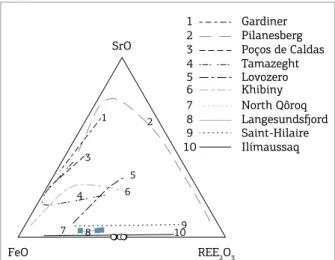
Extensive plagioclase fractionation is usually related to alkaline massifs with a basanite/alkali basalt parental melt, whereas it is absent for nephelinite parental magma (Marks et al. 2011, Schilling et al. 2011a, 2011b). hus, EGMs that are crystallized from agpaitic residual liquids derived from basanite/alkali basalt and nephelinite parental magmas should present Sr-poor and Sr-rich trends, respec-tively. he compositional trends for EGMs from several occurrences are shown in the FeO-SrO-REE2O3 diagram (Fig 7). he FeO-rich corner characterizes the composi-tion of early magmatic EGMs, as indicated by Schilling et al. (2011b). Both REE- and Sr-rich end-members of EGMs are related to late-magmatic and/or post-mag-matic hydrothermal luids, as are, for example, the inal compositions of the EGM trends from the Pilanesberg and Saint-Hilaire complexes (Olivio & Williams-Jones 1999, Mitchell & Liferovich 2006, Grice & Gault 2006, Schilling et al. 2011b). he Sr-poor EGM trends found at Saint-Hilaire and Ilímaussaq reflect their basanite/ alkali basalt parental magma (Larsen & Sørensen 1987, Bailey et al. 2001, Schilling et al. 2011a). Conversely, the Sr-rich EGM trends found at Poços de Caldas, Gardiner, Khibina and Lovozero could be linked to their nephelinite parental magma (Nielsen 1980, Kramm & Kogarko 1994, Sørensen 1997, Ulbrich et al. 2005, Kogarko et al. 2010). he EGMs from Monte de Trigo have relative Fe and REE enrichment that, together with the EGM texture, agrees with its magmatic origin. he Sr-poor EGM trends found in Monte de Trigo relect their basanite/alkali basalt paren-tal magma. A maic dyke with basanite composition has already been described in Monte de Trigo (hompson et al. 1998, Enrich et al. 2009), and it probably represents the parental magma for this alkaline suite. Again, the EGMs from Monte de Trigo are plotted close to the north Qôroq and Langesundsjord EGM data.
Figure 5. (A) C1 chondrite-normalized Ree diagram for EGMs. Chondrite values are from McDonough & Sun (1995); (B) Bulk-rock-normalized multi-element diagram of the EGMs from Monte de Trigo. The bulk-rock values are from the EGM-bearing nepheline microsyenite dyke center sample (Table 1). Blue squares, the EGMs from the dyke border; open circles, the EGMs from the dyke center. The bulk-rock data from the dyke center (blue diamonds), låvenite (open triangle) and wöhlerite (black cross) are also
plotted for comparison. A
B
1000
Sample/C1 Chondrite
Mineral/Whole-rock
10000
100
Ce Nd Sm Gd Dy Er Yb La Pr Eu Tb Ho Tm Lu
Rb Sr Th Ti Ta Ce Nd Eu Tb Ho Tm Lu Mg Ga K Ba Pb U Hf La Pr Sm Gd Dy Er Yb Y Zn 10
10 100
1
Some additional considerations about the compositional diferences between the EGMs from the dyke border in rela-tion to those from the center also could be made. he EGMs from the dyke border have the highest Mg (up to 3,582 ppm) and Zn (up to 852 ppm) contents of the worldwide EGMs (up to 1,000 ppm and 200 ppm for Mg and Zn, respectively; Deer et al. 1986, Gualda & Vlach 1996, Johnsen et al. 1998, Johnsen & Grice 1999, Ridoli et al. 2003, Bulakh & Petrov 2004, Marks et al. 2008, Wu et al. 2010, Schilling et al. 2011b). Such high Mg and Zn contents, associated to relatively high Fe and Sr in these EGMs, could be related to the incorpora-tion and reacincorpora-tion of the melatheralite xenoliths, as these ele-ments are more abundant in the melatheralite (Table 1). he local-scale reaction due to the difusive exchange between the melatheralite and the agpaitic magma at dyke border are sug-gested by the presence of corroded xenoliths (Fig. 1C), large maic aggregates (Fig. 3B) and metasomatic granofels (Fig. 3A), and by the increase in modal maic mineral content, up
to 25% in volume. In addition, låvenite from the dyke bor-der has higher Mg and Zn contents than wöhlerite from the dyke center (Table 2).
Other diference in EGM composition is related to the lower heavy REE contents of the EGMs at the dyke border than at the dyke center (Fig. 5). his seems to be a con-sequence of the crystallization of låvenite rather than of wöhlerite. Our data show that låvenite preferentially incor-porates the heavy REE, whereas wöhlerite incorincor-porates both the light and heavy REE (Fig. 5). he låvenite concomitant crystallization leads to a concurrence in the heavy REE par-titioning between EGMs and låvenite.
CONCLUSIONS
he studied EGMs from Monte de Trigo reveal characteristics of their crystallization environment, i.e., magma composition
Figure 6. Plot of Nb vs. Si, Mn, Ca, ∑REE+Y and Na (apfu) for the EGMs from Monte de Trigo. Trend lines of the
worldwide EGM compositions are compiled from Gualda & Vlach (1996), Johnsen & Gault (1997), Johnsen & Grice (1999), Marks et al. (2008), Schilling et al. (2009, 2011b), and Wu et al. (2010). Blue squares, the EGMs from the dyke border; open circles, the EGMs from the dyke center.
10000
10 1000
100
10000
1000
100
10
1
0.1
3 4 5 6 8 9 10
1000 10000
1
0.1
1000
Nb
Nb
10000 4
10
9 3
6 5
8
4 10
9 3
6 5
8
4
10 9
3
6 5
8
Ba
Poços de Caldas Tamazeght Lovozero Khibiny
Langesundsjord
Saint-Hilaire Ilímaussaq Sr
Almeida F.F.M. 1983. Relações tectônicas das rochas alcalinas mesozóicas da região meridional da plataforma sul-americana. Revista Brasileira de Geociências, 13(3):39-158.
Andersen T., Erambert M., Larsen A.O., Selbekk R.S. 2010. Petrology of nepheline syenite pegmatites in the Oslo Rift, Norway: zirconium silicate mineral assemblages as indicators of alkalinity and volatile fugacity in mildly agpaitic magma. Journal of Petrology, 51(11):2303-2325. DOI: 10.1093/ petrology/egq058
Azzone R.G., Ruberti E., Enrich G.E.R., Gomes C.B. 2009. Geologia e geocronologia do maciço alcalino máico-ultramáico Ponte Nova (SP-MG). Geologia USP Série Cientíica, 9(2):23-46. DOI: http://dx.doi. org/10.5327/z1519-874x2009000200002
Bailey J.C., Gwozdz R., Rose-Hansen J., Sørensen H. 2001. Geochemical overview of the Ilímaussaq alkaline complex, South Greenland. Geology of Greenland Survey Bulletin,190(100):35-53.
Bastin G.F., Van Loo F.J.J., Heijligers H.J.M. 1984. Evaluation and use of gaussian Ф (ρz) curves in quantitative electron probe microanalysis: a new optimization. X-Ray Spectrometry, 13(2):91-97.
Bédard J.H. 2006. Trace element partitioning in plagioclase feldspar. Geochimica et Cosmochimica Acta, 70(14):3717-3742. DOI: 10.1016/j.gca.2006.05.003
Blundy J.D. & Wood B.J. 1991. Crystal-chemical controls on the partitioning of Sr and Ba between plagioclase feldspar, silicate melts, and hydrothermal solutions. Geochimica et Cosmochimica Acta, 55(1):193-209. DOI: 10.1016/0016-7037(91)90411-W
REFERENCES
Bollingberg H.J., Ure A.M., Sørensen I., Leonardsen E.S. 1983. Geochemistry of some eudialyte-eucolite troimens and a co-existing catapleiite from Langesund, Norway. Tschermaks Mineralogische und Petrographische Mitteilungen, 32:153-169.
Brotzu P., Barbieri M., Beccaluva L., Garbarino C., Gomes C.B., Macciotta G., Melluso L., Morbidelli L., Ruberti E., Sígolo J.B., Traversa G. 1992. Petrology and geochemistry of the Passa Quatro alkaline complex, Southeastern Brazil. Journal of South American Earth Science, 6(4):237-252. DOI: 10.1016/0895-9811(92)90044-Y
Brotzu P., Gomes C.B., Melluso L., Morbidelli L., Morra V., Ruberti E. 1997. Petrogenesis of coexisting SiO2-undersaturated to SiO2-oversaturated felsic igneous rocks: The alkaline complex of Itatiaia, southeastern Brazil. Lithos, 40(2-4):133-156. DOI: 10.1016/S0024-4937(97)00007-8
Brotzu P., Melluso L., Bennio L., Gomes C.B., Lustrino M., Morbidelli L., Morra V., Ruberti E., Tassinari C., D’Antonio M. 2007. Petrogenesis of the Early Cenozoic potassic alkaline complex of Morro de São João, southeastern Brazil. Journal of South American Earth Science,
24(1):93-115. DOI: 10.1016/j.jsames.2007.02.006
Brotzu P., Melluso L., D’Amelio F., Lustrino M. 2005. Potassic dykes and intru sions of the Serra do Mar Igneous Province (SE Brazil) In: Comin-Chia ramonti P. & Gomes C.B. (eds.) Mesozoic to Cenozoic alkaline magmatism in the Brazilian Platform. São Paulo, Edusp/ FAPESP, p. 443-472.
Bulakh A.G. & Petrov T.G. 2004. Chemical variability of eudialyte-group minerals and their sorting. Neues Jahrbuch für Mineralogie Monatshete,
2004:127-144. DOI: 10.1127/0028-3649/2004/2004-0127
and concomitant crystallizing phases. he EGMs are charac-terized by moderate variations in Fe and Mn at the M(2) site
and Si and Nb at the M(3,4) site, which are recognized as the major substitution of EGMs worldwide. he relatively Na-poor, Ca-rich EGM compositions seem to be related to the Monte de Trigo transitional agpaitic rocks association, which con-tain wöhlerite and låvenite, and thus follow an agpaitic luo-rine-rich trend. he low-Ba, Sr, and Eu contents are related to previous plagioclase fractionation during magmatic evolution and support the interpretation of a basanite parental magma for the suite. he incorporation and reaction of melatheralite xenoliths into the agpaitic magma could lead to higher Fe, Sr, Mg, and Zn contents in the EGMs found near the dyke bor-der. Finally, the relative depletion of heavy REE in the EGMs from the dyke border seems to be related to the presence of låvenite, which strongly partitions heavy REE.
ACKNOWLEDGMENTS
he authors are grateful to Research Support Foundation of the State of Sao Paulo (FAPESP) (GERE, Processes 00/12576-4 and 2010/20476-1; CBG, Process 2013/18073-4; ER, Process 2012/06082-6) for inancial support. he authors also thank Sandra Andrade and Marcos Mansueto for their assistance during the analytical work. Contributions by anonymous reviewers have signiicantly improved the manuscript.
Figure 7. Ternary plot of FeO-SrO-REE2O3 for the EGMs
from Monte de Trigo. Trend lines of the worldwide EGM compositions are compiled from Coulson & Chambers (1996), Gualda & Vlach (1996), Coulson (1997), Johnsen & Gault (1997), Olivio & Williams-Jones (1999), Johnsen & Grice (1999), Mitchell & Liferovich (2006), Marks et al. (2008), Schilling et al. (2009, 2011b), and Wu et al. (2010). Blue squares, the EGMs from the dyke border; open circles, the EGMs from the dyke center.
FeO
SrO
1 2
3
4
5 6
7 8 109
REE2O3 1 2 3 4 5 6 7 8 9 10
Gardiner Pilanesberg Poços de Caldas Tamazeght Lovozero Khibiny North Qôroq
Saint-Hilaire Ilímaussaq
Carbonin S., Liziero F., Fuso C. 2005. Mineral chemistry of accessory minerals in alkaline complexes from the Alto Paraguay Province In: Comin-Chiaramonti P. & Gomes C.B. (eds.) Mesozoic to Cenozoic alkaline magmatism in the Brazilian Platform. São Paulo, Edusp/ FAPESP, p. 149-158.
Carvalho B.B. & Janasi V.A. 2012. Crystallization conditions and controls on trace element residence in the main minerals from the Pedra Branca syenite, Brazil: an electron microprobe and LA-ICPMS study. Lithos, 153(6):208-223.
Chakhmouradian A.R., Mitchell R.H., Burns P.C., Mikhailova Y., Reguir E.P. 2008. Marianoite, a new member of the cuspidine group from the Prairie Lake silicocarbonatite, Ontario. The Canadian Mineralogist,
46(4):1023-1032. DOI: 10.3749/canmin.46.4.1023
Chukanov N.V., Rastsvetaeva R.K., Rozenberg K.A., Aksenov S.M., Pekov I.V., Belakovskiy D.I., Kristiansen R. 2015. Ilyukhinite, IMA 2015-065. CNMNC Newsletter No. 28, December 2015, page 1860; Mineralogical Magazine, 79(6):1859-1864. DOI: 10.1180/minmag.2015.079.7.18
Comin-Chiaramonti P. & Gomes C.B. 2005. Mesozoic to Cenozoic alkaline magmatism in the Brazilian Platform. São Paulo, Edusp/ FAPESP, 752 p.
Coulson I.A. 1997. Post-magmatic alteration in eudialyte from the North Qôroq centre, South Greenland. Mineralogical Magazine,
61:99-109. DOI: 10.1180/minmag.1997.061.404.10
Coulson I.A. & Chambers A.D. 1996. Patterns of zonation in rare-earth-bearing minerals in nepheline syenites of the North Qôroq center, South Greenland. The Canadian Mineralogist,34:1163-1178.
Deer W.A., Howie R.A., Zussman J. 1986. Rock-forming minerals, volume 1B: Disilicates and Ring Silicates. Oxford, The Geological Society Publishing House, 629 p.
Enrich G.E.R., Azzone R.G., Ruberti E., Gomes C.B., Comin-Chiaramonti P. 2005. Itatiaia, Passa Quatro and São Sebastião Island, the major alkaline syenitic complexes from the Serra do Mar region In: Comin-Chiaramonti P. & Gomes C.B. (eds.) Mesozoic to Cenozoic alkaline magmatism in the Brazilian Platform. São Paulo, Edusp/FAPESP, p. 419-442.
Enrich G.E.R., Ruberti E., Gomes C.B. 2009. Geology and geochronology of Monte de Trigo Island alkaline suite, southeastern Brazil. Revista Brasileira de Geociências, 39(1):67-80.
Gomes C.B., Laurenzi M.A., Censi P., De Min A., Velázquez V.F., Comin-Chiaramonti P. 1996. Alkaline magmatism from northern Paraguay (Alto Paraguay): a Permo-Triassic province In: Comin-Chiaramonti P. & Gomes C.B. (eds.) Alkaline Magmatism in Central-Eastern Paraguay. Relationships with Coeval Magmatism in Brazil. São Paulo, Edusp/Fapesp, p. 223-230.
Grice J.D., Gault R.A. 2006. Johnsenite-(Ce): a new member of the eudialyte group from Mont Saint-Hilaire, Quebec, Canada. The Canadian Mineralogist, 44(1):105-115. DOI: 10.2113/ gscanmin.44.1.105
Gualda G.A.R. & Vlach S.R.F. 1996. Eudialita-eucolita do maciço alcalino de Poços de Caldas, MG-SP: quimismo e correlação com o comportamento ótico. In: 39º Congresso Brasileiro de Geologia, Anais, v. 3, p. 34-36.
Henderson C.M.B. & Pierozynski W.J. 2012. An experimental study of Sr, Ba and Rb partitioning between alkali feldspar and silicate liquid in the system nepheline–kalsilite–quartz at 0.1 GPa P(H2O): a revisitation and reassessment. Mineralogical Magazine, 76 (1):157-190. DOI: 10.1180/minmag.2012.076.1.157
Johnsen O. & Gault R.A. 1997. Chemical variation in eudialyte. Neues Jahrbuch für Mineralogie-Abhandlungen, 171:215-237.
Johnsen O. & Grice J.D. 1999. The crystal chemistry of the eudialyte group. The Canadian Mineralogist,37:865-891.
Johnsen O., Ferraris G., Gault R.A., Grice J.D., Kampf A.R., Pekov I.V. 2003. The nomenclature of eudialyte-group minerals. The Canadian Mineralogist,41:785-794. DOI: 10.2113/gscanmin.41.3.785
Johnsen O., Grice J.D., Gault R.A. 1998. Kentbrooksite from the Kangerdlugssuaq intrusion, East Greenland, a new Mn-REE-Nb-F end-member in a series within the eudialyte group: description and crystal structure. European Journal of Mineralogy, 10(2):207-219. DOI: 10.1127/ejm/10/2/0207
Johnsen O., Grice J.D., Gault R.A. 2001. The eudialyte group: a review. Geology of Greenland Survey Bulletin, 190:65-72.
Khomyakov A.P. 1995. Mineralogy of hiperagpaitic rocks. Oxford, Oxford Scientiic Publications, Clarendon Press, 223 p.
Khomyakov A.P., Dusmatov V.D., Ferraris G., Gula A., Ivaldi G., Nechelyustov G.N. 2003. Zirsilite-(Ce), (Na,☐) 12-(Ce,Na)3Ca6Mn3Zr3Nb(Si25O73)(OH)3(CO3)·H2O, and carbokentbrooksite (Na,☐)12(Na,Ce)3Ca6Mn3Zr3Nb(Si25O73)(OH)3(CO3)·H2O: two new eudialyte-group minerals from the Dara-i-Pioz alkaline massif, Tajikistan. Zapiski Vserossijskogo Mineralogicheskogo Obshchestva,132:40-51.
Khomyakov A.P., Nechelyustov G.N., Ekimenkova I.A., Rastsvetaeva R.K. 2005. Georgbarsanovite, Na12(Mn,Sr,REE)3Ca6Fe2+
3Zr3NbSi25O76Cl2·H2O a mineral species of the eudialyte group: revalidation of barsanovite and the new name of the mineral. Zapiski Rossiiskogo Mineralogicheskogo Obshchetstva,134:47-57.
Khomyakov A.P., Nechelyustov G.N., Rastsvetaeva R.K., Rozenberg K.A. 2008. Andrianovite, Na12(K,Sr,Ce)3Ca6Mn3Zr3Nb(Si25O73)(O,H2O,OH)5, a new potassium-rich mineral species of the eudialyte group from the Khibiny alkaline Pluton, Kola Peninsula, Russia. Geology of Ore Deposits, 50(8):705-712. DOI: 10.1134/S1075701508080060
Kogarko L.N., Lahaye Y., Brey G.P. 2010. Plume-related mantle source of super-large rare metal deposits from the Lovozero and Khibina massifs on the Kola Peninsula, Eastern part of Baltic Shield: Sr, Nd and Hf isotope systematics. Mineralogy and Petrology, 98(1):197-208. DOI: 10.1007/s00710-009-0066-1
Kramm U. & Kogarko L.N. 1994. Nd and Sr isotope signatures of the Khibina and Lovozero agpaitic centres, Kola Alkaline Province, Russia. Lithos, 32(3):225-242. DOI: 10.1016/0024-4937(94)90041-8
Larsen L.M. & Sørensen H. 1987. The Ilímaussaq intrusion-progressive crystallization and formation of layering in an agpaitic magma In: Fitton J.G. & Upton B.G.J. (eds.) Alkaline Igneous Rocks. Geological Society Special Publications, 30, London, Geological Society of London, p. 473-488.
Le Maitre R.W. (Ed.) 2002. Igneous rocks: a classiication of igneous rocks and glossary of terms. Cambridge, Cambridge University Press, 236 p.
Marks M.A.W., Hettmann K., Schilling J., Frost B.R., Markl G. 2011. The mineralogical diversity of alkaline igneous rocks: critical factors for the transition from miaskitic to agpaitic phase assemblages. Journal of Petrology, 52(3):439-455. DOI: 10.1093/petrology/egq086
Marks M.A.W., Schilling J., Coulson I.M., Wenzel T., Markl G. 2008. The Alkaline-Peralkaline Tamazeght Complex, High Atlas Mountains, Morocco: mineral chemistry and petrological constraints for derivation from a compositionally heterogeneous mantle source. Journal of Petrology, 49(6):1097-1131. DOI: 10.1093/petrology/egn019
McDonough W. & Sun S.S. 1995. The composition of the Earth. Chemical Geology, 120(3-4):223-253. DOI: 10.1016/0009-2541(94)00140-4
Mellini M. 1981. Reinement of the crystal structure of låvenite. Tschermaks Mineralogische und Petrographische Mitteilungen,
28:99-112. DOI: 10.1007/BF01081548
Merlino S. & Perchiazzi N. 1988. Modular mineralogy in the cuspidine group of minerals. The Canadian Mineralogist,26(4):933-943.
Mitchell R. & Liferovich R. 2006. Subsolidus deuteric/hydrothermal alteration of eudialyte in lujavrite from the Pilansberg alkaline complex, South Africa. Lithos, 91(1-4):352-372. DOI: 10.1016/j. lithos.2006.03.025
Mitchell R.H. & Chakrabarty A. 2012. Paragenesis and decomposition assemblage of a Mn-rich eudialyte from the Sushina peralkaline nepheline syenite gneiss, Paschim Banga, India. Lithos, 152 :218-226. DOI: 10.1016/j.lithos.2012.02.003
Morbidelli L., Gomes C.B., Beccaluva L., Brotzu P., Conte A.M., Ruberti E., Traversa G. 1995. Mineralogical, petrological and geochemical aspects of alkaline and alkaline-carbonatite associations from Brazil. Earth-Science Reviews, 39(3):135-168. DOI: 10.1016/0012-8252(95)00031-3
Mori P.E., Reeves S., Correia C.T., Haukka M. 1999. Development of a fused glass disc XRF facility and comparison with the pressed powder pellet technique at Instituto de Geociências, São Paulo University. Revista Brasileira de Geociências, 29:441-446.
Navarro M.S., Andrade S., Ulbrich H.H.G.J., Gomes C.B., Girardi V.A.V. 2008. The direct determination of rare earth elements in basaltic and related rocks using ICP-MS: testing the eiciency of microwave oven sample decomposition procedures. Geostandards and Geoanalytical Research, 32(2):167-180. DOI: 10.1111/j.1751-908X.2008.00840.x
Nielsen T.F.D. 1980. The petrology of a melilitolite, melteigite, carbonatite and syenite ring dike system, in the Gardiner complex, East Greenland. Lithos, 13(2):181-197. DOI: 10.1016/0024-4937(80)90019-5
Nomura S.F., Atêncio D., Chukanov N.V., Rastsvetaeva R.K., Coutinho J.M.V., Karipidis T.K. 2010. Manganoeudialyte: a new mineral from Poços de Caldas, Minas Gerais, Brazil. Zapiski Rossiiskogo Mineralogicheskogo Obshchestva, 38:35-47.
Olivio G.R. & Williams-Jones A.E. 1999. Hydrothermal REE-rich eudialyte from the Pilanesberg Complex, South Africa. The Canadian Mineralogist,37(3):653-663.
Peate D.W. 1997. The Paraná-Etendeka Province In: Mahoney J.J. & Coin M.F. (eds.) Large Igneous Provinces. Geophysical Monograph 100. Washington, American Geophysical Union, p. 217-245.
Pekov I.V., Ekimenkova I.A., Chukanov N.V., Rastsvetaeva R.K., Kononkova N.N., Pekova N.A., Zadov A.E. 2001. Feklichevite Na11Ca9(Fe3+,Fe2+)
2Zr3Nb[Si25O73](OH,H2O,Cl,O)5, a new mineral of the eudialyte group from Kovdor Massif, Kola peninsula. Zapiski Vserossijskogo Mineralogicheskogo Obshchestva, 130:55-65.
Rastsvetaeva R.K. 2007. Structural mineralogy of the eudialyte group: a review. Crystallography Reports, 52(1):47-64. DOI: 10.1134/ S1063774507010063
Rastsvetaeva R.K. & Chukanov N.V. 2012. Classiication of eudialyte-group minerals. Geology of Ore Deposits, 54(7):487-497. DOI: 10.1134/S1075701512070069
Riccomini C., Velázquez V.F., Gomes C.B. 2005. Tectonic controls of the Mesozoic and Cenozoic alkaline magmatism in Central-Southeastern Brazilian Platform In: Comin-Chiaramonti P. & Gomes C.B. (eds.) Mesozoic to Cenozoic alkaline magmatism in the Brazilian Platform. São Paulo, Edusp/FAPESP, p. 31-55.
Ridoli F., Renzulli A., Macdonald R., Upton B.G.J. 2006. Peralkaline syenite autoliths from Kilombe volcano, Kenya Rit Valley: evidence for subvolcanic interaction with carbonatitic luids. Lithos, 91 (1-4):373-392. DOI: 10.1016/j.lithos.2006.03.026
Ridoli F., Renzulli A., Santi P., Upton B.G.J. 2003. Evolutionary stages of crystallization of weakly peralkaline syenites: evidence from ejecta in the plinian deposits of Agua de Pau volcano (São Miguel, Azores Islands). Mineralogical Magazine, 67(4):749-767. DOI: 10.1180/0026461036740131
Schilling J., Marks M., Wenzel T., Markl G. 2009. Reconstruction of magmatic to subsolidus processes in an agpaitic system using eudialyte textures and composition: a case study from Tamazeght, Morocco. The Canadian Mineralogist,47(2):351-365. DOI: 10.3749/ canmin.47.2.351
Schilling J., Marks M.A.W., Wenzel T., Vennemann T., Horváth L., Tarassof P., Jacob D.E., Markl G. 2011a. The magmatic to hydrothermal evolution of the intrusive Mont Saint-Hilaire Complex: insights into the late-stage evolution of peralkaline rocks. Journal of Petrology, 52(11):2147-2185. DOI: 10.1093/petrology/egr042
Schilling J., Wu F.-Y., McCammon C., Wenzel T., Marks M.A.W., Pfaf K., Jacob D.E., Markl G. 2011b. The compositional variability of eudialyte-group minerals. Mineralogical Magazine, 75(1):87-115. DOI: 10.1180/minmag.2011.075.1.87
Shannon R.D. 1976. Revised efective ionic radii and systematic studies of interatomic distances in halides and chalcogenides. Acta Crystallographica Section A, 32:751-767. DOI: 10.1107/ S0567739476001551
Sørensen H. 1997. The agpaitic rocks, an overview. Mineralogical Magazine, 61(4):485-498.
Stromeyer F. 1819. Summary of meeting 16 December 1819. Göttingische gelehrte Anzeigen, 3:1993-2000.
Thompson R.N., Gibson S.A., Mitchell J.G., Dickin A.P., Leonardos O.H., Brod J.A., Greenwood J.C. 1998. Migrating Cretaceous-Eocene magmatism in the Serra do Mar Alkaline Province, SE Brasil: melts from the delected Trindade Mantle Plume? Journal of Petrology,
39(8):1493-1526. DOI: 10.1093/petroj/39.8.1493
Ulbrich H.H.G.J. & Ulbrich M.N.C. 2000. The lujavrite and khibinite bodies in the Poços de Caldas alkaline massif, southeastern Brazil: a structural and petrographic study. Revista Brasileira de Geociências,
30(4):615-622.
Ulbrich H.H.G.J., Demaife D., Vlach S.R.F., Ulbrich M.N.C. 2005. Structure and origin of the Poços de Caldas alkaline massif, SE Brazil In: Comin-Chiaramonti P. & Gomes C.B. (eds.) Mesozoic to Cenozoic alkaline magmatism in the Brazilian Platform. São Paulo, Edusp/ FAPESP, p. 367-418.
Van Achterbergh E., Ryan C.G., Jackson S.E., Griin W.L. 2001. Data reduction sotware for LA-ICP-MS: appendix In: Silvester P.J. (ed.) Laser Ablation-ICP-Mass spectrometry in the Earth sciences: principles and applications. Mineralogical Association of Canada Short Course Series 29, Ottawa, Mineralogical Association of Canada, p. 239-243.
Williams C.T. 1996. Analysis of rare earth minerals In: Jones A.P., Wall F., Williams C.T. (eds.) Rare earth minerals: chemistry, origin and ore deposits. Mineralogical Society Series 7, London, Chapman & Hall, p. 327-348.
Wu F.-Y., Yang Y.-H., Marks M.A.W., Liu Z.-C., Zhou Q., Ge W.-C., Yang J.-S., Zhao Z.-S., Mitchell R.H., Markl G. 2010. In situ U-Pb, Nd and Hf isotopic analysis of eudialyte by LA-(MC)-ICP-MS. Chemical Geology, 273(1-2):8-34. DOI: http://dx.doi.org/10.1016/j. chemgeo.2010.02.007