Simple Analytical Expression for Vector Hypernuclear Asymmetry
in Nonmesonic Decay of
5ΛHe and
12ΛC
C´esar Barbero,
Departamento de F´ısica, Facultad de Ciencias Exactas, Universidad Nacional de La Plata, C.C. 67, 1900 La Plata, Argentina.
Francisco Krmpoti´c,
Instituto de F´ısica, Universidade de S˜ao Paulo, C. P. 66318, 05315-970 S˜ao Paulo, SP, Brazil,
Instituto de F´ısica La Plata, CONICET, 1900 La Plata, Argentina.
and Alfredo P. Gale˜ao
Instituto de F´ısica Te´orica, Universidade Estadual Paulista, Rua Pamplona 145, 01405-900 S˜ao Paulo, SP, Brazil.
Received on 18 March, 2006
We present general explicit expressions for a shell-model calculation of the vector hypernuclear parameter in nonmesonic weak decay. We use a widely accepted effective coupling Hamiltonian involving the exchange of the complete pseudoscalar and vector meson octets (π,η,K,ρ,ω,K∗). In contrast to the approximated formula widely used in the literature, we correctly treat the contribution of transitions originated from single-proton states beyond thes-shell. Exact and simple analytical expressions are obtained for the particular cases of5ΛHe and12ΛC, within the one-pion-exchange model. Numerical computations of the asymmetry parameter,aΛ, are presented. Our results show a qualitative agreement with other theoretical estimates but also a contradiction with recent experimental determinations. Our simple analytical formulas provide a guide in searching the origin of such discrepancies, and they will be useful for helping to solve the hypernuclear weak decay puzzle.
Keywords: Hypernuclear decay; Asymmetry parameter; One-meson-exchange model
The free decay of a Λhyperon occurs almost exclusively through the mesonic mode, Λ→πN, emerging the nucleon with a momentum of about 100 MeV/c. Inside the nuclear medium (pF∼270 MeV/c) this mode is Pauli blocked and,
for all but the lightestΛhypernuclei (A≥5), the weak decay is dominated by the nonmesonic channel, ΛN→NN, with enough kinetic energy to put the two emitted nucleons above the Fermi surface. The nonmesonic hypernuclear weak de-cay (NMHWD) offers us a very unique opportunity to investi-gate strangeness-changing weak interaction between hadrons. Assuming that the NMHWD is saturated by theΛN→NN mode, the transitions receive contributions either from neu-trons (Λn→nn) and protons (Λp→np), with rates Γnand
Γp, respectively (ΓNM =Γn+Γp, Γn/p=Γn/Γp). Over the
last three decades amount of theoretical and experimental ef-fort has been invested in solving an interesting puzzle: the theoretical models cannot reproduce simultaneously the ex-perimental values ofΓn/pandaΛ.
From the experimental side there is actually an intense ac-tivity, as can be seen in the light of the experiments under way and/or planned at (KEK) [1], (FINUDA) [2] and Brookhaven National Laboratory (BNL) [3]. The preliminary results give a Γn/pratio value very close to 0.5 [4–6] and the measurements
ofaΛfavor a negative value for12ΛCand a positive value for
5
ΛHe [5–9]. On the other hand, from the pioneering work of
Block and Dalitz [10] there have been many theoretical at-tempts dedicated to solving the puzzle. The earlier studies were based on the simplest model of the virtual pion exchange
[11]. This model naturally explains the long range part of the two body interaction, and it reproduces reasonably well the to-tal decay rate but fails badly in reproducing the other observ-ables. In order to achieve a better description, some improve-ments have been introduced: (i) models that include the ex-change of different combinations of other heavier mesons, like η,K,ρ,ωandK∗[12]–[19], to reproduce the short range part of the interaction ; (ii) analysis of the two nucleon (2N) stim-ulated processΛNN→NNN[20, 21]; (iii) inclusion of inter-action terms that violate the isospin∆T =1/2 rule [22]–[24]; (iv) description of the short range baryon-baryon interaction in terms of quark degrees of freedom [25, 26]; (v) correlated (in the form ofσandρ mesons) and uncorrelated two-pion exchanges [27]–[31]. We emphasize that none of these mod-els give a fully satisfactory description of all the NMHWD observables simultaneously, even though a consistent (though not sufficient) increase ofΓn/phas been found.
All such models reproduce quite well Γnm, but seem to
strongly underestimate the experimentaln/pbranching ratio, Γn/Γp. Besides, the measurements favor a negative value of
aΛfor 12ΛC and a positive one for5ΛHe, meanwhile all
exist-ing calculations based on strict one-meson-exchange (OME) models [14–16, 18, 19, 26, 32, 33] find values between−0.73 and−0.19 for5ΛHe[34, 35] and, when results are available in the same model, very similar values for12ΛC.
º
º
¾
½
½
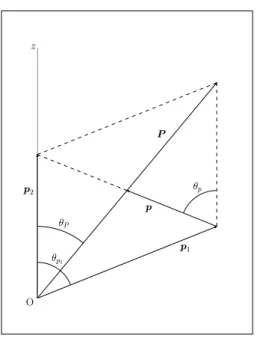
FIG. 1: Coordinate system for the calculation of decay strengths.
in the asymmetry puzzle presented above concerns the com-parison of its values for 5ΛHe and 12ΛC, it would be of great interest to have an expression that is applicable to both cases. Besides, simple formulas containing kinematical factors and nuclear matrix elements separately, will provide a manage-able and useful tool. They will be a guide in searching the
origin of discrepancies between theoretical calculations and experimental data.
Thus, we present in this paper a general formalism for the vector asymmetry parameter in nonmesonic decay and derive exact and simple analytical expressions, within the simplest one-pion exchange model (OPEM), for the particular cases of 5
ΛHe and12ΛC hypernuclei.
Single-Λhypernuclei produced in a(π+,K+)reaction end up with considerable vector polarization along the direction normal to the reaction plane, ˆn= (pπ+×pK+)/|pπ+×pK+|. The angular distribution of protons emitted inΛp→npdecay is given by [34]
dΓ(JIMI→pˆ2tp)
dΩp2
=Γp
4π (1+PVAVpˆ2·nˆ), (1) whereΓpis the full proton-induced decay rate, and
AV=3
JI
JI+1
σ1(JI)
σ0(JI)
, (2)
is thevector hypernuclear asymmetry, with σ0(JI) =
∑
MI
σ(JIMI),
σ1(JI) =
1
JI(JI+1)
∑
MIMIσ(JIMI), (3)
being
σ(JIMI) =
dΩp1
dF
∑
s1s2MF
|p1s1tnp2s2tpJFMF|V|JIMIA|2. (4)
HereV is the OME potential involving the complete pseudoscalar and vector meson octets (π,η,K,ρ,ω,K∗) which has been extensively discussed in Refs. [17, 18],p1s1(p2s2) are the momenta and spin projections of the emitted neutron (proton) and
dF. . . = 2π
∑
JF
p2
2d p2 (2π)3
p2
1d p1 (2π)3 δ
p21 2M+
p22 2M+
|p1+p2|2
2MF −
∆JF
. . . , (5)
with M and MFbeing the nucleon and residual nucleus masses and∆JF the liberated energy.
We assume the hyperon to stay in thejΛ=1s1/2 single-particle state, and the initial hypernuclear state is built as|JI ≡
|(jΛJC)JI, where|JCis theA−1Zground state. Thus, the intrinsic asymmetry parameter is defined as
aΛ =
A
V for JI=JC+1/2,
−JI+1
JI AV for JI=JC−1/2.
(6)
Rewriting the transition amplitude in (4) in the total spin(S,MS)and isospin(T,MT)basis we get
σ(JIMI) =
dΩp1
dF
∑
SMSMF
∑
T
(−)TpPSM
ST JFMF|V|JIMIA
2
, (7)
wherep=1
2(p2−p1),P =p1+p2and
pPSMST JFMF|V|JIMIA (8)
= √1 2
For the integration in (7) we take thez-axis as indicated in Fig. 1 and choosep2,θp1 andφp1 as independent variables. Thus,
expanding the final state in terms of relative and center-of-mass partial waves of the emitted nucleons [17], after integration on φp1 and recoupling of angular momentum, we get
σ(JIMI) =
1 2(4π)
4 dcosθ
p1
dF
∑
ST T′
(−)T+T′
×
∑
lLλJ
∑
l′L′λ′J′
i−l′−L′−l−L(−)λ+S+J+J′+JI+JF lˆlˆ′LˆLˆ′ˆλλˆ′JˆJˆ′
×
∑
kKκ
ˆ
κJˆI(JIMIκ0|JIMI)(l0l′0|k0)(L0L′0|K0) [Yk(θp,π)⊗YK(θP,0)]κ0
×
JI κ JI
J JF J′
κ J′ J S λ λ′
l l′ k L L′ K λ λ′ κ
× (plPLλSJT JF;JI|V|JI)(pl′PL′λ′SJ′T′JF;JI|V|JI)∗. (9)
where(plPLλSJT JF;JI|V|JI) =√1
2
1−(−)l+S+T plPLλSJT J
F;JI|V|JI.
From [17] we have
plPLλSJT JF;JI|V|JI
= (−)JF+J−JIJˆ−1
I
∑
jpJI||
a†j
Λa
†
jp
J||JF
M
(plPLλSJT;jΛjp), (10)where
M
(plPLλSJT;jΛjp) = √12
1−(−)l+S+T(plPLλSJT|V|jΛjpJ). (11)
The two-particle spectroscopic amplitudes are cast as [17]
JI||
a†j
Λa
†
jp
J||JF = (−)
J+JI+JFJˆJˆ
I
JC JI jΛ
J jp JF
JC||a†jp||JF. (12)
To continue, we will adopt the extreme shell model and re-strict our attention to cases where the single-proton states are completely filled in|JC. This is so, for the cores of both5ΛHe
(JI=1/2,JC=0), and12ΛC(JI=1,JC=3/2)[36].
In such cases, the final nuclear states take the form|JF ≡
|(j−1
p JC)JF. This leads to
JC||a†jp||JF= (−)
JF+JC+jpJˆ
F. (13)
Putting all this together and performing the summation onJF,
we obtain
σκ(JI) =
4 πJˆ
3
Iκˆ−1
∑
jp
dcosθp1
dFjp
∑
ST T′ (−)T+T′
×
∑
lLλJ
∑
l′L′λ′J′
i−l′−L′−l−L(−)λ+S+JI+JC−jp+κlˆlˆ′LˆLˆ′ˆλλˆ′Jˆ2Jˆ′2
×
∑
kK
(l0l′0|k0)(L0L′0|K0) [Yk(θp,π)⊗YK(θP,0)]κ0
×
jΛ JI JC
JI jΛ κ
κ jΛ jΛ
jp J J′
κ J′ J S λ λ′
l l′ k L L′ K λ λ′ κ
where
dFjp. . . =
p22d p2
p21d p1δ
p2
1 2M+
p22 2M+
|p1+p2|2
2MF −
∆jp
. . . . (15)
The intrinsic asymmetry parameter can finally be written as [31]
aΛ=ω1
ω0
, (16)
where
ωκ = (−)κ√8
2πκˆ −1
∑
jp
dcosθp1
dFjpYκ0(θp,0)
×
∑
T T′
(−)T+T′
∑
LS
∑
lλJ∑
l′λ′J′
il−l′(−)λ+λ′+S+L+jp+12
× lˆlˆ′ˆλλˆ′Jˆ2Jˆ′2(l0l′0|κ0)
×
κ 1/2 1/2 jp J J′
κ J′ J S λ λ′
l′ l κ λ λ′ L
×
M
(plPLλSJT;jΛjp)M
∗(pl′PLλ′SJ′T′;jΛjp),(17)withL=0 for the 1s1/2state, andL=0 and 1 for the 1p3/2 state. It has been verified thatω0=Γp, in such way that the
new information is carried byω1.
The presence of the Clebsch-Gordan coefficient in Eq. (17), forκ=1, ensures thatl andl′have opposite parities. Since the initial state in the two matrix elements has a definite par-ity, this implies that all contributions toω1come from inter-ference terms between the conserving and the parity-violating parts of the transition potential. Furthermore, the antisymmetrization factor in Eq. (11) shows that the two fi-nal states haveT = T′. These are general properties of the asymmetry parameter.
We have used these general expressions for the numerical computation of aΛ within several OME models. The
val-ues of ω0 and ω1 are shown in Tables I and II, for 5ΛHe
and12ΛC respectively, in units of the freeΛ decay constant, Γ(0)Λ =2.50×10⁻⁶ eV. In the case of 5ΛHe, we have also included, between parentheses, the values obtained with the approximate formula usually adopted in the literature [34], which is strictly valid only fors-shell hypernuclei:
AV(5ΛHe)≈
2ℜ√3ae∗−b(c∗−√2d∗) +√3f(√2c∗+d∗)
|a|2+|b|2+3(|c|2+|d|2+|e|2+|f|2) , (18)
where
a=np,1S
0|V|Λp,1S0, b=inp,3P0|V|Λp,1S0, c=np,3S1|V|Λp,3S1,
d=−np,3D
1|V|Λp,3S1, e=inp,1P1|V|Λp,3S1, f=−inp,3P1|V|Λp,3S1. (19)
We find values ranging from−0.62 to−0.29, in qualitative agreement with other theoretical estimates [14–16, 18, 19, 26, 32–35] but in contradiction with some recent experimental de-terminations [5–9].
We remark here that the approximate formula ignores the fact that the final state of nonmesonic decay is a three-body one and does not include the full contribution of the transitions coming from proton states beyond thes-shell, being therefore of only limited validity, and should not be used forp-shell hy-pernuclei such as12ΛC, or, even worse, for heavier ones. This being said, comparison of the corresponding values foraΛin
Table I shows that the formula works well within its range of validity.
Also, from Table II we observe that the p-shell
contribu-tions toω0andω1for12ΛC are by no means negligible. How-ever, they are also in approximately the same ratio, so that the effect onaΛis much smaller.
In order to obtain simple and manageable analytical expres-sions for the asymmetry parameter, we adopt now the simplest OME model, which takes into account only the contribution of one pion exchange. As can be seen form our numerical re-sults, the main characteristics of the nonmesonic hypernuclear weak decay asymmetry are well described within this OPEM. Then, as a starting point, this model will be enough to obtain such analytical formula[37].
TABLE I: Results for the asymmetry parameter,aΛ, for nonmesonic decay of5ΛHe.
Model/Calculations ω0(1s1/2) ω1(1s1/2) aΛ
π 0.6492 −0.2913 −0.4487 (−0.4456) (π,η,K) 0.3920 −0.2412 −0.6153 (−0.6384) π+ρ 0.5937 −0.1776 −0.2991 (−0.3155) (π,η,K) + (ρ,ω,K∗) 0.5526 −0.2974 −0.5382 (−0.5388)
Experiment KEK-PS E278 [9] 0.24±0.22 aΛ=AV(5ΛHe) KEK-PS E462 [7] (preliminary) 0.11±0.08±0.04
TABLE II: Results for the asymmetry parameter,aΛ, for nonmesonic decay of12ΛC.
Model/Calculations ω0(1s1/2) ω0(1p3/2) ω1(1s1/2) ω1(1p3/2) aΛ
π 0.5206 0.5954 −0.2400 −0.2596 −0.4477 (π,η,K) 0.3336 0.3817 −0.2057 −0.2217 −0.5975 π+ρ 0.4922 0.5514 −0.1461 −0.1596 −0.2930 (π,η,K) + (ρ,ω,K∗) 0.4619 0.5083 −0.2546 −0.2599 −0.5303
Experiment KEK-PS E160 [8] −0.9±0.3
aΛ=−2AV(12ΛC) KEK-PS E508 [7] (preliminary) −0.44±0.32
the strict OPEM, we can write
ω0 = 24
π
dcosθp1
dFjp
3 S0π2
+18 T20π 2
+
P10π 2
,
ω1 = 32√3
√ π
dcosθp1
dFjpY10(θp,0)
S0π−2T20π
P10π, (20)
for5ΛHe, and
ω0 = 24
π
dcosθp1
dFjp
(1+R)[3(S0π)2+18(T20π )2+ (P10π )2] + 7(S1π)2+1
5(T 11
π)2+
9 5(T
31
π )2+
7 3(P
21
π )2
,
ω1 = 32√3
√ π
dcosθp1
dFjpY10(θp,0)
(1+R)
S0π−2T20π P10π
+
S1π+1
5T 11
π −
9 5T
31
π
P21π
, (21)
for 12ΛC. HereSl
π,TlπlandPπll, andR= (bP)2/3 are,
respec-tively, the nuclear moments and the ratio between the 1p3/2 and 1s1/2 contributions defined in Section IV C from Ref. [17]. These formulas clearly show that thes-part of12
ΛC results
agrees with the5
ΛHe ones. This has also been tested
numeri-cally, as can be seen from Tables I and II. There we observe that this conclusion is also valid within the complete OME model. Simultaneously, our numerical computation shows that the contribution of the p-shell of12ΛC has approximately the same magnitude that thes-one, both forω0andω1(this has been extensively discussed in Ref. [17] concerning the decay rate).
On the other side, it is also well known that the main
con-tribution comes from the lower quantum numbers and, as it has been discussed in Ref. [17], the tensorialT20π term is the dominant one in the hypernuclear weak decay case. Thus, ap-proximating thep-shell contribution of12ΛC by thes-one, and retaining only the terms containing the tensorial momentT20
π
in our formula, we arrive to a very simple expression foraΛ:
aΛ≃ −
4√3π 27
dcosθp1
dFjpY10(θp,0)T
20
πP10π
dcosθp1
dFjp(T
20
π )2
. (22)
theo-retical dependence ofaΛon the particular hypernucleus
con-sidered (as indicated by experimental data) future improve-ments of the model are required.
We believe that a different decay mechanism should be in-troduced fors- andp-shell hypernuclei, beyond the Born ap-proximation. X
Summarizing, we have derived simple formulas for the evaluation of the asymmetry parameter, which exactly include the effects of three-body kinematics in the final states and cor-rectly treat the contribution of transitions originated from pro-ton states beyond thes-shell.
Besides, we have deduced exact analytical expressions for the particular cases of5ΛHe and12ΛC written, within the OPEM, in terms of nuclear moments.
The numerical values of aΛ, calculated within different
OME models, variate from−0.62 to−0.29.
The negative value systematically obtained foraΛfor the
two hypernuclei indicates that it will be hard to get a positive or zero value for it in the5ΛHe case, at least within strict OME models. The puzzle posed by the experimental results foraΛ
ins- andp-shell hypernuclei remains unexplained.
However, our results suggest that additional changes in the nuclear model and/or the decay mechanism should be intro-duced fors- andp-shell hypernuclei, in such way that the im-provements lead to a stronger theoretical dependence ofaΛon
the hypernucleus considered, which could reverse the asym-metry sign in the case of5ΛHe, as required to reproduce the more recent experimental data on this observable.
[1] H. Outaet al., KEK Report No. KEK-PS E462, 2000. [2] A. Feliciello, Nucl. Phys. A691, 170c (2001); P. Gionatti,
Nucl. Phys. A691, 483c (2001).
[3] R.L. Gill, Nucl. Phys. A691, 180c (2001).
[4] G. Garbarino, A. Parre˜no, and A. Ramos, Phys. Rev. C 69, 054603 (2004);ibid, Nucl. Phys. A754, 137c (2005).
[5] H. Bhanget al., Nucl. Phys. A754, 144c (2005). [6] H. Outaet al., Nucl. Phys. A754, 157c (2005).
[7] T. Marutaet al., nucl-ex/0402017;ibid, Nucl. Phys. A754, 168c (2005).
[8] S. Ajimuraet al., Phys. Lett. B282, 293 (1992). [9] S. Ajimuraet al., Phys. Rev. Lett.84, 4052 (2000). [10] M.M. Block and Dalitz, Phys. Rev. Lett.11, 96 (1963). [11] J. B. Adams, Phys. Rev.156, 832 (1967) (Cf.correction pointed
out in Ref. [12].)
[12] B. H. J. McKellar and B. F. Gibson, Phys. Rev. C30, (1984) 322.
[13] K. Takeuchi, H. Takaki, and H. Band ¯o, Prog. Theor. Phys.73, 841 (1985).
[14] J. F. Dubach, G. B. Feldman, B. R. Holstein, and L. de la Torre, Ann. Phys. (N.Y.)249, 146 (1996).
[15] A. Parre˜no, A. Ramos, and C. Bennhold, Phys. Rev. C56, 339 (1997) and references therein.
[16] A. Parre˜no and A. Ramos, Phys. Rev. C65, 015204 (2001). [17] C. Barbero, D. Horvat, F. Krmpoti´c, T. T. S. Kuo, Z. Naranˇci´c,
and D. Tadi´c, Phys. Rev. C66, 055209 (2002).
[18] C. Barbero, C. de Conti, A.P. Gale˜ao, and F. Krmpoti´c, Nucl. Phys. A726, 267 (2003).
[19] C. Barbero, A.P. Gale˜ao, and F. Krmpoti´c, Phys. Rev. C72, 035210 (2005).
[20] A. Ramos, E. Oset, and L. L. Salcedo, Phys. Rev. C50, 2314 (1995).
[21] A. Ramos, M.J. Vicente-Vacas, and E. Oset, Phys. Rev. C55, 735 (1997), Erratum-ibid Phys. Rev. C66, 039903 (2002).
[22] A. Parre˜no, A. Ramos, C. Bennhold, and K. Maltman, Phys. Lett. B435, 1 (1998).
[23] W. M. Alberico and G. Garbarino, Phys. Lett. B486, 362 (2000).
[24] J-H. Jun, Phys. Rev. C63, 044012 (2001).
[25] T. Inoue, M. Oka, T. Motoba, and K. Itonaga, Nucl. Phys. A633, 312 (1998).
[26] K. Sasaki, T. Inoue, and M. Oka, Nucl. Phys. A669, 331 (2000), Erratum-ibid A678, 455 (2000).
[27] M. Shmatikov, Phys. Lett. B322, 311 (1994);ibid, Nucl. Phys. A580, 538 (1994).
[28] K. Itonaga, T. Ueda, and T. Motoba, Nucl. Phys. A577, 301c; (1994)ibid, Nucl. Phys. A585, 331c (1995);ibid, Nucl. Phys. A639, 329c (1998).
[29] E. Jido, E. Oset, and J.A. Palomar, Nucl. Phys. A694, 525 (2001).
[30] K. Sasaki, M. Izaki, and M. Oka, Phys. Rev. C71, 035502 (2005).
[31] C. Barbero and A. Mariano, Phys. Rev. C73, 024309 (2006). [32] K. Itonaga, T. Ueda, and T. Motoba, Phys. Rev. C65, 034617
(2002); K. Itonaga, T. Motoba, and T. Ueda,Electrophoto Pro-duction of Strangeness on Nuand Nuclei
(Sendai03), K. Maeda, H. Tamura, S.N. Nakamura, and O. Hashimoto eds., World Scientific (2004) pp. 397-402. [33] K. Sasaki, T. Inoue, and M. Oka, Nucl. Phys. A702, 477 (2002). [34] W. M. Alberico and G. Garbarino, Phys. Rep.369, 1 (2002). [35] W. M. Alberico, G. Garbarino, A. Parre ˜no, and A. Ramos, Phys.
Rev. Lett.94, 1 (2005).
[36] The decay of the11ΛB hypernuclei will be analyzed in a forth-coming paper.