Braz J Med Biol Res, March 2010, Volume 43(3) 303-309
Radioiodine plus recombinant human thyrotropin do not cause
acute airway compression and are effective in reducing
multinodular goiter
C.C. Albino, H. Graf, G. Paz-Filho, L.A. Diehl, M. Olandoski, A. Sabbag and C. Buchpiguel
ISSN 0100-879X
BIOMEDICAL SCIENCES
AND
CLINICAL INVESTIGATION
www.bjournal.com.br
www.bjournal.com.br
Volume 43 (03) 226-324 March 2010
Institutional Sponsors
Radioiodine plus recombinant human thyrotropin
do not cause acute airway compression and
are effective in reducing multinodular goiter
C.C. Albino
1,2, H. Graf
3, G. Paz-Filho
3,4, L.A. Diehl
5, M. Olandoski
6,
A. Sabbag
6and C. Buchpiguel
71Instituto de Diabetes e Endocrinologia de Maringá, Maringá, PR, Brasil 2Núcleo Diagnóstico de Maringá, Maringá, PR, Brasil 3SEMPR - Serviço de Endocrinologia e Metabologia, Universidade Federal do Paraná, Curitiba, PR, Brasil
4The John Curtin School of Medical Research, Australian National University, Canberra, Australia 5Universidade Estadual de Londrina, Londrina, PR, Brasil 6Núcleo de Bioestatística, Pontifícia Universidade Católica do Paraná, Curitiba, PR, Brasil 7Departamento de Radiologia, Universidade de São Paulo, São Paulo, SP, Brasil
Abstract
Recombinant human thyrotropin (rhTSH) reduces the activity of radioiodine required to treat multinodular goiter (MNG), but acute airway compression can be a life-threatening complication. In this prospective, randomized, double-blind, placebo-controlled
study, we assessed the efficacy and safety (including airway compression) of different doses of rhTSH associated with a fixed
activity of 131I for treating MNG. Euthyroid patients with MNG (69.3 ± 62.0 mL, 20 females, 2 males, 64 ± 7 years) received 0.1 mg (group I, N = 8) or 0.01 mg (group II, N = 6) rhTSH or placebo (group III, N = 8), 24 h before 1.11 GBq 131I. Radioactive iodine uptake was determined at baseline and 24 h after rhTSH and thyroid volume (TV, baseline and 6 and 12 months after treat-ment) and tracheal cross-sectional area (TCA, baseline and 2, 7, 180, and 360 days after rhTSH) were determined by magnetic resonance; antithyroid antibodies and thyroid hormones were determined at frequent intervals. After 6 months, TV decreased
significantly in groups I (28.5 ± 17.6%) and II (21.6 ± 17.8%), but not in group III (2.7 ± 15.3%). After 12 months, TV decreased significantly in groups I (36.7 ± 18.1%) and II (37.4 ± 27.1%), but not in group III (19.0 ± 24.3%). No significant changes in TCA were observed. T3 and free T4 increased transiently during the first month. After 12 months, 7 patients were hypothyroid (N = 3 in group I and N = 2 in groups II and III). rhTSH plus a 1.11-GBq fixed 131I activity did not cause acute or chronic changes in TCA. After 6 and 12 months, TV reduction was more pronounced among patients treated with rhTSH plus 131I.
Key words: Hyperthyroidism; Multinodular goiter; Tracheal airway; 131I;Thyrotropin alpha
Introduction
Among many therapeutic options available for volume reduction of multinodular goiter (MNG), surgery is the treat-ment of choice. This approach leads to immediate reduction in thyroid volume (TV), as well as to prompt resolution of compressive symptoms. Additionally, surgery provides the opportunity for a complete histological evaluation (1). The radioactive isotope 131I can be used as an alternative when
surgery is contraindicated or declined by the patient (2). For the last two decades, radioiodine has been an effec-tive therapy. One year after the administration of 131I, the
reduction in TV ranges from 30 to 40% (2,3), with resolution
of compressive symptoms in most patients (4). The
activ-ity of radioiodine required for a significant TV reduction is
positively correlated with the initial TV and inversely cor-related with the 24-h radioactive iodine uptake (RAIU). In many patients with MNG, low RAIU is observed. Since most patients with MNG have large goiters and low or normal RAIU, large activities of radioactive 131I are usually required.
For this reason, patients treated with 131I are often subject
to hospitalization, to greater exposure to radiation, and to
higher treatment costs (5).
Recent studies have shown that low doses of recom-binant human thyrotropin (rhTSH) not only increase RAIU (6), but also lead to a more homogenous pattern of uptake
Correspondence: C.C. Albino, Rua Silva Jardim, 160, 87013-010 Maringá, PR, Brasil. Fax: +55-44-3028-1114.
E-mail: [email protected]
304 C.C. Albino et al.
(7). Taken together, these properties reduce the 131I activity required for the treatment of MNG (8). We have demon-strated that rhTSH, at doses ranging from 0.005 to 0.2 mg, associated with 1.11 GBq 131I, increases RAIU and leads to
significant decreases in TV, with mild and readily treatable
adverse effects (9-12).
Acute airway compression causing goiter swelling after the administration of rhTSH (13-15) or 131I alone (16,17)
can be a life-threatening complication within the first few
days after treatment. Airway compression can be evaluated by measuring the tracheal cross-sectional area (TCA). However, there are no studies evaluating TCA within the
first week of treatment with rhTSH plus 131I or 131I alone
(18). Although treatment of MNG with rhTSH and 131I
ap-pears to be effective and safe, there are few prospective controlled studies reported in the literature.
In the present study, we determined the side effects, especially on the airways, of the treatment of euthyroid
MNG with a fixed activity of 131I activity, 1.11 GBq, after
the administration of placebo or low doses of rhTSH (0.01
or 0.1 mg). This is the first study to evaluate the early ef -fects of combined rhTSH-131I therapy (before 1 week) on
TCA. In addition, we evaluated the efficacy of the proposed
treatment in terms of thyroid volume reduction.
Patients and Methods
Patients
We evaluated 22 patients with MNG (20 females and 2 males; age 64 ± 7 years). Patients were randomly and consecutively selected from the thyroid outpatient clinic of the Maringá University, Brazil. All patients had goiters larger than 40 mL, and either had a contraindication for surgery, or declined surgery. None of the patients had been previously submitted to surgery or to treatment with radioiodine. Prior
to the treatment, malignancy was excluded by ultrasound-guided fine needle aspiration biopsy of the dominant and/
or suspect nodules and by cytology studies. None of the participants had used amiodarone or iodinated contrast in the past 12 months. Patients with TSH levels below normal
were excluded. Normal levels of creatinine, transaminases
and fasting glucose, as well as normal electrocardiogram,
excluded the presence of comorbidities.
Methods
This was a prospective, randomized, double-blind,
placebo-controlled study. Patients underwent clinical exami -nations and blood was drawn before treatment and on days 0, 3, 10, 30, 90, 180, and 360. On those days, we determined total triiodothyronine (T3, chemiluminescence, reference
range 1.23-3.30 nM, sensitivity 0.29 nM), free thyroxine
(T4, chemiluminescence, reference range 10.43-23.81 pM, sensitivity 5.15 pM) and thyroid-stimulating hormone
(TSH, chemiluminescence, reference range 0.4-4.0 mIU/L, sensitivity 0.004 mIU/L). TSH receptor antibody (radioim
-munoassay, reference range <10 IU/L, sensitivity 0.4 U/L), antithyroperoxidase antibody (TPOAb, chemiluminescence, reference range <10 IU/mL, sensitivity 5 IU/mL) and anti -thyroglobulin antibody (enzyme immunoassay, reference
range <20 IU/mL, sensitivity 2.0 IU/mL) were measured on
days 0, 90, 180, and 360. All assays were performed with kits from DPC Diagnostics Products Corporation, USA.
Prior to the treatment, TV was measured by MRI using a 1.5-Telsa magnetic resonance system (Signa GE, 1.5 Tesla, USA), which is an accurate method for assessing TV (19). T1-weighted images were obtained from coronal, transverse and sagittal sections with 0.5 mm of thickness by using a neck coil. The thyroid limits were manually drawn, and the thyroid area was calculated by the built-in (dedicated) software. Thyroid volume was measured at baseline, and 2, 7, 180, and 365 days after treatment with 131I.
Tracheal compression was indirectly estimated by determining the tracheal cross-sectional area before treat-ment and on days 2, 7, 180, and 360. TCA was obtained
by drawing the external border of the trachea, captured
through T1-weigheted transverse images.
Basal 24-h RAIU (Pho/Dot scanner, Nuclear Chicago,
USA) and 131I scintigraphies (dual-headed SPECT camera,
Elscint-Helix, Israel) were obtained after the oral administra -tion of 1.85 MBq 131I. Those evaluations were performed
approximately 30 days before treatment and repeated 24
h after the administration of rhTSH or placebo. All patients were advised to follow a low-iodine diet, starting 2 weeks prior to the administration of the diagnostic and therapeutic activities of 131I.
For the treatment, a 1.1-mg vial of rhTSH (Thyrogen®, Genzyme Corp., USA) was diluted with 1.2 mL sterile water for injection, resulting in a 1-mL drawable solution of rhTSH
concentrated at 0.9 ng/mL. A 1.0-mL aliquot of this solution
was then diluted with 9 mL sterile water for injection, which
resulted in a 0.1-mg/mL solution. In order to obtain the 0.01-mg/mL solution of rhTSH, 1 mL of the 0.1-mg solution was
diluted with 9 mL sterile water.
Twenty-four hours prior to the administration of 131I
(day 0), patients were assigned to a previously predefined
treatment group by simple randomization (20). In that procedure, the patients were assigned directly to study and control groups, with no intermediate stages. Patients in group I received 1.0 mL of this solution (0.1 mg rhTSH) intramuscularly, and group II received 1.0 mL of the
0.01-mg/mL solution. Group III received 1.0 mL isotonic saline.
On the same day, a tracer activity of 1.85 MBq 131I was
given to all patients. On the following day (day 1), RAIU and scintigraphies were obtained, and 1.11 GBq 131I was
administered to all participants as a fixed-dose therapeutic
scheme.
interpretation of the scintigraphies, RAIU and MRI.
Statistical analysis
The Shapiro-Wilks test was used to assess normality. One-way ANOVA with repeated measures was used to compare the responses within groups and within time, in
normally distributed groups. In case of significant differences
between groups by one-way ANOVA, we used the LSD test for multiple comparisons within two groups. For groups without normal distribution, within-group comparisons were
made with the Kruskal-Wallis test. In case of significant dif -ferences between groups by the Kruskal-Wallis test, we used the Mann-Whitney test for multiple comparisons within two
groups. The Wilcoxon test was used to compare the results
after treatment with those obtained at baseline. The relative changes determined by the treatment were compared within the groups by covariance analysis, with the pretreatment
variable fixed as a co-variable. For dichotomous variables,
the groups were compared by a model of logistic
regres-sion. Results were considered to be significant
when P < 0.05. For multiple comparisons by non-parametric tests, the P value was adjusted by the Bonferroni procedure.
This trial was reviewed and approved by the Ethics Committees of the Universities of Maringá and of São Paulo, Brazil, and written informed consent was obtained from all patients.
Results
Baseline
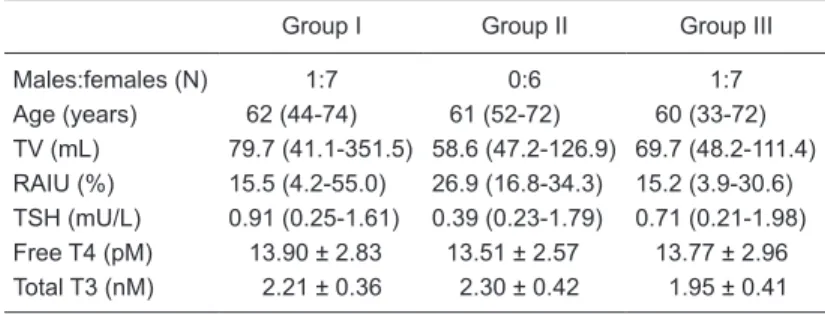
The baseline characteristics of the patients
at the beginning of the study were not signifi -cantly different (Table 1).
Thyroid volume
No acute changes in TV were observed on days 2 or 7 in any of the three groups. After 7
days, TV significantly decreased by 4.0 ± 5.8%
in group I (P = 0.034) and did not change in
group II (4.2 ± 8.4%; P = 0.369). In group III, TV increased by 5.3 ± 4.6% (P = 0.023). The
variations in TV were similar between groups II and III (P = 0.754), and both were different from group I (group I vs group II: P = 0.028; group I
vs group III: P = 0.009).
After 6 months, TV decreased significantly by 28.5 ± 17.6% in group I (P = 0.001), and by 21.6 ± 17.8% in group II (P = 0.023), but not in group III (2.7 ± 15.3%; P = 0.631). The reduc -tions in TV were similar between groups I and II (P = 0.437), and both were different from group III (group I vs group III: P = 0.005; group II vs
group III: P = 0.041).
After 12 months, a significant decrease TV
was observed in groups I and II, i.e., 36.7 ± 18.1% (P = 0.008) and 37.4 ± 27.1% (P = 0.004), respectively. In group III, the changes in TV were not significant compared to baseline (19.0 ± 24.3%; P = 0.087). These relative reductions were
not statistically different among the groups (P = 0.237). The absolute values of TV are given in Table 2.
Tracheal cross-sectional area
No statistical differences between baseline and post-treatment TCA values were observed in groups I, II and
III (ANOVA), and no significant differences in TCA were
demonstrable on days 2, 7, 180, and 360 after treatment (Table 3).
RAIU
RAIU increased from a median of 15.5% (4.2-55.0%) to 40.2% (27.8-61.0%; P = 0.025) after 0.1 mg rhTSH in group I. In group II, RAIU increased from 27.0% (16.8-34.3%) to 34.2% (27.6-54.8; P = 0.028). The post-rhTSH RAIU were
Table 1. Baseline characteristics of the patients studied, before administration of 131I plus rhTSH or 131I plus placebo.
Group I Group II Group III
Males:females (N) 1:7 0:6 1:7
Age (years) 62 (44-74) 61 (52-72) 60 (33-72) TV (mL) 79.7 (41.1-351.5) 58.6 (47.2-126.9) 69.7 (48.2-111.4)
RAIU (%) 15.5 (4.2-55.0) 26.9 (16.8-34.3) 15.2 (3.9-30.6)
TSH (mU/L) 0.91 (0.25-1.61) 0.39 (0.23-1.79) 0.71 (0.21-1.98) Free T4 (pM) 13.90 ± 2.83 13.51 ± 2.57 13.77 ± 2.96 Total T3 (nM) 2.21 ± 0.36 2.30 ± 0.42 1.95 ± 0.41
Data are reported as means ± SD or median (range). Group I = 0.1 mg rhTSH; Group II = 0.01 mg rhTSH; Group III = placebo. rhTSH = recombinant hu-man thyrotropin; TV = thyroid volume; RAIU = radioactive iodine uptake; T3
= triiodothyronine; T4 = thyroxine. All patients were treated with a single oral
activity equal to 30 mCi 131I, preceded by a single subcutaneous injection of
rhTSH or placebo. There were no statistical differences amongst the three groups (ANOVA).
Table 2. Thyroid volume (in mL) before and after treatment with rhTSH plus
131I or placeboplus 131I.
Group I Group II Group III
Baseline 79.7 (41.1-351.5) 58.6 (47.2-126.9) 69.7 (48.2-111.4) Day 2 78.0 (40.5-343.9) 62.8 (47.1-120.8) 75.3 (52.2-106.9) Day 7 74.9 (42.8-346.9)* 66.0 (47.9-121.7) 75.3 (52.5-109.5)* 6 months 51.3 (20.8-304.7)* 48.7 (23.6-101.3)* 66.3 (42.7-110.7) 12 months 45.8 (20.5-249.5)* 35.2 (22.4-89.2)* 54.5 (25.8-106.7)*
Data are reported as median (range). See Table 1 for explanation of groups.
306 C.C. Albino et al.
not different between both groups (P = 0.220). For group III (placebo), no changes in RAIU were observed, with
values from 15.3% (3.9-30.6%) to 16.2% (9.9-31.9%), P
= 0.889.
Before treatment, heterogeneous thyroid uptake was seen in most of the patients with MNG. After rhTSH, a more homogeneous pattern of 131I distribution was seen
in groups I and II.
Thyroid hormones
At baseline, participants in all groups had similar levels
of TSH, total T3 and free T4. Since the first post-treatment
TSH was measured on day 3, we were unable to identify the peak levels of TSH.
After treatment, no statistically significant changes
in free T4 were observed from day 0 to day 30 in group I (P = 0.387). For groups II and III, peak levels of free T4
were detected on day 30 (group II: 17.63 ± 21.9 pM, P = 0.037; group III: 20.72 ± 2.83 pM, P < 0.001), which were
significantly higher than in group I (P = 0.001 for both
comparisons; Figure 1A).
Levels of T3 increased in all groups after treatment. Group I reached peak levels of T3 on day 3 (2.92 ± 0.81 nM, P = 0.004). In group II, peak levels of T3 were reached on day 30 (2.70 ± -0.46 nM, P = 0.03). In group III, peak levels of T3 were observed on day 10 (2.79 ± 0.62 nM, P
< 0.001; Figure 1B). On the first three days, levels of free
T4 and total T3 were maintained within the normal range in all groups.
Adverse events
Starting on day 90, hypothyroidism was observed in 2 patients of 8 in group I, 3 of 6 in group II and 1 of 8 in group III. After one year, one additional patient in groups I and III developed hypothyroidism.
Mild cervical discomfort, localized pain and palpitations, suggesting actinic thyroiditis, were reported by 1 patient in
each group between days 3 and 10. Propranolol, 80 mg/day, and nonsteroidal anti-inflammatory drugs were prescribed
to those patients, with prompt and complete resolution of all symptoms.
Goiter enlargement and/or compressive symptoms with respiratory difficulty were reported at baseline by 3
participants in group I, 2 in group II and 2 in group III. Those symptoms were mild, did not cause physical limitations, and were resolved without additional interventions in all but 1 patient, who had a very large goiter at baseline (351 mL). One year after treatment, that patient from group I remained with the same complaints. After 360 days, in spite of
obtain-ing significant TV reduction and relative improvement of
the compressive symptoms, the participant still had a very
Figure 1. Changes in plasma free T4 (A) and T3 (B) after the administration of recombinant human thyrotropin (rhTSH) or placebo and
radioiodine. See Table 1 for explanation of groups. The box plot indicates the 1 ± SD with the point within each box being mean. The
size of the rectangle indicates SD. *P < 0.05, compared to baseline (ANOVA). Table 3. Tracheal cross-sectional area before and after
treat-ment with rhTSH plus 131I or placeboplus 131I.
TCA (mm2) Group I Group II Group III
Baseline 83 (50-171) 130 (97-161) 129 (82-204) Day 2 103 (54-160) 128 (75-146) 125 (64-209) Day 7 99 (48-151) 125 (105-145) 121 (75-222) Day 180 119 (41-149) 128 (108-151) 119 (80-203) Day 360 120 (40-150) 135 (111-160) 115 (90-150)
Data are reported as median (minimum-maximum). rhTSH =
recombinant human thyrotropin; TCA = tracheal cross-sectional area in mm2. See Table 1 for explanation of groups. There were
large goiter (249 mL). Therefore, this patient was referred for a new treatment with 131I (without rhTSH).
One patient in group II and 1 patient in group III did
not achieve significant TV reductions and remained with
mild cervical discomfort, without respiratory symptoms. However, they preferred clinical observation with no ad-ditional treatment.
Before treatment, cosmetic complaints (discomfort due to esthetic issues) were reported by 5 patients in group I, 2 in group II, and 4 in group III. One year after treatment, only 1 patient in each group still had cosmetic complaints. Therefore, the overall satisfaction rate, regarding cosmetic
complaints, was 86%.
Antithyroid antibodies
Titers of TSH receptor antibody were negative for all groups throughout the study. Three new patients in group I developed TPOAb on day 90 and continued positive up to day 360, different from groups II and III. The incidence of patients with positive antithyroid antibodies is shown in Table 4.
Discussion
In the present study, we demonstrated that treatment with 131I did not lead to acute airway obstruction, and this was independent of the administration of rhTSH. The com-bination of 131I and rhTSH at 0.01 or 0.10 mg was safe,
since the incidence of adverse events was similar in all groups. In addition, treatment of MNG with 131I and rhTSH
led to significant TV reduction, superior to placebo, 6 and
12 months after treatment.
Our study presents data on TCA 48 h after the admin-istration of radioiodine, preceded or not by rhTSH for the
first time. We did not observe significant differences in
TCA after therapy, either within or between groups. This
result agrees with the findings from Fast et al. (15) and
from Bonnema et al. (18). However, in discordance with
the latter study, we did not observe significant individual
changes in TCA. Therefore, in our study, we showed that
treatment with radioiodine does not influence TCA, regard
-less of the use of rhTSH. This could be explained by the
lack of correlation between TCA and TV, also observed by Bonnema et al. (18).
In patients with MNG, rhTSH increases RAIU and deter-mines a more homogenous distribution of radioiodine (7,8), which allows a reduction in the activity of 131I administered
(8). Treatment of MNG with 131I alone leads to decreases in
TV by 30 to 40% after 12 months (2-4). Studies evaluating the effects of rhTSH as an adjuvant to fixed activities of
131I have shown more pronounced TV reductions ranging
from 34% in the first 6 months (21), to 58% in the first year
(22). Even with a very low dose, we have demonstrated that rhTSH was safe and effective (10). In double-blind, randomized, placebo-controlled studies that used adjusted
Table 4. Incidence of patients with positive titers of antithyroid antibodies before and after treatment with rhTSH plus 131I or
pla-ceboplus 131I.
Day 0 Day 90 Day 180 Day 360
TgAb
Group I 2 4 4 3
Group II 1 0 1 1
Group III 1 2 2 1
TPOAb
Group I* 1 4 4 4
Group II 0 1 1 1
Group III 1 1 1 1
TRAb
Group I 0 0 0 0
Group II 0 0 0 0
Group III 0 0 0 0
Data are reported as absolute numbers. See Table 1 for explana -tion of groups. TRAb = thyrotropin receptor antibody; TPOAb =
antithyroperoxidase antibody; TgAb = antithyroglobulin antibody.
*P < 0.05, group I vs groups II and III for TPOAb at 90, 180 and 360 days (Kruskal-Wallis test).
activities of 131I, TV reductions ranged between 53 (23) and
62% (24), which were significantly greater in the groups that
received rhTSH when compared to placebo.
In our study, TV reduction, compared to baseline, was
significantly higher among rhTSH-treated patients, at both 6 and 12 months. Our findings agree with previous studies
that evaluated goiter reduction with rhTSH and 131I. In those
studies, goiter reduction was more significant in patients
treated with rhTSH plus 131I compared to those treated
with 131I alone. However, in terms of relative changes in
TV, there was no difference between groups at the 12th
month. This finding can be attributed to the relatively small
and heterogeneous sample.
No significant transient increases in TSH were observed, with unexpectedly low peak levels in all groups. Had TSH
been measured on day 2, higher TSH levels could have been
observed. Significant peak levels of free T4 were observed
only in groups II and III. This suggests that the increase in free T4 may be attributed more importantly to the actinic effect of radioiodine than to the stimulatory effect of rhTSH.
Significant increases in T3 were observed in all groups, with
higher levels in the groups that received rhTSH. This sug-gests that rhTSH leads to more pronounced changes in T3
than in free T4. The timing of the T3 peaks is explainable by
the rhTSH (D3 in group I) vs the actinic effect of 131I
308 C.C. Albino et al.
References
1. Hegedus L, Bonnema SJ, Bennedbaek FN. Management of simple nodular goiter: current status and future perspectives.
Endocr Rev 2003; 24: 102-132.
2. Hegedus L, Hansen BM, Knudsen N, Hansen JM. Reduc-tion of size of thyroid with radioactive iodine in multinodular
non-toxic goitre. BMJ 1988; 297: 661-662.
3. Nygaard B, Hegedus L, Gervil M, Hjalgrim H, Soe-Jensen P,
Hansen JM. Radioiodine treatment of multinodular non-toxic
goitre. BMJ 1993; 307: 828-832.
4. Huysmans DA, Hermus AR, Corstens FH, Barentsz JO, Kloppenborg PW. Large, compressive goiters treated with radioiodine. Ann Intern Med 1994; 121: 757-762.
5. Huysmans DA, Buijs WC, van de Ven MT, van den Broek WJ, Kloppenborg PW, Hermus AR, et al. Dosimetry and risk estimates of radioiodine therapy for large, multinodular goiters. J Nucl Med 1996; 37: 2072-2079.
6. Huysmans DA, Nieuwlaat WA, Erdtsieck RJ, Schellekens AP, Bus JW, Bravenboer B, et al. Administration of a single
low dose of recombinant human thyrotropin significantly enhances thyroid radioiodide uptake in nontoxic nodular
goiter. J Clin Endocrinol Metab 2000; 85: 3592-3596. 7. Nieuwlaat WA, Hermus AR, Sivro-Prndelj F, Corstens FH,
Huysmans DA. Pretreatment with recombinant human TSH changes the regional distribution of radioiodine on thyroid scintigrams of nodular goiters. J Clin Endocrinol Metab
2001; 86: 5330-5336.
8. Nieuwlaat WA, Huysmans DA, van den Bosch HC, Sweep CG, Ross HA, Corstens FH, et al. Pretreatment with a single, low dose of recombinant human thyrotropin allows dose re-duction of radioiodine therapy in patients with nodular goiter.
J Clin Endocrinol Metab 2003; 88: 3121-3129.
9. Albino CC, Mesa CO Jr, Olandoski M, Ueda CE, Woellner LC, Goedert CA, et al. Recombinant human thyrotropin as adjuvant in the treatment of multinodular goiters with radio-iodine. J Clin Endocrinol Metab 2005; 90: 2775-2780. 10. Cubas ER, Paz-Filho GJ, Olandoski M, Goedert CA,
Woellner LC, Carvalho GA, et al. Recombinant human TSH
increases the efficacy of a fixed activity of radioiodine for
treatment of multinodular goitre. Int J Clin Pract 2009; 63: 583-590.
11. Paz-Filho GJ, Mesa CO, Carvalho GA, Goedert CA, Graf H. Recombinant human TSH associated with radioiodine does not have further effects on thyroid volume and function after 2 years. Clin Endocrinol 2008; 69: 345-346.
12. Paz-Filho GJ, Mesa-Junior CO, Olandoski M, Woellner LC, Goedert CA, Boguszewski CL, et al. Effect of 30 mCi radioiodine on multinodular goiter previously treated with recombinant human thyroid-stimulating hormone. Braz J Med Biol Res 2007; 40: 1661-1670.
13. Nielsen VE, Bonnema SJ, Hegedus L. Effects of 0.9 mg
In agreement with the results of a previous study (21), our data suggest that rhTSH does not increase the incidence of hypothyroidism when compared to placebo, probably because we used low doses of rhTSH. However, other studies obtained different results (22,24).
The incidence of thyrotoxic symptoms was equally dis -tributed among the three groups. Those symptoms were mild and readily treatable with beta-blockers and nonsteroidal
anti-inflammatory drugs. Since the incidence of symptomatic thyrotoxicosis was very low, we do not advocate the use of
prophylactic beta-blockers.
The changes in TPOAb suggest that a higher dose of rhTSH may elicit a stronger, earlier and transient immuno-logical response, in contrast with the results reported by Rubio et al. (25). In their study, the TPOAb surge after 131I
occurred independently of the rhTSH dose.
We chose the highest outpatient radioactivity of 131I that
is permitted by the Brazilian regulatory agencies. Patients receiving more than 1.11 GBq need to be hospitalized. By administering 1.11 GBq, the need for hospitalization was
eliminated and the success rates were maximized.
Our study has some limitations. First, although this was a randomized study, our sample size provided a less-than-optimal statistical power. This could have led to the absence of difference in TV reduction at the 12th month between groups. Second, we have included some patients with relatively high RAIU, who could have been treated without the need for rhTSH. Third, we did not assess iodine intake
in our patients, which could have compromised our findings
if adherence to the diet was low. This confounding factor could have been eliminated by measuring urinary iodine, a procedure that was not undertaken due to logistic issues.
Fourth, it is known that rhTSH leads to maximum stimulation of the expression of the Na+/I- symporter 24 to 72 h after its
injection (26). Possibly, in our study, the post-rhTSH RAIU was underestimated, since the tracer activity of 131I was
administered only 2 h after rhTSH. A strength of our study is the homogeneous sample investigated, consisting only of euthyroid patients. In spite of these limitations, the design of our study proved to be practical and easily applicable in a clinical setting.
In this controlled study, we observed that the use of
rhTSH as an adjuvant to a fixed 1.11 GBq activity of 131I
for the treatment of MNG is safe, without acute airway compression, and with mild to transient adverse effects. rhTSH enhances TV reduction 6 months and 1 year after
treatment. Larger studies are needed to confirm whether
the superiority of rhTSH plus 131I persists after a prolonged
follow-up.
Acknowledgments
G. Paz-Filho received consulting fees from Genzyme do Brasil. This study was partially funded by Genzyme do Brasil. Genzyme do Brasil did not have any involvement in the study design, data collection, data analysis, manuscript
recombinant human thyrotropin on thyroid size and function in normal subjects: a randomized, double-blind, cross-over trial. J Clin Endocrinol Metab 2004; 89: 2242-2247. 14. Nielsen VE, Bonnema SJ, Hegedus L. Transient goiter
enlargement after administration of 0.3 mg of recombinant
human thyrotropin in patients with benign nontoxic nodular
goiter: a randomized, double-blind, crossover trial. J Clin Endocrinol Metab 2006; 91: 1317-1322.
15. Fast S, Nielsen VE, Bonnema SJ, Hegedus L. Dose-depen-dent acute effects of recombinant human TSH (rhTSH) on thyroid size and function. Comparison of 0.1, 0.3 and 0.9 mg of rhTSH. Clin Endocrinol 2009 [Epub ahead of print; doi:
10.1111/j.1365-2265.2009.03650.x].
16. Bonnema SJ, Bertelsen H, Mortensen J, Andersen PB, Knudsen DU, Bastholt L, et al. The feasibility of high dose iodine 131 treatment as an alternative to surgery in patients with a very large goiter: effect on thyroid function and size and pulmonary function. J Clin Endocrinol Metab 1999; 84: 3636-3641.
17. Nygaard B, Faber J, Hegedus L. Acute changes in thyroid volume and function following 131I therapy of multinodular
goitre. Clin Endocrinol 1994; 41: 715-718.
18. Bonnema SJ, Nielsen VE, Boel-Jorgensen H, Grupe P, An-dersen PB, Bastholt L, et al. Recombinant human thyrotro-pin-stimulated radioiodine therapy of large nodular goiters facilitates tracheal decompression and improves inspiration.
J Clin Endocrinol Metab 2008; 93: 3981-3984.
19. Huysmans DA, de Haas MM, van den Broek WJ, Hermus AR, Barentsz JO, Corstens FH, et al. Magnetic resonance imaging for volume estimation of large multinodular goitres: a compari-son with scintigraphy. Br J Radiol 1994; 67: 519-523.
20. Pocock SJ. Clinical trials. A practical approach. Brisbane: John Wiley & Sons; 1989.
21. Cohen O, Ilany J, Hoffman C, Olchovsky D, Dabhi S, Karasik A, et al. Low-dose recombinant human thyrotropin-aided radioiodine treatment of large, multinodular goiters in elderly patients. Eur J Endocrinol 2006; 154: 243-252.
22. Silva MN, Rubio IG, Romao R, Gebrin EM, Buchpiguel C, Tomimori E, et al. Administration of a single dose of
recom-binant human thyrotrophin enhances the efficacy of radio -iodine treatment of large compressive multinodular goitres.
Clin Endocrinol 2004; 60: 300-308.
23. Bonnema SJ, Nielsen VE, Boel-Jorgensen H, Grupe P, An-dersen PB, Bastholt L, et al. Improvement of goiter volume reduction after 0.3 mg recombinant human thyrotropin-stimulated radioiodine therapy in patients with a very large goiter: a double-blinded, randomized trial. J Clin Endocrinol Metab 2007; 92: 3424-3428.
24. Nielsen VE, Bonnema SJ, Boel-Jorgensen H, Grupe P, Hegedus L. Stimulation with 0.3-mg recombinant human thyrotropin prior to iodine 131 therapy to improve the size
reduction of benign nontoxic nodular goiter: a prospective
randomized double-blind trial. Arch Intern Med 2006; 166: 1476-1482.
25. Rubio IG, Perone BH, Silva MN, Knobel M, Medeiros-Neto G. Human recombinant TSH preceding a therapeutic dose of
radioiodine for multinodular goiters has no significant effect
in the surge of TSH-receptor and TPO antibodies. Thyroid
2005; 15: 134-139.