Differential success in sampling of Atlantic Forest amphibians
among different periods of the day
Rocha, CFD.
a*
, Siqueira, CC.
a, Ariani, CV.
a, Vrcibradic, D.
b, Guedes, DM.
a, Kiefer, MC.
c,
Almeida-Gomes, M.
d, Goyannes-Araújo, P.
a,
Borges-Júnior, VNT.
aand Van Sluys, M.
aaDepartamento de Ecologia, Universidade do Estado do Rio de Janeiro – UERJ, Rua São Francisco Xavier, 524,
Maracanã, CEP 20550-013, Rio de Janeiro, RJ, Brazil
bDepartamento de Zoologia, Universidade Federal do Estado do Rio de Janeiro – UNIRIO, Av. Pasteur, 458,
Urca, CEP 22240-290, Rio de Janeiro, RJ, Brazil
cDepartamento de Biologia Geral, Universidade Federal Fluminense – UFF, CP 100.436,
CEP 24020-971, Niterói, RJ, Brazil
dDepartamento de Ecologia, Universidade Federal do Rio de Janeiro – UFRJ, Av. Carlos Chagas Filho, 373,
Bl. A, Cidade Universitária, CEP 21941-902, Rio de Janeiro, RJ, Brazil *e-mail: [email protected]
Received: September 13, 2012 – Accepted: April 15, 2014 – Distributed: May 31, 2015
Abstract
In general, anurans tend to be nocturnal, though diurnal activity is characteristic of some groups. Studies show that frog activity may be inferred based on the number of individuals collected at different periods of the day, during large-scale field surveys. We investigated the best period of the day to conduct amphibian sampling in nine Atlantic Rainforest areas in southeastern Brazil, based on intensive field surveys. At each locality we employed similar sampling effort during diurnal, crepuscular and nocturnal searches (totaling 704.5 sampling hours). We pooled data from all localities for each period and estimated the proportion of frogs of each species active at each period based on the total number of individuals and on the number of species found during all surveys for that period. We recorded a total of 817 individual frogs from 69 species. Species richness was highest at night (median = 12 species), intermediate at dusk (median = 8), and lowest during the day (median = 4). The percentage of the total number of individual frogs found (pooled species) was highest during the night (ca. 53%) and lowest during the day (ca. 14%). Analyzing each species separately, the number of individuals recorded was consistently higher at dusk and night for most species. Our study evidences a trend for nocturnal activity for most Atlantic Rainforest frogs, with few species having primarily diurnal habits. Those results may favor future studies and conservation efforts for amphibian species.
Keywords: activity pattern, amphibian, anuran assemblages, southeastern Brazil, tropical forest.
Sucesso diferenciado na amostragem de anfíbios da Mata Atlântica
entre diferentes períodos do dia
Resumo
Em geral, anuros tendem a ser noturnos, apesar de a atividade diurna ser característica de alguns grupos. Estudos mostram que a atividade de anuros pode ser inferida com base no número de indivíduos coletados em diferentes períodos do dia durante pesquisas de campo de larga escala. Nós avaliamos qual o melhor período do dia para conduzir amostragens de anfíbios em nove áreas da Mata Atlântica no sudeste do Brasil, com base em amostragens de campo intensivas. Em cada localidade nós empregamos esforço de amostragem similar durante amostragens diurnas, crepusculares e noturnas (totalizando 704,5 horas de amostragem). Nós agrupamos dados de todas as localidades para cada período e estimamos a proporção de anuros de cada espécie ativa em cada período com base no número total de indivíduos e no número de espécies encontradas durante todas as buscas naquele período. Nós registramos um total de 817 indivíduos pertencentes a 69 espécies. A riqueza de espécies foi maior à noite (mediana = 12 espécies), intermediária ao crepúsculo (mediana = 8) e menor durante o dia (mediana = 4). A porcentagem do número total de indivíduos encontrados (todas as espécies agrupadas) foi maior durante a noite (ca. 53%) e menor durante o período diurno (ca. 14%). Analisando cada espécie separadamente, o número de indivíduos registrados foi consistentemente maior ao crepúsculo e à noite para a maioria das espécies. Nosso estudo evidencia uma tendência para atividade noturna para a maioria dos anuros da Mata Atlântica, com poucas espécies tendo hábitos primariamente diurnos. Esses resultados podem favorecer futuros estudos e esforços de conservação para as espécies de anfíbios.
1. Introduction
Studies investigating amphibian communities commonly employ different sampling methods, such as ‘plots’ or ‘quadrats’ (Jaeger and Inger, 1994), pitfall traps (Corn, 1994), and visual encounter surveys - VES (Crump and Scott, 1994). In the Neotropics, VES and plots are the methods that have been the most successful during short-term anuran surveys, for both total abundance and species richness (e.g. Doan, 2003; Almeida-Gomes et al., 2008, 2010; Siqueira et al., 2009). However, studies conducted at different times of day in some areas show that capture success is not equal throughout the day, being the highest during the night (e.g. Rocha et al., 2000, 2007; Menin et al., 2008). Therefore, temporal differences in rates of frog activity (by “active” we mean individuals that are not at rest, i.e. that are performing tasks such as calling, mating, foraging, fighting, dispersing, etc) may be inferred based on the number of individuals collected at different periods of the day during field surveys. However, this type of inference has its limitations, since not all the frogs may actually be active at the moment of encounter. Nevertheless, this approach has been used in studies of anuran assemblages/guilds in Atlantic (Rocha et al., 2000, 2007; Almeida-Gomes et al., 2008, 2010; Siqueira et al., 2009) and Amazonian rainforests (Menin et al., 2008) in Brazil. In two studies (Rocha et al., 2000; Menin et al., 2008) a similar proportion of individuals (ca. 70%) was recorded during nocturnal sampling, indicating that most anurans in Neotropical rainforests tend to be found at night. In the present study, we evaluate the differences in the success in detecting amphibians among three periods of the day (diurnal, crepuscular and nocturnal) based on the results of intensive short-term surveys carried out in nine Atlantic Rainforest areas in southeastern Brazil.
2. Material and Methods
Anuran surveys were conducted from 2004 to 2006 in nine areas of Atlantic Rainforest in the state of Rio de Janeiro, southeastern Brazil (Table 1). We sampled frogs
using time-constrained visual search surveys (Crump and Scott, 1994) during five to seven consecutive days in each area. Surveys were conducted during the day (09:00H-16:00H), at dusk (17:30H-18:30H) and at night (19:00H-22:00H) in each locality (usually one survey episode per period per day). During the surveys, each observer walked slowly for 30 minutes carefully looking for frogs on the ground, on tree trunks, branches and shrubs, under and on logs, twigs, roots and stones, and on arbustive and herbaceous vegetation. In addition, some water bodies such as temporary and permanent ponds, shallow rivulets and streams were also searched. A total of 1409 survey episodes were performed resulting in 704.5 hours of sampling in the nine areas studied (Table 1).
Individual species were considered as predominantly diurnal, crepuscular or nocturnal if 35% or more individuals were sampled during one of those periods; if approximately the same proportion of individuals was sampled in each of the three periods, we considered the species’ activity trend as “extensive”. To test for differences among sampling periods (day, dusk and night) in species richness per site and total abundance of frogs per site, we performed one-way analysis of variance (ANOVA) coupled with Tukey post-hoc test, using the software Systat 11.0 (for these analyses we did not consider the locality Estação Ecológica do Paraíso, as the sampling effort was unequal among periods). Because sampling effort was not equal among sampling periods, we used an individual-based rarefaction technique (Gotelli and Colwell, 2001), which provides a richness estimation that is comparable among sampling periods. This analysis was made using software EcoSim 7.71 (Gotelli and Entsminger, 2004), using 1000 iterations. Descriptive statistics are represented in the text as mean ± SD.
3. Results
We recorded a total of 817 individual frogs from 69 species (Tables 2 and 3). Specimens of Flectonotus recorded during fieldwork may represent more than one species (E. Izecksohn, pers. comm.), but due to taxonomic
Table 1. Number of 30-minutes survey bouts (total = 1409) and sampling time (total = 704.5 h) for three periods (diurnal, crepuscular and nocturnal) of searching for frogs in nine Atlantic rainforest areas of Rio de Janeiro State in Brazil.
AREA Coordinates Diurnal Crepuscular Nocturnal
SPP THSP SPP THSP SPP THSP
Estação Ecológica do Paraíso 22° 26’ S, 42° 56’ W 89 44.5 50 25 72 36
Reserva Ecológica de Guapiaçu 22° 24’ S, 42° 44’ W 70 35 70 35 70 35
Serra da Concórdia 22° 22’ S, 43° 47’ W 40 20 40 20 40 20
Morro São João 22° 31’ S, 42° 00’ W 40 20 40 20 40 20
Reserva Ecológica Rio das Pedras 22° 59’ S, 44° 05’ W 50 25 50 25 50 25
APA da Mantiqueira 22° 21’ S, 44° 35’ W 50 25 50 25 50 25
Parque Estadual do Desengano 21° 52’ S, 41° 54’ W 48 24 50 25 50 25
Cambuci 21° 29’ S, 41° 52’ W 50 25 50 25 50 25
Parque Estadual dos Três Picos 22° 25’ S, 42° 34’ W 50 25 50 25 50 25
Total 487 243.5 450 225 472 236
uncertainties were treated as a single species for the purposes of this study.
The number of species recorded per site varied from nine at the Parque Estadual do Desengano to 21 at the Estação Ecológica do Paraíso (Table 2). The highest species richness was recorded at night (median = 12, range = 6 to 19 frog species), followed by the crepuscular period (median = 8, range = 3 to 14 species) (Table 2). During the diurnal surveys we recorded the lowest number of frog species (median = 4, range = 1 to 6) (Table 2). Species richness differed significantly among sampling periods (ANOVA: F2,21 = 7.395; p < 0.005), with differences being significant between diurnal and nocturnal periods (p < 0.005), and non-significant between diurnal and crepuscular (p = 0.087), and between crepuscular and nocturnal periods (p = 0.275).
In most areas, except Serra da Concórdia, P. E. do Desengano and P. E. dos Três Picos, more frogs were found at night than during the day or at dusk (Table 2). Overall, most frogs were found during nocturnal (N = 437 individuals or 53.5%) and crepuscular surveys (N = 267 individuals or 32.7%), whereas only 13.8% of individual frogs (N = 113) were found during diurnal samplings (Table 2). The total number of individuals per site (values log-transformed) differed significantly among sampling periods (ANOVA: F2,21 = 10.982; p = 0.001), with values for the diurnal period being significantly lower than those of the crepuscular (p < 0.01) and nocturnal (p = 0.001) periods, but the latter two not differing between themselves (p = 0.531).
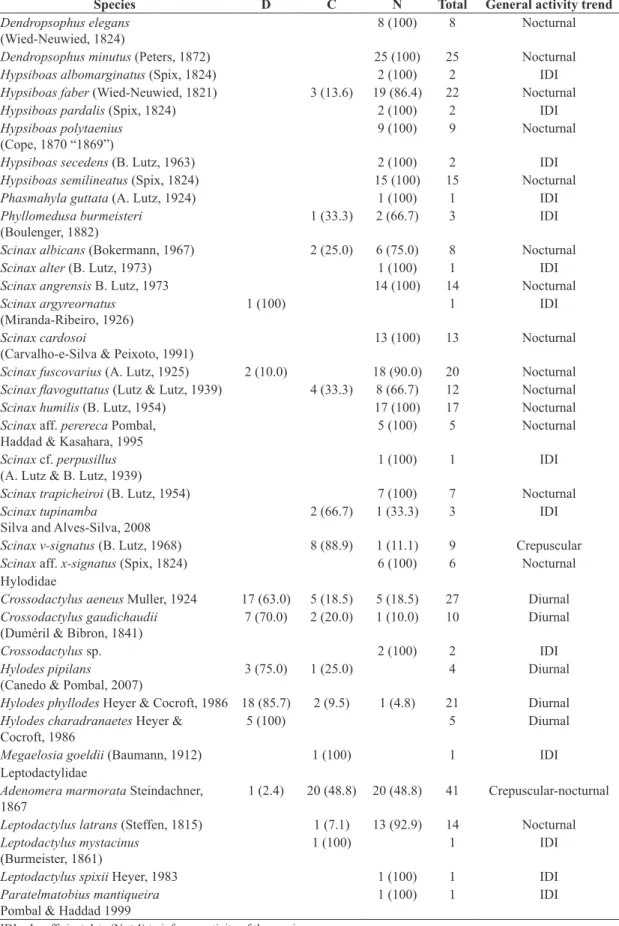
Analyzing each species separately, the number of individuals was consistently higher at dusk and night for most species (Table 3). Fifteen species (21.7%) were found during both the crepuscular and nocturnal surveys, 24 (34.8%) were found only at night, and 15 (21.7%) were found during all three periods (Table 3). Three species (0.4%) were found only during the day, but two of them are represented by a single individual (Table 3).
The individual-based rarefaction (based on N = 113 from diurnal period) gave estimates of higher species richness for the nocturnal period (37.8 spp.) than for the crepuscular (27.6 spp.) and diurnal (23 spp.) periods.
4. Discussion
In our study, approximately 53% of the frogs were recorded during the nocturnal period. If we consider the comparatively shorter crepuscular period together with the nocturnal one, we have about 86% of the individuals recorded during the dusk and night. Rocha et al. (2000) surveyed another Atlantic forest leaf litter frog assemblage in southeast Brazil using the “quadrat” methodology (see Jaeger and Inger, 1994) and recorded 29% of the individuals (belonging to six species) during diurnal sampling and 71% (nine species) during nocturnal sampling (even though the total sampling effort for diurnal quadrats was twice that of nocturnal ones). Similarly, Menin et al. (2008), studying an anuran community in Central Amazonia (total of 30 species recorded) found 27% of the individuals (eight species) during diurnal sampling and 73% (25 species) at night. In contrast, Summers (2002) found similar values of relative abundance and richness for diurnal and nocturnal surveys of a leaf litter frog assemblage in a Panamanian forest. However, his sampling effort was much greater during the day than at night, and the values of relative abundance for his daylight samples were partly influenced by one species of diurnal dendrobatid that was highly abundant in the area.
Assuming that the number of individuals recorded at each time of the day may reflect (at least in part) amphibian activity, our data suggest some patterns for specific taxonomic groups, even though the sample size for some species was reduced. Hylids, for instance, are predominantly nocturnal, and the terrestrial direct-developers [comprising
Table 2. Richness and abundance of frogs found in three sampling periods (diurnal, crepuscular and nocturnal) in nine Atlantic rainforest areas of Rio de Janeiro State in Brazil.
AREA SR Diurnal Crepuscular Nocturnal Total
Individuals (%) SRP Individuals (%) SRP Individuals (%) SRP Estação Ecológica
do Paraíso
21 23 (23.2) 6 24 (24.2) 10 52 (52.5) 17 99
Reserva Ecológica de Guapiaçu
20 11 (9.7) 6 48 (42.1) 11 55 (48.2) 16 114
Serra da Concórdia 13 21 (20.8) 5 45 (44.6) 8 35 (34.6) 6 101
Morro São João 13 16 (22.5) 4 21 (29.6) 7 34 (47.9) 6 71
Reserva Ecológica Rio das Pedras
14 14 (16.3) 4 25 (29.1) 8 47 (54.6) 12 86
APA da Mantiqueira 18 13 (9.8) 2 41 (30.8) 9 79 (59.4) 15 133
Parque Estadual do Desengano
9 4 (10.8) 2 21 (56.7) 4 12 (32.4) 7 37
Cambuci 20 2 (1.7) 1 13 (11.2) 3 101 (87.1) 19 116
Parque Estadual dos Três Picos
17 9 (15.0) 6 29 (48.3) 14 22 (36.7) 7 60
Total 69 113 (13.8) 23 267 (32.7) 38 437 (53.5) 57 817
Table 3. Sampling frequencies (in absolute numbers and percentages, in parentheses) during diurnal (D), crepuscular (C) and nocturnal (N) periods for 69 frog species sampled in nine Atlantic Rainforest areas in Rio de Janeiro State, southeastern Brazil, with inferred activity trends for each.
Species D C N Total General activity trend
Brachycephalidae
Brachycephalus ephippium (Spix, 1824) 1 (100) 1 IDI
Brachycephalus didactylus (Izecksohn, 1971)
1 (25.0) 3 (75.0) 4 Crepuscular
Brachycephalus sp. 1 (50.0) 1 (50.0) 2 IDI
Ischnocnema guentheri (Steindachner, 1864)
3 (6.5) 23 (50.0) 20 (43.5) 46 Crepuscular-nocturnal
Ischnocnema octavioi (Bokermann, 1965) 5 (71.4) 2 (28.6) 7 Crepuscular
Ischnocnema oea (Heyer, 1984) 2 (50.0) 2 (50.0) 4 IDI
Ischnocnema parva (Girard, 1853) 9 (10.5) 56 (65.1) 21 (24.4) 86 Crepuscular
Ischnocnema sp. [gr. lactea (Miranda-Ribeiro, 1923)]
3 (14.3) 15 (71.4) 3 (14.3) 21 Crepuscular
Ischnocnema juipoca (Sazima & Cardoso, 1978)
1 (100) 1 IDI
Bufonidae
Dendrophryniscus brevipollicatus
(Jiménez de la Espada, 1871 “1870”)
1 (50.0) 1 (50.0) 2 IDI
Rhinella ornata (Spix, 1824) 3 (21.4) 3 (21.4) 8 (57.1) 14 Nocturnal
Rhinella crucifer (Wied-Neuwied, 1821) 1 (100) 1 IDI
Rhinella icterica (Spix, 1824) 2 (16.7) 4 (33.3) 6 (50.0) 12 Nocturnal Centrolenidae
Vitreorana uranoscopa (Muller, 1924) 3 (100) 3 IDI
Craugastoridae
Euparkerella brasiliensis (Parker, 1926) 1 (3.8) 14 (53.8) 11 (42.3) 26 Crepuscular-nocturnal
Euparkerella cochranae Izeckshon, 1988 1 (100) 1 IDI
Haddadus binotatus (Spix, 1824) 8 (9.1) 34 (38.6) 46 (52.3) 88 Crepuscular-nocturnal Cycloramphidae
Cycloramphus brasiliensis (Steindachner, 1864)
1 (10.0) 9 (90.0) 10 Nocturnal
Odontophrynus americanus (Duméril & Bibron, 1841)
1 (100) 1 IDI
Proceratophrys boiei
(Wied-Neuwied, 1825) 6 (40.0) 9 (60.0) 15 Crepuscular-nocturnal
Proceratophrys melanopogon (Miranda-Ribeiro, 1926)
10 (34.5) 14 (48.3) 5 (17.2) 29 Diurnal-crepuscular
Thoropa miliaris (Spix, 1824) 9 (19.6) 16 (34.8) 21 (45.6) 46 Crepuscular-nocturnal
Zachaenus parvulus (Girard, 1853) 1 (33.3) 1 (33.3) 1 (33.3) 3 IDI Hemiphractidae
Flectonotus sp. 1 (33.3) 2 (66.7) 3 IDI
Hylidae
Aplastodiscus arildae (Cruz & Peixoto, 1987 “1985”)
2 (100) 2 IDI
Aplastodiscus eugenioi
(Carvalho-e-Silva & Carvalho-e-Silva, 2005)
2 (28.6) 5 (71.4) 7 Nocturnal
Aplastodiscus leucopygius (Cruz & Peixoto, 1985 “1984”)
4 (100) 4 Nocturnal
Bokermannohyla circumdata (Cope, 1871)
1 (5.5) 17 (94.4) 18 Nocturnal
Bokermannohyla sp. (gr. circumdata) 1 (16.7) 5 (83.3) 6 Nocturnal
Dendropsophus decipiens (A. Lutz, 1925) 3 (100) 3 IDI
Species D C N Total General activity trend
Dendropsophus elegans
(Wied-Neuwied, 1824) 8 (100) 8 Nocturnal
Dendropsophus minutus (Peters, 1872) 25 (100) 25 Nocturnal
Hypsiboas albomarginatus (Spix, 1824) 2 (100) 2 IDI
Hypsiboas faber (Wied-Neuwied, 1821) 3 (13.6) 19 (86.4) 22 Nocturnal
Hypsiboas pardalis (Spix, 1824) 2 (100) 2 IDI
Hypsiboas polytaenius (Cope, 1870 “1869”)
9 (100) 9 Nocturnal
Hypsiboas secedens (B. Lutz, 1963) 2 (100) 2 IDI
Hypsiboas semilineatus (Spix, 1824) 15 (100) 15 Nocturnal
Phasmahyla guttata (A. Lutz, 1924) 1 (100) 1 IDI
Phyllomedusa burmeisteri (Boulenger, 1882)
1 (33.3) 2 (66.7) 3 IDI
Scinax albicans (Bokermann, 1967) 2 (25.0) 6 (75.0) 8 Nocturnal
Scinax alter (B. Lutz, 1973) 1 (100) 1 IDI
Scinax angrensis B. Lutz, 1973 14 (100) 14 Nocturnal
Scinax argyreornatus (Miranda-Ribeiro, 1926)
1 (100) 1 IDI
Scinax cardosoi
(Carvalho-e-Silva & Peixoto, 1991)
13 (100) 13 Nocturnal
Scinax fuscovarius (A. Lutz, 1925) 2 (10.0) 18 (90.0) 20 Nocturnal
Scinax flavoguttatus (Lutz & Lutz, 1939) 4 (33.3) 8 (66.7) 12 Nocturnal
Scinax humilis (B. Lutz, 1954) 17 (100) 17 Nocturnal
Scinax aff. perereca Pombal, Haddad & Kasahara, 1995
5 (100) 5 Nocturnal
Scinax cf. perpusillus (A. Lutz & B. Lutz, 1939)
1 (100) 1 IDI
Scinax trapicheiroi (B. Lutz, 1954) 7 (100) 7 Nocturnal
Scinax tupinamba Silva and Alves-Silva, 2008
2 (66.7) 1 (33.3) 3 IDI
Scinax v-signatus (B. Lutz, 1968) 8 (88.9) 1 (11.1) 9 Crepuscular
Scinax aff. x-signatus (Spix, 1824) 6 (100) 6 Nocturnal Hylodidae
Crossodactylus aeneus Muller, 1924 17 (63.0) 5 (18.5) 5 (18.5) 27 Diurnal
Crossodactylus gaudichaudii (Duméril & Bibron, 1841)
7 (70.0) 2 (20.0) 1 (10.0) 10 Diurnal
Crossodactylus sp. 2 (100) 2 IDI
Hylodes pipilans (Canedo & Pombal, 2007)
3 (75.0) 1 (25.0) 4 Diurnal
Hylodes phyllodes Heyer & Cocroft, 1986 18 (85.7) 2 (9.5) 1 (4.8) 21 Diurnal
Hylodes charadranaetes Heyer & Cocroft, 1986
5 (100) 5 Diurnal
Megaelosia goeldii (Baumann, 1912) 1 (100) 1 IDI
Leptodactylidae
Adenomera marmorata Steindachner, 1867
1 (2.4) 20 (48.8) 20 (48.8) 41 Crepuscular-nocturnal
Leptodactylus latrans (Steffen, 1815) 1 (7.1) 13 (92.9) 14 Nocturnal
Leptodactylus mystacinus (Burmeister, 1861)
1 (100) 1 IDI
Leptodactylus spixii Heyer, 1983 1 (100) 1 IDI
Paratelmatobius mantiqueira Pombal & Haddad 1999
1 (100) 1 IDI
Species D C N Total General activity trend
Physalaemus signifer (Girard, 1853) 5 (33.3) 5 (33.3) 5 (33.3) 15 Extensive Microhylidae
Chiasmocleis sp. 1 (100) 1 IDI
Myersiella microps (Duméril & Bibron, 1841)
1 (100) 1 IDI
IDI = Insufficient data (N < 4) to infer on activity of the species. Table 3. Continued...
the Terrarana sensu Hedges et al. (2008) and represented here by the families Brachycephalidae and Craugastoridae] tend to have crepuscular-nocturnal activity. A tendency for nocturnal or crepuscular-nocturnal activity can also be visualized for the Leptodactylidae, the Bufonidae, and the Cycloramphidae (except for Proceratophrys melanopogon), but less clearly due to insufficient data for many species. Similar trends have been observed for Amazonian rainforest frog communities studied by Parmelee (1999) and Menin et al. (2008). In these studies, most species in the Leptodactylidae (sensu Fouquet et al., 2013) and Hylidae were characteristically nocturnal.
Among the species sampled in our study, only those of the family Hylodidae can be considered as diurnal. Individuals of Hylodes fredi (= H. phyllodes; see Canedo and Pombal, 2007) and Crossodactylus gaudichaudii at the Atlantic forest of Ilha Grande, in the state of Rio de Janeiro, begin activity at sunrise and remain active all day, normally ceasing activity at sunset (Hatano et al., 2002; Almeida-Gomes et al., 2007). In the present study, a few individuals of Hylodes and Crossodactylus were found during crepuscular or nocturnal searches. Some of those were probably close to ceasing their activity when found (one individual of Hylodes pipilans collected at dusk was active and calling). However, all Hylodes spp. found during nocturnal samplings were apparently inactive, most of them resting on vegetation, as reported for other species in the genus (Heyer et al., 1990; Hatano et al., 2002; Narvaes and Rodrigues, 2005). Stream-dwelling frog species such as those in the genera Hylodes and Crossodactylus live in moisture-saturated environments, and are thus less subjected to dehydration, which allows them to be active during the day (Duellman and Trueb, 1994; Haddad and Giaretta, 1999).
Our study shows a trend for nocturnal activity for most frogs of the Atlantic Rainforest, with few species having primarily diurnal habits. Those results may favor future studies, optimizing sampling effort for individual frog species and maximizing the gathering of information about them.
Acknowledgements
This study was sponsored by Critical Ecosystem Partnership Fund – CEPF, Conservação Internacional and Aliança para a Conservação da Mata Atlântica. CFDR (Processes
No. 304791/2010-5, 470265/2010-8 and 472287/2012-5) and MVS (Process No. 301401/2002-7 and 307773/2008-6) received research grants from the Conselho Nacional de Desenvolvimento Científico e Tecnológico – CNPq. CFDR also received financial support from Fundação de Amparo à Pesquisa do Estado do Rio de Janeiro (FAPERJ) through the “Programa Cientistas do Nosso Estado” (Process No. E-26/102.765.2012). Graduate scholarships were granted by CNPq to VNTBJ, CAPES to MAG, and CNPq and CAPES to CCS. MCK received a post-doctoral fellowship from CNPq (Process No. 150353/2003-0). We are especially thankful to Alcides Pissinatti (E. E. Paraíso), Alexander Jan Davis (P. E. Três Picos), Nicholas J. Locke and Pieter A. Vroeg (Reserva Ecológica de Guapiaçu, REGUA), T. Nakano and G. Huber (APA Mantiqueira), and Roberto Lamego (Serra da Concórdia) for many facilities, logistical support and for permit to work in the studied areas. Our thanks to many colleagues for field assistance in different moments of the study, especially H.G. Bergallo, M.A.S. Alves, T.J. Nogueira, D.S. Raíces, C.E.L. Esbérard, and M.B. Vecchi. We also thank J.P. Pombal Jr., C.A.G. Cruz, U. Caramaschi, C. Canedo, B.V.S. Pimenta, L. Fusinatto, M.C.S. Cardoso, A.C.C. Lourenço, D. Baêta and E. Izecksohn (in memoriam) for their help with the identification of frogs.
References
ALMEIDA-GOMES, M., ALMEIDA-SANTOS, M., GOYANNES-ARAÚJO, P., BORGES-JÚNIOR, VNT., VRCIBRADIC, D., SIQUEIRA, CC., ARIANI, CV., DIAS, AS., SOUZA, VV., PINTO, RR., VAN SLUYS, M. and ROCHA, CFD., 2010. Anurofauna of an Atlantic Rainforest fragment and its surroundings in Northern Rio de Janeiro State, Brazil. Brazilian Journal of Biology = Revista Brasileira de Biologia, vol. 70, no. 3, suplemento 0, p. 871-877. http://dx.doi.org/10.1590/S1519-69842010000400018. PMid:21085792
ALMEIDA-GOMES, M., VAN SLUYS, M. and ROCHA, CFD., 2007. Calling activity of Crossodactylus gaudichaudii (Anura: Hylodidae) in an Atlantic Rainforest area at Ilha Grande, Rio de Janeiro, Brasil. Belgian Journal of Zoology, vol. 137, no. 2, p. 203-207.
in Rio de Janeiro State, Brazil. Anais da Academia Brasileira de Ciencias, vol. 80, no. 2, p. 291-300. http://dx.doi.org/10.1590/ S0001-37652008000200007. PMid:18506255
CANEDO, C. and POMBAL JÚNIOR, JP., 2007. Two new species of torrent frog of the genus Hylodes (Anura, Hylodidae) with nuptial thumb tubercles. Herpetologica, vol. 63, no. 2, p. 224-235. http://dx.doi.org/10.1655/0018-0831(2007)63[224:TN SOTF]2.0.CO;2.
CORN, PS., 1994. Straight-line drift fences and pitfall traps. In
HEYER, WR., DONNELY, MA., ROY, WM., HAYEK, LC. and
FOSTER, MS. (Eds.). Measuring and Monitoring Biological Diversity: Standard Methods for Amphibians. Washington:
Smithsonian Institution Press. p. 109-117.
CRUMP, ML. and SCOTT JÚNIOR, NJ., 1994. Visual encounter
surveys. In HEYER, WR., DONNELY, MA., ROY, WM., HAYEK,
LC. and FOSTER, MS. (Eds.). Measuring and Monitoring Biological Diversity: Standard Methods for Amphibians. Washington:
Smithsonian Institution Press. p. 84-92.
DOAN, TM., 2003. Which methods are most effective for surveying rain forest herpetofauna? Journal of Herpetology, vol. 37, no. 1, p. 72-81. http://dx.doi.org/10.1670/0022-1511(2003)037[0072:WM AMEF]2.0.CO;2.
DUELLMAN, WE. and TRUEB, L., 1994. Biology of Amphibians. New York: MacGraw-Hill Inc. 670 p.
FOUQUET, A., BLOTTO, BL., MARONNA, MM., VERDADE, VK., JUNCÁ, FA., DE SÁ, R. and RODRIGUES, MT., 2013. Unexpected phylogenetic positions of the genera Rupirana and Crossodactylodes reveal insights into the biogeography and reproductive evolution of leptodactylid frogs. Molecular Phylogenetics and Evolution, vol. 67, no. 2, p. 445-457. http:// dx.doi.org/10.1016/j.ympev.2013.02.009. PMid:23454092 GOTELLI, NJ. and COLWELL, RK., 2001. Quantifying biodiversity: Procedures and pitfalls in the measurement and comparison of species richness. Ecology Letters, vol. 4, no. 4, p. 379-391. http:// dx.doi.org/10.1046/j.1461-0248.2001.00230.x.
GOTELLI, NJ. and ENTSMINGER, GL., 2004. EcoSim: Null models software for ecology. Version 7. Jericho: Acquired Intelligence Inc. & Kesey-Bear. Avaiable from: http://garyentsminger.com/ ecosim/index.htm.
HADDAD, CFB. and GIARETTA, AA., 1999. Visual and acoustic communication in the Brazilian torrent frog, Hylodes asper (Anura: Leptodactylidae). Herpetologica, vol. 55, no. 3, p. 324-333. HATANO, FH., ROCHA, CFD. and VAN SLUYS, M., 2002. Environmental factors affecting calling activity of a tropical diurnal frog (Hylodes phyllodes: Leptodactylidae). Journal of Herpetology, vol. 36, no. 2, p. 314-318. http://dx.doi.org/10.1670/0022-1511(2002)036[0314:EFACAO]2.0.CO;2.
HEDGES, SB., DUELLMAN, WE. and HEINICKE, MP., 2008.
New World direct-developing frogs (Anura:Terrarana): Molecular
phylogeny, classification, biogeography and conservation. Zootaxa, vol. 1737, p. 1-182.
HEYER, WR., RAND, AS., CRUZ, CAG., PEIXOTO, OL. and NELSON, CE., 1990. Frogs of Boracéia. Arquivos de Zoologia, vol. 31, no. 4, p. 231-410.
JAEGER, RG. and INGER, RF., 1994. Quadrat sampling. In
HEYER, WR., DONNELY, MA., ROY, WM., HAYEK, LC. and
FOSTER, MS. (Eds.). Measuring and Monitoring Biological Diversity: Standard Methods for Amphibians. Washington:
Smithsonian Institution Press. p. 97-102.
MENIN, M., WALDEZ, F. and LIMA, P., 2008. Temporal variation in the abundance and number of species of frogs in 10,000 ha of a forest in central Amazonia, Brazil. South American Journal of Herpetology, vol. 3, no. 1, p. 68-81. http://dx.doi.org/10.2994/1808-9798(2008)3[68:TVITAA]2.0.CO;2.
NARVAES, P. and RODRIGUES, MT., 2005. Visual communication, reproductive behavior, and home range of Hylodes dactylocinus (Anura, Leptodactylidae). Phyllomedusa, vol. 4, no. 2, p. 147-158. http://dx.doi.org/10.11606/issn.2316-9079.v4i2p147-147-158. PARMELEE, JR., 1999. Trophic ecology of a tropical anuran assemblage. Scientific Papers (University of Kansas. Natural History Museum), vol. 11, p. 1-59.
ROCHA, CFD., VRCIBRADIC, D., KIEFER, MC., ALMEIDA-GOMES, M., BORGES-JÚNIOR, VNT., CARNEIRO, PCF., MARRA, RV., ALMEIDA-SANTOS, P., SIQUEIRA, CC., GOYANNES-ARAÚJO, P., FERNANDES, CGA., RUBIÃO, ECN. and VAN SLUYS, M., 2007. A survey of the leaf-litter frog assembly from an Atlantic Forest area (Reserva Ecológica de Guapiaçu) in Rio de Janeiro State, Brazil, with an estimate of frog densities. Tropical Zoology, vol. 20, p. 99-108.
ROCHA, CFD., VAN SLUYS, M., ALVES, MAS., BERGALLO, HG. and VRCIBRADIC, D., 2000. Activity of leaf-litter frogs: when should frogs be sampled? Journal of Herpetology, vol. 34, no. 2, p. 285-287. http://dx.doi.org/10.2307/1565426.
SIQUEIRA, CC., VRCIBRADIC, D., ALMEIDA-GOMES, M., BORGES-JÚNIOR, VNT., SANTOS, P., ALMEIDA-SANTOS, M., ARIANI, CV., GUEDES, DM., GOYANNES-ARAUJO, P., DORIGO, TA., VAN SLUYS, M. and ROCHA, CFD., 2009. Density and richness of leaf litter frogs (Amphibia: Anura) of an Atlantic rainforest in the Serra dos Órgãos, Rio de Janeiro State, Brazil. Zoologia, vol. 26, no. 1, p. 97-102. http:// dx.doi.org/10.1590/S1984-46702009000100015.