Comparative analysis between the alveolar
recruitment maneuver and breath stacking
technique in patients with acute lung injury
INTRODUCTION
Patients who undergo general surgery have a high incidence of respiratory complications, such as progressive reduction of lung compliance, atelectasis, pneumonia, tracheobronchial infections and prolonged mechanical ventilation.(1-3) he incidence of these postsurgical complications ranges from 17% to 88% of the cases.(1) Complications occur due to decreased mucociliary Elias Ferreira Porto1, Kelly Cristiani Tavolaro1,
Claudia Kumpel1, Fernanda Augusta Oliveira1, Juciaria Ferreira Sousa1, Graciele Vieira de Carvalho1, Antonio Adolfo Mattos de Castro1,2
1. Undergraduate Program in Physical Therapy, Centro Universitário Adventista de São Paulo - São Paulo (SP), Brazil.
2. Undergraduate Program in Physical Therapy, Universidade Federal do Pampa - Uruguaiana (RS), Brazil.
Objective: To compare the efectiveness of the alveolar recruitment maneuver and the breath stacking technique with respect to lung mechanics and gas exchange in patients with acute lung injury.
Methods: hirty patients were
distributed into two groups: Group 1 - breath stacking; and Group 2 - alveolar recruitment maneuver. After undergoing conventional physical therapy, all patients received both treatments with an interval of 1 day between them. In the irst group, the breath stacking technique was used initially, and subsequently, the alveolar recruitment maneuver was applied. Group 2 patients were initially subjected to alveolar recruitment, followed by the breath stacking technique. Measurements of lung compliance and airway resistance were evaluated before and after the use of both techniques. Gas analyses were collected before and after the techniques were used to evaluate oxygenation and gas exchange.
Results: Both groups had a
signiicant increase in static compliance after breath stacking (p=0.021) and alveolar recruitment (p=0.03), but Conflicts of interest: None.
Submitted on October 29, 2013 Accepted on January 21, 2014
Corresponding author:
Elias Ferreira Porto Departamento de Fisioterapia Estrada de Itapecerica, 5.859
Zip code: 05828-001 - São Paulo (SP), Brazil E-mail: [email protected]
Análise comparativa entre a manobra de recrutamento alveolar e a
técnica de breath stacking em pacientes com lesão pulmonar aguda
ABSTRACT
Keywords: Positive-pressure respiration/ methods; Respiratory mechanics; Breathing exercises; Pulmonary gas exchange; Physical therapy modalities
with no signiicant diferences between the groups (p=0.95). he dynamic compliance did not increase for the breath stacking (p=0.22) and alveolar recruitment (p=0.074) groups, with no signiicant diference between the groups (p=0.11). he airway resistance did not decrease for either groups, i.e., breath stacking (p=0.91) and alveolar recruitment (p=0.82), with no signiicant diference between the groups (p=0.39). he partial pressure of oxygen increased signiicantly after breath stacking (p=0.013) and alveolar recruitment (p=0.04), but there was no signiicant diference between the groups (p=0.073). he alveolar-arterial O2 diference decreased for both groups after the breath stacking (p=0.025) and alveolar recruitment (p=0.03) interventions, and there was no signiicant diference between the groups (p=0.81).
Conclusion: Our data suggest that the breath stacking and alveolar recruitment techniques are efective in improving the lung mechanics and gas exchange in patients with acute lung injury.
hese postsurgical complications are usually treated in the intensive care unit (ICU), where the presence of the physical therapist has become common. However, the efectiveness of physical therapy during the postoperative period is still controversial. Some authors have reported only a prophylactic eicacy of the treatment.(1) Conversely, other researchers have demonstrated the efectiveness of treatments such as bronchial hygiene and lung re-expansion for the clinical improvement of atelectasis, pneumonia, lung compliance and lung capacities.(5-7) Other methods were already considered efective in promoting improvements to collapsed areas of the lung, such as treatment with positive-end expiratory pressure (PEEP), deep-breathing exercises, lung expansion and re-expansion, inspiratory obstruction, intermittent positive pressure, incentive spirometry and chest physical therapy.(1) However, there are few studies proving the eicacy of the individual techniques.(5)
he alveolar recruitment maneuver (ARM) has been used to reverse atelectatic areas.(4,8-10) ARM can be performed using diferent techniques, which consist of increasing the lung volume or pressure and inverting the inspiration-expiration ratio (I:E).(4,8-11) Bittencourt(8) has reported greater efectiveness in increasing the lung volume or pressure when using extrinsic PEEP.
Another technique used in lung re-expansion that has been proven efective is the breath stacking (BS) technique, described by Marini in 1986, which yields good results in terms of improved oxygenation in patients with atelectasis.(1) However, the efects of this technique on respiratory mechanics in patients with severely impaired lung function must still be evaluated, which may contribute to important decisions in clinical practice.
herefore, the present study aimed to compare, in relation to conventional physical therapy, the efectiveness of the BS and ARM techniques in lung mechanics and gas exchange in patients with acute lung injury.
METHODS
he present investigation was a crossover study conducted in the ICU of a public hospital in São Paulo
(Hospital Regional Sul), from June 2009 to June 2011. he
project was analyzed and the study was approved by the Research Ethics Committee of the hospital (no. 407/13). All family members or guardians of the patients involved in the present study signed an informed consent form after being duly informed of the procedures and interventions performed.
Patients meeting the following criteria were included in the present study: from both genders; over 18 years of age; in the postoperative period of surgery requiring general anesthesia, with involvement of at least two quadrants in the chest radiograph, oxygenation index <200, orotracheal intubation, sedation, indication for respiratory physical therapy and hemodynamically stable without the use of vasoactive drugs; and whose guardian signed the informed consent form.
he exclusion criteria consisted of patients with severe traumatic brain injury with intracranial hypertension, cardiogenic and/or hypovolemic shock, preexisting cardiac disease, renal failure (creatinine >1.3) and cardiac arrhythmia.
he study followed a protocol for recording (on a speciic evaluation form) data from all participating subjects, including name, age, gender, weight, height, body mass index (BMI) and diagnosis. All individuals underwent conventional chest physical therapy, using maneuvers to remove bronchial secretions, followed by aspiration of the orotracheal tube using an open and sterile system.
After this procedure and having met all the inclusion criteria, the patients were randomly assigned to two groups. Patients from the irst group (BS group) underwent conventional chest physical therapy combined with the BS technique. On the next day, they received conventional chest physical therapy combined with ARM. Patients from the second group (ARM group) were subjected to conventional respiratory physical therapy combined with ARM, and on the next day, they received conventional respiratory physical therapy combined with BS.
During the application of the techniques, the patients received volume-controlled mechanical ventilation, and the following parameters were maintained: tidal volume
of 8mL/kg, PEEP of 8cmH2O, fraction of inspired
oxygen (FiO2) of 100% and respiratory rate of 12 breaths per minute.
To assess the efect of the intervention, the subjects were reassessed after the technique was applied, and lung mechanics data were again collected using the same device. Subsequently, another blood sample was collected for arterial blood gas analysis. he time interval between the blood collections for arterial blood gas analysis and the intervention was 10 minutes. he procedures were performed in reverse order on the next day.
BS was performed at the bedside with the patient in a 45º supine position.(12) he technique consists of occluding the expiratory limb of the mechanic ventilator circuit with the subject performing repetitive inspiratory eforts for 20 seconds; subsequently, the expiratory limb is released, and the subject expires freely. he technique was performed six consecutive times, totaling 120 seconds with an interval of 2 minutes between applications.
ARM was performed at the bedside with the patient in a 45º supine position. he technique consisted of raising PEEP to the optimal level previously determined by calculating the progressive PEEP.(12) Based on the optimal PEEP, PEEP was raised 2cmH2O at a time until achieving the best lung compliance. he lowest PEEP that produced the best lung compliance was used to perform the ARM,(13) which was applied for 30 seconds in four series, also totaling 120 seconds of recruitment.
To assess the lung mechanics, the individual was precluded from performing spontaneous breaths. If the individual had a respiratory drive, then sedation was increased under medical prescription.
Statistical analysis
he data obtained are expressed as the mean and standard deviation. Data symmetry was analyzed using the Kolmogorov-Smirnov test. Lung mechanics variables before and after application of the BS or ARM techniques were analyzed for all patients (n=30) using the paired t test. To compare the delta lung mechanics (pre minus post BS or ARM) between the two groups (n=15), the unpaired
t test was used. Diferences were considered signiicant when p<0.05.
he sample was calculated considering α=0.05, with a statistical power of 80% (β=0.20), and considering a diference of 4cmH2O between the lung compliance before and after application of the technique as improved lung mechanics, with a standard deviation of 5.4 units. To answer the main research question, the sample size calculation revealed that 19 patients per group would have to be evaluated.
RESULTS
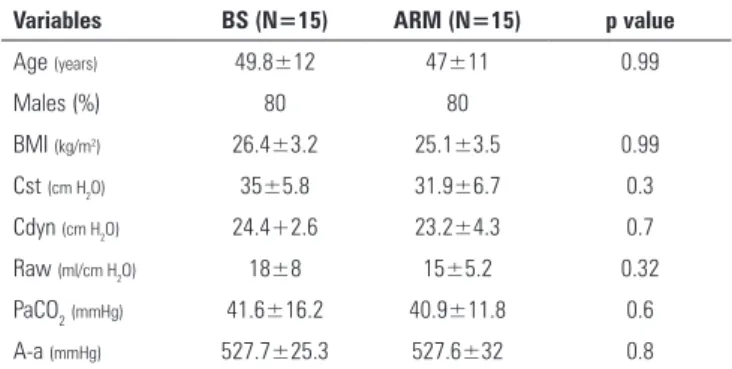
he sample consisted of 30 patients, distributed into two groups of 15 patients each. he mean age was 49.8 years, and 80% of the patients were male. he groups were homogeneous regarding age, gender, BMI and diagnosis (Table 1). In all cases, there was no need to increase the sedation because the patients did not have a respiratory drive at the moment of data collection.
Table 1 - Clinical and demographic characteristics of the breath stacking and alveolar recruitment groups on the first day of application of the techniques
Variables BS (N=15) ARM (N=15) p value
Age (years) 49.8±12 47±11 0.99
Males (%) 80 80
BMI (kg/m2) 26.4±3.2 25.1±3.5 0.99
Cst (cm H2O) 35±5.8 31.9±6.7 0.3
Cdyn (cm H2O) 24.4+2.6 23.2±4.3 0.7
Raw (ml/cm H2O) 18±8 15±5.2 0.32
PaCO2(mmHg) 41.6±16.2 40.9±11.8 0.6
A-a (mmHg) 527.7±25.3 527.6±32 0.8 BS - breath stacking; ARM - alveolar recruitment maneuver; BMI - body mass index; Cst - Static compliance; Cdyn - dynamic compliance; Raw - airway resistance; PaCO2 - partial pressure of carbon dioxide in arterial blood; A-a - alveolar-arterial. Data are expressed as the mean±standard deviation.
Immediately after the BS technique was applied, the patients exhibited an improvement in Cst from
35±5.8mL/cmH2O to 40.7±7mL/cmH2O (p=0.021).
For ARM, there was an improvement in Cst from
31.9±6.8mL/cmH2O to 38.6±9.2 mL/cmH2O (p=0.03)
immediately after the technique was used. he delta improvement (pre minus post) of Cst was similar for both groups (p=0.95) (Figure 1).
he mean Cdyn was 24.5±3.4mL/cmH2O and
26.2±4.2mL/cm H2O before and after BS was used,
respectively (p=0.222). Moreover, there was no improvement before and after ARM was applied, with
mean of 23.2±4.3mL/cmH2O and 26.6±5.8mL/cmH2O,
respectively (p=0.074). No signiicant diference was found between the deltas (pre minus post) of the groups (p=0.11).
he mean Rsr before and after the techniques were applied was 18.2±8mL/cmH2O and 18.5±8.1mL/cmH2O, respectively (p=0.914). For ARM, the mean Rsr decreased from 15±5.3mL/cmH2O before the technique was used to 14.6±5.1mL/cmH2O after it was applied (p=0.821). No signiicant diference was found between the deltas (pre minus post) of the groups (p=0.39).
Regarding oxygenation, the use of BS signiicantly improved PaO2, from 91.1±19.1mmHg to 113.3±26.2mmHg (p=0.013). Similarly, oxygenation improved signiicantly after ARM was used, from 84.2±29 mmHg to 102.8±18.7mmHg (p=0.046) (Figure 2). he delta PaO2 (pre minus post) was similar between the BS (p=0.073) and ARM (p=0.32) groups. Regarding PaCO2, BS caused a non-signiicant reduction from 41.6±16.2mmHg to 39.7±23.4mmHg (p=0.796). By contrast, after ARM was used, there was a non-signiicant increase from 40.9±11.8mmHg to 47.2±22.3mmHg (p=0.396). he delta PaCO2 (pre minus post) was similar between the groups (p=0.117).
Figure 2 - Evaluation of the arterial oxygen pressure in the pre- and post-intervention groups. PaO2 - partial pressure of oxygen.
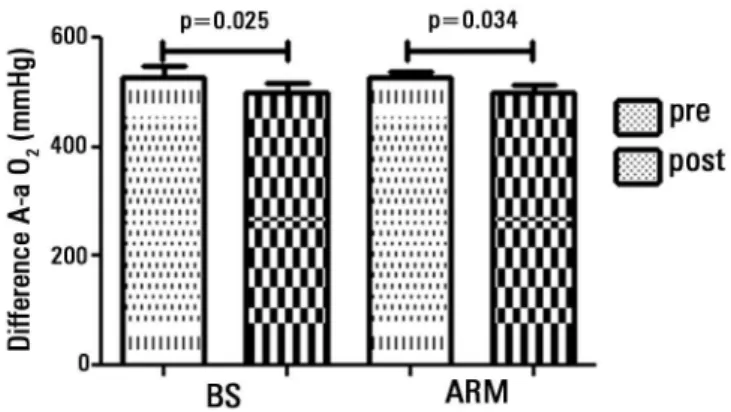
he alveolar-arterial oxygen pressure diference (P(A-a)O2) decreased signiicantly after BS was applied, from 527.7±33.8 to 500.1±30.2 (p=0.025). After ARM
was used, the (P(A-a)O2) diference decreased from
527.6±34.3 to 501.2±25.7 (p=0.034). he P(A-a)O2
diference was similar between the groups immediately after the techniques were applied (p=0.813) (Figure 3).
Figure 3 - Distribution of the alveolar-arterial O2 difference at two time points: before and after application of the techniques in groups I and II.
DISCUSSION
he present study showed that both the BS and ARM techniques led to improved lung mechanics in patients with acute lung injury. However, Cdyn did not improve with the use of these techniques.
he diferential of the present study was the adaptation of the BS technique in the orotracheal tube. his technique consists of occluding the patient’s mask at expiration. hus, the expiratory limb of the ventilator was occluded in the intubated patient. In cases where the threshold pressure was reached, the ventilator cycled continuously for 20 seconds, when the valve was then released. Studies of BS have not evaluated the lung compliance and oxygenation of patients subjected to this technique; the present investigation is the irst study to assess these features.
acute lung injury. he results demonstrated that using both techniques promoted an improvement in Cst, increased oxygenation and reduced the alveolar-arterial O2 diference.
he BS technique was corroborated by two studies. One showed that the technique increases the amplitude and duration of thoracic expansion,(1,15) whereas the second study revealed that BS increases lung volumes.(1) Other investigations compared the efect of high inspiratory volumes sustained in pauses of up to 5 seconds and volumes without inspiratory pauses and found a reversible efect for atelectasis in patients who were in the inspiratory pause group.(14,15)
A study(15) of 26 patients who underwent surgery showed that BS increases the inspiratory volume, and other investigations demonstrated an increase of 15% to 20% in lung volumes.(16-19) Reolon et al.(20) found a mean increase of 58% in the inspiratory volume and reversal of atelectatic areas. Another research group(21) observed improved respiratory muscle strength in individuals subjected to the BS technique. his improvement causes increased chest expansion, thus increasing static and dynamic lung compliance and oxygenation, as well as reversing atelectasis.(18-23)
Certain methods have been discussed regarding
ARM. Authors report the use of 30 and 40cmH2O
PEEP. Others, however, report a 15cmH2O delta, not allowing the peak pressure to exceed 40cmH2O. his fact indicates that the literature on postoperative ARM is still controversial, especially regarding the method of progressive PEEP increases. he hird Brazilian Consensus on Mechanical Ventilation states that ARM has a grade B recommendation because it reverses postoperative atelectasis.(11) Our results showed that ARM also improves static compliance and oxygenation and reduces the alveolar-arterial O2 diference. his most likely occurred because the lung areas were recruited and began to display a better ventilation-perfusion ratio.
ARM not only reverses the atelectasis processes but also decreases the patient’s time on mechanical ventilation, thereby decreasing lung injuries caused by prolonged mechanical ventilation.(2) However, alveolar collapse followed by distension repeatedly causes deleterious efects on the lung parenchyma because it creates shear forces in the alveolar wall, thus increasing the release of inlammatory mediators and aggravating the injury.(9) herefore, the use of ARM does not have the expected efect unless used with alveolar stabilization techniques.(11) It has also been shown that employing other techniques, such as continuous positive airway pressure (CPAP), also reduces the hospitalization time.(24) A study conirmed this fact by showing that the oxygenation index and shunt values return to baseline values 30 minutes after the application of ARM.(20) Another investigation demonstrated that employing these techniques may reduce the duration of mechanical ventilation and the length of the ICU stay.(21)
he present study has several limitations. he sample was not suicient to provide statistical power to our results because 19 patients per group were necessary and our groups comprised only 15 patients. Moreover, the study was not blind and was conducted at a single center. he results consist of short-term outcomes and cannot be extrapolated to medium-term periods, especially for the gas exchange and lung mechanics variables. Moreover, no clinical outcome was evaluated. We suggest that additional investigations with larger samples and more comprehensive measures of lung mechanics be performed.
CONCLUSION
he assessment of lung mechanics in a group of acute-lung-injury patients older than 35 years suggested that the breath stacking and alveolar recruitment maneuver techniques are efective in improving lung mechanics and gas exchange.
Objetivo: Comparar a eicácia da manobra de recrutamento alveolar e a técnica de breath stacking, na mecânica pulmonar e na troca gasosa, em pacientes com lesão pulmonar aguda.
Métodos: Trinta pacientes foram distribuídos em dois
grupos: Grupo 1 - breath stacking e Grupo 2 - manobra de recrutamento alveolar. Após receberem atendimento de isioterapia convencional, todos os pacientes receberam ambos os tratamentos, com intervalo de 1 dia entre eles. No primeiro
grupo foi aplicada primeiramente a técnica de breath stacking
e, posteriormente, a manobra de recrutamento alveolar. Já os pacientes do segundo Grupo 2 foram submetidos inicialmente ao recrutamento alveolar e, após, a técnica de breath stacking. Foram avaliadas as medidas de complacência pulmonar e de resistência de vias aéreas antes e após a aplicação de ambas as técnicas. Foram coletadas gasometrias arteriais pré e pós-técnicas para avaliar a oxigenação e a troca gasosa.
Resultados: Ambos os grupos apresentaram aumento
signiicativo da complacência estática após breath stacking
Descritores: Respiração com pressão positiva/métodos; Mecânica respiratória; Exercícios respiratórios; Troca gasosa pulmonar; Modalidades de isioterapia
REFERENCES
1. Dias CM, Plácido TR, Ferreira MF, Guimarães FS, Menezes SL. Inspirometria de incentivo e breath stacking: repercussões sobre a capacidade inspiratória em indivíduos submetidos à cirurgia abdominal. Rev Bras Fisioter. 2008;12(2):94-9.
2. Malbouisson LM, Humberto F, Rodrigues RR, Carmona MJ, Auler Júnior JO. Atelectasias durante anestesia: fisiopatologia e tratamento. Rev Bras Anestesiol. 2008;58(1):73-83.
3. Filardo FA, Faresin SM, Fernandes AL. Validade de um índice prognóstico para ocorrência de complicações pulmonares no pós-operatório de cirurgia abdominal alta. Rev Assoc Med Bras. 2002;48(3):209-16. 4. Auler Júnior JO, Nozawa E, Toma E, Kobayashi E, Degaki KL, Feltrim
MI, et al. Manobra de recrutamento alveolar na reversão da hipoxemia no pós-operatório imediato em cirurgia cardíaca. Rev Bras Anestesiol. 2007;57(5):476-88.
5. Jerre G, Silva TJ, Beraldo MA, Gastaldi A, Kondo C, Leme F, et al. Fisioterapia no paciente sob ventilação mecânica. J Bras Pneumol. 2007;33 Supl 2:S142-50.
6. Leguisamo CP, Kalil RA, Furlani AP. A efetividade de uma proposta fisioterapêutica pré-operatória para cirurgia de revascularização do miocárdio. Rev Bras Cir Cardiovasc. 2005;20(2):134-41.
7. Rosa FK, Roese CA, Savi A, Dias AS, Monteiro MB. Comportamento da mecânica pulmonar após a aplicação de protocolo de fisioterapia respiratória e aspiração traqueal em pacientes com ventilação mecânica invasiva. Rev Bras Ter Intensiva. 2007;19(2):170-5.
8. Bitencourt WS. Recrutamento alveolar: indicações e técnicas. In: Ismar Cavalcanti I, Cantinho F, Assad A. Medicina perioperatória: anestesia, dor, pós-operatório e reanimação. Rio de Janeiro: SAERJ; 2005. p. 921-6. 9. Costa DC, Rocha E, Ribeiro TF. Associação das manobras de recrutamento
alveolar e posição prona na síndrome do desconforto respiratório agudo. Rev Bras Ter Intensiva. 2009;21(2):197-203.
10. Gonçalves LO, Cicarelli DD. Manobra de recrutamento alveolar em anestesia: como, quando e porque utilizá-la. Rev Bras Anestesiol. 2005;55(6):631-8.
11. Amato MB, Carvalho CR, Ísola A, Vieira S, Rotman V, Moock M, et al. Ventilação mecânica na lesão pulmonar aguda (LPA)/Síndrome do desconforto respiratório agudo (SDRA). J Bras Pneumol. 2007;33 Supl 2:S119-27.
12. Porto EF, Castro AA, Leite JR, Miranda SV, Lancauth A, Kumpel C. Análise comparativa da complacência do sistema respiratório em três diferentes posições no leito (lateral, sentada e dorsal) em pacientes submetidos à ventilação mecânica invasiva prolongada. Rev Bras Ter Intensiva. 2008;20(3):213-9.
13. Suter PM, Fairley B, Isenberg MD. Optimum end-expiratory airway pressure in patients with acute pulmonary failure. N Engl J Med. 1975;292(6):284-9. 14. Foti G, Cereda M, Sparacino M, De Marchi L, Villa F, Pesenti A. Effects
of periodic lung recruitment maneuvers on gas exchange and respiratory mechanics in mechanically ventilated acute respiratory distress syndrome (ARDS) patients. Intensive Care Med. 2000;26(5):501-7.
15. Auler Júnior JO, Galas FR, Hajjar LA, França S. Ventilação mecânica no intra-operatório. J Bras Pneumol. 2007;33 Supl 2:S137-41.
16. Thoren L. Post-operative pulmonary complications: observations on their prevention by means of physiotherapy. Acta Chir Scand. 1954;107 (2-3):193-205.
17. Baker WL, Lamb VJ, Marini JJ. Breath-stacking increases the depth and duration of chest expansion by incentive spirometry. Am Rev Respir Dis. 1990;141(2):343-6.
18. Overend TJ, Anderson CM, Lucy SD, Bhatia C, Jonsson BI, Timmermans C. The effect of incentive spirometry on postoperative pulmonary complications: a systematic review. Chest. 2001;120(3):971-8.
19. Coelho DL, Belisário TG, Souza LF, Zacheu FS, Oliveira JF, Guimarães FS, et al. Efeitos respiratórios da espirometria de incentivo e do breath stacking no pós-operatório de cirurgia cardíaca. Rev Bras Fisioter. 2010;14(Supl 1):422.
20. Reolon VO, Casagrande J, Lorenzon I, Kessler A. Treinamento muscular ventilatório por breath stacking em indivíduos jovens e hígidos [Internet]. In: X Salão de Iniciação Científica PUCRS. 2009. [citado 2014 Jan 25]. Dis-ponível em: http://www.pucrs.br/edipucrs/XSalaoIC/Ciencias_da_Saude/ Fisioterapia_e_Terapia_Ocupacional/71493-VITORIO_ORTIZ_REOLON.pdf 21. Reolon VO, Casagrande JB, Lorenzon IM, Spigolon AP, Gonçalves RR,
Bueno AD, et al. Breath stacking aumenta a força muscular ventilatória em indivíduos jovens e hígidos. Rev Bras Fisioter. 2010;14(Supl 1):296. 22. Oczenski W, Hörmann C, Keller C, Lorenzl N, Kepka A, Schwarz S, et al.
Recruitment maneuvers after a positive end-expiratory pressure trial do not induce sustained effects in early adult respiratory distress syndrome. Anesthesiology. 2004;101(3):620-5.
23. Castro AA, Calil SR, Freitas SA, Oliveira AB, Porto EF. Chest physiotherapy effectiveness to reduce hospitalization and mechanical ventilation length of stay, pulmonary infection rate and mortality in ICU patients. Respir Med. 2013;107(1):68-74.
24. Squadrone V, Coha M, Cerutti E, Schellino MM, Biolino P, Occella P, Belloni G, Vilianis G, Fiore G, Cavallo F, Ranieri VM; Piedmont Intensive Care Units Network (PICUN). Continuous positive airway pressure for treatment of postoperative hypoxemia: a randomized controlled trial. JAMA. 2005;293(5):589-95.
(p=0,021) e recrutamento alveolar (p=0,03), mas não houve diferença entre eles (p=0,95). A complacência dinâmica não aumentou para os grupos breath stacking (p=0,22) e recrutamento alveolar (p=0,074), sem diferença entre os grupos (p=0,11). A resistência de vias aéreas não diminuiu para ambos os grupos: breath stacking (p=0,91) e recrutamento alveolar (0,82), sem diferença entre os grupos p=0,39. A pressão parcial de oxigênio aumentou signiicantemente após breath stacking
(p=0,013) e recrutamento alveolar (p=0,04); mas entre os grupos não houve diferença (p=0,073). A diferença alvéolo
arterial de O2 diminuiu para ambos os grupos após intervenções
breath stacking (p=0,025) e recrutamento alveolar (p=0,03), não
sendo diferente entre os grupos (p=0,81).
Conclusão: Nossos dados sugerem que as técnicas breath
stacking e de recrutamento alveolar são eicazes em melhorar