Bronchial hygiene technique with manual
hyperinlation and thoracic compression:
efectiveness and safety
Efetividade e segurança da técnica de higiene brônquica:
hiperinsulação manual com compressão torácica
INTRODUCTION
Patients under invasive mechanical ventilation (IMV) frequently retain pulmonary secretions because the normal airway clearance mechanisms
(mucociliary transport and cough) are impaired.(1) Pulmonary secretion
accumulation may cause increased airway resistance and partial or total obstruction, resulting in alveolar hypoventilation and atelectasis, hypoxemia and increased respiratory load. Additionally, secretion stasis and atelectasis constitute a favorable environment for bacterial
colonization and pulmonary infections.(1,2) Therefore, it is clear that
Camila Marques Dias1, Tatiane
Martins Siqueira1, Tatiane Regina
Faccio1, Luciana Costa Gontijo1,
Juliana Almeida de Souza Borges Salge1, Marcia Souza Volpe1
1. Physiotherapy Course, Universidade Federal do Triângulo Mineiro – UFTM – Uberaba (MG), Brazil.
ABSTRACT
Objectives: To evaluate the efects of the manual hyperinlation with thoracic compression (MHTC) maneuver on the clearance of secretions, pulmonary m e c h a n i c s , h e m o d y n a m i c s a n d oxygenation in mechanically ventilated patients.
Methods: his was a controlled, crossover study that included twenty patients who were under invasive ventilation for more than 48 hours. Four hours after the last airway suctioning procedure, the patients underwent the study interventions, Suction alone or MHTC plus Suction, in sequence at four hour intervals. he sequence order for the procedures was established by randomization. Data were collected before, during and 5, 15, 30 and 60 minutes after each intervention. he suctioned secretions were collected and weighed.
Results: No signiicant diferences between the procedures were found regarding tidal volume, plateau pressure and pulmonary compliance (p>0.05).
he hemodynamic variables showed increased pressures and heart rate during the procedures and returned to baseline values ive minutes after the end of the procedure (p≤0.001). No signiicant hemodynamic diferences were seen between the interventions (p>0.05). For the duration of the study, oxygen saturation was 99% with only two exceptions during the MHTC + Suction procedure, where saturation was 98% (p<0.05). No signiicant diferences were observed between the techniques regarding the weight of the suctioned secretion.
Conclusion: he results suggest that MHTC, as performed in this study, adds no beneit with respect to oxygenation optimization, pulmonary mechanics and clearance of secretions. However, the MHTC maneuver did not result in hemodynamic changes when compared to the suctioning procedure alone.
Key w o rd s : Su c t i o n ; Ph y s i c a l therapy modalities; Respiratory therapy/ m e t h o d s ; Re s p i r a t i o n , a r t i f i c i a l ; Bronchi/secretion
his study was conducted at Universidade Federal do Triângulo Mineiro – UFTM – Uberaba (MG), Brazil.
Conlicts of interest: None.
Submitted on November 17, 2010 Accepted on May 9, 2011
Corresponding author:
Márcia Souza Volpe
Departamento de Fisioterapia Aplicada - UFTM
Av. Getúlio Guaritá, 159, 3° andar - sala 331
ZIP Code: 38025-440 - Uberaba (MG), Brazil.
pulmonary secretions are a relevant complicating factor that may prolong IMV time and, consequently, negatively impact the patient’s prognosis.
In this context, physiotherapy in IMV patients may be considered to be a strategy for the prevention and treatment of lower respiratory tract infections because it is aimed at removing bronchial secretions, consequently maintaining appropriate
ventilation and gas exchange.(3) Of the available
physiotherapeutic techniques used to aid the removal of secretions, manual hyperinflation with thoracic compression (MHTC), also known as bag squeezing, was first described in 1968 by Clement
and Hübsch.(4) Based on the original description,
MHTC is comprised of manual hyperinflation (MH) using a manual resuscitator and expiratory thoracic compression (TC), and it is completed with the removal of the displaced secretion by tracheal suctioning. MH, in turn, consists of three steps: 1) slow high tidal volume inflation; 2) a two to three second inspiratory pause; and 3) the fast release of
the resuscitator.(5) Steps 1 and 2 aim to promote
pulmonary expansion and uniform gas distribution, providing ventilation of previously collapsed areas, and step 3 aims to provide high expiratory flow, causing the displacement of peripheral secretions toward more central areas. Therefore, by simulating coughing, MHTC promotes clearance of bronchial
secretions.(6) The combination of TC and MH aims
to optimize the maneuver, thus, increasing expiratory flow. In turn, the higher the peak expiratory flow, the more effective that the maneuver is.
However, there is evidence that increasing the clearance of secretions is dependent not only on high expiratory flow peaks but also on the ratio or difference between inspiratory and expiratory peak flows.(7-9) According to Kim et al., to displace
secretions toward the oropharynx, the expiratory peak flow should be 10% above the inspiratory peak flow.(7)
During MHTC, the generation of low inspiratory flows depends on the tidal volume and the operator’s inflation time, i.e., for a given volume, the longer the inflation, the lower the inspiratory flow.(10,11) Yet, the
expiratory peak flow depends on respiratory system compliance, fast resuscitator release, optimal TC and tidal volume.(10,11) The tidal volume, in turn, depends
on the size and type of resuscitator, the size of the operator’s hands and the use of one or both hands for MH.(10)
Because the procedure simulates coughing, this maneuver appears to be particularly indicated for IMV patients who have a reduced or absent coughing reflex, ineffective cough and/or pulmonary hypersecretion. Although bedside evaluation of coughing effectiveness can be particularly simple but not error-free (by measuring the peak flow of a cough(12) or subjectively during tracheal suctioning),
hypersecretion has, thus far, not been clearly defined. The difficulty in specifying the precise indications for the maneuver makes it difficult to evaluate the results of studies that explored the efficacy of MHTC, as well as the results of studies that investigated other bronchial clearance maneuvers or the suctioning procedure alone.(13, 14)
The literature on MH not associated with TC is extensive.(3,5,14-16) According to recent European Task
Force recommendations, MH used to increase the clearance of secretions in IMV patients has a level B recommendation on an A to D scale, i.e., there are published controlled and randomized trials on this subject; however, there is a limited body of
evidence.(3) However, no recommendations were
made concerning the use of MHTC, likely due to the paucity of studies on this subject.(3)
This study was aimed at evaluating the effects of the MHTC bronchial hygiene technique on the clearance of bronchial secretions, pulmonary mechanics, hemodynamics and the oxygenation of IMV patients.
METHODS
A prospective, controlled and randomized crossover trial was conducted in a non-intentional probabilistic sample of patients in an adult general intensive care unit (ICU) at the Hospital das Clínicas da Universidade Federal do Triângulo Mineiro (MG, Brazil). This trial was approved by the institution’s ethics committee. An informed consent form was signed by the appropriate, responsible persons.
We included patients who met the following criteria: above 18 years of age, under IMV for ≥ 48 hours, positive end-expiratory pressure (PEEP) ≤ 10 cmH2O, inspired oxygen fraction (FiO2) ≤ 0.6
and peripheral oxygen saturation (SpO2) > 92%.
chest tubes; bronchospasm; costal arch fractures; suspected or confirmed intracranial hypertension and burn patients were excluded.
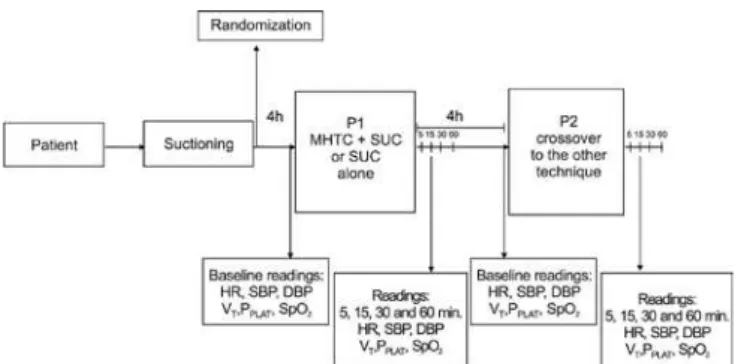
The study protocol consisted of two phases with a four hour interval between them. Four hours before the first phase, a zero time was established. At this time, patients underwent tracheal suctioning. At phase 1 (P1), the patient underwent either suctioning (SUC) alone or the MHTC plus SUC procedure. The order in which the procedures were performed was based on randomization, which was performed by allotment using opaque envelopes in blocks of 10. During the second phase (P2), the patient was crossed to the alternative technique not used during P1 (Figure 1).
Procedures description
SUC: During the SUC alone procedure, immediately after ventilator disconnection, 2 mL of 0.9% saline solution (SS0.9%) was instilled into the airway, and the trachea was suctioned. Next, the patient was reconnected to the ventilator and allowed five ventilator cycles. This procedure was repeated three times, yielding a total infused volume of 6 mL of SS0.9%.
MHTC + SUC: MHTC + SUC was conducted using a manual self-inflating resuscitator (OXIGEL®) with 1,200 mL internal volume, enriched with 15
L/min O2. During the maneuver, a slow and deep
inflation was performed, followed by a 2-3 second inspiratory pause; it was completed with fast resuscitator release combined with expiratory TC. The maneuver was repeated ten times; the first five times the compression was made on the right lung base, and the remaining five times, it was conducted on the left base. Next, 2 mL of SS0.9% was instilled into the airway, and SUC was performed. At the end of the SUC, the patient was reconnected to the ventilator and allowed five ventilator cycles. The procedure was repeated three times, yielding a total infused volume of 6 mL of SS0.9%. The peak inspiratory pressure (PIP) generated during the maneuver was monitored using a manovacuometer connected to the resuscitator, which was limited at
≤ 40 cmH2O. MH and TC were conducted by the
same investigator; the hyperinflation was performed using the right hand, while the TC was performed using the left hand.
Three investigators were involved in the procedures: one performed SUC, another instilled
the SS0.9% and conducted the MHTC (only for MHTC + SUC) procedure, and the third collected data.
One minute before starting and during the
procedures (SUC and MHTC + SUC), FiO2 was
increased and kept at 1.0; the remaining ventilator parameters and mode were not changed during the trial, including during the data recording. The tracheal suctioning technique for both phases was conducted as recommended by the American Association for Respiratory Care.(17)
The patients remained in the supine position for 20 minutes before, during and for 60 minutes after each procedure. During the intervals Zero time-P1 and P1-P2, no tracheal suctioning procedures were performed. In addition, no bronchodilators were given, and no procedures requiring the patient to be mobilized, e.g., bathing, were conducted.
The studied variables consisted of hemodynamic data (heart rate [HR], systolic blood pressure [SBP] and diastolic blood pressure [DBP]), oxygenation (SpO2), respiratory mechanics (tidal volume [VT], plateau pressure [PPLAT] and respiratory system static compliance [Cst]) and suctioned bronchial secretion weight.
Mechanical data were recorded before starting (baseline) and 5, 15, 30 and 60 minutes after the end of the procedure. If the patient had spontaneous ventilation, controlled cycles were awaited to record mechanics data. At each study time, five values were
collected for VT and for PPLAT, and the mean was
considered to be the observed value (Figure 1).
The hemodynamic and SpO2 data were recorded
at the same times described for the collection of
HR – heart rate; SBP – systolic blood pressure; DBP – diastolic blood pressure; VT – tidal volume; PPLAT – plateau pressure; SpO2 –peripheral oxygen saturation; P1 – Phase 1; P2 – Phase 2.
the mechanical data and just after each suctioning procedure during the phases P1 and P2. Blood pressures, HR and SpO2 were read from the patient’s monitor, and respiratory variables were obtained directly from the mechanical ventilator’s screen
(Interplus®, Intermed®). PPLAT was read after a 1-3
second respiratory pause. Cst was calculated using the formula VT /PPLAT – PEEP.
Suctioned bronchial secretions were collected directly from the suction tube into a collector bottle. After each phase’s third SUC, the suction tube was rinsed with 2 mL of SS0.9% to remove any residual secretion. Immediately after the collection, the secretion was weighed on a digital scale. The secretion weight was obtained by taking the total weight and subtracting the empty bottle’s weight.
The analysis of the mechanic and hemodynamic variables associated with the interventions (MHTC + SUC versus SUC alone) was conducted using a repeated-measures analysis of variance (ANOVA), followed by contrast analysis for multiple
comparisons, where applicable. SpO2 data were
analyzed using the Wilcoxon pairwise samples non-parametrical test. The bronchial secretion weights were compared using Student’s t test. The significance level was 5%, i.e., p<0.05.
RESULTS
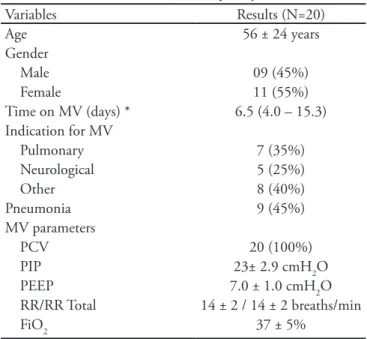
Twenty patients were included; their baseline characteristics are described in Table 1. During the study, no patient used vasoactive drugs, and most (60%) of the patients were under continued sedation with the combination of fentanyl + midazolam. Four patients were on IMV due to chronic obstructive pulmonary disease, three for pneumonia, one for stroke, four for head trauma, two for surgery, one for cardiorespiratory arrest, one for decreased consciousness level, three for exogenous intoxication and one for septic arthritis.
No significant changes were found for the variables VT, VPLAT, and Cst after both procedures (p=0.995; p=0.63 and p=0.675, respectively). In addition, during the course of the procedures, there was
minimal change in these parameters (Figure 2). VT
was reduced no more than 11 mL, PPLAT less than 0.5
cmH2O and Cst less than 2 mL/cmH2O, indicating
that the combination of MHTC and SUC did not offer an additional benefit in the optimization of pulmonary mechanics.
The mean PIP generated during the MHTC was
27.8 ± 6.6 cmH2O, with a range from 14 to 40
cmH2O.
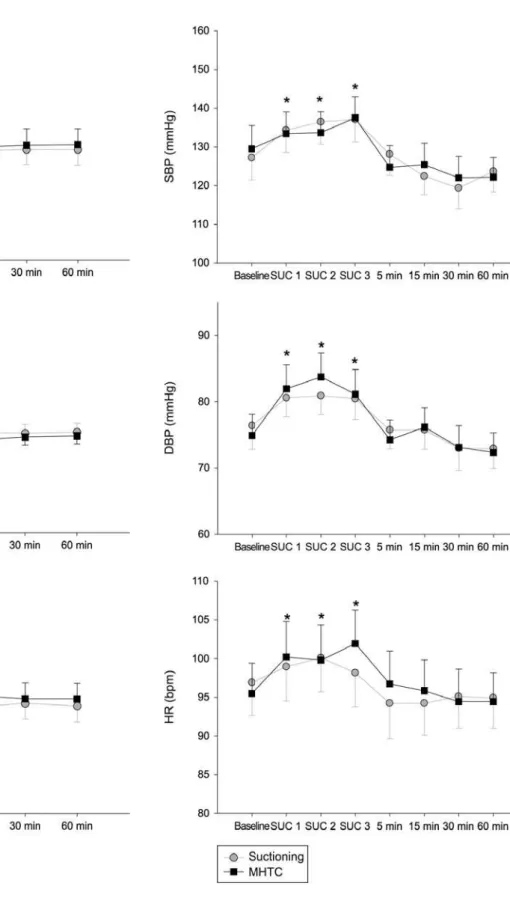
Regarding hemodynamics, SBP, DBP and HR values changed during the procedures, with increased blood pressure and heart rate during the SUC alone and MHTC + SUC (p≤0.001). These variables returned to baseline values five minutes after the interventions. No hemodynamic difference was found between the procedures (p=0.611, p=0.328 and p=0.220 for SBP, DBP and HR, respectively) (Figure 3).
During the study period, the mean SpO2 was
99%, except for the times after the second and third suction during the MHTC + SUC procedure when it was 98% (p=0.028 and p=0.048, respectively). During and after both interventions, the lowest
recorded SpO2 value was 88%, and the highest was
100%.
Regarding the clearance of bronchial secretions, no significant difference was observed between the techniques (p=0.308). The mean wet weight of the collected secretions was 6.60 ± 2.12 grams and 5.95 ± 1.84 grams for the SUC alone and MHTC + SUC techniques, respectively.
Table 1 – Characteristics of the study subjects
Variables Results (N=20)
Age 56 ± 24 years
Gender
Male 09 (45%)
Female 11 (55%)
Time on MV (days) * 6.5 (4.0 – 15.3) Indication for MV
Pulmonary 7 (35%) Neurological 5 (25%)
Other 8 (40%)
Pneumonia 9 (45%)
MV parameters
PCV 20 (100%)
PIP 23± 2.9 cmH2O PEEP 7.0 ± 1.0 cmH2O RR/RR Total 14 ± 2 / 14 ± 2 breaths/min
FiO2 37 ± 5%
VT – tidal volume; PPLAT –plateau pressure; Cst – static compliance; MHTC – manual hyperinlation with thoracic compression; min – minutes. Data expressed as mean ± standard error.
Figure 2 – he proile of the respiratory mechanics during both study phases.
SBP – systolic blood pressure; DBP – diastolic blood pressure; HR – heart rate; MHTC – manual hyperinlation with thoracic compression; SUC – suctioning; min – minutes. Data expressed as mean ± standard error. *p<0.05 versus baseline evaluation.
DISCUSSION
he most important indings in this study can be summarized as follows: 1) the MHTC maneuver combined with tracheal suctioning caused a hemodynamic response that was similar to that observed with suctioning alone and 2) the MHTC procedure as applied in this trial failed to add any beneit regarding oxygenation optimization, respiratory mechanics or clearance of bronchial secretions.
During and after the maneuvers, MHTC + SUC and SUC alone, a similar hemodynamic response was seen, which was characterized by increased HR, SBP and DBP. hese values returned to baseline values ive minutes after the end of the procedures. Because the hemodynamic response observed during and after both maneuvers showed similar patterns, it can be concluded that the observed changes were due to the suctioning procedure and that the MHTC maneuver was shown to be hemodynamically safe without no long-term impact on cardiovascular parameters.
A drop in pressure during the MH maneuver has already been described in the literature. his drop is thought to be the result of reduced venous return due to increased thoracic pressure associated to no HR changes.(18) As in this study, the mean P
IP value during
MHTC was 27.8 cmH2O; thus, the impact on venous
return was probably irrelevant.
Diferent cardiovascular changes, e.g., hypotension and hypertension, bradycardia and tachycardia, have been extensively described in the literature as complications of the suctioning technique.(17,19) According to Segar
et al., an increase in BP is apparently a consequence of the stimulation of the sympathetic receptors of the main airways, which results in increased sympathetic activity, peripheral vasoconstriction and, consequently, increased pressure.(20) However, the changes observed
in this trial may be better ascribed to adrenergic release and sympathetic vasoconstrictive response caused by the stress of the procedure, as suggested by Paraz and Lipman.(21) Regardless of the physiological mechanism
responsible for the increased blood pressure and heart rate, the mean SBP did not increase above 140 mmHg, the DBP did not increase above 85 mmHg and the HR remained below 105 bpm, showing that the suctioning technique was safely performed.
Variables related to respiratory mechanics and the weights of the suctioned secretions were not signiicantly diferent between the procedures in this study, suggesting that the MHTC maneuver, as
performed in this trial and for the studied population, was not efective.
Most of the trials on bronchial hygiene maneuvers in IMV patients have evaluated the efects of MH alone, i.e., not combined with TC, and show conlicting results. Choi et al. compared MH followed by suctioning versus suctioning alone in 15 ventilator-associated pneumonia patients and found improved compliance and reduced resistance, which persisted for at least 30 minutes after the MH.(15) Hodgson et al., in a multicenter trial that
included 18 patients, found improved compliance and increased clearance of secretion (wet weight) after adding MH to the physiotherapeutic treatment with no cardiovascular or oxygenation repercussion.(6) However,
in another trial, the use of MH alone in combination with lateral decubitus positioning and later tracheal suctioning in patients with pulmonary injury failed to signiicantly change compliance and oxygenation values after 60 minutes.(22) Of the few trials associating
MH and TC, Rosa et al. observed reduced respiratory system resistance with no dynamic compliance changes after the maneuver in 12 IMV patients when compared to suctioning alone. his reduction was maintained for two hours after the maneuver; such a reduction was not seen with tracheal suctioning alone.(23) However, in that
study, it was not clear if the MH was used in association with TC or if the techniques were sequentially applied. he lack of literature consensus is likely a consequence of the use of distinct techniques, diferent populations and small samples, rendering a comparison of results diicult.(6)
he failure to identify improvement in compliance or in the amount of suctioned secretions after MHTC
in this study was likely due to the achieved VT,
which was below the recommended, and because the generated expiratory/inspiratory lows ratio was sub-optimal. Some authors have reported that during MH, a VT 50% above the mechanical ventilator VT should be used.(24) However, more recently, when documenting
the ventilation pattern during MH, Maxwell and Ellis found that the VT was close to 100% above the ventilator’s VT , with a mean PIP of 36 cmH2O.(11) he
authors support the idea that VT and PIP during MH should be high enough to promote appropriate alveolar recruitment.
that the broader the diference in absolute peaks (expiratory > inspiratory) above a given threshold, the larger the secretion displacement toward the trachea.(9)
Although the VT generated during the maneuvers was not monitored, the mean PIP achieved during the maneuvers
was 27.8 cmH2O. Considering the resistance imposed
by the ventilatory prosthesis, the pressure efectively distending the pulmonary parenchyma and generating
VT was lower than this value. When VT is low, the
thoracic expansion and recruitment of collapsed units are also lower, resulting in a lower expiratory peak low generated, thus rendering the technique inefective. Administration of a low VT was likely a consequence of performing the MH with a single hand, while the other hand compressed the chest. However, MH with both hands associated with TC demands three concomitant professionals: one for MH, another for TC and a third for suctioning; this is currently unfeasible in clinical practice. Another issue to be considered is the type of resuscitator used in this trial (self-inlating ) with a low internal volume (1,200 mL), which is diferent from low-inlating resuscitators, which are able to provide higher VT.(10) However, diferent from other countries,
e.g., Australia, in Brazil, the use of low-inlating resuscitators is not common in the adult ICU, rather they are used in anesthesiology.(6)
Despite these considerations, our results agree with the observations by Rodrigues, who evaluated the efects of three bronchial hygiene techniques in IMV post cardiovascular surgery patients in two diferent phases.(25) During the irst phase, patients categorized
as not having pulmonary secretions were included, and the second phase included patients categorized as hyper-secreting. For both phases, the author found no signiicant diferences with regard to respiratory mechanics, clearance of secretions and hemodynamic variables between the MHTC maneuver and suctioning alone.
Another possibility to explain the lack of secretion clearance and diferences in respiratory mechanics between the techniques is that both procedures were applied sequentially after a pre-determined four hour interval. he standardization of the time interval is relevant because the accurate bedside identiication of the treatment indication, i.e., presence of pulmonary secretion, is not easy regardless of the procedure utilized. Even with rhonchi on pulmonary auscultation and a sawtooth pattern in the expiratory low signal observed on the ventilator screen, the presence of tracheal secretions cannot be assured.(13) herefore, to
prevent equivocal indications, the time interval has been standardized. Other trials comparing diferent bronchial hygiene treatments in IMV patients have also established two,(25) four,(15) or at least three hour
intervals between the procedures.(6) However, it is not
possible to state that in four hours, even in patients under IMV for longer than 48 hours, that enough secretions would have been produced to indicate the treatment. Additionally, it should be highlighted that in clinical practice, the treatment should always be driven by the patient’s need.(1)
Regarding oxygenation, although a statistically signiicant diference was observed, the lowest mean
SpO2 seen during MHTC + SUC was 98%, and
during SU alone, was 99%. herefore, despite of being statistically signiicant, this diference was not clinically relevant. During both procedures, FiO2 was increased one minute before the procedure and kept at 1.0. However, during MHTC, although the resuscitator was fed with 15 L/min oxygen, a reservoir was not used; thus, the FiO2 provided was lower than 1.0, possibly explaining the lower SpO2.
he limitations of this trial included the broad range of patients’ underlying diseases, the impossibility of assuring that all patients were hyper-secreting or had retained secretions (despite the issues regarding deinition of these concepts), the lack of monitoring VT and the lows generated during MHTC, and not assessing respiratory system resistance, as the mechanical ventilators had no way to monitor inspiratory low. However, regardless of these limitations, this study adds important information concerning the MHTC maneuver, which has been poorly evaluated in the literature and is frequently used during physiotherapeutic care.(5,6,16)
New trials that monitor VT, PIP and the lows
generated during the MHTC maneuver are necessary to provide a better understanding of the efects of this technique.
CONCLUSION
he MHTC maneuver had no clinically relevant impact on cardiovascular function when compared to SUC alone and was shown to be hemodynamically safe when performed by a single professional using one hand for MH and the other hand for TC. However, moderate
PIP values were generated, which were apparently
RESUMO
Objetivos: Avaliar os efeitos da manobra hiperinsulação manual com compressão torácicaem termos de depuração de secreções, mecânica pulmonar, hemodinâmica e oxigenação em pacientes sob ventilação mecânica invasiva.
Métodos: Foi realizado estudo controlado do tipo cruza-do, com vinte pacientes com mais de 48 horas em ventilação mecânica invasiva. Após 4 horas da última aspiração os pa-cientes foram submetidos aos procedimentos, aspiração ou hiperinsulação manual com compressão torácica e aspiração, um após o outro, respeitando intervalo de quatro horas, em ordem estabelecida conforme randomização. As variáveis fo-ram coletadas nos momentos pré, durante e após 5, 15, 30 e 60 minutos do término dos procedimentos. A secreção aspi-rada foi coletada e mensuaspi-rada.
Resultados: Não foram encontradas alterações signiica-tivas para o volume corrente, pressão platô e complacência após os dois procedimentos durante o estudo (p>0,05). As variáveis hemodinâmicas apresentaram comportamento
dis-tinto ao longo do tempo caracterizado por aumento das pres-sões e frequência durante a realização dos procedimentos, com retorno aos valores basais após 5 minutos das interven-ções (p≤0,001). Não foi encontrada diferença no comporta-mento hemodinâmico entre os procedicomporta-mentos (p>0,05). A saturação de oxigênio durante todos os momentos do estudo foi 99%, com exceção de dois momentos durante a realização da HMCT+ASP que foi 98% (p<0,05). Não houve diferença signiicante entre as técnicas em relação ao peso das secreções aspiradas.
Conclusão: Os resultados sugerem que a hiperinsulação manual com compressão torácica, conforme aplicada neste estudo, embora tenha se mostrado segura hemodinamica-mente, não apresentou benefícios em relação à técnica de aspiração isolada em termos de otimização da oxigenação, mecânica respiratória e depuração de secreções.
Descritores: Sucção; Modalidades de isioterapia; Terapia respiratória/métodos; Respiração artificial; Brônquios/ secreção
REFERENCES
1. Branson RD. Secretion management in the mechanically ventilated patient. Respir Care. 2007;52(10):1328-42; discussion 1342-7.
2. Konrad F, Schreiber T, Brecht-Kraus D, Georgief M. Mucociliary transport in ICU patients. Chest. 1994;105(1):237-41.
3. Gosselink R, Bott J, Johnson M, Dean E, Nava S, Norrenberg M, et al. Physiotherapy for adult patients with critical illness: recommendations of the European Respiratory Society and European Society of Intensive Care Medicine Task Force on Physiotherapy for Critically Ill Patients. Intensive Care Med. 2008;34(7):1188-99. 4. Clement AJ, Hübsch SK. Chest physiotherapy by the ‘bag
squeezing’ method: a guide to technique. Physiotherapy. 1968;54(10):355-9.
5. Denehy L. he use of manual hyperinlation in airway clearance. Eur Respir J. 1999;14(4):958-65.
6. Hodgson C, Denehy L, Ntoumenopoulos G, Santamaria J, Carroll S. An investigation of the early efects of manual lung hyperinlation in critically ill patients. Anaesth Intensive Care. 2000;28(3):255-61.
7. Kim CS, Iglesias AJ, Sackner MA. Mucus clearance by two-phase gas-liquid low mechanism: asymmetric periodic low model. J Appl Physiol. 1987;62(3):959-71.
8. Benjamin RG, Chapman GA, Kim CS, Sackner MA. Removal of bronchial secretions by two-phase gas-liquid transport. Chest. 1989;95(3):658-63.
9. Volpe MS, Adams AB, Amato MB, Marini JJ. Ventilation patterns inluence airway secretion movement. Respir
Care. 2008;53(10):1287-94.
10. Maxwell LJ, Ellis ER. he efect of circuit type, volume delivered and “rapid release” on low rates during manual hyperinlation. Aust J Physiother. 2003;49(1):31-8. 11. Maxwell LJ, Ellis ER. Pattern of ventilation during manual
hyperinlation performed by physiotherapists. Anaesthesia. 2007;62(1):27-33.
12. Freitas FS, Parreira VF, Ibiapina CC. Aplicação clínica do pico de luxo da tosse: uma revisão de literatura. Fisioter Mov. 2010;23(3):495-502.
13. Guglielminotti J, Alzieu M, Maury E, Guidet B, Ofenstadt G. Bedside detection of retained tracheobronchial secretions in patients receiving mechanical ventilation: is it time for tracheal suctioning? Chest. 2000;118(4):1095-9. 14. Paulus F, Binnekade JM, Middelhoek P, Schuitz MJ, Vroom
MB. Manual hyperinlation of intubated and mechanically ventilated patients in Dutch intensive care units--a survey into current practice and knowledge. Intensive Crit Care Nurs. 2009;25(4):199-207.
15. Choi JS, Jones AY. Efects of manual hyperinlation and suctioning in respiratory mechanics in mechanically ventilated patients with ventilator-associated pneumonia. Aust J Physiother. 2005;51(1):25-30.
16. Lemes DA, Guimarães FS. O uso da hiperinsulação como recurso isioterapêutico em unidade de terapia intensiva. Rev Bras Ter Intensiva. 2007;19(2):221-5.
17. AARC clinical practice guideline. Endotracheal suctioning of mechanically ventilated adults and children with artiicial airways. American Association for Respiratory Care. Respir Care. 1993;38(5):500-4.
hyperinlation on haemodynamics in an animal model. Physiother Res Int. 2003;8(3):155-63.
19. Pagotto IM, Oliveira LRC, Araújo FCLC, Carvalho NAA, Chiavone P. Comparação entre os sistemas aberto e fechado de aspiração: revisão sistemática. Rev Bras Ter Intensiva. 2008;20(4):331-8.
20. Segar JL, Merrill DC, Chapleau MW, Robillard JE. Hemodynamic changes during endotracheal suctioning are mediated by increased autonomic activity. Pediatr Res. 1993;33(6):649-52.
21. Paratz J, Lipman J. Manual hyperinlation causes norepinephrine release. Heart Lung. 2006;35(4):262-8. 22. Ntoumenopoulos G, Gild A, Cooper DJ. he efect of
manual lung hyperinlation and postural drainage on pulmonary complications in mechanically ventilated trauma
patients. Anaesth Intensive Care. 1998;26(5):492-6. 23. Rosa FK, Roese CA, Savi A, Dias AS, Monteiro MB.
Comportamento da mecânica pulmonar após a aplicação de protocolo de isioterapia respiratória e aspiração traqueal em pacientes com ventilação mecânica invasiva. Rev Bras Ter Intensiva. 2007;19(2):170-5.
24. Singer M, Vermaat J, Hall G, Latter G, Patel M. Hemodynamic efects of manual hyperinlation in critically ill mechanically ventilated patients. Chest. 1994;106(4):1182-7.