A study of a couple with type 2 diabetes: dyadic adjustment and
psychological morbidity
M. GRAÇA PEREIRA1*, JOSÉ C. MACHADO2, M. RUI SOUSA3, SUSANA PEDRAS4
1 Associate professor; School of Psychology, University of Minho, Braga, Portugal
2 Assistant professor; Institute of Social Sciences. School of Psychology, University of Minho, Braga, Portugal 3 Postgraduate student (PhD); School of Nursing of Porto, Porto, Portugal
4 Postgraduate student (PhD); School of Psychology, University of Minho, Braga, Portugal
S
UMMARYStudy conducted at various Health Center Groupings in the North of Portugal
Article received: 3/27/13
Accepted for publication: 1/30/14
*Correspondence:
Escola de Psicologia, Universidade do Minho 4710-054 Braga,
Portugal [email protected]
http://dx.doi.org/10.1590/1806-9282.60.04.010
Conflict of interest: none
Objective: this study assessed dyadic adjustment and psychological morbidity in type 2 diabetic patients and their partners, focusing on the role of gender.
Methods: 214 diabetic patients and their partners participated in the cross-sec-tional study and were assessed on psychological morbidity (HADS) and marital adjustment (RDAS). Data was analyzed using dyadic analysis, a statistical pro-cess that studies the patient/partner dyads simultaneously.
Results: results revealed that the negative relationship between dyadic adjust-ment and psychological morbidity in female patients was stronger than in male diabetic patients or in partners of male diabetic patients. On the other hand, the relationship between dyadic adjustment and psychological morbidity in part-ners of diabetic men was stronger than the same relationship in partpart-ners of dia-betic women.
Conclusion: since gender is a moderator, it is important to attend to the diffe-rent needs of female and male patients and the education of diabetic patients should be centered on the patient/partner dyad.
Keywords: diabetesmellitus, morbidity, marriage, gender identity, health care de-livery, cross-sectional studies.
I
NTRODUCTIONDiabetesmellitus is a chronic disease that has been increa-sing considerably, especially in developed and developing countries. In Portugal, the prevalence of diabetes in 2009 was 11.7%, indicated by the existence of 905,035
Portu-guese people between 20 and 79 with the disease.1
The need for self-control by diabetic patients has sig-nificant implications on their lifestyle, and may affect
them at a psychological level.2 Psychological morbidity
has deserved special attention by investigators, as some studies have demonstrated that diabetes is associated with more anxiety and depression in comparison with
the non-diabetic population.3 Indeed, depression has
ari-sen as one of the most prevalent psychological
disturban-ces, and is estimated to occur in 15 to 20% of diabetics.4
This psychological morbidity may be due to the change in lifestyle required to keep diabetes controlled, evoking symptoms of anxiety and depression. The influence of some social and demographic characteristics has also
been analyzed and the results indicate the existence of more mood disorders in diabetic women, where it seems to be consensual that such patients present more anxiety
and depression when compared to diabetic men.5,6 In
ano-ther study,7 it was verified that women with type 2
diabe-tes (31.7%) showed a higher rate of depressive symptoms than that found in men (22.2%) and a rate of anxiety
symp-toms three times higher than men.6
In fact, women seem to be more disposed to changes in mood. Many studies suggest that the multiple roles per-formed by women in society may overload them, exposing them to greater vulnerability, especially in countries whe-re thewhe-re awhe-re inequalities in terms of gender. Simultaneou-sly, the social role attributed to women, associating them with greater emotional fragility and dependency, may con-tribute to these results, as the expression of feelings is
fa-cilitated more in women than in men.5,6
Dyadic adjustment may also be a facilitating or
importance that the marital relationship assumes in the management of diabetes has been gaining greater
promi-nence in the scientific community.9 A number of authors8-10
reiterates the influence of the marital relationship on self--care, highlighting it as important for successful adapta-tion. Dyadic adjustment is a vague concept which in order to be better understood implies considering the manner in which the marital relationship exercises and impact and affects self-care in diabetes. In fact, studies suggest that good levels of cohesion, organization and communication between the couple are associated with greater adherence
to the therapeutic regime.11 These findings are equally
cor-roborated by various authors, who warn of the importan-ce of the marital relationship in adherenimportan-ce to the treatment regime in diabetes, and how it may contribute to or
impe-de self-care behavior.7,9 Diabetic patients that report
grea-ter satisfaction in their marital relationship describe bet-ter adaptation to the disease and treatment, experience less
stressand report better quality of life and wellbeing.8,12-14
The partner’s support is determinant in dealing with and managing a chronic disease, especially positive support (praising, encouraging, reminding) to the detriment of ne-gative support (criticizing, pressurizing). The support pro-vided by the partner can exercise an important impact on adherence to the diet. In fact, the partner performs a for-mal role in purchase of ingredients, the preparation and cooking of foods and meals, and reminding the diabetic
to eat various times throughout the day.8, 14, 15,17,18 In a
qua-litative study by Trief et al.17 with couples where one
part-ner had diabetes, it was verified that female partpart-ners made an effort to adjust times and locations of meals, reminded their partner to take their medication and measure blood glucose levels, and that these behaviors were perceived as beneficial by the patient. Inevitably, diabetes, as a chronic disease, generates stress and tension, requiring an adapta-tion by the partner and a process of collaboraadapta-tion and
mu-tual help by the couple.15,19 Thus, dyadic adjustment
af-fects adherence to self-care in diabetes, not only through positive reinforcement behaviors but also how they deal
with the diseases, individually and as a couple.20 While
some partners react more actively and together with the patient to decide on which decision to take and what stra-tegies to adopt to deal with the disease, others
performan-ce a more passive and less proactive role.20,21 In fact, the last
author stated that talking about and discussing problems inherent in the management of diabetes is beneficial to pa-tients. In another perspective, the patient and partner’s perception of good dyadic adjustment increases the sense of identity and is a source of self-esteem and company to share activities, which in turn reduces psychological mor-bidity and increases satisfaction with life.
Although studies focus a lot on the diabetic and the role of the partner in the marital relationship, the truth is that this relationship is bidirectional, as the way the dia-betic adjusts and manages their health affects their part-ner, and vice versa. The influence of the marital relation-ship on psychological morbidity may affect the diabetic’s adherence and it is therefore important for health profes-sionals to understand how gender may affect this
relation-ship directly and indirectly metabolic control.8 Thus, it is
important to evaluate the influence of dyadic adjustment on psychological morbidity, taking into consideration the effect of male diabetics on female partners and the effects of female diabetics on male partners, using the dyad as an analysis unit. Women have ways of dealing with the disea-se differently from men, which will affect how they dealt with diabetes as patients and partners. Given the multiple roles that women perform in society it is important to re-flect on how they deal with chronic diseases. Women are the main carers of children, partners and parents, so it is therefore a challenge to adapt to a chronic disease.
As we intend to study the interpersonal and intraper-sonal relationships between patients and partners, the fun-damental unit for analysis should be the dyad. Dyadic analysis provides a methodological and analytical appro-ximation for the study of dyads, as it takes into account the true interpersonal nature of phenomenon under study, with a focus on relationships and not individuals. The in-trinsic dyadic nature of many measurements shows that they are frequently connected to other measurements in the study, and the strength of these connections may be one of the most important investigational issues to be exa-mined. Broadly speaking, dyadic measurements reflect the contribution of two people, although these contributions
may be very different.12
The dyadic study of patients and partners requires statistical precautions owing to the non-independent po-tential of the data from patients and partners. Thus, the
actor–partner interdependence model (APIM)22 was used
to explore the associations between the marital relation-ship and psychological morbidity in the patient-partner dyad, taking gender into consideration. The model con-ceptualizes two effects: intrapersonal and interpersonal with statistical techniques for simultaneously estimating these effects. The model was used in various studies that evaluate the relationship between patients and partners
in chronic diseases such as diabetes,23 cancer,24 and more.
This study had the objective of understanding the re-lationship between dyadic adjustment and psychological morbidity in male and female diabetic patients, studying the moderator role of gender in the relationship between the two variables.
M
ETHODS214 diabetics and their partners participated in the study and were evaluated for a period of one year after diagno-sis with type 2 diabetes by a family physician at a routi-ne nursing consultation at their health center. The data
collection period lasted for two years andtook the form
of a cross-sectional study.
The sample was collected at health centers in the North of Portugal, after approval of the research projects by the Ethics Commission of the Regional Health Admi-nistration and the directors of the health centers. The health professionals that accepted collaborating identi-fied the recently diagnosed diabetics, signed an informed consent statement and completed a form with the clini-cal data of the patients. All of the patients knew the ob-jective of the study and signed statements of informed consent. The patients and partners completed the ques-tionnaires after a routine nursing consultation.
The inclusion criteria for the diabetic patients was: having been diagnosed with diabetes for no more than a year at the time of the evaluation, having a partner, and being over eighteen years old. The exclusion criterion was having an oncologic disease.
The data collection instruments included the Revi-sed Dyadic Adjustment Scale (RDAS)25. This scale is cons-tituted by fourteen items that include three sub-scales: dyadic adjustment, dyadic satisfaction and dyadic cohe-sion. High results correspond to greater dyadic adjust-ment. The alpha in the original version on the full scale was 0.7 and in the present sample was 0.75 in diabetics, as well as in the sample of partners, an indicator of an
ac-ceptable fidelity.26
TheHospital Anxiety and Depression Scale (HADS).27
This scale evaluates psychological morbidity (depression and anxiety) on a scale of fourteen items. Higher scores indicate higher levels of anxiety and depression, respec-tively. In the original version the Cronbach’s alpha was 0.89 in women and 0.9 in men. In this study’s sample, the alpha found for the full scale was 0.85 in diabetics and
0.87 in partners, an indicator of good fidelity.26
In the statistical analysis for characterization of the
sample, the paired Student’s t-test was used to examine
the difference in the means between male patients and their female partners and female patients and their male
partners (dyad comparison) and the Student’s t-test for
independent samples to examine the differences between male and female patients.
Given that the objective of this study was to test the moderator role of gender on the relationship between dyad adjustment and psychological morbidity, structu-ral models were utilized. Therefore, the analyses were un-dertaken using IBM SPSS AMOS 19 and maximum like-lihood estimates. The viability of all the structural models tested was assessed using various adjustment indexes
be-yond χ2, namely comparative fit index, CFI,and the
root--mean-square error of approximation, RMSEA. Referen-ce values of 0.9 or above were used as indicating a good adjustment for the CFI, and values equal to or lower than 0.05 were used as indicators of good adjustment for the
RMSEA.28
In accordance with the expectation for gender diffe-rences in the connections between dyadic adjustment and psychological morbidity, multiple group models were used, comparing the actor and partner effects of dyadic adjustment (RDAS) and psychological morbidity (HADS) to male patients and their female partners (n = 199 dyads) and female patients and their male partners (n = 133 dyads). Each model represents a pair of correlated regres-sions corresponding to the APIM structure. Based on pre-vious work with similar models, and considering the
num-ber of variables (two) taking the Tabachnik and Fidell29
formula as a basis for calculating the regressions, the pre-sent sample would fully satisfy the criterion for testing the hypothesis of the actor and partner effects of the re-lationship between dyadic adjustment and psychological
morbidity in the two groups.22
The dyadic analyses were conducted in two stages.22
First, the actor and partner effects were examined within each group to identify the best adjustment and the most parsimonious model for each group. Initially the two nections representing the actor effects and the two con-nections representing the partner effects were constrained to be equality in order to evaluate the respective similarity within each group. Next, alternative pairs of connections were released systematically to be estimated and compa-red with the adjustment of the model with the constraints
applied, and subsequently removed. χ2 difference tests were
used to compare the models, where the significance
decrea-ses in χ2 (relating to the base model), indicating a better
adjustment of the model when equality constraints are re-moved.
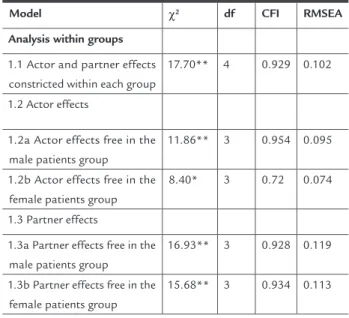
partner effects (i.e. the two connections between each dya-dic adjustment and the psychological morbidity of the partners) within each group, and no connection was res-tricted to equal between the groups (Table 2, model 1.1).
When observing the first comparison between models for the actor effects within each group, we determined that the actor effects were not equivalent, both for male patients
and their female partners (χ2
(1) = 5.84*), and female patients
and their male partners (χ2
(1) = 9.3***). Releasing the
ac-tor effects, the adjustment of this model in relation to the base model improves both for male patients (Table 2, mo-del 1.2a) and female patients (Table 2, momo-del 1.2b).
A similar comparison was conducted on the two con-nections between the patients and partners (partner ef-fect). Through the comparison of the adjusted model with the base model, it was determined that the partner effects were equivalent both for male patients and their
female partners (χ2
(1) = 0.77; Table 2, model 1.3a) and
fe-male patients and their fe-male partners (χ2
(1) = 2.02; Table 2
model 1.3b). Thus, the equality of the constraints was only retained for the partner effects (Table 2).
TABLE 2 Comparison of models in the dyadic effects of dyadic adjustment on psychological morbidity
Model χ2 df CFI RMSEA
Analysis within groups
1.1 Actor and partner effects constricted within each group
17.70** 4 0.929 0.102
1.2 Actor effects
1.2a Actor effects free in the male patients group
11.86** 3 0.954 0.095
1.2b Actor effects free in the female patients group
8.40* 3 0.72 0.074
1.3 Partner effects
1.3a Partner effects free in the male patients group
16.93** 3 0.928 0.119
1.3b Partner effects free in the female patients group
15.68** 3 0.934 0.113
** p < 0.01, * p < 0.05
Next, using the best adjustment model determined by the analysis with the groups (Table 3, model 2.1), the equiva-lence of the actor effects between the two groups was exa-mined. No connection was constrained between the two groups in the base model. Initially, the actor effect of male patient of dyadic adjustment on psychological morbidity the actor effect of the female patients). The starting
mo-del was that presenting the best adjustment for each group, identified in the first stage and, alternatively, the actor connections and partner connections were constricted to
equality between the two groups. χ2 difference tests were
used for comparing the models, in order to determine if the adjustment to the model deteriorated when the equa-lity constraints are imposed on specific connections. The actor and partner connections that were not equivalent between the groups reflect the gender differences in the associations between dyadic adjustment and psychologi-cal morbidity of patients and partners.
R
ESULTSCharacteristics of the sample
In the present sample (n = 214), male patients were, on average, older than their partners (t (199) = 2.69; p < 0.001) and female patients were younger than their partners (t (133) = -1.94; p < 0.001), that is, in both groups, women were younger. In relation to the duration of the marital relationship, the differences between male and female pa-tients were only marginal (t (329) = 1.94; p < 0.1). In rela-tion to dyadic adjustment and psychological morbidity, were verified that men presented higher dyadic adjust-ment and lower psychological morbidity (Table 1).
TABLE 1 Characteristics of the sample (averages and standard deviations)
Male patients Female patients
Patient Partner Patient Partner
Age (years) 59.4 (11) 56.7 (11.1) 59.7 (9.5) 61.6 (9.4)
Relationship duration (months)
381.1 (156.1) 413.6 (140)
Dyadic adjustment
53.7 (6.9) 52.5 (8.3) 53.1 (9.2) 54.6 (8)
Psychological morbidity
8.8 (6.8) 13.8 (8.7) 11.5 (8.3) 8.4 (7)
APIM models
was compared, successively constraining the effect of the male patient to that of the female patient (Table 3, mo-del 2.2a) and equal to that of the male partner (Table 3, model 2.2b). Constraining these connections between the two groups, when the effect of the male patient is equal
to that of the female patient, the adjustment (χ2
(1) = 7.35**)
relative to the base model is reduced. But this does not occur when equaling the effect of the male patient with
that of the male partner (χ2
(1) = 0.04).
The same model comparison process was repeated to examine the differences of the actor effects of the male partner between groups, constraining the effect of the fe-male partner equal to that of the fefe-male patient (Table 3, model 2.3a) and equal to that of the male partner (Table 3, model 2.3b). Constraining this connections to be equal between the two groups, when the female partner effect is equal to that of the female patient, the adjustment (χ2
(1)=4.97*) relative to the base model is reduced. But this
does not occur when equaling the effect of the female
partner with that of the male partner (χ2
(1) = 0.04).
The selection of the final model was based on the mo-difications to the CFI and RMSEA values in relation to the base model, showing that the model with the best ad-justment is model 2.2b (CFI=1.000; RMSEA=0.000), which is represented graphically in Figure 1. In summary, the actor effect of the female patients of dyadic adjustment on psychological morbidity (0.31***) is stronger than that of their partners (0.01) and that of the female part-ners (0.23***). In turn, the actor effect of female partpart-ners is stronger than female patients and their partners (-0.01). Furthermore, the partner effect of male patients and their female partners (-0.18***) is stronger than that of fema-le patients and their partners (-0.06) (Figure 1).
D
ISCUSSIONAlthough the dyadic approach is a strong aspect in the present study, constituting an innovative statistical ap-proach, the results are based on a cross-sectional design and, therefore, it is not possible to determine the causa-lity of the relationship.
Despite the limitations, it was verified in the study that diabetic men showed better dyadic adjustment and lower psychological morbidity. These results are in accordance with the literature, given that on average women
experien-ce twiexperien-ce as much depression than men30 and more distress
as patients and partners.31 In turn, men generally present
a better marital relationship, given that as a result of be-ing overloaded with different roles, women experience more stress in the marital relationship and less marital
satisfac-tion.32 This can be associated with the diversity of roles
they perform, and their inherent responsibilities. The ma-rital relationship functions as a buffering factor for the stress experienced and reduces psychological morbidity. It is therefore natural for men to perceive better dyadic ad-justment and equally experience less psychological
morbi-dity.20 In fact, the literature has been demonstrating that
it is not being married by the quality of the marital rela-tionship and interaction that are positively associated with
better physical and mental health.33
On the other hand, a negative relationship has been verified between dyadic adjustment and psychological morbidity in diabetic patients. The psychological mor-bidity of the partner is related with the psychological morbidity of the patient, whether male or female. In diabetic men and women, the dyadic adjustment, as well that of their partners, is associated with lower psychological morbidity. These results are in
accordan-TABLE 3 Gender differences in the dyadic effects of dyadic adjustment on psychological morbidity
Model χ2 df CFI RMSEA
Analysis between groups
2.1. Base (starting model) 2.56 2 0.997 0.029
2.2. Actor effects of the patient
2.2a. Male patient equal to female patient 9.91* 3 0.964 0.084
2.2b. Male patient equal to male partner 2.60 3 1.000 0.000
2.3. Actor effects of the partner
2.3a. Female partner equal to female patient 3.13 3 0.999 0.011
2.3b. Female partner equal to male partner 7.53 3 0.977 0.068
ce with the literature indicating that the partner may
present symptoms of distressand anxiety and
depres-sion levels as high as the actual patient.8 This
interac-tion between patient and partner has implicainterac-tions for chronic disease. Studies suggest that social relation-ships, financial condition, leisure time and professio-nal commitments are the areas negatively affected by the chronic disease in the partner’s life. The areas po-sitively affected are the increase in self-esteem and sen-se of intimacy. Furthermore, the life of partners is
af-fected by the increased responsibility as carers.34
Moreover, some studies suggest that the quality of life of partners tends to be lower than that of the patient,
especially in female partners.35,36
It was also verified that the relationship between dya-dic adjustment and psychological morbidity in diabetic women is stronger than in diabetic men (in which it is not significant) than in the female partners of male diabetics. In fact, women tend to be more emotionally and physically responsive to the psychological aspects of the relationship than their partners, and may more readily feel the effects
of dyadic maladjustment.37,38 The results of the dyadic
mo-dels showed that dyadic adjustment is more strongly as-sociated with psychological morbidity in the female part-ners of male diabetics than the male partpart-ners of female diabetics (in which it is not significant). This result is so-mewhat in line with the previous result, given that mental health in women is more influenced by the quality of the
RDAS male patient
RDAS female partner
HADS male patient
HADS female partner 0.503***
-0 .0 12
-0.182***
-0.182***
-0.230***
0.941*** 0.748***
0.258***
e2 e1
RDAS female patient
RDAS male partner
HADS female patient
HADS male partner 0.596***
-0.311***
-0.056
-0.056
-0.012
0.672*** 1.057***
0.170*
e2 e1
A: Male patients and partners
B: Female patients and partners
FIGURE 1 Dyadic analysis of patients and partners. A: male patients and partners; B: female patients and partners. *** p < 0.001,
* p < 0.05
relationship than men.39 Furthermore, chronic disease may
be felt as an additional stressor either directly, in women suffering from diabetes, or by female partners dealing with the diseases of their partner as, in addition to the roles and responsibilities they perform in their daily lives, they also
have the added responsibility of managing the illness.40 In
addition to the added stress of managing the disease, wo-men may experience the added stress of dealing with a ch-ronic disease, given that they are more concerned with health, using health services more often and spending more
on health goods than men.41 These facts may make women
more sensitive to the symptoms and changes in the state of health of partners and themselves, as patients, making them seek the use of health services with greater
regula-rity.41 According to Boeing,42 women and patients with
dia-betes are part of the group of patients that rely on physi-cians the most, among others.
In diabetic men, the relationship between dyadic ad-justment and psychological morbidity in their partners is stronger than the relationship between dyadic adjust-ment and psychological morbidity in the male partners of diabetic women. This result once again illustrates the importance of the marital relationship on psychological morbidity in women with chronic diseases or the female
partners of men with chronic diseases.8
This study only covered the moderating role of gen-der, however, other characteristics such as the duration of the diagnosis or the type of support by the partner in
a scenario of diabetes mellitus may be determinant factors
in the relationship between dyadic adjustment and mor-bidity. Future studies should be conducted to study the-se variables as potential moderators.
Given the relationship between dyadic adjustment, psychological morbidity and adherence to treatment, it is important for relationship related aspects to be taken into consideration, as well as evaluating depression and anxiety, given their impact on the management of diabetes,
espe-cially self-care at the level of diet.43 In this study, patients and
partners were only evaluated at the psychological level at the level of morbidity. Future studies should also control the presence of other comorbidities that could interfere in the relationship between morbidity and dyadic adjustment.
Therefore, health professionals with a central role in health education, particularly diabetes, should be sensitive to gender aspects and take into consideration the specific needs of diabetic women and men, in terms of increasing their management of the disease to the level of self-care.
Thus, health professionals in training should be war-ned about issues of gender as determinant on health,
de-veloping sensitive approaches to men and women, the-reby ensuring both have equal access to healthcare.
Through the proximity that health professionals have with the family environment of the population, it is im-portant for interventions to cover the cognitive and be-havioral aspects inherent in the management of the di-sease, as well as emotional aspects that interfere in the way in which the person and their family adapt to the new health situation. The health professional should un-dertake a careful evaluation of the individual’s needs of each of the elements, but also the dyad, paying attention to aspects such as verbal and nonverbal emotional com-munication, roles, influence and power, beliefs and
ma-rital satisfaction.44
C
ONCLUSIONThis study showed the relationship between dyadic adjust-ment and psychological morbidity in type 2 diabetes. Gen-der was revealed as a moGen-derating factor in this association. In general, diabetic women and the female partners of male diabetics showed the most negative relationship between marital adjustment and psychological morbi-dity. Thus, female patients and female partners present greater vulnerability in dealing with the chronic disease, owed to the roles they perform, emphasizing social and cultural aspects associated with gender. Given that gen-der is a mogen-derator variable, it is important to attend to the specific needs of male and female patients, and the education of diabetic patients should be centered on the patient/partner dyad.
Taking into account the results obtained in this study, it is important for female partners of diabetic patients, already presenting psychological morbidity, to be able to benefit from education programs and, on the other hand, for patients and partners to be able to collaborate on the patient’s adherence to self-care, associated with a
decrea-se in health costs.45
Financial support: this study was financed by the Foun-dation for Science and Technology (FCT).
R
ESUMOUm estudo de casal sobre o diabete tipo 2: ajustamento conjugal e morbilidade psicológica.
Métodos: estudo transversal que incluiu uma amostra de 214 diabéticos e os respectivos parceiros, foram ava-liados no nível da morbidade (HADS) e de ajustamento conjugal (RDAS). Os dados foram analisados por meio de um procedimento estatístico de análise diádica, que estuda simultaneamente os pares paciente/parceiro(a).
Resultados: verificou-se que a relação negativa entre ajus-tamento conjugal e morbidade psicológica nas mulheres diabéticas era mais forte que nos homens diabéticos e suas parceiras. Por sua vez, a relação entre ajustamento conjugal e morbidade psicológica nas parceiras de ho-mens diabéticos foi mais forte que a mesma relação nos parceiros de mulheres diabéticas.
Conclusão: dado o gênero ser uma variável moderadora, é importante atender às necessidades específicas dos doen-tes femininos e masculinos e a educação do paciente dia-bético deve centrar-se na díada paciente/parceiro.
Unitermos: diabete melito; morbidade; casamento; iden-tidade de gênero; prestação de cuidados de saúde; estu-dos transversais.
R
EFERENCES1. Ministério da Saúde. Estudo da Prevalência da Diabetes em Portugal.[citado Fev. 2012]. Available from: http://www.minsaude.pt/portal/conteudos/ a+saude+em+portugal/noticias/arquivo/2009/3/diabetes.htm. 2009. 2. Gameiro F, Moos E, Teixeira J. Satisfação de sujeitos diabéticos em relação
aos cuidados de saúde. In: Ribeiro JL, Leal I, Dias MR, editores. 3.º Congresso Nacional de Psicologia da Saúde. Psicologia da Saúde nas Doenças Crónicas; 2000 Fev 23-25; Lisboa. Actas. Lisboa: Instituto Superior de Psicologia Aplicada; 2000. p. 297-310.
3. Duangdao KM, Roesch SC. Coping with diabetes in adulthood: a meta-analysis. J Behav Med. 2008;31(4):291-300.
4. DiMatteo MR, Lepper HS, Croghan TW. Depression is a risk factor for noncompliance with medical treatment: meta-analysis of the effects of anxiety and depression on patient adherence. Arch Intern Med. 2000;160(14):2101-7. 5. Khuwaja A, Lalani S, Dhanani R, Azam IS, Rafique G, White F. Anxiety and depression among outpatients with type 2 diabetes: a multi-centre study of prevalence and associated factors. Diabetol Metab Syndr. 2010; 2:72. 6. Roupa Z, Κουulouri Α, Sotiropoulou P, Makrinika E, Marneras X, Lahana
Ι, et al. Anxiety and depression in patients with type 2 Diabetes mellitus, depending on sex and body mass index. Health Sci J. 2009;3(1):32-40. 7. Sass A, Gravena AA, Pilger C, MathiasTA, Marcon SS. Depression in elderly
enrolled in a control program for hypertension and diabetes Mellitus. Acta Paul Enferm. 2012;25(1):80-5
8. Trief PM, Himes CL, Orendorff R, Weinstock RS. The marital relationship and psychosocial adaptation and glycemic control of individuals with diabetes. Diabetes Care. 2001;24(8):1384-9.
9. Fisher L, Chesla CA, Chun KM, Skaff MM, Mullan JT, Kanter RA, et al. Patient-appraised couple emotion management and disease management among Chinese American patients with type 2 diabetes. J Fam Phychol. 2004;18(2):302-10.
10. Beverly E, Wray LA, Miller CK. Practice Implications of what couples tell us about type 2 diabetes management. Diabetes Spectr. 2008;21(1):39-45. 11. Delamater AM. Improving patient adherence. Clin Diabetes. 2006;24(2):71-7. 12. Schokker MC, Stuive I, Bouma J, Keers JC, Links TP, Wolffenbuttel B, et al.
Support behavior and relationship satisfactions in couples dealing with diabetes: Main and Moderating effects. J Fam Psychol. 2010;24(5):578-86.
13. Stephens MA, Rook KS, Franks MM, Khan C, Iida M. Spouses use of social control to improve diabetic patients dietary adherence. Fam Syst Health. 2010;28(3):199-208.
14. Trief PM, Wade MJ, Britton KD, Weinstock RS. A prospective analysis of marital relationship factors and quality of life in diabetes. Diabetes Care. 2002;25(7):1154-8.
15. Ruddy N, McDaniel SH. Couple therapy and medical issues: working with couples facing illness. In: Gurman AS, Jacobson NS, editors. Clinical handbook of couple therapy. 3th ed. New York: Guilford; 2002. p. 699-716. 16. Fisher L. Family relationships and diabetes care during the adult years.
Diabetes Spectr. 2006;19(2):71-4.
17. Trief PM, Sandberg J, Greenberg RP, Graff K, Castronova N, Yoon M, et al. Describing support: a qualitative study of couples living with diabetes. Fam Syst Health. 2003;21(1):57-67.
18. Trief PM, Ploutz-Snyder R, Britton KD, Weinstock R. The relationship between marital quality and adherence to the diabetes care regimen. Ann Behav Med. 2004;27(3):148-54.
19. Fisher L, Chesla CA, Bartz RJ, Gilliss C, Skaff MA, Sabogal F. The family and type 2diabetes: a framework for intervention. Diabetes Educ. 1998;24(5):599-607
20. Fung K. Type 2 diabetes: a couples study on spousal relationship and health behaviors [dissertation]. [cited 2014]. Dietrich College Honors Theses; 2009. Available from: http://repository.cmu.edu/cgi/viewcontent.cgi?article=101 1&context=hsshonors.
21. Coyne JC, Smith DA. Couples coping with a myocardial infarction: a contextual perspective on patient self-efficacy. J Pers Soc Psychol. 1991;61(3):404-12.
22. Kenny DA, Kashy D, Cook W. Dyadic data analysis. 3rd ed. New York: Guilford Press; 2006.
23. Franks MM, Lucas T, Stephens MA, Rook KS, Gonzalez R. Diabetes distress and depressive symptoms: a dyadic investigation of older patients and their spouses. Fam Relat. 2010;59(5):599-610.
24. Segrin C, Badger TA, Meek P, Lopez AM, Bonham E, Sieger A. Dyadic interdependence on affect and quality-of-life trajectories among women with breast cancer and their partners. J Soc Pers Relat. 2005;22(5):673-89. 25. Busby DM, Christensen C, Crane DR, Larson JH. A revision of the dyadic
adjustment scale for use with distressed and nondistressed couples: construct hierarchy and multidimensional scales. J Marital Fam Ther. 1995;21(3):289-308.
26. Nunnally JC. Psychometric Theory. 2nd ed. New York: McGraw; 1978. 27. Zigmond AS, Snaith RP. The hospital anxiety and depression scale. Acta
Psychiatr Scand.1983;67(6):361-70.
28. Kline RB. Principles and practice of structural equation modeling. 3rd ed.
New York: The Guilford Press; 2011.
29. Tabachnick BG, Fidell LS. Using Multivariate Statistics. 6th ed. Boston: Allyn
and Bacon; 2013.
30. Nolen-Hoeksema S. Gender differences in depression. Curr Dir Psychol Sci. 2001;10(5):173-6.
31. Hagedoorn M, Sanderman R, Bolks HN, Tuinstra J, Coyne JC. Distress in couples coping with cancer: A meta-analysis and critical review of role and gender effects. Psych Bull. 2008;134(1):1-30.
32. Hill EJ. Work-family facilitation and conflict, working fathers and mothers, work- family stressors and support. J Fam Issues. 2005;26(6):793-819. 33. Levenson RW, Carstensen LL, Gottman JM. Long-term marriage: age, gender,
and satisfaction. Psychol Aging. 1993;8(2):301-13.
34. Baanders AN, Heijmans MJWM. The impact of chronic diseases: the partner´s perspective. Fam Community Health. 2007;30(4):305-17.
35. Kornblith AB, Herr HW, Ofman US, Scher HI, Holland JC Quality of life of patients with prostate cancer and their spouses. Cancer. 1994;73(11):2791-802. 36. Cliff AM, MacDonagh RP. Psychological morbidity in prostate cancer. II. A
comparison of patients and their partners. BJU Int. 2000;86(7):384-9. 37. Glasdam S, Timm H, Vittrup R. Support efforts for caregivers of chronically
ill persons. Clin Nurs Res. 2010;19(3):233-65.
38. Soubhi H, Fortin M, Hudon C. Perceived conflict in the couple and chronic illness management: preliminary analyses from the Quebec Health Survey. BMC Fam Pract. 2006;07:59 AM.
39. Campbell TL. The effectiveness of family interventions for physical disorders. J Marital Fam Ther. 2003;29(2):263-81.
41. Mourão PR. Tempo decorrido desde a última consulta: Análise de um modelo estatístico aplicado ao caso das mulheres na Espanha. Rev Assoc Med Bras. 2011;57(2):164-70.
42. Boing A, Matos IB, Arruda MP, Oliveira MC, Njaine K. Prevalência de consultas médicas e fatores associados: um estudo de base popu lacional no sul do Brasil. Rev Assoc Med Bras. 2010;56(1):41-6.
43. Pereira MG. Importância das variáveis familiares na doença crónica: estudos empíricos aplicados à adesão terapêutica na diabetes tipo 2. In: Conferencia apresentada no Centro de Investigação em Psicologia. Universidade do Minho; 2013.
44. Wright L, Leahey M. Enfermeiras e famílias. Um guia para a avaliação e intervenção na família. São Paulo: Roca; 2009.