REVISTA
PAULISTA
DE
PEDIATRIA
www.rpped.com.br
ORIGINAL
ARTICLE
Family
relationships
with
pediatricians:
the
maternal
views
Simone
de
Carvalho
∗,
José
Martins
Filho
UniversidadeEstadualdeCampinas(Unicamp),Campinas,SP,Brazil
Received8June2015;accepted8October2015 Availableonline11April2016
KEYWORDS Pediatrician; Childguidance; Women’sgroup
Abstract
Objective: Toanalyzetheperceptionofpediatricguidelinesbymothersatthetimeof consul-tationinprivateoffices,inordertoknowhowtheyassimilate,processandusetheinformation receivedfromthepediatricians.
Methods: Datacollectionwas carriedoutby aquestionnairesenttoparticipantsby atotal of200mothersfromavirtualcommunityinsocialnetworksparticipatedintheresearch.The answers weretranscribedusingthe Discourseofthe CollectiveSubjectmethod.The analy-sesweresupportedbytheresearchqualitativeperspective,fromtheviewpointofthesocial representationtheory.
Results: Three categories were obtained through data analysis: (1) assessing the pediatric guidelines,(2)confrontingtheoryandpracticeand(3)developingacriticalviewofthepediatric guidelines.Thesecategorieshaveelucidatedthatthelevelofknowledgeofpediatricissuesby mothersandtheirabilitytousethemwhenmakingdecisionsaboutthecareoftheirbabies, haveadirectassociationbetweenfollowingornotthepediatricguidelines.
Conclusions: Themother’sdecisiononfollowingthepediatrician’srecommendationsdepends ontwomainfactors:(a)certificationoftheupdatedandprovenrecommendations,according totheofficialhealthagencies;(b)supportandrecognitionbythepediatricianofthematernal empowerment duringthe follow-upprocess. Themothers’ practiceofaccessing knowledge throughsocialnetworkshindersthepediatricmonitoring.
©2015SociedadedePediatriadeS˜aoPaulo.PublishedbyElsevierEditoraLtda.Thisisanopen accessarticleundertheCCBYlicense(http://creativecommons.org/licenses/by/4.0/).
PALAVRAS-CHAVE Pediatra;
Orientac¸ãoda crianc¸a;
Grupodemulheres
Asrelac¸õesdafamíliacomospediatras:asvisõesmaternais
Resumo
Objetivo: Analisarapercepc¸ãodasorientac¸õespediátricaspelasmãesnaocasiãodo atendi-mento emconsultórios particulares,paraconhecer dequemaneira assimilam,processame usamasinformac¸õesrecebidasdeseupediatra.
∗Correspondingauthor.
E-mail:[email protected](S.Carvalho).
http://dx.doi.org/10.1016/j.rppede.2016.03.015
2359-3482/©2015SociedadedePediatriadeS˜aoPaulo.PublishedbyElsevierEditoraLtda.ThisisanopenaccessarticleundertheCCBY
Métodos: Acoletadedadosfoifeitaporquestionárioenviadoàsparticipantes.Participaram dapesquisa200mãesdeumacomunidadevirtualnasredessociais.Asrespostasforam tran-scritaspormeiodométodododiscursodosujeitocoletivo.Asanálisesforamrespaldadasna perspectivaqualitativadepesquisa,sobaóticadateoriadasrepresentac¸õessociais.
Resultados: Obtiveram-se três categorias por meio da análise de dados: (1) avaliac¸ão das orientac¸õespediátricas,(2)confrontodateoriaepráticae(3)desenvolvimentodeumolhar críticoacercadasorientac¸õespediátricas.Taiscategoriaselucidaramqueonívelde conhec-imentodetemaspediátricosporpartedasmãeseasuacapacidadedeusá-losnatomadade decisõessobreoscuidadosdosseusbebêsapresentamumarelac¸ãodiretaentreseguirounão asorientac¸õespediátricas.
Conclusões: Adecisãodasmãesquantoaseguirasrecomendac¸õesdopediatradependededois fatoresprincipais:(a)certificac¸ãodasrecomendac¸õesatualizadasecomprovadas,deacordo comosórgãosoficiaisdesaúde;(b) apoioereconhecimentoporpartedopediatradopapel maternoduranteoprocessodeacompanhamento.Apráticadoacessoaoconhecimentodas mãespormeioderedessociaisdificultaoacompanhamentopediátrico.
©2015SociedadedePediatriadeS˜aoPaulo.PublicadoporElsevierEditoraLtda.Esteéumartigo OpenAccesssobalicençaCCBY(https://creativecommons.org/licenses/by/4.0/deed.pt).
Introduction
In our society, the pregnant woman is seen as a sick individual,1 requiringfrequent medicalcare from
concep-tion to delivery. The Western method of Medicine is still associatedwithdetachment,impersonality,objectivityand thecareprovider’sauthority.Thisperspectivedirectly influ-encesthewaythiswomanseesherselfandinmany cases affects her self-confidence and capacity to manage the maternal processes,including delivery, breastfeeding and careprovidedtothebaby.2
The literature has been increasingly discussing the empowerment processes3 and their applicabilityto
moth-erhood. Maternal empowerment can be understood as women’sachievementtowardstrengtheningtheirpersonal autonomy, which may occur individually or collectively, making them capable of self-managing their maternal dilemmas.4
Empowerment inthe health areaisseen by its profes-sionalsasasupporttoolinhealthself-controlprocessesby patients.Ithasbeenshownthatwomenwhomanageorare directlyresponsibleforthecareoftheirbabiesreach,asa result,asignificantimprovementinchildhealthquality.5
Theattainmentofknowledgeonbabycarebythemother, basedonherownmaternalexperiencesandacquired knowl-edge,hasadirecteffectonherdecisiontofollowornotthe advice she receives from this professional.6 This decision
isbasedoninternalizedsuppositionsfromexperiencesand knowledgeacquiredbythismotherduringherownexistence andexperiencessharedwithotherwomen,especiallywhen shefeelsinsecureabouttherecommendationsshereceived fromthepediatrician.Inthissense,pediatricianswhoshow appreciationforthesematernalexperiencesandthus reaf-firmthemother’spersonalbeliefswillbemoresuccessfulin theirprofessionalperformance.
Thisstudyconsidersthematernalempowermentasany behavior that givesmothers a positive andinformed con-trolregarding their decisionsonthe care oftheir babies’ health,whichresultinwhatmightbecalledgoodpediatric practices.Theobjectivesofthestudyinclude:tounderstand themeaningsofdiscourses throughmaternalpractices,to
associate themeaning assignedby themto suchbehavior andtheirperceptionsofpediatriccareinthisinteraction.
Therefore,giventhe scarcityof dataonthe impactof maternalempowermentinpromotingandimproving mater-nalandchildhealth,wedecidedtoassesstheperceptions ofmothersaboutpediatriccare,studyingindepththe fac-torsthatmotivatethispracticeamongmothers,aswellas thesupportavailableontheinternet.
Method
Thisisadescriptiveexploratorystudy,whichallowedusto interpretthediscoursesofthemothersparticipatingina vir-tualmotherhoodsupportgroup,regardingtheirperceptions ofpediatriccareandtheconsequentdecisionsregardingthe healthoftheirbabies,characterizingthetypeofbehavior thatis defined asmaternal empowerment(ME). The ana-lyzedvirtualcommunityonFacebookhasbeenactiveforfive yearsasasupportgroupthatguideandshareexperiences dailywiththousandsofmothersthroughtheInternet, rely-ingonthevoluntaryparticipationofapproximately50,000 motherslivinginseveralBraziliancities. Thecommunity’s goalismaternalempowermentinthevirtualnetwork.
The main reasonthat leads mothers toseek the com-munity, in general, is experiencing some difficulty in the postpartumperiod,especiallyregardingbreastfeeding.The communityusuallyfollowsthismotherinthedailydynamics ofinvolvementandcareofherbabyandsheparticipatesin thesupportgroupsaccordingtoherneeds,remainsa mem-berof thesegroups --- monitorsthedaily publicationsand activelyparticipatesincommunitylife---throughdebates, supportingothermothersandsharingpersonalexperiences relatedto their maternal processes. The fruitfulnessand varietyofthisvirtualsupportnetworkallowsusto under-stand the dynamics of this relationship and its practical consequencesinchildcareandthus,meetthegoalsofthis research.
thestudy.The anonymityof participantswasguaranteed. The mothers were selected from the community through a pollgenerated by the social network system and those interestedinparticipatinginthestudyprovidedtheiremail addressthroughaprivatemessage,individually.
Datawere collected fromSeptember 19 toOctober 9, 2014throughasemi-structuredquestionnairesentto partic-ipantsbye-mail,aimingtoassessthemothers’perceptions aboutthe pediatricguidelinesat the timeofconsultation andontheconsequentjudgmentof valuetheydeveloped fromthisinteractionwiththephysician.Thefirstpartofthe questionnaire contained questions that characterized the studypopulation.Inthesecond part,twocategorieswere createdtoinvestigatethehistoryofpediatriccareof moth-ers in the postpartum period,with six sub-categories for thetopicanalysis.Inthelastsub-category,themothershad spacetojustifytheiranswers,whichassistedintheanalysis ofdataobtainedthroughthe200completedquestionnaires. Motherswereapproachedbyformalinvitationthrougha pollpreviouslycreated bythetoolontheFacebooksocial network. The second phase consisted in the collectionof questionnairescompletedbythemothers.Ofthe350emails sent,exactly200emailswerereturned,appropriatelyfilled outandsigned.Oftheremaining150mothers,26refusedto participateand124didnotanswere-mailandthediscourse ofthecollectivesubjectwasappliedtothe200responses receivedfromthequestionnaires.
The qualitative data were classified according to the comprehensive study of the discourses, which indicates a realityofexperienceslivedbythesemothersandtheir accu-racyleavesnodoubtregardingthereliabilityof reproduc-tionofvariables,forwhichreadersareabletorecognize.7
Results
Wesought todescribe,throughthemothers’responses to thequestionnaire,theirperceptionsofthepediatric guide-linesat thetimeof theconsultationsandtheconsequent judgmentof value theycreated based onthis interaction with the health care professional. This study resulted in threecategories:(1)evaluationofpediatricguidelines,(2) confrontationof theoryandpracticeand(3) developinga criticalviewofthepediatricrecommendations.
Evaluationofpediatricguidelines
‘‘Ifollowedthepediatrician’srecommendationsbecause they were clear and according to my convictions and compatible with the information I researched in the mothers’ groups for guidance on social networks. I felt very insecure in the first moments and I trusted herbecauseofherprofessionalexperienceandcorrect recommendations, which I considered consistent. The recommendations were clear, precise and it was very important toreceive guidancethat went against what ourfamilypreached,andsotheyalsolearnedfromthe guidelinesandhavecome torespectthe recommenda-tionswereceived,inadditiontotheassistanceprovided bythevirtualgroups.Nowadayssheknowsmewelland knowswhatmyprioritiesare.’’(DSC1)
The evaluation of pediatric guidelines for the mothers of this study is basedon thefigure of thepediatrician in relationtotheirprofessionalexperienceandcredibilityas an expert in the area,but also thecompatibility of their recommendationswiththeirpersonalknowledgeandtheir maternal perceptions. The pediatrician’s action in recog-nizingtheirprioritiesandsharingthematernalimpressions supportsthemother’sdecision-making,both inherchoice and the decision to continue the follow-up. The dynam-ics of everyday knowledge shared through the mothers’ socialization, based on readings and studies available on theInternetandvirtualdiscussiongroups,influencestheir maternal management processes. It is based on this col-lectedandinternallysystematizedinformationthatmothers filtertheinformation,whichallowsthemtodecidewhether ornottofollowthereceivedinstructions.
Confrontationoftheoryandpractice
‘‘Ididnotfollowallthepediatrician’srecommendations becauseIhadreadmuchaboutthesubject;Ialways fol-lowed my natural mother’sinstinct and I chose whatI thoughtwasbest.WhatIconsideredunnecessary accord-ing to my research and personal experience I did not follow,asitdidnotmatchwhatIhadlearnedfromthe groupsIparticipateintheinternet.Infact,Iwouldnot sayall,butmost,andattimesIresortedtotheopinion ofothermothers.Iusedthepediatrician’s recommenda-tions asan addendumtomydecisions,becauseIknew whatIneeded todo,thatis,Iknew Icouldhaveother options, and not simply accept them without further investigation.IfollowedtherecommendationsI consid-ered consistent withthe current practice of Pediatrics andtheWHOrecommendation.’’(DSC1)
Theconstantsearchofmothersforadditionalsourcesof knowledgeinvirtualgroupsoftheirinterestcanbe under-stoodasaconscious efforttocomparethe opinionof the health professional,balancingit withtheacquired knowl-edge and their own perceptions of motherhood. In this sense,thepediatricrecommendationsbecome justoneof manysourcesofsupportformakingdecisionsaboutthecare oftheirbabies.
Appreciating theimportance of these mothers’ mater-nalempowermentpracticebecomesvitaltounderstandthe decision-makingprocessregardingthecareoftheirbabies, withtheir interactionwithpeersand health professionals thattreattheirbabies.Fromtheperspectiveofthe inter-viewedmothers,beingempoweredmeansbeingincontrol oftheirmaternalprocessesbasedonthislearnedbehavior.
‘‘Althoughthepediatricianprovidesalltheinformation, we sometimes follow our intuition and do what works athome.BecauseIamthemotherandIknowwhatmy babyneeds,I’vealwaysresearchedalotaboutmydoubts andoftendidnothavethecorrectanswerfromthesaid pediatrician.Iusedmycommonsenseandsensibility;in theory I thinkit is easy and simple, but in practiceit is quite different and in some moments I preferredto followmyintuition.Mostofthetime,Iaskotherfriends whoare mothers, other pediatricians and the internet beforeIfollowcertainrecommendations.Itrytoconsider everything,what Iknow and the pediatrician’sclinical evaluation.Iveryoftendowhatmyhearttellsmeto.’’
(DSC1)
The multiple impressions about the received pediatric guidelines,which aresharedinthe virtual supportgroup, demonstrateaconfrontationbetweentheoryandpractice; confirmthe maternalobservationandintuition asidealto conveytothepediatricianthespecificneedsoftheirbaby andtheappropriatenessofcaredesiredbythesemothers.
Developmentofacriticalviewofthepediatric recommendations
‘‘Idonotagreewithcertainproceduresand recommen-dations;Iinvestigatedandsawthatthepediatricianwas outofdate. Theywereinadequateandoutdatedwhen comparedtotherecommendationsofnationaland inter-national societies. Ihad great confrontations with the pediatriciantobeabletomaintainexclusive breastfeed-ing for six months and did not introduce other foods early(atfourmonths)asrecommended.Afterthis consul-tation, Iswitched doctors.First becauseof the absurd recommendations,secondbecauseofthelackof breast-feedingsupportandthirdbecauseIstoppedbelievingin everythinghesaid,becausetheywerealwaystoovague. Ilookedforinformationontheinternetandonceagain disregardedthepediatrician’srecommendation.Irealize thattheidealisapediatricianinwhomwetrustto elim-inateallourdoubts,butwearelivinginatimewhenthe Brazilianmedicalprofessionisgoingfrombadtoworse, more concernedwith the numberof consultation than theirquality.’’(DSC1)
The mother’s decision tofollow the pediatrician’s rec-ommendations is supported both by what she hears from thepediatricianandbyherknowledge,basedonher mater-nalexperiences.Sincethemotherisinaconstantexercise to confront what the pediatrician says and what is her own truth, the appropriation of her acquired self-power is disclosed and the action of decision-making based on the evaluations of these two distinct realities result in thepracticalbehaviorofthisrelationship,especiallywhen
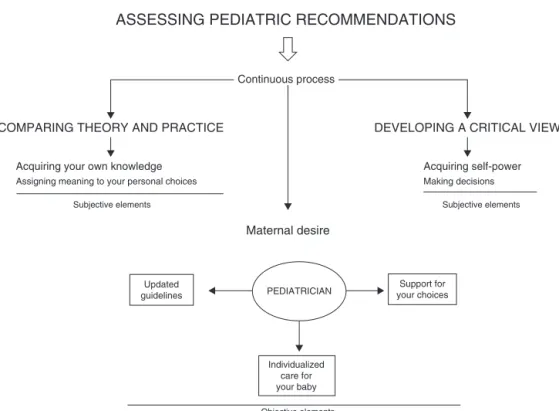
there is lack of support and recognition by the pediatri-cian.These categories were understood asparticularities of the discourse of these mothers that belonged to the assessedmaternalgroup.Theresultsofthemeaningof pedi-atricrecommendationsatthetimeoftheconsultationfor themothersparticipatinginthisstudyweredescribedand exemplifiedthroughaflowchart(Fig.1).
Discussion
Thecyberspace hasbecomeaplaceofinteraction, where motherscanopenlyexpress theiremotionsabout mother-hood.ForPorter,8 mothers areincreasingly turningtothe
Internetseekingthesenetwork-sharedactions.9,10Theterm
‘‘empowerment’’11 is relativelynewandhasbeen studied
inrelationtoitsapplicabilityinpeople’sself-management acquisition.Socialrepresentations12relatedtothemothers’
interactivityanddiscursivelinesdemonstrate thepractice ofacontagiousempowermentrepertoireamongthe moth-ers,throughtheir own interpretationsand perceptionsof realityexperiencedinpediatricoffices,inaconstantaction of developing views and perceptions to reconstruct and modifythem.Virtualgroupsofmutual support,awareness andsharingexperiencesandperceptionsprovidethebasic elementsthatallowthematernalempowermentdescribed herein.
Especiallyinthehealth area,theknowledge of mater-nal empowerment becomes important for professionals to allocate time for the mother to make her own deci-sions regarding her baby’s care and to assess which information is relevant, in order to verify the practical applicabilityandagreementwiththeprovided recommen-dations, --- the bioethics of care --- which may ultimately influence the mother’s decision to follow or not these recommendations.13,14
IntheresultsofthestudybyBonvicini,15whichrecorded
1800 interactions of discourses of 170 doctors with their patients,itwasobservedthatmedicalempathyisessential forthepatienttocomfortablyexpressimportantconcerns andproblems.Suchstudieshaveshownthatphysicians rec-ognizethepresenceofacommunicationgap,specificallyin themanagementofbehavioralandemotionalreactionsand theneed for the involvement of a comprehensive educa-tionalprograminrelationtocounseling,whichcouldresult in a positive change in their empathy expression. On the otherhand,pediatriciansareburdenedbyaservicebased onproductivityandthatdoesnotleavethemenough time to talk to the mother, an essential part of the pediatric consultation.
ASSESSING PEDIATRIC RECOMMENDATIONS
Continuous process
DEVELOPING A CRITICAL VIEW COMPARING THEORY AND PRACTICE
Acquiring self-power Acquiring your own knowledge
Making decisions Assigning meaning to your personal choices
Subjective elements Subjective elements
Maternal desire
Objective elements Updated
guidelines PEDIATRICIAN
Support for your choices
Individualized care for your baby
Figure1 Themeaningofthepediatricrecommendationsatthetimeoftheconsultationaccordingtotheconceptofmaternal empowerment.
inrelation tothe acquired knowledge. The mothersshow theyare able toassess whether such information is safe andshowincreasinglymorecriticismregardingtheavailable contentandchoose reliable sites; thiswasmade possible throughtheemergenceofvirtual socialnetworks. Accord-ingto Bartlett,16 themother’s trustof the pediatric care
isstrengthenedwhenherpersonalexperiencesandher per-sonalempowermentareconfirmedandrecognized.Maternal empowermentontheinternetisapowerfulandfacilitating toolofmaternalandchildhealth.
According tothedata, thereisa recurringbehavior in mostofthemothers’discoursesabouttheconstant consid-erationregardingthepediatricrecommendationsreceived bythemandknowledgeoftherecommendationsissuedby national and international health agencies, through free accesstothisinformationontheInternet.Inthediscourse ofthemothersparticipatinginthestudy,thefindingofthe majorityofnegativeresponses---thatthepediatric recom-mendationsgiven to the mothers were outdatedand not consistent with their acquired knowledge --- hindered the relationshipofcareandfollow-upoftheirbabies.Thiswas duetothefactthattherewasdistrustbetweenthe infor-mationthatsolvedtheirquestionsandtheconfrontationof thenon-confirmationofthesequestionsatthetimeofthe pediatricconsultation,ahypothesis raisedin thestudyby Berkel.17
By offeringsupporttothe motherandlisteningtoher, onthepartofthehealthprofessionals,itcanbeconcluded that maternal empowerment is an important tool for the mothers to exercise their motherhood while aware of theirdailyexperienceintheobservationandcareoftheir babies.Noonebetterthanthemotherknowsherbabyas wellasshedoes---whatishappeningwiththechildandits
peculiarities. The mother is, therefore, an assiduous and crucialobserverasasupportfigure forthequalityof care provided by the pediatrician. In this study, we identified the process of maternal empowerment as supportive of this relationship, in which the first step is the mothers’ evaluation ofreceived recommendations;the second, the confrontationbetween theoryandpracticebasedontheir personal empowerment and, finally, the development of a criticalviewthroughtheacquisition of knowledge,now acquiredthroughthevirtualsupportgroups.
The limitations of this study are related to the need for the creation of a specific tool to validatethe degree of maternal empowerment andthe carryingoutof future studies toreinforcetheresults ofthepresent one.In the analysisofwomenfromeightcountries,empowerment indi-catorsarenotallsimilarintermsofmethodologyandthus, thecreationofaquantificationofempowermentindicators foracorrectassessmentisnecessary,astheincapacityofa purelystatisticalapproachwouldhaveconceptual implica-tions,accordingtoKabeer.18
Knowing the maternal empowerment behavior and its practiceisrelevanttounderstandwhymothersare increas-ingly using social networks to share their perceptions, experiencesandtheirknowledgeaboutmaternityand pedi-atriccare. Itis worthmentioning thatchildren’shealth is closely relatedtothe mothers’decisionsaccordingtothe perceivedpediatricinstructions.
Funding
Conflicts
of
interest
Theauthorsdeclarenoconflictsofinterest.
References
1.FigueiredoB,DiasCC,BrandãoS,CanárioC,Nunes-CostaR. Breastfeeding and postpartum depression: state of the art review.JPediatr(RioJ).2013;89:332---8.
2.Correia MJ. Sobre a maternidade. Analise Psicológica. 1998;3:365---71.
3.RodwellCM.Ananalysisoftheconceptofempowerment.JAN. 1996;23:305---13.
4.KlebaME,WendausenA. Empoderamento:processode forta-lecimento dos sujeitos nosespac¸os de participac¸ão social e democratizac¸ãopolítica.SaudeSoc.2009;8:733---43.
5.GibsonCH.Theprocessofempowermentinmothersof chroni-callyillchildren.JAN.1995;21:1201---10.
6.Carlson GJ, Kordas K, Murray-Kolb LE. Associations between women’s autonomy and child nutritional status: a review of the literature. Matern Child Nutr. 2015;11: 452---82.
7.LefèvreF,LefèvreAM,MarquesMC.Depoimentosediscursos: umapropostadeanáliseempesquisasocial.Brasília:LiberLivro Editora;2005.
8.Porter N, Ispa MJ. Mothers’ online message board ques-tions about parenting infants and toddlers. J Adv Nurs. 2013;69:559---68.
9.ArmstrongN,PowellJ.Patientperspectivesonhealthadvice postedonInternetdiscussionboards:aqualitativestudy.Health Expect.2009;12:313---20.
10.Broom A. Virtually he@lthy: the impact of internet use on diseaseexperienceandthedoctor---patientrelationship.Qual HealthRes.2005;15:325---45.
11.Cattaneo LB, Chapman AR. The process of empowerment: a model for use in research and practice. Am Psychol. 2010;65:646---59.
12.Moscovici S. A representac¸ão social da psicanálise. Rio de Janeiro:Zahar;1978.
13.ZoboliEL,SartórioNA.Bioéticaeenfermagem:umainterface nocuidado.OMundodaSaúde.2006;30:382---97.
14.Cruz AC, Angelo M. Cuidado centrado na família em pedi-atria: redefinindo os relacionamentos. Cienc Cuid Saude. 2011;10:861---5.
15.Bonvicini KA, Perlin MJ, Bylund CL, Carroll G, Rouse RA, GoldsteinMG.Impactofcommunicationtrainingonphysician expression of empathy in patient encounters. Patient Educ Couns.2009;75:3---10.
16.Bartlett YK, Coulson NS. An investigation into the empow-erment effects of using online support groups and how this affects health professional/patient communication. Patient EducCouns.2011;83:113---9.
17.BerkelJJ,LambooijMS,HeggerI.Empowermentofpatientsin onlinediscussionsaboutmedicineuse.BMCMedInformDecis Mak.2015;15:24.