Comparison of performance on
neuropsychological tests in amnestic
Mild Cognitive Impairment and
Alzheimer’s disease patients
Patrícia Helena Figueirêdo do Vale
1, Lívia Spíndola
1, Maira Okada de Oliveira
1,
Cristiane Garcia da Costa Armentano
1, Claudia Sellitto Porto
2, Sonia Maria Dozzi Brucki
3Abstract – Mild Cognitive Impairment (MCI) can be an intermediate state between normality and dementia in some patients. An early diagnosis, through neuropsychological assessment, could identify individuals at risk of developing dementia. Objective: Toverify differences in performance on neuropsychological tests among controls, amnestic MCI (aMCI) and Alzheimer’s disease (AD) patients. Methods: Sixty-eightAD patients (mean age 73.77±7.24; mean schooling 9.04±4.83; 40 women and 28 men), 34 aMCI patients (mean age 74.44±7.05; mean schooling 12.35±4.01; 20 women) and 60 controls (mean age 68.90±7.48; mean schooling 10.72±4.74; 42 women) were submitted to a neuropsychological assessment composed of tasks assessing executive functions, language, constructive abilities, reasoning and memory. Results: There were statistically significant differences in performance across all tests among control, aMCI and AD groups, and also between only controls and AD patients. On comparing control and aMCI groups, we found statistically significant differences in memory tasks, except for immediate recall of Visual Reproduction. There were also statistically significant differences between aMCI and AD groups on tasks of constructive and visuoperceptual abilities, attention, language and memory, except for delayed recall of Visual Reproduction. Conclusions: Neuropsychological assessment was able to discriminate aMCI from AD patients in almost all tests except for delayed recall of Visual Reproduction, visual organization (Hooper) and executive functions (WCST); and discriminate controls from AD patients in all tests, and controls from aMCI patients in all memory tests except for immediate recall of Visual Reproduction.
Key words: Mild Cognitive Impairment, Amnestic Mild Cognitive Impairment, Alzheimer’s disease,
neuropsychological tests, memory.
Comparação do desempenho em testes neuropsicológicos em pacientes com comprometimento cognitivo leve amnéstico e com doença de Alzheimer
Resumo – Comprometimento Cognitivo Leve (CCL) pode ser um estágio entre normalidade e demência em
alguns pacientes. Um diagnóstico precoce, com avaliação neuropsicológica, pode identificar indivíduos com risco para desenvolvimento de demência. Objetivo: Verificar diferenças no desempenho em testes neuropsicológicos entre controles, pacientes com CCL amnéstico (CCLa) e com doença de Alzheimer (DA). Métodos: Sessenta e oito pacientes com DA (média de idade 73,77±7,24; média de escolaridade 9,04±4,83; 40 mulheres), 34 pacientes com CCLa (média de idade 74,44±7,05; média de escolaridade 12,35±4,01; 20 mulheres) e 60 controles (média de idade 68,90±7,48; média de escolaridade 10,72±4,74; 42 mulheres) foram submetidos à ampla avaliação neuropsicológica. Resultados: Houve diferenças estatisticamente significativas em todos os testes entre os grupos
1Psychologist, Behavioral and Cognitive Neurology Unit, Department of Neurology of the University of São Paulo School of Medicine and Cognitive
Disorders Reference Center (CEREDIC), Hospital das Clínicas of the University of São Paulo School of Medicine, São Paulo, SP, Brazil. 2PhD, Behavioral
and Cognitive Neurology Unit, Department of Neurology of the University of São Paulo School of Medicine and Cognitive Disorders Reference Center (CEREDIC), Hospital das Clínicas of the University of São Paulo School of Medicine, São Paulo, SP, Brazil. 3MD, PhD, Behavioral and Cognitive
Neurol-ogy Unit, Department of NeurolNeurol-ogy of the University of São Paulo School of Medicine and Cognitive Disorders Reference Center (CEREDIC), Hospital das Clínicas of the University of São Paulo School of Medicine, São Paulo, SP, Brazil.
Patrícia Helena Figueirêdo do Vale – Rua Teodoro Sampaio, 408/83 - 05406-000 São Paulo SP - Brazil. E-mail: [email protected]
Disclosure: The authors reports no conflicts of interest. Sources of aid: None.
controle, CCLa e DA, e entre controles e o grupo DA. Na comparação entre controles e pacientes com CCLa foram encontradas diferenças estatisticamente significativas nos testes de memória, exceto na evocação imediata do teste de Reprodução Visual. Foram também encontradas diferenças estatisticamente significativas entre pacientes com CCLa e DA, nas tarefas de habilidades construtivas e visuoperceptuais, atenção, linguagem e memória, com exceção da evocação tardia do teste Reprodução Visual. Conclusões: A avaliação neuropsicológica foi capaz de discriminar pacientes com CCLa de pacientes com DA em quase todos os testes exceto na evocação tardia do teste Reprodução Visual, organização visual (Hooper) e funções executivas (WCST); controles de pacientes com DA em todos os testes, e controles de pacientes com CCLa nos testes de memória, exceto na evocação imediata do teste Reprodução Visual.
Palavras-chave: Comprometimento Cognitivo Leve, Comprometimento Cognitivo Leve Amnéstico, doença de
Alzheimer, testes neuropsicológicos, memória.
Mild Cognitive Impairment (MCI) is a term proposed
by Petersen et al.
1to report a clinical syndrome presented
by individuals with measurable cognitive deficits who do
not fulfill criteria for diagnosis of dementia but who are
at high risk of developing it, mainly in the form of
Al-zheimer’s disease (AD).
2The diagnosis of MCI is established based on evidence
of cognitive disorder in non-demented individuals who
present complaints (preferably corroborated by an
infor-mant) in conjunction with objectively measured cognitive
deficits, preserved activities of daily living, and intact or
minimally impaired complex instrumental functions.
2,3The clinical presentations of MCI can be classified
ac-cordingly to three subtypes: amnestic MCI (aMCI),
mul-tiple domains (mdMCI) and nonmemory single domain
(naMCI single domain) MCI. In aMCI, memory is
im-paired, but the other cognitive functions can be preserved.
On the other hand, mdMCI is characterized by cognitive
impairments in other domains such as language, attention,
executive functions or visuospatial skills. In these cases, if
memory is significantly impaired then this confers aMCI
multiple domains, and if not naMCI multiple domains.
In the naMCI single domain only one function beyond
memory is impaired (e.g. language or visuospatial).
2,3Subjects with MCI can progress to AD or other
demen-tia, remain stable or even recover, although when a person
with aMCI has a suspected degenerative disorder this is
most likely a case of prodromal AD.
2-4Data on the prevalence of MCI and the conversion rate
to dementia vary widely, depending on the different
defin-ing criteria applied
5. In a cohort study, Fisher et al.
6com-pared the conversion rate of the subtypes of MCI to AD in
elderly subjects, followed for 30 months. The conversion
rates were 48.7% for subjects with aMCI and 28.6% for
those with non-amnestic MCI. The rate of conversion to
AD among healthy subjects was 12.6%. Visser et al.
7con-ducted a 10-year follow up study involving subjects with
cognitive impairment aged 40 to 85 years to investigate
the risk of dementia, and reported rates of conversion of
27% in subjects with cognitive complaints, 28% in subjects
with aging-associated cognitive decline, 44% in subjects
with mild functional impairment, and 48% in subjects with
amnestic MCI.
Controversy exists as to how MCI can be best assessed,
as there is insufficient evidence to recommend specific
tests
2. Petersen et al.
1compared MCI patients, mild AD and
controls on a neuropsychological battery and observed that
subjects with MCI performed worse than controls, but
bet-ter than AD patients on memory tasks, and proved more
similar to control subjects than to AD patients on
mea-sures of general cognition and other nonmemory indexes.
In longitudinal studies, delayed recall tests were found to
be good predictors of progression to AD
8,9, while poor
performance in delayed recall and executive function tests
indicate a high risk of progression to dementia. Arnaiz and
Almkvist
4believe that beyond memory tests, tasks
evaluat-ing other cognitive functions such as verbal abilities and
learning, visuospatial function, attention and executive
functions are important for screening and diagnosis of
MCI and early AD.
The aim of this study was to verify differences in
per-formance on neuropsychological tests by controls, aMCI
and AD patients.
Methods
In this retrospective study we reviewed 102 medical files
of subjects which were divided into three groups: controls
(n=60), Alzheimer’s disease patients (n=68), and aMCI
patients (n=34) (Table 1).
and neurological evaluation and to screening tests
compris-ing the Mini-Mental State Examination (MMSE)
10, Brief
Cognitive Screening Battery (BCSB),
11,12and Functional
Activities Questionnaire.
13,14The patients were classified with mild dementia
accord-ing to the American Psychiatric Association, Diagnostic
and Statistical Manual of Mental Disorders, Third Edition,
revised (DSM-III-R)
15criteria and probable AD according
to National Institute of Neurological Disorders and
Com-municative Disorders and Stroke Alzheimer Disease and
Related Disorders Association (NINCDS-ADRDA)
crite-ria
16. Amnestic MCI patients were diagnosed based on the
criteria proposed by Petersen et al.
3,17All patients were also submitted to a comprehensive
neuropsychological battery of tests including: executive
functions (Trail Making Test versions A and B, Wisconsin
Card Sorting Test – WCST);
18visual perception (Hooper
Visual Organization Test,
19Raven’s Progressive Matrices
20);
language (Boston Naming Test,
21,22semantic verbal
fluen-cy
18); constructive abilities (Block Design, Wechsler Adult
Intelligence Scale – WAIS
23, Rey Complex Figure Copy
18,24);
visual and verbal memory tests (Visual Reproduction of the
Wechsler Memory Scale – Revised - WMS-R,
25Rey
Com-plex Figure – delayed recall
18,24, WMS-R Logical Memory,
25Rey Auditory Verbal Learning Test – RAVLT
26).
Cases of moderate or severe AD, and those
present-ing other disorders that could affect cognitive functions
and non-corrected visual or auditory disorders were
excluded.
The control group was composed of 60 volunteers (42
women and 18 men) with no memory or functional
distur-bances. To be included they had to score above the median
Table 1. Demographics of the sample.
Controls (n=60) aMCI (n=34) AD (n=68)
p
Mean SD Mean SD Mean SD
Gender (female/male) 42/18 20/14 40/28 0.364* Age 68.90 ±7.48 74.44 ±7.05 73.77 ±7.24 <0.001** Education 10.72 ±4.74 12.35 ±4.01 9.04 ±4.83 0.03**
*Chi-Square Test; **Kruskall-Wallis Test; SD, standard deviation.
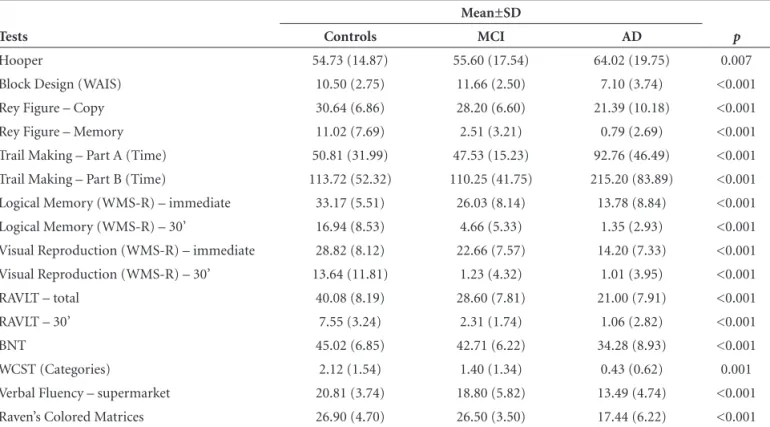
Table 2. Performance of controls, aMCI and AD patients on neuropsychological tests*.
Tests
Mean±SD
p
Controls MCI AD
Hooper 54.73 (14.87) 55.60 (17.54) 64.02 (19.75) 0.007 Block Design (WAIS) 10.50 (2.75) 11.66 (2.50) 7.10 (3.74) <0.001 Rey Figure – Copy 30.64 (6.86) 28.20 (6.60) 21.39 (10.18) <0.001 Rey Figure – Memory 11.02 (7.69) 2.51 (3.21) 0.79 (2.69) <0.001 Trail Making – Part A (Time) 50.81 (31.99) 47.53 (15.23) 92.76 (46.49) <0.001 Trail Making – Part B (Time) 113.72 (52.32) 110.25 (41.75) 215.20 (83.89) <0.001 Logical Memory (WMS-R) – immediate 33.17 (5.51) 26.03 (8.14) 13.78 (8.84) <0.001 Logical Memory (WMS-R) – 30’ 16.94 (8.53) 4.66 (5.33) 1.35 (2.93) <0.001 Visual Reproduction (WMS-R) – immediate 28.82 (8.12) 22.66 (7.57) 14.20 (7.33) <0.001 Visual Reproduction (WMS-R) – 30’ 13.64 (11.81) 1.23 (4.32) 1.01 (3.95) <0.001 RAVLT – total 40.08 (8.19) 28.60 (7.81) 21.00 (7.91) <0.001 RAVLT – 30’ 7.55 (3.24) 2.31 (1.74) 1.06 (2.82) <0.001 BNT 45.02 (6.85) 42.71 (6.22) 34.28 (8.93) <0.001 WCST (Categories) 2.12 (1.54) 1.40 (1.34) 0.43 (0.62) 0.001 Verbal Fluency – supermarket 20.81 (3.74) 18.80 (5.82) 13.49 (4.74) <0.001 Raven’s Colored Matrices 26.90 (4.70) 26.50 (3.50) 17.44 (6.22) <0.001
values for their educational level on the MMSE,
10below 22
in the Memory Complaint Questionnaire (MAQ-Q)
27and
below 3.84 on the Informant Questionnaire on Cognitive
Decline in the Elderly (IQCODE).
28Subjects with
neuro-logical disease, history of alcoholism, depression, or any
other psychiatric disorder, non-corrected visual or
audi-tory disorders, motor disorders, or users of psychotropic
drugs that could affect cognitive functions were excluded.
Chronic diseases such as hypertension, diabetes mellitus
and cardiac disorders, if adequately controlled, were not
criteria for exclusion.
All patients and control individuals who agreed to
participate in the study signed a written informed consent
term. This study was approved by the Ethics Committee
of the Hospital das Clínicas of the University of São Paulo
School of Medicine.
Statistical analysis
We used the Chi-square test to evaluate associations
between the categorical variables and the results. When
the variables were continuous, the comparisons were
per-formed by Mann-Whitney for two samples, and by the
Kruskall-Wallis test for more than two samples. The value
of significance accepted was 0.01.
All statistical analysis was carried out using the
pro-gram
Statistical Package for the Social Sciences (SPSS),
for
Windows,
version
10.0.
Results
No differences related to gender (
p
=0.364) were found
among the control group, aMCI and AD patients, but
sta-tistically significant differences related to age (
p
<0.001) and
schooling (
p
=0.03) were observed (Table 1).
Comparison among controls, aMCI and AD patients
on neuropsychological assessments yielded statistically
sig-nificant differences in all tests applied (Table 2).
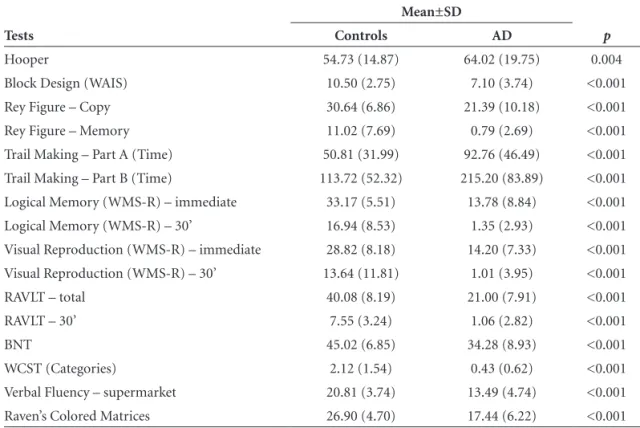
When control group and AD patients were compared,
sta-tistically significant differences were found in all tests (Table 3).
Comparison between the control group and aMCI
pa-tients revealed statistically significant differences in
mem-ory tasks (visual and verbal) for immediate and delayed
recall, except for the immediate recall of Visual
Reproduc-tion test (Table 4).
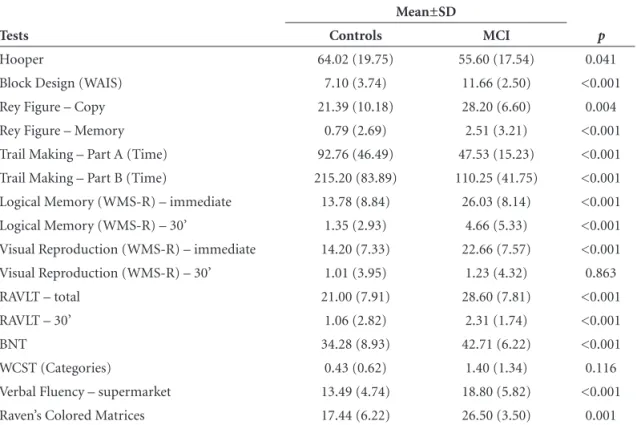
Statistically significant differences were observed
be-tween aMCI and AD patients on tasks of constructive and
visuoperceptual abilities; attention; language and memory
(except for delayed recall of Visual Reproduction test). No
statistically significant differences in visual organization
(measured by Hooper) and executive functions were noted
(measured by WCST) (Table 5).
Table 3. Performance of controls and AD patients on the neuropsychological tests*.
Tests
Mean±SD
p
Controls AD
Hooper 54.73 (14.87) 64.02 (19.75) 0.004 Block Design (WAIS) 10.50 (2.75) 7.10 (3.74) <0.001 Rey Figure – Copy 30.64 (6.86) 21.39 (10.18) <0.001 Rey Figure – Memory 11.02 (7.69) 0.79 (2.69) <0.001 Trail Making – Part A (Time) 50.81 (31.99) 92.76 (46.49) <0.001 Trail Making – Part B (Time) 113.72 (52.32) 215.20 (83.89) <0.001 Logical Memory (WMS-R) – immediate 33.17 (5.51) 13.78 (8.84) <0.001 Logical Memory (WMS-R) – 30’ 16.94 (8.53) 1.35 (2.93) <0.001 Visual Reproduction (WMS-R) – immediate 28.82 (8.18) 14.20 (7.33) <0.001 Visual Reproduction (WMS-R) – 30’ 13.64 (11.81) 1.01 (3.95) <0.001 RAVLT – total 40.08 (8.19) 21.00 (7.91) <0.001 RAVLT – 30’ 7.55 (3.24) 1.06 (2.82) <0.001 BNT 45.02 (6.85) 34.28 (8.93) <0.001 WCST (Categories) 2.12 (1.54) 0.43 (0.62) <0.001 Verbal Fluency – supermarket 20.81 (3.74) 13.49 (4.74) <0.001 Raven’s Colored Matrices 26.90 (4.70) 17.44 (6.22) <0.001
Table 4. Performance of controls and aMCI patients on the neuropsychological tests*.
Tests
Mean±SD
p
Controls MCI
Hooper 54.73 (14.87) 55.60 (17.54) 0.280 Block Design (WAIS) 10.50 (2.75) 11.66 (2.50) 0.074 Rey Figure – Copy 30.64 (6.86) 28.20 (6.60) 0.079 Rey Figure – Memory 11.02 (7.69) 2.51 (3.21) <0.001 Trail Making – Part A (Time) 50.81 (31.99) 47.53 (15.23) 0.963 Trail Making – Part B (Time) 113.72 (52.32) 110.25 (41.75) 0.986 Logical Memory (WMS-R) – immediate 33.17 (5.51) 26.03 (8.14) 0.004 Logical Memory (WMS-R) – 30’ 16.94 (8.53) 4.66 (5.33) <0.001 Visual Reproduction (WMS-R) – immediate 28.82 (8.18) 22.66 (7.57) 0.023 Visual Reproduction (WMS-R) – 30’ 13.64 (11.81) 1.23 (4.32) <0.001 RAVLT – total 40.08 (8.19) 28.60 (7.81) <0.001 RAVLT – 30’ 7.55 (3.24) 2.31 (1.74) <0.001 BNT 45.02 (6.85) 42.71 (6.22) 0.138 WCST (Categories) 2.12 (1.54) 1.40 (1.34) 0.280 Verbal Fluency – supermarket 20.81 (3.74) 18.80 (5.82) 0.034 Raven’s Colored Matrices 26.90 (4.70) 26.50 (3.50) 0.831
*Mann-Whitney Test; SD, standard deviation; MCI, Mild Cognitive Impairments; WAIS, Wechsler Adult Intelligence Scale; WMS-R, Wechsler Memory Scale – Revised; RAVLT, Rey Auditory Verbal Learning Test; BNT, Boston Naming Test; WCST, Wisconsin Card Sorting Test.
Table 5. Performance of aMCI and AD patients on the neuropsychological tests*.
Tests
Mean±SD
p
Controls MCI
Hooper 64.02 (19.75) 55.60 (17.54) 0.041 Block Design (WAIS) 7.10 (3.74) 11.66 (2.50) <0.001 Rey Figure – Copy 21.39 (10.18) 28.20 (6.60) 0.004 Rey Figure – Memory 0.79 (2.69) 2.51 (3.21) <0.001 Trail Making – Part A (Time) 92.76 (46.49) 47.53 (15.23) <0.001 Trail Making – Part B (Time) 215.20 (83.89) 110.25 (41.75) <0.001 Logical Memory (WMS-R) – immediate 13.78 (8.84) 26.03 (8.14) <0.001 Logical Memory (WMS-R) – 30’ 1.35 (2.93) 4.66 (5.33) <0.001 Visual Reproduction (WMS-R) – immediate 14.20 (7.33) 22.66 (7.57) <0.001 Visual Reproduction (WMS-R) – 30’ 1.01 (3.95) 1.23 (4.32) 0.863 RAVLT – total 21.00 (7.91) 28.60 (7.81) <0.001 RAVLT – 30’ 1.06 (2.82) 2.31 (1.74) <0.001 BNT 34.28 (8.93) 42.71 (6.22) <0.001 WCST (Categories) 0.43 (0.62) 1.40 (1.34) 0.116 Verbal Fluency – supermarket 13.49 (4.74) 18.80 (5.82) <0.001 Raven’s Colored Matrices 17.44 (6.22) 26.50 (3.50) 0.001
Discussion
Comparison of control group, aMCI and AD patients
revealed a statistically significant difference in all tests
ap-plied. Our finding of differences among the groups for all
cognitive functions evaluated is in line with results of
sev-eral other studies. Boeve et al.
29demonstrated that MCI
pa-tients showed intermediate scores on memory tasks which
lay between normal subjects and dementia patients. As
ex-pected, comparisons between control group and AD
pa-tients yielded statistically significant differences in all tests
applied, where this result corroborates with characteristics
of AD in that beyond memory impairments, other
func-tions including attention, language, reasoning and
visu-ospatial abilities are also damaged.
30Neuropsychological assessment was able to
discrimi-nate controls from aMCI patients through memory tasks,
except for the immediate recall of Visual Reproduction.
These findings may be explained since memory begins to
decline early in the disease process while the most
impor-tant evidence for aMCI is poor performance on memory
tests
3,4,31-34. Petersen et al.
1compared controls, MCI and
mild AD patients by a neuropsychological assessment
comprising the MMSE, WAIS-R, WMS-R, Dementia
Rat-ing Scale, Free and Cued Selective RemindRat-ing Test (FCSRT)
and Rey Auditory Verbal Learning Test (RAVLT). The
re-sults showed similar performance on measures of general
cognition between controls and MCI, but subjects with
MCI were more significantly impaired on memory tasks.
Perri et al.
35investigated different aspects of episodic
long-term, short-term and implicit long-term memory in aMCI
patients. Results showed normal short-term memory
abili-ties, while the episodic long-term memory showed poorer
results in aMCI than in controls. The authors affirmed that
although some episodic memory functions were relatively
well preserved, others appeared to have deteriorated to a
level comparable to that of mild AD patients.
Statistically significant differences were observed
be-tween AD and aMCI patients in tasks of constructive and
visuoperceptual abilities, attention, language, immediate
and delayed recall verbal memory and immediate visual
memory. The differences observed in other tasks beyond
memory tests can be explained by the fact that AD patients
present more severe disorders in many other cognitive
do-mains such as attention, visuospatial abilities, language and
complex motor tasks.
1,4,36Kramer et al.
37compared aMCI
subjects, with presumably isolated memory impairment,
with controls and very mild AD patients using a battery of
neuropsychological tests. As expected, deficits in episodic
memory were observed, but the aMCI group performed
less well than controls yet better than the AD group on
design fluency, category fluency, a set shifting task and the
Stroop interference condition. Economou et al.
38compared
patients with aMCI, mild AD and controls on nonepisodic
memory measures. Working memory, processing speed,
se-mantic fluency and complex motor tasks were significantly
worse in the mild AD than the aMCI group. Rozzini et al.
39investigated the risk factors associated with conversion of
aMCI to dementia of Alzheimer type. Subjects who
con-verted to AD over time were classified as demented and
subjects that remained unchanged, or became cognitively
normal during follow-up were defined as Stable. After a
one-year period, demented individuals presented worse
performance on phonemic verbal fluency, Raven’s colored
matrices, Trail Making test A and B, and in Instrumental
Activities of Daily Living than Stable subjects.
No statistically significant difference was observed
be-tween AD and aMCI patients in the delayed recall stage
of the Visual Reproduction. Alescio-Lautier et al.
40found
that both MCI and AD patients’ had impairments on visual
tasks. Griffith et al.
41showed that on the DRS, Initiation/
Perseveration scores below 37 and Visual Reproduction
Percent Retention scores below 26% correctly identified AD
converters with 76.9% sensitivity and 91.7% specificity.
Many studies
4,29,33have shown that MCI subjects have a
neuropsychological performance which lies between
nor-mal older individuals and demented patients. However,
neuropsychological features for MCI classification are not
yet well established. Studies
42-44have suggested that there
is probably a continuum between aMCI and AD at early
stages, which hampers discrimination among these groups,
where the results of our study confirmed these difficulties.
According to Nelson and O’Connor
45there is no consensus
regarding an optimal test battery useful in the detection of
MCI. Nonetheless, a well-constructed neuropsychological
battery which comprises tests investigating specific aspects
of memory complaints can detect subtle cognitive deficits
that can easily be overlooked, particularly in patients with
a high intellectual baseline. Winblad et al.
2suggested that
individual slopes of decline in both functional and
cogni-tive performance may be the best measures for diagnosing
MCI. According to Celone et al.
46a longitudinal follow-up
is necessary, however, to determine whether MCI subjects
are indeed in the early phases of AD.
The present study confirmed that a well-constructed
neuropsychological battery is important to reach
differen-tial diagnosis among controls, aMCI and AD patients, but
in order to achieve diagnostic accuracy the scales must be
used in conjunction with clinical features, functional
activi-ties investigation, biomarkers and neuroimaging measures.
interference of these variables on performance in the
neu-ropsychological tests.
References
1. Petersen RC, Smith GE, Waring SC, et al. Mild Cognitive Im-pairment: clinical characterization and outcome. Arch Neurol 1999;56:303-308.
2. Winblad B, Palmer K, Kivipelto M, et al. Mild cognitive im-pairment – beyond controversies, towards a consensus: report of the International Working Group on Mild Cognitive Im-pairment. J Int Med 2004;256:240-246.
3. Petersen RC, Doody R, Kurz A, et al. Current concepts in Mild Cognitive Impairment. Arch Neurol 2001;58:1985-1992. 4. Arnáiz E, Almkvist O. Neuropsychological features of mild
cognitive impairment and preclinical Alzheimer’s disease. Acta Neurol Scand 2003;107(Suppl. 179):34-41.
5. Dawe B, Procter A. Concepts of mild memory impairment in the elderly and their relationship to dementia – a review. Int J Geriatr Psychiatry 1998;7:473- 479.
6. Fischer P, Jungwirth S, Zehetmayer S, et al. Conversion from subtypes of mild cognitive impairment to Alzheimer demen-tia. Neurology 2007;68:288-291.
7. Visser PJ, Kester A, Jolles J, et al. Ten-year risk of demen-tia in subjects with mild cognitive impairment. Neurology 2006;7:1201-1207.
8. Flicker C, Ferris SH, Reisberg B. Mild cognitive impairment in the elderly: predictors of dementia. Neurology1991;41:1006-09. 9. Bäckman L, Small BJ, Fratiglioni L. Stability of the preclini-cal episodic memory deficit in Alzheimer’s disease. Brain 2001;124:96-102.
10. Brucki SMD, Nitrini R, Caramelli P, Bertolucci PHF, Oka-moto I H. Suggestions of utilization of the Mini-mental state examination in Brazil. Arq Neuropsiquiatr 2003;61:777-781. 11. Nitrini R, Lefèvre BH, Mathias SC, et al. Neuropsychologi-cal tests of simple application for diagnosing dementia. Arq Neuropsiquiatr 1994;52:457-465.
12. Nitrini R, Carameli P, Porto CS, et al. Avaliação Cognitiva Breve no diagnóstico de doença de Alzheimer leve. Arq Neu-ropsiquiatr 2005;63;27.
13. Pfeffer RI, Kusosaki TT, Harrah Jr CH, Chance JM, Filos S. Measurement of functional Activities in Older Adults in the Community. J Gerontol 1982;37:323-329.
14. Nitrini R, Caramelli P, Bottino CMC, Damasceno BP, Brucki SMD, Anghinah R. Diagnóstico de doença de Alzheimer no Brasil: avaliação cognitiva e funcional. Recomendações do Departamento Científico de Neurologia Cognitiva e do Envelhecimento da Academia Brasileira de Neurologia. Arq Neuropsiquiatr 2005;63:720-727.
15. American Psychiatric Association. Diagnostic and Statisti-cal Manual of Mental Disorders. 3 ed. Ver Washington, DC: American Psychiatric Association;1987.
16. McKann G, Drachman D, Folstein M, Katzman R, Prince D, Staklan EM. Clinical diagnosis of Alzheimer’s Disease: report of the NINCDS-ADRDA work group under the auspices of department of health and human services force on Alzheim-er’s Disease. Neurology 1984;34:939-944.
17. Petersen RC, Stevens JC, Ganguli M, et al. Practice parameter: Early detection of dementia: Mild cognitive impairment (an evidence-based review). Report of the Quality Standards Sub-committee of the American Academy of Neurology. Neurol-ogy 2001;56:1133-1142.
18. Spreen O, Strauss E. A Compendium of Neuropsychological Tests. Administration, Norms, and Commentary. Second Edi-tion. Oxford University Press;1998.
19. Hooper Visual Organization Test (VOT) Manual. Los Angeles, CA: Western Psychological Services;1983.
20. Raven JC, Raven J, Courth JH. Manual Matrizes Progressivas Coloridas. São Paulo: Casa do Psicólogo;1988.
21. Goodglass H, Kaplan E. The assessment of aphasia and related disorders. 2nd ed. Philadelphia: Lea & Febiger;1987. 22. Radanovic M, Mansur LL, Scaff M. Normative data for
the Brazilian population in the Boston Diagnostic Aphasia Examination: influence of schooling. Braz J Med Biol Res 2004;37:1731-1738.
23. Wechsler D. Teste de Inteligencia para adultos (WAIS). Manu-al. 2a Edição. Buenos Aires, Argentina. Editorial Paidos;1993. 24. Rey A. Figuras Complexas de Rey. Casa do Psicólogo;1998. 25. Wechsler D. Wechsler Memory Scale. Manual The
Psychologi-cal Corporation Harcourt Brace Jovanovich;1987.
26. Diniz LFM, Cruz MF, Torres VM, Consenza, RM. Teste de aprendizagem auditivo verbal de Rey: normas para uma população brasileira. Rev Bras Neurol 2000;36:79-83. 27. Mattos P, Lino V, Rizo L, Alfano A, et al. Memory complaints
and test performance in health elderly persons. Arq Neurop-siquiatr 2003;61: 920-924.
28. Jorm, AF. A short form of the Informant Questionnaire on Cognitive Decline in the Elderly (IQCODE): development and cross-validation. Psychol Med1994;24:145-153. 29. Boeve B, McCormick J, Smith G, et al. Mild Cognitive
impair-ment in the oldest old. Neurology 2008;60:477-480. 30. Mesulam MM. Principles of Behavior and Cognitive
Neurol-ogy. Second Edition. New York: Oxford;2000:1-540. 31. Jacobs DM, Sano M, Dooneief G, Marder K, Bell KL, Stern Y.
Neuropsychological detection and characterization of pre-clinical Alzheimer’s Disease. Neurology 1995;45 957-962. 32. Chen P, Ratcliff G, Phil D, et al. Cognitive tests that best
dis-criminate between presymptomatic AD and those who re-main nondemented. Neurology 2000, 55:1847-1853. 33. Grundeman M, Petersen RC, Ferris SH, et al. Mild Cognitive
measures in normal individuals that predict subsequent cog-nitive decline. Arch Neurol 2007;64:862-871.
35. Perri R, Serra L, Carlesimo GA, Caltagirone C. Preclinical de-mentia: an Italian multicentre study on amnestic mild cognitive impairment. Dement Geriatr Cogn Disord 2007;23:289-300. 36. Feldman HH, Jacova C. Mild Cognitive Impairment. Am J
Geriatr Psychiatry 2005;13:645-655.
37. Kramer JH, Nelson A, Johnson JK, et al. Multiple cognitive deficits in amnestic mild cognitive impairment. Dement Geriatr Cogn Disord 2006;22:306-311.
38. Economou A, Papageorgiou SG, Karageorgiou C, Vassilopou-los D. Nonepisodic memory deficits in amnestic MCI. Cogn Behav Neurol 2007;20:99-106.
39. Rozzini L, Chilovi BV, Conti M, et al. Conversion of amnestic Mild Cognitive Impairment to dementia of Alzheimer type is independent to memory deterioration. Int J Geriatr Psychia-try 2007;22:1217-1222.
40. Alescio-Lautier B, Michael BF, Herrera C, et al. Visual and visuospatial short-term memory in mild cognitive impair-ment and Alzheimer disease: Role of attention. Neuropsy-chologia 2007;45:1948-1960.
41. Griffith HR, Netson KL, Harrel LE, Zamrini EY, Brockington JC, Marson DC. Amnestic mild cognitive impairment: diag-nostic outcomes and clinical prediction over a two-year time period. J Int Neuropsychol Soc 2006;12:166-175.
42. Tabert MH, Manly JJ, Liu X, et al. Neuropsychological pre-diction of conversion to Alzheimer disease in patients with mild cognitive impairment. Arch Gen Psychiatry 2006;63: 916-924.
43. Clemént F, Belleville S, Gauthier S. Cognitive complaint in mild cognitive impairment and Alzheimer’s disease. J Int Neuropsychol Soc, 2008, 14:222-232.
44. Morris JC, Storandt M, Miller JP, et al. Mild cognitive impair-ment represents early-stage Alzheimer disease. Arch Neurol 2001;58:397-405.
45. Nelson AP, O’Connor MG. Mild Cognitive Impairment: A neuropsychological perspective. CNS Spectr 2008;13: 56-64.