BASIC RESEARCH
Preconditioning of the response to ischemia/
reperfusion-induced plasma leakage in hamster cheek
pouch microcirculation
Fabiana Gomes da Conceic¸a˜o,ICristiane Maria Simonato Conde,IErik Svensjo¨,IIDaniel Alexandre Bottino,I Eliete BouskelaI
ILaboratory for Clinical and Experimental Research on Vascular Biology, Biomedical Center, State University of Rio de Janeiro/RJ, Brazil.IIInstitute of Biophysics Carlos Chagas Filho, Health Sciences Center, Federal University of Rio de Janeiro/RJ, Brazil.
OBJECTIVE:Ischemic preconditioning and some drugs can protect tissues from injury by preserving microcirculation. This study evaluated vascular permeability in a hamster cheek pouch preparation using either short ischemic periods or bradykinin as preconditioning stimuli followed by 30 min of ischemia/reperfusion.
METHOD:Sixty-six male hamsters were divided into 11 groups: five combinations of different ischemic frequencies and durations (one, three or five shorts periods of ischemia, separated by one or five minutes) with 10 min intervals between the ischemic periods, followed by 30 min ischemia/reperfusion; three or five 1 min ischemic periods with 10 min intervals between them followed by the topical application of histamine (2mM); bradykinin (400 nM)
followed by 30 min of ischemia/reperfusion; and three control groups (30 min of ischemia/reperfusion or histamine or bradykinin by themselves). Macromolecular permeability was assessed by injection of fluorescein-labeled dextran (FITC-dextran, MW = 150 kDa; 250 mg/Kg body weight), and the number of leaks/cm2 was counted using an intravital microscope and fluorescent light in the cheek pouch.
RESULTS:Plasma leakage (number of leaks/cm2) was significantly reduced by preconditioning with three and five 1 min ischemic periods, one and three 5 min ischemic periods and by bradykinin. Histamine-induced macro-molecular permeability was also reduced after three periods of 5 min of ischemia.
CONCLUSION: Short ischemic periods and bradykinin can function as preconditioning stimuli of the ischemia/ reperfusion response in the hamster cheek pouch microcirculation. Short ischemic periods also reduced histamine-induced macromolecular permeability.
KEYWORDS: Ischemic Preconditioning; Bradykinin Preconditioning; Vascular Permeability; Microcirculation; Hamster Cheek Pouch.
Conceic¸a˜o FG, Conde CM, Svensjo¨ E, Bottino DA, Bouskela E. Preconditioning of the response to ischemia/reperfusion-induced plasma leakage in hamster cheek pouch microcirculation. Clinics. 2012;67(8):923-929.
Received for publication onDecember 21, 2011;First review completed onJanuary 10, 2012;Accepted for publication onMarch 2, 2012
E-mail: [email protected] Tel.: 55 21 2334 0703
INTRODUCTION
Mortality by cardiovascular disease is still an important concern worldwide. According to World Health Organization (WHO), in 2004, coronary heart disease was the second most common cause of death in low- and middle-income countries and the most common cause of death in high-income ones (1). During an acute myocardial infarction, many attempts to reestablish blood flow are performed by physicians to save as many cardiomyocytes as possible before they are damaged by
ischemia. However, after blood flow normalization, reper-fusion injury also restricts cell survival. Consequently, larger myocardial infarct areas predict worse prognosis due to the loss of contractile mass and inadequate ventricle remodeling through hypertrophy, eventually causing heart failure (2).
Preconditioning refers to a phenomenon wherein tissues are rendered resistant to the deleterious effects of prolonged ischemia and reperfusion by prior exposure to oxidants, brief periods of vascular occlusion, endotoxin derivatives, heat shock, a variety of pharmacological agents (chemical or pharmacological preconditioning), or chronic ethanol con-sumption (3). Of these perturbations, our best understand-ing of the mechanisms involved in conferrunderstand-ing protection is related to ischemic preconditioning (IPC) (4).
Myocardial preconditioning has been developed to minimize the effects of acute ischemia to the heart. In 1986, Murry et al. reported that four brief episodes of 5 Copyrightß2012CLINICS– This is an Open Access article distributed under
the terms of the Creative Commons Attribution Non-Commercial License (http:// creativecommons.org/licenses/by-nc/3.0/) which permits unrestricted non-commercial use, distribution, and reproduction in any medium, provided the original work is properly cited.
minutes of ischemia in the circumflex coronary in dogs followed by 5 minutes of reperfusion reduced the infarct size by 75% compared to controls (5). Since the publication of that report, many studies have tried to explain the mechanistic steps involved in the preconditioning process, such as mitochondrial ATP-sensitive K+ channels, nitric
oxide, adenosine and bradykinin (BK) (6-8).
Several studies in the hamster cheek pouch (HCP) on experimental perturbations with drugs and the subsequent responses suggest that it could be a useful model for studies of IPC and other types of preconditioning (9-12). In a study of ischemia/reperfusion (I/R) in the HCP, a period of 30 minutes of ischemia resulted in a 30% reduction in plasma leakage in response to a second ischemic period, although the response to histamine appeared unchanged (12).
The main element affected by ischemia that determines cell survival is the microcirculation, the smallest vessels of the vascular system; the endothelium plays a key role in the ischemic process. Endothelial barrier dysfunction is a well-recognized response to ischemia, which involves inflamma-tion (13). Many changes occur in the structure of the endothelial monolayer; one example is the widening of paracellular junctions caused by the dissociation of junc-tional proteins or cytoskeletal contractions (14,15). Increased microvascular permeability results in edema and organ failure. The magnitude of albumin leakage from post-ischemic venules during ischemia-reperfusion injury was reportedly proportional to the number of adherent and emigrated leucocytes (16). However, histamine, normally associated with allergic reactions and increases in vascular permeability through H2action, has been shown to decrease inflammation by reducing chemotactic responsiveness of leukocytes (17,18). Adachi et al. demonstrated that diphen-hydramine, a histamine H1 receptor antagonist, inhibits histamine-N-methyltransferase, which is a histamine-inacti-vating enzyme in the brain. Thus, brain histamine amelio-rated reperfusion injury after cerebral ischemia in rats (19). The combination of biogenic amines such as histamine, bradykinin and ischemic preconditioning may minimize the deleterious effects of ischemia-reperfusion injury on the microcirculation.
The main objectives of this work were to test the use of the hamster cheek pouch as a model of preconditioning and the effects of different frequencies and durations of brief ischemic preconditioning (IP) episodes followed by 30 minutes of total ischemia and reperfusion or histamine compared to the topical application of bradykinin followed by ischemia/reperfusion on microvascular permeability in hamster cheek pouch preparations.
MATERIALS AND METHODS
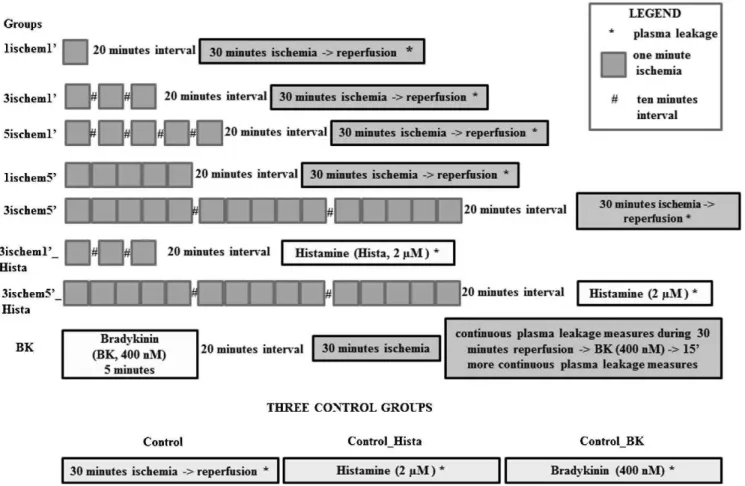
This study was approved by the Ethical Committee of the State University of Rio de Janeiro, RJ, Brazil (CEA/215/2007). Sixty-six male Syrian golden hamsters (Mesocricetus auratus, Botucatu, Sa˜o Paulo, SP, Brazil), weighing between 80 g to 100 g, were randomly divided into eleven experimental groups: control (C) - 30 minutes of ischemia; 1ischem19 - 1 minute of ischemia (IP) followed by 20 minutes of waiting time and 30 minutes of ischemia; 3ischem19- three 1 minute periods of ischemia with 10-minute intervals between them (IP), followed by 20 minutes of waiting time and 30 minutes of ischemia; 5ischem19- five 1 minute periods of ischemia with 10-minute intervals between them (IP), followed by 20 minutes
of waiting time and 30 minutes of ischemia; 1ischem59 – 5 minutes of ischemia (IP) followed by 20 minutes of waiting time and 30 minutes of ischemia; 3ischem59- three 5- minute periods of ischemia with 10-minute intervals between them (IP), followed by 20 minutes of waiting time and 30 minutes of ischemia; 3ischem19_Hista – three one minute periods of ischemia with 10-minute intervals between them (IP), followed by 20 minutes of waiting time and the topical application of histamine (2mM); 3ischem59_Hista - three 5 minutes periods
of ischemia with 10-minute intervals between them (IP), followed by 20 minutes of waiting time and topical application of histamine (2mM); control_Hista - topical application of
histamine (2mM); BK - preconditioning with bradykinin (BK)
was achieved by the topical application of 400 nM BK for 5 minutes, followed after 20 minutes by either 30 minutes of ischemia or no treatment (control) (Figure 1).
Hamster cheek pouch preparation
The hamster cheek pouch was prepared according to studies by Duling (1973) (20), Svensjo¨ et al. (1978) (21), modified by Persson et al. (1985) (12) and by Bouskela and Grampp (1992) (22) (Figure 2A and B). Anesthesia was induced by an intraperitoneal injection of sodium pentobar-bital (0.2 ml/100 g body weight, pentobarpentobar-bital sodium, Sanofi, Paris, France, 60 mg/ml). After cannulation of the femoral vein, anesthesia was maintained with an injection of alpha-chloralose (2.5 ml/kg body weight, Merck, Darmstadt, Germany). Thirty minutes after the preparation was com-pleted, fluorescein-labeled dextran (FITC-dextran, MW = 150 kDa; 250 mg/kg body weight) was injected intravenously as a macromolecular tracer.
The cheek pouch (Figure 2B) was subjected to ischemic periods of different durations with an inflatable cuff made of thin latex tubing, mounted around the neck of the everted pouch where it leaves the mouth of the hamster. The cuff did not disturb the local blood flow, and an intracuff pressure of 200–220 mmHg created by air compression with a syringe resulted in complete arrest of the microvascular blood flow within few seconds (12).
Increases in microvascular permeability for large mole-cules (plasma leakage) was quantified by counting sites with extravasation of fluorescent plasma (leaky sites = leaks) at post-capillary venules at 2–5 min intervals after the onset of reperfusion and/or topical application of bradykinin (400 nM) or histamine (2mM) for 5 minutes. The results are
reported as the number of leaks counted 10 minutes after the onset of reperfusion.
Statistical Analysis
Results are reported as means¡standard deviations
unless otherwise noted. For statistical analyses, ANOVA was used to compare groups to controls. p,0.05 was considered to indicate a statistically significant difference.
RESULTS
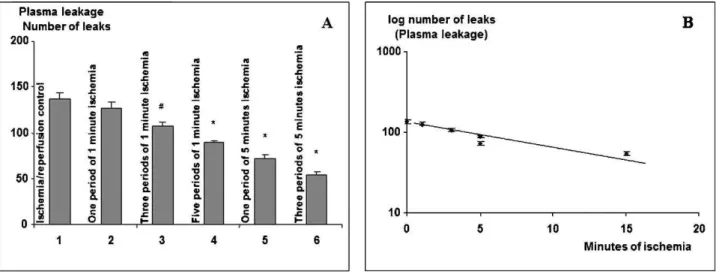
Brief 1- to 5-minute periods of ischemia followed by reperfusion caused no visible increases in the number of leaks or plasma leakage. One period of 1 minute of ischemia had influence (p.0.05) on the subsequent 30-minute period of I/R on plasma leakage, but several brief ischemic periods reduced the response to the 30-minute period of ischemia as shown in Figure 3A. Three periods of 5 minutes of ischemia produced a significant reduction of the response to the
Preconditioning and microcirculation
subsequent 30 minutes of I/R. When logarithmic values of the maximal number of leaks induced by 30 minutes of ischemia were plotted versus the total duration of ischemia during IPC, a linear correlation could be observed (Figure 3B).
Figure 4 shows two IPC groups with three one-minute and three five-minute ischemia periods followed by the topical application of histamine compared to control. Three occlusions of five minutes produced the fewest leaks compared to the control group. Bradykinin also contrib-uted microcirculatory protection. Five-minute topical
applications of 400 nM bradykinin given 30 minutes prior to I/R reduced the response to I/R-induced plasma leakage from 125 to 40 leaks/cm2 (32% of the I/R con-trol group) and reduced the bradykinin-induced plasma leakage from 305 to 226 leaks/cm2 (74% of the control group) (Figure 5).
Table 1 displays the results as means and standard devia-tions of leaks in the 3ischem19, 3ischem19_Hista, 3ischem59, and 3ischem59_Hista groups. Additionally, it is possible to visualize the percentage of leaks from each group with the associated control values. There was no statistical difference
Figure 1 -The experimental protocol of the present study. Groups with one, three, and five one-minute ischemic periods: 1ischem19, 3ischem19, and 5ischem19. Groups with one and three five-minute ischemic periods: 1ischem59and 3ischem59. Groups with three one-minute and three five-one-minute ischemic periods followed by histamine: 3ischem19-Hista and 5ischem19_Hista. All ischemic periods had 10-minute rest intervals between them. Bradykinin group (BK) and three control groups: ischemia/reperfusion, histamine, and bradykinin (control, Control_Hista, Control_BK).
between the 3ischem19and 3ischem19_Hista groups concern-ing the percentage of leaks. However, the decreases in the percentage of leaks from the 3ischem59and 3ischem59_Hista groups compared to 3ischem19 and 3ischem19_Hista were highly significant. Further, the decrease in the percentage of leaks was much more evident in the 3ischem59group than in the 3ischem59_Hista group.
DISCUSSION
The hamster cheek pouch as prepared for intravital microscopy has been used in several studies to elucidate the mechanisms behind I/R-induced increases in plasma leakage. A 30-minute period of ischemia was originally selected because it resulted in statistically significant and reproducible increases in plasma leakage during reperfu-sion, whereas 5-minute ischemic periods produce no visible changes in plasma leakage (12). However, the possible effect
of IPC on I/R-, histamine and bradykinin induced plasma leakage has not been studied in the HCP.
This study confirmed that repeated minor episodes of ischemia have a protective effect on the microcirculation. This is a natural phenomenon where several primary pathways converge to cardioprotective effect (24,25). Not all of the mechanisms involved in this cardioprotection are known, and our first question in this study was how long the cheek pouch vessels should be occluded to decrease the microvascular permeability during I/R. We found that a one-minute ischemic period was not enough to reduce the number of leaks during reperfusion. We tested three and five one-minute ischemic periods with ten-minute reflow periods, and the results revealed a decreasing number of leaks. The greatest reduction in plasma leakage induced by 30 min I/R were observed with one and three five-minute ischemic periods with the same reflow time. Murry et al. used 15-minute occlusions to precondition myocardial
Figure 3 -Effect of brief periods of ischemia and reperfusion prior to a period of 30 minutes of ischemia.A.Plasma leakage (maximal number of leaks¡SD) induced at reperfusion after 30 minutes of ischemia following brief periods of ischemia/reperfusion in six groups of hamsters (each group, n = 6) prior to the final 30 minute-ischemic period.#=p,0.05, * =p,0.01 as compared with I/R controls.B. Log-linear relationship between the number of leaks and the total ischemic period prior to the final 30 min I/R.
Figure 4 -Effect of brief periods of I/R prior to histamine application. Plasma leakage (maximal number of leaks¡SD) induced by histamine (2mM). Three periods of 1 or 5 minutes of ischemia reduced the subsequent response to histamine. * =p,0.05,#p,0.01 as compared with histamine controls (2mM).
Preconditioning and microcirculation
tissue in dogs with high mortality (5). When they attempted to use more occlusions with smaller durations, including four five-minute occlusions with 5-minute reflow between them, they observed protective effects on the myocardium. At 10 minutes reflow period, the maximum number of leaks occured and for that reason we have chosen this time to report. We could also demonstrate that the log of IPC-induced reduction was linearly correlated to the total duration of ischemia for 15 minutes (Figure 3B) suggesting that the preconditioning effect was related to the total time of ischemic rather than the number of ischemic periods.
Preconditioning can protect the heart and other tissues from a subsequent sustained period of ischemia. Early preconditioning is independent of protein synthesis, and the prolonged insult should be less than 2 hours (28). Our model used 30 minutes of total ischemia. Prolonged ische-mia will produce impaired endothelial-dependent vasodila-tion, capillary plugging, increased adhered and transmi-grated leukocytes and venous protein leakage (28). Ischemic preconditioning protects endothelial cells and reverses mic-rocirculatory injury caused by ischemia (3).
The effect of IPC (361 min) on histamine-induced plasma leakage did not differ from that observed with I/R; the respective effects were 79% and 78% of the non-IPC-control group response. When the IPC-period was prolonged (365 min), further 63% and 40% reductions were observed in the histamine and I/R groups, respectively, compared to the non-IPC-control group. A similar histamine-precondi-tioning effect was observed by Erlansson et al. (1985), who reported that in a series of four repeated histamine challenges, the second, third, and fourth challenges produced plasma leakages that were each 65% of the first challenge (12). Taken together, these results may suggest that the precondi-tioning effect is more related to the strength of the stimuli (the duration of ischemic periods or the dose of histamine) on endothelial cells, rather than the nature of preconditioning (IPC or histamine). In this context, it is interesting to note that in a study using HCP an antioxidant (flavonoid) reduced the plasma leakage responses induced by histamine, bradykinin
and I/R to 26%, 32% and 31%, respectively, of the control group without antioxidant pretreatment (23).
Delbin et al. have shown that histamine did not influence pulmonary ischemia/reperfusion injury in sedentary or preconditioned exercised rats (five days a week for eight weeks) (29). However, increased nitric oxide (NO) release after regular physical exercise is cardioprotective (30). Perhaps ischemic preconditioning protection is different from the protection developed from exercise training. Indeed, IPC prevented the impairment of pulmonary endothelium-dependent vasodilation partially due to nitric oxide (NO) release in isolated rat lungs (31).
In this study we observed a significant preconditioning effect of three one-minute and three five-minute ischemic periods (Table 1) when tested with 30 min I/R and with histamine (2mM). There was no difference in the
precondi-tioning effect with one-minute ischemic periods (78 % and 79% of control). However, the three five-minute ischemic periods induced a greater preconditioning effect in the 30 min I/R group (39% of control) than in the histamine group (63% of control) suggesting a difference in the mechanism of plasma leakage induction due to ROS formation and the direct receptor stimulation with histamine. Indeed during ischemia in the HCP the presence of reactive oxygen species have been observed (32), and with the addition of histamine, calcium channels may exhibit more prominent action after three five-minute ischemic periods. Some studies have shown the contribution of histamine to ischemic precondi-tioning and microcirculation. Kandilci et al. prevented the decrease in pulmonary vasodilator response to histamine and acetylcholine following two hours of hypothermic ischemia in rats using two 5-minute cycles of ischemia and reperfusion (33). Moreover, Wang et al. demonstrated that mast cell granules are not affected by ischemic preconditioning. The theory behind this finding was that an initial brief ischemia would result in mast cell degranu-lation without significant cardiovascular damage, but when a prolonged ischemic episode would occur, no more degranulation could be possible (34).
We have observed the preconditioning effect of bradykinin on ischemia/reperfusion by reducing plasma leakage com-pared to the control group. In clinical practice, exogenous administration of bradykinin prior to cardiopulmonary bypass in coronary artery bypass grafting reduces myocardial injury (35). Bradykinin can also be considered an endothe-lium protector. Indeed,in vitroexperiments with pig cerebral endothelial cells exposed to necrotic and apoptotic cell inducers (H2O2) demonstrated enhanced expression of the cytoprotective proteins COX-2 and (Cu/Zn) SOD when the cells were pretreated with bradykinin (36). Nevertheless, nitrite production in response to bradykinin was enhanced in microvessels during second window protection (SWOP) in dogs subjected to myocardial preconditioning with 10 minutes of coronary artery occlusion (37). Further, endothe-lial nitric oxide synthase (eNOS) protein in the SWOP myocardium was twofold higher than in control groups.
Our study has demonstrated a preconditioning effect of short periods of ischemia and reperfusion when measured as plasma leakage induced by a 30 min I/R-period. This preconditioning effect (reduction in the response to 30 min I/R-induced plasma leakage) that was log-linear related to the total time of brief ischemic periods. When the same preconditioning protocol was applied before histamine application a similar but smaller reduction in the plasma leakage was observed. A preconditioning effect was also observed after topical application of bradykinin 30 minutes prior to I/R-induced plasma leakage that was of the same magnitude as that induced by brief ischemic periods.
REFERENCES
1. World Health Organization. http://www.who.int/mediacentre/fact-sheets/fs310/en/index4.html.World Health Organization. 2010. Accessed 13-12-22010.
2. Yang X, Cohen MV, Downey JM. Mechanism of cardioprotection by early ischemic preconditioning. Cardiovasc Drugs Ther. 2010;24(3):225-34, http://dx.doi.org/10.1007/s10557-010-6236-x.
3. Dayton C, Yamaguchi T, Warren A, Korthuis RJ. Ischemic precondition-ing prevents post-ischemic arteriolar, capillary, and post-capillary venular dysfunction: signaling pathways mediating the adaptive metamorphosis to a protected phenotype in preconditioned endothe-lium. Microcirculation. 2002;9(2):73-89.
4. Das M, Das DK. Molecular mechanism of preconditioning. IUBMB Life. 2008;60(4):199-203, http://dx.doi.org/10.1002/iub.31.
5. Murry CE, Jennings RB, Reimer KA. Preconditioning with ischemia: a delay of lethal cell injury in ischemic myocardium. Circulation. 1986;74(5):1124-36, http://dx.doi.org/10.1161/01.CIR.74.5.1124. 6. Ardehali H. Role of the mitochondrial ATP-sensitive K+channels in
cardioprotection. Acta Biochim Pol. 2004;51(2):379-90.
7. Bertuglia S, Giusti A. Role of nitric oxide in capillary perfusion and oxygen delivery regulation during systemic hypoxia. Am J Physiol Heart Circ Physiol. 2005;288(2):H525-31.
8. Noda K, Sasaguri M, Ideishi M, Ikeda M, Arakawa K. Role of locally formed angiotensin II and bradykinin in the reduction of myocardial infarct size in dogs. Cardiovasc Res. 1993;27(2):334-40, http:// dx.doi.org/10.1093/cvr/27.2.334.
9. Bertuglia S. Intermittent hypoxia modulates nitric oxide-dependent vasodilation and capillary perfusion during ischemia-reperfusion-induced damage. Am J Physiol Heart Circ Physiol. 2008;294(4):H1914-22, http:// dx.doi.org/10.1152/ajpheart.01371.2007.
10. Mabanta L, Valane P, Borne J, Frame MD. Initiation of remote microvascular preconditioning requires K(ATP) channel activity. Am J Physiol Heart Circ Physiol. 2006;290:H264-71, http://dx.doi.org/ 10.1152/ajpheart.00455.2005.
11. Frame MD, Mabanta L. Remote microvascular preconditioning alters specific vasoactive responses. Microcirculation. 2007;14(7):739-51, http://dx.doi.org/10.1080/10739680701410074.
12. Persson NH, Erlansson M, Svensjo E, Takolander R, Bergqvist D. The hamster cheek pouch–an experimental model to study post-ischemic macromolecular permeability. Int J Microcirc Clin Exp. 1985;4(3):257-63. 13. Rodrigues SF, Granger DN. Role of blood cells in ischaemia-reperfusion induced endothelial barrier failure. Cardiovasc Res. 2010;87(2):291-9, http://dx.doi.org/10.1093/cvr/cvq090.
14. Kumar P, Shen Q, Pivetti CD, Lee ES, Wu MH, Yuan SY. Molecular mechanisms of endothelial hyperpermeability: implications in inflam-mation. Expert Rev Mol Med. 2009;11:e19, http://dx.doi.org/10.1017/ S1462399409001112.
15. Aghajanian A, Wittchen ES, Allingham MJ, Garrett TA, Burridge K. Endothelial cell junctions and the regulation of vascular permeability and leukocyte transmigration. J Thromb Haemost. 2008;6(9):1453-60, http://dx.doi.org/10.1111/j.1538-7836.2008.03087.x.
16. Kurose I, Anderson DC, Miyasaka M, Tamatani T, Paulson JC, Todd RF, et al. Molecular determinants of reperfusion-induced leukocyte adhesion and vascular protein leakage. Circ Res. 1994;74(2):336-43, http:// dx.doi.org/10.1161/01.RES.74.2.336.
17. Hiraga N, Adachi N, Liu K, Nagaro T, Arai T. Suppression of inflammatory cell recruitment by histamine receptor stimulation in ischemic rat brains. Eur J Pharmacol. 2007;557(2-3):236-44, http:// dx.doi.org/10.1016/j.ejphar.2006.11.020.
18. Azuma Y, Shinohara M, Wang PL, Hidaka A, Ohura K. Histamine inhibits chemotaxis, phagocytosis, superoxide anion production, and the production of TNFalpha and IL-12 by macrophages via H2-receptors. Int Immunopharmacol. 2001;1(9-10):1867-75, http://dx.doi.org/10.1016/ S1567-5769(01)00112-6.
19. Adachi N, Liu K, Ninomiya K, Matsuoka E, Motoki A, Irisawa Y, et al. Reduction of the infarct size by simultaneous administration of l-histidine and diphenhydramine in ischaemic rat brains. Resuscitation. 2011;82(2):219-21, http://dx.doi.org/10.1016/j.resuscitation.2010.10.024. 20. Duling BR. The preparation and use of the hamster cheek pouch for
studies of the microcirculation. Microvasc Res. 1973;5(3):423-9, http:// dx.doi.org/10.1016/0026-2862(73)90059-9.
21. Svensjo E, Arfors KE, Arturson G, Rutili G. The hamster cheek pouch preparation as a model for studies of macromolecular permeability of the microvasculature. Ups J Med Sci. 1978;83(1)71-9, http://dx.doi.org/ 10.3109/03009737809179115.
22. Bouskela E, Grampp W. Spontaneous vasomotion in hamster cheek pouch arterioles in varying experimental conditions. Am J Physiol. 1992;262(2 Pt 2):H478-H85.
23. Bouskela E, Donyo KA. Effects of oral administration of purified micronized flavonoid fraction on increased microvascular permeability induced by various agents and on ischemia/reperfusion in diabetic hamsters. Int J Microcirc Clin Exp. 1995;15(6):293-300, http://dx.doi.org/ 10.1159/000179078.
24. Baines CP, Zhang J, Wang GW, Zheng YT, Xiu JX, Cardwell EM, et al. Mitochondrial PKCepsilon and MAPK form signaling modules in the murine heart: enhanced mitochondrial PKCepsilon-MAPK interactions and differential MAPK activation in PKCepsilon-induced cardioprotection. Circ Res. 2002;90(4):390-7, http://dx.doi.org/10.1161/01.RES.0000012702. 90501.8D.
25. Goto M, Liu Y, Yang XM, Ardell JL, Cohen MV, Downey JM. Role of bradykinin in protection of ischemic preconditioning in rabbit hearts. Circ Res. 1995;77(3):611-21, http://dx.doi.org/10.1161/01.RES.77.3.611. 26. Reimer KA, Murry CE, Yamasawa I, Hill ML, Jennings RB. Four brief
periods of myocardial ischemia cause no cumulative ATP loss or necrosis. Am J Physiol. 1986;251(6 Pt 2):H1306-15.
27. Swain JL, Sabina RL, Hines JJ, Greenfield JC Jr, Holmes EW. Repetitive episodes of brief ischaemia (12 min) do not produce a cumulative depletion of high energy phosphate compounds. Cardiovasc Res. 1984;18(5):264-9, http://dx.doi.org/10.1093/cvr/18.5.264.
Table 1 -Comparison of the effects of three ischemic periods (of one minute or three minutes duration) on subsequent I/ R (30min) and on histamine (2mM) induced plasma leakage.
I/R Control
I/R after 3 ischemic periods of one minute
I/R after 3 ischemic periods of five minutes
Control histamine
Histamine after 3 ischemic periods of one minute
Histamine after 3 ischemic periods of five minutes
Number of leaks¡SD
137¡7 107¡4 54¡3 386¡27 306¡15 245¡11
% 100 78 39 100 79 63
p-value - ,0.05 ,0.01 - ,0.05 ,0.01
Preconditioning and microcirculation
28. Carden DL, Granger DN. Pathophysiology of ischaemia-reperfusion injury. J Pathol. 2000;190(3):255-66, http://dx.doi.org/10.1002/ (SICI)1096-9896(200002)190:3,255::AID-PATH526.3.0.CO;2-6. 29. Delbin MA, Moraes C, Camargo E, Mussi RK, Antunes E, de NG, et al.
Influence of physical preconditioning on the responsiveness of rat pulmonary artery after pulmonary ischemia/reperfusion. Comp Biochem Physiol A Mol Integr Physiol. 2007;147(3):793-8, http:// dx.doi.org/10.1016/j.cbpa.2006.08.037.
30. Woodman CR, Thompson MA, Turk JR, Laughlin MH. Endurance exercise training improves endothelium-dependent relaxation in brachial arteries from hypercholesterolemic male pigs. J Appl Physiol. 2005;99(4): 1412-21, http://dx.doi.org/10.1152/japplphysiol.00293.2005.
31. Kandilci HB, Gumusel B, Topaloglu E, Ucar G, Korkusuz P, Ugur Y, et al. Effects of ischemic preconditioning on rat lung: role of nitric oxide. Exp Lung Res. 2006;32(7):287-303, http://dx.doi.org/10.1080/019021406008 17473.
32. Erlansson M, Bergqvist D, Marklund SL, Persson NH, Svensjo¨ E. Superoxide dismutase as an inhibitor of postischemic microvascular permeability increase in the hamster. Free Radical Biology & Medicine. 1990;9:59-65.
33. Kandilci HB, Gumusel B, Demiryurek AT, Lippton H. Preconditioning modulates pulmonary endothelial dysfunction following ischemia-reperfusion injury in the rat lung: role of potassium channels. Life Sci. 2006;78(19):2172-8, http://dx.doi.org/10.1016/j.lfs.2006.07.011. 34. Wang P, Downey JM, Cohen MV. Mast cell degranulation does not
contribute to ischemic preconditioning in isolated rabbit hearts. Basic Res Cardiol. 1996;91(6):458-67, http://dx.doi.org/10.1007/BF00788727. 35. Wang X, Wei M, Kuukasjarvi P, Laurikka J, Rinne T, Moilanen E, et al.
The anti-inflammatory effect of bradykinin preconditioning in coronary artery bypass grafting (bradykinin and preconditioning). Scand Cardiovasc J. 2009;43(1):72-9, http://dx.doi.org/10.1080/1401743080218 0449.
36. Bovenzi V, Savard M, Morin J, Cuerrier CM, Grandbois M, Gobeil F Jr. Bradykinin protects against brain microvascular endothelial cell death induced by pathophysiological stimuli. J Cell Physiol. 2010;222(1):168-76, http://dx.doi.org/10.1002/jcp.21933.