Influence of the extraction protocol of two
maxillary premolars on the occlusal stability of
Class II treatment
Leonardo Tavares Camardella*, Guilherme Janson**, Janine Della Valle Araki***, Marcos Roberto de Freitas****, Arnaldo Pinzan*****
Abstract
Objective: With the purpose of evaluating the influence of two upper premolar extrac-tion on the occlusal stability of full cusp Class II malocclusion treatment, a comparison was performed with a non-extraction treatment protocol. Methods: To this end, a sample consisting of 59 patients with complete Class II malocclusion was selected from the files of the Department of Orthodontics of the Dental School of Bauru. This sample was split into two groups according to the following characteristics: Group 1 included 29 patients treated without extractions and Group 2 included 30 patients treated with the extraction of two upper premolars. Using the TPI and PAR occlusal indices the subjects’ study mod-els were evaluated at the beginning and end of treatment, and at a minimum of 2.4 years after treatment. The occlusal conditions at the end of treatment and in the post-treatment period, the percentage of relapse and post-treatment occlusal changes were compared using Student’s t-test. Results: The results showed no statistically significant differences between the nonextraction and the extraction of two maxillary premolars treatment pro-tocols in terms of the occlusal stability of complete Class II malocclusion treatment in any of the evaluated variables. Conclusions: The extraction of two upper premolars in the treatment of Class II malocclusion did not influence the stability of the occlusal results achieved at the end of the orthodontic treatment. Therefore, a similar stability is achieved by finishing a treatment with either a Class II or a Class I molar relationship.
Keywords: Stability. Class II malocclusion treatment. Tooth extraction.
* MSc in Orthodontics, Bauru Dental School, University of São Paulo.
** Full Professor of the Department of Pedodontics, Orthodontics and Public Health and Head of the Masters Course in Orthodontics, Bauru Dental School, University of São Paulo.
*** MSc in Orthodontics, Bauru Dental School, University of São Paulo.
**** Professor of the Department of Pedodontics, Orthodontics and Public Health and Head of the PhD Course in Orthodontics, Bauru Dental School, University of São Paulo.
INTRODUCTION
Angle Class II malocclusion has several cor-rection protocols, which can generally be di-vided into treatments with or without extrac-tions. Both professionals and patients, however, seek efficiency and excellence in any given treatment protocol. Research has shown that treatment of Class II with premolar extraction is more efficient than treatment without ex-traction or with the exex-traction of four premo-lars.4,17 Nevertheless, in addition to efficiency,
long-term stability of the results, although difficult to achieve,30 is among the main goals
of orthodontic treatment. Longitudinal stud-ies have shown that although improvements in dentition can be achieved with orthodontic treatment, relapse to the original malocclusion tends to occur many years after the removal of the orthodontic appliance.9,14,30
Orthodon-tists should, therefore, use all means available to them to minimize the risks of jeopardizing the results obtained by orthodontic treatment.
Tooth extractions do not significantly influ-ence the success of long-term Class II treatment, which indicates that when fixed appliances are used adequate stability is likely to be achieved both with and without extractions.3,5,9,10,23,30
Although there are only studies that have as-sessed the stability of Class II correction with the extraction of four premolars,3,5,9,10,30 which
entails maintaining a Class I molar relationship. In contrast, studies assessing the stability of treatment protocols involving the extraction of two upper premolars22 are scarce.
Today’s orthodontics is still heavily influ-enced by the precepts advanced by Angle2 and
Tweed29 that orthodontic treatment should
be finished in a Class I molar relationship. Al-though Class II treatment with premolar ex-traction has shown higher efficiency,4,17 there
still are doubts whether or not finishing treat-ment with a Class II molar relationship can af-fect treatment stability.21,26
Therefore, to find an answer to these ques-tions the influence of the two-premolar extrac-tion protocol on Class II stability was evaluated, comparing it with the nonextraction protocol, which establishes a Class I molar relationship at the end of treatment.
MATERIAL AND METHODS Material
For our retrospective sample selection, the records on file at the Department of Ortho-dontics, Dental School of Bauru, University of São Paulo were used.
Sample selection included the following cri-teria: Complete bilateral Class II malocclusion, treated without extractions or with the ex-traction of two upper premolars; the presence of all permanent teeth up to the first molars; absence of retained and supernumerary teeth; absence of abnormalities in tooth size and/or shape; treatment with fixed appliances using standard Edgewise mechanics; exclusion of cases treated with orthognathic surgery; com-plete orthodontic records and post-treatment time of at least 2.4 years.
The TPI11 and PAR7 indices were used to
evaluate the intra and inter-arch occlusal re-lationships in study models of the 59 patients selected, at 3 different stages: Pre-treatment (T1), post-treatment (T2) and a minimum of 2.4 years post-treatment (T3). The sample was divided into two groups (Table 1).
Group 1
The changes between values at T3 and T2 of the TPI (DIFTPI3-2) and PAR (DIFPAR3-2) in-dices were calculated so as to express the amount of relapse after treatment. Based on these mea-surements we also obtained the percentage of relapse expressed by the TPI (PTPI3-2) and PAR (PPAR3-2) indices, using the formulas below.
TPI relapse rate (%)
PAR relapse rate (%)
TPI3 - TPI2
TPI1
PAR3 - PAR2
PAR1 =
=
All measurements relating to the amount of overjet, overbite, crowding and midline shift were obtained from the models using a Zürcher Modell (Seitz & Haag, Germany) caliper capable of yield-ing measurements with a 0.1 mm accuracy. of 7.26 ± 3.43 years (minimum of 2.40 and
maximum of 16.15). Ages mean was of 12.65 ± 1.38 years (minimum of 9.52 and maximum of 15.90) at T1, 15.17 ± 1.58 years (minimum of 12.94 and maximum of 18.72) at T2, and 22.44 ± 3.50 years (minimum of 16.29 and maximum of 31.76) at T3.
Group 2
This group consisted of 30 patients (17 male and 13 female) whose complete Class II malocclusion was treated with the extraction of two upper premolars. Regarding the type of malocclusion, this group included 22 pa-tients with Class II division 1 and 8 papa-tients with Class II division 2. As regards treatment time, group 2 took a mean of 2.24 ± 0.75 years (minimum of 0.93 and maximum of 4.19); while post-treatment time mean was of 9.60 ± 3.55 years (minimum of 3.23 and maximum of 15.99). Ages mean was of 13.32 ± 1.52 years (minimum of 11.21 and maximum of 17.09) at T1, 15.57 ± 1.71 years (minimum of 12.55 and maximum of 19.48) at T2, and 25.18 ± 3.97 years (minimum of 19.02 and maximum of 34.04) at T3.
Methods
The changes between values at T1 and T2 of the TPI (DIFTPI1-2) and PAR (DIF-PAR1-2) indices were calculated so as to ex-press the amount of improvement resulting from treatment. Based on these measurements we also obtained the percentage of improve-ment expressed by the TPI (PTPI1-2) and PAR (PPAR1-2) indices, described by the formulas shown below.4,5,17
TPI improvement rate (%)
PAR improvement rate (%)
TPI1 - TPI2
TPI1
PAR1 - PAR2
PAR1 =
=
TABLE 1 - Description of abbreviations.
Abbreviations Description
TPI1 TPI index at T1
PAR1 PAR index at T1
TPI2 TPI index at T2
PAR2 PAR index at T2
TPI3 TPI index at T3
PAR3 PAR index at T3
DIFTPI1-2 Change in the TPI index during treatment
DIFPAR1-2 Change in the PAR index during treatment
PTPI1-2 Improvement rate of the TPI index during treatment (%)
PPAR1-2 Improvement rate of the PAR index during treatment (%)
DIFTPI3-2 Change in the TPI index after treatment
DIFPAR3-2 Change in the PAR index after treatment
PTPI3-2 Relapse rate of the TPI index after treatment (%)
treatment according to the two aforesaid in-dices, was used the Pearson’s correlation test (Table 10). The Spearman correlation test was used to assess whether the changes in overjet and overbite which occurred during treatment showed a correlation with post-treatment changes (Table 11).
The results were considered statistically sig-nificant for p values lower than 0.05.
Statistical Analysis
Method error
Intrarater error was evaluated by performing new measurements and calculating a new index for the models of 25 patients, randomly select-ed between the two groups, totaling 50 mod-els. The formula proposed by Dahlberg6 (Se2 =
2d2/2n) was applied to estimate the magnitude
of random errors, while systematic errors were analyzed by applying the paired t test, accord-ing to Houston13 (Table 2).
Comparative analysis
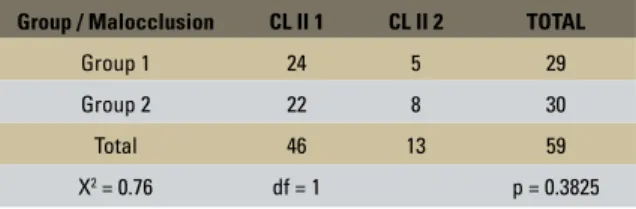
Group compatibility as regards the propor-tion of Class II malocclusion types (Class II, Di-visions 1 and 2) and gender compatibility were assessed by the chi-square test (Tables 3 and 4), whereas the t test was used to evaluate the compatibility of the severity of the initial mal-occlusion (TPI1 and PAR1), occlusal outcome after orthodontic treatment (TPI2 and PAR2), duration of treatment (TreatTime), initial age (AGE1) and final age (AGE2) (Table 5).
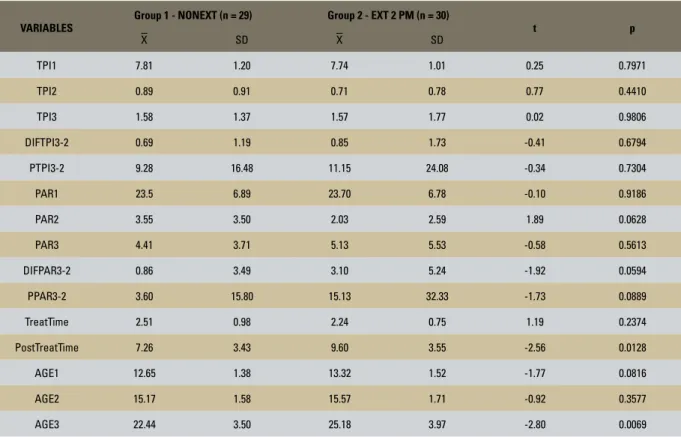
The t test was applied to variables TPI3 and PAR3 to compare the occlusal character-istics present at T3 between groups 1 and 2. A similar comparison was also performed for the variables that expressed the amount of relapse (DIFTPI3-2; DIFPAR3-2) and relapse rate in percentage (PTPI3-2; PPAR3-2) (Table 6).
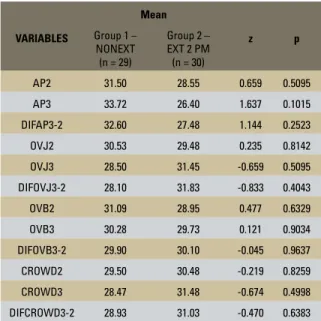
To compare the scores given to each of the components of the PAR index at T3 and post-treatment changes between the two groups, the Mann-Whitney test was used (Table 7).
Since both groups had patients with and without a 3x3 lower retainer, the independent t test was used to compare intragroup stability of patients with 3x3 retainers with those who had no retainer at stage T3 in order to observe a possible influence of retainers on treatment stability for each group1 (Tables 8 and 9).
In order to find a possible correlation of changes during treatment with changes after
TABLE 3 - Results of chi-square test to assess the compatibility of the groups in terms of the proportion of malocclusion types.
TABLE 4 - Results of chi-square test to assess the compatibility of the groups in terms of the proportion of genders.
TABLE 2 - Results of paired t-test and Dahlberg’s formula6 as applied
to the TPI and PAR variables to estimate the systematic and random intrarater errors, respectively.
VARI-ABLES
1ST MEASURE-MENT (n = 25)
2ND
MEASURE-MENT (n = 25) t p DAHL-BERG
X SD X SD
TPI 1.63 1.90 1.85 1.77 -1.39 0.1763 0.5915
PAR 5.12 5.83 5.00 5.46 0.42 0.6771 0.9899
Group / Malocclusion CL II 1 CL II 2 TOTAL
Group 1 24 5 29
Group 2 22 8 30
Total 46 13 59
X2 = 0.76 df = 1 p = 0.3825
Group / Gender M F TOTAL
Group 1 14 15 29
Group 2 17 13 30
Total 31 28 59
VARIABLES
Group 1 - NONEXT (n = 29) Group 2 - EXT 2 PM (n = 30)
t p
X SD X SD
TPI1 7.81 1.20 7.74 1.01 0.25 0.7971
TPI2 0.89 0.91 0.71 0.78 0.77 0.4410
TPI3 1.58 1.37 1.57 1.77 0.02 0.9806
DIFTPI3-2 0.69 1.19 0.85 1.73 -0.41 0.6794
PTPI3-2 9.28 16.48 11.15 24.08 -0.34 0.7304
PAR1 23.5 6.89 23.70 6.78 -0.10 0.9186
PAR2 3.55 3.50 2.03 2.59 1.89 0.0628
PAR3 4.41 3.71 5.13 5.53 -0.58 0.5613
DIFPAR3-2 0.86 3.49 3.10 5.24 -1.92 0.0594
PPAR3-2 3.60 15.80 15.13 32.33 -1.73 0.0889
TreatTime 2.51 0.98 2.24 0.75 1.19 0.2374
PostTreatTime 7.26 3.43 9.60 3.55 -2.56 0.0128
AGE1 12.65 1.38 13.32 1.52 -1.77 0.0816
AGE2 15.17 1.58 15.57 1.71 -0.92 0.3577
AGE3 22.44 3.50 25.18 3.97 -2.80 0.0069
TABLE 5 - Results of the independent t test applied to variables in groups 1 and 2.
TABLE 6 - Results of the independent t test, considering the compatibility of groups 1 and 2, in terms of post-treatment time and age at T3.
VARIABLES
Group 1 - NON-EXT (n = 28) Group 2 - EXT 2 PM (n = 26)
t p
X SD X SD
TPI3 1.57 1.40 1.43 1.85 0.31 0.7527
DIFTPI3-2 0.71 1.21 0.77 1.82 -0.12 0.9001
PTPI3-2 9.61 16.68 10.04 25.35 -0.07 0.9422
PAR3 4.46 3.77 5.07 5.89 -0.45 0.6489
DIFPAR3-2 1.14 3.20 3.19 5.60 -1.66 0.1021
PPAR3-2 4.35 15.55 16.06 34.60 -1.62 0.1105
TreatTime 2.51 1.00 2.26 0.63 1.11 0.2690
PostTreatTime 7.31 3.48 8.89 3.16 -1.74 0.0871
AGE1 12.64 1.40 13.05 1.35 -1.09 0.2764
AGE2 15.16 1.61 15.31 1.48 -0.36 0.7132
TABLE 7 - Results of the Mann-Whitney test applied in the post-treat-ment and post-treatpost-treat-ment follow-up periods, and their respective change in the post-treatment period of each component of the PAR index in groups 1 and 2.
TABLE 9 - Comparison, using the independent t test, of the stability of group 2 between cases with and without lower 3x3 retainer at stage T3.
TABLE 11 - Spearman correlation test applied to variables that as-sess changes in overbite and overjet during treatment (DIFOVJ1-2, DIFOVB1-2) and after treatment (DIFOVJ3-2, DIFOVB3-2).
TABLE 10 - Results of the Pearson correlation test between changes during treatment (DIFTPI1-2, DIFPAR1-2, PTPI1-2, PPAR1-2) and changes after treatment (DIFTPI3-2, DIFPAR3-2, PTPI3- 2, PPAR3-2).
TABLE 8 - Comparison, using the independent t test, of the stability of group 1 between cases with and without lower 3x3 retainer at stage T3.
VARIABLES
Mean
z p
Group 1 – NONEXT
(n = 29)
Group 2 – EXT 2 PM (n = 30)
AP2 31.50 28.55 0.659 0.5095
AP3 33.72 26.40 1.637 0.1015
DIFAP3-2 32.60 27.48 1.144 0.2523
OVJ2 30.53 29.48 0.235 0.8142
OVJ3 28.50 31.45 -0.659 0.5095
DIFOVJ3-2 28.10 31.83 -0.833 0.4043
OVB2 31.09 28.95 0.477 0.6329
OVB3 30.28 29.73 0.121 0.9034
DIFOVB3-2 29.90 30.10 -0.045 0.9637
CROWD2 29.50 30.48 -0.219 0.8259
CROWD3 28.47 31.48 -0.674 0.4998
DIFCROWD3-2 28.93 31.03 -0.470 0.6383
VARIABLES
with 3x3 (n = 14)
without 3x3 (n = 15)
t p
X SD X SD
TPI2 1.03 0.97 0.75 0.87 0.79 0.4340
TPI3 1.88 1.62 1.30 1.09 1.12 0.2706
DIFTPI3-2 0.84 1.28 0.54 1.13 0.67 0.5080
PTPI3-2 10.94 17.61 7.74 15.80 0.51 0.6102
PAR2 3.71 3.53 3.40 3.58 0.23 0.8140
PAR3 4.78 4.50 4.06 2.91 0.51 0.6117
DIFPAR3-2 1.07 3.19 0.66 3.84 0.30 0.7613
PPAR3-2 5.19 15.93 2.12 16.08 0.51 0.6097
VARIABLES
without 3x3 (n = 17)
with 3x3
(n = 13) t p
X SD X SD
TPI2 0.93 0.82 0.43 0.63 1.82 0.0784
TPI3 1.65 1.91 1.46 1.64 0.28 0.7792
DIFTPI3-2 0.71 1.93 1.03 1.50 -0.48 0.6284
PTPI3-2 9.44 26.78 13.39 20.86 -0.43 0.6641
PAR2 2.58 3.08 1.30 1.60 1.35 0.1847
PAR3 4.82 5.72 5.53 5.47 -0.34 0.7323
DIFPAR3-2 2.23 5.28 4.23 5.16 -1.03 0.3097
PPAR3-2 10.43 27.29 21.27 38.22 -0.90 0.3718
VARIABLES DIFTPI3-2 PTPI3-2 DIFPAR3-2 PPAR3-2
DIFTPI1-2 R = 0.0698 p = 0.599
PTPI1-2 R = 0.1830p = 0.165
DIFPAR1-2 R = 0.0920 p = 0.488
PPAR1-2 R = 0.1562p = 0.237
VARIABLES N Spearman t (N-2) p
DIFOVJ1-2 X
DIFOVJ3-2 59 0.166 1.27 0.2066
DIFOVB1-2 X
DIFOVB3-2 59 0.093 0.70 0.4806
RESULTS
test between groups 1 and 2 regarding orth-odontic treatment stability and group matching in light of variables TPI1, TPI2, PAR1, PAR2, TreatTime, AGE1 and AGE2. Table 6 presents the results of the comparison, using the inde-pendent t test, of orthodontic treatment stabil-ity in groups 1 and 2, considering the compat-ibility between post-treatment time (PostTreat-Time) and age at T3 (AGE3). Table 7 presents the results of intergroup comparison of scores given to each component of the PAR index, us-ing the Mann-Whitney test. Were compared the components of the PAR index in the models at T2 and T3 and the corresponding changes in the post-treatment period.
Tables 8 and 9 show the comparison, using the independent t test, of intragroup stabil-ity for cases with and without 3x3 retainer at stage T3, in groups 1 and 2, respectively. Table 10 correlates the changes during treatment with changes after treatment using the Pearson correlation test, and Table 11 correlates the changes in overjet and overbite during treat-ment (DIFOVJ1-2 and DIFOVB1-2) and after treatment (DIFOVJ3-2 and DIFOVB3-2) us-ing the Spearman correlation test.
No variable used to assess orthodontic treat-ment stability showed a statistically significant difference between the two groups.
DISCUSSION Sample description
After careful consideration of all the crite-ria mentioned above, a sample of 59 patients (29 from group 1 and 30 from group 2) was selected from approximately 4,000 orthodon-tic records pertaining to specialist, master’s and continued education programs, archived at the Department of Orthodontics, Dental School of Bauru, São Paulo State. Assuming that the incidence of Angle Class II malocclu-sion is approximately 30%, the selected sample should have comprised a much larger number
of patients. One must consider, however, that the criteria used for selecting and matching the sample accounted for the elimination of a large number of patients who presented with this malocclusion. Furthermore, it should be emphasized that despite the efforts made to obtain complete records of all patients treated at the Department, some lacked an orthodon-tic documentation consistent with the specific needs of this study while others did not meet the minimum time period required by this study for post-treatment follow-up.
In Group 1, comprised of 29 patients, we used different orthodontic appliances and ac-cessories to correct anteroposterior discrepancy. Among these, 25 patients wore headgear, 20 used Class II elastics and 12 used functional ap-pliances, such as: bionator (7 patients), headgear with activator (3 patients), activator (one pa-tient) and Cantilever Bite-Jumper (1 papa-tient). For retention, we used upper Hawley plates in 27 patients and active retention with bionators in 2 patients for 1 year. A lower 3x3 retainer was installed in all patients. During consultation at stage T3, 15 patients were still using it.
The anteroposterior discrepancy of the 30 patients in group 2 was corrected by premolar extraction and retraction of the upper anterior teeth. We used headgear and Class II elastics as anchorage resources. For retention we used upper Hawley plates for 1 year and a lower 3x3 retainer in all patients. During consulta-tion at stage T3, 13 patients still maintained the lower retainer.
Occlusal stability
Class II molar relationship could compromise treatment stability.21,26 These findings,
there-fore, confirm reports in the literature that the stability of Class II correction does not depend on whether or not the protocol involved tooth extraction,3,5,9,10,23,30 even though this is the
first study comparing stability between non-extraction treatment and treatment involving the extraction of two upper premolars. Several studies have evaluated the stability of treat-ment without extractions and with the extrac-tion of four premolars.3,5,9,10,30 Both are
treat-ment protocols which establish a Class I molar relationship at the end of treatment.
Although relapse occurred in both treat-ment protocols assessed in this study, not only did they not exhibit statistically significant dif-ferences between them, but they also did not show significant clinical magnitude (Table 5). This finding supports most studies in the litera-ture attesting to the adequate stability of Class II correction.10,27,30
Treatment time and age at T3 might affect treatment stability.1,3,19 However, even though
group 2 had a lengthier treatment time and, therefore, an increased age at stage T3 as well— which could comparatively benefit group 1— there were no statistically significant differenc-es in all variabldifferenc-es that assdifferenc-ess treatment stability. After matching post-treatment time and age at T3, both groups continued not to show statisti-cally significant differences in Class II correc-tion stability (Table 6).
It can therefore be concluded that post-treatment time did not affect stability between the two groups. This finding corroborates other authors who assert that relapse occurs most of-ten in the first post-treatment years, and that in the following years occlusion tends to sta-bilize, with the exception of the shift of lower incisor contact points, which tends to increase over the years.1,15,19
None of the evaluated components that
were present in the PAR index, after it was split, showed a statistically significant differ-ence when compared through the Mann-Whit-ney test, between groups with and without extraction of premolars (Table 7). This result confirms that the anteroposterior relationship of the arches does not change over time when orthodontic treatment is finished in a Class II molar relationship, contrary to the findings of Harris and Behrents,12 which indicated that
over time lower molars tend to move distally in patients with a Class II molar relationship.
After the corrective treatment of all 59 patients in the sample, 28 patients still had the 3x3 retainer at stage T3 (15 in group 1 and 13 in group 2). Thus, one may be led to believe that the use of a 3x3 retainer could influence the stability of dental changes in the lower arch. We therefore decided to make an intragroup comparison using the t test to assess the stability of patients with a 3x3 re-tainer who did not have a rere-tainer at T3. The results showed no statistically significant dif-ference in the stability of Class II correction in patients with and without 3x3 in both groups (Tables 8 and 9).
It can therefore be concluded that the pres-ence of a 3x3 retainer did not influpres-ence the post-treatment results found in this study. However, since incisor irregularity shows a tendency to increase over time,1,15,19 3x3
re-tainers should be employed to ensure stability of the lower incisors at the end of orthodontic treatment.1,25
post-treatment relapse, according to the Spear-man correlation test (Table 11). This finding refutes other studies which concluded that the greater are the changes during treatment, the greater is the chance of post-treatment re-lapse.14,30 One possible explanation for this
dif-ference could be in the type of measurement. While other studies evaluated the changes dur-ing and after treatment by means of cephalo-grams, in the present study these changes were analyzed using study models. Moreover, the stability achieved by the two groups can be ascribed to the movements made during treat-ment, which remained within the limits of the soft tissues. This enabled a better balance of all orofacial muscles, thanks to the correction of the overjet and overbite, thereby improving the prognosis of long-term stability.
CLINICAL CONSIDERATIONS
The quest for efficiency in orthodontic treatment should be a constant goal in the life of every orthodontist.4 Therefore, adequate
outcome quality combined with a treatment time that meets the expectations of profes-sional and patient alike are essential stepping stones towards achieving excellence in ortho-dontics. Efficient orthodontic correction, how-ever, is not enough. The search for lasting re-sults should always be seen as a major goal of treatment.1,10,14,15 In this context, knowledge of
result stability is particularly valuable in help-ing the orthodontist to choose more efficient and stable treatments.
In considering the treatment of Class II with or without premolar extraction, scientific evidence points to greater efficiency of treat-ment with extraction of two upper premolars.4
A major reason for this difference is that in non-extraction treatment it is necessary to cor-rect the molar relationship,29 which requires
greater patient compliance17 and therefore
re-duces success rate.4 Furthermore, the argument
that this Class II treatment approach avoids tooth extraction is not sustained because non-extraction treatment requires a certain amount of distalization of the entire upper arch, signif-icantly increasing the likelihood of impaction of third molars,16 whose surgical removal
en-tails a greater risk to the patient and a greater burden to the treatment than the extraction of two premolars. Moreover, extractions per-formed in the upper arch may favor, or at least not hinder the eruption of third molars.16
There prevails in the literature a certain re-sistance to treatment with upper arch extrac-tions in patients in the growth phase, which restricts the application of this protocol to adult patients.23 This approach seems biased
and certainly not at all based on scientific evi-dence. Evidence supports the implementation of these two treatment protocols during the ac-tive phase of growth. Moreover, non-extraction protocols undoubtedly impart a higher degree of difficulty to complete Class II treatment.4
Among the components evaluated in Class II treatment relapse, the anteroposterior relation-ship of the arches, crowding and overbite and overjet are worthy of note. Several studies show a consistent stability of Class I molar relation-ship after treatment of Class II malocclusion,27,30
whereas other studies on relapse have shown little clinical significance,10,30 as attested in this
study. However, since there had been no stud-ies comparing Class II correction stability with and without extraction of two upper premolars, uncertainty regarding the possible instability of a Class II molar relationship at the end of treat-ment still persisted.21,26 In line with this
reason-ing, we concluded that finishing a case with a Class II molar relationship after treatment of Class II malocclusion with extraction of two up-per premolars showed excellent stability, similar to finishing it with a Class I molar relationship.
relapse is related to post-treatment changes in incisor tipping, such as proclination of the up-per incisors10 and retroclination of the lower
incisors.10 In this study the stability of overjet
correction was similar between the two groups, which corroborates the findings of other au-thors who claim that the stability of overjet correction does not depend on whether or not the protocol involves tooth extractions.10,23
Overbite decreased during treatment and tended to increase after treatment20,27,30 due to
relapse, although this occurred more frequent-ly in cases of Class II, division 2.18 Therefore,
one safe approach to overbite treatment would be to overcorrect this condition18 because the
greater is the initial vertical overlap, the great-er the relapse and the need for greatgreat-er ovgreat-ercor- overcor-rection.30 Another way to reduce the potential
instability of the incisors lies in appropriate torque control during mechanics implemen-tation in order to ensure an adequate interin-cisal relationship at the end of treatment.8
This study concluded that overbite correction showed similar stability between the groups with and without extraction of premolars.
Regarding the relapse of lower incisor crowding, the motives underlying such insta-bility20 are still unclear since the same process
can also be seen in normal, untreated occlu-sions.24,28 Therefore, for cases with dubious
treatment stability prognoses and for patients who cannot tolerate mild irregularities of the lower incisors, we recommend the use of a 3x3 retainer for an unlimited period of time.1,25
According to the literature, Class II correc-tion is reasonably stable10,30 and it seems fair to
say that this stability is independent of wheth-er or not the thwheth-erapy involves tooth extrac-tions.3,5,9,10,23,30 As shown in this study, protocols
1. Al Yami EA, Kuijpers-Jagtman AM, van‘t Hof MA. Stability of orthodontic treatment outcome: follow-up until 10 years postretention. Am J Orthod Dentofacial Orthop. 1999 Mar;115(3):300-4.
2. Angle EH. The latest and best in orthodontic mechanism. Dental Cosmos. 1928 Dec;70(12):1143-5.
3. Artun J, Garol JD, Little RM. Long-term stability of mandibular incisors following successful treatment of Class II, division 1, malocclusions. Angle Orthod. 1996;66(3):229-38.
4. Barros SEC. Avaliação do grau de eiciência do tratamento da Classe II realizado sem extrações e com extrações de dois pré-molares superiores. [dissertação]. Bauru (SP): Universidade de São Paulo; 2004.
5. Birkeland K, Furevik J, Boe OE, Wisth PJ. Evaluation of treatment and post-treatment changes by the PAR Index. Eur J Orthod. 1997 Jun;19(3):279-88.
6. Dahlberg G. Statistical methods for medical and biological students. New York: Interscience; 1940.
7. DeGuzman L, Bahiraei D, Vig KW, Vig PS, Weyant RJ, O’Brien K. The validation of the Peer Assessment Rating index for malocclusion severity and treatment dificulty. Am J Orthod Dentofacial Orthop. 1995 Feb;107(2):172-6.
8. Demir A, Uysal T, Sari Z, Basciftci FA. Effects of camoulage treatment on dentofacial structures in Class II division 1 mandibular retrognathic patients. Eur J Orthod. 2005 Oct;27(5):524-31.
9. Elms TN, Buschang PH, Alexander RG. Long-term stability of Class II, division 1, nonextraction cervical face-bow therapy: I. Model analysis. Am J Orthod Dentofacial Orthop. 1996 Mar;109(3):271-6.
10. Fidler BC, Artun J, Joondeph DR, Little RM. Long-term stability of Angle Class II, division 1 malocclusions with successful occlusal results at end of active treatment. Am J Orthod Dentofacial Orthop. 1995 Mar;107(3):276-85. 11. Grainger RM. Orthodontic treatment priority index. Vital
Health Stat 2. 1967 Dec;(25):1-49.
12. Harris EF, Behrents RG. The intrinsic stability of Class I molar relationship: a longitudinal study of untreated cases. Am J Orthod Dentofacial Orthop. 1988 Jul;94(1):63-7.
13. Houston WJ. Analysis of errors in orthodontics measurements. Am J Orthod. 1983 May;83(5):382-90.
14. Janson G, Caffer DC, Henriques JFC, Freitas MR, Neves LS. Stability of Class II, division 1 treatment with the headgear-activator combination followed by the edgewise appliance. Angle Orthod. 2004 Oct;74(5):594-604.
15. Janson G, Nakamura A, Chiqueto K, Castro R, Freitas MR, Henriques JFC. Eruption guidance appliance treatment stability. Am J Orthod Dentofacial Orthop. 2000 Feb;117(2):119-29. 16. Janson G, Putrick LM, Henriques JFC, Freitas MR, Henriques
RP. Maxillary third molar position in Class II malocclusions: the effect of treatment with and without maxillary premolar extractions. Eur J Orthod. 2006 Dec;28(6):573-9.
REFERENCES CONCLUSIONS
The extraction of two upper premolars in treat-ing complete Class II malocclusion did not influ-ence the stability of the occlusal results achieved at the end of orthodontic correction, since no difference in stability was noted between the orthodontic treatment protocols with or without extraction of two premolars. Therefore, a similar
stability is achieved by finishing a treatment with either a Class II or a Class I molar relationship.
ACKNOWLEDGEMENTS
Contact address
Leonardo Tavares Camardella
Rua Xavier da Silveira, 67 apt. 601 Copacabana CEP: 22.061-010 – Rio de Janeiro / RJ, Brazil E-mail: [email protected]
17. Janson G, Brambilla Ada C, Henriques JFC, Freitas MR, Neves LS. Class II treatment success rate in 2 and 4 premolar extraction protocols. Am J Orthod Dentofacial Orthop. 2004 Apr;125(4):472-9.
18. Kim TW, Little RM. Postretention assessment of deep overbite correction in Class II division 2 malocclusion. Angle Orthod. 1999 Apr;69(2):175-86.
19. Little RM. Stability and relapse of mandibular anterior alignment: University of Washington studies. Semin Orthod. 1999 Sep;5(3):191-204.
20. Little RM, Wallen TR, Riedel RA. Stability and relapse of mandibular anterior alignment-irst premolar extraction cases treated by traditional Edgewise orthodontics. Am J Orthod. 1981 Oct;80(4):349-65.
21. Mailankody J. Enigma of Class II molar inishing. Am J Orthod Dentofacial Orthop. 2004 Dec;126(6):A15-6.
22. Mihalik CA, Profit WR, Phillips C. Long-term follow-up of Class II adults treated with orthodontic camoulage: a comparison with orthognathic surgery outcomes. Am J Orthod Dentofacial Orthop. 2003 Mar;123(3):266-78. 23. Paquette DE, Beattie JR, Johnston LE Jr. A long-term comparison of nonextraction and premolar extraction edgewise therapy in “borderline” Class II patients. Am J Orthod Dentofacial Orthop. 1992 Jul;102(1):1-14.
24. Richardson ME. A review of changes in lower arch alignment from seven to ifty years. Semin Orthod. 1999 Sep;5(3):151-9. 25. Sadowsky C, Schneider BJ, BeGole EA, Tahir E. Long-term
stability after orthodontic treatment: Nonextraction with prolonged retention. Am J Orthod Dentofacial Orthop. 1994 Sep;106(3):243-9.
26. Servoss JMA, Vanarsdall RL, Musich DR. Adult orthodontics: diagnosis and treatment. In: Graber TM, Vanarsdall RL. Orthodontics: current principles and techniques. 2nd ed. St.
Louis: Mosby Year Book; 1994. p. 824.
27. Simons ME, Joondeph DR. Change in overbite: a ten-year postretention study. Am J Orthod. 1973 Oct;64(4):349-67. 28. Sinclair PM, Little RM. Maturation of untreated normal
occlusions. Am J Orthod. 1983 Feb;83(2):114-23.
29. Tweed CH. The application of the principles of the Edgewise arch in the treatment of Class II, division 1 malocclusion: part 2. Angle Orthod. 1936 Oct;6(4):255-7.
30. Uhde MD, Sadowsky C, BeGole EA. Long-term stability of dental relationships after orthodontic treatment. Angle Orthod. 1983 Jul;53(3):240-52.
Submitted: April 2007