Adanai de Brito Freire1, Leonard Euler Andrade Gomes do Nascimento2, Ana de Lourdes Sá de Lira3
Effects induced after the use of maxillary protraction appliances:
A literature review
original article
Objective: The present literature review, examined the effects of maxillary protraction in patients treated with
different types of facial masks.
Methods: The review searched for relevant articles, including randomized controlled trials, controlled clinical trials
and uncontrolled trials. Comparisons were made between eight different types of facial masks: Delaire; Grummons; Pe-tit; Turley; Batista; “Sky Hook”; Nanda and Türbinger. Following aspects were evaluated: a) the type of anchorage; the origin, direction and magnitude of forces and b) the relevant results of following skeletal and dental measurements: angular (SNA and SNB), linear (AFAI); vertical angles (SN.GoGn, FMA); dental (IMPA) and linear (1-NA, 1-NB).
Conclusion: The results showed that there was no uniformity in the choice of anchorage type and form of
applica-tion of forces between the facial masks examined, but there were similarities in skeletal and dental aspects: Anterior displacement of the maxillary complex (increase in SNA) ; anterior displacement of the upper anterior teeth (increase of 1-NA), the lingual inclination of mandibular incisors (decrease of 1-NB), down and back rotation of the mandible (increase AFAI, SN.GoGn, FMA, decrease in SNB).
Keywords: Headgear Appliances. Angle Class III malocclusion. Maxilla.
How to cite this article: Freire AB, Nascimento LEAG, Lira ALS. Effects induced after the use of maxillary protraction appliances: A literature review. Dental Press J Orthod. 2012 July-Aug;17(4):122-8.
Submitted: March 03, 2010 - Revised and accepted: October 04, 2011
» The authors report no commercial, proprietary or financial interest in the products or companies described in this article.
Contact address: Leonard Euler Andrade Gomes do Nascimento R. Senador Cân-dido Ferraz, 1770 – Jockey – CEP: 64.049-250
Teresina/PI – Brazil – E-mail: [email protected]
1 Specialist in Orthodontics, UFPI.
2 MSc in Dentistry, UFRJ. Professor of the Orthodontics Specialization course, UFPI.
3 MSc in Dentistry, UFRJ. PhD in Orthodontics. Professor of the Orthodontics
Adanai de Brito Freire1, Leonard Euler Andrade Gomes do Nascimento2, Ana de Lourdes Sá de Lira3
Efeitos induzidos após uso de aparelhos para tração reversa
da maxila: uma revisão de literatura
Objetivo: o presente trabalho de revisão de literatura consistiu em realizar um estudo comparativo entre diversos modelos de máscaras faciais em relação às suas influências dentárias e esqueléticas e suas implicações sobre a al-tura facial inferior.
Métodos: optou-se pela busca de artigos relevantes, abrangendo estudos randomizados controlados, ensaios clínicos controlados e não-controlados, incluídos de acordo com critérios de elegibilidade. Foi realizada a comparação entre oito diferentes modelos de máscaras faciais: Delaire, Grummons, Petit, Turley, Batista, Sky Hook, Nanda e Tübinger. Foram coletados: a) o tipo de ancoragem, a origem, direção e magnitude das forças entre as máscaras faciais; e b) os resultados pertinentes às alterações das grandezas esqueléticas SNA e SNB, AFAI - ENA-Me, SN.GoGn, FMA; e as grandezas dentárias IMPA, 1-NA e 1-NB.
Conclusão: não houve uniformidade na escolha do tipo de ancoragem e forma da aplicação das forças entre as másca-ras envolvidas no estudo. Houve semelhança nas grandezas esqueléticas e dentárias: deslocamento anterior do com-plexo maxilar (aumento do SNA), deslocamento anterior dos dentes superiores (aumento do 1-NA), inclinação lingual dos incisivos inferiores (diminuição do 1-NB e IMPA), rotação da mandíbula para baixo e para trás (aumento do AFAI, SN.GoGn e FMA, diminuição do SNB).
Palavras-chave: Má oclusão de Angle Classe III. Maxila. Aparelhos de tração extrabucal.
Como citar este artigo: Freire AB, Nascimento LEAG, Lira ALS. Effects induced after the use of maxillary protraction appliances: A literature review. Dental Press J Orthod. 2012 July-Aug;17(4):122-8.
Enviado em: 03 de março de 2010 - Revisado e aceito: 04 de outubro de 2011
» Os autores declaram não ter interesses associativos, comerciais, de propriedade ou financeiros, que representem conflito de interesse nos produtos e companhias des-critos nesse artigo.
Endereço para correspondência: Leonard Euler Andrade Gomes do Nascimento R. Senador Cândido Ferraz, 1770 – Jockey – CEP: 64.049-250
Teresina/PI – E-mail: [email protected]
1 Especialista em Ortodontia, UFPI.
2 Mestre em Odontologia, UFRJ. Professor de Especialização em Ortodontia, UFPI.
Doutorando em Ortodontia, UFRJ.
3 Mestre em Odontologia, UFRJ. Professora de Especialização em Ortodontia, UFPI.
Freire AB, Nascimento LEAG, Lira ALS
INTRODUCTION
The first treatments relative to Class III maloc-clusions using facial mask were performed by Potpe-schnigg47 in 1875. In 1971,9 Delaire established the
clinical use and popularization.15,29,31,36 Over the years,
authors1,11,28,37,43,44,48 modified Delaire’s concepts related
to: 1) the traction mechanics, increasing the quantity of force applied and reducing the treatment time; 2) the expander, using the acrylic occlusal covering as anchorage; and 3) the patient cooperation, with the use of personalized facial masks.
Within the treatment options for Class III mal-occlusions the following approaches can be usually found: Inclined plane, chin cap, facial mask, fixed ap-pliances30 and the Frankel functional regulator III.12
Hyrax, Haas or McNamara palatal disjunction are ap-pliances used for median palatine suture disjunction (RME), which after accomplished, frees the craniofa-cial sutures and facilitates the desired anterior move-ment of the maxilla. Moreover, maxillary splinted teeth are maintained during the post-disjunction pe-riod (six to eight months) and used as anchorage for protraction by means of hooks for elastics.27,38,49
The indications for protraction are: 1) young pa-tients; 2) well-positioned or lingually inclined upper teeth; 3) normal or decreased inferior facial height;37,44
4) Class III malocclusion with anteroposterior (AP) and/or vertical maxillary deficiency;44 and 5) slight to
moderate skeletal Class III malocclusion, with retrud-ed maxilla and hypodivergent growth pattern.37 The
use of reverse pull facial masks are not indicated in patients with increased inferior facial height. A skel-etal effect of the mask is an anterior movement of the upper teeth and downward-backward rotation, which contributes to a greater increase of the patient’s infe-rior facial height at the end of the treatment.17,34,44 The
existing devices contain variations in their classifica-tion with relaclassifica-tion to extra-oral anchorage: a) occipi-tal-mentum support (Sky Hook), b) fronto-mentum support (Delaire, Petit, Turley, Tübinger), c) fronto-infraorbital support (Grummons).23,26
Treatment with facial masks for early correction of Class III maxillary deficiency is completely depen-dent on a good level of cooperation by the patient.30,31
The growing interest in early treatment of this maloc-clusion has kindled the necessity of knowing the treat-ment approaches, types of masks, their mechanisms
of action, indications, as well as knowledge of palatine disjunction and its mechanisms. The objective of this research was to perform a comparative study between the various types of facial masks and their dental and skeletal influences and the implications regarding the effect on inferior facial height.
MATERIAL AND METHODS Literature review
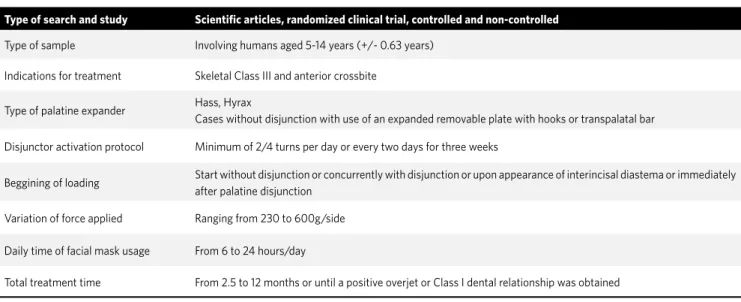
The strategy for this review was based on four data sources and internet gateways (Cochrane Central Reg-ister of Controlled Trials, Ovide ALL EMB Reviews, PubMed and Bireme) from January 1965 to May 2011, using the key-words: Class III malocclusion, reverse-pull, facial mask and rapid maxillary expansion. Two of the authors separately searched for additional rel-evant publications that may have been absent in the data banks (for example: Manual search of scientific articles in libraries and direct contact with the au-thors). There were no language restrictions. At first, the articles were selected by reading the titles and abstracts. The full text was obtained of publications that fulfilled the inclusion criteria (Tab 1). The selec-tion of each article was evaluated independently, and at the second consensus, a 100% final agreement was obtained between the two authors.
Collection of data
After selection based on the inclusion criteria, the articles were used to compare the effects of eight differ-ent models of facial masks: Delaire, Grummons, Petit, Turley, Batista, Sky Hook, Nanda and Tübinger. The fol-lowing data was selected from each article: a) the type of anchorage; the origin, direction and magnitude of force b) the results pertinent to the alterations in sagittal angles (SNA and SNB) and vertical (AFAI) skeletal mea-surements; vertical angles (SN.GoGn, FMA); angular (IMPA) and linear (1-NA, 1-NB) dental measurements.
RESULTS
Strategies for literature review
The search strategy resulted in 14 arti-cles2,3,6,7,8,16,21,25,33,34,40,41,42,50 selected according to the
Data collection
After evaluating the items: a) type of anchorage; or-igin, direction and magnitude of force applied (Tab 2), it was verified that besides chin and forehead support, other extra-oral anchorage sites exist for reverse-pull therapy such as midfacial, cervico-occipital-molar and cervico-mentum regions. Canines and molars are used as the origin of the forces, which varied in in-tensity, inclination and duration in hours per day, as well as not being standardized in treatment duration among the analyzed models.
In the analysis of the results pertinent to the al-teration of the sagittal skeletal angular measures
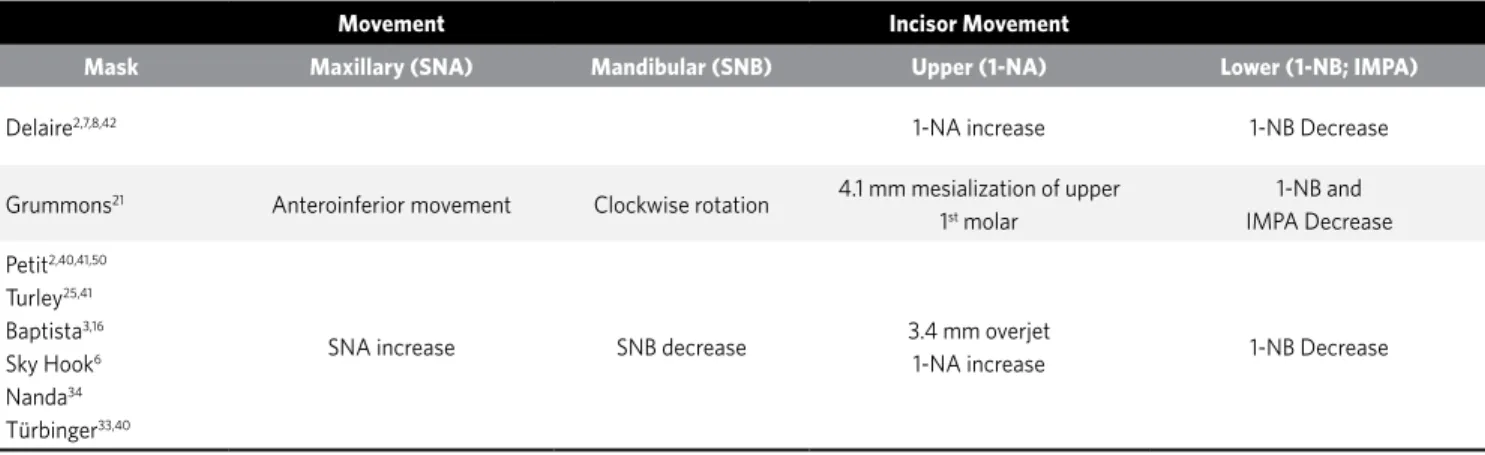
(SNA and SNB); dental angular (IMPA) and linear (1-NA, 1-NB) measures, it was observed that with all models there was anteroinferior movement of the maxilla confirmed by the increase of SNA; clockwise rotation of the mandible with decrease in SNB; ves-tibularization of the upper incisors or compensation of the Class III with increase in 1-NA. With the lower teeth, there was a decrease in 1-NB, lingual inclina-tion or compensainclina-tion of the Class III (Tab 3).
In the analysis of the results pertinent to the al-terations of vertical skeletal (AFAI) and vertical angu-lar (SN.GoGn, FMA) measurements, and increase in AFAI, the SN.GoGn angle with mandibular clockwise
Type of search and study Scientific articles, randomized clinical trial, controlled and non-controlled
Type of sample Involving humans aged 5-14 years (+/- 0.63 years)
Indications for treatment Skeletal Class III and anterior crossbite
Type of palatine expander Hass, Hyrax
Cases without disjunction with use of an expanded removable plate with hooks or transpalatal bar
Disjunctor activation protocol Minimum of 2/4 turns per day or every two days for three weeks
Beggining of loading Start without disjunction or concurrently with disjunction or upon appearance of interincisal diastema or immediately after palatine disjunction
Variation of force applied Ranging from 230 to 600g/side
Daily time of facial mask usage From 6 to 24 hours/day
Total treatment time From 2.5 to 12 months or until a positive overjet or Class I dental relationship was obtained
Table 1 - Inclusion criteria for the selection of articles.
Legend: plo = occlusal plane; min = minute; gf = gram force; N = Newton.
Table 2 - Data collected from selected articles showing the differences in type of anchorage, origin, direction and magnitude of the forces.
Mask
Model Type of anchorage Force Direction Force Magnitude
Origin Inclination degrees/opl Intensity/side Duration hours/day Duration months
Delaire2,7,8,42 Fronto-mentum Canines 257;30-408;4542 350 gf
7; 230-285 gf8;
340 gf42; 400-600 gf2 10-167,8 6-127,8,42
Grummons21 Fronto-mid-face Molars Anteroinferior 0,5 N 24 8
Petit2,41,40,50 Fronto-mentum Canines 3040;30-4050 400-600 gf 2;
300-500 gf50;600 gf41 14-16
2,40,50 350; 8±2,540
Turley25,41 Fronto-mentum Canines 20-3025 400 gf25 orthopedic41 14-2025,41 625
Baptista3,16 Cervico-occipital-molar Molars Anteroinferior3,16 415 gf3; 500 gf16 1416 123; 3116
Sky Hook6 Cervico-mentum Canines Anteroinferior 300 cN 12+1 min. 6
Nanda34 Fronto-mentum Molars 15 mm above and parallel to
the opl 300-450 gf 12-16 6
Freire AB, Nascimento LEAG, Lira ALS
turn and increase of the FMA angle was noticed as a results of the facial mask types analyzed (Tab 4).
DISCUSSION
Correction of skeletal Class III malocclusion using maxillary protraction therapy results in a combination of bone and dental changes that en-tail significant improvements in facial profile.41
In the last few years, this type of therapy became common due to the significant influence of maxil-lary deficiency within this malocclusion providing useful results for young patients.50
It was observed that the majority of facial mask models used fronto-mentum support as extra-oral anchorage with vertical effect mainly for Class III patients with normal or decreased AFAI. The Bap-tista model, using the lower molar as anchorage and modified headgear, has a pleasant aesthetic effect, but with the high cost of adverse effects on these teeth
and considerable limitations in the patient’s opening of the mouth and speaking. The Sky Hook and Grum-mons models have more favorable aesthetic and ver-tical effects, being the best alternative for patients with increased AFAI.6,21 The absence of chin support
on the Grummons model eliminated the force vector directed backward and upward, acting on the tem-poromandibular joint, compressing the ligaments and impairing mandibular movements involved in speak-ing, breathing and deglutition.21 Aside from
fronto-mentum anchorage, the Nanda model uses a vertical chin cup concurrently to reduce effects on AFAI.34
For The majority of the models2,6,7,8,25,33,40,41,42,50
(Tab 2) the canine region was used as the origin of the force to avoid anterior bite opening and to enhance anteroinferior rotation of the max-illa and its influence on the mandibular clockwise rotation,improving the profile.24,45 This maxillary
rotation can be affected by many factors including
Movement Incisor Movement
Mask Maxillary (SNA) Mandibular (SNB) Upper (1-NA) Lower (1-NB; IMPA)
Delaire2,7,8,42 1-NA increase 1-NB Decrease
Grummons21 Anteroinferior movement Clockwise rotation 4.1 mm mesialization of upper
1st molar
1-NB and IMPA Decrease
Petit2,40,41,50
Turley25,41
Baptista3,16
Sky Hook6
Nanda34
Türbinger33,40
SNA increase SNB decrease 3.4 mm overjet
1-NA increase 1-NB Decrease
Table 3 - Data collected from selected articles showing alterations in sagittal skeletal angular measures (SNA e SNB); dental angular (IMPA) and linear (1-NA, 1-NB)
measures.
Table 4 - Data collected from the selected articles showing the linear sagittal (AFAI) skeletal measurements and vertical angles (SN.GoGn, FMA).
Skeletal measurements Linear sagittal Vertical angles
AFAI SN.GoGn FMA
Delaire2,7,8,42 Considerable increase Increase
Grummons21
Petit2,40,41,50
Turley25,41
Baptista3,16
Increase – Profile improvement Increase - Profile improvement
Sky Hook6 Increase Increase: Discrete effect
Nanda34 Increase: Discrete effect Increase: Discrete effect
the point where the force is activated, the direc-tion of elastic tracdirec-tion and the patient’s facial pat-tern.50 Nanda used the molars due to the necessity
of adapting the modified AEB to the tubes of these teeth, yet with force vectors passing through the center of the maxillary resistance to ensure move-ment of the maxilla with minimal rotation.34 The
point of application of the force on the maxilla var-ies according to the necessity of each case.16 For
upper arch traction, elastics originating from the upper first molars are used, while for other cases,21
elastics are placed transversely from the bands on deciduous molars to the facial mask, protecting the corners of the mouth.
No uniformity in relation to the value of the angu-lation to the occlusal plane and force vector could be found, varying from 20º to 45º2,7,8,25,33,34,40-42,50 (Tab 2).
In some papers, only the following informations were given: “anteroinferior inclination”3,6,16,21 or “force
vec-tor 15 mm above and parallel to the occlusal plane with the line of action through the center of maxillary re-sistance favoring anterior movement with minimal clockwise maxillary inclination”.34 In the
encoun-tered results, the force applied to each side of the max-illa varied between 230 gf to 285 gf/side, meanwhile authors8,41 suggest using orthopedic forces to pull
the maxilla with forces of 230 g to 285 g.8 The suture
anatomy and age of the patient have an important role in determining the magnitude of the force necessary for maxillary protraction, because, maxillary sutures such as the zygomatic-maxillary, pterigo-palatine and nasomaxillary sutures become mechanically inter-laced and sinuous in their trajectories, with numer-ous areas of bone remodeling (apposition, absorption, synostosis), which slightly resembles the median pal-atine suture in younger individuals.34
When evaluating the effects between the same models among different authors2,3,8,16,25,27,33,40,41,50 (Tab
2), there was no uniformity in relation to the amount of time of use per day, varying between 10 hours/day and 24 hours/day. Night time use is recommended due to the discomfort and appearance of the apparatus. In addition, and collaboration obtained in clinical prac-tice is good if the minimal protocol of 8 to 10 hours is accepted (night time use).6 In the same manner, when
comparing different models,2,3,6,7,8,16,21,25,33,34,40,41,42,50
there was no consistency in relation to the duration of
the treatment varying from 6 to 31 months. The force is applied until positive overjet or Class I occlusion is obtained.50 The device is monitored every 3 to 5 weeks,
with force that is being increased being between 0.3 and 0.4 N on each side.21
In the Grummons model, without chin support, there was clockwise maxillary rotation, with increase in SNA, ANB and slight clockwise rotation of the max-illomandibular complex.21 With the Nanda model,
there was a 1 to 3 mm translation of the maxilla and re-modeling of the B point, improving the profile.34 There
was distinct improvement in the sagittal maxilloman-dibular relation with alteration in the facial convexity, and medium increase of the ANB angle of 2.1º.34 The
use of expanders and quad-helix can be employed with extra-oral forces using the Batista device.3 Even
with-out external chin support, there was clockwise man-dibular rotation due to lower molar anchorage, and the vector of maxillary traction promoted maxillary protraction with clockwise rotation in the anteroinfe-rior direction.3 Even varying the nomenclature among
the authors, there was vestibular movement of the upper incisors, compensation of the Class III maloc-clusion with consequent increase of 1-NA in all mod-els.51 With the Grummons model there was
vestibu-larization of the upper incisors with a 3.4 mm average increase of the overjet. This effect could be caused by the compression of the soft tissue in the chin region as a consequence of chin support (Tab 3).50 In this model
a posteroinferior biteplate was used with the plane in-clined vestibularly stimulating anterior displacement of the maxilla and Hawley bow stimulating lingual in-clination of the lower incisors.
In all models there was an increase in the AFAI, SN.GoGn and FMA angles, with consequent clock-wise mandibular rotation. For the Grummons model, these results imply a better sagittal rela-tion between the maxilla and mandible with a pro-file improvement. The AFAI increased due to facial growth.25 The anterior positioning of the hooks and
use of the Sky Hook device denote concern with vertical displacement, triggering milder vertical components.6 Backward rotation of the mandible
Freire AB, Nascimento LEAG, Lira ALS
The mandibular rotation could be due to the ver-tical maxillary movement and retraction force on the chin,50 and eruption of the upper molars.7 This
rotation influences anterior overjet, the skeletal maxillomandibular relationship, the facial convex-ity and increase of the AFAI.50 In the selected
ar-ticles, it was observed that there was no relation in the aesthetic requirement in the perception by the patients, laypersons and professionals, since the facial mask could influence or interfere in the re-sults of the treatments. The Sky Hook and Grum-mons models have less aesthetic compromise and vertical effects, being recommended for patients
with increased AFAI. The Nanda model34
occa-sioned minimal mandibular rotation, showing that predictable changes can be achieved regarding the maxillary advancement, with desired mandibular changes or absence of undesired alterations, since altering the point of application of the force on the mask or on the external curve of the facial arch, the vertical dimension could be controlled satisfacto-rily. This fact is especially important for Class III
patients with long vertical dimension and exces-sive mandibular plane angle.6
CONCLUSIONS
Upon analyzing the literature related to the effects of reverse-pull of the maxilla in patients treated with eight different models of facial masks, it was considered that:
a) There was no uniformity in choice of the ex-tra and inex-traoral anchorage types, direction and magnitude of elastic forces and time necessary for the treatment duration.
b) There were similarities in skeletal and den-tal measurements: anterior displacement of the maxillary complex (increase in SNA); an-terior displacement of upper teeth (increase in 1-NA); lingual inclination of lower incisors (decrease in 1-NB); backward-downward ro-tation of the mandible (increase in AFAI, SN.GoGn and FMS; decrease in SNB), result-ing in significant improvement in facial pro-file and establishment of positive overjet.
1. Almeida RR, Garib DG, Henriques JFC, Almeida MR. Ortodontia preventiva e interceptora: mito ou realidade? Rev Dental Press Ortodon Ortop Facial. 1999;4(6):87-108.
2. Arman A, Toygar TU, Abuhijleh E. Profile changes associated with different orthopedic treatment approaches in Class III malocclusions. Angle Orthod. 2004;74(6):409-14
3. Baptista JM. Aparelho de tração reversa na maxila (BHG). In: Ortodontia Personalizada. São Paulo (SP): Ed. Santos; 2004.
4. Battagel JM. The etiological factors in Class III malocclusion. Eur J Orthod. 1993;15(5):347-70.
5. Capelozza LF, Taniguchi SM, Silva filho OG. Expansão rápida e tração extrabucal reversa da maxila na dentadura mista: Comentários através de caso clínico. Ortodontia. 1990;23(3):66-78.
6. Capelozza LF, Suguino R, Cardoso MA, Bertoz FA, Mendonça MR, Cuoghi OA. Tratamento ortodôntico da Classe III: revisando o método (ERM e Tração) por meio de um caso clínico. R Dental Press Ortodon Ortop Facial. 2002;(6):99-119. 7. Carlini MG, Miguel JAM, Goldner MTA. Tratamento precoce da má-oclusão Classe
III de Angle com expansão rápida e uso de máscara facial: relato de um caso clínico. R Dental Press Ortodon Ortop Facial. 2002;7(2):71-5.
REFERENCES 8. Chong Yea-Hwe, Ive JC, Artun J. Alterações após o uso da ancoragem extrabucal para protração a fim de realizar a correção precoce da má-oclusão Classe III. R Dental Press de Ortodon Ortop. 1997;2(4):52-53.
9. Delaire J. Confection du masque orthopédique. Rev Stomatol. 1971;72(5):579-82. 10. Dewey M. Practical Orthodontia. St. Louis (MO): Mosby; 1919.
11. Dietrich UC. Morphological variability of skeletal Class 3 relationships as revealed by cephalometric analysis. Rep Congr Eur Orthod Soc. 1970;131-43.
12. Frankel R. Maxillary retrusion in Class 3 and treatment with the function corrector 3. Rep Congr Eur Orthod Soc. 1970;249-59.
13. Goddard CL. Orthodontia. Philadelphia (PA): Lea Brothers; 1900.
14. Schatz MD, Göz G . Early treatment to correct Class III relations with or without facemasks. Angle Orthod. 2008;8(1):44-49.
15. Goh GK; Kaan SK. Dentofacial orthopedic correction of maxillary retrusion with the protaction facemask- a literature review. Aust Orthod J Brisbane. 1992;12(3):143-50. 16. Gonçalves Filho S, Chaves A, Benvenga MN. Apresentação de um caso clínico
de Classe III de Angle, tratado com o aparelho extrabucal basculante inferior de ação reversa proposto por Baptista. R Dental Press Ortodon Ortop Facial. 2005;10(1):46-58.
18. Grandori F, Merlini C, Amelotti C, Piasente M, Tadini G, Ravazzani PA. Mathematical model for the computation of the forces exerted by the facial orthopedic mask. Am J Orthod Dentofac Orthop. 1992;101(5):441-8.
19. Haas A. Rapid expansion of the maxillary dental arch and nasal cavity by opening the midpalatal suture. Angle Orthod. 1961;31(2):73-90.
20. Hata S, Itoh T, Nakagawa M, Kamogashira K, Ichikawa K, Matsumoto M, et al. Biomechanical effects of maxillary protraction on the craniofacial complex. Am J Orthod Dentofacial Orthop. 1987;91(4): 305-11.
21. Hegmann M, Rüther AK. The Grummons face mask as an early treatment modality within a Class III therapy concept. J Orofac Orthop. 2003;64(6): 450-6. 22. Hellman M. A study of some etiological factors of malocclusion. Dent Cosmos.
1914;73(9):1017-32.
23. Hickham JH. Maxillary protraction therapy: diagnosis and treatment. J Clin Orthod. 1991;25(2):102-13.
24. Itoh T, Chaconas SJ, Caputo AA, Matyas J. Photoelastic effects of maxillary protraction on the craniofacial complex. Am J Orthod. 1985;88(2):117-24. 25. Janson G, Toruno JÁ, Cruz KS, Henriques JC, Freitas MR. Tratamento e estabilidade
da má oclusão de Classe III. R Dental Press Ortodon Ortop Facial. 2002;7(3):85-94. 26. Janson GRP, Canto GL, Martins DR, Pinzan A, Neto JV. Tratamento precoce da má-oclusão de classe III com a máscara facial individualizada. R Dental Press Ortodon Ortop Facial. 1998;3(3):41-51.
27. McDonald KE, Kapust AJ, Turley PK. Cephalometric changes after the correction of Class III malocclusion with maxillary expansion/facemask therapy. Am J Orthod Dentofacial Orthop. 1999;116(1):13-24.
28. McNamara JA. An orthopedic approach to the treatment of Class III malocclusion in growing children. J Clin Orthod. 1987;21(9):598-608.
29. McNamara JA, Budron WL. Orthopedic facial mask therapy. In: Orthopedic and orthodontic treatment in the mixed dentition. Needham Press. 1995;15(5):283-95. 30. Marcotte EM. Extra oral. In: Marcotte EM. Biomecânica em Ortodontia. São Paulo
(SP): Ed. Santos; 1993. Cap. 4, p. 83-97.
31. Martins DR. Tratamento da maloclusão de classe III com máscara de protração maxilar (Tração reversa). Ortodontia. 1994;1(1):1-31.
32. Moore GR. Heredity as a guide in dentofacial orthopedics. Am J Orthod Dentofacial Orthop. 1944:30(10):549-54.
33. Merwin D, Ngan P, Hagg U, Yui C, Wei SHY. Timing for effective application of anteriorly directed orthopedic force to the maxilla. Am J Orthod Dentofacial Orthop. 1997;112(3):292-99.
34. Nanda R. Aspectos biomecânicos de uma máscara facial modificada para tração reversa. In: Nanda R. Estratégias biomecânicas e estéticas na clínica ortodôntica. São Paulo (SP): Ed. Santos; 2007. Cap. 13, p. 264-77.
35. Nartallo PE, Turley PK. Cephalometric effects of combined palatal expansion and facemask therapy on Class III malocclusion. Angle Orthod. 1998;68(3):217-24. 36. Ngan P, Wei SH, Hagg U, Yiu CK, Merwin, Stickel B. Effect of protraction headgear
on Class III malocclusion. Quintessence Int. 1992;23(3):197-207.
37. Ngan PW. Tratamento das más oclusões de classe III nas dentaduras decídua e mista, In: Bishara, SE. Ortodontia. São Paulo (SP): Ed. Santos; 2004. Cap. 21, p. 375-414. 38. Ngan PW, Hagg U, Yiu C, Merwin D, Wei SH. Treatment response to maxillary
expansion and protraction. Eur J Orthod. 1996;18(2):151-68.
39. Ngan PW, Hagg U, Yiu C, Wei SH. Treatment response and long-term dentofacial adaptations to maxillary expansion and protraction. Semin Orthod. 1997;4(3):255-64. 40. Oktay H, Ulukaya E. Maxillary protraction appliance effect on the size of the upper
airway passage. Angle Orthod. 2008;78(2):209-14.
41. Oltramari PVP, Garib DG, Conti ACCF, Henriques JFC, Freitas MR. Tratamento ortopédico da Classe III em padrões faciais distintos. R Dental Press Ortodon Ortop Facial. 2005;10(5):72-82.
42. Pereira CM, Demito CF. Série aparelhos ortodônticos: máscara facial. Maringá (PR): Dental Press; 2008. p. 1-6.
43. Petit H. Adaptations following accelerated facial mask therapy in clinical alteration of the growing face. In: McNamara J Jr, Ribbens KA, Howe RP, editors. Clinical Alterations of the growing face. Ann Arbor (MI): University of Michigan; 1983. Monograph 14, Craniofacial Growth Series, center for Human Growth and Development.
44. Proffit WR. Tratamento de problemas esqueléticos em crianças na fase de pré-adolescência. In: Proffit WR. Ortodontia contemporânea. Rio de Janeiro (RJ): Guanabara Koogan; 2002. p. 451-94.
45. Tanne K, Hiraga J, Kakiuchi K, Yamagata Y, Sakuda M. Biomechanical effect of anteriorly directed extraoral forces on the craniofacial complex: a study using the finite element method. Am J Orthod Dentofacial Orthop. 1989;95(3):200-7. 46. Thompson JR. The individuality of the patient in facial skeletal growth. Part 2. Am J
Orthod Dentofacial Orthop. 1994;105(2):117-27.
47. Turley PK. Orthopedic correction of Class III malocclusion: retention and phase II therapy. J Clin Orthod. 1996;30(6):313-24.
48. Turley PK. Orthopedic correction of Class III malocclusion with palatal expansion and custom protraction headgear. J Clin Orthod. 1988;22(5):314-25.
49. Wagemans PA, Van de Velde JP, Kuijpers-Jagtman AM. Sutures and forces: a review. Am J Orthod Dentofacial Orthop. 1988;94(2):129-41.