*e-mail: [email protected]
Encapsulation of the Alpha-tocopherol in a Glassy Food Model Matrix
Melina Campagnaro Fariasa, Miriam Leite Mourab, Leonardo Andradec,
Maria Helena Miguez Rocha Leãoa,d*
a
Programa de Ciência de Alimentos Instituto de Química,
Universidade Federal do Rio de Janeiro – UFRJ,
b
Faculdade de Farmácia, Universidade Federal do Rio de Janeiro – UFRJ,
c
Departamento de Histologia e Embriologia, Universidade Federal do Rio de Janeiro – UFRJ,,
dEscola de Química, Universidade Federal do Rio de Janeiro – UFRJ,
CT, Bloco E, sala 203, 21910-900 Rio de Janeiro - RJ, Brazil
Received: July 5, 2006; Revised: January 25, 2007
α-tocopherol was encapsulated in a glassy food model based on solution of maltodextrin (DE 20) and gelatin, through the use of quick freeze and freeze-drying procedures. The ratio of the maltodextrin, α-tocopherol and gelatin was 3:2:1 respectively. The morphology of the glassy food model was observed by scanning electron microscopy, whose analyses showed a slightly smooth surface and a rather fragile and porous structure due to cavities formed by ice crystals during freezing, and the absence of crystalline structure. It was observed by x ray diffraction that the material is an amorphous state. The samples stored in a specific plastic vessel isolated from gas and light held its amorphous state with no variations that concern to morphology and keeping 100% of the encapsulated α-tocopherol up to 90 days at 25 and 35 °C.
Keywords: alpha-tocopherol, encapsulation, freeze-drying, glassy food model
1. Introduction
Introduction
Vitamin E is the generic term for tocols and tocotrienols that ex-hibit vitamin activity similar to α-tocopherol. Tocols are 2-methyl-2 (4’, 8’, 12’-trimethyltridecyl) chroman-6-ols, while tocotrienols are’, 12’-trimethyltridecyl) chroman-6-ols, while tocotrienols are, 12’-trimethyltridecyl) chroman-6-ols, while tocotrienols are identical except for the presence of double bonds at positions 3’,7’, and 11’ positions in the side chains. Tocopherol, the main compounds has vitamin E activity in foods, is derivative of tocol family, and has one or more methyl groups at 5, 7 or 8 positions of the ring structure (chromanol ring). The α, β, γ forms of tocopherol and tocotrienol differ according to the number and position of the methyl groups and thus differ significantly in vitamin E activity1.
All tocopherols and tocotrienols are nonpolar and present mainly in the lipid phase of foods. All tocopherols and tocotrienols, when not esterified, have the ability to act as antioxidants; quench free radicals by donating the phenolic H and an electron. Tocopherols are natural constituents of all biological membranes and are thought to contribute to membrane stability through their antioxidant activity. Naturally occurring tocopherols and tocotrienols also contribute to the stability of highly unsaturated vegetable oils through this anti-oxidant action1.
Vitamin E requires special transport mechanism in plasma, body fluids and cells due to its hidrofobicity. In humans, vitamin E is taken up in the proximal part of the intestine depending on the amount of food lipids, bile and pancreatic esterase. It is emulsified together with the fat-soluble components of the food. Lipolysis and emulsification of the formed lipid droplets then lead to the spontaneous formation of mixed micelles, which are absorbed at the brush border membrane of the mucosa by passive diffusion. Including triglycerides, phospholipids, cholesterol and apolipoproteins, the tocopherols are re-assembled to chylomicrons by the Golgi apparatus of the mucosa cells. The chylomi-crons are stored as secretory granula and eventually excreted by exocy-tosis to the lymphatic compartment, reaching the blood stream2.
Vitamin E compounds exhibit reasonably good stability in the absence of oxygen and oxidizing lipids. Anaerobic treatments in food processing, such as retorting of canned foods, have little effect on vitamin E activity. In contrast, the rate of vitamin E degradation increases in the presence of molecular oxygen and can be especially rapid when free radicals are also present. Oxidative degradation of vitamin E is strongly influenced by the same factors that influence oxidation of unsaturated lipids1.
Dehydrated foods have thermal and physical properties character-istic of amorphous materials and, during dehydration, the amorphous state may encapsulate compounds such as lipids and thereby protect them from oxidation3. The structural stability of the glassy matrix4-6,
the diffusivity of oxygen7,8, the moisture content9,10, and the
pres-ence of pro-and antioxidants are among the factors to be considered when the oxidative stability of products with encapsulated lipids is evaluated.
An amorphous matrix at a temperature below the glass transition temperature has an extremely high viscosity and changes in macro-molecular conformation are extremely slow. This11 further causes
low molecular mobility in the glassy state, which is why collision of reactants in the glassy matrix is limited. The glassy state is there-fore expected to inhibit most chemical reactions involving reactants trapped in the glassy matrix11. A number of studies have investigated
the diffusion of small molecules in high-viscosity carbohydrate systems12-14, whereas others have dealt with the consequences of the
physical state on the rate of chemical reactions, such as non-enzymatic browning15-17. General conclusions seem to be that the diffusivity of
molecules in a carbohydrate system increases dramatically at tem-peratures close to the glass transition temperature14,18,19.
sensitive to this parameter, the glass transition concept appeared to be a powerful tool for understanding the mechanisms of processes in food products and for controlling their shelf-life20,21.
Indeed, the glass transition temperature was considered as a refer-ence temperature: below Tg, the food was expected to be stable; above this temperature, the difference (T – Tg) between Tg and the storage temperature T was assumed to control the rate of physical, chemical and biological changes. The glass transition was also shown to allow the identification of the water content (and temperature) domains where a product could exhibit either a hard, crispy texture or a soft, rubbery or viscous one. Moreover, the variations of mechanical and transport properties in the glass transition range could contribute to a better control of some food processing operations such as drying and freeze-drying, extrusion and flaking20.
Among various food procedures, drying is the most commonly used method to preserve and reduce the volume of the food materials. The collapse of the dehydrating food during freeze drying, stickiness of the product during spray drying, caking and agglomeration of powders during processing and storage are some of the properties, which are related to the glass transition temperature22. These defects
also lead to structural changes on matrices like stability loses of the coated component due to an increase of the molecular mobility, the diffusivity of oxygen in the matrices, decrease of the matrices viscosity and increase of the chemical reactions involving reactants trapped in the glassy matrix22.
The objective of the present study is to encapsulate α-tocopherol protecting against loss by oxidation during storage at 35 °C for a period less of 3 month using a hydrophilic matrix in order to obtain hydrosoluble particles. It is important to note that due to its lipophilic nature the α-tocopherolis generally is microencapsulated using hydro-phobic matrices as waxes and oils23. However, improved experimental
techniques may now be combined, and we have embarked on studies of α-tocopherol oxidation in food with glassy state. The encapsulation technique was through fast freezing followed by freeze-drying. Besides that, we developed a new way to encapsulate α-tocopherol, water-solu-ble one, which allowed more industrialized use of this vitamin in order to enrichment foods such as, powder milk, flours, wholemeal.
2. Material and Methods
α-tocopherol _ Sigma; Maltodextrin (De = 20) MOR REX 1920. Corn Products Brazil; Gelatin - Vetec; absolute Etanol- Vetec; Fer-ric Chloride – Reagen; α-α – dipyridyl – Merck (Germany); EDTA – Carlo Erba; FEMTO 482 Espectrophotometer; 002 CB – FANEM incubator;
3. Experimental
A glassy food model composed of carbohydrates and proteins was previously established3. Maltodextrin ( 5.01 g) was dissolved in
distilled water at 30 °C and gelatin (1.67 g) in boiling water. After a fast cooling of the gelatin solution on tap water, the solutions were mixed and α-tocopherol (3.34 g) added. The proportion of the blend was 3:2:1, maltodextrin, α-tocopherol and gelatin, respectively. After that, the blend was emulsified for 6 minutes, divided in two parts and transferred to FalconTM polystyrene conic bottom tubes, isolated from
the air and light. The samples were frozen in liquid nitrogen and im-mediately freeze-dried (p ~ 91 x 10-3 mbar; 48 hours; -48 °C). The dried matrices were stored in an incubator at 25 and 35 °C.
4. Morphological Characterization
Scanning Electron Microscopy (SEM) was used to investigate the structure of the glassy food model and surface morphology. The
dried samples were prepared through direct deposition on a conduc-tive carbon tape covering aluminum stubs, gold-sputtered (Bal-Tec SC 050, Germany), and examined in the a Jeol Scanning Microscope (JSM-5310), operated at 15 kV with a working-distance of 10 mm.
5. X Ray Diffraction
The x ray diffraction patterns were recorded for the samples using a powder diffractometer (HGZ-4, Germany) and generator (ID 3000, Germany). The powder samples were carefully pressed on double-face tape covering aluminium trays, and exposed to CuKxradiation (λ= 15418 Å) at diffraction angles of 2θ, from 10 °C to 100 °C (step size 0.05, time per step 1.0 s).
6. Analyses of Encapsulated
α
-Tocopherol
The samples were transferred to FalconTM tubes, isolated from air
and light, and stored up to 90 days in an incubator at 25 and 35 °C. The analyses were made in triplicate, periodically, up to 90 days. Colorimetric assay was used for quantitative determination of the encapsulated α-tocopherol24. The α-tocopherol was released from
the matrices by water dissolution, which 100 mg of the encapsulate sample were dissolved in 100 mL of water at 35 °C. Aliquots of 1 mL (1 mg/mL) from this solution were transferred to 25 mL volumetric balloon and fulfilled with absolute Ethanol. From this alcoholic solution, aliquots of 1 mL were transferred to assay tubes where 1 mL of α’-α’-dipyridyl (0.6% w/v in absolute ETOH) and 1 mL of Ferric Chloride (0.25% w/v dissolved in absolute ETOH) and EDTA (0.35% w/v dissolved in distilled water) were added and mixed for 30 s. The absorbance of the mixture was read at 520 nm in a 1 cm diameter cell. A blank solution containing the reagents cited above but without the sample was read in the same wavelength and used to calculate the results. The α-tocopherol correspondent was calculated from the regression equation of the standard curve.
A quantitative determination and the oxidation rate of 2 g of the α-tocopherol sample, uncoated have been used. About 100 mg of these samples were accurately weighed periodically and submitted to a quantitative analysis, up to 45 storage days and 25 °C temperature, using the same methodology of the coated one. The results obtained from the two assays have been compared.
7. Statistical Analysis
The results were statistical analyzed by the linear model analysis of variance (ANOVA) and Tukey test (p < 0.05) for main effects of storage time and temperature between the matrices and interaction as fixed factors using software (ORIGIN).
8. Results and Discussion
8.1. Avaliation of the encapsulated
α
-tocopherol
The calibration curve used to calculate the α-tocopherol con-tent in the matrix, was expressed by the following linear equation: Y = 4.7629x + 0.0019; R2 = 0.9973. Where Y is the absorbance and
X is the α-tocopherol concentration. Maltodextrin and gelatin were used in this work, because they are appropriate to encapsulate oil particles efficiently.
The results of the quantification analysis of the α-tocopherol stored at two different temperatures (25 and 35 °C) are similar, con-firming the stability of the treatmenst (Figure 1).
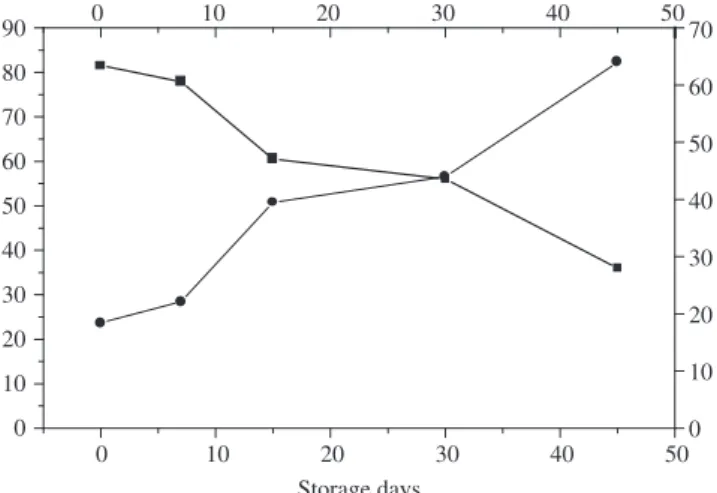
The Figure 2 shows the quantitative determination and the deg-radation kinetic of the uncoated α-tocopherol at 25 °C up to 45 stor-age days. This procedure was used in order to compare stability of the uncoated and coated α-tocopherol under same experimental conditions.
It was weighted 81.57 mg of α-tocopherol of initial 100 mg and degradation rate about 18.43% at the beginning of these analyses, which is explained by its exposition to light and air, that lead isomeri-zation of its structure and loses on biological activity. After 45 days of storage uncoated α-tocopherol had quantitative determination of 36 mg of 100 mg degradation rate about 64%, indicating a possible chemical instability. On the other hand, the coated α-tocopherol shows chemical stability up to 90 storage days, and recovery rate of 85% after the coating procedure.
The results showed in the Figure 1 started from 10 g of coated α-tocopherol content on the encapsulation procedure, where 100 mg of this sample were submitted to quantitative determination up to 90 storage days, and the results showed on the Figure 2 initiate from 2 g of uncoated α-tocopherol, where 100 mg samples were submitted to quantitative determination up to 45 storage days. The content of α-tocopherol for each analysis was different comparing the same storage days, but the chemical instability of the uncoated α-tocopherol was evident.
Accordingly to3, lipids in dried foods such as milk powder, dried
soups and biscuits are often encapsulated in an amorphous food matrix of saccharides and proteins. Lipid oxidation is known to be more significant at interfaces than in bulk and, due to the large surface area of encapsulated oil, it is often found to be rather vulnerable to lipid oxidation. On the other hand, encapsulation in a glassy matrix could be expected to give some protection from oxidation by: preventing or at least limiting oxygen diffusion through the glassy matrix to the lipid phase; and by protecting the oil from oxidation through immobilizing radicals formed by pro-oxidants in the hydrophilic phase.
The collapse of freeze-dried products induces the loss of structure, the reduction of pore size and volume of the food material, which results in the loss of desirable appearance, texture and volatile sub-stances. During the freeze-drying operation, if the temperature of the porous layer or its water content is increased (the product being then above its Tg), the viscosity is not high enough to support the structure of the sold material and collapse occurs25-28.
The possible changes in frozen or low-water food products are also the result of chemical or biochemical reactions such as non-en-zymatic browning, oxidation or ennon-en-zymatic reactions29,30.
Karmas et al.16 studied the temperature effect on the reaction rate
constant of non-enzymatic browning in model food systems. They showed that the rate of the reaction is low at temperatures below Tg and increases as the temperature difference (T – Tg) increases above Tg. Those authors16, however, underlined that the reaction is also controlled by several other factors such as structural changes or water content independently of its plasticizing effect. Roos and Himberg31 have also studied this reaction and showed that it is not
stopped by the glass-liquid transition of the maltodextrin, lysine and xylose matrix, and is possible in the glassy state.
It was observed that the glassy food model maintained the amor-phous structure up to 90 days in different temperatures. Defects related to the matrix such as collapse, crystallization, agglomeration and caking that could affect the stability of the α-tocopherol were not observed.
9. Morphological Characterization
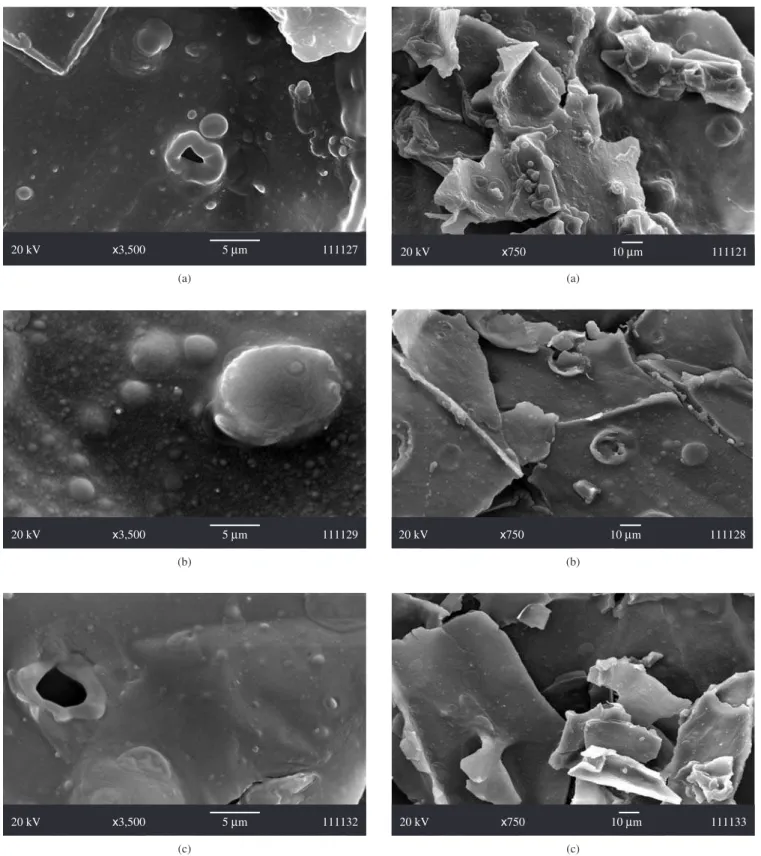
The scanning electron micrographics of the flakes can be observed in the Figures 3 and 4. Images from the glassy food model had a relatively smooth surface and a rather fragile and porous structure. The porous observed were possibly formed by cavities left from ice crystals or air bubbles retained during the freezing.
In the freeze drying process, the liquid product is first frozen and then the water is removed by sublimation. This is a low process, and has been considered superior than other drying methods in terms of product quality (taste and aroma) though being relatively expensive. While evaporating the moisture, the product becomes porous in nature and the solid network should be able to hold this porous structure. If the temperature of the dehydrating porous product is above Tg, the viscosity of the solid material may not be enough to support the structure and “collapse” or shrinkage occurs32,33.
Accordingly to13, the freezing speed will affect the crystal size
and the properties of the lyophilized. Rapid cooling leads to small and heterogeneous crystals, improves freezing out effects. The crystal size is a key factor for the speed of sublimation during freeze-dry-ing and also for the reconstitution process. A great number of small crystals and the presence of large amorphous regions may cause a fast sublimation due to formation of a very dense lyophilized network. Slow freezing leads to the formation of large crystals and results in unrestricted sublimation.
Freeze drying has been shown to be an attractive method for ex-tending the shelf life of foods34. The drying of food products in
freeze-0 10 20 30 40 50 60 70 80 90 Stability of α-tocopherol at different temperature
Storage day
A
-tocopherol mg/100 mg of sample
30
20
10
0
35 °C 25 °C
Figure 1. α-tocopherol analysis determination up to 90 days.
0 10 20 30 40 50
Storage days
0 10 20 30 40 50
70
60
50
40
30
20
10
0 90
80
70
60
50
40
30
20
10
0
Figure 2. Degradation kinetic uncoated α-tocopherol up to 45 days.
Figure 3. Scanning electron micrograph of the glassy food model at 25 °C.
a) after the freeze-drying procedure; b) 60 storage days; and c) 90 storage days.
20 kV x3,500 5Mm 111127
(a)
20 kV x750 10Mm 111121
(a)
20 kV x3,500 5Mm 111129
(b)
20 kV x750 10Mm 111128
(b)
20 kV x3,500 5Mm 111132
(c)
20 kV x750 10Mm 111133
(c)
drying has two main characteristics: 1) Virtual absence of air during processing: the low processing temperature and the absence of air prevent deterioration due to oxidation or chemical modification of the product, 2) Drying at temperatures lower than ambient temperature: products that decompose or undergo changes in structure, texture,
appearance, and/or flavor as a consequence of high temperature can be dried under vacuum with minimum damage35.
The Figure 3 and 4 shows the glassy food model stored more than 90 days at 25 and 35 °C respectively. The glassy food model maintained the amorphous structure and it retained all α-tocopherol Figure 4. Scanning electron micrograph of the glassy food model at 35 °C.
present at the initial mixture. More over, changes in macromolecular conformation such as collapse, crystallization, agglomeration and cak-ing were not occurred. Thus, in both temperatures the glass transition temperature of the matrix was not exceeded, allowing its chemical integrity up to storage days tested.
10. X Ray Diffraction Measurements (XRD)
The Figure 5 and 6 shows a spectrum of the glassy food model matrices storage at 25 and 35 °C respectively, with the characteristics of an amorphous structure: line broad, x ray signals without defini-tion, x ray intensities without uniform behavior, which are peculiar of the amorphous structure. Showing up that the storage tempera-ture does not exceed the glass transition temperatempera-ture so, changes in macromolecular conformation such as collapse, crystallization that leads to structural changes on matrices and stability loses of the encapsulated α-tocopherol was not observed up to the storage time and temperature.
The Figure 6 shows a spectrum of the glassy food model matrices storage at 35 °C, which had similar profile of the Figure 5.
11. Conclusions
The morphological characterization by MEV and the x ray diffraction spectra showed the amorphicity of the matrix without crystallization. The results show that the glassy matrix is able to protect the encapsulated α-tocopherol from oxidation. The glassy food model is believed to be of value also for future investigations, since storage conditions often encountered for matrix like that during tropical condition can be imitated without collapse of structure for temperatures up to at least 35 °C.
Acknowledgments
The authors would like to thank CNPq for providing financial support necessary to carry on the present research work.
Figure 6. (XRD) spectra of the glassy food model at 35 °C storage temperature. a) after freeze-drying procedure; and b) after 90 storage days.
0 20 40 60 80 100
2Q
Intensity
600
500
400
300
200
100
0
(a)
0 20 40 60 80 100
2Q
Intensity
500
400
300
200
100
0
(b)
0 20 40 60 80 100
2Q
Intensity
600
500
400
300
200
100
0
(a)
0 20 40 60 80 100
2Q
Intensity
600
500
400
300
200
100
0
(b)
References
1. Fennema OR. Food Chemistry. 3rd ed. New York: Marcel Dekker;
1996.
2. Azzi A, Stocker A. Vitamin E: non-antioxidant roles. Progress in Lipid Research. 2000; 39:231-255.
3. Orlien V, Andersen AB, Sinkko T, Skibsted LH. Hydroperoxide forma-tion in rapeseed oil encapsulated in a glassy food model as influenced by hydrophilic and lipophilic radicals. Food Chemistry. 2000; 68:191-199.
4. Gejl-Hansen F, Flink J. Freeze – dried carbohydrate containing oil-in-water emulsions: microstructure and fat distribution. Journal of Food Science.1977; 42:1049-1055.
5. Labrouse S, Roos Y, Karel M. Collapse and crystallization in amorphous matrices with encapsulated compounds. Sciences des aliments. 1992; 12(4):757-769.
6. Shimada Y, Roos Y, Karel M. Oxidation of methyl linoleate encapsulated in amorphous lactose-cased food model. Journal of Agricultural and Food Chemistry. 1991; 39:637-641.
7. Anandaram S, Reineccius GA. Stability of encapsulated orange peel oil.
Food Technology. 1986; 11:88-92.
8. Imagi J, Muraya K, Yamashita D, Adachi S, Matsuno R. Retarded oxidation of liquids entrapped in matrixes of saccharides or proteins.
Bioscience, Biotechnology and Biochemistry. 1992; 56:1236-1240.
9. Labuza TP, Maloney JF, Karel M. Autoxidation of methyl linoleate in freeze-dried model systems. II. Effect of water on cobalt-catalyzed oxida-tion Journal of Food Science. 1966; 31:885-891.
10. Maloney B, Labuza JF, Wallace DH, Karel MJ. Autoxidation of methyl linoleate in freeze-dried model systems. I. Effect of water on the auto-catalyzed oxidation. Journal of Food Science. 1966; 31:878-884.
11. Slade L, Levine H. Glass transitions and water-food structure interactions.
Advances in Food and Nutrition Research. 1995; 38:103-269.
12. Champion D, Hervet H, Blond G, Le Meste M, Simatos D. Translational diffusion in sucrose solutions in the vicinity of their glass transition tem-perature. Journal of Physical Chemistry B. 1997; 101:10674-10679. 13. Goubet I, Le Quere J, Voilley AJ. Retention of aroma compounds by
carbohydrates: influence of their physicochemical characteristics and of their physical state. A review. Journal of Agricultural and Food Chemistry.
1998; 46:1981-1990.
14. Roozen MJGW, Hemminga MA. Molecular motion in sucrose-water mixtures in the liquid and glassy state as studied by spin probe ESR.
Journal of Food Technology. 1990; 94:7326-7329.
15. Bell LN. Kinetics of non-enzymatic browning in amorphous solid sys-tems: distinguishing the effects of water activity and the glass transition. Food Research International. 1996; 28:591-597.
16. Karmas R, Buera MDP, Karel M. Effect of glass transition on rates of nonenzymatic browning in food systems. Journal of Agricultural and Food Chemistry. 1992; 40:873-879.
17. Claude J, Ubbink J. Thermal degradation of carbohydrate polymers in amorphous states: A physical study including colorimetry. Food Chem-istry. 2006; 96:402-410.
18. Roozen JP, Hemminga MA, Walstra P. Molecular motion in glassy water-malto-oligosaccharide (maltodextrin) mixtures as studied by conventional and saturation-transfer spin-probe e.s.r spectroscopy. Carbohydrate Re-search. 1991; 215:229-237.
19. Tromp RH, Parker R, Ring SG. Water diffusion in glasses of carbohy-drates. Carbohydrates Research. 1997; 30:199-205.
20. Champion D, Le Meste M, Simatos D. Towards an improved understand-ing of glass transition and relaxations in foods: molecular mobility in the glass transition range. Trends in Food Science & Technology. 2000; 11:41-55.
21. Ubbink J, Krüger J. Physical approaches for the delivery of active ingredi-ents in foods. Trends in Food Science & Technology. 2006; 17:244-254.
22. Bhandari BR, Howes T. Implication of glass transition for the drying and stability of dried foods. Journal of Food Engineering. 1999; 40:71-79.
23. Chang PS, Lee JH, Lee JH. Development of a new colorimetric method determining the yield of microencapsulation of α-tocopherol. Journal of Agriculture Food Chemistry. 2005; 53:7385-7389.
24. Pregnolato W. Normas Analíticas do Instituto Adolfo Lutz. Métodos químicos e físicos para análise de alimentos. 3ed. São Paulo: Instituto
Adolfo Lutz; 1985.
25. Lev G, Karel M. Volumetric Shrinkage (Collapse) in Freeze-dried Car-bohydrates above their Glass Transition Temperature in Food. Res. Int.
1995; 28:145-151.
26. Belows RJ, King CJ. Product Collapse during Freeze Drying of Liquid Foods. Alche Sym. Ser. 1973; 69:33-41.
27. To EC, Flink JM. Collapse a Structural Transition in Freeze Dried Car-bohydrates. Journal of Food Technology. 1978; 13:551-594.
28. Pikal M.J, Shah S. The Collapse Temperature in Freeze Drying: Depend-ence on Measurement Methodology and Rate of Water Removal from The Glassy Phase. Journal of Pharmacology. 1990; 62:165-186.
29. Karel M, Saguy I. Effects of Water on Diffusion in Food Systems. Water Relationships in Foods (Levine, H., Slade, L., eds). New York: Plenum;
1990.
30. Slade L, Levine H. Beyond Water Activity: Recent Advances Based on an Alternative Approach to the Assessment of Food Quality and Safety.
Food Science Nutrition.1991; 30:1-360.
31. Roos YH, Himberg M J. Nonenzymatic Browing Behavior, as Related to Glass Transition, of Food Model at Chilling Temperature. Journal of Agricultural and Food Chemistry. 1994; 42:893-898.
32. To EC, Flink JM. Collapse, a structural transition in freeze dried carbo-hydrates II.Effect of solute composition. Journal of Food Technology.
1978; 13:567-581.
33. Tsourouflis S, Flink JM, Karel M. Loss of structure in freeze-dried carbohydrates solutions: effect of temperature, moisture content and composition. Journal of the Science of Food and Agriculture. 1976;
27:509-519.
34. Ma YH, Arsem H. Low pressure sublimation in combined radiant and microwave freeze drying. In A. S. Mujumdar (Ed.) Drying`82. New York: McGraw-Hill; 1982.