ISSN 0104-6632 Printed in Brazil
www.abeq.org.br/bjche
Vol. 30, No. 04, pp. 877 - 882, October - December, 2013
Brazilian Journal
of Chemical
Engineering
THE ROLE OF ZEOLITES IN THE DEACTIVATION
OF MULTIFUNCTIONAL FISCHER-TROPSCH
SYNTHESIS CATALYSTS: THE INTERACTION
BETWEEN HZSM-5 AND Fe-BASED
FT-CATALYSTS
P. C. Zonetti
1, A. B. Gaspar
1, F. M. T. Mendes
1, R. R. de Avillez
2,
E. F. Sousa-Aguiar
3and L. G. Appel
1*1
INT/MCT, Phone + (55) (21) 21231165, Fax + (55) (21) 21231166, Av. Venezuela 82/518, CEP: 21081-312, Rio de Janeiro - RJ, Brazil.
E-mail: [email protected]
2PUC-Rio, Rua Marquês de São Vicente 225, CEP: 22451-900,
Rio de Janeiro - RJ Brazil.
3
CENPES/Petrobras, Ilha do Fundão, Quadra 7, CEP: 21949-900, Rio de Janeiro - RJ Brazil.
(Submitted: August 22, 2012 ; Revised: February 14, 2013 ; Accepted: March 11, 2013)
Abstract - In order to produce gasoline directly from syngas, HZSM-5 can be added to the Fischer-Tropsch catalyst. However, this catalytic system shows an important deactivation rate. Aiming at describing this phenomenon, Fe-based catalysts and physical mixtures containing these catalysts and HZSM-5 were employed in this reaction. All these systems were characterized using the following techniques: XRD, XPS, TPR and TPD of CO. This work shows that HZSM-5 interacts with the Fe-based Fischer-Tropsch catalyst during the reduction step, decreasing the Fe concentration on the catalytic surface and thus lowering the activity of the catalytic system in the Fischer-Tropsch Synthesis.
Keywords: Fischer-Tropsch Synthesis; HZSM-5; Fe; Deactivation.
INTRODUCTION
The production of bio-fuels is one of the most important subjects being researched nowadays as governments and societies from all over world are increasingly becoming aware of how global warming is adversely affecting the environment. Moreover, the local production of bio-fuels is also very relevant nowadays because it can ensure a continuous supply, especially in countries where the demand for fuel is high. For both purposes, the Fischer-Tropsch Synthesis (FTS) is one of the most important chemical processes as it can produce clean fuels from biomass.
As well known, the FTS produces large amounts of n-paraffin, which generates diesel. However, in order to produce gasoline, linear hydrocarbons need to be further processed (Yoneyama et al., 2005). Aiming to generate isoparaffin during the FTS, many groups have proposed the addition of zeolites to the Fischer-Tropsch catalyst (FT catalyst) (Botes, 2005), (Botes and Bohringer, 2004), (Pour et al., 2008), (Martínez et al., 2008).
alkali metal from the Fe-based catalyst towards the zeolite surface was the main deactivation reason.
The deactivation of a bi-functional Fe-HZSM-5 catalyst during the FTS was also studied by Pour et al. (2008). These researchers proposed that the formation of coke together with the alkali migration were the main contributing factors to the deactivation process.
Martínez et al. (2008) generated high quality gaso-line employing mixtures which were comprised of 20%Co/SiO2 and zeolites. By doing so, they also
ob-served a severe deactivation process, and thus sug-gested that the structural properties of the zeolites determine the amount and location of the coke.
It can be inferred that, until now, it is not clear which is the main cause of the deactivation process mentioned above. Therefore, this contribution aims at further studying this phenomenon when a physical mixture of a zeolite and a Fe-based FT catalyst is employed in the FTS.
EXPERIMENTAL
Catalyst Syntheses
The Fe-based catalysts were prepared by co-precipitation using Ca, Al, K or Ru as promoters. Calcium and Al were added during the precipitation procedure, whereas K was included later by impreg-nation of the solid previously obtained. Ruthenium was also employed as a promoter, replacing K. Firstly, an ammonium hydroxide solution (5 M) was added to the Fe, Ca and Al nitrates solutions (1.2 M, 0.045 M and 0.049 M, respectively). The materials obtained were aged for 24 h. Then they were filtered, washed with hot water and dried (100 ºC for 24 h). After that, the solids were calcined in a muffle furnace at 450 ºC for 5 h at a heating rate of 10 ºCmin-1. The promoters K or Ru were added afterwards by impregnation em-ploying K2CO3 and [Ru(NO)(NO3)x(OH)y] (x+y=3) as
precursors, respectively. The resulting materials were calcined at 450 ºC during 5 h and the final samples were labeled as FT-K (FT catalyst prepared by K impreg-nation) and FT-Ru (FT catalyst prepared by Ru impregnation). The nominal concentrations of CaO, Al2O3, K2O and Ru were 2.5, 2.5, 0.65 and 3 wt. %,
respectively.
Characterization
X- Ray Diffraction (XRD)
Diffraction patterns were obtained using a D5000 Siemens diffractometer with a Bragg-Brentano ge-ometry and a copper tube and also a graphite
mono-chromator. The 2Θ scans were performed from 5° to 80°, with a 0.05° step and a 5s acquisition time per step. Diffractograms were analyzed employing the TOPAS 4.2 software (Cheary and Coelho, 1992). Both fresh and used samples (catalyst + SiC) were analyzed. After the reaction, the samples were exposed to X-ray diffraction without any special treatment.
Temperature-Programmed Reduction (TPR)
The TPR experiments were carried out using a multipurpose analytical system. Firstly, the fresh catalysts (100 mg) were dried at 200 ºC for 30 min under nitrogen flow. After that, the analyses were per-formed employing the following experimental condi-tions: 2% H2/He, 30 mL min-1 and10 ºC min-1. The
FT-Ru catalyst and the physical mixture of FT-Ru + HZSM-5 were evaluated. The same FT-Ru/HZSM-5 weight ratio was employed in the catalytic test.
Temperature Programmed Desorption of CO (TPD of CO)
The TPD of CO experiments were carried out using a microreactor system coupled to a QMS200 Balzers mass quadrupole spectrometer. Fresh samples of Ru, HZSM-5 and the physical mixture of FT-Ru+HZSM-5 were analyzed. The masses of the samples were 200, 300, and 500 mg for FT-Ru, HZSM-5 and FT-Ru+HZSM-5 (1:1.5), respectively. The samples were reduced at 450 ºC for 6 h under 5%H2/He. Afterwards, they were exposed to 10%
CO/He at room temperature for 1 h (12mLmin-1). The TPD measurements of CO were carried out heating the samples under He flow (80 mLmin-1) at 20 ºCmin-1 up to 500 ºC, and then remaining at that temperature during 30 min. The CO (m/z = 28) frag-ment was continuously monitored.
X- Ray Photoelectron Spectroscopy (XPS)
The experiments were performed in an Omicron UHV chamber (base pressure below 10-7 Pa during measurement). The chamber was equipped with a concentric hemisphere analyzer EAC2000 SPHERA and a monochromatic AlKα (1486.6 eV) X-ray beam. Each spectrum was calibrated by using the C1s signal
with a peak position of 284.6 eV. A pass energy (Epass) of 50 eV (5 scans) was employed to obtain the wide scan spectra, while 20 eV was used for the short range (20 scans). The samples, probed before and after reaction, were diluted using SiC.
FT-Ru+ZSM-5 (oxidized). The reduction of the samples followed the same procedure described for the TPD experiments. After that, the reduced samples were passivated employing a 5%O2/He mixture and
using a bath of isopropyl alcohol and liquid N2 for
1h. Then, the samples remained for another hour under 5%O2/He at room temperature.
Catalyst Evaluation
The reaction studies were carried out using a fixed bed reactor and the following catalysts: FT-K, FT-Ru and physical mixtures of these catalysts with a commercial HZSM-5 (SAR=41 and 393 m2/g). The weight ratio between the FT catalysts and the zeolite was 1:1.5. The mass of the FTS catalysts was 200 mg and of the physical mixtures 500 mg (200 mg of FT-Ru and 300 mg of HZSM-5). The reactor volume was kept constant by using SiC as a diluent. The catalysts were reduced at 100 °C for 1 h, then at 200 °C for 1 h, and finally, at 500 °C during 36 h under 5% H2/He at
30 mLmin−1 (5 °C min−1). The reaction conditions were 230 ºC, 34 atm, H2/CO=2, GHSV=900 h-1. Reactants
and products were analyzed by online gas chroma-tography (CG) every 30 min. The CG employed was an Agilent 7890, with two detectors (TCD and FID) and four columns (Porapak-Q, DC-200, molecular sieve and Pona).
RESULTS AND DISCUSSION
Figure 1 shows the CO conversion over FT-Ru and FT-K catalysts and the physical mixtures of these catalysts with HZSM-5 in the FTS. The K-promoted catalyst (FT-K) exhibits higher activity than that promoted by Ru (FT-Ru), (Farias et al., 2011). Both physical mixtures show a very low CO conversion, suggesting that HZSM-5 promotes a decrease of the activity of the FT-catalysts. All these catalytic systems generate hydrocarbons in the range of C1-C12. When physical mixtures were employed, a decrease of the catalyst activity was noticed im-mediately, i.e., the traditional smooth decrease in conversion with time on stream was not observed (Figure 1). Therefore, it can be suggested that the deactivation process is either extremely fast or it occurs during the pretreatment (reduction) of the catalytic system.
In order to investigate this specific phenomenon the following techniques were employed: XRD, XPS, TPR and TPD of CO. Considering that the catalytic behavior of both FT-Ru and FT-K in the physical mixtures was quite similar, only the former and its physical mixture were characterized.
Figure 1: CO conversion obtained with promoted
FT catalysts (Ru and K) and their physical mixtures.
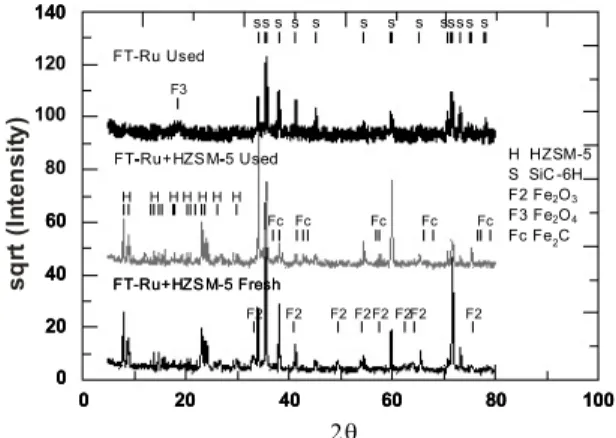
Figure 2 shows the XRD patterns of the used FT-Ru catalyst. It also shows the patterns of the fresh and used (after the reaction) physical mixtures. The XRD pattern of the fresh physical mixture depicts the diffraction peaks of Fe2O3, HZSM-5 and SiC,
and mostly SiC-6H, as expected. The fresh FT-Ru catalyst also shows peaks of Fe2O3, but its diffraction
is not displayed in Figure 2. As can be observed, the used physical mixture exhibits diffraction peaks of SiC, HZSM-5 and a very small amount of Fe2C, with
a major peak at 42.7. The amount of Fe2O3 suffered a
sharp reduction when compared with the fresh physi-cal mixture and its peaks are no longer visible. However, no major changes were observed in the lattice parameters of HZSM-5 when these mixtures were compared once again. The used FT-Ru catalyst also showed the disappearance of Fe2O3. It was
re-placed by nanocrystalline Fe3O4, depicting a major
and broad peak at 18.3. This catalyst does not show Fe2C.
s s s s s s s sss s s
s
F2 F2 F2 F2F2 F2F2 F2
Fc Fc Fc Fc Fc
F3
H H H H HHH
60 40
20
0 80 100
020 000 060 040 100 080 140
120 FT-Ru Used
FT-Ru+HZS M-5 Used
FT-Ru+ HZS M-5 Fresh
H HZSM-5 S SiC -6H
F2 Fe2O3
F3 Fe2O4
Fc Fe2C
2θ
s s s s s s s sss s s
s
F2 F2 F2 F2F2 F2F2 F2
Fc Fc Fc Fc Fc
F3
H H H H HHH
60 40
20
0 80 100
020 000 060 040 100 080 140
120 FT-Ru Used
FT-Ru+HZS M-5 Used
FT-Ru+ HZS M-5 Fresh
H HZSM-5 S SiC -6H
F2 Fe2O3
F3 Fe2O4
Fc Fe2C
s s s s s s s sss s s
s
F2 F2 F2 F2F2 F2F2 F2
FcFc Fc Fc Fc
F3
H H H H HHH
60 40
20
0 20 40 60 80 100
0 80 100
020 000 060 040 100 080 140 120 020 000 060 040 0 140 FT-Ru Used
FT-Ru+ HZS M-5 Used
FT-Ru+ HZS M-5 Fresh
-
-FT-Ru+ HZS M-5 Fresh
H HZSM-5 S SiC -6H
F2 Fe2O3
F3 Fe2O4
Fc Fe2C
2θ s q rt ( In te n s it y )
As well known, X-ray diffraction (XRD) can only detect inorganic structures that show long-range periodicity. It is not sensitive to amorphous or well-dispersed Fe species. Therefore, the phases described above can not be associated with the catalytic activ-ity. However, the FT-Ru and FT-Ru+HZSM-5 cata-lytic systems employ the same FT catalyst and show different phases after the reaction. Thus, it can be suggested that, during the pretreatment or the reac-tion, or during both of them, HZSM-5 interacts with the FT catalyst, changing its composition and phases.
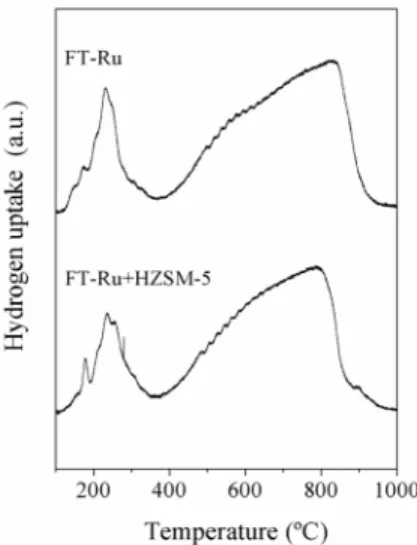
Figure 3 shows the TPR profiles of FT-Ru and FT-Ru+HZSM-5. The FT-Ru catalyst shows two main broad peaks at 232 and 832 ºC. According to Li et al. (2002), these peaks are related to the reduction of Fe2O3 to Fe3O4 and Fe3O4 to Feo, respectively. The
TPR profile of the physical mixture is similar to that of the FT-Ru catalyst, suggesting that the zeolite seems not to change the reduction process of the FT catalyst. In other words, HZSM-5 does not seem to interact with the FT catalyst during the reduction process under these conditions.
Figure 3: TPR profiles of FT-Ru and physical
mixture FT-Ru+HZSM-5 catalysts (fresh samples).
The CO desorption profiles are depicted in Figure 4. Fresh samples of Ru, HZSM-5 and FT-Ru+HZSM-5, previously reduced, were analyzed. As can be observed, the FT-Ru catalyst exhibits two desorption peaks: one at 137 ºC and another at 497 ºC, which are related to two distinct CO adsorption sites. The adsorption of CO on the FT-Ru catalyst is mainly related to the presence of Feo on the catalyst surface. The HZSM-5 sample shows only a very small peak at low temperature, which is assigned to the CO interaction with Lewis acid sites (Binet et al., 1999). The FT-Ru+HZSM-5 physical mixture does not
show desorption peaks. Therefore, the concentration of Feo on the physical mixture surface (FT-Ru+HZSM-5) should be very low as this system is not able to adsorb CO.
Figure 4: TPD spectra of CO (fresh samples).
The results obtained employing the TPD of CO suggest that the FT catalyst interacts with HZSM-5 during the reduction step, leading to a very low concentration of Feo on the catalytic surface and, consequently, low activity for the FTS.
On the one hand, the TPR experiments expose the catalysts to a fast reduction process and the results obtained do not suggest any interaction between FT-Ru and HZSM-5. On the other hand, the pretreat-ment of the catalysts (reduction) employed in the TPD of CO is a slow process (see experimental section) and the results show that FT-Ru and HZSM-5 interact. Thus, it can be proposed that this phe-nomenon occurs at a low rate during the reduction of the catalyst.
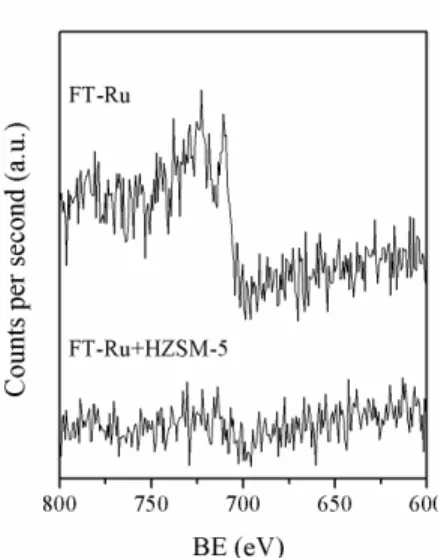
Figure 5 depicts the photoelectron spectra (XPS) of the Fe2p binding energy region for both catalysts FT-Ru
and FT-Ru+HZSM-5 after the reaction. The samples analyzed were diluted in SiC (see methodology). Despite the fact that the signal/noise ratio was very low, it could be observed that the spectrum of the FT-Ru catalyst showed a low Fe signal, whereas the FT-Ru+HZSM-5 physical mixture exhibits a Fe2p
Figure 5: XPS spectra of catalysts after reaction (used samples)
The XPS analyses were also carried out employing fresh samples of FT-Ru and FT-Ru+HZSM-5, which had been previously reduced (see methodology). The photoelectron spectrum of the FT-Ru+HZSM-5 physical mixture before reduction was also collected. It was observed that the Ru atomic superficial concentration was almost the same for both the reduced and oxidized physical mixtures. This metal seems not to be affected by the reduction process or by the interaction with the zeolite. Therefore, Ru was used as a reference. Table 1 shows the ratios of Fe/Ru and Si/Al. When comparing, the Fe/Ru ratio of FT-Ru and FT-FT-Ru+HZSM-5 (both reduced), it can be observed that the physical mixture shows a lower Fe concentration, which can be related to the interaction between the FT catalyst and HZSM-5. These data agree with the results of TPD of CO and also with the results of the catalytic tests. Indeed, the TPD of CO shows less Fe than XPS. This result is related to the fact that the TPD results are associated with the outermost layer of the solid, whereas some layers near the external surface of the catalyst are analyzed by XPS. Table 1 also shows the values of the Si/Al ratios. It can be inferred that, for both the oxidized and reduced mixtures, the values are almost similar.
Therefore, when employing XPS analysis, it is not possible to associate the decrease of the Fe concentration with changes on the HZSM-5 surface.
Some previous works have showed that the catalytic behavior of physical mixtures can be com-pletely different from the behavior of each of the components of the system (Ramos et al., 2005), (Zonetti et al, 2011). Taking the results described
above into account, it can be inferred that the sinteri-zation of Fe is promoted by HZSM-5, generating a catalytic system which shows very poor activity. However, at the moment, it is not possible to describe this phenomenon in details.
Table 1: Fe/Ru and Si/Al atomic ratios by XPS analyses
Samples Fe/Ru Si/Al
FT-Ru (reduced) 20.6 -
FT-Ru + HZSM-5 (reduced) 5.5 17.6
FT-Ru + HZSM-5 (before reduction) 10.4 17.1
It is worth stressing that these results have never been described in the literature. They are related to a solid-solid interaction phenomenon in which differ-ent parameters can change its intensity. Considering former publications which have already studied physical mixtures of FT catalysts with zeolites, it can be inferred that some of these works employed lower reduction temperatures (Yoneyama et al., 2005), larger particle sizes (Botes and Bohringer, 2004) and lower zeolite/FT catalyst ratios (Botes and Bohringer, 2004) when compared with the conditions employed in this study. As these parameters change the inten-sity of the solid-solid interactions, it can be sug-gested that this phenomenon might have also occurred in these former studies, but at lower intensities when compared with the data shown above. Moreover, the other modes of deactivation, which have already been proposed in the literature, may have also occurred together with this phenomenon.
CONCLUSION
This work shows that, when HZSM-5 is added to an Fe-based FT catalyst, it interacts with this cata-lyst, decreasing the Fe concentration on the catalytic surface, leading to a low activity of the catalytic system in the Fischer-Tropsch Synthesis (FTS).
ACKNOWLEDGMENTS
REFERENCES
Binet, C., Daturi, M., Lavalley, J. C., IR study of polycrystalline ceria properties in oxidised and reduced states. Catal. Today, 50, 225 (1999). Botes, F. G. and Bohringer, W., The addition of
HZSM-5 to the Fischer–Tropsch process for improved gaso-line production. Appl. Catal., A, 267, 217 (2004). Botes, F. G., The effect of a higher operating tem-perature on the Fischer–Tropsch/ HZSM-5 bi-functional process. Appl. Catal., A, 284, 21 (2005). Cheary, R. W. and Coelho, A., A fundamental
pa-rameters approach to X-ray line-profile fitting. J. Appl. Crys., 25, 109 (1992).
Li, S., Krishnamoorthy, S., Li, A., Meitzner, G. D., Iglesia, E., Promoted iron-based catalysts for the Fischer–Tropsch Synthesis: Design, synthesis, site densities, and catalytic properties. J. Catal., 206, 202 (2002).
Martínez, A., Valencia, S., Murciano, R., Cerqueira, H. S., Costa, A. F., Souza-Aguiar, E. F., Catalytic behavior of hybrid Co/SiO2-(medium-pore) zeolite
catalysts during the one-stage conversion of syngas to gasoline. Appl. Catal., A, 346, 117 (2008).
Farias, F. E. M., Rabelo Neto, R. C., Baldanza, M. A. S., Schmal, M., Fernandes, F. A. N., Effect of K promoter on the structure and catalytic behavior of supported iron-based catalysts in Fischer-Tropsch synthesis. Braz. J. Chem. Eng., 28(3), 495 (2011).
Pour, A. M., Shari, S. M. K., Zamani, Y., Irani, M., Tehrani, S., Deactivation studies of bifunctional Fe-HZSM5 catalyst in Fischer-Tropsch process. J. Natural Gas Chem., 17, 242 (2008).
Ramos, F. S., Farias, A. M. D., Borges, L. E. P., Monteiro, J. L., Fraga, M. A., Sousa-Aguiar, E. F., Appel, L. G., Role of dehydration catalyst acid properties on one-step DME synthesis over physical mixtures. Catal Today, 101, 39 (2005). Yoneyama, Y., He, J., Morii, Y., Azuma, S., Tsubaki,
N., Direct synthesis of isoparaffin by modified Fischer–Tropsch synthesis using hybrid catalyst of iron catalyst and zeolite. Catal. Today, 104, 37 (2005).