Article
J. Braz. Chem. Soc., Vol. 26, No. 10, 2144-2149, 2015. Printed in Brazil - ©2015 Sociedade Brasileira de Química 0103 - 5053 $6.00+0.00
A
*e-mail: [email protected]
Chemical Speciation of Iron in Different Varieties of Beans (
Phaseolus vulgaris
L.):
Cooking Effects
Aline P. Oliveira and Juliana Naozuka*
Instituto de Ciências Ambientais, Químicas e Farmacêuticas, Universidade Federal de São Paulo, 09972-270 Diadema-SP, Brazil
Beans are considered a source of iron (Fe), and hence have considerable contribution in cases of Fe deficiency. Beans also contain certain anti-nutritional constituents, which are imperative to the cooking of beans. The nutritional value of beans depends on the bioavailability, which can be affected by cooking. Studies about heating effects in distribution of Fe-based inorganic species are limited, especially for bean cultivars commonly consumed in Brazil. The aim of this work was to evaluate the effects of domestic cooking on the distribution of Fe species (water soluble and inorganic) in seven varieties of Phaseolus beans. Fractionation procedures were used to separate Fe associated to various species. The Fe content was quantified by graphite furnace atomic absorption spectrometry (GF AAS). In raw beans, the inorganic Fe species significantly contributes to the water soluble fraction obtained after fractionation. Cooking lowered the concentration of water soluble Fe in majority varieties of beans.
Keywords: beans, Phaseolus, iron, speciation
Introduction
The leguminous varieties of beans (Phaseolus vulgaris L.) are consumed heavily in South American countries, mainly by the Brazilian population. Beans represent an important source of various nutrients, such as proteins, carbohydrates, vitamins, minerals and fibres.1-3 Additionally, beans are also
considered an iron (Fe) source, and are valuable in cases of Fe deficiency diseases, such as anaemia.2,4 However, in relation
to Fe content, the nutritional value of the beans depends on the bioavailability of Fe. According to literature, only water soluble non-heme Fe (inorganic) can be absorbed in vivo, FeII being more available than FeIII.5
Besides the beneficial nutrients, beans contain certain anti-nutritional constituents, such as trypsin inhibitors, tannins, phytic acid and oligosaccharides, that limit protein- and carbohydrate-absorption,6 which make the cooking
of beans imperative. Cooking can increase the protein digestibility and induce desirable sensory perceptions, making the beans ready for human consumption.7 However,
cooking can considerably affect the composition and bioavailability of numerous chemical constituents,8
including Fe.
The effects of cooking on the distribution of water soluble Fe were evaluated in legumes, white beans, chickpeas and lentils. Cooking increases the amount of soluble, hence bioavailable, non-heme Fe in the beans. Nevertheless, interaction of inorganic Fe-species, mainly divalent cations, with phytic acid, tannins and other anti-nutrients, decreases the Fe-bioavailability.9,10
Studies about heating effects on the distribution of Fe-species are limited, especially for bean cultivars commonly consumed in Brazil. Considering the nutritional importance of Fe and the effects of heating on Fe-bioavailability, the aim of this work was to evaluate the effects of domestic cooking on distribution of Fe-species (water soluble, acid soluble and inorganic) in seven different varieties of Phaseolus beans.
Experimental
Instrumentation
For quantification of total Fe content, an atomic absorption spectrometer (Model AAS Vario 6, Analytik Jena AG, Jena, Germany), equipped with a deuterium lamp for background correction, was used. Acetylene flow of 70 L h-1, air flow of 430 L h-1 and an observation
high-sensitivity detector was required, hence Fe content was quantified using a ZEEnit® 60 model atomic absorption
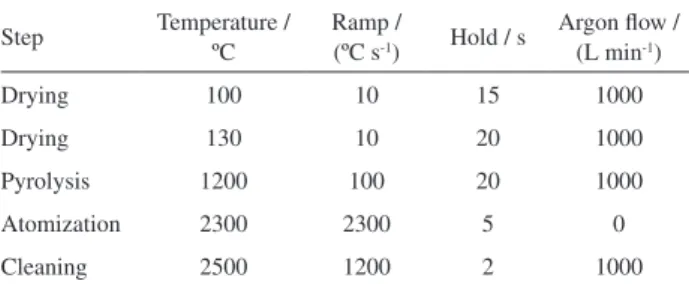
spectrometer (AnalytikjenaAG, Jena, Germany) equipped with a transversely heated graphite atomizer, a pyrolytically coated graphite tube and a transverse-Zeeman-effect background corrector. In both the spectrometers, a hollow Fe cathode lamp was used, operating with wavelength, lamp current and slit-width equal to 248.3 mm, 4 mA and 0.8 nm, respectively. Table 1 shows the heating program for the graphite tube atomizer.
The sample digestion was carried out by a diluted oxidant mixture in a closed-vessel microwave system (Multiwave 3000, Anton Paar, Austria), equipped with sixteen fluoropolymer vessels and a ceramic vessel jacket.
The drying and milling of the samples were done in an oven (515 model, FANEM, SP, Brazil) and a cryogenic grinder (MA 775 model, Marconi, Brazil), respectively. The beans were cooked in an electric pressure cooker (Philips Walita Daily Collection).
Phase separation was performed by centrifugation (Spectrafuge 6C Compact model, Labnet International, New Jersey, USA). For fractionation, the samples were submitted to heating using a magnetic stirrer (Q261-12 model, Quimis, São Paulo, Brazil).
Reagents and samples
All solutions were prepared from analytical reagent grade chemicals, using high-purity deionized water obtained from a Milli-Q water purification system (Millipore, Belford, MA, USA) as the solvent. Analytical grade 65% (v/v) HNO3,
distilled in a quartz sub-boiling still (Marconi, Piracicaba, SP, Brazil) and 30% (m/m) H2O2 (Merck, Darmstadt, Germany)
were used for sample digestion.
Titrisol standard solution of 1000 mg L-1 of Fe (Merck,
Darmstadt, Germany) was used to prepare the reference analytical solutions in 0.14 mol L-1 HNO
3 (1-3 mg L-1 and
10-80 µg L-1 for determination of Fe content by flame atomic
absorption spectrometry (FAAS) and graphite furnace atomic absorption spectrometry (GF AAS), respectively).
For Fe speciation, two different precipitation solutions were prepared: (1) one composed of 25 g trichloroacetic acid (Merck), 25 g hydroxylamine (Merck) and 25 mL hydrochloric acid (Synth) and (2) the other composed of 25 g trichloroacetic acid (Merck) and 25 mL hydrochloric acid (Synth). Both solutions were diluted to 250 mL with deionised water.
Two brands of beans encompassing seven Phaseolus species (common, black, “rajado”, “rosinha”, “bolinha”, “fradinho” and “jalo”) were purchased at a local market in São Paulo, each species weighing 500 g. Six species were of the same brand and the “jalo” species was of a different brand. The geographic origin of the species are São Paulo (“rosinha”, “rajado” and “bolinha”) and Minas Gerais (common, black, “fradinho” and “jalo”), according to the producers.
Procedures
Preliminary sample preparation
The raw beans were cleaned with deionized water and dried in an oven at 60 ºC to obtain a constant mass. The raw beans were done after milled in the cryogenic grinder (particle size value < 100 µm), with 5 min of freezing followed by three cycles of 2 min of grinding, with 1 min of freezing between each cycle. The rest of the raw beans (ca. 20 g) were left to soak in deionized water (ca. 200 mL) at room temperature for 24 h. The soaking water was discarded and the soaked beans were cooked in deionized water (proportion of 1:4 m/v bean:water)5 for
30 min. Cooked beans and deionized water were mixed and dried in an oven at 60 ºC until a constant mass was reached. The mixture was ground using a porcelain mortar and pestle.
Total Fe determination
The raw and cooked beans were submitted to acid digestion in a closed-vessel microwave system. Samples weighing 150-250 mg were digested using a diluted oxidant mixture (2 mL HNO3, 1 mL H2O2 and 3 mL H2O).11 The
heating program was done in three steps (temperature / oC;
ramp / min; hold / min): (i) (140; 5; 1); (ii) (180, 4, 5); and (iii) (220, 4, 10). The system was cooled through forced ventilation for 20 min. After digestion, the samples and blank solutions were transferred to plastic flasks and their volumes were made up to 10 mL with deionized water.
Digested solutions were analysed by FAAS and three separate readings were taken for each sample. Total Fe concentrations in raw and cooked grains were compared by Student’s t-test at a 95% confidence limit and p-value below 0.05 was considered statiscally significant.
Table 1. Heating program for Fe determination by GF AAS
Step Temperature / ºC
Ramp /
(ºC s-1) Hold / s
Argon flow / (L min-1)
Drying 100 10 15 1000
Drying 130 10 20 1000
Pyrolysis 1200 100 20 1000
Atomization 2300 2300 5 0
Fe speciation (soluble and inorganic)
Samples of both raw and cooked varieties of beans, weighing 4-7 g, were mixed with 30 mL of deionized water. These mixtures were agitated for 5 min at room temperature and their supernatants were separated by centrifugation at 4000 rpm for 10 min. These aqueous supernatants were analysed by GF AAS after appropriated dilution (10-110 times) with deionized water, resulting in the Fe concentration water soluble (inorganic iron and iron associated to macromolecules).
In 5 mL of the aqueous supernatant it was added to 2.5 mL of the second precipitant reagent (2, without hydroxylamine), and heated in a boiling water bath for 10 min. This mixture was centrifuged at 4000 rpm for 10 min and diluted (10-100 times) with deionized water. Iron was quantified by GF AAS, giving the total acid soluble Fe concentration (no macromolecule-associated). Aliquots of 10 µL of the supernatants were introduced into the graphite tube without addition of any chemical modifier. A similar procedure was performed using the first precipitant reagent (1, with hydroxylamine) to obtain the total inorganic Fe concentration; in this procedure, the Fe was quantified as FeII, as all the FeIII was reduced to FeII by hydroxylamine.5
The results represent the means and standard deviations (SD) of triplicate determinations. Statistical significance of the data was determined by Student’s t-test (95% confidence limit). A p value below 0.05 was considered statistically significant.
Results and Discussion
Method characteristics
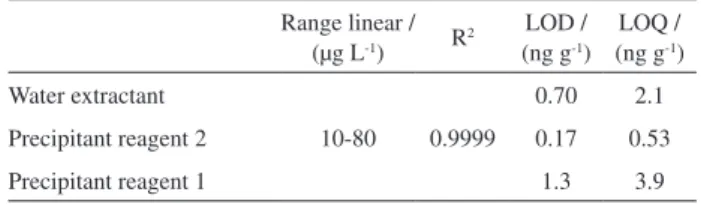
The method characteristics for total Fe determination by FAAS, have been published by our group.1 Table 2 lists the
characteristic parameters of the analytical calibration curve, such as linear range, correlation coefficient (R2), average
relative standard deviation (RSD) for repeatability of calibration solution measurements (n = 5), limit of detection (LOD) and limit of quantification (LOQ). LOD was calculated using the standard deviation of 10 measurements of the analytical blank sample (LOD = 3 × σblank, where
σ is the standard deviation), and LOQ = 3 × LOD. The
values were obtained in ng g-1, considering a sample
mass of 5 g and a final volume of 30 mL. The presence of hydroxylamine (precipitant reagent 1) promoted the increase of the standard deviation of 10 measurements of the analytical blank, resulting in higher LOD and LOQ than with precipitant reagent 2.
It is worth pointing out that highly diluted (10-110 times) supernatant samples were used for GF AAS analysis, to
ensure the absence of chemical interferences during the Fe quantification.
Cooking effects
The total Fe concentration varied appreciably between the different varieties of beans (Table 3), probably due to varying soil characteristics, physiology/genetic profile of the plants, different water source compositions and external factors like fertilizers, insecticides, pesticides and fungicides used in the plantations.12 Comparing the total Fe
concentrations in the raw and cooked grains and applying Student’s t-test at a 95% confidence limit, it is noteworthy that cooking did not affect the total Fe concentration in all varieties of beans. Only the common, “jalo” and “rajado” varieties showed slight reduction in the Fe concentration after cooking, which may be due to discarding of the soaking water. Studies have shown that soaking beans in water and discarding the water may eliminate a percentage of minerals, along with anti-nutrients like tannins, phytates and oligosaccharides.1,13
The reference daily intake (RDI) for Fe in humans is 18 mg for adults and children above 4 years14 and data from
the Instituto Brasileiro de Geografia e Estatística (IBGE, Brazilian Institute of Geography and Statistics),15 between
2008 and 2009, showed that the daily consumption of beans for the current Brazilian population is 183 g per day. Table 3 shows the total Fe content in the different varieties of beans, ranging from 10.8 (“bolinha”) to 18.5 (“black”) mg per day, suggesting that only the black variety reached the RDI standard.
Thermal treatment of the beans improves their nutritional value, as it neutralises the anti-nutrients, such as phytic acid and tannins, and increases protein digestibility.5,13,16 However, literature reports on chemical
speciation, bioavailability studies and the effects of cooking on essential element concentrations are scarce.
Water extraction allows the extraction of soluble Fe and Fe associated to macromolecules, mainly albumins.17 Transitions metal ions, such as FeII, have strong
coordinating interactions with albumins, constituting the
Table 2. Methods characteristics for Fe determination by GF AAS
Range linear / (µg L-1) R2
LOD / (ng g-1)
LOQ / (ng g-1)
Water extractant
10-80 0.9999
0.70 2.1
Precipitant reagent 2 0.17 0.53
Precipitant reagent 1 1.3 3.9
R2: coefficient of determination; LOD: limit of detection; LOQ: limit of
metalloproteins.18 Comparing the total Fe with water
soluble (inorganic and macromolecule-associated) Fe species concentrations (Table 3), it is possible to calculate the percentage of the water soluble (inorganic and macromolecule-associated) Fe species that ranged from 9.7% (black) to 54% (“fradinho”) for raw grains and 3.7% (black) to 36% (“bolinha”) for cooked grains.
Applying Student’s t-test at a 95% confidence limit, the water soluble Fe species concentrations in the raw and cooked grains are significantly different (p < 0.05), except for common and “bolinha” varieties. The cooking lowered the water soluble Fe concentration (inorganic and macromolecule-associated) in majority of the varieties (48% for “jalo” and 64% for “rajado”), while the “rosinha” (68%) and the “bolinha” (13%) varieties suffered an increase. It is interesting to observe that despite the fact that beans act as a good Fe source, they have a low concentration of bioavailable Fe, possibly water-soluble non-heme Fe-species.19 The
reduction in the Fe concentration can be resulted of association reactions between interest element and food components. On the other hand, the increase can have been promoted by contaminations during the cooking process or dissociation reactions. Dissociation reactions are more likely, because only two varieties (“rosinha” and “bolinha”) had increased water soluble Fe species concentration and total Fe concentration in all varieties were significantly equals.
The precipitant reagent 2 (trichloroacetic acid and hydrochloric acid) promotes the precipitation of
macromolecules.5,20 Therefore, it is possible to quantify
the acid soluble Fe. Comparing the acid soluble Fe concentration with total Fe concentration in the aqueous supernatant of different varieties of beans, no difference was observed for raw grains, except for the black variety, which shows a decrease of 25%. In the other cases, it is possible that the aqueous supernatant holds only acid soluble Fe and no macromolecule-associated Fe. For black beans, macromolecule-associated Fe may be present. However, cooking caused a decrease in the acid soluble Fe concentration for all varieties of beans (72% for black and 93% for “jalo”). The heating can promote the interaction of the water soluble Fe species with other food compounds, mainly proteins like the albumins, which were precipitated by trichloroacetic acid.
Besides the precipitation of macromolecules by trichloroacetic acid and hydrochloric acid, the addition of hydroxylamine (precipitant reagent 1) resulted in the reduction of FeIII to FeII.5,21,22 Comparing the acid soluble
Fe concentration in the supernatant of precipitant reagent 2 with precipitant reagent 1 of different varieties of raw beans, a decrease of acid soluble Fe content is observed for all varieties (48% for common to 77% for “bolinha”).
The decrease in acid soluble Fe content may have been promoted by the interaction of FeII with macromolecules
that suffered precipitation, or with anti-nutritional compounds, such as tannins and phytates. The tannins can react with bivalent metal ions, through its hydroxyl
Table 3. Fe determination (total, in the water supernatant, soluble, in the supernatant with precipitant reagent 2, in the supernatant with precipitant reagent 1 and inorganic)
Variety Fe concentration ± standard deviation (n = 3) / (µg g
-1)
Total Water supernatant Precipitant reagent 2a Precipitant reagent 1b Inorganicc
Black Raw 94 ± 3 9.1 ± 0.1 6.9 ± 0.8 2.9 ± 0.4 4.0 ± 0.9
Cooked 101 ± 2 3.7 ± 0.1 1.9 ± 0.3 3.5 ± 0.1 ND
Common Raw 87 ± 9 19 ± 1 24 ± 2 13 ± 1 12 ± 2
Cooked 81 ± 2 16 ± 1 4.2 ± 0.7 5.6 ± 0.1 ND
“Jalo” Raw 84 ± 2 25 ± 2 28 ± 1 10 ± 1 18 ± 2
Cooked 79 ± 2 13 ± 1 1.9 ± 0.3 3.9 ± 0.2 ND
“Fradinho” Raw 61 ± 5 33 ± 1 35 ± 1 16 ± 3 19 ± 3
Cooked 64 ± 1 13 ± 1 7.9 ± 0.7 19 ± 3 ND
“Rajado” Raw 75 ± 9 24 ± 3 25 ± 1 5.9 ± 0.1 20 ± 1
Cooked 68 ± 3 8.6 ± 0.1 1.7 ± 0.6 3.3 ± 0.1 ND
“Rosinha” Raw 56 ± 3 13 ± 1 15 ± 1 3.1 ± 0.4 12 ± 1
Cooked 60 ± 1 22 ± 1 5.1 ± 0.8 2.9 ± 0.4 ND
“Bolinha” Raw 61 ± 4 17 ± 2 18 ± 1 4.0 ± 0.7 14 ± 1
Cooked 59 ± 1 19 ± 1 8.6 ± 1.3 6.3 ± 0.2 ND
aPrecipitant reagent 2: trichloroacetic acid and hydrochloride acid (Fe acid soluble); bprecipitant reagent 1: trichloroacetic acid, hydroxylamine and
and carboxyl groups, forming insoluble complexes.9,10,23
A similar effect is shown by phytic acid that has high chelating potential owing to its phosphoryl groups.24,25 The
use of the weakly acidic precipitant reagent 1 (pH = 5.54) allowed the exposure of the twelve negative charges of the six phosphate groups, resulting in complexation with FeII.26 As the inorganic Fe species are reduced to FeII and
this species interacts with tannins and phytates forming insoluble complexes, it is possible to quantify the inorganic Fe of raw beans from the difference between the acid soluble Fe concentration and the total Fe concentration in the supernatant treated with precipitant reagent 1.
In the cooked beans, the concentration of anti-nutrients is minimised by soaking beans in water and discarding this water.13,16 Additionally, the heating-promoted association
and dissociation reactions of the soluble Fe with other compounds present in the beans, makes the determination of inorganic Fe impossible. However, the Fe concentration in the aqueous supernatant, obtained with precipitant reagent 1, showed the presence of soluble Fe, which may possibly include inorganic Fe-species.
In the raw beans, the difference between the total acid soluble Fe concentration and Fe concentration in the supernatant with precipitant reagent 1 gives the inorganic Fe concentration (Table 3). The soluble fraction has significant inorganic Fe content, in the following ascending order: common (50%), “fradinho” (57%), black (58%), “jalo” (64%), “rajado” (77%), “bolinha” (78%) and “rosinha” (79%).
In summary, Fe distribution can be altered due to association or dissociation reactions between soluble Fe (mainly inorganic species) and albumin-associated Fe with other food components, such as other proteins (globulin, prolamin and glutelin) and anti-nutrients. Studies with common and faba beans indicated that after the heating, about 80% of the proteins and more than 70% of the Cu- and Fe-species become insoluble, owing to protein denaturation and association with polyphenols and phytate.27
Conclusions
Simple fractionation procedures allowed the chemical speciation of Fe and also the study of cooking effects on the distribution of Fe-species in seven different varieties
of Phaseolus beans. Extraction with deionized water, a
mixture of trichloroacetic acid and hydrochloric acid, and a mixture of trichloroacetic acid, hydroxylamine and hydrochloric acid were used to separate soluble macromolecule-associated Fe, soluble Fe and inorganic Fe, respectively. The total Fe concentration did not suffer changes with thermal procedure. However, all Fe-species
(soluble and inorganic) suffered alterations, due to cooking. Additionally, these alterations in the Fe-species distribution (water soluble Fe and inorganic species) may have been promoted by the association or dissociation reactions of Fe-species with other nutrients and anti-nutrients present in the beans.
Acknowledgments
The authors are grateful to Professors Pedro Vitoriano de Oliveira, Cassiana Seimi Nomura and Thiago Regis Longo Cesar da Paixão of the Chemistry Institute of the São Paulo University, for laboratory infrastructure support. Aline Pereira de Oliveira thanks grant #2013/14455-0 São Paulo Research Foundation for the fellowship provided. Juliana Naozuka thanks grant #2012/11517-1 São Paulo Research Foundation and Conselho Nacional de Desenvolvimento Científico e Tecnológico (475282/2013-2) for financial support.
References
1. Ferreira, A. S. T.; Kelmer, G. A. R.; Oliveira, P. V.; Naozuka, J.; J. Food Process. 2014, 2014, 01.
2. Naozuka, J.; Oliveira, P. V.; J. Braz. Chem. Soc. 2012, 23, 156. 3. Silva, C. O.; Gomes, J. C.; Costa, N. M. B.; de Andrade, N. J.;
Minim, V. P. R.; Revista Ceres 2006, 53, 528.
4. Geil, P. B.; Anderson, J. W.; J. Am. Coll. Nutr. 1994, 13, 549. 5. Quinteros, A.; Farré, R.; Lagarda, M.; J. Food Chem. 2001, 75,
365.
6. Wang, N.; Hatcher, D. W.; Tyler, R. T.; Toews, R.; Gawalko, E.; Food Res. Int. 2010, 43, 589.
7. Ranilla, L. G.; Genovese, M. I.; Lajolo, F. M.; J. Agric. Food Chem. 2007, 55, 90.
8. Słupski, J.; Food Chem. 2010, 121, 1171. 9. Bravo, L.; Nutr. Rev. 1998, 56, 317. 10. Lynch, S. R.; Nutr. Rev. 1997, 55, 102.
11. Naozuka, J.; Vieira, E. C.; Nascimento, A. N.; Oliveira, P. V.; Food Chem. 2011, 124, 1667.
12. Harnly, J. M.; Pastor-Corrales, M. A.; Luthria, D. L. J.; J. Agric. Food Chem. 2009, 57, 8705.
13. Fernandes, A. C.; Nishida, W.; Proença, R. P. C.; Int. J. Food Sci. Technol. 2010, 45, 2209.
14. Dolan, S. P.; Capar, S. G.; J. Food Compos. Anal. 2002, 15, 593. 15. http://www.ibge.gov.br/home/estatistica/populacao/ condicaodevida/pof/2008_2009_analise_consumo/comentario. pdf, accessed in January 2015.
16. Costa, N. M. B.; Rosa, C. O. B.; Alimentos Funcionais, Benefícios para a Saúde, UFV: Viçosa, 2008.
18. Garcia, J. S.; Magalhães, C. S.; Arruda, M. A. Z.; Talanta 2006, 69, 1.
19. Garcia, R. M.; Arocena, R. V.; Laurena, A. C.; Tecson-Mendoza, E. M.; J. Agric. Food Chem. 2005, 53, 1734.
20. Carreira, R. L.; Ornella, C. B. D.; Morais, H. A.; Motta, S.; Silvestre, M. P. C.; Cienc. Agrotec. 2003, 27, 2414.
21. Kosse, J. S.; Yeung, A. C.; Gil, A.; Miller, D. D.; Food Chem. 2001, 75, 371.
22. Benstsson, G.; Acta Chem. Scand. 1973, 27, 1717.
23. Hurrell, R. F.; Reddy, M.; Cook, J. D.; Br. J. Nutr. 1999, 81, 289.
24. Hallberg, L.; Rossander, L.; Skander, A. B.; Am. J. Clin. Nutr. 1987, 45, 988.
25. Sandberg, A. S.; Carlsson, N. G.; Svanberg, U.; J. Food Sci. 1989, 54, 159.
26. Pallauf, J.; Rimbach, G.; Arch. Anim. Nutr. 1997, 50, 301. 27. Carbonara, M.; Grant, G.; Aguzzi, A.; Pusztai, A.; Biol. Trace
Elem. Res. 2001, 84, 181.
Submitted: May 7, 2015
Published online: August 14, 2015