Prevalence of Dyslipidemia in Individuals Physically Active during
Childhood, Adolescence and Adult Age
Rômulo Araújo Fernandes
1, Diego Giulliano Destro Christofaro
2,4, Juliano Casonatto
3, Jamile Sanches Codogno
1,
Eduardo Quieroti Rodrigues
5, Mauro Leandro Cardoso
5, Sandra Satie Kawaguti
3, Angelina Zanesco
1Programa de pós-graduação em Ciências da Motricidade - Universidade Estadual Paulista1, Campus de Rio Claro; Programa de
pós-graduação em Saúde Coletiva - Universidade Estadual de Londrina2; Programa de pós-graduação em Educação Física - Universidade Estadual
de Londrina3, Londrina, PR; Departamento de Educação Física da Universidade do Oeste Paulista4; Departamento de Educação Física da
Universidade Estadual Paulista5, Campus de Presidente Prudente, Presidente Prudente, SP, Brazil
Abstract
Background: The prevalence of dyslipidemia is increasing in many parts of Brazil, but it is yet unclear how much exercise
is needed to attain beneficial effects on plasma lipoprotein levels.
Objetive: The study analyzed eight cities of the state of São Paulo, the association between the continued practice of
physical exercise throughout life and the occurrence of dyslipidemia in adulthood.
Methods: Cross-sectional study involving 2,720 adults, of both sexes, living in eight cities of the state of São Paulo.
Through household interviews, the presence of dyslipidemia was self-reported and physical exercise practice was assessed in childhood (7 to 10 years), adolescence (11 to 17 years) and adulthood (leisure activities). In the statistical analysis, multivariate models were created using binary logistic regression.
Results: The prevalence of dyslipidemia was 12.2% (95%CI: 11.1% -13.5%) and there was no difference between cities
(p = 0.443). Women (p = 0.001) and obese individuals (p = 0.001) had a higher rate of dyslipidemia. Current practice of physical exercise was not associated with the presence of dyslipidemia ([≥ 180 minutes per week] p = 0.165); however, physical exercise, both in childhood (p = 0.001) and adolescence (p = 0.001) was associated with a lower incidence of the disease. Physically active adults in all three stages of life were 65% less likely to report dyslipidemia (OR = 0.35 [0.15 to 0.78]).
Conclusion: The continued practice of physical exercise throughout life was associated with a lower incidence of
dyslipidemia in adults in the State of São Paulo. (Arq Bras Cardiol 2011;97(4):317-323)
Keywords: Dyslipidemias; motor activity; exercise; adult; Brazil.
Mailing Address: Giulliano Destro Christofaro •
Rua Belo Horizonte, 99 / 704 – Centro - 86001-970, Londrina, PR, Brazil E-mail: [email protected], [email protected] Manuscript received January 31, 2011; revised manuscript received April 14, 2011; accepted May 25, 2011.
Introduction
Dyslipidemia is characterized by alterations in the concentration of one or more lipids/lipoproteins in the blood (triglycerides, cholesterol, high-density [HDL] and low density lipoproteins [LDL]). These changes in the lipid profile are
closely related to the process of atherosclerosis development1.
High concentrations of LDL-cholesterol in the bloodstream make this molecule penetrate the sub-endothelial space and, once there, it is oxidized by free radicals. This oxidized LDL causes damage to nearby structures, causing monocytes to be recruited for elimination and form the so-called “foam cells” after the absorption of this oxidized LDL. These foam cells release toxic substances causing injury to the cell endothelium, hypertrophy and hyperplasia
of vascular smooth muscle. This process also triggers the platelet activation and aggregation, as it impairs the production/availability of nitric oxide, resulting in decrease of vessel lumen and causing ischemia of tissues and organs. With the progression of this inflammatory process, the disease is established and develops into more advanced
stages of atherosclerosis1.
High rates of dyslipidemia are observed in the Brazilian
population. Gigante et al2 analyzed data of 49,395 adults
living in state capitals and the Federal District, and observed a self-reported rate of dyslipidemia close to 16.5%, emphasizing the challenge to be faced by the Brazilian public health system.
The insufficient practice of physical exercise is also a risk factor for the development of the clinical picture of dyslipidemia and atherosclerosis. Lipids are important substrates for energy production during physical exercise and studies show that physically active adults have higher plasma levels of HDL-cholesterol, lower levels of LDL-cholesterol and triglycerides
Furthermore, the systematic practice of physical exercise seems to be an important stimulus to increase the size of LDL-cholesterol molecules, reducing its ability to penetrate
the sub-endothelial space and be oxidized5. Based on these
beneficial effects, the IV Brazilian Guideline for Dyslipidemia
and Atherosclerosis Prevention6 indicates that the change in
lifestyle should be the first front line to fight dyslipidemia. Hence, more than than a nonpharmacological agent used in the treatment of this disease, exercise can be a mainstay of primary prevention in the disease’s natural history, playing an important role in prevention and, at this point, there is a gap in the literature on the protective effect of exercise accumulated throughout life in the occurrence of dyslipidemia in adulthood.
Recent studies have indicated that the practice of physical exercise in childhood and adolescence, more than those practiced in adulthood, is an important determinant in the occurrence of outcomes such as hypertension, type 2
diabetes mellitus and dyslipidemia at adult age7,8. However,
in these studies, physical exercise in adulthood and that performed during childhood and adolescence were treated as independent variables and, thus, did not clearly assess the true importance of the continued practice of physical activity throughout life over these diseases.
The objective of this study was to analyze, in a large population survey conducted in eight cities in the state of São Paulo, the association between the continued practice of exercise throughout life and the occurrence of dyslipidemia in adulthood.
Methods
Sample size calculation e subject selection process
Before the interview, all subjects received information relevant to the study and signed a free and informed consent form. This study was approved by the research ethics committee of the institution.
This was a descriptive/analytical retrospective study involving adults of both genders living in eight cities of the state of São Paulo. The sample was estimated from an equation to estimate population parameters and indicated the need to interview a total of 2,243 individuals. The calculation was made using an expected prevalence of
physically active individuals at leisure of 14.8%9, sampling
error of 1.8%, 80% power, 5% statistical significance (z = 1.96) and a design effect of 50%. Anticipating possible sample loss, participant withdrawal was estimated at 20%, so we planned to interview at least 2,691 individuals. This sample size allowed us to detect differences of 2%.
Eight towns were selected for the study in different regions of the state: Presidente Prudente, Bauru, Guaratinguetá, Registro, Santos, Sao Jose do Rio Preto, Rio Claro and the capital city of São Paulo. Considering the presence of at least one resident per interviewed household, of the 2,243 individuals that should be interviewed at the end of the study, this number was divided equally among the eight cities (2243 / 8) and we planned to visit a minimum of 281 households per city. Finally, we proceeded to a random sampling process at different stages, which took
into account: parts of town, neighborhoods, streets/avenues and finally, three or four households in each street/avenue were randomly selected.
In each of these households, all adults were considered eligible, and then invited to participate as long as they met the study inclusion criteria: (a) age ≥ 18 years, (b) resident of the city for at least two years; (c) not presenting any kind of illness or disability that interfered with physical activity (chronic orthopedic injuries, arthritis or any type of malformation).
Data collection was coordinated by the researcher responsible for the research project and conducted by a doctoral student under his supervision and previously trained undergraduate/ graduate students (mandatory training participation).
In each of the selected households, when the researchers found no residents, the next household in the numbering sequence was analyzed in its place.
Current physical exercise and sports activities in childhood and adolescence
Information concerning the usual practice of physical exercise was obtained by the questionnaire developed by
Baecke et al10, which has already been used in the Brazilian
population after being validated by Florindo et al11. The current
practice of physical exercise during leisure time was assessed through the second session of the instrument, related to sports activities during leisure time. Also computed was the practice of activities rather than sports (weight lifting, gymnastics, wrestling practice and walking). We analyzed three constructs of physical exercise during leisure time: intensity (low, moderate and vigorous), weekly practice time (<1h/week; 1 to 2h/week; 2 to 3h/week; 3 to 4h/week ;> 4h/week) and prior engagement time (<1 month, 1 to 3 months, 4 to 6 months, 7 to 9 months,> 9 months). Thus, individuals were considered sufficiently active when they reported at least 180 minutes per week (3 to 4h/ week) of physical exercise of moderate or vigorous intensity in the last four months (4 to 6 months).
According to previous methodologies7,12, an individual
was considered sufficiently active during childhood (7 to 10 years) and adolescence (11 to 17 years) when they responded positively to two questions: “Between 7 and 10 years of age, outside school, were you engaged in a supervised sports activity for at least one uninterrupted year (considering the vacation periods in the middle and the end of the year)?” and “Between 11 and 17 years of age, outside school, were you engaged in any supervised sports activity for at least one uninterrupted year (considering the vacation periods in the middle and end of the year)?”, respectively. While excluding physical education classes at school, participations in training teams at school (extra-curriculum activities) were considered.
Also included in these activities were: dancing (ballet, jazz, among others), gymnastics, martial arts (karate, judo etc) and boxing.
(n = 548) 4. In childhood and adulthood (n = 13), 5. Only in adolescence (n = 219) 6. In adolescence and adulthood (n = 65), 7. Only in adulthood (n = 187) 8. In childhood, adolescence and adulthood (persistent activity [n = 187]).
Dyslipidemia
The presence of dyslipidemia was self-reported by the interviewees, who answered the question: “In your last blood test, did your doctor say you had any problems such as high cholesterol, low good cholesterol or high bad cholesterol?” The presence of dyslipidemia was confirmed for individuals who reported the presence of any of these outcomes, or who
reported using any lipid control drugs13. Individuals who had
never had this type of examination were considered “without dyslipidemia.” Thirty subjects were randomly selected and 14 days after the first interview, they were interviewed again by another interviewer. There was high agreement between measurements (k = 1.00, p = 0.001).
Age, schooling and nutritional status
When determining the level of education, we used degrees of schooling (1 to 4 years, 5 to 8 years, 9 to 11 years, ≥ 12 years) and age was calculated in decimal form (18 to 29.9 years, 30 to 49.9 years, from 50 to 64.9 years, ≥ 65 years). Body weight (kg) and height (m) were reported and, based on
this information, the body and mass index (BMI [kg/m2]) was
calculated. A BMI between 25-30 kg/m2 was used as indicator
of overweight and those ≥ 30 kg/m2 as indicators of obesity
(reproducibility for BMI ≥ 30 kg/m2 was k = 0.86 with p =
0.001). During data collection, 33 subjects were unable to report their current weight and thus the analysis for nutritional status was conducted with only 2,687 individuals.
Statistical Analysis
For categorical variables, prevalence rates and 95% confidence intervals (95%CI) were calculated. The Chi-square test analyzed the association between the dependent variable and the other independent variables. The binary logistic regression was used to build a multivariate model for the observed associations. For that purpose, all independent variables, which in the chi-square test were associated with the dependent variable up to 20% (p = 0.200) were entered simultaneously in the multivariate model. This process generated values of adjusted odds ratios (ORs) and their respective 95% CI. Values of significance (p) < 5% were considered statistically significant and all tests were performed using the SPSS software, version 13.0 (Statistical Package for Social Sciences Inc., Chicago, Illinois).
Results
Upon completion of field work, 2720 individuals had been interviewed, as follows: 367 (13.5%) in Rio Claro, 440 (16.2%) in Presidente Prudente, 384 (14.1%) in São Paulo, 297 (10.9%) in Bauru, 303 (11.1%) in Sao Jose do Rio Preto, 291 (10.7%) in Registro; 308 (11.3%) in Guaratinguetá, and 330 (12.1%) in Santos. Regarding gender (p = 0.213), schooling (p = 0.412) and age (p = 0.145), the proportion
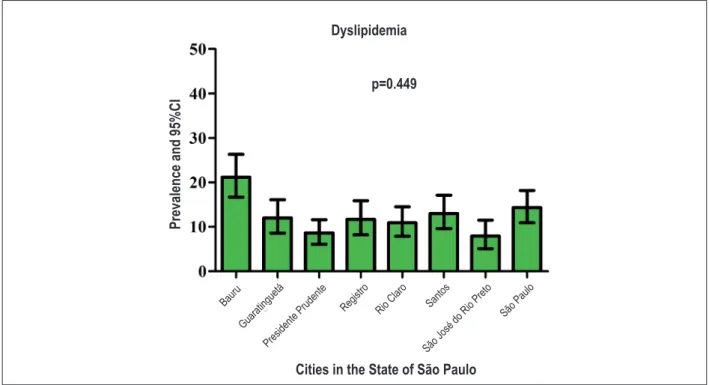
of interviewees was similar in the analyzed cities. The mean age of the sample was 46.3 ± 18.5 years (95% CI = 45.6 to 47.1). The overall prevalence of dyslipidemia was 12.2% (95% CI = 11.1% -13.5%) and figure 1 shows its occurrence according to the eight cities studied. There was no difference among the analyzed cities (p = 0.443). Table 1 shows the association of dyslipidemia with different independent variables analyzed in the study. Women had a dyslipidemia rate that was almost twice higher than that of men (p = 0.001). Similarly, individuals with lower degrees of schooling education and those who were older had higher rates of dyslipidemia. The prevalence of obesity was 15.1% (95% CI = 13.8% -16.5%) and was associated with a higher incidence of dyslipidemia. The prevalence of individuals who met the cutoff adopted for the current practice of physical exercise during leisure time was 16.6% (95% CI = 15.2% -18%) and was not associated with the presence of dyslipidemia. On the other hand, physical exercise, both in childhood (p = 0.001) and adolescence (p = 0.001) was associated with a lower incidence of the disease.
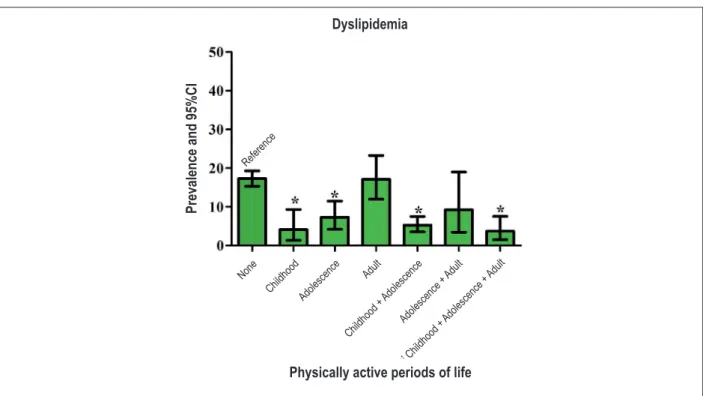
The three periods of life during which interviewees were sufficiently active were grouped and the occurrence of dyslipidemia was compared between the formed groups (Figure 2). When compared to persistently sedentary subjects (no physical exercise in the three time periods), those who practiced physical exercises in childhood, childhood + adolescence and adolescence had a lower rate of dyslipidemia (p = 0.001 for all). Similarly, the lowest rate was observed among those persistently active throughout life (exercise practice in all three periods analyzed).
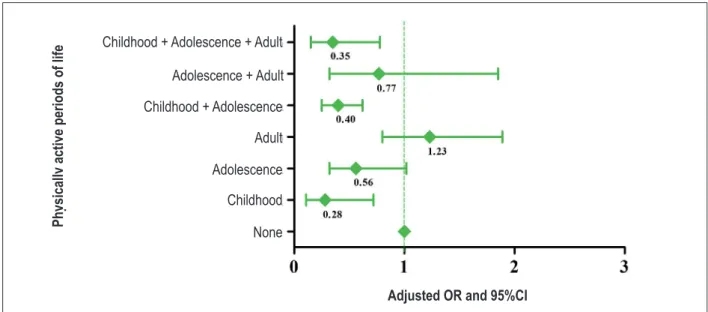
In the constructed multivariate model (Figure 3), those who had sufficient practice of physical exercises in
childhood only (adjustedOR = 0.28 [0.11 to 0.72], p = 0.008);
childhood + adolescence (adjustedOR = 0.40 [0.25 to 0.62],
p = 0.001) and active in all three stages of life were 65%
less likely to report dyslipidemia (adjustedOR = 0.35 [0.15 to
0.78], p = 0.010 ).
Discussion
The epidemiological study showed an association between the maintenance of physical exercise throughout life and the occurrence of dyslipidemia in adulthood, which identified a lower incidence of the analyzed outcome in adults who reported engaging in these activities throughout life.
In our study, 12% of the interviewees reported a diagnosis of dyslipidemia. Given the wide variety of indicators to establish the diagnosis of dyslipidemia, its occurrence varies greatly. However, a recent study identified a self-reported occurrence close to 12% in some cities of the state of São Paulo, with 16% in the
capital city12. These values are similar to the 16.5% observed in
Brazilian capitals2 and indicate that, even based on self-reporting,
a procedure that can lead to underestimation of the outcome, the rates are high and public health actions are necessary in order to fight this outcome in the Brazilian population.
for some time after it, can contribute to lower concentrations
of lipids14. Thus, physical exercise programs carried out during
adulthood have been shown to be effective in decreasing the
concentrations of some lipid components4, as well as stimulating
an increase in the size of LDL-cholesterol molecules, reducing
its atherosclerotic capacity5. In our study, the current practice
of physical exercise was not associated with the presence of dyslipidemia; furthermore, when analyzing those subjects who started this practice in adulthood only, they showed a similar rate to those who remained persistently sedentary. This pattern can be attributed to reverse causality, for adults that were sedentary when young can develop dyslipidemia, and only after the diagnosis, begin the practice of physical exercises.
Healthcare professionals play an important role in this process, as in recent years, major health organizations have included physical exercise in their guidelines as a nonpharmacological agent for the treatment of several diseases, including dyslipidemia. This attitude has motivated different health professionals to recommend it to their patients.
If, on the one hand, this relationship in adulthood has been well researched, on the other hand, there is little information on the effect of exercise performed throughout life on the occurrence of dyslipidemia in adulthood. Recently it was found that the practice of physical exercise in childhood and adolescence is an agent associated with lower occurrence of dyslipidemia adult
age12; however, these studies did not take into account the
continued practice of physical activity throughout life.
The relationship between physical exercise and dyslipidemia control is yet to be clarified. A meta-analysis assessing around
51 studies showed there is no direct relationship between the intensity of exercise and improvement in the lipid profile, i.e.,
there is no dose-response relationship15. Other studies have
shown that the effects of physical exercise were primarily on the control of body adiposity and subsequent obesity prevention,
which would result in better lipid profile8,16. Along these
lines of research, recent studies indicate that the relationship between current physical exercise and dyslipidemia reflects
mainly changes in the body composition7,12.
It is known that adipose tissue produces and releases into the bloodstream a large variety of inflammatory substances that act on different organs and are associated with the development of different diseases. Among these adipokines,
interleukin 6 (IL-6) and tumor necrosis factor alpha (TNF-α) are
noteworthy, which, through different mechanisms, generate processes related to decreased glucose uptake by target tissues and, consequently, increased release/use of free fatty acids in
the bloodstream1,17. Body weight reduction is associated with
lower concentrations of these adipokines18.
In turn, as observed in our study, this relationship may not be as dependent on modifications in body composition, as the practice of physical exercises affects the control of inflammatory agents in the body, regardless of changes
in body composition corporal19. Studies show that
increased practice of physical exercise increases the plasma concentrations of adiponectin (anti-inflammatory agent that increases sensitivity to insulin action), and decreases levels of
IL-6 and TNF-α19, with this protective effect being observed
since early ages20.
Figure 1 – Occurrence of dyslipidemia in 8 cities of the state of Sao Paulo; Note. Bars indicate the prevalence and the error lines indicate the 95% confidence intervals of prevalence.
Dyslipidemia
Bauru
Guarati nguetá
Pres idente P
rudente Regi stro
Rio C laro
Santos
São J osé do R
io Preto São P
aulo
P
re
va
le
nc
e a
nd 9
5%C
I
p=0.449
Table 1 – Association between dyslipidemia and different factors in adults living in 8 cities in the state of São Paulo
Variable Category
Presence of dyslipidemia
n (%) ORcrude (95%CI) p
Sex Male 90 (8.2) 1.00
Female 244 (15) 1.97 (1.53-2.55) 0.001
Age (years) 18 to 29.9 15 (2.1) 1.00
30 to 49.9 67 (8.7) 4.45 (2.52-7.87) 0.001
50 to 64.9 132 (18.4) 10.56 (6.12-18.23) 0.001
≥65 120 (23.7) 14.57 (8.40-25.28) 0.001
Level of schooling (years) 1 to 4 126 (21.9) 2.67 (1.90-3.74) 0.001
5 to 8 57 (12.5) 1.35 (0.91-2.00) 0.124
9 to 11 95 (8.7) 0.90 (0.63-1.27) 0.568
≥12 56 (9.5) 1.00
Nutritional status * Normal 109 (7.8) 1.00
Overweight 143 (16.4) 2.31 (1.77-3.02) 0.001
Obesity 72 (17.7) 2.54 (1.84-3.51) 0.001
PE in childhood No 292 (15.8) 1.00
Yes 42 (4.8) 0.27 (0.19-0.37) 0.001
PE in adolescence No 276 (16.2) 1.00
Yes 58 (5.7) 0.31 (0.23-0.41) 0.001
Current PE None 218 (12.6) 1.00
<180min/week 70 (13.1) 1.04 (0.78-1.40) 0.745
≥180min/week 46 (10.2) 0.78 (0.56-1.10) 0.165
*Analysis carried out with 2.687 individuals; PE - physical exercise; OR - odds ratio; 95%CI - 95% conidence interval; min/week - minutes per week.
Figure 2 – Occurrence of dyslipidemia according to the involvement with physical exercise practice throughout life; Note. Bars indicate the prevalence and the error lines indicate the 95% CI of the prevalence; OR - odds ratio; 95%CI - 95% conidence interval.
Referenc e
Physically active periods of life
P
re
va
le
nc
e a
nd 9
5%C
I
Dyslipidemia
None Childho
od
Adol escenc
e Adul
t
Childho od +
Adol escenc
e
Adol escenc
e + Adul t
Childho od +
Adol escenc
P
er
íodos
da
V
ida
Fis
ic
ame
nte
A
tiv
os
P
hy
sic
ally
a
ct
iv
e pe
riods
of lif
e
Childhood + Adolescence + Adult
Adolescence + Adult
Adult
Adolescence
Childhood
None
Childhood + Adolescence
Adjusted OR and 95%CI
Figure 3 – Multivariate model for the association between the occurrence of dyslipidemia and involvement with the practice of physical exercises throughout life. Note. Squares represent OR values and error lines indicate 95% CI 95% of the OR; OR - odds ratio; 95%CI - 95% conidence interval.
adjustedOR - adjusted by city, sex, age, schooling and nutritional status.
It is noteworthy the fact that our results also indicated that, in addition to physical exercise in the three periods of life, physical exercise performed only in childhood and adolescence + adulthood was significantly associated with lower incidence of dyslipidemia in adulthood. In fact, there is evidence in the literature indicating that higher BMI values recorded in childhood and adolescence are
related to unfavorable lipid profile in adulthood21 and thus,
weight gain control provided by the practice of sports since childhood and adolescence would be a determinant factor for this lower occurrence in adulthood.
Such data confirm the importance of childhood obesity prevention through changes in lifestyle. In addition, previous studies showed that the amount of exercise, and not the intensity, promotes beneficial effects on plasma
levels of lipoproteins5,22. These studies corroborate our
findings, showing that the maintenance of physical activity throughout life (childhood, adolescence and adulthood) promotes the prevention of dyslipidemia and associated diseases.
The retrospective analysis of the practice of physical exercises used in this study can be an alternative to the use of cross-sectional analyses; however, it does not meet the need of carrying out prospective studies addressing this issue. Thus, the absence of causal associations should be considered when analyzing the presented results. Another limitation that should not be overlooked is the use of self-report to detect the presence of dyslipidemia. In this type of analysis it is not possible to describe which lipid components would be altered, which constitutes a study limitation. Additionally, this methodological approach can generate significant underestimation of the event; however,
in addition to having high reproducibility, the associations found with BMI, age and socioeconomic status (schooling) are similar to previous reports in the literature. These patterns of association indicate that this underestimation was similar in all substrates of the sample and did not significantly affect the research findings.
In summary, this study indicates that the continued practice of physical exercises throughout life was associated with a lower occurrence of the analyzed outcome and thus can be an important tool to prevent the development of dyslipidemia in adulthood. Such findings are of relevance for the public health in Brazil, by indicating that, regarding the prevention of chronic diseases, more important than promoting physical exercise in adulthood is to encourage it among young people. It is therefore crucial that the role of physical education be reviewed in the Brazilian educational system within the system of public policies.
Potential Conflict of Interest
No potential conflict of interest relevant to this article was reported.
Sources of Funding
This study was funded by FAPESP.
Study Association
References
1. Diaz MN, Frei B, Vita JA, Keaney JF Jr. Antioxidants and atherosclerotic heart disease. N Engl J Med. 1997;337(6):408-16.
2. Gigante DP, Moura EC, Sardinha LM. Prevalence of overweight and obesity and associated factors, Brazil, 2006. Rev Saude Publica. 2009;43 (supl. 2):83-9.
3. Guedes DP, Gonçalves LA. [Impact of the habitual physical activity on lipid profile in adults]. Arq Bras Endocrinol Metab. 2007;51(1):72-8.
4. Zaros PR, Pires CE, Bacci M Jr, Moraes C, Zanesco A. Effect of 6-months of physical exercise on the nitrate/nitrite levels in hypertensive postmenopausal women. BMC Womens Health. 2009;9:17.
5. Kraus WE, Houmard JA, Duscha BD, Knetzger KJ, Wharton MB, McCartney JS, et al. Effects of the amount and intensity of exercise on plasma lipoproteins. N Engl J Med. 2002;347(19):1483-92.
6. Sposito AC, Caramelli B, Fonseca FA, Bertolami MC, Afiune Neto A, Souza AD, et al. / Sociedade Brasileira de Cardiologia. IV Brazilian Guideline for dyslipidemia and atherosclerosis prevention: Department of Atherosclerosis of Brazilian Society of Cardiology. Arq Bras Cardiol. 2007;88(Suppl. 1):2-19.
7. Fernandes RA, Zanesco A. Early physical activity promotes lower prevalence of chronic diseases in adults Hypertens Res. 2010;33(9):926-31.
8. Fernandes RA, Christofaro DG, Casonatto J, Costa Rosa CS, Costa FF, Freitas Júnior IF, et al. Leisure time behaviors: prevalence, correlates and associations with overweight in Brazilian adults: a cross-sectional analysis. Rev Med Chil. 2010;138(1):29-35.
9. Florindo AA, Hallal PC, de Moura EC, Malta DC. Practice of physical activities and associated factors in adults, Brazil, 2006. Rev Saude Publica. 2009;43(Suppl. 2):65-73.
10. Baecke JA, Burema J, Frijters JE. A short questionnaire for the measurement of habitual physical activity in epidemiological studies. Am J Clin Nutr. 1982;36(5):936-42.
11. Florindo AA, Latorre M do R, Jaime PC, Tanaka T, Zerbini CA. Methodology to evaluation the habitual physical activity in men aged 50 years or more. Rev Saude Publica. 2004;38(2):307-14.
12. Fernandes RA, Sponton CHG, Zanesco A. Atividade física na infância e
adolescência promove efeitos benéficos na saúde de adultos. Rev SOCERJ. 2009;22(6):365-72.
13. Borges JL. Drug combinations: statins and niacin. Arq Bras Cardiol. 2005;85(Suppl. 5):36-41.
14. Horowitz JF, Leone TC, Feng W, Kelly DP, Klein S. Effect of endurance training on lipid metabolism in women: a potential role for PPARalpha in the metabolic response to training. Am J Physiol Endocrinol Metab. 2000;279(2):E348-55.
15. Leon AS, Sanchez OA. Response of blood lipids to exercise training alone or combined with dietary intervention. Med Sci Sports Exerc. 2001;33(6 Suppl.):S502-15.
16. Donnelly JE, Blair SN, Jakicic JM, Manore MM, Rankin JW, Smith BK. American College of Sports Medicine Position Stand. Appropriate physical activity intervention strategies for weight loss and prevention of weight regain for adults. Med Sci Sports Exerc. 2009;41(2):459-71.
17. Kotsis V, Stabouli S, Papakatsika S, Rizos Z, Parati G. Mechanisms of obesity-induced hypertension. Hypertens Res. 2010;33(5):386-93.
18. Tousoulis D, Tsarpalis K, Cokkinos D, Stefanadis C. Effects of insulin resistance on endothelial function: possible mechanisms and clinical implications. Diabetes Obes Metab. 2008;10(10):834-42.
19. Balducci S, Zanuso S, Nicolucci A, Fernando F, Cavallo S, Cardelli P, et al. Anti-inflammatory effect of exercise training in subjects with type 2 diabetes and the metabolic syndrome is dependent on exercise modalities and independent of weight loss. Nutr Metab Cardiovasc Dis. 2010;20(8):608-17.
20. Carrel AL, McVean JJ, Clark RR, Peterson SE, Eickhoff JC, Allen DB. School-based exercise improves fitness, body composition, insulin sensitivity, and markers of inflammation in non-obese children. J Pediatr Endocrinol Metab. 2009;22(5):409-15.
21. Sinaiko AR, Donahue RP, Jacobs DR Jr, Prineas RJ. Relation of weight and rate of increase in weight during childhood and adolescence to body size, blood pressure, fasting insulin, and lipids in young adults. The Minneapolis Children’s Blood Pressure Study. Circulation. 1999;99(11):1471-6.