AR
TIGO ORIGINAL / ORIGINAL AR
TICLE
INTRODUCTION
Spontaneous bacterial peritonitis (SBP) is one of the most common and severe complication of cirrhotic patients(5, 18, 21). Without early therapeutic intervention, mortality of SBP is about 20%-40% (22). The charac-teristic of the SBP is spontaneous infection of the ascetic luid without an intra-abdominal source of infection(10, 20, 25). SBP patients usually have symptoms like fever, abdominal pain, impaired renal function, hypertension and progression to encephalopathy.
EVALUATION OF LEUKOCYTE ESTERASE
REAGENT STRIPS TEST IN THE DIAGNOSIS
OF SPONTANEOUS BACTERIAL
PERITONITIS IN CHILDREN WITH CIRRHOSIS
Naser
HONAR
1, Bita
GERAMIZADEH
2, Seyed-Mohsen
DEHGHANI
1, Gholamreza
KALVANDI
3,
Iraj
SHAHRAMIAN
3, Asghar
RAHMANI
4and Hazhir
JAVAHERIZADEH
3Received 16/3/2015 Accepted 27/4/2015
ABSTRACT - Background - Spontaneous bacterial peritonitis is deined as an ascetic luid infection without an evident intra-abdom-inal surgically treatable source. Spontaneous bacterial peritonitis is one of the severe complications in patients with cirrhosis and ascites. Without early antibiotic treatment, this complication is associated with high mortality rate; therefore, early diagnosis and treatment of spontaneous bacterial peritonitis is necessary for survival. Leukocyte esterase reagent can rapidly diagnose the spon-taneous bacterial peritonitis. Objective - This study aimed to ind out the diagnostic accuracy of leukocyte esterase dipstick test for the diagnosis of spontaneous bacterial peritonitis. Methods - A single centered hospital-based cross-sectional study was conducted during July 2013 to August 2014 on children with cirrhotic liver disease and ascites who were admitted in the Department of Pe-diatric Gastroenterology in Nemazee Hospital afiliated to Shiraz University of Medical Sciences (Iran). All patients underwent abdominal paracentesis, and the ascitic luid was processed for cell count, leukocyte esterase reagent strip test (Combiscreen SL10) and culture. Spontaneous bacterial peritonitis was deined as having a polymorphonuclear count (PMN ≥250/m3) in ascitic luid.
Sensitivity, speciicity, positive predictive value and negative predictive value of leukocyte esterase test were calculated according to the formula. Results - Totally, 150 ascitic luid sample of cirrhotic male patients (53.2%) and their mean age (4.33±1.88 years) were analyzed. Biliary atresia (n=44, 29.4%) and idiopathic neonatal hepatitis (n=29, 19.3%) were the most frequent etiology of cirrhosis. Also, abdominal pain (68.6%) and distension (64%) were the most common presenting complaint. Of all cases, 41patients (27.35%) were diagnosed to have spontaneous bacterial peritonitis (PMN ≥250/mm3). Sensitivity and speciicity of leukocyte esterase reagent
test according to PMNs ≥250mm3 were 87.80% and 91.74%, also on ascitic luid culture results were 88.23% and 77.44%. Positive
predictive value and negative predictive value of this test in PMNs ≥250mm3 were 80% and 95.23% and in cases with positive culture
33.33% and 98.09% were obtained, respectively. Eficiency of leukocyte esterase reagent test in diagnosing spontaneous bacterial peritonitis, according to PMNs ≥250mm3 and culture results were 90.66% and 78.66%. Conclusion - The leukocyte esterase strip test
may be used as rapid test for diagnosis of spontaneous bacterial peritonitis due to its high diagnostic validity.
HEADINGS - Peritonitis. Ascites. Ascitic luid. Neutrophils. Esterases. Leukocyte esterase. Child. Liver cirrhosis.
Declared conflict of interest of all authors: none Disclosure of funding: no funding received
1 Gastroenterohepatology Research Center, Nemazee Teaching Hospital, School of Medicine, Shiraz University of Medical Sciences, Shiraz, Iran; 2 Shiraz Transplant
Research Center, Shiraz University of Medical Sciences, Shiraz, Iran; 3 Fellow of Pediatric Gastroenterology, Nemazee Teaching Hospital, School of Medicine, Shiraz
University of Medical Sciences, Shiraz, Iran; 4 Student Research committee, School of medicine, Ilam University of Medical Sciences, Ilam. Iran.
Correspondence: Gholamreza Kalvandi. Dept. of Pediatric Gastroenterology d, Nemazee Teaching Hospital, School of Medicine, Shiraz University of Medical Sciences, Shiraz, Iran. Email: [email protected]
However, the diagnosis of SBP takes hours by cell counter method. On the other hand, limitations in the adequate and necessary laboratory facilities and the long duration of ascitic luid cultures are the causes of the delay in diagnosis of SBP with ascetic luid cultures. This condition implies the necessity of a rapid diagnostic test. Leukocyte esterase reagent (LER) dipstick is a test that removes this time limit, such that the diagnosis of peritonitis is possible with this test within a few minutes(2, 17). Recently, this test has been used for rapid diagnosis of infection in any type of body luid, such as pleural luid, ascetic luid, and cerebrospinal luid (CSF) (6, 17, 23). The LER basic principle is interaction between leukocyte esterase and esteriies compound in the reagent strip yielding a violet azoic dye(15, 22). Further studies in diagnosis of SBP using LER test have been performed on adults but a comprehensive study of the performance of this test has not been performed in children. Using this test, phy-sicians may perform a timely diagnosis, clinical management and appropriate treatment. This study aimed to ind out the diagnostic accuracy of leukocyte esterase dipstick test for the diagnosis of spontaneous bacterial peritonitis.
Study design
A single centered hospital-based cross-sectional study was conducted during July 2013 to August 2014 on children with cirrhotic liver disease and ascites who were admitted in the Department of Pediatric Gastroenterology in Nemazee Hospital afiliated Shiraz University of Medical Sciences (Iran), the major referral center in the ield of hepatology and liver transplantation in children in Iran. This study was approved by the Ethics Committee of the University and written consent was obtained from all parents after inform-ing them about this study. All the parents were asked to sign the informed consent. Patients who had received antibiotics within the previous week within or outside the hospital for any reason, patients with a history of surgery for any reason in the past month, hematemesis, primary renal dysfunction, secondary bacterial peritonitis, peritonitis carcinomatosis, pancreatic ascites, subjects with portal hypertension due to malignancy or tuberculosis were also excluded.
Patients aged less than 19 years with cirrhosis of the liver, regardless of the gender, were selected as the study popula-tion. A total of 150 cirrhotic patients were included in the current study. Demographic and clinical information was collected through questionnaires, oral interview, and careful physical examination. Differential cell count and cytology were examined with a conventional optical microscope. The diagnosis of cirrhosis in our study was according to histo-logical, clinical and sonographic indings of the liver. In this study, ascitic luid PMN count ≥250/mm3 with or without a positive culture for ascetic luid (without contiguous source of intra-abdominal infection) was considered as standard for diagnosis of SBP.
Paracentesis
All patients underwent abdominal paracentesis under aseptic condition. With the use of aseptic techniques, 20mL
of ascetic luid was sent for routine biochemical and culture test. The reagent strip (Combiscreen SL10, Analyticon, Germany) was immersed in 5mL of ascetic luid placed on a dry and clean container as described by the manufacturer for identiication of LER test. After 2 minutes, the reagent strip was read comparing the color of the leukocyte reagent strip area with the colorimetric 5-grade scale depicted on the bottle. The test is based on the esterase activity of the granulocytes present in the ascetic luid that reacts with an ester releasing 3-Hydroxy-5-phenyl-pyrrole. This reaction causes a color change in an azo dye (purple). Results of leukocyte esterase reagent strip were compared with ascetic luid PMN cell count.
Diagnostic criteria
The diagnosis of SBP was based on a PMN ≥250/mm3
in ascitic luid, irrespective of a positive ascetic luid culture and clinical signs of SBP, and an absence of intra-abdominal sources of infection or inlammation(16).
Statistical analysis
Data are presented as means ±SD for quantitative vari-ables and as frequencies for qualitative varivari-ables the exact 95% conidence interval for each statistic was calculated from the binominal distribution. The sensitivity, speciicity, positive predictive value (PPV) and negative predictive value (NPV) were calculated according to their standard formulas. SPSS statistical software version 14.0 (SPSS Inc., Chicago, IL, USA) was used for data analysis.
RESULT
In total, the data of 150 patients were analyzed. Seven-ty-nine (52.3%) patients were male and 71 (43.7%) female (P=0.362). Mean ±SD age of patients was 4.88±4.37 years (range 1 month to 18 years). Mean age of females was 4.92±3.49 years (range 2 months to 18 years) and that of males was 8.83 ± 4.73 years (range 1 month to 16 years) (P=0.341).
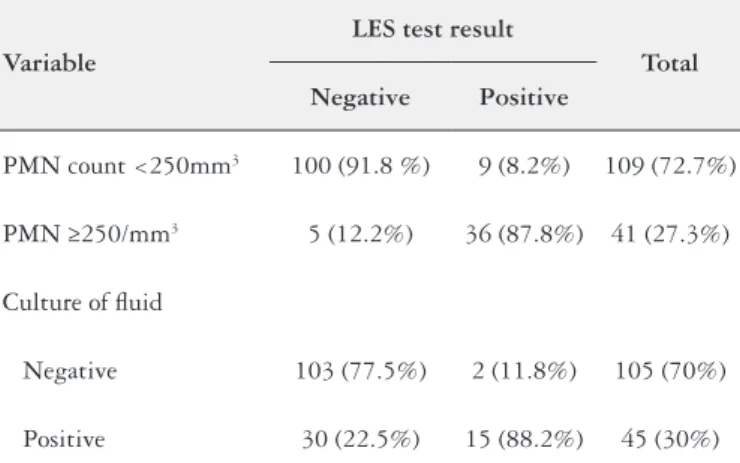
The most common symptom in subjects was abdominal pain (68.6%), distension (64%) and fever (58.6%), respective-ly. The prevalence of symptoms of vomiting, irritability, loss of consensus and poor feeding was 29.3%, 23.3%, 13%, 3%, 26%, respectively. The most common etiology of patients was biliary tract artesia (27.6%) followed by idiopathic neonatal hepatitis (19.3%) and lowest prevalence of autoimmune hep-atitis (2%) and congenital hepatic ibrosis (4.6%), (Table 1). In our study, the positive and negative LER test separately based on number of PMNs and culture were evaluated. Pos-itive and negative results of leukocyte esterase test in terms of the number of PMNs were shown in Table 2. According
to PMN ≥250/mm3 of ascetic luid, 41 (27.35%) patients
test result and 9 (8.2%) revealed a positive test result. Of the total of 150 patients, 105 (70%) had a negative test result and 45 (30%) had a positive leukocyte esterase (LES) test result.
Among the total patients (150 patients), ascitic luid cul-tures in 17 (11.3%) were positive and in 133 (88.6%) patients were negative. Of the 17 patients with positive cultures, 2 (11.7%) patients and 15 (88.2%) patients were found to have positive and negative result tested for leukocyte esterase, respectively. Also, of the 133 patients with negative culture results, 103 (77.5%) patients and 30 (22.5%) patients were found to be positive and negative in leukocyte esterase, res-pectively. Sensitivity and speciicity of LER test on the basis
of PMN ≥250/mm3 were 87.80% and 91.74%.
Also, based on ascitic luid culture results, sensitivity and speciicity were obtained 88.23% and 77.44%, respectively.
The PPV and NPV of this test based on the PMN ≥250/ mm3
and positive cultures were obtained 80%, 95.23% and 33.33%, 98.09%, respectively. In total, accuracy of LER test in
de-tecting SBP on PMN ≥250/mm3 was 90.66% and based on
the culture results it was 78.66% (Table 3).
TABLE 3. Sensitivity, speciicity, PPV, and NPV of the LES test in SBP
Variable PMN ≥250/mm3 Culture positive
Sensitivity % 89.80 % 87.00
Speciicity % 91.74 % 77.44
PPV % 80 % 33.33
NPV % 95.23 % 98.09
Accuracy % 90.66 % 78.66
PPV: positive predictive value; NPV: negative predictive value; LES: leukocyte esterase; SBP: spontaneous bacterial peritonitis; PMN: polymorphonuclear.
TABLE 1. Characteristics of patients
Variable
Sex (male/female, % ) 79 (52.3%) / 71 (43.7%)
Age (mean ± SD, year) 4.37 ± 1.88
Clinical symptoms
Vomiting (%) 44 (29.3%)
Abdominal pain (%) 103 (68.6%)
Distension (%) 96 (64%)
Irritability (%) 35 (23.3%)
Loss of consciousness (%) 20 (13.3%)
Fever (%) 88 (58.6%)
Poor feeding (%) 39 (26%)
Etiology of cirrhosis (%)
Idiopathic neonatal hepatitis (%) 29 (19.3%)
Biliary artesia (%) 44 (29.4%)
Cryptogenic cirrhosis (%) 8 (5.3%)
Wilson disease (%) 14 (9.3%)
Fulminant hepatitis (%) 12 (8%)
Tyrosinemia (%) 8 (5.3%)
Congenital hepatic ibrosis (%) 7 (4.7%)
Autoimmune hepatitis (%) 3 (2.0%)
Others (%) 25 (16.7%)
TABLE 2. Positive and negative result of LER test based on number of PMNs and culture
Variable
LES test result
Total Negative Positive
PMN count <250mm3 100 (91.8 %) 9 (8.2%) 109 (72.7%)
PMN ≥250/mm3 5 (12.2%) 36 (87.8%) 41 (27.3%)
Culture of luid
Negative 103 (77.5%) 2 (11.8%) 105 (70%)
Positive 30 (22.5%) 15 (88.2%) 45 (30%)
LER: leukocyte esterase reagent; PMN: polymorphonuclear; LES: leukocyte esterase.
DISCUSSION
important marker for PMN cell activity(3, 9). The eficacy of LER test for diagnosis of SBP has been reported in previous studies(4, 13, 18, 26, 28, 29). Leukocyte esterase was used for urine analysis irst, but recently it has been found to be useful across a wide range of body luid infections(2, 17).
This study was conducted to evaluate the accuracy of LES test for diagnosis of SBP in cirrhotic children.
Accord-ing to PMN ≥250/mm3, SBP was diagnosed in 41 (27.35%)
patients. Of these, the leukocyte esterase test in ive (12.1%) patients was negative and in 36 (87.8%) patients was posi-tive. Also, in 109 (72.7%) patients PMNs <250mm3 with no SBP; 100 (91.7%) patients had negative and 9 (8.2%) had a positive LER test result. Therefore in this study, sensitivity, speciicity, PPV and NPV of LER test in diagnosing SBP were 95.23%, 80%, 91.74% and 87.80%, respectively. Also, based on ascitic luid culture results, sensitivity, and spec-iicity, PPV and NPV of LER test was obtained 88.23%, 77.44%, 33.33% and 98.09%, respectively. Although several studies have been conducted on the use of leukocyte esterase test in SBP, the results of these studies vary. In a study by Farahmand et al., nine patients with cirrhosis were studied and sensitivity, speciicity, positive and negative predicate value for all of patients were derived 100% respectively(7). Other studies have been done on adults, each reporting various reporting sensitivity and speciicity. For example, in a study by Torun et al. performed on 63 consecutive adult patients with cirrhotic ascites, 15 subjects showed SBP. The sensitivity, speciicity, PPV and NPV of the leukocyte esterase reagent strips were 93%, 100%, 100%, and 98%, respectively(27). In another study done by Vanbiervliet et al. on 72 patients with cirrhosis, nine patients included were diagnosed with SBP, and LER test was positive in all cases with 100% sensitivity and speciicity(28). Butani et al. used LER test to diagnose SBP in 136 patients. The sensitivity, speciicity, PPV and NPV value at this study were obtained 83%, 99%, 91%, and 98% respectively(3). Following other studies on adults, Khatwani and colleagues reported the sensitivity, specificity, PPV, NPV of leukocyte esterase dipstick test to diagnose SBP 92%, 95%, 96%, and 90%, res-pectively in ninety four patients with cirrhosis(12). Although several studies have been conducted on the use of LER test in SBP, the results of these studies are varied. Variation in the results of these studies can be partly explained by the use of different brands of reagent strips and the use of dif-ferent cutoff points for positivity. The majority of studies have examined the use of leukocyte esterase testing in the diagnosis of peritonitis in adult. So far, only one study has been conducted by Farahmand et al.(7). using LER test in the diagnosis of SBP in children.
Our study is the irst study carried out with a large sam-ple size on the accuracy of LER test in diagnosing SBP in children. The mean age of the patients was 4.88 years (range 1 month to 18 years). As mentioned, in our study, accuracy of LER tests in detecting SPB was 90.66%. There is a great potential in using LER test for diagnosis of SBP in children. This test is easy, does not require expertise, is rapid, can be performed bedside with a low cost, and has high sensitivity and speciicity for diagnosis of SBP. Also, saving time at diagnosis of SBP leads to rapid start of antibiotic therapy. LER test is also useful in determining the effectiveness of antibiotic therapy.
CONCLUSION
In conclusion, LER test strips is a very sensitive, speciic and very rapid identiication method for diagnosis of SBP in children with cirrhosis speciically. This is a rapid bedside test that is easy to use and can be performed eficiently in order to speed up the bedside diagnosis of this clinical entity. It its easily into the work low of a routine gastroenterology department and can be conducted in settings that do not have the facilities to carry out biochemical and bacteriological tests for diagnosis of SBP. In addition, a positive test result should be an indication for initiation of empirical treatment, and negative results should exclude SBP. Finally, LER test can be used extensively in paracentesis as a screening test to exclude ascitic luid infection in children.
ACKNOWLEDGMENTS
This paper was issued from fellowship thesis of Dr. Ghol-amreza Kalvandi and supported by research affairs of Shiraz University of Medical Sciences .The authors gratefully thank the laboratory personnel and Vice Chancellor of Researches and Technology for their valuable help on this study. This work was financially supported by Shiraz University of Medical Science. The authors would like to thank Dr. Nasrin Shokrpour at Center for Development of Clinical Research of Nemazee Hospital for editorial assistance.
Authors’ contributions
Honar N, Geramizadeh B, Dehghani SM, Kalvandi G, Shahramian I, Rahmani A, Javaherizadeh H. Avaliação de tiras reagentes de teste de esterase de leucócitos no diagnóstico de peritonite bacteriana espontânea em crianças com cirrose. Arq Gastroenterol. 2015,52(3):195-9.
RESUMO - Contexto - A peritonite bacteriana espontânea é deinida como uma infecção do luido ascítico sem evidente origem intra-abdominal cirur-gicamente tratável. A peritonite bacteriana espontânea é uma das complicações graves em pacientes com cirrose e ascite. Sem tratamento antibiótico precoce, esta complicação é associada com alta taxa de mortalidade. Portanto, o diagnóstico precoce e tratamento de peritonite bacteriana espontânea são necessários para a sobrevivência. O reagente de esterase de leucócitos pode rapidamente diagnosticar a peritonite bacteriana espontânea. Ob-jetivo - Este estudo teve como objetivo descobrir a acurácia diagnóstica do teste com tiras de esterase de leucócitos para o diagnóstico de peritonite bacteriana espontânea. Métodos - Um estudo transversal hospitalar unicêntrico foi realizado entre julho de 2013 e agosto de 2014 em crianças com cirrose hepática e ascite que foram admitidas no Departamento de Gastroenterologia Pediátrica no Hospital de Nemazee ailiado à Universidade de Ciencias Médicas de Shiraz (Irã). Todos os pacientes foram submetidos a paracentese abdominal, e o líquido ascítico foi processado para contagem de células, teste de tira de reagente de esterase de leucócitos (Combiscreen SL10) e cultura. Peritonite bacteriana espontânea foi deinida como tendo uma contagem de polimorfonucleares (PMN ≥250/m3) no líquido ascítico. Sensibilidade, especiicidade, valor preditivo positivo negativo do teste
de esterase de leucócitos foram calculados de acordo com a fórmula. Resultados - Foram analisados um total de 150 amostras de líquido ascítico de pacientes cirróticos; (53,2%) eram do sexo masculino e sua média de idade (4,33±1,88 anos). A atresia biliar (n=44, 29,4%) e hepatite neonatal idiopática (n=29, 19,3%) foram as etiologias mais frequentes de cirrose. Além disso, dor abdominal (68,6%) e distensão (64%) foram as queixas mais comuns de apresentação. De todos os casos, 41 (27,35%) foram diagnosticados com peritonite bacteriana espontânea (PMN ≥250/mm3). A
sensibil-idade e especiicsensibil-idade do teste de reagente de esterase de leucócitos segundo PMN ≥250mm3 foi de 87,80% e 91,74% e, para os resultados de cultura
de líquido ascítico, de 88,23% e 77,44%. Valor preditivo positivo e valor preditivo negativo do teste em PMN ≥250mm3 foi de 80% e 95,23% e em
casos com cultura positiva 33,33% e 98,09%, respectivamente. A eiciência do teste de reagente esterase de leucócitos no diagnóstico de peritonite bacteriana espontânea, de acordo com resultados de ≥250mm3 e cultura PMN, foi de 90,66% e 78,66%. Conclusão - O teste de tiras de esterase de
leucócitos pode ser usado como um teste rápido para diagnóstico de peritonite bacteriana espontânea, devido a sua alta validade diagnóstica.
DESCRITORES - Peritonite. Ascite. Líquido ascítico. Neutróilos. Esterases. Leucócitos. Criança. Cirrose hepática.
REFERENCES
1. Arvaniti V, D’Amico G, Fede G, Manousou P, Tsochatzis E, Pleguezuelo M, Burroughs AK. Infections in patients with cirrhosis increase mortality four-fold and should be used in determining prognosis. Gastroenterology. 2010;139(4):1246-56.
2. Azoulay E, Fartoukh M, Galliot R, Baud F, Simonneau G, Le Gall JR, Schlemmer B, Chevret S. Rapid diagnosis of infectious pleural effusions by use of reagent strips. Clin Infect Dis. 2000;31(4):914-9.
3. Butani RC, Shaffer RT, Szyjkowski RD, Weeks BE, Speights LG, Kadakia SC. Rapid diagnosis of infected ascitic luid using leukocyte esterase dipstick testing. Am J Gastroenterol. 2004;99(3):532-7.
4. Castellote J, Lopez C, Gornals J, Domingo A, Xiol X. Use of reagent strips for the rapid diagnosis of spontaneous bacterial empyema. J Clin Gastroenterol. 2005;39(4):278-81.
5. Chinnock B, Afarian H, Minnigan H, Butler J, Hendey GW. Physician clinical impression does not rule out spontaneous bacterial peritonitis in patients under-going emergency department paracentesis. Ann Emerg Med. 2008;52(3):268-73. 6. Evans LT, Kim WR, Poterucha JJ, Kamath PS. Spontaneous bacterial peritonitis
in asymptomatic outpatients with cirrhotic ascites. Hepatology. 2003;37(4):897-901. 7. Farahmand F, Eshagh Roze M, Shams S, Ghajarzadeh M, Mohammadi B. Di-agnosis of spontaneous bacterial peritonitis in children by reagent strips. Acta Med Iran. 2013;51(2):125-8.
8. Hoefs JC, Runyon BA. Spontaneous bacterial peritonitis. Dis Mon. 1985;31(9):1-48. 9. Jacobs JA, De Brauwer EI, Cornelissen EI, Drent M. Correlation of leukocyte
esterase detection by reagent strips and the presence of neutrophils: a study in BAL luid. Chest, 2000;118(5):1450-4.
10. Jepsen P, Vilstrup H, Møller JK, Sørensen HT. Prognosis of patients with liver cirrhosis and spontaneous bacterial peritonitis. Hepatogastroenterology. 2003;50(54):2133-6.
11. Khan J, Pikkarainen P, Karvonen AL, Mäkelä T, Peräaho M, Pehkonen E, Col-lin P. Ascites: aetiology, mortality and the prevalence of spontaneous bacterial peritonitis. Scand J Gastroenterol. 2009;44(8):970-4.
12. Khatwani NR, Chhutto MA, Abro HA, Habib-ur-Rahman, Shaikh MA. Diagnostic validity of leukocyte esterase dipstick test for diagnosis of sponta-neous bacterial peritonitis in cirrhotic patients. J Ayub Med Coll Abbottabad. 2011;23(1):51-4.
13. Kim DY1, Kim JH, Chon CY, Han KH, Ahn SH, Kim JK, et al. Usefulness of urine strip test in the rapid diagnosis of spontaneous bacterial peritonitis. Liver Int. 2005;25(6):1197-201.
14. Koulaouzidis A, El-Ramli R, Gasem J, Saeed AA. Leukocyte esterase re-agent strips for spontaneous bacterial peritonitis: what now? Ann Hepatol. 2008;7(3):255-6.
15. Kutter D, Figueiredo G, Klemmer L. Chemical detection of leukocytes in urine by means of a new multiple test strip. J Clin Chem Clin Biochem. 1987;25(2):91-4. 16. Moore KP, Wong F, Gines P, Bernardi M, Ochs A, Salerno F, et al. The manage-ment of ascites in cirrhosis: report on the consensus conference of the International Ascites Club. Hepatology. 2003;38(1):258-66.
17. Moosa AA, Quortum HA, Ibrahim MD. Rapid diagnosis of bacterial meningitis with reagent strips. Lancet. 1995;345(8960):1290-1.
18. Nousbaum JB, Cadranel JF, Nahon P, Khac EN, Moreau R, Thévenot T, et al. Diagnostic accuracy of the Multistix 8 SG reagent strip in diagnosis of sponta-neous bacterial peritonitis. Hepatology. 2007;45(5):1275-81.
19. Parsi MA, Atreja A, Zein NN. Spontaneous bacterial peritonitis: recent data on incidence and treatment. Cleve Clin J Med. 2004;71(7):569-76.
20. Rerknimitr R, Rungsangmanoon W, Kongkam P, Kullavanijaya P. Eficacy of leukocyte esterase dipstick test as a rapid test in diagnosis of spontaneous bacterial peritonitis. World J Gastroenterol. 2006;12(44):7183-7.
21. Rimola A, García-Tsao G, Navasa M, Piddock LJ, Planas R, Bernard B, Inadomi JM. Diagnosis, treatment and prophylaxis of spontaneous bacterial peritonitis: a consensus document. International Ascites Club. J Hepatol. 2000;32(1):142-53. 22. Runyon BA, McHutchison JG, Antillon MR, Akriviadis EA, Montano AA.
Short-course versus long-course antibiotic treatment of spontaneous bacterial peritonitis. A randomized controlled study of 100 patients. Gastroenterology. 1991;100(6):1737-42.
23. Sam R, Sahani M, Ulozas E, Leehey DJ, Ing TS, Gandhi VC. Utility of a peri-toneal dialysis leukocyte test strip in the diagnosis of peritonitis. Artif Organs. 2002;26(6):546-8.
24. Tandon P, Garcia-Tsao G. Bacterial infections, sepsis, and multiorgan failure in cirrhosis. Semin Liver Dis. 2002;28(1):26-42.
25. Thanopoulou AC, Koskinas JS, Hadziyannis SJ. Spontaneous bacterial peritonitis (SBP): clinical, laboratory, and prognostic features. A single-center experience. Eur J Intern Med. 2002;13(3):194-8.
26. Thévenot T, Cadranel JF, Nguyen-Khac E, Tilmant L, Tiry C, Welty S, Merzoug N. Diagnosis of spontaneous bacterial peritonitis in cirrhotic patients by use of two reagent strips. Eur J Gastroenterol Hepatol. 2004;16(6):579-83.
27. Torun S, Dolar E, Yilmaz Y, Keskin M, Kiyici M, Sinirtas M, et al. Evaluation of leukocyte esterase and nitrite strip tests to detect spontaneous bacterial peritonitis in cirrhotic patients. World J Gastroenterol. 2007;13(45):6027-30.
28. Vanbiervliet G, Rakotoarisoa C, Filippi J, Guérin O, Calle G, Hastier P, et al. Diagnostic accuracy of a rapid urine-screening test (Multistix8SG) in cirrhotic patients with spontaneous bacterial peritonitis. Eur J Gastroenterol Hepatol. 2002;14(11):1257-60.