Solanidane and iminosolanidane alkaloids from
Solanum campaniforme
Maria Conceição M. Torres
a, Roberta Jeane B. Jorge
b, Rafael M. Ximenes
b, Natacha Teresa Q. Alves
b,
João Victor de A. Santos
b, Aline D. Marinho
b, Helena S.A. Monteiro
b, Marcos H. Toyama
c,
Raimundo Braz-Filho
a,1, Edilberto R. Silveira
a, Otília Deusdênia L. Pessoa
a,⇑ aDepartamento de Química Orgânica e Inorgânica, Universidade Federal do Ceará, 12.200, Fortaleza-CE 60.021-970, BrazilbDepartamento de Fisiologia e Farmacologia, Universidade Federal do Ceará, Campus do Porangabuçu, Fortaleza-CE 60430-270, Brazil
cLaboratório de Química de Macromoléculas, Universidade Estadual Paulista Júlio Mesquita Filho, Campus Experimental do Litoral Paulista, São Vicente-SP 11330-900, Brazil
a r t i c l e
i n f o
Article history:
Received 24 April 2013
Received in revised form 22 August 2013 Available online 26 September 2013
Keywords:
Solanum campaniforme
Solanaceae Solanidane alkaloids Iminosolanidane alkaloids
Bothrops pauloensis
a b s t r a c t
From the leaves ofSolanum campaniforme(Solanaceae), eight solanidane alkaloids were isolated, four of which contain ap-hydroxyphenylethylamine unit. Their structures were established as: 22b,23b-epoxy-solanida-1,4-dien-3-one; 22a,23a-epoxy-10-epi-solanida-1,4,9-trien-3-one; 22a,23a -epoxy-solanida-4-en-3-one; 22b,23b-epoxy-solanida-4--epoxy-solanida-4-en-3-one; (E)-N-[80(4-hydroxyphenyl)ethyl]-22a,23a-epoxy-solanida-1,
4,9-trien-3-imine; (E)-N-[80(4-hydroxyphenyl)ethyl]-22a,23a-epoxy-solanida-1,4-dien-3-imine; (Z)-N
-[80(4-hydroxyphenyl)ethyl]-22a,23a-epoxy-solanida-1,4,9-trien-3-imine and (Z)-N-[80(4-hydroxyphenyl)
ethyl]-22a,23a-epoxy-solanida-1,4-dien-3-imine. All structures were determined using spectroscopic techniques, such as 1D and 2D NMR, and HRESIMS. The cytotoxicity and the antiophidic activities of the alkaloids were evaluated. The alkaloids did not show any cytotoxicity, but inhibited the main toxic actions ofBothrops pauloensisvenom.
Ó2013 Elsevier Ltd. All rights reserved.
1. Introduction
Plants belonging to the genusSolanum(Solanaceae) have been intensively investigated in terms of their chemical and/or biologi-cal properties (Lu et al., 2011; Chauhan et al., 2011; Silva, 2008; Pandurangan et al., 2010, 2011). In this context, several reviews have also been published (Li et al., 2011; Milner et al., 2011; Wang et al., 2011). The economic importance of the genusSolanumis also striking, including its ability to produce steroidal alkaloids many of which are of therapeutic interest (Nino et al., 2009). Due the medicinal importance of these plants in traditional medicine in the northeast region of Brazil, efforts have been dedicated to inves-tigation of some species from the Solanaceae, especially those of the generaAcnistusandSolanum(Rocha et al., 2012; Pinto et al., 2011; Veras et al., 2004). A preliminary study ofSolanum campan-iformeresulted in the isolation of three major solanidane alkaloids from the EtOAc fraction of the EtOH extract, these being active against theBothrops pauloensis venom (Torres et al., 2011). The study was then extended herein to the dichloromethane fraction of the same EtOH extract, from which were isolated several new minor solanidane alkaloids.
2. Results and discussion
Various chromatographic procedures, including open silica gel column, Sephadex LH-20, C-18 SPE cartridge and HPLC of the dichloromethane fraction of the EtOH extract from leaves of
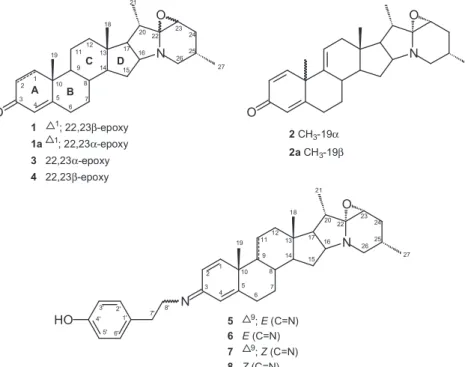
S. campaniformeafforded eight (1–8) new alkaloids (Fig. 1). Their structures and relative stereochemistries were elucidated using spectroscopic analyses, including NMR (1D and 2D) techniques and HRESIMS. Compounds1–8were isolated as dark resins which showed positive alkaloid-tests with the Dragendorf reagent.
The IR spectrum of compound 1contained absorption bands consistent with a conjugated carbonyl (
m
1680 cm 1) and anolefinic double bond (
m
1618 cm 1), besides absorptions forcar-bon–nitrogen and carbon–oxygen stretching bands (
m
1212–1039 cm 1). Its molecular formula C
27H37NO2was established by
HRESIMS which gave a quasimolecular ion [M+H]+ at m/z
408.2895 (calcd. 408.2897). Its1H NMR spectrum displayed two
doublets atd7.28 (H-1) and 6.21 (H-2), both with characteristic
ciscoupling constants (9.8 Hz), a singlet atd6.06 (s, H-4) for an
iso-lated olefinic proton, as well as signals atd4.37 (br d,J= 7.2 Hz,
H-16), 3.16 (d,J= 12.4 Hz, H-23), and 3.04 (br d,J= 11.0 Hz, H-26) indicating presence of a heteroatom (nitrogen and/or oxygen) in the structure. In addition, signals for four methyl groups were observed atd1.00 (s, Me-18), 1.26 (s, Me-19), 1.10 (d,J= 6.2 Hz, Me-21) and 1.01 (d,J= 6.2 Hz, Me-27), respectively, beside a series of resonances for methine and methylene protons. The 13C
NMR-CPD and DEPT spectra displayed signals for 27 carbon atoms,
0031-9422/$ - see front matterÓ2013 Elsevier Ltd. All rights reserved.
http://dx.doi.org/10.1016/j.phytochem.2013.09.007
⇑ Corresponding author. Tel.: +55 85 33669441; fax: +55 85 33669782.
E-mail address:[email protected](O.D.L. Pessoa).
1 Pesquisador Visitante Emérito – FAPERJ/UENF/UFRRJ.
Contents lists available atScienceDirect
Phytochemistry
among which there was one carbonyl atd189.0 (C-3), four olefinic
resonances atd173.5 5), 159.5 1), 127.8 2) and 124.2
(C-4), as well as signals for sp3nitrogenated [d72.2 (C-16) and 45.9
(C-26)] and oxygenated [d 62.7 (C-23)] carbon atoms (Lawson
et al., 1997). These data were in agreement with a structure of a solanidane alkaloid similar to that of 22
a
,23a
-epoxy-solanida-1,4-dien-3-one (1a) previously isolated from S. campaniforme(Torres et al., 2011). A detailed comparison of the 1H and 13C
NMR spectroscopic data of1, to those of1a, clearly established dif-ferences that justified ab-position for the epoxy ring in contrast to
the previously 22
a
,23a
-epoxy-solanidane alkaloid (1a) [1: dH/dC1.10 (H-21), 3.16 (H-23), 1.97 and 1.53 (2H-24)/16.3 (C-21), 95.8 (C-22), 62.7 (C-23) and 41.5 (C-24); 1a: dH/dC 1.27 (H-21), 3.12
(H-23), 2.16 and 1.38 (2H-24)/19.0 21), 93.7 22), 60.1 (C-23) and 45.6 (C-24)]. A NOESY experiment supported this proposi-tion through the dipolar interacproposi-tions of H-23 (dH3.16), with Me-21
(dH1.10) and H-16 (dH4.37), and the Me-21 (dH1.10) with H-17 (dH
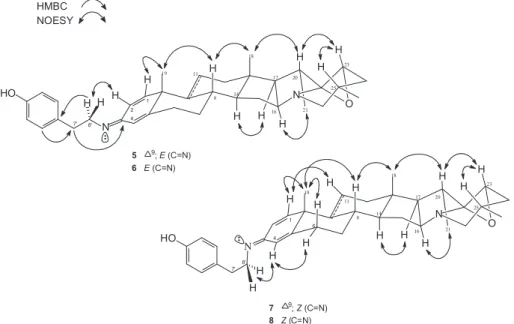
1.29). Additional important spatial interactions are depicted in
Fig. 2. Accordingly, structure 1 was established as the new 22b,23b-epoxy-solanida-1,4-dien-3-one, a configurational isomer
of1a.
Compound2had a molecular formula of C27H35NO2, as
deter-mined by analysis of the HRESIMS spectrum through its quasimo-lecular ion [M+H]+ at m/z 406.2757 (calcd. 406.2741). Detailed
analyses of the 1D- and 2D-NMR spectra indicated that2possessed a structural profile similar to1and1a, but particularly with the 22
a
,23a
-epoxy-solanida-1,4,9-trien-3-one (2a), which differs onlyby the 19
a
-methyl orientation (dH/dC 1.18/24.9), uncommon tosolanidane alkaloids. The higher shielding (DdC= 5.4 ppm) of C-6
(d27.9) and the concomitant deshielding (DdC= 4.2 ppm) of C-8
(d41.9) compared to the same carbons for2a(d33.3 and 37.7,
respectively) can be associated with the
c
-gauche effect caused bya
-orientation of the 19-Me group. The configuration ascribed as 19a
-Me was also supported by the NOESY experiment which showed interactions of H-6a
(d1.59) with Me-19 (d1.18) andH-14 (d1.40) (seeFig. 2). Thus, structure2was established as the new solanidane alkaloid 22
a
,23a
-epoxy-10-epi-solanida-1,4,9-tri-en-3-one.
Compound3had a molecular formula of C27H39NO2, which was
determined by the HRESIMS spectrum from its quasimolecular ion [M+H]+atm/z410.3057 (calcd. 410.3054). Comparative analysis of
the 1D- and 2D-NMR spectra established that 3 shared a high structural similarity to1a. Its1H and13C NMR spectra contained
signals for just one carbon–carbon double bond [d 175.0 (C-5)
and 124.4 (C-4)] and two additional methylene sp3 carbons [d
36.9 (C-1) and 34.8 (C-2)]. Deshielding of the carbonyl signal atd
202.4 (C-3) compared to1[d189.0 (C-3)] and2[d189.9 (C-3)]
al-lowed inference of A ring containing just an
a
,b-conjugated systemand not a cross-conjugated system as observed for1and2. The complete structure of 3, including its relative stereochemistry, was deduced by interpretation of its NMR spectroscopic data, including the NOESY spectrum, and comparative analyses with analogous compounds. Thus, structure3 was established as the new alkaloid 22
a
,23a
-epoxy-solanida-4-en-3-one.Compound4, from its HRESIMS spectrum, gave a quasimolecu-lar ion peak [M+H]+atm/z410.3059 (calc. 410.3054) indicating the
same molecular formula as3(C27H39NO2), suggesting they were
stereoisomers. An accurate analysis of the 1D- and 2D-NMR spec-tra, indicated that4differed from3solely by the configuration of the epoxy ring, as observed for1and1a. Theb-position adopted
by the epoxy moiety was supported by the chemical shift of the methine protons H-20 (d2.07) and H-25 (d2.07), which were both
a
-oriented and from the13C NMR chemical shifts of the C-22 (d95.8) and C-23 (d62.8), both showing a deshielding higher than
2 ppm, as compared to the same carbons in3(Table 2). On the other hand, C-21 (d16.4) and C-24 (d41.5) were shielded by more
than 2.5 ppm. The dipolar interactions observed in the NOESY experiment of H-23 (d3.16) with H-16 (d4.39) and the Me-21(d
1.1) constitute additional support to establish the relative stereo-chemistry. Thus, the final structure of4is 22b,23b
-epoxy-solan-ida-4-en-3-one.
From the quasimolecular ion [M+H]+atm/z525.3487 [M+H]+
(calcd. 525.3476 for) observed in the HRESIMS spectrum, the molecular formula C35H44N2O2 of compound 5was determined.
The1H and13C NMR spectroscopic data of
5were partially similar to those of2a(Torres et al., 2011), albeit with additional signals
2 CH3-19α
2a CH3-19β N
O
O
N
O
O
N
N
O
HO 12 11
6 3
1 2
4 5 10 19
7 8 9
13 14 15
16 17 18
20 22 24
25 26 23 21
27
12 11
6 3
1 2
4 5 10 19
7 8 9
13 14
15 16 17 18
20 22 24
25 26 23 21
27
1' 7'
6' 4'
3'
5'
2' 8'
1 1; 22,23β-epoxy
1a 1; 22,23α-epoxy
3 22,23α-epoxy
4 22,23β-epoxy
5 9; E (C=N)
6 E (C=N)
7 9; Z (C=N)
8 Z(C=N)
A B
C D
related to ap-hydroxy-ethylamine moiety and some variations for the chemical shifts of the ring A of the solanidane nucleus, ( Ta-ble 2). The imino and benzyl methylene protons at d 3.92 (t,
J= 6.2 Hz, 2H-80) and 2.94 (m, 2H-70), correlated in the HSQC
spec-trum with the carbons atd47.6 and 35.5, respectively, displayed
long range correlations with the carbons of the aromatic ring (C-10) and of ring A (C-3) of the solanidane nucleus (Fig. 3). This
indicated the presence of an imino system, thereby explaining the shielding of the carbon atoms at d115.3 (C-2), 176.5 (C-3),
115.9 (C-4) and 165.5 (C-5) when compared with the equivalent carbons of2a, caused by the smaller eletronegativity of the nitro-gen atom compared to oxynitro-gen (Torres et al., 2011). In the NOESY experiment, the dipolar interaction between the olefinic proton (H-2) and the imino-methylene protons (2H-80) allowed inference Table 1
1H NMR spectroscopic data for compounds1–8(500 MHz in MeOD).
No. 1 2 3 4 5 6 7 8
1 7.28 d (10.0) 7.02 d (9.8) 2.07, 1.69 2.07, 1.69 7.60 d (10.2) 7.38 d (10.0)
7,60 d (10,0)
7.41 d (9.7) 2 6.21 d (10.0) 6.19 d (9.8) 2.48, 2.30 2.46, 2.30 6.61 d (10.2) 6.55 d
(10.0)
6,61 d (10,0)
6.68
4 6.06 s 6.07 s 5.70 s 5.71 s 6.46 s 6.45 s 6.27 s 6.25 s
6 2.59, 2.39 1.94, 1.59 2.51, 2.33 2.48, 2.30 2.85 dt (13.3, 4.4); 2.67, 2.54 2.77, 2.45 2.56 2.58 d (13.3)
7 2.03, 1,09 1.96, 1.58 1.89, 1.05 1.91, 1.05 2.30, 1.12 m 2.08, 1.09 2.24, 1.15 2.38
8 1.88 2.02 1.69 1.77 2.45 m 1.86 2.38 1.82
9 1.10 – 1.07 1.00 – 1.0 – 0.88
11 1.79 5.91 br s 1.61, 1.54 1.60, 1.53 5.49 d (5.3) 1.83, 1.69 5.55 s 1.80, 1.73 12 1.97, 1.29 2.16; 2.05 1.82; 1.08 1,97; 1,30 2.07 dd (17.0, 5.3); 1.81, 1.12 2.06, 1.82 1.86
1.83 br d (17.0)
14 1.01 1.40 0.96 1.01 1.20 0.94 1.20 0.99
15 2.11. 1.29 2.38, 1.40 2.26, 1.38 2.27, 1.30 2.40, 1.40 2.25, 1.40 2.34, 1.44 2.21, 1,37 16 4.37 dd (7.2) 4.72 br s 4.67 br s 4.39 br s 4.68 m 4.67 s 4.69 br s 4.66 s
17 1.29 1.41 1.21 d (6.2) 1.30 1.28 1.23 1.32 1.23
18 1.00 s 0.90 s 1.00 s 0.96 s 0.94 s 0.94 s 0.93 s 0.99 s
19 1.26 s 1.18 s 1.26 s 1.25 s 1.45 s 1.28 s 1.44 s 1.26 s
20 2.10 2.30 2.30 2.07 2.27 2.25 2.27 2.30
21 1.10 d (6.2) 1.35 d (7.3) 1.30 d (7.0) 1.10 d (5.8) 1.31 d (7.2) 1.31 d (7.0) 1.32 d (7.2) 1.32 d (7.2) 23 3.16 d (12.4) 3.18 d (6.5) 3.14 d (6.0) 3.16 d (12.4) 3.18 d (6.6) 3.15 d (6.4) 3.17 d (6.7) 3.15 d
(6.0) 24 1.97 1.89, 1.38 1.89, 1.35 1.97, 1.53 1.88 br dd (12.9); 1.89, 1.31 1.87, 1.36 2.01, 1.37
1.53 t (13.4) 1.36 br dd (12.9)
25 2.10 2.30 2.30 2.07 2.28 m 2.25 m 2.27 m 2.28 m
26 3.04 br d (11.0) 2.64
3.26 d (9.0) 2.77 t (11.5)
3.25 d (9.6); 2.75 t (11.9)
3.04 d (11.4); 2.65 t (12.2)
3.26 br d (12.1, 3.0) 2.77 t (12.1)
3.26, 2.77 3.27, 2.77 3.27, 2.76
27 1.01 1.00 d (6.4) 1.00 d (6.4) 1.01 d (6.6) 1.00 d (6.6) 1.00 1.00 d (6.6) 1.01
p-Hydroxyphenylethylamine unit
2’/6’ 7.00 d (8.3) 7.00 d (7.6) 7.00 d (8.3) 7.01 d
(7.9)
3/5’ 6.67 d (8.3) 6.68 d (7.6) 6.67 d (8.3) 6.66
7’ 2.94 m 2.95, 2.91 2.94 m 2.98, 2.89
8’ 3.92 t (6.2) 3.91 3.92 t (6.2) 3.99, 3.91
aOverlapped1H NMR signals are reported without designating multiplicity. The chemical shifts were determined through the HSQC correlations. O
H H
H
N
H
O
H H
H
8 14 17 19
18
11
9
21 20
23 25 16
8 14 17 19
18
11
9
21 20
23
25
16
O
H H
H
N
H H
O H
H
8 14
17 19
18
11
21 20
23
25
16 H H
N H
O H
H
O
H
H
6
1 1; 22,23β-epoxy 4 22,23β-epoxy
2
3 22,23α-epoxy
of anEconfiguration to the carbon–nitrogen double bond (Fig. 3). The above data were thus consistent with the structure of5being (E)-N-[80(4-hydroxyphenyl)ethyl]-22
a
,23a
-epoxy-solanida-1,4,9-trien-3-imine, a natural unknown imino-solanidane alkaloid. Compound6gave a molecular formula of C35H46N2O2, as
deter-mined through the HRESIMS spectrum of its quasimolecular ion [M+H]+atm/z527.3673 (calcd. 527.3632), this being two atomic
mass units lower than5. Comparative analysis of the1H and13C
NMR spectroscopic data of6 with those of 5 (Tables 1 and 2) showed that6differs from5via two carbon–carbon double bonds located in ring A. A detailed analysis of the HSQC, HMBC and NOESY experiments allowed establishment of both the structure and relative stereochemistry of 6 as the (E)-N-[80
(4-hydroxy-phenyl)ethyl]-22
a
,23a
-epoxy-solanida-1,4-dien-3-imine.Compound7, like5, also showed a molecular ion peak [M+H]+at
m/z 525.3487 (calc. 525.3476) indicating the same molecular
Table 2
13C NMR spectroscopic data for compounds1–8(125 MHz in MeOD).
No. 1 2 3 4 5 6 7 8
1 159.5 160.1 36.9 36.9 165.1 166.1 162.1 163.2
2 127.8 127.3 34.8 34.8 115.3 115.3 119.9 120.1
3 189.0 189.9 202.4 202.4 176.5 178.8 180.4 182.3
4 124.2 123.2 124.4 124.4 115.9 116.2 111.8 112.0
5 173.5 170.8 175.0 175.0 165.6 165.4 165.4 165.2
6 33.9 27.9 34.0 34.0 33.4 34.5 34.5 35.4
7 35.2 36.1 33.3 33.3 36.6 35.5 36.6 35.2
8 36.3 41.9 36.6 36.5 37.5 36.2 37.5 36.2
9 54.2 140.7 55.9 55.4 144.3 55.8 144.8 56.3
10 45.5 42.7 40.2 40.1 50.4 48.7 50.4 48.3
11 23.9 127.3 21.9 22.0 123.4 23.9 123.2 24.0
12 40.9 40.7 38.1 41.8 40.7 37.8 40.6 38.0
13 43.2 43.0 43.7 43.0 42.7 44.0 42.7 44.0
14 53.6 51.3 54.0 54.0 51.1 53.4 51.1 53.1
15 34.3 35.0 34.4 34.4 35.5 34.6 35.5 34.6
16 72.2 69.8 70.0 72.3 69.8 69.8 69.8 69.9
17 62.0 58.2 58.8 62.1 58.4 58.6 58.3 58.6
18 15.5 15.4 15.4 15.4 15.3 15.5 15.3 15.5
19 19.2 24.9 17.8 17.8 26.9 18.8 26.9 18.8
20 27.6 27.9 27.6 27.6 27.7 27.9 27.9 27.6
21 16.3 18.8 19.0 16.4 18.8 19.0 18.8 19.1
22 95.8 93.8 93.7 95.8 93.8 93.8 93.8 93.8
23 62.7 60.0 60.1 62.8 60.0 60.1 60.1 60.1
24 41.5 45.4 45.5 41.5 45.5 45.5 45.5 45.5
25 27.0 28.2 28.1 27.1 28.2 28.1 28.2 28.1
26 45.9 52.1 52.1 46.0 52.1 52.2 52.2 52.2
27 18.3 18.2 18.2 18.3 18.3 18.3 18.3 18.3
p-Hydroxyphenylethylamine
1’ 128.8 128.7 128.8 128.9
2’/6’ 131.6 131.8 131.8 132.0
3/5’ 116.8 116.7 116.8 116.8
4’ 158.1 158.1 158.0 158.0
7’ 35.5 35.6 35.6 35.7
8’ 47.6 47.4 47.6 47.4
5 9; E (C=N)
6 E (C=N)
7 9; Z (C=N)
8 Z (C=N)
HMBC NOESY
8 14
17 19
18
11
21 20
23
25
16
2
8'
1
4 7'
HO
H H
N
H H
N
H H
O H
H
H H
H
6
8 14
17 19
18
11
21 20
23
25
16
8' 1
4
7'
HO
H
H
N
H H
N
H H
O H
H
H H
H H
H H
formula C35H44N2O2. Comparative analysis of the13C NMR
spectro-scopic data of7with those of5, established that, except for C-2, C-3 and C-4 which differ by4 ppm, all chemical shifts are similar.
Deshielding of C-2 (d119.9) and C-3 (d180.4), and shielding of C-4
(d111.8) comparated to the same carbons of5(d115.3, 176.5 and
115.9, respectively) indicated a Zconfiguration for the carbon– nitrogen double bond. This was confirmed through the dipolar interaction between the olefinic proton H-4 and the nitrogenated methylene protons (2H-80) that were clearly observed in the
NOESY experiment. Thus, structure 7 was determined as the (Z)-N-[80(4-hydroxyphenyl)ethyl]-22
a
,23a
-epoxy-solanida-1,4,9-tri-en-3-imine, a configurational stereoisomer of5.
Compound8, was a stereoisomer of6as indicated by its HRE-SIMS spectrum through the molecular ion peak [M+H]+ at m/z
527.3678 (calc. 527.3632). Comparative analysis of the 1H and 13C NMR spectroscopic data of
8with those of6established several similarities except for the chemical shift values of C-1 to C-4, which differed significantly (2.9–4.2 ppm). Deshielding of C-2 (d120.1)
and C-3 (d182.3) and relative shielding of C-1 (d163.2) and C-4
(d 112.0) to the same carbons of 6, supported aZconfiguration for the carbon–nitrogen double bond instead ofE, as determined for compound6. TheZconfiguration was confirmed through the dipolar interaction between the olefinic proton H-4 (d6.25) and
the nitrogen methylene protons 2H-80 (d 3.99/3.91) as observed
in the NOESY experiment. Thus, structure 8 was (Z)-N-[80
(4-hydroxyphenyl)ethyl]-22
a
,23a
-epoxy-solanida-1,4-dien-3-imine. As the previously reported solanidane alkaloids isolated fromS. campaniformewere able to inhibit some enzymatic and toxic ac-tions ofB. pauloensisvenom, compounds1,3–5, and7–8, as well as the ethanol crude extract and the dichloromethane fraction, were submitted to the same activity test. Both the crude extract and the CH2Cl2crude fraction inhibited proteolytic activity ofazoc-asein (Fig. 4), and also inhibited hemorrhagic and skin necrotizing activities, these being the most important related toxic actions of the bothropic venoms in general (seeFig. 5a and b, respectively).
When the alkaloids were assayed individually, no inhibition of proteolytic activity in vitro was observed, except for compound8
which showed15% inhibition. However, the in vivo tests showed
a significant decrease in the hemorrhagic area when the venom was incubated with1,3and8. The necrotic areas were also smaller after treatment with3–5, and8(Fig. 6a and b). These results sug-gest a synergistic or additive action of the alkaloids, and the involvement of the three major alkaloids previously isolated from the EtOAc fraction (Torres et al., 2011) that were also found in the CH2Cl2fraction. This can explain the greater inhibitions
ob-tained using the crude extract and the CH2Cl2fraction.
The proteolytic enzymes found in snake venoms cause local hemorrhage and necrosis through disruption of the protein arrangements in the basal membrane of capillaries and micro ves-sels. These damaged vessels enable blood cells to come into the extravascular space thereby causing an inflammatory reaction, and also by interrupting the oxygen supply. These factors together result in cellular death and tissue necrosis, mainly in the skin (Gutiérrez and Rucavado, 2000; Gutiérrez et al., 2005).
Another important group of toxins implicated in local tissue damage of bothropic envenomation is the phospholipase A2group,
which is divided into enzymatically active Asp49-phospholipases A2(Asp49-PLA2) and their homologues, as well as the
enzymati-cally inactive Lys49-PLA2myotoxins. These toxins cause massive
local myonecrosis with increasing plasma creatine kinase activity, but without generating rhabdomyolysis (Montecucco et al., 2008). Inhibition of these toxins is very important, since traditional treat-ment of victims with antiophidic sera are not able to fully neutral-ize them, leading to deforming sequelae and permanent incapacity (Lomonte et al., 2009).
In this work, both the crude extract and CH2Cl2fraction
inhib-ited the elevation of plasma CK activity in mice injected intramus-cularly with B. pauloensis venom (Fig. 7). Alkaloids 1–4 also inhibited an increase in CK activity (Fig. 8), but when analyzed in the light of previous studies, with other antiophidic solanidane alkaloids also fromS. campaniforme(Torres et al., 2011), one can speculate about their synergistic action, since none of them, sepa-rately, has any activity comparable to the crude extract.
Fig. 4.Inhibition of proteolytic activity ofB. pauloensisvenom by theS. campan-iformecrude extract (EESc) and CH2Cl2fraction (EESc-D). Data were expressed as
mean ± SEM and analyzed by ANOVA with Dunnett’s post test.⁄⁄⁄p< 0.001 in
comparison with BpV group,#p< 0.05 between the treated groups.
Fig. 5.In vivo inhibition of the (a) hemorrhagic, and (b) necrotizing activities ofB. pauloensisvenom by theS. campaniformecrude extract (EESc) and CH2Cl2fraction
(EESc-D). Data were expressed as mean ± SEM and analyzed by ANOVA with Dunnett’s post test.⁄⁄⁄p< 0.001,⁄⁄p< 0.01 and⁄p< 0.05 comparing with the BpV
3. Conclusion
The genusSolanumis a prolific source of steroidal alkaloids like pregnane, piperidylpregnane, solanocapsin, solanidane and spiros-olane derivatives, including their glycosides. By far, solanidane and spirosolane derivatives are the most common chemomarkers to the genus, particularly those with either an oxygen or nitrogen function at C-3. Although rare, imine derivatives are also known (Ripperger, 1998). In the case of S. campaniforme, both types of the most common chemormarkers were found, but a larger amount of solanidanes (11) versus spirosolanes (4) were isolated (Torres et al., 2012), in opposition to the current trend shown in the literature where the spirosolanes have a major occurrence. In this work, eight new solanidane alkaloids in small amounts were isolated from the dichloromethane fraction of the EtOH extract of leaves ofS. campaniforme. All compounds showed a similar skeletal profile with minor differences as regards the presence of additional double bonds, specifically the imineZ/E configuration and C-10 epimerization. The imine solanidane derivatives5–8, were proba-bly produced by nucleophilic addition of tyramine to the carbonyl (C-3) followed by an elimination reaction; tyramine was previ-ously isolated from this plant in significant amounts.
4. Experimental
4.1. General experimental procedure
One-dimensional (1H,13C, DEPT) and two-dimensional (COSY,
NOESY, HSQC and HMBC) NMR experiments were recorded on a Bruker DRX-500 spectrometer operating at 500 MHz for1H and
125 MHz for13C, using standard pulse sequences supplied by the
manufacturer. Chemical shifts are given in ppm, referenced to the residual undeuterated solvent peak (dH3.31, ppm for1H) and dC 49.1 ppm for the13C central peak of CD3OD. High resolution
electrospray ionization mass spectra (HRESIMS) were acquired using a LCMS-IT-TOF (SHIMADZU) spectrometer. Positive ion mass spectra were recorded in the (m/z300–700 Da) range, using a po-tential of 4.0 kV on the capillary and He as collision gas. IR spectra (KBr pellets) were recorded using a FT-LA 2000–102, ABB-BOMEM spectrometer, in the range from 4000 to 400 cm 1. Optical
rota-tions were measured on a Perkin-Elmer 341 digital polarimeter. HPLC analyses were carried out using a UFLC (SHIMADZU) system equipped with a SPD-M20A diode array UV–Vis detector and a Phe-nomenexÒ
C-18 column, 5
l
m (4.6250 mm). The eluting mobilephase consisted of H2O with TFA (0.2%; solvent A) and MeOH or
CH3CN (solvent B) with a flow rate 4.72 ml/min and the
chromato-gram was monitored from 210 to 350 nm.
Column chromatography (CC) steps were carried out on either silica gel60(70–230 mesh, Vetec or 230–400 mesh, Merck), Sepha-dex LH-20 or SPE C-18 cartridges (Strata C18-E, 20 g/60 mL, 55
l
m, 70 Å) from Phenomenex. TLC was performed on precoated silica gel aluminium sheets (kieselgel 60F254, 0.20 mm, Merck). Fractionsand pure compounds were monitored by TLC, and the spots were visualized by either the Dragendorff reagent solution or by spray-ing with vanillin/perchloric acid/EtOH solution and heatspray-ing (100°C).
4.2. Plant material
Leaves of S. campaniforme were collected in Guaramiranga County, Ceará State – Brazil, in October 2007, and identified by Pro-fessor Edson P. Nunes of the Departamento de Biologia, Universid-ade Federal do Ceará. A voucher specimen (No 41038) has been
deposited at the Herbário Prisco Bezerra (EAC) of the Universidade Federal do Ceará.
Fig. 6.In vivo inhibition of (a) hemorrhagic, and (b) necrotizing activities ofB. pauloensisvenom by alkaloids isolated fromS. campaniforme. Data were expressed as mean ± SEM and analyzed by ANOVA with Dunnett’s post test. ⁄p< 0.05 in
comparison with the BpV group.
Fig. 7.In vivo inhibition of myotoxicity induced by intramuscular injection ofB. pauloensisvenom by theS. campaniformecrude extract (EESc) and CH2Cl2fraction
(EESc-D). Data were expressed as mean ± SEM and analyzed by ANOVA with Dunnett’s post test.⁄⁄⁄p< 0.001 comparing with the BpV group.
Fig. 8.In vivo inhibition of myotoxicity induced by intramuscular injection ofB. pauloensis venom by the alkaloids isolated from S. campaniforme. Data were expressed as mean ± SEM and analyzed by ANOVA with Dunnett’s post test.
4.3. Extraction and isolation
Dried leaves (3.14 kg) ofS. campaniformewere macerated with EtOH (36 L) at room temperature for 24 h, and the combined
EtOH solubles were concentrated under reduced pressure to afford the crude extract (347.8 g). The crude EtOH extract was next dissolved in a mixture of MeOH–H2O (7:3, 300 mL) and partitioned
successively with hexane, CH2Cl2, EtOAc andn-BuOH (5200 mL,
each), then concentrated to yield the fractions: hexane (72.6 g), CH2Cl2(109.9 g), EtOAc (59.5 g) andn-BuOH (88.9 g), respectively.
An aliquot of the CH2Cl2fraction (50.0 g) was treated with a
mix-ture of MeOH–H2O (1:5) and kept in a refrigerator for 6 h to
elim-inates mainly chlorophyll. The material virtually free of chlorophyll (29.40 g) was separated by silica gel CC using CH2Cl2, EtOAc and
MeOH mixtures of increasing polarity, to give four fractions: F-1 (1.1 g), F-2 (1.0 g), F-3 (20.7 g), and F-4 (3.0 g). The F-3 fraction (20.7 g), eluted with EtOAc–MeOH (1:1 v/v), was submitted to sil-ica gel CC using as eluent gradients of EtOAc–MeOH (10:0 to 6:4) affording 38 fractions of 10 mL, which after TLC analyses were combined to provide five subfractions (1–17; 18–20; 21–25; 26– 33 and 34–38). Subfraction 34–38 (6.4 g), containing a mixture of alkaloids, was subjected to silica gel CC using CH2Cl2–MeOH as
mo-bile phase to give 41 subfractions. Subfraction 34–38/11–20 (632.8 mg) was purified through a SPE cartridge using MeOH– H2O (5:5 to 8:2) as eluent. The fraction MeOH–H2O 5:5
(221.1 mg) was further purified by HPLC analyses (MeOH–H2O
52:48) to give compounds1(tR12.3 min, 8.1 mg),2(tR13.1 min,
4.0 mg),3(tR16.3 min, 18.0 mg) and4(tR18.1 min, 8.7 mg).
Subfraction 34–38/21–34 (3.3 g), after silica gel CC using increasing amounts of CH2Cl2–MeOH, afforded fraction 16–21
(406.7 mg), which was submitted to SPE chromatography using MeOH–H2O (2:8 to 8:2) as eluent. The fraction MeOH–H2O 2:8
(91.8 mg), composed of a mixture of alkaloids, was further purified by HPLC (CH3CN–H2O 25:75) to afford compounds5 (tR9.5 min,
12.9 mg),6(tR10.1 min, 4.1 mg),7 (tR10.6 min, 11.7 mg) and8
(tR11.6 min, 11.2 mg), respectively.
4.4. Compound (1)
22b,23b-Epoxy-solanida-1,4-dien-3-one (1): Dark resin; [
a
]25D+ 5.4 (c 0.54, MeOH); For 1H- (500 MHz, MeOD) and 13C
NMR (125 MHz, MeOD) spectroscopic data, seeTables 1 and 2; po-sitive HRESIMS: m/z 408.2895 [M+H]+ (calcd. 408.2897 for
C27H38NO2).
4.5. Compound (2)
22
a
,23a
-Epoxy-10-epi-solanida-1,4,9-trien-3-one (2): Dark re-sin; [a
]25D+ 44.1 (c0.45, MeOH); For1H- (500 MHz, MeOD) and 13C NMR (125 MHz, MeOD) spectroscopic data, seeTables 1 and
2; positive HRESIMS: m/z406.2757 [M+H]+ (calcd. 406.2741 for
C27H36NO2).
4.6. Compound (3)
22
a
,23a
-Epoxy-solanida-4-en-3-one (3): Dark resin; [a
]25D+ 8.6 (c 0.40, MeOH); For 1H- (500 MHz, MeOD) and 13C
NMR (125 MHz, MeOD) spectroscopic data, seeTables 1 and 2; po-sitive HRESIMS: m/z 410.3057 [M+H]+ (calcd. 410.3054 for
C27H40NO2).
4.7. Compound (4)
22b,23b-Epoxy-solanida-4-en-3-one (4): Dark resin; [
a
]25D 21.2 (c 0.44, MeOH); For1H- (500 MHz, MeOD) and13C
NMR (125 MHz, MeOD) spectroscopic data, seeTables 1 and 2;
positive HRESIMS: m/z 410.3059 [M+H]+ (calcd. 410.3054 for
C27H40NO2).
4.8. Compound (5)
(E)-N-[80(4-hydroxyphenyl)ethyl]-22
a
,23a
-epoxy-solanida-1,4,9-trien-3-imine (5): Dark resin; [
a
]25D 7.6 (c 0.46, MeOH);
For1H- (500 MHz, MeOD) and13C NMR (125 MHz, MeOD)
spectro-scopic data, seeTables 1 and 2; positive HRESIMS:m/z525.3487 [M+H]+(calcd. 525.3476 for C
35H45N2O2).
4.9. Compound (6)
(E)-N-[80(4-hydroxyphenyl)ethyl]-22
a
,23a
-epoxy-solanida-1,4-dien-3-imine (6): Dark resin; [
a
]25D+ 11.2 (c0.47, MeOH); For 1H- (500 MHz, MeOD) and 13C NMR (125 MHz, MeOD)
spectro-scopic data, seeTables 1 and 2; positive HRESIMS:m/z527.3673 [M+H]+(calcd. 527.3632 for C
35H47N2O2).
4.10. Compound (7)
(Z)-N-[80(4-hydroxyphenyl)ethyl]-22
a
,23a
-epoxy-solanida-1,4,9-trien-3-imine (7): Dark resin; [
a
]25D+ 16.1 (c0.47, MeOH);
For1H- (500 MHz, MeOD) and13C NMR (125 MHz, MeOD)
spectro-scopic data, seeTables 1 and 2; positive HRESIMS:m/z525.3487 [M+H]+(calcd. 525.3476 for C
35H45N2O2).
4.11. Compound (8)
(Z)-N-[80(4-hydroxyphenyl)ethyl]-22
a
,23a
-epoxy-solanida-1,4-dien-3-imine (8): Dark resin; [
a
]25D+ 6.0 (c0.47, MeOH); For 1H- (500 MHz, MeOD) and 13C NMR (125 MHz, MeOD)
spectro-scopic data, seeTables 1 and 2; positive HRESIMS:m/z527.3678 [M+H]+(calcd. 527.3632 for C
35H47N2O2).
4.12. Antiophidic assays
4.12.1. Animals and venom
Male Swiss mice (18–22 g) obtained from the Animal Facilities of the Federal University of Ceará were maintained in acrylic cages at 22 ± 2°C, with a light/dark cycle of 12 h according to Guide for
the Care and Use of Laboratory Animals of the National Institute of Health (NIH). All protocols were approved by the Ethics Committee of Animal Research of the Federal University of Ceará.
B. pauloensis snake venom was kindly provided by Prof. M. H. Toyama of São Paulo State University (UNESP).
4.12.2. Experimental groups
The antiophidic tests were performed to evaluate the ethanol extract of S. campaniforme (EESc), the dichloromethane fraction (EESc-D) and the alkaloids 1, 3–5, and 7–8 isolated from that fraction.
4.12.3. Effect on the proteolytic activity of the venom
Proteolytic activity was tested on azocasein using 96 well plates as describeb byRucavado et al. (2008). The B. pauloensisvenom (BpV) or mixtures containing BpV and the alkaloids or extracts (1:1; w:w) were diluted in the reaction buffer (25 mM Tris, 150 mM NaCl, 5 mM CaCl2, pH 7.4) at 1 mg/mL. Ten microliters
of this solution were incubated with an azocasein solution (100
l
L; 5 mg/mL in the reaction buffer) at 37°C for 60 min, afterwhat the reaction was stopped by the addition 5% CCl3CO2H
450 nm. Proteolytic activity was normalized considering the ve-nom alone as 100% of activity.
4.12.4. Inhibition of myotoxicity
The capability of neutralizing the myotoxicity induced by B. pauloensis venom was assayed according toTorres et al. (2011). Male Swiss mice (18–22 g,n= 6) were injected in the right gastroc-nemius muscle with PBS (50
l
L; pH 7.4) containingB. pauloensisvenom (BpV) (50
l
g). Inhibition studies were performed by inject-ing 50l
L of a mixed solution composed of BpV (50l
g) and each alkaloid or extract (50l
g), dissolved in 1% DMSO in PBS (pH 7.4). Prior to the injections, mixtures containing BpV and alkaloids were pre-incubated for 30 min at 37°C. Control groups were injectedwith 1% DMSO in PBS (50
l
L), containing or not containing each alkaloid. After 4 h, the blood was collected by retro-orbital punc-ture in heparinized tubes and centrifuged for separation of the plasma. Creatine kinase (CK) activity was determined using a com-mercial kit CK-UV (Labtest, Brazil) as described in the manufac-turer’s instructions. CK activity was expressed in U/L, with one unit corresponding to production of NADH (1l
mol) per minute at 37°C. The values of the control groups were subtracted fromthe corresponding treated group. No statistical differences were observed among control groups.
4.12.5. Antihemorrhagic and antinecrotizing activities
Antihemorrhagic and antinecrotizing activities of alkaloids were assessed as described byEsmeraldino et al. (2005), and mod-ified by Torres et al. (2011). Briefly, male Swiss mice (18–22 g,
n= 12) were anesthetized with sodium pentobarbital (50 mg/kg, i.p.), and had the dorsal skin shaved and injected with 50
l
L of a solution containing 50l
g of BpV. For neutralization assays, 50l
L of a mixed solution composed of 50l
g of BpV and 50l
g of each alkaloid or extract, dissolved in 1% DMSO in PBS (pH 7.4), were used. Prior to the injections, the mixtures containing BpV and the alkaloids were pre-incubated for 30 min at 37°C. The controlgroups were injected with 50
l
L of 1% DMSO in PBS, containing or not containing each alkaloid. After 2 h, six animals were killed. The dorsal skins were removed, and inner surfaces were examined and photographed. Images were analyzed using the ImageTool 3.00 software (University of Texas Health Science Center, San Antonio, TX; http://ddsdx.uthscsa.edu/dig/itdesc.html), with hemorrhagic area measured in mm2. After 72 h, the other six animals werekilled and the same procedure was done. Necrotic areas were also expressed in mm2.
4.13. Statistical analysis
Results were expressed as the mean ± SEM, and analyzed by Two-Way ANOVA followed by a Dunnett’s test when several experimental groups were compared with the control group. The confidence limit for significance was set atp< 0.05.
Acknowledgments
The authors thank the National Brazilian Agencies: CNPq, FUNCAP, CAPES, PRONEX and INCT-573925/2008-9 for financial support.
Appendix A. Supplementary data
Supplementary data associated with this article can be found, in the online version, at http://dx.doi.org/10.1016/j.phytochem. 2013.09.007.
References
Chauhan, K., Sheth, N., Ranpariya, V., Parmar, S., 2011. Anticonvulsant activity of solasodine isolated fromSolanum sisymbriifoliumfruits in rodents. Pharm. Biol. 49, 194–199.
Esmeraldino, L.E., Souza, A.M., Sampaio, S.V., 2005. Evaluation of the effect of aqueous extract of Croton urucurana Baillon (Euphorbiaceae) on the hemorrhagic activity induced by the venom ofBothrops jararaca, using new techniques to quantify hemorrhagic activity in rat skin. Phytomedicine 12, 570– 576.
Gutiérrez, J.M., Rucavado, A., 2000. Snake venom metalloproteinases: their role in the pathogenesis of local tissue damage. Biochimie 82, 841–850.
Gutiérrez, J.M., Rucavado, A., Escalante, T., Díaz, C., 2005. Hemorrhage induced by snake venom metalloproteinases: biochemical and biophysical mechanisms involved in microvessel damage. Toxicon 15, 997–1011.
Lawson, D.R., Green, T.P., Haynes, L.W., Miller, A.R., 1997. Nuclear magnetic resonance spectroscopy and mass spectrometry of solanidine, leptinidine, and acetylleptinidine steroidal slkaloids fromSolanum chacoenseBitter. J. Agric. Food Chem. 45, 4122–4126.
Li, H.N., Mei, Q.X., Zhang, Z.Q., Chen, Z.L., Jiang, Q.M., 2011. Research progress of chemical components and pharmacological effects ofSolanum nigrum. Jinri Yaoxue 21, 713–715.
Lomonte, B., León, G., Angulo, Y., Rucavado, A., Núñez, V., 2009. Neutralization of Bothrops aspervenom by antibodies, natural products and synthetic drugs: contributions to understanding snakebite envenoming and their treatment. Toxicon 54, 1012–1028.
Lu, Y., Luo, J., Kong, L., 2011. Steroidal alkaloid saponins and steroidal saponins from Solanum surattense. Phytochemistry 72, 668–673.
Milner, S.E., Brunton, N.P., Jones, P.W., O’Brien, N.M., Collins, S.G., Maguire, A.R., 2011. Bioactivities of glycoalkaloids and their aglycones from Solanum species. J. Agric. Food Chem. 59, 3454–3484.
Montecucco, C., Gutiérrez, J.M., Lomonte, B., 2008. Cellular pathology induced by snake venom phospholipase A2 myotoxins and neurotoxins: common aspects of their mechanisms of action. Cell. Mol. Life Sci. 65, 2897–2912.
Nino, J., Correa, Y.M., Mosquera, O.M., 2009. Biological activities of steroidal alkaloids isolated fromSolanum leucocarpum. Pharm. Biol. 47, 255–259.
Pandurangan, A., Khosa, R.L., Hemalatha, S., 2011. Anti-inflammatory activity of an alkaloid fromSolanum trilobatumon acute and chronic inflammation models. Nat. Prod. Res. 25, 1132–1141.
Pandurangan, A., Khosa, R.L., Hemalatha, Si., 2010. Antinociceptive activity of steroid alkaloids isolated fromSolanum trilobatumLinn. J. Asian Nat. Prod. Res. 12, 691–695.
Pinto, F.C.L., Uchoa, D.E.A., Silveira, E.R., Pessoa, O.D.L., Braz-Filho, R., Silva, F.M., Theodoro, P.N.E.T., Espindola, L.S., 2011. Antifungal glycoalkaloids, flavonoids and other chemical constituents ofSolanum asperum. Quim. Nova 34, 284–288.
Ripperger, H., 1998. Solanum steroid alkaloids – an update. Alkaloids: Chem. Biol. Persp. 12, 103–185.
Rocha, D.D., Balgi, A., Maia, A.I.V., Pessoa, O.D., Silveira, E.R., Costa-Lotufo, L.V., Roberge, M., Pessoa, C., 2012. Cell cycle arrest through inhibition of tubulin polymerization by withaphysalin F, a bioactive compound isolated from Acnistus arborescens. Invest. New Drugs 30, 959–966.
Rucavado, A., Henríquez, M., García, J., Gutiérrez, J.M., 2008. Assessment of metalloproteinase inhibitors clodronate and doxycycline in the neutralization of hemorrhage and coagulopathy induced by Bothrops aspersnake venom. Toxicon 52, 754–759.
Silva, T.M.S., 2008. Steroidal glycoalkaloids and molluscicidal activity ofSolanum asperumRich. Fruits. J. Braz. Chem. Soc. 19, 1048–1052.
Torres, M.C.M., Almeida, J.G., Braz-Filho, R., Silveira, E.R., Pessoa, O.D., 2012. Structure elucidation and NMR assignments of new spirosolane alkaloids from Solanum campaniforme. Magn. Reson. Chem. 50, 74–78.
Torres, M.C.M., Pinto, F.C.L., Braz-Filho, R., Silveira, E.R., Pessoa, O.D.L., Jorge, R.J.B., Ximenes, R.M., Monteiro, H.S.A., Evangelista, J.S.A.M., Diz-Filho, E.B.S., Toyama, M.H., 2011. Antiophidic solanidane steroidal alkaloids from Solanum campaniforme. J. Nat. Prod. 74, 2168–2173.
Veras, M.L., Bezerra, M.Z.B., Braz-Filho, R., Pessoa, O.D.L., Montenegro, R.C., Pessoa, C.O., Moraes, M.O., Costa-Lotufo, L.V., 2004. Cytotoxic epimeric withaphysalins from leaves ofAcnistus arborescens. Planta Med. 70, 551–555.