A Work Project, presented as part of the requirements for the Award of a Masters Degree in Management from NOVA - School of Business and Economics
Cost-to-serve Customers
’ Optimization
Macro Project Unilever
–
Jerónimo Martins
João Pedro Oliveira Ceia
Student Number 1446
A Project carried out on the Field Lab in Entrepreneurial Innovative Ventures, with the supervision of Professor Filipe Castro Soeiro
2
1.
Purpose of the Project, Scope and Main Objectives
The objective of this work project is to analyse and discuss the importance of the “Cost to
Serve” as a differentiation key factor, by accessing cost to serve customers of a Portuguese subsidiary of a multinational company, which is operating in the sector of fast moving consumer goods (FMCG) – Unilever – Jerónimo Martins (UJM). I will also suggest and quantify key proposals to decrease costs and increase customers’ value. Hence, the scope of this work project is focused on logistics and distribution processes of the company supply chain.
Keywords: Cost-to-Serve, Logistics and Distribution, Supply Chain Management, 3PLs
2.
Introduction
Unilever is a multinational corporation with presence in more than 190 countries. It is the third-largest fast moving consumer goods (FMCG) company (by turnover - €51.3B in 2012) in world. Therefore, it benefits from economies of scale in several areas, namely in procurement, product development, marketing, in logistics and distribution operations. It has a broad based portfolio, includes Beverages and Ice Creams, HPC1, Savoury, Dressings & SCC. This wide portfolio can bring to the emergence of economies of scope, if revenues are seen as something incremental. However, on the other hand, this may also lead to an increased complexity of operations, and thus also increase costs, such as inventory costs in result of stock levels, obsolescence, and consequently working capital, etc. Therefore, this portfolio diversification should always be carefully thought so that there is a balance between these two forces that leads to maximization in profits.
Jerónimo Martins is a Portuguese company, and nowadays it operates primarily in the food retail sector but also in the industrial sector which includes UJM.
The partnership between these two companies became a reality with the creation of the company Fima (production of margarine) in 1949, and prior to this date JM already marketed Unilever’s products. Nowadays Unilever – Jerónimo Martins is a joint venture of Unilever (with a 55% share) and Jerónimo Martins (JM) (with 45%).
Internally at Unilever, this is also called marketing & sales organization. In addition to sending and sell products manufactured in Sta. Iria to customers in Portugal, will also sell and promote products from other factories of Unilever worldwide to customers in Portugal,
1
3
requiring an increased level of complexity and ongoing cooperation with the parent company. This partnership has enabled Unilever to a greater proximity to its customers in Portugal and thus greater penetration in this market. However, by not centralizing operations, they may have lost efficiency and economies of scale and scope, in relation to logistics and cost to serve customers processes2. Currently, the company has manufacturing facilities in Sta. Iria, which has the Olá (IceCream), Knorr and Fima factories. It also had a factory (Lever) in Sacavém, that produced powder products (HPC), which meantime closed at October 2013. Actually the company have around 323M€ turnover, and is 4th in operating in the FMCG sector in Portugal. Thus, enjoys of economies of scale as its parent company. However, is limited by the small dimension of the country. So, this competitive advantage may be only seen at national level competition, losing for instance against a competitor who has their operations centralized across Iberian Peninsula.
To perform logistics and distribution operations, UJM resorts to outsourcing, contracting two 3PLs3: Frissul and DLS4. Both provide services of storage, inventory management, handing, primary transportation5 and secondary transportation6. Frissul is dedicated to frozen products, while DLS is in charge of the remaining, both chilled and ambient products. Both have their warehouses in located in Carregado, in center of Portugal, close
to the most important customers’ distribution centers of UJM in Azambuja.
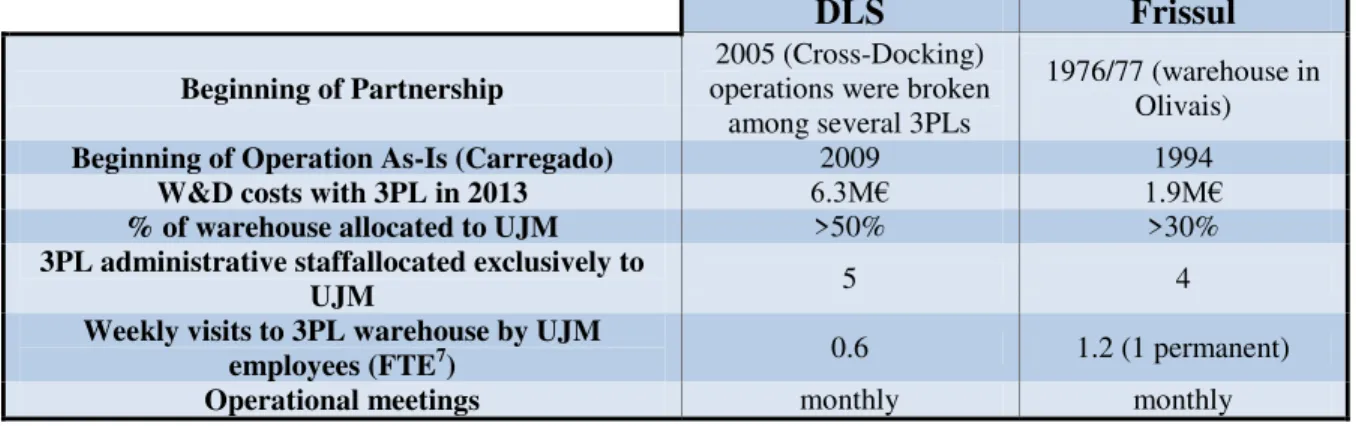
The table below presents the most relevant aspects of the partnership with the two 3PLs:
DLS Frissul
Beginning of Partnership
2005 (Cross-Docking) operations were broken
among several 3PLs
1976/77 (warehouse in Olivais)
Beginning of Operation As-Is (Carregado) 2009 1994
W&D costs with 3PL in 2013 6.3M€ 1.9M€
% of warehouse allocated to UJM >50% >30%
3PL administrative staffallocated exclusively to
UJM 5 4
Weekly visits to 3PL warehouse by UJM
employees (FTE7) 0.6 1.2 (1 permanent)
Operational meetings monthly monthly
Table 1: Information about partnerships with 3PLs
2
By reducing inventory levels (square root law of inventory) and lower complexity. To see the relation between operating costs, levels of service and number of distribution centers see (Shen, 2005)
3
Third-party logistics providers
4
Distribuição Luís Simões s.a
5
Transport from the factory to warehouse
6Transport to customers’ delivery point.
7
4
From UJM side, there is a department full dedicated to logistics and distribution, located in Sta. Iria site. There are 8 employees working exclusively in this department, beyond the director, who shares the functions of logistics with the customer service.
The importance of logistics and distribution is due to the fact that it allows both physical and information flow. It can, and it should, be integrated into a broader network that includes all the companies in the supply chain, from raw material suppliers to the final consumer. More and more, the competition takes a form of chain versus supply-chain, rather than just individual company competition.
Unilever is aware of this, and therefore it sees itself as an important player in a network. Their management is a strategic point, so, it includes in its mission the following: be "ONE Supply Chain Adding Value to Unilever by delivering World Class Service to our Customers and Superior Quality products to our Consumers in a Responsive, Cost Competitive and Sustainable way".
Figure 1:Unilever’s Supply Chain Scheme and Focus of the Project
However, in a survey8 done to their most important customers in Portugal, the company demonstrates having a mediocre performance in logistics and distribution, positioning 10/21 when compared to other FMCG companies operating in Portugal. In this sense, the importance of this project is vital to allow detail information about cost, which so far is known only in aggregate. This will allow detect the main inefficiencies, and the measures proposed increase operational efficiency by reducing costs and improving the level of service. In addition to immediate improvements, a correct analysis of integrated logistics and distribution in a supply chain can suggest a number of changes in contracts with clients, so guiding incentives to create value along the entire chain.
8
5
3.
Research Question Analysis and Methodology
The overarching Research Question is “How to optimize the cost to serve customers’ of UJM?”, and it is subdivided in three sub research questions.
First, we need to know what is the cost-to-serve each customer currently and, after, how to interpret that data in a comprehensive way. The analysis will be based on data for the entire year of 2013.
Figure 2: Problem Breakdown
6
improvements (To-Be situation) based on several components of the cost-of-each customer. This aligns the incentives between the company and customers and to create greater combined value, and prevent situations where costs are reduced only to the other party's own expense. In the second, are proposed improvements in secondary transport planning. Throughout this project, I was accompanied by warehouse & distribution controller and project developer, Miguel Carrilho, and I had access to quantitative data through the IT system SAP-BW. Figure 2 shows a diagram-tree with the research question and its ramifications in sub-research questions and steps. After each of these steps is presented the methodology that was used to address the problem.
4.
Literature review
In recent decades there has been a change of mindset in supply chain management. From an adverse strong-arm competition between firms within the same chain, that sometimes even led to destruction of value (win-lose paradigm), it moved to a management that values collaboration with supplies and customers in order to crease joint value (win-win). Competition thus became between supply chains rather within the chain. Management began to focus on the relationships with partners to increase the profitability of the chain. Nonetheless, this new vision does not eliminate the need for functional excellence. In fact, both are necessary and neither can be totally dominant over the other.
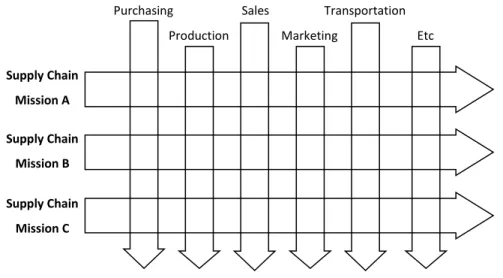
In (Braithwaite, 1998) the main points that support this new view of things are presented. Due to the vision of the supply chain as a whole, the operations should be seen as the processes instead of functional vision that insulates companies, and worse, departments. Therefore it is necessary to integrate the various functions within a company and also integrate them with their partners. “Working across functional boundaries to integrate business processes is the future. The days of working in functional silos are numbered and organizations must learn how to integrate themselves”. One way to control this in practice is by monitoring service levels, with different goals for different partners.
Costing Systems: from the functional view to the process view (Braithwaite, 1998)
7
allow separating costs by product category, or even by product; and also, should allow separating costs by customer group, or, in more detail, by customer.
Thus, the allocation of costs should most of all reflect the physical flow of products and assign each customer the costs of services provided to them.
Traditional costing systems only show the average costs for each activity or service. It is important to realize that there may be significant differences around the mean. Although the details of the costing system can be done at various levels and can add up categories of products or customers with similar requirements, thus making an analysis of costs for each of these channels, one two most notable achievements was the introduction of the ABC system in the early 90's (Cooper and Kaplan 1991) that allows companies to allocate costs in great detail, based on activities, and which revolutionized managerial accounting and management as a whole.
Figure 3: Missions that cut across functional boundaries (Christopher, 2012)
Regardless of greater or lesser level of detail used, this new way of analyzing costs allows managers to have a notion of trade-offs that exist, and the cost necessary to ensure a certain output or a certain level of service.
Cost-to-Serve (Braithwaite, 1998; Guerreiro 2008; Christopher, 2001)
According to this new way of analyzing management according to processes, we can see costs associated with each customer. Specifically, the cost to serve is defined as the additional cost of the processes and activities needed to provide the service to customer. As has been seen, by applying this method, the variables will no longer be aggregated as
Purchasing
Production Sales
Marketing
Transportation
Etc
Supply Chain
Mission A
Supply Chain
Mission B
Supply Chain
8
before and a more comprehensive understanding of the costs, and in many cases these depend on the behavior of the client, beyond on what the company assures.
In (Christopher, 2001) is explained some of the applicability of knowledge of the cost structure of a company, in particular the cost-to-serve. He states that the cost knowledge allows the company to gain greater bargaining power towards its partners in the supply chain. These relationships may increase efficiency through collaborative actions and better allocation of tasks along the chain as a whole.
It should also be noted that the traditional costing systems may be misleading to falsely indicate that certain companies are profiting from certain customers, when what actually happens is exactly the opposite. Two customers with the same gross profit may require completely different level of service, and therefore one of them to be profitable and the other not. The first ends up subsidizing the second. Usually there is a small number of customers that is the major contributor to profitability, a large group that has a low or virtually zero contribution, and finally, a group that creates prejudice and is subsidized by others. On the other hand, knowledge of the cost-to-serve allows rebalancing at organizational level. Regarding logistics and distribution will be a useful tool to determine which channels that should be favored, to determine the conditions of service customers, and which investments should be made in capacity and network design.
From the factory up to the client, there are several activities, with an associated cost. We can ask to what, or to whom, that cost should be allocated. Traditionally the costs have been allocated only to products. Various methods have been used, since the traditional costing system, coarser, up to activity-based costing system, much more detailed. This is used increasingly and it allows a much more accurate allocation of costs, being a powerful tool to help management. Nevertheless, as we have seen, customer service is increasingly a more fundamental part for companies. This is taken by many companies as a way to differentiate towards competition, when their products are increasingly commoditized. However, this option inevitably brings costs.
9
condition of goods) and then after-transaction (after-sales support, claims procedures, etc.). Therefore is strongly connected to the Logistics and Distribution
Looking at the distribution chain, the activities further upstream in the chain will inevitably be more product-specific. That is, the characteristics of it will be what will most determine the costs to perform these activities. While most downstream activities will be more customer-specific. For instance, in the case of outbound handling costs are directly related to the specifications and the type of customer order. Secondary transport costs also depend a lot on the specifications, location, frequency of delivery, to the customer service level agreements, etc. Thus, for a study of optimization of the cost-to-serve will focus mostly on what concerns outbound handling and secondary transport.
Sourcing Unit Customer
Product Specific Customer Specific
Figure 4: Allocation of costs from the factory to the customer
However, though this might be a guideline, it is not linear and we must take into account that there are some exceptions. For instance, there may be cases where a large customer can be served with product shipped directly from the factory, and in this case, all primary transport and handling activities are avoided (since the passage through the distribution center is avoided). In another hand, the design of the product, the size of the cases, etc, will also affect the costs of secondary transport for instance.
Third Party Logistics Providers
UJM's decision to outsource its logistics operations is aligned with the market trend of FMCG companies. Outsourcing is not limited to physical distribution, but now extends to the management of orders, execution planning, inventory management, information systems, etc. Basically, in logistics and distribution in all functions can be outsourced. As explained in (Braithwait, 1998), the main argument for outsourcing is the fact that the customer is externalizing aspects of the operation that are not part of its core competencies, and in which would not have a competitive advantage.
In many cases, the 3PL, apart from experience, it also has other clients, allowing increase in economies of scale, and in some cases also combat seasonality of products from a single
Primary Transport Inbound Handling
Distribution Center
Outbound Handling
10
customer. Connected to the company's financial strategy, outsourcing of such services also leads to a reduction of operational risk. There usually a transition from fixed costs (internalized operation) to variable costs, because the payment to the logistic operating are based on tariffs by activity realized, and there is no need for investment, nor fixed costs/payments for client. This is precisely what happens in the case of UJM. However, there are also disadvantages by outsourcing such services, as indicated by the author. By externalizing, the client may lose control of the operation, and not to guarantee adequate levels of service to its customers to help you stand out from their competitors and cannot provide adequate levels of service to its customers to enable it to stand out from their competitors.
In response to this (Rushton, 2010) presents an analysis of 3PLs under a continuum that begins at a point where all operations are internalized to another where they are all outsourced. One must understand why the UJM has the current level of outsourcing, which is critically important at a strategic level decision. According to the author, some of the cons of outsourcing can be combated if the company has a partnership with high degree of trust and cooperation of both sides. This is the only way to have a (adequate) high level of control over the operation. The degree of trust in the relationship will determine the level of flexibility and will allow the 3PL operating in better shape, increasing levels of customer service to clients. The author also presents another complementary method of analysis of 3PLs, segmenting between completely dedicated operations (an operation completely separate for a specific customer) and multi-user (many fragmented customers). While dedicated operation allows complete control of the client, the multiuser operations allows use of economies of scale and reduce possible risks of seasonality to serve other customers, with a corresponding loss in service levels and control.
Applying this framework to UJM, I notice that it is at an intermediate level. UJM is the largest customer in operations in Carregado, although the operations are not dedicated. The control of the distribution operation will also depend on the type of transport chosen (freight or drop, with freight being exclusive and drop being shared).
11
5.
Allocation Costs Model
The model that I intend to implement goes in line with what was seen in the literature. While the company had only aggregate information, I try to allocate the costs to the physical flow going to each client. I begin with an analysis of the cost to serve each customer, and later we will use this information to find opportunities of improvement.
5.1
Cost to Serve Customers
5.1.1
Understanding operations
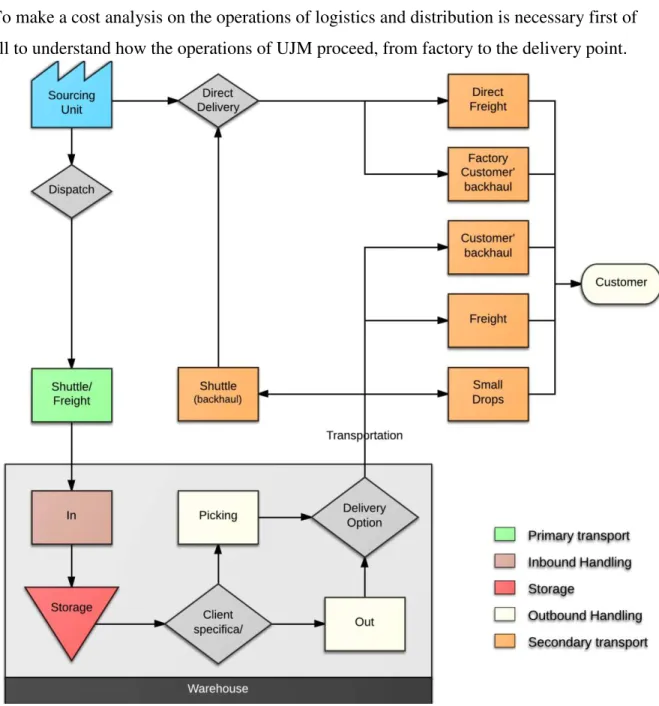
To make a cost analysis on the operations of logistics and distribution is necessary first of all to understand how the operations of UJM proceed, from factory to the delivery point.
12
The system flowchart that I developed gives a description of decisions, physical flows and macro-processes involved.
The products leave the factories and are shipped to the warehouses of DLS and Frissul, both in Carregado. In case of Sta. Iria and Sacavém factories there are freights to go back and forth constantly (Shuttle). For the remaining Sourcing Units and CoPackers the product is shipped by freight also, but through a process of replenishment managed by the company UltraLogistik9
Upon arrival at the warehouse, there is a sequence of activities that we will describe:
Handling: Are the activities related to the handling of the product, were divided into two subcategories, Inbound and Outbound Handling, for input and output of the product from the warehouse respectively.
In (Inbound Handling) – Corresponds to the process of entry of products in warehouse. Pallets are downloaded from incoming trucks and are stored in the warehouse.
Picking / Out (Outbound Handling)– This corresponds to activities where products are withdrawn from warehouse for shipment. Out is for a whole pallet while picking is for product cases that are taken from stored pallets and placed in a new one according to customers' order. After that, these pallets are loaded onto the truck.
Transport:
Small Drops (SD) – In this delivery method, the load is delivered together with the other customers' loads, being the planning done by the 3PL. This is the only mode of delivery from Frissul, it is also carried out by DLS, being suitable for small orders. Is paid according gross weight and region. For deliveries below 100kg the tariff is fixed. Above that they assigned a value per ton, increasingly lower when greater the weight.
Freight– Corresponds to a truck that is rented for a day by UJM to the 3PL. Currently only DLS provides this option. The price depends on the district and of the truck (20, 23 or 33 pallets, with a limit on gross weight of 10, 16 and 24 ton respectively). There is a maximum of three discharges with an increased price for each one.
Customers’ Backhaul– Some customers agree with UJM to pick up their order at the warehouse. It is given a discount on the sales price to customers that choose this
9
13
option. The discount depends on net weight of products and the location of customer delivery point (by echelons of distance).
Factory Customers’ Backhaul –The same as customers' backhaul, but in this case the customer pick up the products directly from the factory.
Direct Freight – Large orders (usually from customers like Sonae or Pingo Doce) may eventually be sent directly from Sta. Iria, Sacavém or Pombal (Sumol-Compal CoPacker) with products that are manufactured there.
Furthermore, in the case of Sta. Iria and Sacavém, as the Shuttle usually returns empty sometimes is used its backhaul capacity to bring another products that the customers demand and that are not produced there and fill up the remaining space in the freight.
Delivery note –Each delivery is associated with a delivery note which is given to the truck driver. It serves for administrative purposes. There is also a separation by product division and performed transportation deliveries from Sta. Iria or Sacavém doesn't pay delivery guides since they are made in-house.
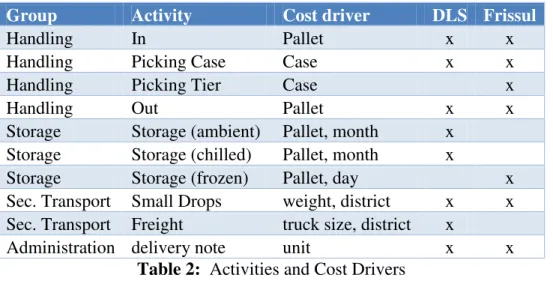
The different activities are then summarized in the table below, and can be grouped into four broad categories (Handling, Storage, Secondary Transport and Administration). Each activity has cost-drivers associated to it, important to calculate costs. It is also indicated at right if they are practiced by DLS and/or Frissul.
Group Activity Cost driver DLS Frissul
Handling In Pallet x x
Handling Picking Case Case x x
Handling Picking Tier Case x
Handling Out Pallet x x
Storage Storage (ambient) Pallet, month x Storage Storage (chilled) Pallet, month x
Storage Storage (frozen) Pallet, day x
Sec. Transport Small Drops weight, district x x Sec. Transport Freight truck size, district x
Administration delivery note unit x x
Table 2: Activities and Cost Drivers
5.1.2 Cost to serve model
14
Only calculations related to operations of DLS will be presented here10, since the operations of Frissul are separated and the analysis is similar11.
It was provided the access to the program BW that access SAP database to extract several data. The analysis was performed for the year of 2013.
The primary transport costs were not included as these are directly linked to the cost structure of the product (transfer price). However, in the case of direct delivery from factory and factory customers’ backhaul the discount for the primary transport was calculated and incorporated in (net) secondary transport costs. The used driver was the number of pallets, since each primary transport truck carrying 33 pallets, and each trip has fixed price.
For the allocation of IN tariffs, it was needed to see the amount of cases of each product that each customer ordered during the year (excluded those that leave directly from the factory to the customer, and not passed through the warehouse). Furthermore, it was necessary to know how many cases will fit on a pallet by type of product (and also fix data when cases are in half-pallets). After crossing this information it was possible to know how many pallets have entered in the warehouse, allocated by customer (usually this corresponds to a fractional value). This value will always be lower than the exiting pallets, because some of them exiting not complete and the reorganization though picking is not optimal. Thus it was possible to allocate IN tariff allocated customer.
To compute storage tariffs further information was needed. First of all, to compute average coverage by product I had inventory levels from 1Jan 2013 and differences of stock by each month12.With that, it was possible to compute stock levels at the end of each month, and then I calculate the average stock level of each product by the year of 2013, in cases. Having the information about the number of cases sold during the same year was possible to calculate the coverage by product. After, by crossing data with the temperatures of each product, it was possible to know if a product was stored in ambient or chilled facilities and so ascertain which of the two tariffs should be applied.
10
Main data are in the file CostsDLS.xlsx
11
In fact, the analysis of Frissul is simpler; there is only one mode of transportation, by Small Drops. Results for Frissul are in appendix.
12
15
By multiplying the storage tariff per month per pallet by the coverage by product I got the (average) storage tariff paid per pallet for each type of product.
Finally, knowing how many fractions of each pallet by product was delivered for each customer the procedure is similar13 to the calculation of IN, except that in this case the tariff will vary by product, and thus it was necessary to cross the information again.
In turn, the cost of outbound handling - Picking and Out - was calculated based on the number of cases (not in a full pallet) and full pallets, respectively that left the distribution center. Transport costs were already introduced directly into the system, it is necessary to consider all points of departure, i.e., beyond the DLS were considering the outputs from Sta Iria, Sacavém and Pombal factories directly to customers. The only exception was
Customers’ backhaul and factory customers’ backhaul, were the cost is not in fact a tariff paid to the 3PL but a rebate made to the customer. The cost driver for this type of transportation is the net weight, with several ranges depending on the distance from DLS distribution center to the customers' delivery point14.
Finally, the calculation of administrative costs, ie those that correspond to the delivery notes, was simply calculated based on the number of deliveries. However, those made from Sta Iria or Sacavém were not counted, as they are made by the internal staff of UJM, and there is no paidd tariff to DLS.
In the next section I will present the data in a graphical way for interpretation.
13
This last step for allocation of storage tariffs is even done in InDLS.xlsx file because it ends up using the data necessary to calculate the IN
14
It is important to note that the item in the system associated with this type of transport (customers' backhaul) was wrongly used to place also resending of products whose delivery cannot be made the day before due to DLS responsibility. These cases will thus skew the results by affecting the net weight in that item. To work around this, I listed (the few) customers that used this mode of transportation in 2013, being only ITMP Alimentar (Intermarché) the only one with a significant volume. Thus, I only consider customers' backhaul for these customers and force the cost of this type of transportation to be zero in other ones, even if net weight is positive in this item.
16
5.1.3 Graphical analysis
To characterize customers, I present data using a point for each delivery point (ship-to party) under a graph of relative costs versus volume. This, in addition to considering the points that are important to the operation also presents the data in greater detail what would happen if I aggregate data per customer à priori. Costs are presented as a percentage of Gross Sales Value (GSV), which does not consider customer specific discounts. While for the volume a
number of variables can be used, as the revenue (net sales values), gross weight, pallets or cases from each delivery point. I begin by presenting data on the total cost of tariffs assigned to each ship-to party, and then this cost is shown for each of the cost components. It is found that costs (as percentage of GSV) tends to decrease monotonically with the increasing of volume according to a power law . The rationale behind this law is very simple: a little percentage increase in implies a small decrease in .15
To be more accurate and understand this relation, I will explore costs in more detail, since different types of costs may have different behavior. dispersed. The (relative) costs will be primarily related to the product mix that customers purchase, but there are no economies of scale (relative to customers’ size)16.
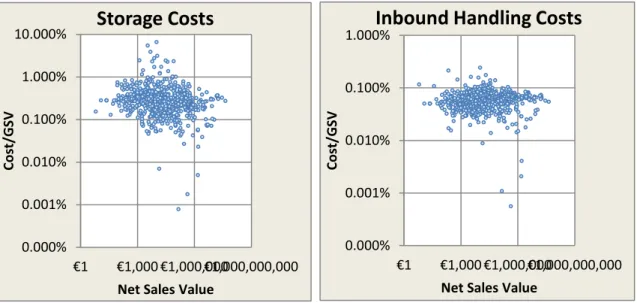
Regarding inbound handling and storage costs, I notice that is no such correspondence between volume of customers and costs, and these are relatively disperse. The points further low correspond to delivery points who order products produced in Portugal, receiving direct loads from those factories and thus avoiding the passage by DLS (and thus tariffs) which is an important factor for savings.
15
If ( ) ', with a little then (( ) ) ( ) ( ) . So, if increases x in 1%, y decreases %.
16
However see Limitations, Recommendations and Next steps regarding this.
Graphic 1: total costs by delivery point
y = 0.1798x-0.213
R² = 0.4524
0.01% 0.10% 1.00% 10.00% 100.00%
€1 €1,000 €1,000,000 €1,000,000,000
Co
st/
GSV
Net Sales Value
17 0.00% 20.00% 40.00% 60.00% 80.00% 100.00%
1 € 1,000 € 1,000,000 €
Net Sales Value
% Picking Cases
y = 0.0059x-0.115
R² = 0.2189
0.00% 0.00% 0.01% 0.01% 0.02% 0.05% 0.10% 0.20% 0.39% 0.78%
1 € 1,000 € 1,000,000 €
Co
st/
GSV
Net Sales Value
Outbound Handling Costs
Graphic 5: % of cases in picking
Graphic 4: Outbound Handling Costs
Therefore, excluding these points (which will actually depend on customers’ profile) that should be analyzed separately, the optimization of such costs primarily is up to planning and product design.
Regarding outbound handling costs it already appears the decrease with volume as observed with total costs, although the correlation is not narrow, which is confirmed by the coefficient of R2 = 0.22.
The power line may be used as an internal benchmark for comparing customers and thus the distance to it serve as an indicator to classify clients regarding handling.
0.000% 0.001% 0.010% 0.100% 1.000% 10.000%
€1 €1,000 €1,000,000 €1,000,000,000
Co
st/
GSV
Net Sales Value
Storage Costs
0.000% 0.001% 0.010% 0.100% 1.000%€1 €1,000 €1,000,000 €1,000,000,000
Co
st/
GSV
Net Sales Value
Inbound Handling Costs
18
y = 0.1703x-0.49 R² = 0.5743 0.000%
0.001% 0.010% 0.100% 1.000% 10.000%
1 € 1,000 € 1,000,000 €
Co
st/
GSV
Net Sales Value
Delivery Note Costs
Another important indicator, as we shall see later, is the classification of customers by number of cases in picking as a percentage of the total number of cases delivered.
But is in secondary transport where there is the greater correlation between volume and cost, with a coefficient of determination of 0.38. I notice that there is a transition band from small drops to other transportation types (mainly freight). This may be an important indicator for segmenting customers and identify opportunities to improving delivery
planning. Important customers (in volume) with a high percentage of weight transported by small drops may be an indicator that it may be placing orders too often, the last time, or on dates that do not allow the sharing of freight with other customers. Thus, this indicator can be good to find bad instances of which might otherwise might go unnoticed.
Finally, the costs relating to the administrative component also present a strong correlation with volume. This is
natural since the greater the volume the greater number of deliveries. As before the power line serves as an internal reference for comparing customers. Thus, customers above the
y = 0.123x-0.222
R² = 0.3812
0.01% 0.10% 1.00% 10.00% 100.00%
€1 €1,000 €1,000,000
Co
st/
GSV
Net Sales Value
Sec. Transp. Costs
0% 20% 40% 60% 80% 100%
1 1,000 1,000,000
Net Sales Value
% SD Weight
Graphic 6: Secondary Transport Costs Graphic 7: % of weight in Small Drops
19
Graphic 9: Net Secondary Transport Costs by Region
line have a worse behavior than the average of those of similar volume. The importance of this component does not get as much for its cost, as administrative costs are low compared with other cost components. But as it is proportional to the number of deliveries (except for Sta Iria and Sacavém) it will have a strong influence on transport costs. For customers with similar volumes, the higher the number of deliveries, the higher costs of transport in general.
5.1.4 Geographical Analysis
After the allocation of costs to each delivery point can agglutinate costs in terms of geography. Logically, the values that should vary more will be those related to secondary transport. Nevertheless, it appears that the main driver for change in these costs is the volume of sales rather than the distance to the district (although it also has some influence)17. Applying a power law as was done previously, I found that the points above the line correspond to the districts that are more distant from the distributions centers (in Carregado) and vice-versa. Given that secondary transport performed by DLS can be done in several ways, with different cost drivers (such as weight or number of pallets, beyond geography) it seems to me that it is more appropriate to use these average values to fix the cost-to-serve customers due to its geographical location, in order to characterize them.
17
The table with the most relevant is in costsDLS.xlsx
A ve iro A zam buja B e ja B raga B ragança C aste lo B ranco C oi m bra Év ora Faro V is e u Le iri
a Lisboa
P ort al eg re P orto Sant aré m Se túbal V iana do C aste lo V ila R e al V is e u
y = 0.347x-0.24
R² = 0.6772
0.20% 0.40% 0.80% 1.60% 3.20%
10 100 1,000 10,000 100,000
Co
st/
GSV
Gross Weight (ton)
20
5.1.5
Customers’ Characterization
As discussed above, there are two important components of the cost-to-serve that will vary significantly with the type of customer, their characteristics and behavior. One is the outbound handling, as customers decide directly whether they want full pallet or picking. As explained in the graphical analysis, an important indicator that would characterize the customers would be the number of boxes in picking, as intuition suggests. I now present graphic 10 with
outbound handling costs as a function of the indicator. This indicator, although not perfect, represents a simple way to characterize clients, and does not expose privileged information (as costs), so it could be a good KPI to share with clients.
The other most important component is the secondary transport. However, to characterize the customers in terms of their behavior and potential for optimization, we find that we can not change certain components such as the location of the delivery point, which is a factor that will greatly affect the cost of transport, since rates vary greatly from region to region. As we see, contrary to what happened in the outbound handling, external factors will also influence these costs, and will not (only) depend on the customer behavior. Therefore I propose a model that corrects this regional factor. While I initially noticed that transportation cost follows a power law , I now conjecture that the decay remains the same, regardless of the region (and therefore will be
), but the parameter will vary y = 0.0031x + 0.0007
R² = 0.4531
0.00% 0.20% 0.40% 0.60% 0.80% 1.00% 1.20%
0% 50% 100%
Co
st/
GSV
% Picking Cases
Outbound Handling Costs
y = 599.58x-0.263
R² = 0.6435
1 € 10 € 100 € 1,000 € 10,000 €
1 100 10,000 1,000,000
Co
st/
to
n
Gross Weight
Adjusted Sec. Transp Costs:
Cost/ton
Graphic 10: Outbound Handling Costs in function % of picking cases
Graphic 11:
21
accross regions. Specifically, I put , where is the cost of secondary transport, the gross weight shipped, is the regional component and is a specific component of the customer according to their behavior (and thus works as an indicator of performance for the customer). Forcing ∑ podemos encontrar 18. Adjusting the values
it is possible to make an interregional comparison (graphic 11) 19
.
5.2
Contract Management
Good practices in contract management are essential in the supply chain to align incentives between the partners in the network, and thus create value. According to (Christopher, 2001) knowledge of costs is essential both in appearance (together create value) how to acquire negotiating power in these (claim a fair share of that value creation). In addition to the internal benchmarking we can do by comparing the company's customers as we did in the previous section, it is important to know if the company can change their order behavior to reduce costs. A negotiation focus on these components, rather than just positional bargaining, may furthermore increase outcomes (principled negotiation20). Negotiations should focus on interests not positions; invent options for mutual gain, and be based on objective criteria.
Currently UJM policy is assign discounts to customers (on the GSV) based on two indicators: the percentage of cases in picking and the number of pallets shipped on each delivery day, divided by the number of trucks (ie, if the value exceeds the 33 it takes more than a truck). There is a table of discounts to customers based on these factors.
I suggest that other factors must also be considered, including the frequency of delivery discussed below. Other variable volume than the GSV should also be used to assign discounts, as the weight or number of cases, since is it that reveals the true costs of operations.
18
By the sum of all components for each region ( ) ( )
∑ ( ( ) ( ) ) and so we get
19
Another method of doing this correction would be to correct the values based on regional analysis taken earlier, as I had been initially thought
20
22
5.2.1
Frequency of deliveries
One of the components that can be used in the renegotiation of contracts is an alteration in the frequency of deliveries to a customer. For this, we see that the frequency of deliveries indirectly will affect the average transported gross weight for each day of delivery, and this may be a factor that will induce a variation in the costs of secondary transport. As this measure is only meaningful for customers who place their orders with some frequency, the
data was filtered for customers that do more than 25 orders (in different days) per year (there is at least, more or less, a biweekly request), The results are shown in the chart x, and the parameter indicates that a reduction in the frequency of deliveries by 1% leads to a reduction in the costs of secondary transport by 0.443% .
5.2.2
Outbound Handling
As already seen outbound handling costs will depend directly on the type of order the customer makes. Looking at the current scenario, where a rebate is made on the basis of GSV, I suggest that the rebate be based on the volume variable that reflects the operation, the number of cases. So the company does not distort the benefits given to different customers that order product mixes quite distinct, with different mean values of GSV per case. To realize this, just compare the graphics 10 and 13 to realize that the latter has a much more reliable representation of the
costs. That is, percentage of picking cases represents better outbound handling costs per case rather than per GSV.
In graphic 13 is also possible to note that the average cost per case in OUT is 1cent, and therefore savings will be 7cent per case compared to picking.
y = 0.0698x + 0.0104 R² = 0.9921 0.00 €
0.02 € 0.04 € 0.06 € 0.08 € 0.10 €
0% 50% 100%
Co
st/
Cases
% Picking Cases
Outbound Handling Costs
per Case
Graphic 14: Outbound Handling Costs per case as function of % ofcases in Picking
y = 1009.8x-0.443
R² = 0.7922
1.0 € 10.0 € 100.0 € 1,000.0 €
1 10 100 1000 10000 100000
C
o
st/
to
n
kg per day
Sec. Transportat. Costs
23
5.3
Costs Optimization in
Distribution
In addition to the alignment of incentives there are other ways reduce costs and create value, thought measures to increase operational efficiency
The joint deliveries of Foods and HPC were recently introduced, and in 2013 were still in the testing phase, in small quantities for AUCHAN, Pingo Doce and DIA. By allowing a more efficient fleet management, the costs will be lower because in some occasions will be possible to use void in the truck that otherwise would not be used.
To determine the impact of joint deliveries I use the values for the delivery points which
ran with this mode in 2013 and see if the parameter δ_i introduced in 5.1.5 is influenced by
the percentage of gross weight transported joint deliveries. Although the coefficient of determination is low, I know from the operation that joint-deliveries will reduce transport costs. The results presents a reduction in costs of 3.35% for each 1% increase of in volume joint deliveries, which will be valid only for small values, but makes us anticipate a very positive perspective on cost reduction.
6.
Limitations, Recommendations and Next steps
Along the implementation of this project I had several ideas and acquired knowledge and sensibility that enable me to make several recommendations and suggestions of what could be done in the future. The cost-to-serve method can be applied with varying degrees of sophistication, and in the case of this project the focus was limited to the allocation of tariffs paid to 3PL for direct logistics to customers.
Several improvements can then be suggested. First, the method can be extended into the area of logistics and distribution, including costs, as costs associated with holding inventory - as net working capital and depreciation of products. Also costs associated with reverse logistics - returns and refunds. There was an attempt to supplement some of these, but due to limitations in terms of time, but in particular the impossibility of access to certain information, such as the cost of products.
y = -3.3458x + 0.3283 R² = 0.0353
-0.60 -0.40 -0.20 0.00 0.20 0.40 0.60 0.80
0% 2% 4% 6% 8%
δ
_i
% of joint-deliveries (gross weight)
Impact of joint deliveries on
sec. transport cost indicator δ_i
24
Still in logistics and distribution, there were also several ideas that arose during the project due to limitations of time. However, they could be interesting to analyze, both from a practical as from a theoretical point of view, since I had not found literature that addressed that issues deeply enough.
Costs associated with storage could be separated into two components: safety stocks, and the remaining (which, at first, will be half of the EOQ21). Thus, this second part should be allocated to the product' cost structure. But, more interesting, the safety stock would be (partially) allocated to customers as the unpredictability of their orders, their lead-times and agreed service levels. More specifically, the difference in costs of maintaining safety stock, to serve or not the customer should be the cost associated to it, according to the principle of avoidable costs. For that, it would also need the correlations between (unforeseen) variations in orders from customers, because some factors may be external (and therefore systematic for all customers), while other depend directly on customer' behavior. Under the danger of be affected by noise, customers could be segmented into groups according to their size, lead times and unpredictability in orders.
We could associate to some variables of service an opportunity cost. For example, relate the delivery failures with losses in sales (for instance, seeing the correlation between the volume of the failed deliveries with the volume of the next order), which may vary by customer segment, with different lead-times and inbound buffers with distinct room.
In these two cases would be, for example, possible to quantify the impacts that would have a project of collaboration, namely collaborative networks in terms of planning processes, with a big client.
The extension of the project to other departments, including marketing and sales and finance (payment terms) would achieve total cost-to-serve for each customer (and not just focused on logistics and distribution as in this project) and hence know the customer-profitability. This would, first of all, give to the company a huge bargaining power towards their customers, namely the big ones. In another hand, this information could be vital to define the company's strategy in the coming years. Both to determine levels of marketing
21
25
budgets for each customer segment and define service levels targets. To sum up, customer profitability will enable the company to drives resource allocation in a correct way.
Finally, this project could be the start of a larger work in which the company should invest and will surely allow it to have the tools to succeed at long term in the market.
7.
Bibliography
Published Articles
Bernon, M. and Rossi, S. 2011. “Retail reverse logistics: a call and grounding framework for research”,
International Journal of Physical Distribution & Logistics Management, 41(1): 484-510
Braithwaite, A. and Samakh, E. 1998. “The Cost-to-Serve Method”, International Journal of Logistics Management, 9(1): 69-84.
Cooper, R., and Kaplan, R. May-June 1991. “Profit priorities from activity-based costing”, Harvard Business Review
Epstein, M. and Jones, J. “Customer profitability analysis”, Good Practice Guideline Nº37, The Institute of Chartered Accountants, Faculty of Finance and Management.
Freeman, B., Haasz, S. Lizzola, S. and Seiersen, N. 2000. “Managing your Cost-to-Serve”, KPMG Business, Transformation Services
Guerreiro, R., Bio, S. and Merschmann, E. 2008. “Cost-to-serve measurement and customer profitability
analysis”, The International Journal of Logistics Management, 19(3): 389-407.
Kone, E. and Karwan, M. 2011. “Combining a new data classification technique and regression analysis to predict Cost-To-Serve new customers”, Computers & Industrial Engineering, 61(1): 184-197.
Mason, R., Lalwani, C. and Boughton, R. 2007 “Combining vertical and horizontal collaboration for
transport optimization”, Supply Chain Management: An International Journal, 12(3): 187-199.
Mulhern, J. winter 1999 “Customer Profitability Analysis: Measurement, concentration and research
Directions”, Journal of Interactive Marketing, 13(1)
Norek, C. and Pohlen, T. 2001. “Cost Knowledge: A Foundation for Improving Supply Chain
Relationships”, International Journal of Logistics Management, 12(1): 37-51.
Shen, Z. and Daskin, M. 2005 “Trade-offs Between Customer Service and Cost in Integrated Supply Chain
Design”, Integrated Supply Chain Design Manufacturing & Service Operations Management, 7(3):
188-207
Books
Christopher, M. 2011. Logistics & Supply Chain Management, Edinburg Gate: Pearson Education
Drury, C. 2012. Management and Cost Accounting, London: Cengage Learning
Fisher, R. and Ury, W. 2012. Getting to yes, negotiation an agreement without diving in, London: Random House Business Books