Prevalence of excess weight and associated factors in adolescents
of private schools of an Amazonic urban area, Brazil
Prevalência de excesso de peso e fatores associados em adolescentes de escolas privadas de região urbana na Amazônia
Prevalencia de exceso de peso y factores asociados en adolescentes de escuelas privadas de región urbana en Amazonia
Laércio M. Silva Júnior1, Angelita Pereira dos Santos2, Orivaldo Florencio de Souza3, Edson dos Santos Farias4
Instituição: Universidade Federal do Acre (Ufac), Rio Branco, AC, Brasil 1Graduando em Medicina pela Ufac, Rio Branco, AC, Brasil
2Especialista em Treinamento Desportivo pela Unidade de Ensino Superior Vale do Iguaçu (Uniguaçu); Docente do Centro de Ciências da Saúde e Desporto da Ufac, Rio Branco, AC, Brasil
3Doutor em Saúde Pública pela Universidade de São Paulo (USP); Docente do Centro de Ciências da Saúde e Desporto da Ufac, Rio Branco, AC, Brasil 4Doutor em Saúde da Criança e Adolescente pela Unicamp; Docente do Centro de Ciências da Saúde e Desporto da Ufac; Rio Branco, AC, Brasil
Endereço para correspondência: Edson dos Santos Farias
Avenida Sete de Setembro, 1.516 – casa 25 – Conjunto Nova Esperança CEP 69900-000 – Rio Branco/AC
E-mail: [email protected]
Conflito de interesse: nada a declarar
Recebido em: 27/6/2011 Aprovado em: 31/10/2011
ABSTRACT
Objective: To assess the prevalence and factors associated with excess weight among high school students.
Methods: Cross-sectional study with 741 adolescents from private schools in Rio Branco, Acre, Northern Brazil. The weight and height were prospectively measured in order to calculate the body mass index. Overweight was defined according to World Health Organization refer-ences in 2007. The following variables were collected: gender, age, socioeconomic status, parental education, number of household members and siblings, physical activity, time watching TV and computer time. Factors associated with excess weight were identified by multi-ple Poisson regression using the backward elimination procedure for variable selection.
Results: The prevalence of overweight was 29.5%. Males showed righer prevalence (33.2%) compared with females (26.4%). As for age, the prevalence was higher at 14 years (40%) in both genders. In the multivariate analysis, adjusted for age and gender, more than two hours in the computer per day and a sedentary lifestyle were associated with excess weight.
Conclusions: Excess weight is a serious public health problem in high school students from private institutions of an urban area of the Amazonia Region. The promotion of
physical activity and the reduction of time in the computer should be considered as strategies to improve the health of adolescents.
Key-words: overweight; obesity; social class; motor activity; adolescent behavior.
RESUMO
Objetivo: Analisar a prevalência e fatores associados ao excesso de peso corporal em adolescentes do ensino médio.
Métodos: Estudo transversal com 741 adolescentes de escolas privadas de Rio Branco, Acre. O peso e a altura foram aferidos de forma prospectiva e o índice de massa corporal calculado, definindo-se excesso de peso de acordo com a curva de referência da Organização Mundial da Saúde de 2007. Coletaram-se infor-mações quanto a sexo, idade, classe socioeconômica, escolaridade dos pais, número de moradores no domicílio, número de irmãos, atividade física, tempo gasto assistindo à televisão e tempo de uso de computador. Os fatores associados ao excesso de peso foram identificados mediante regressão múltipla de Poisson e utilizando-se o procedimento de eliminação retrógrada para a seleção das variáveis do modelo múltiplo.
idade, a prevalência foi maior aos 14 anos (40%) em ambos os sexos. Na análise múltipla, ajustada pela idade e sexo, o uso de computador acima de duas horas diárias e o sedentarismo associaram-se ao excesso de peso.
Conclusões: O excesso de peso apresenta-se como um sé-rio problema de saúde pública em escolares do ensino médio de instituições particulares de Rio Branco, Acre. Sugere-se a promoção da atividade física e a redução no tempo de uso de computador para o declínio do excesso de peso.
Palavras-chave: sobrepeso; obesidade; classe social; ati-vidade motora; comportamento do adolescente.
RESUMEN
Objetivo: Analizar la prevalencia y los factores asociados al exceso de peso corporal en adolescentes de la secundaria.
Métodos: Estudio transversal con 741 adolescentes de escuelas privadas de Rio Branco, Acre (Brasil). El peso y la altura fueron medidos de modo prospectivo y el índice de masa corporal calculado, definiéndose exceso de peso conforme a la curva de referencia de la Organización Mundial de la Salud de 2007. Se recogieron informaciones respecto a sexo, edad, clase socioeconó-mica, escolaridad de los padres, número de moradores en el domicilio, número de hermanos, actividad física, tiempo gasto asistiendo a la televisión y tiempo de uso de computadora. Los factores asociados al exceso de peso fueron identificados mediante regresión múltiple de Poisson y el uso de eliminación retrógrada para la selección de las variables del modelo múltiple.
Resultados: La prevalencia de exceso de peso fue de 29,5%. El sexo masculino mostró mayor prevalencia (33,2%) en comparación al femenino (26,4%). Respecto a la edad, la prevalencia fue superior a los 14 años (40%) en ambos sexos. En el análisis múltiple, ajustado por edad y sexo, el uso de computadora por más que dos horas diarias y el sedentarismo se asociaron al exceso de peso.
Conclusiones: El exceso de peso se presenta como un serio problema de Salud Pública en escolares de la secundaria de instituciones privadas de Rio Branco, Acre (Brasil). Se sugiere la promoción de la actividad física y la reducción en el tiempo de uso de computadora para la disminución del exceso de peso.
Palabras clave: sobrepeso; obesidad; clase social; activi-dad motora; comportamiento del adolescente.
Introduction
Excess weight (overweight and obesity) is now con-sidered a public health problem in many countries, both
developed and in development. Popkin(1) has described
the characteristics of the dietary habits and physical ac-tivity habits of today’s urbanized society resulting from nutritional transition and shown how they contribute to increasing levels of obesity in the worldwide population. Brazilian studies have shown that prevalence is elevated here too, with a trend for excess body weight to increase
among adolescents(2-4). The most recent national surveys
of excess weight in adolescents indicate that prevalence has almost tripled in 30 years(5).
A hypothesis proposed by Barker(6) postulates that
health status at the start of life may program health in later stages. In the same vein, international studies have found that children diagnosed as obese are at greater risk
of obesity during adolescence and adulthood(7,8). Obesity
is associated with dyslipidemias, type 2 Diabetes mel-litus, coronary artery diseases, respiratory problems, degenerative arthropathy, arterial hypertension and
increased risk of certain types of cancer(9,10). This is why
prevention of excess weight in childhood and adolescence is necessary.
Schools can be considered environments that have an important impact on behavior and lifestyle choices, since children spend so much of their time there. Therefore, in addition to socio-familial characteristics, dietary and physi-cal activity habits acquired during school years can have an
inluence on excess weight(11). The objectives of this study
were to determine the prevalence of excess weight and factors associated with it in adolescents at private secondary schools in Rio Branco, Acre, Brazil, in 2009.
Methods
This was a cross-sectional, school-based, descrip-tive study conducted during the second half of 2009 with adolescent schoolchildren from private secondary schools in the city of Rio Branco, Acre state, which is in the Western Brazilian Amazon, in the country’s North administrative region.
Sample size was calculated for a 22% estimated prevalence
of excess weight (overweight + obesity)(12), sampling error
of three percentage points, 95% conidence level and a total population of 1,747 students. On this basis, the minimum sample size was estimated at 516 students. This igure was then increased by 40% to cover refusals and losses and so the initial study sample was 741 students.
A probabilistic sampling process was employed, utiliz-ing a three-stage stratiied proportional samplutiliz-ing frame, Neyman proportional allocation, as follows: a) Randomized selection of schools; b) Randomized selection of grades, by class; c) Randomized selection of schoolchildren(13,14). Each
of the 11 private schools in the city had an equal likelihood of being selected using this sampling frame and in the event 5 were selected.
Data collection was conducted after permission had been granted by the schools’ administrations, the students’ parents and the students themselves, all of whom signed free and informed consent forms. The study was approved by the Human Research Ethics Committee at the Universidade Federal do Acre (UFAC).
Questionnaires on socioeconomic data and physical activity were administered in the classroom by teach-ers and students of Medicine and Physical Education from UFAC. At least one teacher from the school be-ing studied was present in each classroom durbe-ing data collection. The questionnaires were made up of closed questions.
Independent variables analyzed were sex, age (in years, to two decimal places), parents’ educational level, number of residents in household, number of siblings,
time spent watching television (≤2 hours, 2–4 hours or
≥4 hours), time spent using a computer (≤2 hours, 2–4
hours and ≥4 hours), socioeconomic level(15), categorized
as high, medium or low. Physical activity levels were estimated using the short form of the International
Physical Activity Questionnaire(16). Physical activity
levels were classified as inactive (mild activity involv-ing little physical effort) or active (moderate activity requiring prolonged physical effort and activity requir-ing intense physical effort).
Subjects were weighed using a portable electronic digital balance, sensitive to 50g and with a maximum capacity of 150kg. Height was measured using a 2m portable stadiometer with 0.1cm divisions. Weight and height were measured according to procedures described
by Lohman, Roche and Martorell(17). WHO AnthroPlus
software was used to calculate z scores for body mass in-dex against age (BMI/age) using the new World Health
Organization references(18) (WHO, 2007). The 2007
WHO cutoff points were used to classify subjects into healthy weight (z score <+1) or excess weight (z score
≥+1) groups.
Statistical analysis of data was conducted using the svy
module in StataTM 9.2. Prevalence rates and their
respec-tive 95% conidence intervals were calculated. Factors associated with excess weight were analyzed in two stages. Initially, independent variables that had associations with
excess weight of p<0.20 (chi-square test for
homogene-ity) were selected as candidates for a multivariate model. Poisson multivariate regression with backward elimina-tion was then used to identify factors associated with
excess weight. Variables with p<0.05 were considered
to be factors associated with excess weight. Age and sex were used as adjustment variables during all stages of constructing the multiple model.
Results
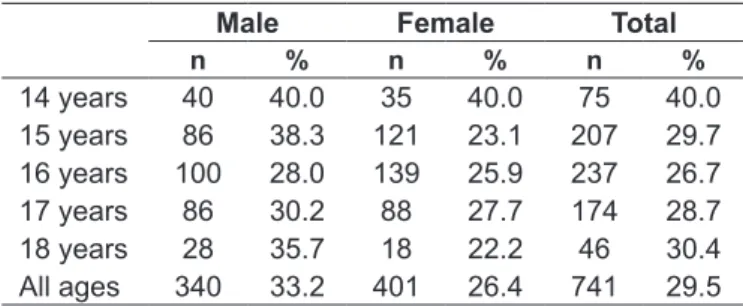
A total of 741 adolescent schoolchildren aged 14 to 18 were interviewed for this study. Three hundred and forty of them were male (45.9%) and 401 (54.1%) were female. The prevalence of excess weight was 29.5%. Prevalence was greater among males (33.2%) than females (26.4%). With regards to age, prevalence was greatest at 14 years (40%) in both sexes. Sixteen-year-old males (28.0%) and 18-year-old females (22.2%) had the lowest excess weight prevalence rates (Table 1).
Table 2 lists excess weight prevalence rates and preva-lence ratios for schoolchildren at private secondary schools in Rio Branco. The explanatory variables socioeconomic level, time spent using a computer and physical activity
Male Female Total
n % n % n %
Discussion
This is one of the irst studies conducted in the Brazilian state of Acre to use the WHO’s new 2007 recommenda-tions to determine the prevalence of excess weight in schoolchildren from private secondary schools. It was found that the prevalence of excess weight was elevated, at 29.5% of adolescents of both sexes aged 14 to 19 years, which is indicative of an emerging public health problem and is associated with inactive lifestyles.
Comparisons of the prevalence of excess weight among the schoolchildren studied here with previous Brazilian and international investigations is confounded by the
use of different reference standards(18-19). These standards
diverge in terms of the statistical methods employed and the cutoff points used to diagnose of excess weight.
n % RP 95%CI p-value
Sex
Male 340 33.2 1.00
Female 401 26.4 0.79 (0.52–1.20) 0.202
Age (years)
14 75 40.0 1.00
15 207 29.4 0.73 (0.35–1.54) 0.315
16 239 26.7 0.66 (0.32–1.39) 0.204
17 174 28.7 0.71 (0.32–1.57) 0.307
18 46 30.4 0.76 (0.43–1.31) 0.238
Socioeconomic level
High 658 30.8 1.00
Medium or Low 83 19.2 0.62 (0.31–1.23) 0.129
Head of family’s educational level
Higher education 473 29.6
Primary and secondary education 268 29.4 0.99 (0.67–1.47) 0.978 Number of residents in household
> More than 3 residents 520 29.2 1.00
≤ Less than 3 residents 221 30.2 1.03 (0.79–1.35) 0.727 Number of siblings
> More than 2 siblings 176 30.1 1.00
≤ Less than 2 siblings 565 29.3 0.97 (0.65–1.45) 0.872 Time spent watching television
≤ Less than 2 hours 234 26.9 1.00
> More than 2 hours 507 30.7 1.14 (0.76–1.70) 0.407 Time spent using a computer
≤ Less than 2 hours 290 25.1 1.00
> More than 2 hours 451 32.3 1.28 (0.94–1.75) 0.088 Physical activity
Active 450 22.2 1.00
Inactive 291 40.8 1.84 (0.93–3.62) 0.067
Tabela 2 - Excess weight prevalence and prevalence ratios for adolescents from private secondary schools in Rio Branco, Acre, Brazil, 2009
RP: prevalence ratio; 95%CI: 95% conidence interval
PR* 95%CI p-value
Time spent watching television
≤ Less than 2 hours 1.00
> More than 2 hours 1.20 (1.04–1.39) 0.023 Physical activity
Active 1.00
Inactive 1.87 (1.00–3.51) 0.049 Tabela 3 - Factors associated with excess weight in adolescents from private secondary schools in Rio Branco, Acre, Brazil, 2009
PR: prevalence ratio; *adjusted for age and sex
Notwithstanding, the 2007 WHO reference was chosen in view of the inlux of immigrants that contributed to the composition of the population of Acre, since the 2007 standards are based on a representative multiethnic sample drawn from many different countries, including Brazil.
Although there are many published studies of excess weight prevalence in adolescent schoolchildren, few similar studies have been conducted in Rio Branco, Acre(20). The
29.5% excess weight prevalence observed among schoolchil-dren from private schools in Rio Branco is higher than the percentage of excess weight observed for Brazilian adoles-cents aged 10 to 19 (20.5%) by the Family Budgets Survey
(Pesquisa de Orçamentos Familiares)(5), which was conducted
in 2008–9 and also used the 2007 WHO reference. The prevalence observed here also differs from the results of studies of adolescents from private schools in several Brazilian towns. Data from the cities of Fortaleza(21) and Florianópolis(22)
both show lower excess weight prevalence than was observed here among schoolchildren from Rio Branco. In contrast, data from the National Survey of Schoolchildren’s Health(23) found
higher rates of excess weight than were observed among the students from private schools in Rio Branco.
In Brazil, a linear relationship has been identiied between family income measured in multiples of the minimum monthly wage and prevalence of excess weight among adolescents(5). Particularly with reference to secondary
edu-cation, there is a tendency in Brazil for students at private schools to come from high income families while children enrolled at public schools come from lower-income families. A study that used a reference standard similar to the 2007 WHO standard found a lower prevalence of excess weight among schoolchildren from public primary schools in Rio
Branco (17.6%)(20) than was observed among the
schoolchil-dren from private schools described here.
Suñé et al(12), conducted an investigation in the town of
Capão da Canoa, in Rio Grande do Sul state, and observed 31.4% prevalence of excess weight among schoolchildren who spent more than 4½ hours engaged in sedentary activi-ties (watching TV, playing video games, using computers). A study conducted in India found that time spent watching television and using computers was associated with excess
weight(24). The data presented here also conirm the
associa-tion between hours spent using computers and excess weight prevalence. Adolescents who spent more than 2 hours per day in front of a computer were more likely to have excess
weight. According to Lamounier and Abrantes(25), who
conducted a review of the subject, the increase in obesity
among adolescents is related to what can be considered a major phenomenon of the 1990s, i.e. proliferation of tele-vision and dissemination of internet access. As technology advances, children and adolescents are reducing the amount of time they spend watching television and increasing the time they spend using computers(26,27).
After adjustment for age and sex, inactive lifestyle was associated with excess weight. This evidence is similar to indings gathered by research conducted with adolescents in the South administrative region of Brazil, which showed that low levels of physical activity were associated with the preva-lence of overweight and obesity(12). In contrast, Tassitano et
al(28) analyzed adolescents from the state of Pernambuco and
did not detect a signiicant association between being active and overweight or obesity. Seemingly contradictory results were reported by Terres et al(29), who found that overweight
adolescents in Pelotas engaged in physical activity outside of school. This could be an example of reverse causality, by which the adolescents began to exercise after gaining excess weight. Additionally, the differences between these investigations’ results could be linked to use of different data collection and analysis methodologies.
With regard to the limitations of this study, the cross-sectional design makes it impossible to identify the temporal relationships between the independent variables and excess weight. Memory bias, however, can be assumed to have been kept to a minimum since students were reporting on recent occurrences.
Considering that adolescents spend a large proportion of their time at school, the physical activity and dietary habits that they acquire during their school years can impact on their nutritional status. By the same token, schools are potentially good places to diagnose excess weight and intervene to reduce it. Professionals from nine different countries(30) proposed a
series of suggestions for preventing obesity in children and adolescents, recommending that schools should provide physi-cal education classes and basic education on nutrition and the health beneits of physical activity. The elevated prevalence of excess weight observed among these adolescents from private secondary schools in Rio Branco highlights the need to plan and implement public policies designed to reduce to preva-lence of excess weight and its comorbidities.
References
1. Popkin BM. The nutrition transition and obesity in the developing world. J Nutr 2001;131:871S-3.
2. Farias ES, Guerra-Júnior G, Petroski EL. Nutricional status of schoolchildren in Porto Velho, Rondônia, Brazil. Rev Nutr 2008;21:401-9.
3. Pelegrini A, Silva DA, Petroski EL, Gaya AC. Overweight and obesity in seven to nine-year-old Brazilian students: data from the Brazilian Sports Project. Rev Paul Pediatr 2010;28:290-5.
4. Cardoso LO, Engstron EM, Leite LC, Castro IR. Socioeconomic, demografhic, environmental and behavioral factors associated with overweight in adolescents: a systematic literature review. Rev Bras Epidemiol 2009;12:378-403. 5. Brasil. Instituto Brasileiro de Geograia e Estatística. Pesquisa de orçamentos
familiares 2008-2009 - Avaliação nutricional da disponibilidade domiciliar de alimentos no Brasil. Rio de Janeiro: IBGE; 2010.
6. Barker DJ. The fetal origins of adult hypertension. J Hypertens Suppl 1992;10:S39-44.
7. Guo SS, Chumlea WC. Tracking of body mass index in children in relation to overweight in adulthood. Am j Clin Nutr 1999;70:145S-8.
8. Wang Y, Ge K, Popkin BM. Tracking of body mass index from childhood to adolescence: a 6-y follow-up study in China. Am J Clin Nutr 2000;72:1018-24. 9. Enes CC, Slater B. Obesity in adolescence and its main determinants. Rev
Bras Epidemiol 2010;13:163-71.
10. Weil EJ, Curtis JM, Hanson RL, Knowler WC, Nelson RG. The impact of disadvantage on the development and progression of diabetic kidney disease. Clin Nephrol 2010;74 (Suppl 1):S32-8.
11. Carter RC. The impact of public schools on childhood obesity. JAMA 2002;288:2180.
12. Suñé FR, Dias-da-Costa JS, Olinto MT, Pattussi MP. Prevalence of overweight and obesity and associated factors among schoolchildren in a southern Brazilian city. Cad Saude Publica 2007;23:1361-71.
13. Vanzelli AS, Castro CT, Pinto MS, Passos SD. Prevalence of overweight and obesity among children of public schools in the city of Jundiaí, São Paulo, Brazil. Rev Paul Pediatr 2008;26:48-53.
14. Silva NN, editor. Amostragem probabilística: um curso introdutório. 2ª ed. São Paulo: Edusp; 2001.
15. Associação Brasileira de Empresas de Pesquisa [homepage on the Internet]. Critério de classiicação econômica - 2010 [cited 2010 Mar 05]. Available from: http://www.abep.org/novo/Content.aspx?ContentID=301
16. Guedes DP, Lopes CC, Guedes JE. Reproducibility and validity of the International Physical Activity Questionnaire in adolescents. Rev Bras Med Esporte 2005;11:151-8.
17. Lohman TG, Roche AF, Martorell R, editors. Anthropometric standardization reference manual. Champaign: Human Kinetics Pub; 1988.
18. De Onis M, Onyango AW, Borghi E, Siyam A, Nishida C, Siekmann J. Development of a WHO growth reference for school-aged children and adolescents. Bull World Health Organ 2007;85:660-7.
19. Cole TJ, Bellizzi MC, Flegal KM, Dietz WH. Establishing a standard deinition for child overweight and obesity worldwide: international survey. BMJ 2000;320:1240-3.
20. Souza OF, Farias ES. Underweight and overweight in school children from Rio Branco, Acre State, Brazil. Rev Bras Crescimento Desenvolv Hum 2011;21:878-82.
21. Araújo MF, Almeida LS, Silva PC, Vasconcelos HC, Lopes MV, Damasceno MM. Overweight among adolescents from private schools in Fortaleza, CE, Brazil. Rev Bras Enferm 2010;63:623-8.
22. Silva KS, Pelegrini A, Hoefelmann LP, Vasques DG. Lopes AS. Prevalência de excesso de peso corporal em escolas públicas e privadas da cidade de Florianópolis, SC. Arq Bras Endrocrinol Metab 2008;52:574-5.
23. Araújo C, Toral N, Silva AC, Velásquez-Melendez G, Dias AJ. Nutritional status of adolescents and its relation with socio-demographics variables: National Adolescent School-based Health Survey (PeNSE), 2009. Cien Saude Colet 2010;15 (Suppl 2):3077-84.
24. Kotian MS, Kumar SG, Kotian SS. Prevalence and determinants of overweight and obesity among adolescent school children of South Karnataka, India. Indian J Community Med 2010;35:176-8.
25. Lamounier JA, Abrantes MM. Prevalence of obesity and overweight in Brazilian adolescents. Rev Med Minas Gerais 2003;13:275-84.
26. Pérez A, Hoelscher DM, Springer AE, Brown HS, Barroso CS, Kelder SH et al. Physical activity, watching television, and the risk of obesity in students, Texas, 2004-2005. Prev Chronic Dis 2011;8:A61.
27. Shi L, Mao Y. Excessive recreational computer use and food consumption behaviour among adolescents. Ital J Pediatr 2010;36:52.
28. Tassitano RM, Barros MV, Tenório MC, Bezerra J, Hallal PC. Prevalence of overweight and obesity and associated factors among public high school students in Pernambuco State, Brazil. Cad Saude Publica 2009;25:2639-52.
29. Terres NG, Pinheiro RT, Horta BL, Pinheiro KA, Horta LL. Prevalence and factors associated to overweight and obesity in adolescents. Rev Saude Publica 2009;40:627-33.
30. Speiser PW, Rudolf MC, Anhalt H, Camacho-Hubner C, Chiarelli F, Eliakim A