Devices Included in this Data Sheet:
Microcontroller Core Features:
• High-performance RISC CPU
• Only 35 single word instructions to learn • All single cycle instructions except for program
branches which are two cycle
• Operating speed: DC - 20 MHz clock input DC - 200 ns instruction cycle • Up to 8K x 14 words of FLASH Program Memory,
Up to 368 x 8 bytes of Data Memory (RAM) Up to 256 x 8 bytes of EEPROM data memory • Pinout compatible to the PIC16C73B/74B/76/77 • Interrupt capability (up to 14 sources)
• Eight level deep hardware stack
• Direct, indirect and relative addressing modes • Power-on Reset (POR)
• Power-up Timer (PWRT) and Oscillator Start-up Timer (OST)
• Watchdog Timer (WDT) with its own on-chip RC oscillator for reliable operation
• Programmable code-protection • Power saving SLEEP mode • Selectable oscillator options
• Low-power, high-speed CMOS FLASH/EEPROM technology
• Fully static design
• In-Circuit Serial Programming (ICSP)via two pins
• Single 5V In-Circuit Serial Programming capability • In-Circuit Debugging via two pins
• Processor read/write access to program memory • Wide operating voltage range: 2.0V to 5.5V • High Sink/Source Current: 25 mA
• Commercial and Industrial temperature ranges • Low-power consumption:
- < 2 mA typical @ 5V, 4 MHz - 20 µA typical @ 3V, 32 kHz - < 1 µA typical standby current
Pin Diagram
Peripheral Features:
• Timer0: 8-bit timer/counter with 8-bit prescaler • Timer1: 16-bit timer/counter with prescaler,
can be incremented during sleep via external crystal/clock
• Timer2: 8-bit timer/counter with 8-bit period register, prescaler and postscaler
• Two Capture, Compare, PWM modules - Capture is 16-bit, max. resolution is 12.5 ns - Compare is 16-bit, max. resolution is 200 ns - PWM max. resolution is 10-bit
• 10-bit multi-channel Analog-to-Digital converter • Synchronous Serial Port (SSP) with SPI (Master
Mode) and I2C (Master/Slave)
• Universal Synchronous Asynchronous Receiver Transmitter (USART/SCI) with 9-bit address detection
• Parallel Slave Port (PSP) 8-bits wide, with external RD, WR and CS controls (40/44-pin only) • Brown-out detection circuitry for
Brown-out Reset (BOR) • PIC16F873 • PIC16F874 • PIC16F876 • PIC16F877 RB7/PGD RB6/PGC RB5 RB4 RB3/PGM RB2 RB1 RB0/INT VDD VSS RD7/PSP7 RD6/PSP6 RD5/PSP5 RD4/PSP4 RC7/RX/DT RC6/TX/CK RC5/SDO RC4/SDI/SDA RD3/PSP3 RD2/PSP2 MCLR/VPP/THV
RA0/AN0 RA1/AN1 RA2/AN2/VREF -RA3/AN3/VREF+ RA4/T0CKI RA5/AN4/SS RE0/RD/AN5 RE1/WR/AN6 RE2/CS/AN7 VDD VSS OSC1/CLKIN OSC2/CLKOUT RC0/T1OSO/T1CKI RC1/T1OSI/CCP2 RC2/CCP1 RC3/SCK/SCL RD0/PSP0 RD1/PSP1 1 2 3 4 5 6 7 8 9 10 11 12 13 14 15 16 17 18 19 20 40 39 38 37 36 35 34 33 32 31 30 29 28 27 26 25 24 23 22 21 PI C16F 8 77/8 7 4 PDIP
Pin Diagrams P IC1 6F 876 /873 10 11 2 3 4 5 6 1 8 7 9 12 13 14 15 16 17 18 19 20 23 24 25 26 27 28 22 21 MCLR/VPP/THV
RA0/AN0 RA1/AN1 RA2/AN2/VREF -RA3/AN3/VREF+ RA4/T0CKI RA5/AN4/SS VSS OSC1/CLKIN OSC2/CLKOUT RC0/T1OSO/T1CKI RC1/T1OSI/CCP2 RC2/CCP1 RC3/SCK/SCL RB7/PGD RB6/PGC RB5 RB4 RB3/PGM RB2 RB1 RB0/INT VDD VSS RC7/RX/DT RC6/TX/CK RC5/SDO RC4/SDI/SDA 10 11 12 13 14 15 16 17
18 19 20 21 22 23 24 25 26
44
8 7
6 5 4 3 2 1
27 28 29 30 31 32 33 34 35 36 37 38 39 40 41 42 43 9 PIC16F877 RA4/T0CKI RA5/AN4/SS RE0/RD/AN5 OSC1/CLKIN OSC2/CLKOUT RC0/T1OSO/T1CK1 NC RE1/WR/AN6 RE2/CS/AN7 VDD VSS RB3/PGM RB2 RB1 RB0/INT VDD VSS RD7/PSP7 RD6/PSP6 RD5/PSP5 RD4/PSP4 RC7/RX/DT RA3 /AN3 /V RE F + RA2 /AN2 /V RE F -RA1 /AN1 RA0 /AN0 MC L R /V PP /T HV NC RB7 /PG D RB6 /PG C
RB5 RB4 NC
NC RC6 /T X/C K RC 5 /S D O RC4 /SDI/ S D A RD3 /PSP3 RD2 /PSP2 RD1 /PSP1 RD0 /PSP0 R C 3 /SCK/ SCL RC2 /CCP1 RC1 /T 1 O SI/CCP2 10 11 2 3 4 5 6 1
18 19 20 21 22 12 13 14 15
38
8 7
44 43 42 41 40 39
16 17 29 30 31 32 33 23 24 25 26 27 28 36 35 34
Key Features
PICmicro™ Mid-Range Reference Manual (DS33023)
PIC16F873 PIC16F874 PIC16F876 PIC16F877
Operating Frequency DC - 20 MHz DC - 20 MHz DC - 20 MHz DC - 20 MHz Resets (and Delays) POR, BOR
(PWRT, OST)
POR, BOR (PWRT, OST)
POR, BOR (PWRT, OST)
POR, BOR (PWRT, OST) FLASH Program Memory
(14-bit words)
4K 4K 8K 8K
Data Memory (bytes) 192 192 368 368
EEPROM Data Memory 128 128 256 256
Interrupts 13 14 13 14
I/O Ports Ports A,B,C Ports A,B,C,D,E Ports A,B,C Ports A,B,C,D,E
Timers 3 3 3 3
Capture/Compare/PWM modules 2 2 2 2
Serial Communications MSSP, USART MSSP, USART MSSP, USART MSSP, USART
Parallel Communications — PSP — PSP
Table of Contents
1.0 Device Overview ... 5
2.0 Memory Organization... 11
3.0 I/O Ports ... 29
4.0 Data EEPROM and FLASH Program Memory ... 41
5.0 Timer0 Module ... 47
6.0 Timer1 Module ... 51
7.0 Timer2 Module ... 55
8.0 Capture/Compare/PWM (CCP) Module(s)... 57
9.0 Master Synchronous Serial Port (MSSP) Module ... 63
10.0 Universal Synchronous Asynchronous Receiver Transmitter (USART) ... 95
11.0 Analog-to-Digital Converter (A/D) Module... 111
12.0 Special Features of the CPU... 121
13.0 Instruction Set Summary... 137
14.0 Development Support ... 145
15.0 Electrical Characteristics... 151
16.0 DC and AC Characteristics Graphs and Tables... 173
17.0 Packaging Information ... 175
Appendix A: Revision History ... 183
Appendix B: Device Differences... 183
Appendix C: Conversion Considerations... 183
Index ... 185
On-Line Support... 191
Product Identification System... 193
To Our Valued Customers
Most Current Data Sheet
To obtain the most up-to-date version of this data sheet, please register at our Worldwide Web site at: http://www.microchip.com
You can determine the version of a data sheet by examining its literature number found on the bottom outside corner of any page. The last character of the literature number is the version number. e.g., DS30000A is version A of document DS30000.
New Customer Notification System
Register on our web site (www.microchip.com/cn) to receive the most current information on our products. Errata
An errata sheet may exist for current devices, describing minor operational differences (from the data sheet) and recommended workarounds. As device/documentation issues become known to us, we will publish an errata sheet. The errata will specify the revi-sion of silicon and revirevi-sion of document to which it applies.
To determine if an errata sheet exists for a particular device, please check with one of the following: • Microchip’s Worldwide Web site; http://www.microchip.com
• Your local Microchip sales office (see last page)
• The Microchip Corporate Literature Center; U.S. FAX: (480) 786-7277
When contacting a sales office or the literature center, please specify which device, revision of silicon and data sheet (include liter-ature number) you are using.
Corrections to this Data Sheet
We constantly strive to improve the quality of all our products and documentation. We have spent a great deal of time to ensure that this document is correct. However, we realize that we may have missed a few things. If you find any information that is missing or appears in error, please:
• Fill out and mail in the reader response form in the back of this data sheet. • E-mail us at [email protected].
1.0
DEVICE OVERVIEW
This document contains device-specific information. Additional information may be found in the PICmicro™ Mid-Range Reference Manual, (DS33023), which may be obtained from your local Microchip Sales Represen-tative or downloaded from the Microchip website. The Reference Manual should be considered a comple-mentary document to this data sheet, and is highly rec-ommended reading for a better understanding of the device architecture and operation of the peripheral modules.
There are four devices (PIC16F873, PIC16F874, PIC16F876 and PIC16F877) covered by this data sheet. The PIC16F876/873 devices come in 28-pin packages and the PIC16F877/874 devices come in 40-pin packages. The 28-40-pin devices do not have a Paral-lel Slave Port implemented.
The following two figures are device block diagrams sorted by pin number; 28-pin for Figure 1-1 and 40-pin for Figure 1-2. The 28-pin and 40-pin pinouts are listed in Table 1-1 and Table 1-2, respectively.
FIGURE 1-1: PIC16F873 AND PIC16F876 BLOCK DIAGRAM
FLASH Program Memory
13 Data Bus 8
14 Program
Bus
Instruction reg
Program Counter
8 Level Stack (13-bit)
RAM File Registers
Direct Addr 7
RAM Addr (1) 9 Addr MUX Indirect Addr FSR reg STATUS reg MUX ALU W reg Power-up Timer Oscillator Start-up Timer Power-on Reset Watchdog Timer Instruction Decode & Control Timing Generation OSC1/CLKIN OSC2/CLKOUT
MCLR VDD, VSS
PORTA PORTB PORTC RA4/T0CKI RA5/AN4/SS RB0/INT RC0/T1OSO/T1CKI RC1/T1OSI/CCP2 RC2/CCP1 RC3/SCK/SCL RC4/SDI/SDA RC5/SDO RC6/TX/CK RC7/RX/DT 8 8 Brown-out Reset USART CCP1,2 Synchronous 10-bit A/D
Timer0 Timer1 Timer2
Serial Port
RA3/AN3/VREF+ RA2/AN2/VREF -RA1/AN1 RA0/AN0 8 3 Data EEPROM RB1 RB2 RB3/PGM RB4 RB5 RB6/PGC RB7/PGD Device Program FLASH
Data Memory Data EEPROM
PIC16F873 4K 192 Bytes 128 Bytes
PIC16F876 8K 368 Bytes 256 Bytes
FIGURE 1-2: PIC16F874 AND PIC16F877 BLOCK DIAGRAM
FLASH Program Memory
13 Data Bus 8
14 Program
Bus
Instruction reg
Program Counter
8 Level Stack (13-bit)
RAM File Registers
Direct Addr 7
RAM Addr (1) 9 Addr MUX
Indirect Addr
FSR reg
STATUS reg
MUX
ALU
W reg Power-up
Timer Oscillator Start-up Timer
Power-on Reset Watchdog
Timer Instruction
Decode & Control
Timing Generation OSC1/CLKIN
OSC2/CLKOUT
MCLR VDD, VSS
PORTA
PORTB
PORTC
PORTD
PORTE
RA4/T0CKI RA5/AN4/SS
RC0/T1OSO/T1CKI RC1/T1OSI/CCP2 RC2/CCP1 RC3/SCK/SCL RC4/SDI/SDA RC5/SDO RC6/TX/CK RC7/RX/DT
RD7/PSP7:RD0/PSP0
RE0/AN5/RD
RE1/AN6/WR RE2/AN7/CS 8
8
Brown-out Reset
Note 1: Higher order bits are from the STATUS register.
USART CCP1,2 Synchronous
10-bit A/D
Timer0 Timer1 Timer2
Serial Port
RA3/AN3/VREF+ RA2/AN2/VREF -RA1/AN1 RA0/AN0
Parallel Slave Port 8
3
Data EEPROM
RB0/INT RB1 RB2 RB3/PGM RB4 RB5 RB6/PGC RB7/PGD Device Program
FLASH
Data Memory Data EEPROM
PIC16F874 4K 192 Bytes 128 Bytes
PIC16F877 8K 368 Bytes 256 Bytes
TABLE 1-1: PIC16F873 AND PIC16F876 PINOUT DESCRIPTION
Pin Name DIP
Pin#
SOIC Pin#
I/O/P Type
Buffer
Type Description
OSC1/CLKIN 9 9 I ST/CMOS(3) Oscillator crystal input/external clock source input.
OSC2/CLKOUT 10 10 O — Oscillator crystal output. Connects to crystal or resonator in crystal oscillator mode. In RC mode, the OSC2 pin outputs CLKOUT which has 1/4 the frequency of OSC1, and denotes the instruction cycle rate.
MCLR/VPP/THV 1 1 I/P ST Master clear (reset) input or programming voltage input or high voltage test mode control. This pin is an active low reset to the device.
PORTA is a bi-directional I/O port.
RA0/AN0 2 2 I/O TTL RA0 can also be analog input0
RA1/AN1 3 3 I/O TTL RA1 can also be analog input1
RA2/AN2/VREF- 4 4 I/O TTL RA2 can also be analog input2 or negative analog reference
voltage
RA3/AN3/VREF+ 5 5 I/O TTL RA3 can also be analog input3 or positive analog reference
voltage
RA4/T0CKI 6 6 I/O ST RA4 can also be the clock input to the Timer0 module. Output
is open drain type.
RA5/SS/AN4 7 7 I/O TTL RA5 can also be analog input4 or the slave select for the
synchronous serial port.
PORTB is a bi-directional I/O port. PORTB can be software programmed for internal weak pull-up on all inputs.
RB0/INT 21 21 I/O TTL/ST(1) RB0 can also be the external interrupt pin.
RB1 22 22 I/O TTL
RB2 23 23 I/O TTL
RB3/PGM 24 24 I/O TTL RB3 can also be the low voltage programming input
RB4 25 25 I/O TTL Interrupt on change pin.
RB5 26 26 I/O TTL Interrupt on change pin.
RB6/PGC 27 27 I/O TTL/ST(2) Interrupt on change pin or In-Circuit Debugger pin. Serial
programming clock.
RB7/PGD 28 28 I/O TTL/ST(2) Interrupt on change pin or In-Circuit Debugger pin. Serial
programming data. PORTC is a bi-directional I/O port.
RC0/T1OSO/T1CKI 11 11 I/O ST RC0 can also be the Timer1 oscillator output or Timer1 clock
input.
RC1/T1OSI/CCP2 12 12 I/O ST RC1 can also be the Timer1 oscillator input or Capture2 input/
Compare2 output/PWM2 output.
RC2/CCP1 13 13 I/O ST RC2 can also be the Capture1 input/Compare1 output/PWM1
output.
RC3/SCK/SCL 14 14 I/O ST RC3 can also be the synchronous serial clock input/output for
both SPI and I2C modes.
RC4/SDI/SDA 15 15 I/O ST RC4 can also be the SPI Data In (SPI mode) or
data I/O (I2C mode).
RC5/SDO 16 16 I/O ST RC5 can also be the SPI Data Out (SPI mode).
RC6/TX/CK 17 17 I/O ST RC6 can also be the USART Asynchronous Transmit or
Synchronous Clock.
RC7/RX/DT 18 18 I/O ST RC7 can also be the USART Asynchronous Receive or
Synchronous Data.
VSS 8, 19 8, 19 P — Ground reference for logic and I/O pins.
VDD 20 20 P — Positive supply for logic and I/O pins.
Legend: I = input O = output I/O = input/output P = power
TABLE 1-2: PIC16F874 AND PIC16F877 PINOUT DESCRIPTION
Pin Name DIP Pin#
PLCC Pin#
QFP Pin#
I/O/P Type
Buffer
Type Description
OSC1/CLKIN 13 14 30 I ST/CMOS(4) Oscillator crystal input/external clock source input.
OSC2/CLKOUT 14 15 31 O — Oscillator crystal output. Connects to crystal or resonator in
crystal oscillator mode. In RC mode, OSC2 pin outputs CLK-OUT which has 1/4 the frequency of OSC1, and denotes the instruction cycle rate.
MCLR/VPP/THV 1 2 18 I/P ST Master clear (reset) input or programming voltage input or high voltage test mode control. This pin is an active low reset to the device.
PORTA is a bi-directional I/O port.
RA0/AN0 2 3 19 I/O TTL RA0 can also be analog input0
RA1/AN1 3 4 20 I/O TTL RA1 can also be analog input1
RA2/AN2/VREF- 4 5 21 I/O TTL RA2 can also be analog input2 or negative analog
reference voltage
RA3/AN3/VREF+ 5 6 22 I/O TTL RA3 can also be analog input3 or positive analog
reference voltage
RA4/T0CKI 6 7 23 I/O ST RA4 can also be the clock input to the Timer0 timer/
counter. Output is open drain type.
RA5/SS/AN4 7 8 24 I/O TTL RA5 can also be analog input4 or the slave select for the
synchronous serial port.
PORTB is a bi-directional I/O port. PORTB can be software programmed for internal weak pull-up on all inputs.
RB0/INT 33 36 8 I/O TTL/ST(1) RB0 can also be the external interrupt pin.
RB1 34 37 9 I/O TTL
RB2 35 38 10 I/O TTL
RB3/PGM 36 39 11 I/O TTL RB3 can also be the low voltage programming input
RB4 37 41 14 I/O TTL Interrupt on change pin.
RB5 38 42 15 I/O TTL Interrupt on change pin.
RB6/PGC 39 43 16 I/O TTL/ST(2) Interrupt on change pin or In-Circuit Debugger pin. Serial
programming clock.
RB7/PGD 40 44 17 I/O TTL/ST(2) Interrupt on change pin or In-Circuit Debugger pin. Serial
programming data. PORTC is a bi-directional I/O port.
RC0/T1OSO/T1CKI 15 16 32 I/O ST RC0 can also be the Timer1 oscillator output or a Timer1
clock input.
RC1/T1OSI/CCP2 16 18 35 I/O ST RC1 can also be the Timer1 oscillator input or Capture2
input/Compare2 output/PWM2 output.
RC2/CCP1 17 19 36 I/O ST RC2 can also be the Capture1 input/Compare1 output/
PWM1 output.
RC3/SCK/SCL 18 20 37 I/O ST RC3 can also be the synchronous serial clock input/output
for both SPI and I2C modes.
RC4/SDI/SDA 23 25 42 I/O ST RC4 can also be the SPI Data In (SPI mode) or
data I/O (I2C mode).
RC5/SDO 24 26 43 I/O ST RC5 can also be the SPI Data Out
(SPI mode).
RC6/TX/CK 25 27 44 I/O ST RC6 can also be the USART Asynchronous Transmit or
Synchronous Clock.
RC7/RX/DT 26 29 1 I/O ST RC7 can also be the USART Asynchronous Receive or
PORTD is a bi-directional I/O port or parallel slave port when interfacing to a microprocessor bus.
RD0/PSP0 19 21 38 I/O ST/TTL(3)
RD1/PSP1 20 22 39 I/O ST/TTL(3)
RD2/PSP2 21 23 40 I/O ST/TTL(3)
RD3/PSP3 22 24 41 I/O ST/TTL(3)
RD4/PSP4 27 30 2 I/O ST/TTL(3)
RD5/PSP5 28 31 3 I/O ST/TTL(3)
RD6/PSP6 29 32 4 I/O ST/TTL(3)
RD7/PSP7 30 33 5 I/O ST/TTL(3)
PORTE is a bi-directional I/O port.
RE0/RD/AN5 8 9 25 I/O ST/TTL(3) RE0 can also be read control for the parallel slave port, or analog input5.
RE1/WR/AN6 9 10 26 I/O ST/TTL(3) RE1 can also be write control for the parallel slave port, or analog input6.
RE2/CS/AN7 10 11 27 I/O ST/TTL(3) RE2 can also be select control for the parallel slave port, or analog input7.
VSS 12,31 13,34 6,29 P — Ground reference for logic and I/O pins.
VDD 11,32 12,35 7,28 P — Positive supply for logic and I/O pins.
NC — 1,17,28,
40
12,13, 33,34
— These pins are not internally connected. These pins should be left unconnected.
TABLE 1-2: PIC16F874 AND PIC16F877 PINOUT DESCRIPTION (CONTINUED)
Pin Name DIP Pin#
PLCC Pin#
QFP Pin#
I/O/P Type
Buffer
Type Description
Legend: I = input O = output I/O = input/output P = power
— = Not used TTL = TTL input ST = Schmitt Trigger input Note 1: This buffer is a Schmitt Trigger input when configured as an external interrupt.
2: This buffer is a Schmitt Trigger input when used in serial programming mode.
3: This buffer is a Schmitt Trigger input when configured as general purpose I/O and a TTL input when used in the Parallel Slave Port mode (for interfacing to a microprocessor bus).
2.0
MEMORY ORGANIZATION
There are three memory blocks in each of these PICmicro MCUs. The Program Memory and Data Memory have separate buses so that concurrent access can occur and is detailed in this section. The EEPROM data memory block is detailed in Section 4.0.Additional information on device memory may be found in the PICmicro Mid-Range Reference Manual, (DS33023).
2.1 Program Memory Organization
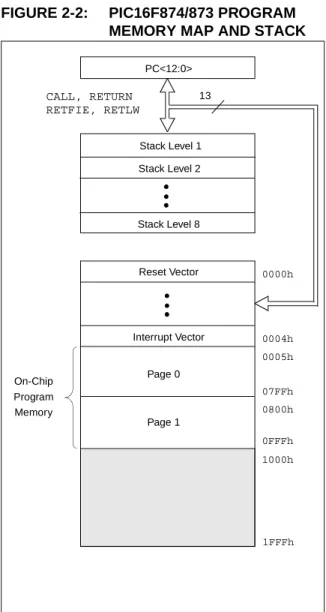
The PIC16F87X devices have a 13-bit program counter capable of addressing an 8K x 14 program memory space. The PIC16F877/876 devices have 8K x 14 words of FLASH program memory and the PIC16F873/ 874 devices have 4K x 14. Accessing a location above the physically implemented address will cause a wrap-around.
The reset vector is at 0000h and the interrupt vector is at 0004h.
FIGURE 2-1: PIC16F877/876 PROGRAM
MEMORY MAP AND STACK
FIGURE 2-2: PIC16F874/873 PROGRAM
MEMORY MAP AND STACK
PC<12:0>
13
0000h
0004h 0005h
Stack Level 1
Stack Level 8
Reset Vector
Interrupt Vector
On-Chip
CALL, RETURN RETFIE, RETLW
1FFFh
Stack Level 2
Program Memory
Page 0
Page 1
Page 2
Page 3
07FFh 0800h
0FFFh
1000h
17FFh 1800h
PC<12:0>
13
0000h
0004h 0005h
Stack Level 1
Stack Level 8
Reset Vector
Interrupt Vector
On-Chip
CALL, RETURN RETFIE, RETLW
1FFFh
Stack Level 2
Program Memory
Page 0
Page 1
07FFh 0800h
0FFFh
2.2 Data Memory Organization
The data memory is partitioned into multiple banks which contain the General Purpose Registers and the Special Function Registers. Bits RP1(STATUS<6>) and RP0 (STATUS<5>) are the bank select bits.
Each bank extends up to 7Fh (128 bytes). The lower locations of each bank are reserved for the Special Function Registers. Above the Special Function Regis-ters are General Purpose RegisRegis-ters, implemented as static RAM. All implemented banks contain Special Function Registers. Some “high use” Special Function Registers from one bank may be mirrored in another bank for code reduction and quicker access.
2.2.1 GENERAL PURPOSE REGISTER FILE The register file can be accessed either directly, or indi-rectly through the File Select Register FSR.
RP1:RP0 Bank
00 0
01 1
10 2
11 3
FIGURE 2-3: PIC16F877/876 REGISTER FILE MAP
Indirect addr.(*) TMR0 PCL STATUS FSR PORTA PORTB PORTC PCLATH INTCON PIR1 TMR1L TMR1H T1CON TMR2 T2CON SSPBUF SSPCON CCPR1L CCPR1H CCP1CON OPTION_REG PCL STATUS FSR TRISA TRISB TRISC PCLATH INTCON PIE1 PCON PR2 SSPADD SSPSTAT 00h 01h 02h 03h 04h 05h 06h 07h 08h 09h 0Ah 0Bh 0Ch 0Dh 0Eh 0Fh 10h 11h 12h 13h 14h 15h 16h 17h 18h 19h 1Ah 1Bh 1Ch 1Dh 1Eh 1Fh 80h 81h 82h 83h 84h 85h 86h 87h 88h 89h 8Ah 8Bh 8Ch 8Dh 8Eh 8Fh 90h 91h 92h 93h 94h 95h 96h 97h 98h 99h 9Ah 9Bh 9Ch 9Dh 9Eh 9Fh 20h A0h 7Fh FFh
Bank 0 Bank 1
Unimplemented data memory locations, read as ’0’. * Not a physical register.
Note 1: These registers are not implemented on 28-pin devices. 2: These registers are reserved, maintain these registers clear.
File Address Indirect addr.(*) Indirect addr.(*)
PCL STATUS FSR PCLATH INTCON PCL STATUS FSR PCLATH INTCON 100h 101h 102h 103h 104h 105h 106h 107h 108h 109h 10Ah 10Bh 10Ch 10Dh 10Eh 10Fh 110h 111h 112h 113h 114h 115h 116h 117h 118h 119h 11Ah 11Bh 11Ch 11Dh 11Eh 11Fh 180h 181h 182h 183h 184h 185h 186h 187h 188h 189h 18Ah 18Bh 18Ch 18Dh 18Eh 18Fh 190h 191h 192h 193h 194h 195h 196h 197h 198h 199h 19Ah 19Bh 19Ch 19Dh 19Eh 19Fh 120h 1A0h 17Fh 1FFh
Bank 2 Bank 3
Indirect addr.(*)
PORTD PORTE TRISD ADRESL TRISE TMR0 OPTION_REG PIR2 PIE2 RCSTA TXREG RCREG CCPR2L CCPR2H CCP2CON ADRESH ADCON0 TXSTA SPBRG ADCON1 General Purpose Register General Purpose Register General Purpose Register General Purpose Register 1EFh 1F0h accesses
70h - 7Fh EFh F0h accesses 70h-7Fh 16Fh 170h accesses 70h-7Fh General Purpose Register General Purpose Register TRISB PORTB
96 Bytes 80 Bytes 80 Bytes 80 Bytes
FIGURE 2-4: PIC16F874/873 REGISTER FILE MAP
Indirect addr.(*) TMR0 PCL STATUS FSR PORTA PORTB PORTC PCLATH INTCON PIR1 TMR1L TMR1H T1CON TMR2 T2CON SSPBUF SSPCON CCPR1L CCPR1H CCP1CON OPTION_REG PCL STATUS FSR TRISA TRISB TRISC PCLATH INTCON PIE1 PCON PR2 SSPADD SSPSTAT 00h 01h 02h 03h 04h 05h 06h 07h 08h 09h 0Ah 0Bh 0Ch 0Dh 0Eh 0Fh 10h 11h 12h 13h 14h 15h 16h 17h 18h 19h 1Ah 1Bh 1Ch 1Dh 1Eh 1Fh 80h 81h 82h 83h 84h 85h 86h 87h 88h 89h 8Ah 8Bh 8Ch 8Dh 8Eh 8Fh 90h 91h 92h 93h 94h 95h 96h 97h 98h 99h 9Ah 9Bh 9Ch 9Dh 9Eh 9Fh 20h A0h 7Fh FFh
Bank 0 Bank 1
File Address Indirect addr.(*) Indirect addr.(*)
PCL STATUS FSR PCLATH INTCON PCL STATUS FSR PCLATH INTCON 100h 101h 102h 103h 104h 105h 106h 107h 108h 109h 10Ah 10Bh 180h 181h 182h 183h 184h 185h 186h 187h 188h 189h 18Ah 18Bh 17Fh 1FFh
Bank 2 Bank 3
Indirect addr.(*)
PORTD PORTE TRISD ADRESL TRISE TMR0 OPTION_REG PIR2 PIE2 RCSTA TXREG RCREG CCPR2L CCPR2H CCP2CON ADRESH ADCON0 TXSTA SPBRG ADCON1 General Purpose Register General Purpose Register 1EFh 1F0h accesses
A0h - FFh 16Fh 170h accesses 20h-7Fh TRISB PORTB
96 Bytes 96 Bytes (1) (1) (1) (1) SSPCON2 10Ch 10Dh 10Eh 10Fh 110h 18Ch 18Dh 18Eh 18Fh 190h EEDATA EEADR EECON1 EECON2 EEDATH EEADRH Reserved(2) Reserved(2)
Unimplemented data memory locations, read as ’0’.
2.2.2 SPECIAL FUNCTION REGISTERS
The Special Function Registers are registers used by the CPU and peripheral modules for controlling the desired operation of the device. These registers are implemented as static RAM. A list of these registers is given in Table 2-1.
The Special Function Registers can be classified into two sets; core (CPU) and peripheral. Those registers associated with the core functions are described in detail in this section. Those related to the operation of the peripheral features are described in detail in the peripheral feature section.
TABLE 2-1: SPECIAL FUNCTION REGISTER SUMMARY
Addres
s Name Bit 7 Bit 6 Bit 5 Bit 4 Bit 3 Bit 2 Bit 1 Bit 0
Value on: POR, BOR
Value on all other resets
(2)
Bank 0
00h(4) INDF Addressing this location uses contents of FSR to address data memory (not a physical register) 0000 0000 0000 0000
01h TMR0 Timer0 module’s register xxxx xxxx uuuu uuuu
02h(4) PCL Program Counter's (PC) Least Significant Byte 0000 0000 0000 0000
03h(4) STATUS IRP RP1 RP0 TO PD Z DC C 0001 1xxx 000q quuu
04h(4) FSR Indirect data memory address pointer xxxx xxxx uuuu uuuu
05h PORTA — — PORTA Data Latch when written: PORTA pins when read --0x 0000 --0u 0000
06h PORTB PORTB Data Latch when written: PORTB pins when read xxxx xxxx uuuu uuuu
07h PORTC PORTC Data Latch when written: PORTC pins when read xxxx xxxx uuuu uuuu
08h(5) PORTD PORTD Data Latch when written: PORTD pins when read xxxx xxxx uuuu uuuu
09h(5) PORTE — — — — — RE2 RE1 RE0 ---- -xxx ---- -uuu
0Ah(1,4) PCLATH — — — Write Buffer for the upper 5 bits of the Program Counter ---0 0000 ---0 0000
0Bh(4) INTCON GIE PEIE T0IE INTE RBIE T0IF INTF RBIF 0000 000x 0000 000u
0Ch PIR1 PSPIF(3) ADIF RCIF TXIF SSPIF CCP1IF TMR2IF TMR1IF 0000 0000 0000 0000
0Dh PIR2 — (6) — EEIF BCLIF — — CCP2IF -r-0 0--0 -r-0 0--0
0Eh TMR1L Holding register for the Least Significant Byte of the 16-bit TMR1 register xxxx xxxx uuuu uuuu
0Fh TMR1H Holding register for the Most Significant Byte of the 16-bit TMR1 register xxxx xxxx uuuu uuuu
10h T1CON — — T1CKPS1 T1CKPS0 T1OSCEN T1SYNC TMR1CS TMR1ON --00 0000 --uu uuuu
11h TMR2 Timer2 module’s register 0000 0000 0000 0000
12h T2CON — TOUTPS3 TOUTPS2 TOUTPS1 TOUTPS0 TMR2ON T2CKPS1 T2CKPS0 -000 0000 -000 0000
13h SSPBUF Synchronous Serial Port Receive Buffer/Transmit Register xxxx xxxx uuuu uuuu
14h SSPCON WCOL SSPOV SSPEN CKP SSPM3 SSPM2 SSPM1 SSPM0 0000 0000 0000 0000
15h CCPR1L Capture/Compare/PWM Register1 (LSB) xxxx xxxx uuuu uuuu
16h CCPR1H Capture/Compare/PWM Register1 (MSB) xxxx xxxx uuuu uuuu
17h CCP1CON — — CCP1X CCP1Y CCP1M3 CCP1M2 CCP1M1 CCP1M0 --00 0000 --00 0000
18h RCSTA SPEN RX9 SREN CREN ADDEN FERR OERR RX9D 0000 000x 0000 000x
19h TXREG USART Transmit Data Register 0000 0000 0000 0000
1Ah RCREG USART Receive Data Register 0000 0000 0000 0000
1Bh CCPR2L Capture/Compare/PWM Register2 (LSB) xxxx xxxx uuuu uuuu
1Ch CCPR2H Capture/Compare/PWM Register2 (MSB) xxxx xxxx uuuu uuuu
1Dh CCP2CON — — CCP2X CCP2Y CCP2M3 CCP2M2 CCP2M1 CCP2M0 --00 0000 --00 0000
1Eh ADRESH A/D Result Register High Byte xxxx xxxx uuuu uuuu
1Fh ADCON0 ADCS1 ADCS0 CHS2 CHS1 CHS0 GO/
DONE — ADON 0000 00-0 0000 00-0
Legend: x = unknown, u = unchanged, q = value depends on condition, - = unimplemented read as ’0’, r = reserved. Shaded locations are unimplemented, read as ‘0’.
Note 1: The upper byte of the program counter is not directly accessible. PCLATH is a holding register for the PC<12:8> whose contents are transferred to the upper byte of the program counter.
2: Other (non power-up) resets include external reset through MCLR and Watchdog Timer Reset. 3: Bits PSPIE and PSPIF are reserved on the 28-pin devices; always maintain these bits clear. 4: These registers can be addressed from any bank.
Bank 1
80h(4) INDF Addressing this location uses contents of FSR to address data memory (not a physical register) 0000 0000 0000 0000
81h OPTION_R
EG RBPU INTEDG T0CS T0SE PSA PS2 PS1 PS0 1111 1111 1111 1111 82h(4) PCL Program Counter’s (PC) Least Significant Byte 0000 0000 0000 0000
83h(4) STATUS IRP RP1 RP0 TO PD Z DC C 0001 1xxx 000q quuu
84h(4) FSR Indirect data memory address pointer xxxx xxxx uuuu uuuu
85h TRISA — — PORTA Data Direction Register --11 1111 --11 1111
86h TRISB PORTB Data Direction Register 1111 1111 1111 1111
87h TRISC PORTC Data Direction Register 1111 1111 1111 1111
88h(5) TRISD PORTD Data Direction Register 1111 1111 1111 1111
89h(5) TRISE IBF OBF IBOV PSPMODE — PORTE Data Direction Bits 0000 -111 0000 -111
8Ah(1,4) PCLATH — — — Write Buffer for the upper 5 bits of the Program Counter ---0 0000 ---0 0000
8Bh(4) INTCON GIE PEIE T0IE INTE RBIE T0IF INTF RBIF 0000 000x 0000 000u
8Ch PIE1 PSPIE(3) ADIE RCIE TXIE SSPIE CCP1IE TMR2IE TMR1IE 0000 0000 0000 0000
8Dh PIE2 — (6) — EEIE BCLIE — — CCP2IE -r-0 0--0 -r-0 0--0
8Eh PCON — — — — — — POR BOR ---- --qq ---- --uu
8Fh — Unimplemented — —
90h — Unimplemented — —
91h SSPCON2 GCEN ACKSTAT ACKDT ACKEN RCEN PEN RSEN SEN 0000 0000 0000 0000
92h PR2 Timer2 Period Register 1111 1111 1111 1111
93h SSPADD Synchronous Serial Port (I2C mode) Address Register 0000 0000 0000 0000
94h SSPSTAT SMP CKE D/A P S R/W UA BF 0000 0000 0000 0000
95h — Unimplemented — —
96h — Unimplemented — —
97h — Unimplemented — —
98h TXSTA CSRC TX9 TXEN SYNC — BRGH TRMT TX9D 0000 -010 0000 -010
99h SPBRG Baud Rate Generator Register 0000 0000 0000 0000
9Ah — Unimplemented — —
9Bh — Unimplemented — —
9Ch — Unimplemented — —
9Dh — Unimplemented — —
9Eh ADRESL A/D Result Register Low Byte xxxx xxxx uuuu uuuu
9Fh ADCON1 ADFM — — — PCFG3 PCFG2 PCFG1 PCFG0 0--- 0000 0--- 0000
TABLE 2-1: SPECIAL FUNCTION REGISTER SUMMARY (CONTINUED)
Addres
s Name Bit 7 Bit 6 Bit 5 Bit 4 Bit 3 Bit 2 Bit 1 Bit 0
Value on: POR, BOR
Value on all other resets
(2)
Legend: x = unknown, u = unchanged, q = value depends on condition, - = unimplemented read as ’0’, r = reserved. Shaded locations are unimplemented, read as ‘0’.
Note 1: The upper byte of the program counter is not directly accessible. PCLATH is a holding register for the PC<12:8> whose contents are transferred to the upper byte of the program counter.
2: Other (non power-up) resets include external reset through MCLR and Watchdog Timer Reset. 3: Bits PSPIE and PSPIF are reserved on the 28-pin devices; always maintain these bits clear. 4: These registers can be addressed from any bank.
Bank 2
100h(4) INDF Addressing this location uses contents of FSR to address data memory (not a physical register) 0000 0000 0000 0000
101h TMR0 Timer0 module’s register xxxx xxxx uuuu uuuu
102h(4) PCL Program Counter's (PC) Least Significant Byte 0000 0000 0000 0000
103h(4) STATUS IRP RP1 RP0 TO PD Z DC C 0001 1xxx 000q quuu
104h(4) FSR Indirect data memory address pointer xxxx xxxx uuuu uuuu
105h — Unimplemented — —
106h PORTB PORTB Data Latch when written: PORTB pins when read xxxx xxxx uuuu uuuu
107h — Unimplemented — —
108h — Unimplemented — —
109h — Unimplemented — —
10Ah(1,4) PCLATH — — — Write Buffer for the upper 5 bits of the Program Counter ---0 0000 ---0 0000
10Bh(4) INTCON GIE PEIE T0IE INTE RBIE T0IF INTF RBIF 0000 000x 0000 000u
10Ch EEDATA EEPROM data register xxxx xxxx uuuu uuuu
10Dh EEADR EEPROM address register xxxx xxxx uuuu uuuu
10Eh EEDATH — — EEPROM data register high byte xxxx xxxx uuuu uuuu
10Fh EEADRH — — — EEPROM address register high byte xxxx xxxx uuuu uuuu
Bank 3
180h(4) INDF Addressing this location uses contents of FSR to address data memory (not a physical register) 0000 0000 0000 0000
181h OPTION_R
EG RBPU INTEDG T0CS T0SE PSA PS2 PS1 PS0 1111 1111 1111 1111 182h(4) PCL Program Counter's (PC) Least Significant Byte 0000 0000 0000 0000
183h(4) STATUS IRP RP1 RP0 TO PD Z DC C 0001 1xxx 000q quuu
184h(4) FSR Indirect data memory address pointer xxxx xxxx uuuu uuuu
185h — Unimplemented — —
186h TRISB PORTB Data Direction Register 1111 1111 1111 1111
187h — Unimplemented — —
188h — Unimplemented — —
189h — Unimplemented — —
18Ah(1,4) PCLATH — — — Write Buffer for the upper 5 bits of the Program Counter ---0 0000 ---0 0000
18Bh(4) INTCON GIE PEIE T0IE INTE RBIE T0IF INTF RBIF 0000 000x 0000 000u
18Ch EECON1 EEPGD — — — WRERR WREN WR RD x--- x000 x--- u000
18Dh EECON2 EEPROM control register2 (not a physical register) ---- ----
----18Eh — Reserved maintain clear 0000 0000 0000 0000
18Fh — Reserved maintain clear 0000 0000 0000 0000
TABLE 2-1: SPECIAL FUNCTION REGISTER SUMMARY (CONTINUED)
Addres
s Name Bit 7 Bit 6 Bit 5 Bit 4 Bit 3 Bit 2 Bit 1 Bit 0
Value on: POR, BOR
Value on all other resets
(2)
Legend: x = unknown, u = unchanged, q = value depends on condition, - = unimplemented read as ’0’, r = reserved. Shaded locations are unimplemented, read as ‘0’.
Note 1: The upper byte of the program counter is not directly accessible. PCLATH is a holding register for the PC<12:8> whose contents are transferred to the upper byte of the program counter.
2: Other (non power-up) resets include external reset through MCLR and Watchdog Timer Reset. 3: Bits PSPIE and PSPIF are reserved on the 28-pin devices; always maintain these bits clear. 4: These registers can be addressed from any bank.
2.2.2.1 STATUS REGISTER
The STATUS register contains the arithmetic status of the ALU, the RESET status and the bank select bits for data memory.
The STATUS register can be the destination for any instruction, as with any other register. If the STATUS register is the destination for an instruction that affects the Z, DC or C bits, then the write to these three bits is disabled. These bits are set or cleared according to the device logic. Furthermore, the TO and PD bits are not writable, therefore, the result of an instruction with the STATUS register as destination may be different than intended.
For example, CLRF STATUS will clear the upper-three bits and set the Z bit. This leaves the STATUS register as 000u u1uu (where u = unchanged).
It is recommended, therefore, that only BCF, BSF, SWAPF and MOVWF instructions are used to alter the STATUS register, because these instructions do not affect the Z, C or DC bits from the STATUS register. For other instructions not affecting any status bits, see the "Instruction Set Summary."
REGISTER 2-1: STATUS REGISTER (ADDRESS 03h, 83h, 103h, 183h)
Note 1: The C and DC bits operate as a borrow and digit borrow bit, respectively, in sub-traction. See the SUBLW and SUBWF
instructions for examples.
R/W-0 R/W-0 R/W-0 R-1 R-1 R/W-x R/W-x R/W-x
IRP RP1 RP0 TO PD Z DC C R = Readable bit
W = Writable bit
U = Unimplemented bit, read as ‘0’
- n= Value at POR reset
bit7 bit0
bit 7: IRP: Register Bank Select bit (used for indirect addressing)
1 = Bank 2, 3 (100h - 1FFh)
0 = Bank 0, 1 (00h - FFh)
bit 6-5: RP1:RP0: Register Bank Select bits (used for direct addressing)
11 = Bank 3 (180h - 1FFh)
10 = Bank 2 (100h - 17Fh)
01 = Bank 1 (80h - FFh)
00 = Bank 0 (00h - 7Fh) Each bank is 128 bytes bit 4: TO: Time-out bit
1 = After power-up, CLRWDT instruction, or SLEEP instruction
0 = A WDT time-out occurred bit 3: PD: Power-down bit
1 = After power-up or by the CLRWDT instruction
0 = By execution of the SLEEP instruction bit 2: Z: Zero bit
1 = The result of an arithmetic or logic operation is zero
0 = The result of an arithmetic or logic operation is not zero
bit 1: DC: Digit carry/borrow bit (ADDWF, ADDLW,SUBLW,SUBWF instructions) (for borrow the polarity is reversed)
1 = A carry-out from the 4th low order bit of the result occurred
0 = No carry-out from the 4th low order bit of the result
bit 0: C: Carry/borrow bit (ADDWF, ADDLW,SUBLW,SUBWF instructions)
1 = A carry-out from the most significant bit of the result occurred
0 = No carry-out from the most significant bit of the result occurred
2.2.2.2 OPTION_REG REGISTER
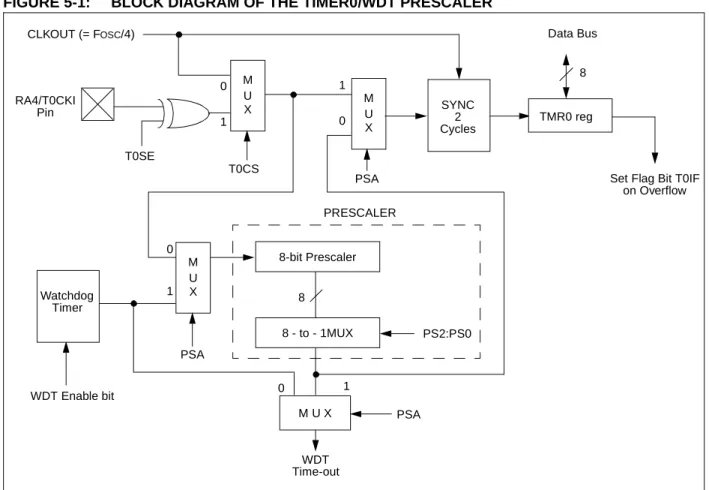
The OPTION_REG Register is a readable and writable register, which contains various control bits to configure the TMR0 prescaler/WDT postscaler (single assign-able register known also as the prescaler), the External INT Interrupt, TMR0 and the weak pull-ups on PORTB.
REGISTER 2-2: OPTION_REG REGISTER (ADDRESS 81h, 181h)
Note: To achieve a 1:1 prescaler assignment for the TMR0 register, assign the prescaler to the Watchdog Timer.
R/W-1 R/W-1 R/W-1 R/W-1 R/W-1 R/W-1 R/W-1 R/W-1
RBPU INTEDG T0CS T0SE PSA PS2 PS1 PS0 R = Readable bit W = Writable bit
U = Unimplemented bit, read as ‘0’
- n= Value at POR reset
bit7 bit0
bit 7: RBPU: PORTB Pull-up Enable bit
1 = PORTB pull-ups are disabled
0 = PORTB pull-ups are enabled by individual port latch values bit 6: INTEDG: Interrupt Edge Select bit
1 = Interrupt on rising edge of RB0/INT pin
0 = Interrupt on falling edge of RB0/INT pin bit 5: T0CS: TMR0 Clock Source Select bit
1 = Transition on RA4/T0CKI pin
0 = Internal instruction cycle clock (CLKOUT) bit 4: T0SE: TMR0 Source Edge Select bit
1 = Increment on high-to-low transition on RA4/T0CKI pin
0 = Increment on low-to-high transition on RA4/T0CKI pin bit 3: PSA: Prescaler Assignment bit
1 = Prescaler is assigned to the WDT
0 = Prescaler is assigned to the Timer0 module bit 2-0: PS2:PS0: Prescaler Rate Select bits
Note: When using low voltage ICSP programming (LVP) and the pull-ups on PORTB are enabled, bit 3 in the TRISB register must be cleared to disable the pull-up on RB3 and ensure the proper operation of the device.
000 001 010 011 100 101 110 111
1 : 2 1 : 4 1 : 8 1 : 16 1 : 32 1 : 64 1 : 128 1 : 256
2.2.2.3 INTCON REGISTER
The INTCON Register is a readable and writable regis-ter, which contains various enable and flag bits for the TMR0 register overflow, RB Port change and External RB0/INT pin interrupts.
REGISTER 2-3: INTCON REGISTER (ADDRESS 0Bh, 8Bh, 10Bh, 18Bh)
Note: Interrupt flag bits get set when an interrupt condition occurs, regardless of the state of its corresponding enable bit or the global enable bit, GIE (INTCON<7>). User soft-ware should ensure the appropriate inter-rupt flag bits are clear prior to enabling an interrupt.
R/W-0 R/W-0 R/W-0 R/W-0 R/W-0 R/W-0 R/W-0 R/W-x
GIE PEIE T0IE INTE RBIE T0IF INTF RBIF R = Readable bit W = Writable bit
U = Unimplemented bit, read as ‘0’
- n= Value at POR reset
bit7 bit0
bit 7: GIE: Global Interrupt Enable bit
1 = Enables all un-masked interrupts
0 = Disables all interrupts
bit 6: PEIE: Peripheral Interrupt Enable bit
1 = Enables all un-masked peripheral interrupts
0 = Disables all peripheral interrupts bit 5: T0IE: TMR0 Overflow Interrupt Enable bit
1 = Enables the TMR0 interrupt
0 = Disables the TMR0 interrupt
bit 4: INTE: RB0/INT External Interrupt Enable bit
1 = Enables the RB0/INT external interrupt
0 = Disables the RB0/INT external interrupt bit 3: RBIE: RB Port Change Interrupt Enable bit
1 = Enables the RB port change interrupt
0 = Disables the RB port change interrupt bit 2: T0IF: TMR0 Overflow Interrupt Flag bit
1 = TMR0 register has overflowed (must be cleared in software)
0 = TMR0 register did not overflow bit 1: INTF: RB0/INT External Interrupt Flag bit
1 = The RB0/INT external interrupt occurred (must be cleared in software)
0 = The RB0/INT external interrupt did not occur bit 0: RBIF: RB Port Change Interrupt Flag bit
1 = At least one of the RB7:RB4 pins changed state (must be cleared in software)
2.2.2.4 PIE1 REGISTER
The PIE1 register contains the individual enable bits for the peripheral interrupts.
REGISTER 2-4: PIE1 REGISTER (ADDRESS 8Ch)
Note: Bit PEIE (INTCON<6>) must be set to enable any peripheral interrupt.
R/W-0 R/W-0 R/W-0 R/W-0 R/W-0 R/W-0 R/W-0 R/W-0
PSPIE(1) ADIE RCIE TXIE SSPIE CCP1IE TMR2IE TMR1IE R = Readable bit W = Writable bit
U = Unimplemented bit, read as ‘0’
- n= Value at POR reset
bit7 bit0
bit 7: PSPIE(1): Parallel Slave Port Read/Write Interrupt Enable bit
1 = Enables the PSP read/write interrupt
0 = Disables the PSP read/write interrupt bit 6: ADIE: A/D Converter Interrupt Enable bit
1 = Enables the A/D converter interrupt
0 = Disables the A/D converter interrupt bit 5: RCIE: USART Receive Interrupt Enable bit
1 = Enables the USART receive interrupt
0 = Disables the USART receive interrupt bit 4: TXIE: USART Transmit Interrupt Enable bit
1 = Enables the USART transmit interrupt
0 = Disables the USART transmit interrupt
bit 3: SSPIE: Synchronous Serial Port Interrupt Enable bit
1 = Enables the SSP interrupt
0 = Disables the SSP interrupt bit 2: CCP1IE: CCP1 Interrupt Enable bit
1 = Enables the CCP1 interrupt
0 = Disables the CCP1 interrupt
bit 1: TMR2IE: TMR2 to PR2 Match Interrupt Enable bit
1 = Enables the TMR2 to PR2 match interrupt
0 = Disables the TMR2 to PR2 match interrupt bit 0: TMR1IE: TMR1 Overflow Interrupt Enable bit
1 = Enables the TMR1 overflow interrupt
0 = Disables the TMR1 overflow interrupt
2.2.2.5 PIR1 REGISTER
The PIR1 register contains the individual flag bits for the peripheral interrupts.
REGISTER 2-5: PIR1 REGISTER (ADDRESS 0Ch)
Note: Interrupt flag bits get set when an interrupt condition occurs, regardless of the state of its corresponding enable bit or the global enable bit, GIE (INTCON<7>). User soft-ware should ensure the appropriate inter-rupt bits are clear prior to enabling an interrupt.
R/W-0 R/W-0 R-0 R-0 R/W-0 R/W-0 R/W-0 R/W-0
PSPIF(1) ADIF RCIF TXIF SSPIF CCP1IF TMR2IF TMR1IF R = Readable bit W = Writable bit - n= Value at POR reset
bit7 bit0
bit 7: PSPIF(1): Parallel Slave Port Read/Write Interrupt Flag bit
1 = A read or a write operation has taken place (must be cleared in software) 0 = No read or write has occurred
bit 6: ADIF: A/D Converter Interrupt Flag bit
1 = An A/D conversion completed 0 = The A/D conversion is not complete bit 5: RCIF: USART Receive Interrupt Flag bit
1 = The USART receive buffer is full 0 = The USART receive buffer is empty bit 4: TXIF: USART Transmit Interrupt Flag bit
1 = The USART transmit buffer is empty 0 = The USART transmit buffer is full
bit 7: SSPIF: Synchronous Serial Port (SSP) Interrupt Flag
1 = The SSP interrupt condition has occurred, and must be cleared in software before returning from the interrupt ser-vice routine. The conditions that will set this bit are:
SPI
A transmission/reception has taken place. I2C Slave
A transmission/reception has taken place. I2C Master
A transmission/reception has taken place.
The initiated start condition was completed by the SSP module. The initiated stop condition was completed by the SSP module. The initiated restart condition was completed by the SSP module. The initiated acknowledge condition was completed by the SSP module. A start condition occurred while the SSP module was idle (Multimaster system). A stop condition occurred while the SSP module was idle (Multimaster system). 0 = No SSP interrupt condition has occurred.
bit 2: CCP1IF: CCP1 Interrupt Flag bit Capture Mode
1 = A TMR1 register capture occurred (must be cleared in software) 0 = No TMR1 register capture occurred
Compare Mode
1 = A TMR1 register compare match occurred (must be cleared in software) 0 = No TMR1 register compare match occurred
PWM Mode Unused in this mode
bit 1: TMR2IF: TMR2 to PR2 Match Interrupt Flag bit
2.2.2.6 PIE2 REGISTER
The PIE2 register contains the individual enable bits for the CCP2 peripheral interrupt, the SSP bus collision interrupt, and the EEPROM write operation interrupt.
REGISTER 2-6: PIE2 REGISTER (ADDRESS 8Dh)
U-0 R/W-0 U-0 R/W-0 R/W-0 U-0 U-0 R/W-0
— — — EEIE BCLIE — — CCP2IE R = Readable bit
W = Writable bit
U = Unimplemented bit, read as ‘0’
- n= Value at POR reset
bit7 bit0
bit 7: Unimplemented: Read as '0'
bit 6: Reserved: Always maintain this bit clear bit 5: Unimplemented: Read as '0'
bit 4: EEIE: EEPROM Write Operation Interrupt Enable
1 = Enable EE Write Interrupt
0 = Disable EE Write Interrupt bit 3: BCLIE: Bus Collision Interrupt Enable
1 = Enable Bus Collision Interrupt
0 = Disable Bus Collision Interrupt bit 2-1: Unimplemented: Read as '0' bit 0: CCP2IE: CCP2 Interrupt Enable bit
1 = Enables the CCP2 interrupt
2.2.2.7 PIR2 REGISTER
The PIR2 register contains the flag bits for the CCP2 interrupt, the SSP bus collision interrupt and the EEPROM write operation interrupt.
.
REGISTER 2-7: PIR2 REGISTER (ADDRESS 0Dh)
Note: Interrupt flag bits get set when an interrupt condition occurs, regardless of the state of its corresponding enable bit or the global enable bit, GIE (INTCON<7>). User soft-ware should ensure the appropriate inter-rupt flag bits are clear prior to enabling an interrupt.
U-0 R/W-0 U-0 R/W-0 R/W-0 U-0 U-0 R/W-0
— — — EEIF BCLIF — — CCP2IF R = Readable bit
W = Writable bit
U = Unimplemented bit, read as ‘0’
- n= Value at POR reset
bit7 bit0
bit 7: Unimplemented: Read as '0'
bit 6: Reserved: Always maintain this bit clear bit 5: Unimplemented: Read as '0'
bit 4: EEIF: EEPROM Write Operation Interrupt Flag bit
1 = The write operation completed (must be cleared in software)
0 = The write operation is not complete or has not been started bit 3: BCLIF: Bus Collision Interrupt Flag
1 = A bus collision has occurred in the SSP, when configured for I2C master mode
0 = No bus collision has occurred bit 2-1: Unimplemented: Read as '0' bit 0: CCP2IF: CCP2 Interrupt Flag bit
Capture Mode
1 = A TMR1 register capture occurred (must be cleared in software)
0 = No TMR1 register capture occurred Compare Mode
1 = A TMR1 register compare match occurred (must be cleared in software)
0 = No TMR1 register compare match occurred PWM Mode
2.2.2.8 PCON REGISTER
The Power Control (PCON) Register contains flag bits to allow differentiation between a Power-on Reset (POR), a Brown-out Reset (BOR), a Watch-dog Reset (WDT) and an external MCLR Reset.
REGISTER 2-8: PCON REGISTER (ADDRESS 8Eh)
Note: BOR is unknown on POR. It must be set by the user and checked on subsequent rests to see if BOR is clear, indicating a brown-out has occurred. The BOR status bit is a don’t care and is not predictable if the brown-out circuit is disabled (by clearing the BODEN bit in the configuration word).
U-0 U-0 U-0 U-0 U-0 U-0 R/W-0 R/W-1
— — — — — — POR BOR R = Readable bit
W = Writable bit
U = Unimplemented bit, read as ‘0’
- n= Value at POR reset
bit7 bit0
bit 7-2: Unimplemented: Read as '0' bit 1: POR: Power-on Reset Status bit
1 = No Power-on Reset occurred
0 = A Power-on Reset occurred (must be set in software after a Power-on Reset occurs) bit 0: BOR: Brown-out Reset Status bit
1 = No Brown-out Reset occurred
2.3 PCL and PCLATH
The program counter (PC) is 13-bits wide. The low byte comes from the PCL register, which is a readable and writable register. The upper bits (PC<12:8>) are not readable, but are indirectly writable through the PCLATH register. On any reset, the upper bits of the PC will be cleared. Figure 2-5 shows the two situations for the loading of the PC. The upper example in the figure shows how the PC is loaded on a write to PCL (PCLATH<4:0> → PCH). The lower example in the fig-ure shows how the PC is loaded during a CALL or GOTO
instruction (PCLATH<4:3> → PCH).
FIGURE 2-5: LOADING OF PC IN
DIFFERENT SITUATIONS
2.3.1 COMPUTED GOTO
A computed GOTO is accomplished by adding an offset to the program counter (ADDWF PCL). When doing a table read using a computed GOTO method, care should be exercised if the table location crosses a PCL memory boundary (each 256 byte block). Refer to the application note, “Implementing a Table Read" (AN556).
2.3.2 STACK
The PIC16CXX family has an 8-level deep x 13-bit wide hardware stack. The stack space is not part of either program or data space and the stack pointer is not readable or writable. The PC is PUSHed onto the stack when a CALL instruction is executed or an interrupt causes a branch. The stack is POPed in the event of a
RETURN,RETLW or a RETFIE instruction execution. PCLATH is not affected by a PUSH or POP operation.
2.4 Program Memory Paging
PIC16CXX devices are capable of addressing a contin-uous 8K word block of program memory. The CALL and
GOTO instructions provide only 11 bits of address to allow branching within any 2K program memory page. When doing a CALL or GOTO instruction, the upper 2 bits of the address are provided by PCLATH<4:3>. When doing a CALL or GOTO instruction, the user must ensure that the page select bits are programmed so that the desired program memory page is addressed. If a return from a CALL instruction (or interrupt) is exe-cuted, the entire 13-bit PC is popped off the stack. Therefore, manipulation of the PCLATH<4:3> bits are not required for the return instructions (which POPs the address from the stack)
Example 2-1 shows the calling of a subroutine in page 1 of the program memory. This example assumes that PCLATH is saved and restored by the interrupt ser-vice routine(if interrupts are used).
EXAMPLE 2-1: CALL OF A SUBROUTINE IN
PAGE 1 FROM PAGE 0
ORG 0x500
BCF PCLATH,4
BSF PCLATH,3 ;Select page 1 (800h-FFFh)
CALL SUB1_P1 ;Call subroutine in
: ;page 1 (800h-FFFh)
:
ORG 0x900 ;page 1 (800h-FFFh)
SUB1_P1
: ;called subroutine
: ;page 1 (800h-FFFh)
:
RETURN ;return to Call subroutine
;in page 0 (000h-7FFh)
PC
12 8 7 0
5 PCLATH<4:0>
PCLATH
Instruction with
ALU
GOTO,CALL
Opcode <10:0> 8
PC
12 11 10 0
11 PCLATH<4:3>
PCH PCL
8 7
2
PCLATH
PCH PCL
PCL as Destination
Note 1: There are no status bits to indicate stack overflow or stack underflow conditions. 2: There are no instructions/mnemonics
2.5 Indirect Addressing, INDF and FSR Registers
The INDF register is not a physical register. Addressing the INDF register will cause indirect addressing. Indirect addressing is possible by using the INDF reg-ister. Any instruction using the INDF register actually accesses the register pointed to by the File Select Reg-ister, FSR. Reading the INDF register itself indirectly (FSR = ’0’) will read 00h. Writing to the INDF register indirectly results in a no-operation (although status bits may be affected). An effective 9-bit address is obtained by concatenating the 8-bit FSR register and the IRP bit (STATUS<7>), as shown in Figure 2-6.
A simple program to clear RAM locations 20h-2Fh using indirect addressing is shown in Example 2-2.
EXAMPLE 2-2: INDIRECT ADDRESSING
movlw 0x20 ;initialize pointer
movwf FSR ;to RAM
NEXT clrf INDF ;clear INDF register
incf FSR,F ;inc pointer
btfss FSR,4 ;all done?
goto NEXT ;no clear next
CONTINUE
: ;yes continue
FIGURE 2-6: DIRECT/INDIRECT ADDRESSING
Note 1: For register file map detail see Figure 2-3. Data
Memory(1)
Indirect Addressing Direct Addressing
bank select location select
RP1:RP0 6 from opcode 0 IRP 7 FSR register 0
bank select location select
00 01 10 11
Bank 0 Bank 1 Bank 2 Bank 3
FFh 80h
7Fh 00h
17Fh 100h
3.0
I/O PORTS
Some pins for these I/O ports are multiplexed with an alternate function for the peripheral features on the device. In general, when a peripheral is enabled, that pin may not be used as a general purpose I/O pin. Additional information on I/O ports may be found in the PICmicro™ Mid-Range Reference Manual, (DS33023).
3.1 PORTA and the TRISA Register
PORTA is a 6-bit wide bi-directional port. The corre-sponding data direction register is TRISA. Setting a TRISA bit (=1) will make the corresponding PORTA pin an input (i.e., put the corresponding output driver in a hi-impedance mode). Clearing a TRISA bit (=0) will make the corresponding PORTA pin an output (i.e., put the contents of the output latch on the selected pin). Reading the PORTA register reads the status of the pins, whereas writing to it will write to the port latch. All write operations are read-modify-write operations. Therefore, a write to a port implies that the port pins are read, the value is modified and then written to the port data latch.
Pin RA4 is multiplexed with the Timer0 module clock input to become the RA4/T0CKI pin. The RA4/T0CKI pin is a Schmitt Trigger input and an open drain output. All other PORTA pins have TTL input levels and full CMOS output drivers.
Other PORTA pins are multiplexed with analog inputs and analog VREF input. The operation of each pin is selected by clearing/setting the control bits in the ADCON1 register (A/D Control Register1).
The TRISA register controls the direction of the RA pins, even when they are being used as analog inputs. The user must ensure the bits in the TRISA register are maintained set when using them as analog inputs.
EXAMPLE 3-1: INITIALIZING PORTA
BCF STATUS, RP0 ;
BCF STATUS, RP1 ; Bank0
CLRF PORTA ; Initialize PORTA by
; clearing output ; data latches
BSF STATUS, RP0 ; Select Bank 1
MOVLW 0x06 ; Configure all pins
MOVWF ADCON1 ; as digital inputs
MOVLW 0xCF ; Value used to
; initialize data ; direction
MOVWF TRISA ; Set RA<3:0> as inputs
; RA<5:4> as outputs ; TRISA<7:6> are always ; read as ’0’.
FIGURE 3-1: BLOCK DIAGRAM OF
RA3:RA0 AND RA5 PINS
FIGURE 3-2: BLOCK DIAGRAM OF RA4/
T0CKI PIN
Note: On a Power-on Reset, these pins are con-figured as analog inputs and read as '0'.
Data Bus Q D Q CK Q D Q CK Q D EN P N WR Port WR TRIS Data Latch TRIS Latch RD TRIS RD PORT VSS VDD
I/O pin(1)
Note 1: I/O pins have protection diodes to VDD and VSS. Analog Input Mode TTL Input Buffer
To A/D Converter
Data Bus WR PORT WR TRIS RD PORT Data Latch TRIS Latch RD TRIS Schmitt Trigger Input Buffer N VSS
I/O pin(1)
TMR0 clock input Q D Q CK Q D Q CK EN Q D EN
TABLE 3-1: PORTA FUNCTIONS
TABLE 3-2: SUMMARY OF REGISTERS ASSOCIATED WITH PORTA
Name Bit# Buffer Function
RA0/AN0 bit0 TTL Input/output or analog input RA1/AN1 bit1 TTL Input/output or analog input RA2/AN2 bit2 TTL Input/output or analog input RA3/AN3/VREF bit3 TTL Input/output or analog input or VREF
RA4/T0CKI bit4 ST Input/output or external clock input for Timer0 Output is open drain type
RA5/SS/AN4 bit5 TTL Input/output or slave select input for synchronous serial port or analog input Legend: TTL = TTL input, ST = Schmitt Trigger input
Address Name Bit 7 Bit 6 Bit 5 Bit 4 Bit 3 Bit 2 Bit 1 Bit 0
Value on: POR,
BOR
Value on all other resets
05h PORTA — — RA5 RA4 RA3 RA2 RA1 RA0 --0x 0000 --0u 0000
85h TRISA — — PORTA Data Direction Register --11 1111 --11 1111
9Fh ADCON1 ADFM — — — PCFG3 PCFG2 PCFG1 PCFG0 --0- 0000 --0- 0000
Legend:x = unknown, u = unchanged, - = unimplemented locations read as '0'. Shaded cells are not used by PORTA.
3.2 PORTB and the TRISB Register
PORTB is an 8-bit wide, bi-directional port. The corre-sponding data direction register is TRISB. Setting a TRISB bit (=1) will make the corresponding PORTB pin an input (i.e., put the corresponding output driver in a hi-impedance mode). Clearing a TRISB bit (=0) will make the corresponding PORTB pin an output (i.e., put the contents of the output latch on the selected pin). Three pins of PORTB are multiplexed with the Low Volt-age Programming function; RB3/PGM, RB6/PGC and RB7/PGD. The alternate functions of these pins are described in the Special Features Section.
Each of the PORTB pins has a weak internal pull-up. A single control bit can turn on all the pull-ups. This is per-formed by clearing bit RBPU (OPTION_REG<7>). The weak pull-up is automatically turned off when the port pin is configured as an output. The pull-ups are dis-abled on a Power-on Reset.
FIGURE 3-3: BLOCK DIAGRAM OF
RB3:RB0 PINS
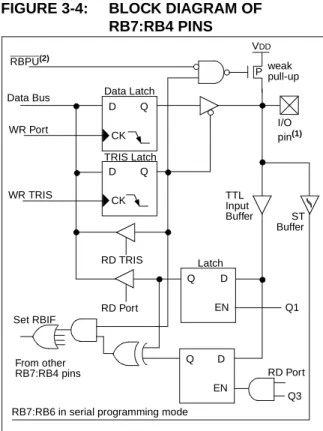
Four of PORTB’s pins, RB7:RB4, have an interrupt on change feature. Only pins configured as inputs can cause this interrupt to occur (i.e. any RB7:RB4 pin con-figured as an output is excluded from the interrupt on change comparison). The input pins (of RB7:RB4) are compared with the old value latched on the last read of PORTB. The “mismatch” outputs of RB7:RB4 are OR’ed together to generate the RB Port Change Inter-rupt with flag bit RBIF (INTCON<0>).
This interrupt can wake the device from SLEEP. The user, in the interrupt service routine, can clear the inter-rupt in the following manner:
a) Any read or write of PORTB. This will end the mismatch condition.
b) Clear flag bit RBIF.
A mismatch condition will continue to set flag bit RBIF. Reading PORTB will end the mismatch condition and allow flag bit RBIF to be cleared.
The interrupt on change feature is recommended for wake-up on key depression operation and operations where PORTB is only used for the interrupt on change feature. Polling of PORTB is not recommended while using the interrupt on change feature.
This interrupt on mismatch feature, together with soft-ware configureable pull-ups on these four pins, allow easy interface to a keypad and make it possible for wake-up on key-depression. Refer to the Embedded Control Handbook, “Implementing Wake-Up on Key Stroke” (AN552).
RB0/INT is an external interrupt input pin and is config-ured using the INTEDG bit (OPTION_REG<6>). RB0/INT is discussed in detail in Section 12.10.1.
FIGURE 3-4: BLOCK DIAGRAM OF
RB7:RB4 PINS Data Latch RBPU(2) P VDD Q D CK Q D CK Q D EN Data Bus WR Port WR TRIS RD TRIS RD Port weak pull-up RD Port RB0/INT I/O pin(1) TTL Input Buffer Schmitt Trigger Buffer TRIS Latch
Note 1: I/O pins have diode protection to VDD and VSS. 2: To enable weak pull-ups, set the appropriate TRIS bit(s)
and clear the RBPU bit (OPTION_REG<7>). RB3/PGM Data Latch From other RBPU(2) P VDD I/O Q D CK Q D CK Q D EN Q D EN Data Bus WR Port WR TRIS Set RBIF TRIS Latch RD TRIS RD Port RB7:RB4 pins weak pull-up RD Port Latch TTL Input Buffer pin(1) ST Buffer
RB7:RB6 in serial programming mode
Q3 Q1
Note 1: I/O pins have diode protection to VDD and VSS. 2: To enable weak pull-ups, set the appropriate TRIS bit(s)
and clear the RBPU bit (OPTION_REG<7>).
TABLE 3-3: PORTB FUNCTIONS
TABLE 3-4: SUMMARY OF REGISTERS ASSOCIATED WITH PORTB
Name Bit# Buffer Function
RB0/INT bit0 TTL/ST(1) Input/output pin or external interrupt input. Internal software programmable weak pull-up.
RB1 bit1 TTL Input/output pin. Internal software programmable weak pull-up. RB2 bit2 TTL Input/output pin. Internal software programmable weak pull-up. RB3/PGM bit3 TTL Input/output pin or programming pin in LVP mode. Internal software
programmable weak pull-up.
RB4 bit4 TTL Input/output pin (with interrupt on change). Internal software programmable weak pull-up.
RB5 bit5 TTL Input/output pin (with interrupt on change). Internal software programmable weak pull-up.
RB6/PGC bit6 TTL/ST(2) Input/output pin (with interrupt on change) or In-Circuit Debugger pin. Internal software programmable weak pull-up. Serial programming clock. RB7/PGD bit7 TTL/ST(2) Input/output pin (with interrupt on change) or In-Circuit Debugger pin.
Internal software programmable weak pull-up. Serial programming data. Legend: TTL = TTL input, ST = Schmitt Trigger input
Note 1: This buffer is a Schmitt Trigger input when configured as the external interrupt. 2: This buffer is a Schmitt Trigger input when used in serial programming mode.
Address Name Bit 7 Bit 6 Bit 5 Bit 4 Bit 3 Bit 2 Bit 1 Bit 0
Value on: POR, BOR
Value on all other resets
06h, 106h PORTB RB7 RB6 RB5 RB4 RB3 RB2 RB1 RB0 xxxx xxxx uuuu uuuu
86h, 186h TRISB PORTB Data Direction Register 1111 1111 1111 1111
81h, 181h OPTION_REG RBPU INTEDG T0CS T0SE PSA PS2 PS1 PS0 1111 1111 1111 1111
3.3 PORTC and the TRISC Register
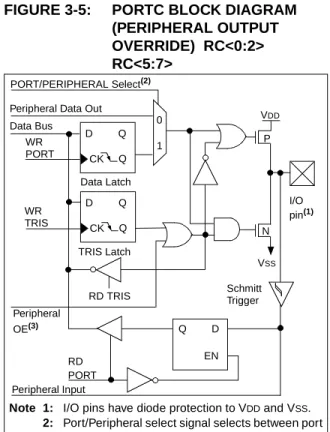
PORTC is an 8-bit wide, bi-directional port. The corre-sponding data direction register is TRISC. Setting a TRISC bit (=1) will make the corresponding PORTC pin an input (i.e., put the corresponding output driver in a hi-impedance mode). Clearing a TRISC bit (=0) will make the corresponding PORTC pin an output (i.e., put the contents of the output latch on the selected pin). PORTC is multiplexed with several peripheral functions (Table 3-5). PORTC pins have Schmitt Trigger input buffers.
When the I2C module is enabled, the PORTC (3:4) pins can be configured with normal I2C levels or with SMBUS levels by using the CKE bit (SSPSTAT <6>). When enabling peripheral functions, care should be taken in defining TRIS bits for each PORTC pin. Some peripherals override the TRIS bit to make a pin an out-put, while other peripherals override the TRIS bit to make a pin an input. Since the TRIS bit override is in effect while the peripheral is enabled, read-modify-write instructions (BSF, BCF, XORWF) with TRISC as destination should be avoided. The user should refer to the corresponding peripheral section for the correct TRIS bit settings.
FIGURE 3-5: PORTC BLOCK DIAGRAM
(PERIPHERAL OUTPUT OVERRIDE) RC<0:2> RC<5:7>
FIGURE 3-6: PORTC BLOCK DIAGRAM
(PERIPHERAL OUTPUT OVERRIDE) RC<3:4>
PORT/PERIPHERAL Select(2)
Data Bus WR PORT WR TRIS RD Data Latch TRIS Latch
RD TRIS SchmittTrigger Q D Q CK Q D EN Peripheral Data Out
0 1 Q D Q CK P N VDD VSS PORT Peripheral OE(3) Peripheral Input I/O pin(1)
Note 1: I/O pins have diode protection to VDD and VSS. 2: Port/Peripheral select signal selects between port
data and peripheral output.
3: Peripheral OE (output enable) is only activated if peripheral select is active.
PORT/PERIPHERAL Select(2)
Data Bus WR PORT WR TRIS RD Data Latch TRIS Latch
RD TRIS SchmittTrigger Q D Q CK Q D EN Peripheral Data Out
0 1 Q D Q CK P N VDD Vss PORT Peripheral OE(3) SSPl Input I/O pin(1)
Note 1: I/O pins have diode protection to VDD and VSS. 2: Port/Peripheral select signal selects between port
data and peripheral output.
3: Peripheral OE (output enable) is only activated if peripheral select is active.
TABLE 3-5: PORTC FUNCTIONS
TABLE 3-6: SUMMARY OF REGISTERS ASSOCIATED WITH PORTC
Name Bit# Buffer Type Function
RC0/T1OSO/T1CKI bit0 ST Input/output port pin or Timer1 oscillator output/Timer1 clock input RC1/T1OSI/CCP2 bit1 ST Input/output port pin or Timer1 oscillator input or Capture2 input/
Compare2 output/PWM2 output
RC2/CCP1 bit2 ST Input/output port pin or Capture1 input/Compare1 output/PWM1 output
RC3/SCK/SCL bit3 ST RC3 can also be the synchronous serial clock for both SPI and I2C modes.
RC4/SDI/SDA bit4 ST RC4 can also be the SPI Data In (SPI mode) or data I/O (I2C mode). RC5/SDO bit5 ST Input/output port pin or Synchronous Serial Port data output
RC6/TX/CK bit6 ST Input/output port pin or USART Asynchronous Transmit or Synchro-nous Clock
RC7/RX/DT bit7 ST Input/output port pin or USART Asynchronous Receive or Synchro-nous Data
Legend: ST = Schmitt Trigger input
Address Name Bit 7 Bit 6 Bit 5 Bit 4 Bit 3 Bit 2 Bit 1 Bit 0
Value on: POR,
BOR
Value on all other resets
07h PORTC RC7 RC6 RC5 RC4 RC3 RC2 RC1 RC0 xxxx xxxx uuuu uuuu
87h TRISC PORTC Data Direction Register 1111 1111 1111 1111
3.4 PORTD and TRISD Registers
This section is not applicable to the PIC16F873 or PIC16F876.
PORTD is an 8-bit port with Schmitt Trigger input buff-ers. Each pin is individually configurable as an input or output.
PORTD can be configured as an 8-bit wide micropro-cessor port (parallel slave port) by setting control bit PSPMODE (TRISE<4>). In this mode, the input buffers are TTL.
FIGURE 3-7: PORTD BLOCK DIAGRAM (IN
I/O PORT MODE)
TABLE 3-7: PORTD FUNCTIONS
TABLE 3-8: SUMMARY OF REGISTERS ASSOCIATED WITH PORTD
Data Bus
WR PORT
WR TRIS
RD PORT
Data Latch
TRIS Latch
RD TRIS
Schmitt Trigger Input Buffer
I/O pin(1)
Note 1: I/O pins have protection diodes to VDD and VSS. Q
D
CK
Q D
CK
EN
Q D
EN
Name Bit# Buffer Type Function
RD0/PSP0 bit0 ST/TTL(1) Input/output port pin or parallel slave port bit0 RD1/PSP1 bit1 ST/TTL(1) Input/output port pin or parallel slave port bit1 RD2/PSP2 bit2 ST/TTL(1) Input/output port pin or parallel slave port bit2 RD3/PSP3 bit3 ST/TTL(1) Input/output port pin or parallel slave port bit3 RD4/PSP4 bit4 ST/TTL(1) Input/output port pin or parallel slave port bit4 RD5/PSP5 bit5 ST/TTL(1) Input/output port pin or parallel slave port bit5 RD6/PSP6 bit6 ST/TTL(1) Input/output port pin or parallel slave port bit6 RD7/PSP7 bit7 ST/TTL(1) Input/output port pin or parallel slave port bit7 Legend: ST = Schmitt Trigger input TTL = TTL input
Note 1: Input buffers are Schmitt Triggers when in I/O mode and TTL buffer when in Parallel Slave Port Mode.
Address Name Bit 7 Bit 6 Bit 5 Bit 4 Bit 3 Bit 2 Bit 1 Bit 0
Value on: POR,
BOR
Value on all other resets
08h PORTD RD7 RD6 RD5 RD4 RD3 RD2 RD1 RD0 xxxx xxxx uuuu uuuu
88h TRISD PORTD Data Direction Register 1111 1111 1111 1111
89h TRISE IBF OBF IBOV PSPMODE — PORTE Data Direction Bits 0000 -111 0000 -111