Original Article
Morphometric variation among three local mangrove clam species
of Corbiculidae
Hadi Hamli*, Azimah Abdul Rahim, Mohd Hanafi Idris, Abu Hena Mustafa Kamal, and Wong Sing King
Department of Animal Science and Fishery, Faculty of Agriculture and Food Sciences, Universiti Putra Malaysia, Bintulu Sarawak Campus,
P.O. Box 396, Nyabau Road, Bintulu, Sarawak, 97008 Malaysia.
Received: 12 March 2014; Accepted: 8 December 2014
Abstract
Three common species of Corbiculidae (Polymesda erosa, P. bengalensis and P. expansa) can be found inhabiting the mangrove areas in Southeast Asia. The morphometric variations of three species were examined based on 15 morphometric characters. A total of 16 populations from six localities were analyzed in the present study. Analysis of variance had revealed significant differences (P<0.05) for LCT/SL and VPM/SL for proportion ratio on morphometric variables among species. Cluster analysis for these populations formed two groups at 70% of similarity. Morphometric characteristics, such as LCT and VPM, of Corbiculidae are proposed to differentiate these three species.
Keywords: Corbiculidae, morphometric analysis, mangrove clam, Sarawak, wetland
1. Introduction
Corbiculidae is grouped under bivalvia class, heterodonta subclass (Okutani, 2000). One of the important characters that are used to differentiate them with other bivalve family is the present of heterodon type of tooth at the hinge of the shell. There are four common species in Southeast Asia, Polymesoda erosa, Polymesoda expansa,
Polymesoda bengalensis and Batissa violacea (Morton,
1984). Few studies on Corbiculidae such as food effect to
Polymesoda erosa were conducted on Corbiculidae at the
Southeast Asia region (Supriyantini et al., 2007), isolation of
Vibrio sp. gene from Corbicula moltkiana (Marlina et al., 2007), and a review of Polymesoda (Morton, 1984) have indicated the importance of this family in a malacology study. Those four species distribute in the Indo-West Pacific from India to Vanuatu, north to southern island of Japan, south to Queensland and New Caledonia (Poutiers, 1998).
Corbiculidae can be found in the mangrove area because it is a suitable place to support many types of organisms and a source of plenty of nutrients (Macintosh et al., 2002). Malaysia has several places with mangrove such as Sarawak mangrove forest which covers 173,792 ha from the total of land (Paul, 2011). It was reported that Corbiculidae was found at Sabah (Hashim, 1993; Supian and Ikhwanudin, 2002) and at the west coast of Peninsular Malaysia (Abu Hena et al., 2004).
Morton (1984) proposed that these four species can be differentiated based on the hinge structure. Identifying species based on morphology character is easier, cheaper, and faster compared to genetic identification. Many other studies were conducted based on shell characters and size for species identification. However, both characters are not enough to differentiate Corbiculidae species because of the environ-mental variables effect (Fuiman et al., 1999; Akester and Martel, 2000). Morphometric characteristics can be used to differentiate two different species of Pinnidae as described by Idris et al. (2009). The morphometric method can be used with other methods such as, to identify relationship between morphometric measurement with anatomical character for
* Corresponding author.
Email address: [email protected]
Corbicula taxonomic clarification and distribution (Araujo et al., 1993). Other methods involve morphological techniques supported with molecular genetics in order to assess mussel populations (Mass et al., 1999). The combination with other method is to specify the identified species. However there is no study on Corbiculidae family particularly on the mor-phology and morphometric characters from Sarawak region. Thus, the present study aimed to fill the information gap on this family by determining the morphometric differences between Corbiculidae species that exist in the mangrove areas of this region.
2. Materials and Methods
2.1 Locality
The study was carried out in seven localities (Figure 1) in Sarawak: Kuching (N 01°33.094' E 110°20.256'), Sibu (N 02°17.335' E 111°49.756'), Mukah (N 02°58.837' E 112°05.751'), Bintulu (N 03°10.250' E. 113°02.393'), Miri (N 03°23.526' E 113°59.142'), Limbang (N 04°46.864' E 115°02.539'), and Lawas (N 04°54.902' E 115°13.506') between July 2010 and January 2012. Study sites at the Kuching, Sibu, Mukah and Bintulu localities are located at the south of Sarawak area with pH range between 7.36-7.49, 6.46-6.67, 7.83-7.84, and 7.52-7.90, respectively. The North of Sarawak sites are represented by Miri, Limbang, and Lawas localities with pH range between 6.03-6.07, 6.53-6.59, and 6.93-6.99, respectively. These locali-ties are mangrove forest covered with brackish water during high tide.
2.2 Morphometric and morphology characteristics
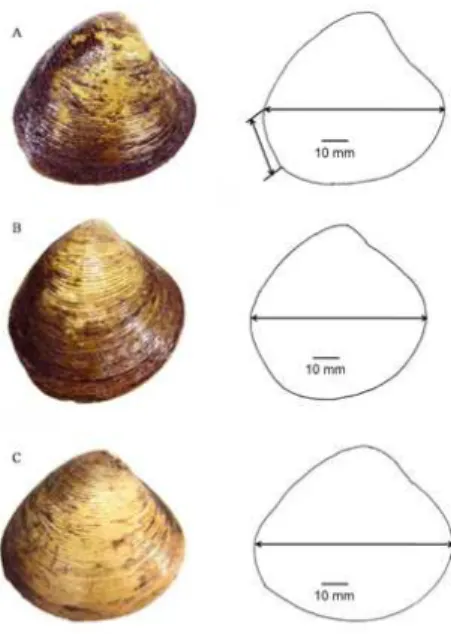
A total of 436 individuals of matured Polymesoda erosa, P. expansa and P. bengalensis were collected from the natural habitats. Samples preserved under freeze point before identification based on Morton (1984), Poutiers (1998), and Hamli et al. (2012). A total of 14 characters were used to study morphometric characteristics, which are ratio to standard length (SL) based on Scheltema (1983) and Idris et al. (2008). Five general characters: shell height (SH), shell width (SW), umbo length (UL), anterior length (AL), and posterior length (PL) (Mass et al., 1999) were examined. Moreover nine additional characters: ligament length (LL), cardinal tooth length (LCT), anterior adductor muscle scar width (AW), posterior adductor muscle scar width (PW), length from anterior adductor muscle scar to posterior adductor muscle scar (LPAS), length from anterior adductor muscle scar to anterior margin (AAAM), length from posterior adductor muscle scar to posterior margin (PAPM), length from ventral margin to pallial line (PVM), and ventral posterior margin length (VPM) were also included in the analysis (Figure 2). In the addition shape of each shell were observed and recorded qualitatively.
2.3 Statistical analysis
The ratio of morphometric variables were tested with one way analysis of variance (ANOVA) with general linear model (GLM) by using statistical analysis computer software (SAS) version 9.1 (SAS Institute, 2004). Tukey mean com-parison was used to determine which of the characters were significantly different from others. Clustering by Bray-Curtis similarity distance at 70% analysis was carried out based on Nurul Amin et al. (2010) by using computer program PRIMER version 5 (Plymouth Routines In Multivariate Ecological Research) (Clarke and Gorley, 2001).
Figure 1. Seven different localities of three Polymesoda species.
3. Results
3.1 Morphometric and morphology
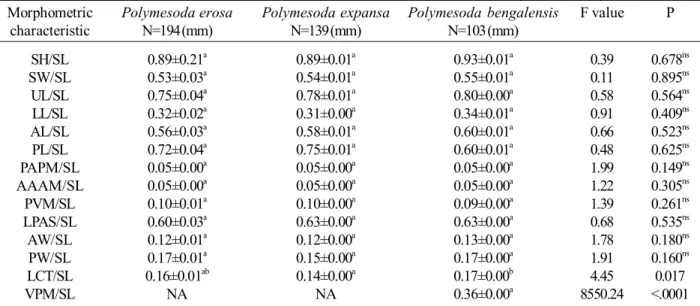
Results on shell measurement and their ratios was significantly different (P<0.05) between P. erosa, P. expansa,
and P. bengalensis (Table 1). The ratio on cardinal tooth length to standard length (LCT/SL) showed significant differ-ences on the mean value. Other morphometric characteristics were indicated non-significant differences among three species. Mean value of LCT/SL for P. bengalensis was higher than P. expansa and P. erosa with 0.17±0.00 mm, 0.14±0.00 mm, and 0.16±0.00 mm respectively (Figure 3). Polymesoda
bengalensis isthe only species that presents VPM characters
and that therefore was available for VPM/SL (Figure 4). In terms of morphology, P. erosa has subrhomboidal-ovate shell shape which is very different compared to P. expansa
that has shell expand posteriorly and P. bengalensis with subtrigonal shell shape.
3.2 Cluster analysis
A total of 16 populations of P. erosa, P. bengalensis
and P. expansa were tested for cluster analysis. Two groups of clusters have been formed through similarity based on LCT and VPM morphometric characteristics (Figure 5).
Group 1 comprised of P. bengalensis from Kuching, Bintulu, Miri, Lawas, Limbang, and Sibu locality. Group 2 comprised of P. expansa (Miri, Bintulu, Lawas and Limbang) and
P. erosa (Limbang, Lawas, Miri, Sibu, Mukah and Bintulu).
3.3 Dichotomus key for polymesoda spp.
Polymesoda genus from Sarawak was categorized into
three species, P. erosa, P. expansa, and P. bengalensis based on morphology and morphometric characteristics. The particular identification key of mangrove clam as listed below: 1. Shell peculiarly presence of ventral posterior margin
Polymesoda bengalensis
2. Shell absence of ventral posterior margin
(Refer to number 3) 3. Shell expanded posteriorly in outline
P. expansa
4. Shell subrhomboidal-ovate in outline
P. erosa
4. Discussion
The propotion of LCT/SL is significantly diverse between P. bengalensis (0.17±0.00 mm) and P. expansa
(0.14±0.00 mm) (Table 1). However, the proportion of VPM/ SL is applicable only to P. bengalensis. Both of these
charac-Table 1. Analysis of one way ANOVA with general linear model (GLM) for 14 morphometric characteristic proportion with standard length of three Polymesoda species.
Morphometric Polymesoda erosa Polymesoda expansa Polymesoda bengalensis F value P characteristic N=194 (mm) N=139 (mm) N=103 (mm)
SH/SL 0.89±0.21a 0.89±0.01a 0.93±0.01a 0.39 0.678ns
SW/SL 0.53±0.03a 0.54±0.01a 0.55±0.01a 0.11 0.895ns
UL/SL 0.75±0.04a 0.78±0.01a 0.80±0.00a 0.58 0.564ns
LL/SL 0.32±0.02a 0.31±0.00a 0.34±0.01a 0.91 0.409ns
AL/SL 0.56±0.03a 0.58±0.01a 0.60±0.01a 0.66 0.523ns
PL/SL 0.72±0.04a 0.75±0.01a 0.60±0.01a 0.48 0.625ns
PAPM/SL 0.05±0.00a 0.05±0.00a 0.05±0.00a 1.99 0.149ns
AAAM/SL 0.05±0.00a 0.05±0.00a 0.05±0.00a 1.22 0.305ns
PVM/SL 0.10±0.01a 0.10±0.00a 0.09±0.00a 1.39 0.261ns
LPAS/SL 0.60±0.03a 0.63±0.00a 0.63±0.00a 0.68 0.535ns
AW/SL 0.12±0.01a 0.12±0.00a 0.13±0.00a 1.78 0.180ns
PW/SL 0.17±0.01a 0.15±0.00a 0.17±0.00a 1.91 0.160ns
LCT/SL 0.16±0.01ab 0.14±0.00a 0.17±0.00b 4.45 0.017
VPM/SL NA NA 0.36±0.00a 8550.24 <.0001
SL=Standard length, SH=Shell height , SW=Shell width, UL=Umbo length, LL=Ligament length, AL=Anterior length, PL=Posterior length, PAPM=Posterior adductor scar to posterior margin, AAAM=Anterior adductor scar to anterior margin, PVM=Pallial line to ventral margin, LPAS=Length of posterior adductor scar to anterior adductor scar, AW= Anterior adductor scar width, PW=Posterior adductor scar width, LCT=Cardinal tooth lenght, VPM=Ventral posterior margin length, NA=Not available.
ters (LCT and VPM) are unable to differentiate between
P. erosa and P. expansa. Idris et al. (2009) reported that the ratio on width and total length was able to differentiate
Pinna bicolor and P. deltodes which is contradictory to the present study. This suggests LCT can be used to differentiate between P. bengalensis and P. expansa. Meanwhile the VPM character is unique for P. bengalensis so that it can be used to differentiate P. erosa and P. expansa. Similar morphometric characteristics between P. erosa and P. expansa might be caused by the abiotic factor such as shallow habitat which is reported by Lajtner et al. (2004). Shallower habitat can produce a higher ratio of shell length and shell width compared to deeper habitat (Lajtner et al., 2004). Hamli et al.
(2012) reported that P. bengalensis, P. erosa, and P. expansa
were found to inhabit similar localities which may cause the shell character during growth to be comparable. The only character to differentiate between P. erosa and P. expansa
are by morphological observation based on Poutiers (1998).
Polymesoda erosa has subrhomboidal-ovate shape compared
to P. expansa that has expanded posteriorly (Figure 2).
Polymesoda bengalensis has a shell with subtrigonal shape
compared to P. erosa and P. expansa. Mangrove clam also were potentially rendering to desiccation and variable range of salinities which might be able alter the shell outline (Gimin, 2004).
A cluster analysis of 16 Polymesoda localities were separated into two groups which is a group of P. bengalensis
and the other group comprise of P. erosa and P. expansa.
Polymesoda erosa and P. expansa were grouped in the
similar cluster due to similar characteristics of LCT and VPM. This is in agreement with Morton (1984) who states that the two species Geloina erosa and G. expansa were hard to differentiate. Similar abiotic properties in a habitat probably cause high similarities in morphometric characteristic between two Polymesoda species of different localities. Moreover the presence of salinity, total suspended solid, pH, ferrous, and ferric iron affected the abundance of bivalve at the particular habitat (Tanyaros and Tongnunui, 2011). The range of pH for every locality of Polymesoda mentioned at the locality
Figure 3. Photo on Cardinal tooth lenght (A) P. bengalensis, (B) P. erosa, (C) P. expansa.
Figure 4. Photo sketch of morphometric ratio on ventral posterior margin (VPM/SL). (A) P. bengalensis, (B) P. erosa and (C) P. expansa.
section was slightly different probably affecting shell outline of P. erosa and P. expansa. Bivalve shells especially from mangrove area are vulnerable to erosive effects of the acid mangal soil (Morton, 1984). However, salinity condition does not affected to the P. bengalensis population,maybe due to its strong shell feature such as ventral posterior margin which is grouped P. bengalensis in the same clade. Hiebenthal et al.
(2012) has reported that salinity less affect to the bivalve shell formation.
Present morphometric characteristics investigation can be used to differentiate different species that are known and same species from different populations. Through this morphometric analysis differences morphological character-istics between species have been revealed. The present study provides new taxonomic characters that can be applied in the key of these three species. It is important to apply these characters for species identification because it is a fast, cheap and efficient method. Furthermore, additional genetic iden-tifications can help to reveal the species identity.
Acknowledgements
The authors would like to thank the Dean and staffs of the Department of Animal Science and Fishery, Faculty of Agriculture and Food Sciences, Universiti Putra Malaysia Bintulu Sarawak Campus, Malaysia for technical, logistic supports, and laboratory facilities provided. H.H would like to thank the Ministry of Education, for a research grant (5523703 FRGS and 9199876 RUGS).
References
Abu Hena, M.K., Hisamuddin, O., Misri, K., Abdullah F. and Loo, K.K. 2004. Benthic faunal composition of
Penaeus monodon Fabricius Culture pond West Coast
of Peninsular Malaysia. Journal of Biological Sciences. 4(5), 631–636.
Akester, R.J. and Martel, A.L. 2000. Shell shape, dysodont tooth morphology, and hinge ligament thickness in the bay mussel Mytilus trossulus correlate with wave exposure. Canadian Journal of Zoological. 78, 240– 253.
Araujo, R., Moreno, D. and Ramos, M.A. 1993. The asiatic clam Corbicula fluminea (Muller 1774) (Bivalvia: Corbiculidae) in Europe. American Malacological Bullein. 10(1), 39–49.
Clarke, K.R. and Gorley, R.N. 2001. Primer Version 5. Primer-E, Plymouth, UK.
Fuiman, L.A., Gage, J.D. and Lamont, P.A. 1999. Shell Morphometry of deep sea protobranch bivalve Ledella pustulosa in the Rockall Trough, North- East Atlantic. Journal of the Marine Biological Association of the United Kingdom. 79, 661–671.
Gimin, R., Mohan, R., Thinh, L.V. and Griffiths, A.D. 2004. The relationship of shell dimensions and shell volume
to live weight and soft tissue weight in the mangrove clam, Polymesoda erosa (Solander, 1786) from northern Australia. NAGA, Worldfish Center Quarterly. 27(3&4), 32–35.
Hamli, H., Idris, M.H., Abu Hena M.K. and Wong, S.K. 2012. Taxonomic study of edible bivalve from selected divi-sion of Sarawak. International Journal of Zoological Research. 8(1), 52–58.
Hashim, R. 1993.Sumber makanan laut pesisiran laut Sabah. Dewan Bahasa dan Pustaka, pp. 309.
Hiebenthal, C., Philipp, E.E.R., Eisenhauer, A. and Whal, M. 2012. Interactive effects of temperature and salinity on shell formation and general condition in Baltic Sea
Mytilus edulis and Arctica islandica. Aquatic Bio-logy. 14, 289–298.
Idris, M.H., Arshad, A., Japar Sidik, B., Mazlan, A.G. and Daud, S.K. 2008. Morphometric analysis as an appli-cation tool to differentiate three local pen shell species. Pertanika Journal of Tropical Agriculture Science. 31(2), 387–398.
Idris, M.H., Arshad, A., Japar Sidik, B., Mazlan, A.G. and Daud. S.K. 2009. Morphological characteristics of
Pinna bicolor Gmelin and Pinna deltodes Menke
from seagrass bed of Sungai Pulai, Johor, Peninsular Malaysia. Sains Malaysiana. 38(3), 333–339.
Lajtner, J., Marusic, Z., Klobucar, G.I.V., Maguire, I. and Erben, R. 2004. Comparative shell morphology of the zebra mussel, Dreissena polymorpha in the Drava river (Croatia). Biologia. 59, 595–600.
Macintosh, D.J., Ashton, E.C. and Havanon, S. 2002. Mangrove rehabilitation and intertidal biodiversity: A Study in the Ranong Mangrove ecosystem Thai-land.Estuarine Coastal and Shelf Science. 55, 331– 345.
Marlina, Radu, S., Kqueen, C.Y., Napis, S., Zakaria, Z., Mutalib, S.A. and Nishibushi, M. 2007. Detection of TDH and TRH gene in Vibrio Parahaemolyticus
isolated from Corbicula Moltkiana prime in West Sumatera, Indonesia. Southeast Asian Journal Tropi-cal Medicine and Public Health. 38(2), 349–355. Mass, P.A.Y., O’Mullan, G.D., Lutz, R.A. and Vrijenhoek. R.C.
1999. Genetic and morphometric characterization of mussels (Bivalvia: Mytilidae) from Mid-Atlantic hydrothermal vents. Biological Bulletin. 196, 265–272. Morton, B.A. 1984. Review of Polymesoda (Geloina) Gray 1842 (Bivalvia: Corbiculacea) from Indo-Pacific Mangroves. Asian Marine Biology.1, 77–86.
Nurul Amin, S.M., Arshad, A., Ismail, N.H., Idris, M.H., Japar Sidik, B. and Siraj, S.S. 2010. Morphometric variation among the three species of genus Acetes (Decapoda: Sergestidae) in the coastal waters of Malacca, Penin-sular Malaysia. Pertanika Journal of Tropical Agri-culture Science. 33(2), 341–347.
Paul, C.P.K. 2011. Management of Mangrove Forest of Sarawak. Available from: http://www.sarwakforestry. com/pdf/hj7-wetland10.pdf. [August, 20 2011]. Poutiers, M. 1998. Bivalve. In The living marine resources of
the Western Central Pacific. FAO Species Identifica-tion Guide for Fishery Purpose, K.E. Carpenter and V. H. Niem, editors. Vol. 1. Food and Agriculture Orga-nization of the United Nations, Rome, Italy, pp 123– 362.
SAS® Institute Inc. 2004. SAS ODBC Driver 9.1: User’s Guide and Programmer’s Reference. Cary, NC: SAS Institute Inc., U.S.A.
Scheltema, A. 1983. Pinna deltodes Menke newly described and differentiated from P. Bicolor Gmelin (Bivalvia, Ptreioida). Journal of the Malacolgica Society of Austalia. 6 (1–2), 37-52.
Supian, Z. and Ikhwanuddin, A.M. 2002. Population dynamic of freshwater molluscs (Gastropod: Melanoides
Tuberculata) in Croker Range Park, Sabah. ASEAN
ARBEC.
Supriyantini, E., Ambariyanto and Widowati, I. 2007. The influence of natural food Tetraselmis chuii and
Skeletonema costatum on the profile of the
unsatur-ated fatty acid in marsh clam Polymesoda erosa.
Jurnal Pasir Laut. 3(1), 46–60.
Suwanjarat, J., Pituksalee, C. and Thongchai, S. 2009. Re-productive cycle of Anadara granosa at Pattani Bay and its relationship with metal concentrations in sediments. Songklanakarin Journal of Science and Technology. 31(5), 471–479.
Tanyaros, S. and Tongnunui, P. 2011. Influence of environ-mental variables on the abundance of estuarine clam
Meretrix casta (Chemnitz, 1782) in Trang Province.