during Rapid Activation of Ethylene Responsive Genes
Yongfeng Hu, Yuan Shen, Natalia Conde e Silva, Dao-Xiu Zhou*
Institut de Biologie des Plantes, Universite´ Paris-Sud, Orsay, France
Abstract
Ethylene signaling pathway leads to rapid gene activation by two hierarchies of transcription factors with EIN3/EIL proteins as primary ones and ERF proteins as secondary ones. The role of chromatin modifications during the rapid gene activation is not known. In this work we studied trimethylated histone H3 lysine 4 (H3K4me3) and lysine 27 (H3K27me3), two opposite histone methylation marks for gene activity, during the induction course of three ethylene-responsive genes (ERF1,AtERF14
andChiB). We found that the three genes displayed different histone modification profiles before induction. After induction, H3K4me3 was increased in the 59region and the gene body ofERF1, while H3K27me3 was decreased in the promoter of
AtERF14. But the modification changes were later than the gene activation. Analysis of other rapidly inducibleERFgenes confirmed the observation. In addition, histone H2A.Z occupancy on the three genes and the association of the H3K27me3-binding protein LHP1 withAtERF14andChiBwere not affected by the inductive signal. However, the mutation of genes encoding H2A.Z and LHP1 attenuated and enhanced respectively the induction of target genes and altered H3K4me3. These results indicate that the induction of ethylene-responsive genes does not require immediate modulation of H3K4me3 and H3K27me3 and dissociation of LHP1 and H2A.Z from the targets, and suggest that the chromatin structure of the genes before induction is committed for transcriptional activation and that H3K4me3 is not required for ethylene-responsive gene activation, but may serve as a mark for gene activity.
Citation:Hu Y, Shen Y, Conde e Silva N, Zhou D-X (2011) The Role of Histone Methylation and H2A.Z Occupancy during Rapid Activation of Ethylene Responsive Genes. PLoS ONE 6(11): e28224. doi:10.1371/journal.pone.0028224
Editor:Mohamed-Ali Hakimi, French National Centre for Scientific Research, France
ReceivedAugust 9, 2011;AcceptedNovember 3, 2011;PublishedNovember 28, 2011
Copyright:ß2011 Hu et al. This is an open-access article distributed under the terms of the Creative Commons Attribution License, which permits unrestricted use, distribution, and reproduction in any medium, provided the original author and source are credited.
Funding:This work was supported by a grant from the French Agence Nationale de la Recherche. The funders had no role in study design, data collection and analysis, decision to publish, or preparation of the manuscript.
Competing Interests:The authors have declared that no competing interests exist.
* E-mail: [email protected]
Introduction
In addition to transcription factors chromatin structure plays an important role in the regulation of gene expression. The basic unit of chromatin is nucleosome that is formed by histone octamer containing two copies of H3, H4, H2A and H2B wrapped around by 147 base pairs of DNA. Chromatin structure change includes histone modifications and DNA methylation, histone variant deposition and chromatin remodeling. Histone modifications, especially H3K4 trimethylation and H3K27 trimethylation, have been largely reported to be tightly associated with gene transcription activity [1,2]. H3K4me3 is associated with highly expressed and/or housekeeping genes whereas H3K27me3 marks under-expressed and/or repressed tissue-specific genes [1,2]. Both modification marks could be recognized by different chromatin factors through specific protein domains. For example, the Plant Homeodomain (PHD) of ING2 (Inhibitor of Growth 2) can bind to H3K4me3 and the chromodomain of Polycomb proteins in animal cells and LIKE HETEROCHROMATIN PROTEIN1 (LHP1) in Arabidopsis can bind to H3K27me3 [3,4]. The recognitions may serve as a mechanism by which histone modifications regulate gene expression. Histone variant H2A.Z is another important regulator of gene expression which is deposited into nucleosome by SWR complex. Recent analysis in various species has revealed that activation of H2A.Z-regulated genes was accompanied by eviction of H2A.Z or replacement of
H2A.Z with H2A by INO80 complex [5,6,7]. Other studies have suggested that H2A.Z may act as an epigenetic mark to promote gene reactivation [8,9].
In plants, H3K4me3 and the H3K27me3/LHP1 module have been shown to mediate developmental genes expression such as
FLC(FLOWERING LOCUS C),AG(AGAMOUS),FUS3(FUSCA 3) and FT (FLOWERING LOCUS T) [10,11,12,13]. However, how these modifications affect rapidly induced gene activation was not clear. Ethylene is a plant hormone participating in different processes including germination, flower and leaf senescence, fruit ripening, leaf abscission, root nodulation, programmed cell death, and response to stress and pathogen attack. Genetic and molecular analyses have revealed a response pathway from perception to a series of MAP kinase and finally transduced to two hierarchies of transcription regulation [14]. The primary transcription regulation is that transcription factors EIN3 (ETHYLENE-INSENSI-TIVE3)/EIL1 (ETHYLENE-INSENSITIVE3-LIKE 1) directly bind to EREBP (ethylene-responsive element binding protein) genes such as ERF1 (ETHYLENE RESPONSE FACTOR 1) to activate their expression. Subsequently EREBP proteins activate downstream effecter genes (e.g.ChiB, basic chitinaseand PDF1.2,
Plant Defensin 1.2). However, it was not known whether the rapid activation of ethylene-responsive genes involves change of chromatin structure. Here, we chose ERF1 and AtERF14
targets to analyze whether chromatin structures of these target genes changed during rapid induction by ethylene. We used 1-aminocyclopropane-1-carboxylic acid (ACC) which is converted to ethylene by 1-aminocyclopropane-1-carboxylic acid oxidase (ACO) in plants to treat 12 day-old seedlings. Increase of H3K4me3 and decrease of H3K27me3 were observed during the treatment, but the changes of both marks were much later than the gene activation. H2A.Z occupancy and LHP1 binding did not respond to the treatment indicating that the gene induction by ethylene signaling did not require immediate change of the cognate chromatin structure. However, mutation of genes encoding H2A.Z and LHP1 affected the induction of ethylene-responsive genes, suggesting that the committed chromatin
structure of these genes before induction is important for the transcriptional activation.
Results
Histone methylation profile and H2A.Z deposition over ethylene-responsive genes before induction
To assess the chromatin structure of ethylene-responsive genes before induction we tested H3K4me3, H3K27me3 and H2A.Z deposition in the promoter, the 59 region and the gene body of
ERF1, AtERF14 and ChiB (Fig. 1A). RBCS-1A (RIBULOSE BISPHOSPHATE CARBOXYLASE SMALL CHAIN 1A), AG and
HSP70 (heat shock protein 70) were used as positive controls
Figure 1. Chromatin status ofERF1,AtERF14andChiBbefore ACC induction.(A) Diagrams of the gene structure ofERF1,AtERF14,ChiB,AG, andRBCS1A. The solid boxes indicate the coding regions, and the open boxes indicate untranslated regions (UTRs). The solid bars indicate the regions in which primers were designed for ChIP tests. (B) H3K4me3 on the three genes before induction. The relative enrichments were calculated by compared to input. RBCS was used as a positive control. The regions (P1, P2 and P3) shown in A represent promoter, 59region and gene body respectively. (C) H3K27me3 on the three genes before induction. AG was used as a positive control. (D) H2A.Z abundance on the three genes before induction. HSP70 was used as a positive control and At4g07700 was used as a negative control. Bars represent mean values+/2SD from three repeats.
respectively for H3K4me3, H3K27me3 and H2A.Z deposition [1,5,13]. The At4g07700 locus was used as negative control for H2A.Z deposition [5]. Moderate levels of H3K4me3 were detected in the 59 region and the gene body, but not the promoter, of ERF1 and ChiB compared to that of RBCS-1A
(Fig. 1B). In contrast, H3K4me3 was not detected overAtERF14
(Fig. 1B). H3K27me3 was enriched in the 59region and the gene body of both AtERF14 and ChiB but not in ERF1 (Fig. 1C). Analysis of five additional ERF genes (ORA59, TDR1, AtERF1,
AtERF2andAtERF11) revealed thatTDR1displayed a high level of H3K27me3 but a low level of H3K4me3, while the other four genes showed a high level of H3K4me3 but a low level of H3K27me3 (Fig. S2). Similar to what found inERF1andChiB, H3K4me3 levels on the promoter of these genes were relatively low (Fig. S2). This analysis revealed that the ethylene-inducible genes displayed different histone modification profiles before induction.
To test whether H2A.Z was present in the chromatin of these genes, chromatin fragments isolated from H2A.Z-GFP transgenic plants were precipitated with GFP antibody. We found that H2A.Z was incorporated into chromatin over the three genes with highest levels in the gene bodies and lowest levels in the promoters (Fig. 1D). The presence of H2A.Z was detected also over the five additionalERFgenes (Fig. S2).
Histone methylation dynamics during induction of ethylene responsive genes
In order to study histone modification dynamics during gene activation, we chose five time points to monitor ACC induction time course of ethylene-responsive genes by quantitative RT-PCR. The induction ofERF1by ACC was early, which was 4 folds after 1 hour and elevated to 40 folds after 8 hours (Fig. 2A). For
AtERF14, the expression began to increase after 2 hours and reached to 12 folds after 8 hours (Fig. 2A). The induction ofChiB
was moderate, only 2 to 3 folds after 8 hours (Fig. 2A).ORA59,
AtERF1, AtERF2 and AtERF11were induced as early as ERF1, while the induction ofTDR1was delayed (Fig. S2).
H3K4me3 and H3K27me3 are two opposite histone modifica-tion marks associated with gene transcripmodifica-tion activity. However, it is still not clear whether the two modifications are involved in gene activation process. Therefore, we tested the levels of these modifications over ethylene responsive genes during the ACC induction process. ForERF1, H3K4me3 in the 59region and the gene body began to increase only after 4 hours, which was later than the initial increase of gene expression (Fig. 2B). Similarly, the increase of H3K4me3 overORA59,AtERF1,AtERF2andAtERF11
was also later than gene activation (Fig. S2). This suggested that the induction ofERF1 did not require a concurrent increase of H3K4me3. The late increase might indicate that H3K4me3 served as a mark of elevated transcription activity of the genes. H3K4me3 remained undetectable over AtERF14 and TDR1and did not change overChiBduring the induction (Fig. 2B) (Fig. S2). These results indicated that H3K4me3 was not necessary for the induction of AtERF14 and TDR1. However, it was not clear whether the basal levels of H3K4me3 overERF1andChiBbefore induction was required for the induction of the genes.
Due to the low level of H3K27me3 overERF1before induction we did not expect that there would be any change during the induction. So we tested H3K27me3 over AtERF14 and ChiB. H3K27me3 was not much changed in the gene body of both genes during induction, but was decreased in the promoter of the genes, especially AtERF14 (Fig. 2C). However the decrease of H3K27me3 was delayed compared to the gene induction, suggesting that rapid gene activation did not require or lead to
immediate demethylation of H3K27me3 and that the presence of H3K27me3 did not prevent the induction process. Analysis of H3K27me3 overORA59, TDR1,AtERF1, AtERF2and AtERF11
confirmed the results (Fig. S2).
Negative function of LHP1 on the induction ofAtERF14 andChiB
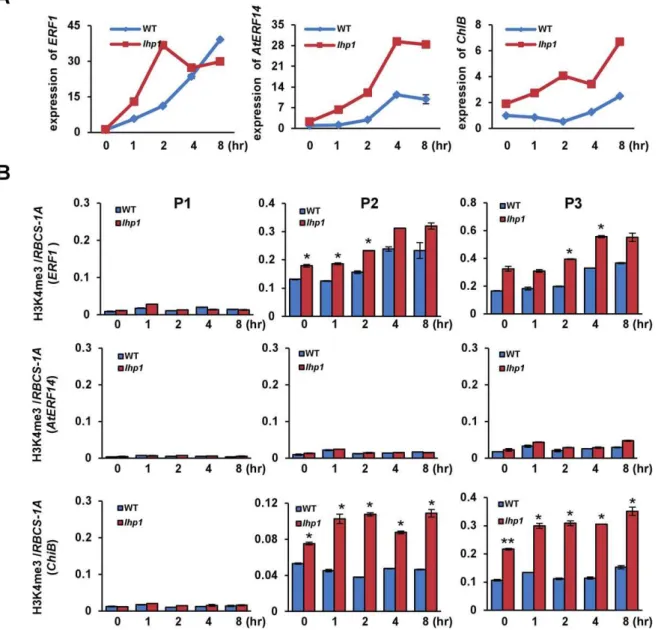
H3K27me3 is recognized and bound by LHP1 that is suggested to be an H3K27me3 effector. To explore the role of LHP1 in rapid gene activation, we analyzed the induction of ethylene responsive genes in thelhp1mutant. ForAtERF14andChiBthat displayed high levels of H3K27me3 the induction by ACC was clearly enhanced in the mutant (Fig. 3A), indicating that LHP1 had a repressive function on induction of the two genes. However, we also detected an elevated expression ofERF1inlhp1(Fig. 3A). Considering that there was a low level of H3K27me3 overERF1we speculated that this might be an indirect effect of increased expression ofAtERF14,as it has been reported that overexpression ofAtERF14could lead to increased expression of ERF1 [15]. In addition, we tested H3K4me3 levels over the target genes inlhp1in comparison with the wild type. We found that inlhp1H3K4me3 was increased in the 59region and the gene body, but not the promoter, ofERF1and
ChiB. The increased H3K4me3 levels may be also a consequence of increased transcription activity of the genes as mentioned before. However, H3K4me3 remained undetectable overAtERF14despite the increased expression of this gene inlhp1(Fig. 3B). The early induction of 4 of the 5 additional ERF genes was found to be enhanced in thelhp1mutant. Except TDR1 that had no H3K4me3, the other three genes displayed increased H3K4me3 (Fig. S3).
To study whether LHP1 was bound toChiBandAtERF14, ChIP analysis of thelhp1mutant complemented byLHP1::LHP1-MYC
was performed by using anti-MYC antibodies[16]. The analysis revealed that LHP1 was associated withChiBandAtERF14as well as with AG, but not with ERF1 (Fig. 4). Importantly, ACC treatment did not lead to dissociation of LHP1 from these genes (Fig. 4). Therefore, although thelhp1mutation had an effect on the induction of ethylene-induced genes, the presence of the H3K27me3 /LHP1 module on the genes was irresponsive to the inductive signal.
Requirement of H2A.Z for the induction ofERF1andChiB In Arabidopsis, H2A.Z has been shown to be involved in multiple responses such as temperature and phosphate starvation [5,7]. It either activates or represses target genes expression by eviction from nucleosomes occupying around the transcription start site. The presence of H2A.Z was detected over the three ethylene-inducible genes before ACC induction (Fig. 1D). During ACC treatment, no immediate decrease of H2A.Z abundance over ethylene-responsive genes was detected, albeit a slight decrease was observed after induction (Fig. 5; Fig. S2), suggesting that a clear H2A.Z eviction was not required for the initial induction of the genes.
In order to study whether H2A.Z was required for the induction, we tested the expression of these genes inhta9/hta11
double mutants that have a reduced level of H2A.Z [17]. In the mutant the induction ofERF1was reduced, while that ofAtERF14
was not clearly affected (Fig. 6A). The effect of the mutations on the induction ofChiBwas detected after 8 hours, but was more severe after 24 hours (Fig. 6A). These results indicated that H2A.Z was involved in the induction ofERF1andChiB. Then we tested H3K4me3 over ERF1 and ChiB during ACC induction in the
We speculated that H2A.Z had no effect on H3K4me3 and the delayed increase of H3K4me3 over ERF1 might be a result of decreased transcription activity of the gene in the mutants.
Discussion
H3K4me3 serves as a mark of gene transcription activity
Genome-wide analysis in plants indicates that H3K4me3 is associated with actively transcribed genes. But how it affects gene expression remains unclear [1,18]. Some researchers have
proposed that this modification may be recognized and bound by specific proteins which act as effectors to control transcription [3,19,20]. But other studies have suggested that H3K4me3 could serve as a memory or a mark of active genes [21]. In this study we tried to find out the role of H3K4me3 during activation of ethylene-inducible genes. Our results indicated that elevated H3K4me3 was not necessary for the ethylene-induced gene activation but may serve as a mark of transcription activity of the genes. First, H3K4me3 was not detected overAtERF14andTDR1
before induction and was not increased after ACC treatment
Figure 3. The role of LHP1 on the induction of ethylene responsive genes.(A) Transcript levels of the three genes at different time points during ACC induction in wild type (WT) andlhpplants. Relative fold changes were determined by normalization withACTIN2transcripts. (B) H3K4me3 levels onChiB,ERF1andAtERF14in wild type (WT)and lhp1mutants during treatment. The relative enrichments (toRBCS-1A) on three regions of the three genes are presented. Bars represent mean values+/2SD from three repeats. Significance of H3K4me3 differences between WT andlhp1at different time points was determined by two-tailed Student’s t-test, * p,0.05, **p,0.005.
doi:10.1371/journal.pone.0028224.g003
the reference geneAGAMOUS(AG). The three regions were analyzed for ChIP. Bars represent mean values+/2SD from three repeats. Significance of H3K4me3 and H3K27me3 differences between after ACC treatment (at different time points) and before treatment (0) was tested by two-tailed Student’s t-test, * p,0.05, **p,0.005.
(Fig. 1B, Fig. 2B; Fig. S2). Second, although some increase of H3K4me3 was detected in the 59region and/or the gene body of
ERF1, ORA59,AtERF1,AtERF2andAtERF11after induction, the increase of H3K4me3 lagged behind that of gene activation (Fig. 2B; Fig. S2). Finally, the level of H3K4me3 was associated with that of gene expression in lhp1and hta9/hta11 mutant and wild type plants. For instance, H3K4me3 was increased when the induction ofERF1andChiBwas enhanced inlhp1over these genes (Fig. 3). Conversely, the increase of H3K4me3 was delayed when the induction of the genes was attenuated by the mutation of H2A.Z genes (Fig. 6). Although there was no concomitant increase of H3K4me3 with activation of gene expression, it is not excluded the possibility that the basal level of H3K4me3 over ERF1and
ChiB might contribute to the chromatin commitment of these genes for the induction.
Repressive function of the H3K27me3/LHP1 module on inducible genes
The observations that H3K27me3 did not change over
AtERF14, ChiB andTDR1 during ACC induction are consistent with recent results showing that although H3K27me3 on the floral time repressor FLC is inversely correlated with transcriptional activity, the abundance of this mark is not diminished in the first 12h following activation of transcription [22]. Analysis of cold-inducible genes has detected H3K27me3 to decline only one to several days after application of the inductive signals [23]. These observations suggest that transcription activation may not involve immediate demethylation of H3K27me3, or the presence of H3K27me3 is not sufficient to impair transcriptional activation during induction. This is supported by a recent result showing that
vernalization-mediated induction ofVERNALISATION INSENSI-TIVE 3(VIN3) does not lead to any decrease of H3K27me3 on the locus 40 days after exposure to cold temperature [24,25].
The observations that the binding of LHP1 toAtERF14andChiB
was not affected by ACC induction and that the mutation ofLHP1
led to increased induction of the genes suggest that the H3K27me3 /LHP1 module is required for the repression of the genes and the repressive effect could be lifted by additional events during the induction. The constitutive association of LHP1 with these targets is reminiscent of the data showing that LHP1 remains to be associated withVIN3chromatin many days after induction by vernalization [25], indicating that the LHP1 binding in that conditions does not lead to gene silencing. These observations collectively suggest that additional elements associated with the H3K27me3/LHP1 module, which can be inactivated by inductive signals, might be involved in H3K27me3/LHP1–mediated gene silencing.
Involvement of H2A.Z in the induction of gene expression
Our data showing that deposition of histone variant H2A.Z over the eight ethylene-responsive genes was not evicted after ACC induction are in agreement with the findings that H2A.Z is present in both silent and activeFLCchromatin (Fig. 5; Fig. S2) [8]. Probably, the presence of H2A.Z may mark these genes for induction, supporting the notion that H2A.Z serves to mark active gene and poise silent genes for reactivation [8,9]. Recent results have shown that H2A.Z is required for both gene activation and repression in responding to warmer temperature [5]. In contrast to the observations on the ethylene-responsive genes, H2A.Z-containing nucleosomes are found to be lost from both
up-Figure 4. LHP1 binding to different genes before and after ACC treatment.WT andlhp1mutants complemented byLHP1::LHP1-MYCwere used for ChIP analysis with anti-MYC antibodies. The relative enrichments were normalized with input. Bars represent mean values+/2SD from three repeats.
regulated and down-regulated genes after an increase of temperature. Therefore, the role of H2A.Z in chromatin structure and in gene activity is complex, which may be dependent on the chromatin context of the gene. In addition, our results showed that mutation of H2A.Z genes had an obvious negative effect on the induction of ERF1and ChiB but not AtERF14. Considering the undetectable level of H3K4me3 over AtERF14 and moderate levels overERF1andChiBwe speculate that H2A.Z may have a coordinated effect with H3K4me3 on the activation of these genes during ACC induction.
Chromatin structure is considered as an important regulator of transcription in addition to transcription factors especially for the developmental genes. In this work we tried to figure out whether chromatin modifications take place during activation of rapidly inducible genes. Our work revealed that histone modifications including H3K4me3 and H3K27me3 and presence of chromatin proteins such as LHP1 and H2A.Z did not display any immediate change upon ACC treatment. However, mutation of LHP1 and H2A.Z genes had an effect on the induction suggesting that basal chromatin structure before induction is important for the induction.
Materials and Methods
Plant material and Exogenous ACC treatment
The mutants used in this study arelhp1[26], hta9/hta11[17],
lhp1 complemented by LHP1::MYC [16] and H2A.Z-GFP transgenic plants [5]. Arabidopsis seeds were surface-sterilized and growth at 22uC with a 16 h light/8 h dark (long day) cycle.
Twelve days after germination 50mM ACC solution was added. The samples were harvested at indicated time points.
RNA extraction and reverse transcription
Total RNA was extracted from twelve day-old seedling using Trizol (Invitrogen). Fourmg total RNA were treated first with 1 unit of DNase I (Promega) and then reverse transcribed in a total volume of 20mL with 0.5mg oligo(dT)15, 0.75 mM dNTPs, 2.5 mM MgCl2, 1ml ImProm-II reverse transcriptase (Promega).
The resulting products were tested by Real-Time PCR with gene specific primers (Table S1).
Chromatin Immunoprecipitation
Chromatin Immunoprecipitation (ChIP) experiment was per-formed most as described in [27]. One gram of 12 day-old seedlings before and after ACC treatment were harvested and crosslinked in 1% formaldehyde under vacuum. Nuclei were then extracted with extraction buffers. Chromatin was fragmented to 200–2000 bp by sonication and ChIP was performed using antibodies: c-Myc (Sigma, M4439), H3K4me3 (Cell Signaling, 9751S) H3K27me3 (Millipore, 07–449) and GFP antibody (Abcam, ab290). The precipitated and input DNAs were then analyzed by real-time PCR with gene specific primer sets (Fig. S1, Table S1). At least three biological repeats were performed for the ChIP experiments.
Real-Time PCR
Real-time PCR was performed in a total volume of 20mL with
1.0ml of the reverse transcription or ChIP products, 0.25mM
Figure 5. H2A.Z deposition over ethylene responsive genes during ACC induction.H2A.Z-GFP transgenic plants were used for ChIP analysis with GFP antibody. The enrichments on three regions are shown. Bars represent mean values+/2SD from three repeats. Significance of H2A.Z level difference between induced (at different time points) and non induced (0) was determined by two-tailed Student’s t-test, * p,0.05, **p,0.005.
primers, and 10ml SYBR Green Master mix (Roche) on a LightCycler 480 real-time PCR machine (Roche) according to the manufacturer’s instructions. All primers were annealed at 60uC and run 45 cycles. The ChIP enrichment for GFP, H3K27me3 and H3K4me3 was quantified by comparing the thresholdcycle (Ct) of the ChIP samples with that of the input and then normalized with the levels of control genes: 2(Ct of input-Ct of sample ChIP)
/2(Ct of input-Ct of control ChIP). The expression level of target genes was normalized with that ofACTIN: 2(Ct of actin- Ct of target).
Supporting Information
Figure S1 Genes used as controls in this study were not affected by ACC treatment. The expression of ACTIN2,
AGAMOUS(AG) andRBCS1Awas not affected by ACC treatment. ForACTIN2, three biological replication of ACC induction were performed. Data represent average means and the expression before ACC induction was set as 1. The expressions of AGand
RBCS-1Awere normalized with that ofACTIN2. (TIF)
Figure S2 Expression, histone methylation and H2A.Z deposition of five additional ethylene responsive factor (ERF) genes during ACC induction. RNA levels (A), H3K4me3 (B, C), H3K27me3 (D) and H2A.Z (E) of ORA59
(At1g066160), TDR1 (At3g23230), AtERF1(At4g17500), ATER-F2(At4g47220) andATERF11(At1g28370) were measured at the different time points during ACC treatment as indicated. Bars represent mean values +/2 SD from three repeats. For ChIP experiments, primers corresponding to the promoter (B) and gene bodies (C-E) were used. Significance of H3K4me3, H3K27me3 and H2A.Z induction compared to that before treatment (0) was determined by two-tailed Student’s t-test, * p,0.05, **p,0.005. (TIF)
Figure S3 Expression and H3K4me3 of additional ethylene responsive factor (ERF) genes between WT and lhp1 during ACC induction. RNA levels (upper) and H3K4me3 (lower) were measured during ACC treatment. Bars represent mean values +/2 SD from three repeats. For ChIP experiments, primers corresponding to the gene bodies were used.
Figure 6. Function of H2A.Z in the ACC induction ofERF1,AtERF14andChiB.(A) Transcript levels of the three genes at different time points during ACC induction in wild type (WT) andhta9/hta1mutants. Relative fold changes were determined by normalization withACTIN2transcripts. (B) H3K4me3 levels onERF1andChiBduring ACC induction in WT andhta9/hta11. The relative enrichments (toRBCS-1A) on three regions are shown. Bars represent mean values+/2SD from three repeats. Significance of H3K4me3 difference between WT andhta9/hta11at different time points was determined by two-tailed Student’s t-test, * p,0.05, **p,0.005.
Significance of H3K4me3 levels between WT andlhp1before and after ACC treatment was determined by two-tailed Student’s t-test, *p,0.05, **p,0.005.
(TIF)
Table S1 Sequences of primers used in this study.
(DOC)
Author Contributions
Conceived and designed the experiments: YH DXZ. Performed the experiments: YH YS NCES. Analyzed the data: YH DXZ. Wrote the paper: YH DXZ.
References
1. Zhang X, Bernatavichute YV, Cokus S, Pellegrini M, Jacobsen SE (2009) Genome-wide analysis of mono-, di- and trimethylation of histone H3 lysine 4 in Arabidopsis thaliana. Genome Biol 10: R62.
2. Zhang X, Clarenz O, Cokus S, Bernatavichute YV, Pellegrini M, et al. (2007) Whole-genome analysis of histone H3 lysine 27 trimethylation in Arabidopsis. PLoS Biol 5: e129.
3. Shi X, Hong T, Walter KL, Ewalt M, Michishita E, et al. (2006) ING2 PHD domain links histone H3 lysine 4 methylation to active gene repression. Nature 442: 96–99.
4. Zhang X, Germann S, Blus BJ, Khorasanizadeh S, Gaudin V, et al. (2007) The Arabidopsis LHP1 protein colocalizes with histone H3 Lys27 trimethylation. Nat Struct Mol Biol 14: 869–871.
5. Kumar SV, Wigge PA (2010) H2A.Z-containing nucleosomes mediate the thermosensory response in Arabidopsis. Cell 140: 136–147.
6. Papamichos-Chronakis M, Watanabe S, Rando OJ, Peterson CL (2011) Global regulation of H2A.Z localization by the INO80 chromatin-remodeling enzyme is essential for genome integrity. Cell 144: 200–213.
7. Smith AP, Jain A, Deal RB, Nagarajan VK, Poling MD, et al. (2010) Histone H2A.Z regulates the expression of several classes of phosphate starvation response genes but not as a transcriptional activator. Plant Physiol 152: 217–225. 8. Deal RB, Topp CN, McKinney EC, Meagher RB (2007) Repression of flowering in Arabidopsis requires activation of FLOWERING LOCUS C expression by the histone variant H2A.Z. Plant Cel 19: 74–83.
9. Kelly TK, Miranda TB, Liang G, Berman BP, Lin JC, et al. (2010) H2A.Z maintenance during mitosis reveals nucleosome shifting on mitotically silenced genes. Mol Cell 39: 901–911.
10. Adrian J, Farrona S, Reimer JJ, Albani MC, Coupland G, et al. (2010) cis-Regulatory elements and chromatin state coordinately control temporal and spatial expression of FLOWERING LOCUS T in Arabidopsis. Plant Cell 22: 1425–1440.
11. Makarevich G, Leroy O, Akinci U, Schubert D, Clarenz O, et al. (2006) Different Polycomb group complexes regulate common target genes in Arabidopsis. EMBO Rep 7: 947–952.
12. Mylne JS, Barrett L, Tessadori F, Mesnage S, Johnson L, et al. (2006) LHP1, the Arabidopsis homologue of HETEROCHROMATIN PROTEIN1, is required for epigenetic silencing of FLC. Proc Natl Acad Sci U S A 103: 5012–5017. 13. Schubert D, Primavesi L, Bishopp A, Roberts G, Doonan J, et al. (2006)
Silencing by plant Polycomb-group genes requires dispersed trimethylation of histone H3 at lysine 27. Embo J 25: 4638–4649.
14. Guo H, Ecker JR (2004) The ethylene signaling pathway: new insights. Curr Opin Plant Biol 7: 40–49.
15. Onate-Sanchez L, Anderson JP, Young J, Singh KB (2007) AtERF14, a member of the ERF family of transcription factors, plays a nonredundant role in plant defense. Plant Physiol 143: 400–409.
16. Latrasse D, Germann S, Houba-Herin N, Dubois E, Bui-Prodhomme D, et al. (2011) Control of flowering and cell fate by LIF2, an RNA binding partner of the polycomb complex component LHP1. PLoS One 6: e16592.
17. March-Diaz R, Garcia-Dominguez M, Lozano-Juste J, Leon J, Florencio FJ, et al. (2008) Histone H2A.Z and homologues of components of the SWR1 complex are required to control immunity in Arabidopsis. Plant J 53: 475–487. 18. Li X, Wang X, He K, Ma Y, Su N, et al. (2008) High-resolution mapping of epigenetic modifications of the rice genome uncovers interplay between DNA methylation, histone methylation, and gene expression. Plant Cell 20: 259–276. 19. Flanagan JF, Mi LZ, Chruszcz M, Cymborowski M, Clines KL, et al. (2005) Double chromodomains cooperate to recognize the methylated histone H3 tail. Nature 438: 1181–1185.
20. Vermeulen M, Mulder KW, Denissov S, Pijnappel WW, van Schaik FM, et al. (2007) Selective anchoring of TFIID to nucleosomes by trimethylation of histone H3 lysine 4. Cell 131: 58–69.
21. Muramoto T, Muller I, Thomas G, Melvin A, Chubb JR (2010) Methylation of H3K4 Is required for inheritance of active transcriptional states. Curr Biol 20: 397–406.
22. Buzas DM, Robertson M, Finnegan EJ, Helliwell CA (2010) Transcription-dependence of histone H3 lysine 27 trimethylation at the Arabidopsis polycomb target gene FLC. Plant J.
23. Kwon CS, Lee D, Choi G, Chung WI (2009) Histone occupancy-dependent and -independent removal of H3K27 trimethylation at cold-responsive genes in Arabidopsis. Plant J 60: 112–121.
24. Jean Finnegan E, Bond DM, Buzas DM, Goodrich J, Helliwell CA, et al. (2011) Polycomb proteins regulate the quantitative induction of VERNALIZATION INSENSITIVE 3 in response to low temperatures. Plant J 65: 382–391. 25. Kim DH, Zografos BR, Sung S (2010) Vernalization-mediated VIN3 Induction
Overcomes the LIKE-HETEROCHROMATIN PROTEIN1/POLYCOMB REPRESSION COMPLEX2-mediated epigenetic repression. Plant Physiol 154: 949–957.
26. Gaudin V, Libault M, Pouteau S, Juul T, Zhao G, et al. (2001) Mutations in LIKE HETEROCHROMATIN PROTEIN 1 affect flowering time and plant architecture in Arabidopsis. Development 128: 4847–4858.