Lower Guinea, Africa
Myriam Heuertz1,2*¤, Je´roˆme Duminil1,3, Gilles Dauby1, Vincent Savolainen4,5, Olivier J. Hardy1
1Universite´ Libre de Bruxelles, Faculte´ des Sciences, Evolutionary Biology and Ecology, Brussels, Belgium,2INIA, Forest Research Centre, Forest Ecology and Genetics, Madrid, Spain,3Bioversity International, Forest Genetic Resources Programme, Sub-Regional Office for Central Africa, Yaounde´, Cameroon,4Imperial College London, South Kensington Campus, London, United Kingdom,5Jodrell Laboratory, Royal Botanic Gardens Kew, Richmond, London, United Kingdom
Abstract
Comparative phylogeography is an effective approach to assess the evolutionary history of biological communities. We used comparative phylogeography in fourteen tree taxa from Lower Guinea (Atlantic Equatorial Africa) to test for congruence with two simple evolutionary scenarios based on physio-climatic features 1) the W-E environmental gradient and 2) the N-S seasonal inversion, which determine climatic and seasonality differences in the region. We sequenced the
trnC-ycf6plastid DNA region using a dual sampling strategy: fourteen taxa with small sample sizes (dataset 1, mean n = 16/ taxon), to assess whether a strong general pattern of allele endemism and genetic differentiation emerged; and four taxonomically well-studied species with larger sample sizes (dataset 2, mean n = 109/species) to detect the presence of particular shared phylogeographic patterns. When grouping the samples into two alternative sets of two populations, W and E,vs.N and S, neither dataset exhibited a strong pattern of allelic endemism, suggesting that none of the considered regions consistently harboured older populations. Differentiation in dataset 1 was similarly strong between W and E as between N and S, with 3–5 significantFSTtests out of 14 tests in each scenario. Coalescent simulations indicated that, given the power of the data, this result probably reflects idiosyncratic histories of the taxa, or a weak common differentiation pattern (possibly with population substructure) undetectable across taxa in dataset 1. Dataset 2 identified a common genetic break separating the northern and southern populations ofGreenwayodendron suaveolenssubsp.suaveolens var.
suaveolens, Milicia excelsa, Symphonia globulifera and Trichoscypha acuminata in Lower Guinea, in agreement with differentiation across the N–S seasonal inversion. Our work suggests that currently recognized tree taxa or suspected species complexes can contain strongly differentiated genetic lineages, which could lead to misinterpretation of phylogeographic patterns. Therefore the evolutionary processes of such taxa require further study in African tropical rainforests.
Citation:Heuertz M, Duminil J, Dauby G, Savolainen V, Hardy OJ (2014) Comparative Phylogeography in Rainforest Trees from Lower Guinea, Africa. PLoS ONE 9(1): e84307. doi:10.1371/journal.pone.0084307
Editor:Paul V. A. Fine, University of California, Berkeley, United States of America
ReceivedMarch 5, 2013;AcceptedNovember 13, 2013;PublishedJanuary 2, 2014
Copyright:ß2014 Heuertz et al. This is an open-access article distributed under the terms of the Creative Commons Attribution License, which permits unrestricted use, distribution, and reproduction in any medium, provided the original author and source are credited.
Funding:Funding was obtained from the Spanish Ministry for Science and Innovation (Ramo´n y Cajal programme, RYC2009-04537) and Ministry for Economy and Competitiveness (AFFLORA project, CGL2012 CGL2012-40129-C02-02), from the Belgian Fund for Scientific Research (FRS-FNRS projects 1.2.155.06F, FC66560-1.5.095.08F, 2.4.577.10.F and F.4.519.10.F) and from an Intra-European Marie Curie fellowship to MH. The funders had no role in study design, data collection and analysis, decision to publish, or preparation of the manuscript.
Competing Interests:The authors have declared that no competing interests exist. * E-mail: [email protected]
¤ Current address: Universite´ de Fribourg, Department of Biology, Unit of Ecology and Evolution, Fribourg, Switzerland
Introduction
The rich biodiversity of tropical rainforests results from the complex interaction of continental drift, past climate oscillations, dispersal events and adaptive processes. The rainforests of Atlantic Equatorial Africa, ranging from Liberia in the West to Gabon in the East, are among the World’s major biodiversity hotspots [1–3]. These forests suffer from deforestation and habitat degradation [4,5], yet the evolutionary processes that shaped their diversity have received relatively little attention [6].
Comparative phylogeography, which examines the distribution of genetic lineages across co-distributed taxa, is an effective approach to assess the evolutionary history of biological commu-nities. Genetic lineages bear the signal of past range dynamics and population size fluctuations (e.g., population bottlenecks or expansion), enabling researchers to test whether genetic data are compatible with defined evolutionary scenarios [7–9]. Congruent
genetic patterns across taxa of a community are indicative of a similar response to historical events such as climatic oscillations or vicariance events [9,10]. Such approaches have demonstrated for example a (i) congruent signal of population size decline in Panamanian rainforest trees [11], and (ii) a congruent phylogeo-graphic pattern in South American forest organisms [12], in European Alpine herbs as a function of substrate affinity [13] and in European forest trees, reflecting northward post-glacial recolonization after glacial isolation in southern refugia [10,14].
Leone to Ghana) and the Congolia (C) – of the Guineo-Congolian tropical forest phytogeographic region [15], which harbours ca. 6400 endemic species [1,16]. Two types of physio-climatic features can have affected the distribution of biodiversity at the regional scale in LG, 1) the west-east environmental gradient, and 2) the north-south climate hinge, and both can have influenced the distribution of within-taxa genetic diversity in complex ways through evolutionary time [17–19].
The LG rainforests reflect a west-east (W-E) environmental gradient, with generally evergreen forests located close to the coast of the Gulf of Guinea (W) and semi-evergreen forests inland (E) [19–21]. The Atlantic forests are strongly affected by the monsoon regime and receive high annual rainfall (aboveca.2000 mm/year), lower insolation (ca. 1300 hours/year) and have less marked seasonality than inland forests, which receiveca.1600–2000 mm precipitation per year and up to 2000 hours of sunlight [17]. Atlantic forests show both high species richness and endemism, especially those of southwestern Cameroon [3,22–25]. The W-E environmental gradient may have influenced the distribution of biodiversity in conjunction with the Plio-Pleistocene climate oscillations. Fossil pollen evidence from marine and lake cores indicates that African tropical forests have been repeatedly fragmented while savannah vegetation expanded during the Plio-Pleistocene cold and dry stages [26–29]. Palaeoecological and species distribution data led to the suggestion that many rainforest taxa survived the cold and dry stages essentially in the comparatively moister, mountainous Atlantic region of LG [18,23,30–33]. These W-E regional settings lead to two contrast-ing expectations for W-E genetic diversity patterns within taxa in LG: If separate populations occurred in the Wvs.E regions, for instance in the case of old differential adaptation to water availability and/or past history, we would expect differentiation between Atlantic (W) and inland (E) forests. Allelic endemism patterns could then emerge in either the W or E depending on the age of the differentiated populations. For instance, the distribution of distinct sister species of Erythrophleum (Fabaceae) close to the Bight of Bonny (W) and inland (E) concurs with this expectation [34]. Alternatively, current W and E populations could be derived more recently from the same regional population, for instance if populations persisted in the W and population extinction occurred in the E in recent glacial cycles [18,33]. In this case we would expect only weak differentiation between regions and a pattern of higher allele endemism in the ancient vs. the more recently colonized range part of the rainforest taxa, because only a subsample of the original allelic diversity is expected to colonize (e.g., [35]).
The second feature that characterizes the LG region is the climate hinge, or latitude of N-S seasonal inversion, which runs roughly parallel to the equator between ca. 0uand 3uN. During the boreal summer (June-August), the northern part of the LG forest (i.e., Cameroon) receives increased rainfall while in the southern part (Gabon) an overcast sky limits evapotranspiration in the absence of rain. In the austral summer, southern Gabon receives heavy rainfall while dry continental winds produce a dry season in the northern fringes of the forest block [17]. Most of the tree taxa included in our study bear fruit in the boreal summer in Cameroon, whereas the phenology is shifted on average by six months in the Gabonese populations. This shift in phenology may
have limited gene flow between both regions, and the N-S differences in seasonality may be at the origin of adaptive differences that hinder establishment in the non-native zone (e.g., [36,37]). These N-S regional settings would lead to the expectation of a pattern of genetic differentiation between populations located respectively N and S of the climatic hinge. The Plio-Pleistocene rainforest history (see previous paragraph) may have enhanced the expected N-S pattern if distinct glacial populations existed N and S of the climatic hinge (e.g., following [18], but not [33]). For instance, Greenwayodendron suaveolens
(Annonaceae) displays N-S differentiation in LG [38].
In this study we examined two alternative evolutionary scenarios by characterizing the genetic diversity and its spatial structure at maternally-inherited plastid DNA markers in fourteen tree taxa in the LG. We asked the question whether one of the before-mentioned physio-climatic features, the W-E environmen-tal gradient, or the N-S seasonal inversion, was strong enough to have imprinted a very general geographic pattern of genetic variation at maternally-inherited genomes in Central African trees. To capture genetic signals that may have resulted from Plio-Pleistocene or still on-going events, we focused on low-level taxa, usually taxonomic species. Early phylogeographical studies iden-tified considerable levels of lineage divergence within taxonomic species in central Africa and other tropical regions [12,38,39], suggesting high levels of undocumented species diversity. Given the paucity of well-established knowledge on the evolution and species delimitation of African rainforest trees, we opted for two complementary sampling strategies. (i) First, we considered fourteen tree taxa with limited sample sizes (12 to 20 individuals) and possibly encompassing a wide range of phylogenetic depths (dataset 1); i.e. some of these taxa may not match the biological species concept, containing more than one genetic species according to current taxon delimitation. This sampling allowed us to assess whether a very general phylogeographic pattern emerges given a wide range of phylogenetic depths among different lineages. (ii) Second, we analyzed larger sample sizes (66 to 169 individuals) in four tree species that are taxonomically very well studied (dataset 2). This sampling provided increased power to detect particular shared phylogeographic patterns among the four species, though at the cost of generality. While several phylogeographic studies have examined the distribution of genetic diversity in tree species from LG [34,38,40–45], no study to our knowledge has compared diversity using the same plastid marker across taxa or attempted a multi-taxa analysis.
Materials and Methods
Ethics Statement
We sampled fourteen common rainforest tree taxa typically occurring in evergreen and semi-evergreen rainforests of the Lower Guinea. Sampling sites included national parks and public land. Sampling permits were obtained from the CENAREST (Gabon) and the Ministry of Scientific Research and Innovation (Cameroon) and sample collection was facilitated by the Wildlife Conservation Society (La Lope´, Gabon), the CIRMF (Franceville, Gabon), the logging company Pallisco (Cameroon), the Missouri Botanical Garden and the NGO Nature Plus. According to IUCN,
Baillonella toxisperma Pierre (Sapotaceae) is listed as ‘‘vulnerable Figure 1. Haplotype maps of 14 Afrotropical tree taxa (dataset 1).Sizes of circles are proportional to the sample sizes of each population, haplotypes are colour-coded. Statistical parsimony networks of haplotypes are included for each taxon: each link represents a single mutation, white circles indicate unobserved putative haplotypes and the black box on theStrombosiopsis tetrandranetwork represents 26 mutations. The scale bar on the maps corresponds to 200 km.
A1cd ver 2.30, Milicia excelsa (Welw.) C.C. Berg (Moraceae) as ‘‘lower risk/near threatened ver 2.30, and Greenwayodendron suaveolens(Engl. & Diels) Verdc. as ‘‘least concern’’, while there is no data on the remaining taxa.
Sampling Strategy and Molecular Methods
In a first stage (dataset 1), we sampled fourteen common tree taxa typically occurring in evergreen and semi-evergreen rain-forests of the LG (Table 1, Figure 1, Table S1). Thirteen of the sampled taxa are considered as species according to most taxonomic reference books (e.g., Flore d’Afrique Centrale, Flore du Gabon, Flora Zambesiaca) whereasErythrophleumharbours two vegetatively similar and closely related sister species traded under the same timber name (tali) [34]. However, recent or on-going taxonomic revisions or genetic work suggest that the LG study
region harbours several species in the genera Carapa [46,47],
Strombosiopsis([48], F.J. Breteler, pers. com.) andGreenwayodendron
[38]. Current knowledge is insufficient to establish whether any of the used taxa matches the biological species concept, and there is evidence that several taxa correspond to closely related species or species complexes (e.g.,Erythrophleum[34],Carapa[47]). Hence, the patterns of genetic diversity observed should include a relatively wide phylogenetic depth, from within-species (in the biological sense) to within complexes of closely related species. Studying plastid DNA patterns of diversity and structure in species complexes should generally be a valid approach because the genealogy of a non-recombinant DNA fragment is not directly dependent on speciation processes [47]. By using a comparative phylogeographic approach across 14 taxa, we were interested in identifying a general pattern across taxa, notwithstanding one or the other outlier potentially caused by geographically delimited evolutionary processes or sampling bias associated to small sample sizes in species complexes. For each taxon, leaf or cambium samples were collected at 7–11 geographic locations (Table 1, Figure 1, Table S1), in a way to include coastal and inland populations, as well as populations north and south of the climate hinge (Figure 2; see also [36]). Taxa represent a wide range of life history traits with respect to successional behaviour, seed dispersal syndromes, size of geographic range and tree strata in the rainforest communities ([49–54], Table S2).
In a second stage, we included additional samples for four species (dataset 2, Figure 3): Greenwayodendron suaveolens subsp.
suaveolens var. suaveolens (Engl. & Diels) Verdc., totalling n = 169 individuals from 41 locations published by Dauby et al. [38];
Milicia excelsa(Welw.) C.C. Berg, n = 127, 19 locations, published by Daı¨nou et al. [40]; and new data inSymphonia globulifera Lf., n = 67, 20 locations and Trichoscypha acuminata Engl., n = 73, 28 locations. Complementary information indicated that these taxa most likely matched the biological species concept; specifically, in
G. suaveolenssubsp.suaveolens, we only included samples morpho-logically and genetically identified as var.suaveolens which likely represents a distinct biological species from G. suaveolens subsp.
suaveolens var.gabonica[38]; inM. excelsa, polymorphism was low and no deep lineage divergence was previously identified in LG [40]; in S. globulifera, the same samples included here did not display deep lineage divergence when sequenced at another marker (psba-trnHregion of plastid DNA, [55]) and inT. acuminata, although closely related species are present in LG [56], we only included samples which were identified asT. acuminatain the field and that displayed closely related haplotypes. Herbarium vouchers were collected generally in duplicate for at least one individual per location when possible and deposited at the National Herbarium of Cameroon (YA) or the Herbier National du Gabon (LBV) and at the herbarium of the Universite´ Libre de Bruxelles (BRLU, see Table S1).
Total DNA was extracted from silica-dried plant material using either a CTAB procedure [57] or the InvisorbHDNA Plant HTS 96 Kit (Invitek, Berlin, Germany). After an initial screening for sequence polymorphism of six plastid DNA (cpDNA) regions [58], we retained thetrnC-ycf6region because it could be amplified in all taxa and displayed fairly high levels of polymorphism. The trnC-ycf6region was amplified in a reaction volume of 25mL containing
c. 20 ng of DNA and 0.625 U Taq polymerase in 16reaction buffer (Qiagen, Venlo, Netherlands) supplemented with 0.1mM of each primer (trnC: [59],petN1r: [60]), 1 mM MgCl2and 0.2 mM of each dNTP. The cycling profile was 94uC for 3 min; 35 cycles of 94uC for 30 s, 50uC for 30 s and 72uC for 1 min 20 s; final extension at 72uC for 7 min and cooling to 10uC. PCR products were purified on filter columns (MSB HTS PCRapace/C(96) kit, Figure 2. Two physioclimatic features of the Lower Guinea
region that led to the formulation of alternative evolutionary scenarios for Afrotropical tree taxa. A) The W-E environmental gradient, B) the N-S seasonal inversion, illustrated by the difference of January and July precipitation (mm).
Invitek, Berlin, Germany) and sequenced using Big Dye v.3.1 chemistry (Applied Biosystems, Lennik, Belgium) and an ABI3100 sequencer (Applied Biosystems).
Data Analysis
Genetic diversity and relatedness of
haplotypes. Sequence trace files corresponding to forward and reverse reads were aligned with CodonCode Aligner 3.0.1. (CodonCode Corporation Dedham, MA, USA). Within-taxon alignments of individual sequences were done with MUSCLE 3.6 [61]. To characterize genetic variation in each taxon, we recorded the number of segregating sites S, the number of singletons, the number of insertion/deletion (indel) polymorphisms, inversions and microsatellite (SSR) length polymorphisms. Considering point mutations only, we used DnaSp v. 5.10.1 software [62] to compute haplotype diversity Hd and two estimators of the population mutation parameter, h= 4Nem, namely, nucleotide diversity (p),
which represents the average number of nucleotide differences per site between two sequences [63], and Watterson’s estimatorhW
[64] based on S. We then considered all polymorphism types
(except in the largeS. globulifera data set, where only SNPs were considered because complex indel polymorphisms prevented unambiguous coding of all polymorphisms) to define haplotypes and computed a haplotype distance matrix for each taxon, defining the distance between two haplotypes as the proportion of polymorphisms differing between them. Statistical parsimony networks among haplotypes were constructed based on these distance matrices using the program TCS 1.21 [65]. The totality of polymorphisms was used for all further analyses except in the largeS. globuliferadata set. We computed genetic diversityhandv
[66], based respectively on ordered or on un-ordered haplotypes, in SPAGeDi v. 1.3. [67]. The frequencies of haplotypes per sampling location were represented in haplotype maps using ArcGIS 10 software (ESRI, Redlands, CA, USA).
Demographic inference, isolation by distance and phylogeographic structure. To test for demographic or spatial genetic signals of population expansion, such as expected if population recovery and/or recolonization after Plio-Pleistocene fragmentation left a genetic footprint, we used the mismatch distribution with 1000 parametrical bootstraps in Arlequin 3.5.1.3 [68], where a significant test means that the null model of
Table 1.Diversity patterns at thetrnC-ycf6region in 14 Afrotropical tree taxa.
Point mutations only
All polymorphic characters
Taxon Family N pops Ltot L
S
(singl.) inv. indel SSR haps Hd pT hW haps h v
Dataset 1
Anthonotha macrophyllaP Beauv. Fabaceae (Caesalpinioideae)
17 8 1022 787 12(0) 0 10 1 6 0.824 5.14 4.51 6 0.905 0.394
Baillonella toxispermaPierre Sapotaceae 13 7 759 721 1(0) 1 0 2 2 0.385 1.07 0.89 4 0.750 0.342
Carapa parvifloraHarms Meliaceae 17 9 741 579 4(1) 0 4 0 5 0.647 1.35 2.04 7 0.920 0.210
Ceiba pentandra(L.) Gaertn. Malvaceae 11 8 600 576 0(0) 0 0 0 1 0.000 0.00 0.00 1 0.000 0.000
Coula edulisBaill. Olacaceae 18 9 853 598 0(0) 0 1 0 1 0.000 0.00 0.00 2 0.071 0.071
Diospyros manniiHiern Ebenaceae 14 8 794 621 5(3) 0 0 2 3 0.275 1.54 2.53 3 0.133 0.114
Erythrophleum ivorenseA. Chev./ E.suaveolens(Guill. & Perr.) Brenan
Fabaceae (Caesalpinioideae)
20 11 1002 917 9(2) 0 2 2 6 0.747 4.02 2.74 8 0.806 0.393
Greenwayodendron suaveolens (Engl. & Diels) Verdc.
Annonaceae 16 8 1019 977 4(0) 1 0 0 4 0.733 1.47 0.15 4 0.786 0.298
Milicia excelsa(Welw.) C.C. Berg Moraceae 16 7 1020 939 1(0) 0 0 0 2 0.525 0.56 0.32 2 0.571 nc
Panda oleosaPierre Pandaceae 12 8 915 893 0(0) 0 0 0 1 0.000 0.00 0.00 1 0.000 0.000
Scorodophloeus zenkeriHarms Fabaceae (Caesalpinioideae)
13 8 985 894 7(0) 0 2 1 5 0.821 2.50 2.52 6 1.000 0.380
Strombosiopsis tetrandraEngl. Olacaceae 16 9 887 719 26(0) 0 7 2 6 0.783 13.85 10.90 6 0.875 0.337 Symphonia globuliferaL.f. Clusiaceae 19 9 868 688 11(4) 0 1 2 8 0.842 4.83 4.57 10 0.933 0.321 Trichoscypha acuminataEngl. Anacardiaceae 19 9 712 612 1(0) 0 1 0 2 0.281 0.46 0.47 3 0.446 0.232
Overall 15.8 8.4 870 752 5.8 (0.7) 0.1 2 0.9 3.7 0.49 2.63 2.26 4.5 0.585 0.238
Dataset 2
Greenwayodendron suaveolenssubsp. suaveolensvar.suaveolens(Engl. & Diels) Verdc
Annonaceae 169 41 963 954 5(1) 2 1 0 5 0.187 0.22 0.75 10 0.668 0.078
Milicia excelsa(Welw.) C.C. Berg) Moraceae 127 20 939 939 2(1) 0 0 0 3 0.399 0.44 0.39 3 0.528 0.280 Symphonia globuliferaL. f. Clusiaceae 66 20 912 693 22(9) 0 4 1 22 0.906 5.54 6.67 22 0.974 0.152 Trichoscypha acuminateEngl. Anacardiaceae 73 28 752 547 3(0) 0 1 0 4 0.477 0.96 1.13 5 0.516 0.145
N, sample size;pops, number of sampling locations;Ltot, total length of alignment;L, length of alignment excluding gaps and missing data;S(singl.), total number of single nucleotide mutations (number of singletons);inv., number of inversions;indel, number of insertions/deletions;SSR, number of simple sequence repeats;haps, number of haplotypes;Hd, haplotype diversity;pTandhW, estimates of nucleotide diversity x 103;handv, genetic diversity based on ordered or unordered alleles; nc, not calculated. For details see materials and methods.
population expansion can be rejected. We further investigated phylogeographic structure in each taxon using isolation by distance (IBD) approaches: We first tested for IBD among unordered haplotypes by regressing the kinship coefficient Fij between pairs of individuals on the logarithm of geographic distance and compared the slope blog(Fij) to its null expectation from random permutations of the sampling locations using SPAGeDi (one-sided test with alternative hypothesis blog(Fij)
,-blog(Fij permuted)). We then tested whether nearby individuals were more likely to bear closely related haplotypes than individuals chosen at random, performing the same test using the coefficient
Nij based on ordered haplotypes (O.J. Hardy, unpublished). Finally, we tested for phylogeographic structure by comparing
blog(Nij) to its expectation from permuting rows and columns of the genetic distance matrix.
Patterns of endemism and differentiation. To test for patterns of allelic endemism and genetic differentiation as expected under two contrasting evolutionary scenarios (see Introduction), we grouped samples into pairs of categories (hereafter regions) and examined levels of genetic diversity and endemism within regions and differentiation between them. For the W-E scenario (1), which emphasizes the response to environmental and climatic conditions (e.g., past population differentiation, or recent common origin in a single region), samples were classified as belonging to generally evergreen Atlantic forests or to semi-evergreen inland forests [19]. For the N-S scenario (2), which emphasizes the role of the climate inversion and seasonality differences across the climate hinge (possibly in conjunction with Plio-Pleistocene forest history, see Introduction), samples were classified as located N or S of the seasonal inversion line (Figure 2). Within each of the regions Figure 3. Haplotype maps of four Afrotropical tree species (dataset 2).Sizes of circles are proportional to the sample sizes of each population, haplotypes are colour-coded. Statistical parsimony networks of haplotypes are included for each species: each link represents a single mutation; white circles indicate unobserved putative haplotypes. Red lines correspond to the three strongest genetic barriers (BARRIER program) identified in each species.
defined according to the two scenarios, we recorded the number of haplotypes observed (Nhaps), the rarefied haplotype richness (Arx, the number of haplotypes expected in a sample of size x), the number of private haplotypes (Npriv) and the rarefied private haplotype richness (Arprivx, the number of private haplotypes expected in a sample of sizex) using the program HP-Rare [69], and we computed genetic diversity and its standard error using the
program CONTRIB [70]. In dataset 1, haplotype richness statistics were collected separately for each taxon and for haplotypes pooled across the 14 taxa. In dataset 1, we carried out one-way analysis of variance in theRsoftware [71] to test for the effects of taxa and of geographical regions on genetic diversity statistics in each of the two scenarios. We then computed the differentiation statistics FST for unordered and NST for ordered alleles [66] for each scenario (both datasets) and tested against the null hypothesis of no population differentiation using permutation tests in SPAGeDi. The number of significant differentiation tests between regions was recorded for each scenario and the contribution of mutations to differentiation was assessed with permutation tests (NST.NST(permuted), [72]). We also evaluated the relative support of both scenarios counting the taxa with stronger differentiation (FST) in the candidate vs. alternative scenario (in dataset 1).
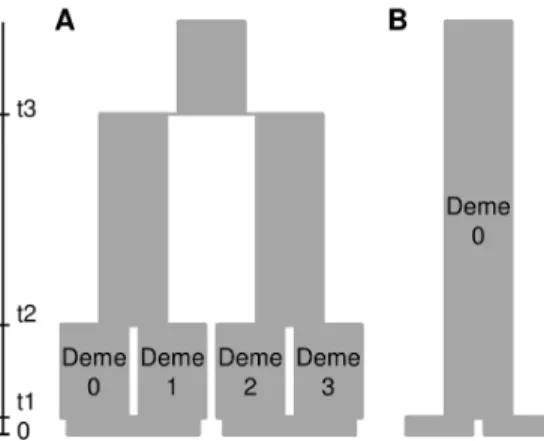
To assess the power of our approach to identify population subdivision, discriminate between the tested scenarios, and to assess the rate of false detection of population subdivision when it is absent (type I error), we applied a coalescent simulation approach using simulated sample sizes mimicking our initial (n = 8/population) and enhanced data sets (n = 30/population). We used the software fastsimcoal [73] to simulate two simple evolutionary scenarios (Figure 4): in each scenario, two samples of n = 8 or n = 30 genes were taken at generation 0 (present time) in each of two populations, their genealogy was simulated backward in time, and then mutations were added onto the genealogy Figure 4. Graphical representation of two evolutionary
scenar-ios tested using coalescent simulations.A) population divergence scenario, B) constant population size scenario.
doi:10.1371/journal.pone.0084307.g004
Table 2.Tests of population expansion and patterns of isolation by distance in 14 Afrotropical tree taxa.
P-value,H0: Demographic expansion
P-value,H0: Spatial
expansion blog(Fij) P(IBD_Fij)blog(Nij) P(IBD_Nij)
P(blog(Nij),
blog(Nijperm.))
Dataset 1
Anthonotha macrophylla * ns 20.167 *** 20.196 *** ns
Baillonella toxisperma * * 20.179 *** 20.176 ** ns
Carapa parviflora ns ns 20.093 *** 20.153 *** ns
Ceiba pentandra nc nc nc nc nc nc nc
Coula edulis ns ns 0.002 ns 0.014 ns ns
Diospyros mannii * ns 0.007 ns 0.059 ns ns
Erythrophleum ivorense/suaveolens * + 20.157 *** 20.231 *** *
Greenwayodendron suaveolens ns ns 20.238 *** 20.181 ** ns
Milicia excelsa ns * 20.185 ** 20.169 ** ns
Panda oleosa nc nc nc nc nc nc nc
Scorodophloeus zenkeri * ns 20.144 *** 20.147 * ns
Strombosiopsis tetrandra ns ns 20.147 *** 20.037 ns ns
Symphonia globulifera + ns 20.103 *** 20.175 *** ***
Trichoscypha acuminata ns ns 20.073 * 20.067 + ns
Dataset 2
Greenwayodendron suaveolenssubsp. suaveolens var. suaveolens (Engl. & Diels) Verdc.
* *** 20.268 *** 20.401 *** **
Milicia excelsa(Welw.) C.C. Berg + ** 20.096 *** 20.179 *** ns
Symphonia globuliferaL.f. * ns 20.126 *** 20.173 *** **
Trichoscypha acuminataEngl. * *** 20.093 *** 20.092 *** ns
blog(Fij) andP(IBD_Fij), slope and test of isolation by distance;blog(Nij) andP(IBD_Nij) slope and test of isolation by distance using ordered alleles;
P(blog(Nij),blog(Nijperm.)), test for phylogeographic structure. For details, see materials and methods.+,P,0.1; *,P,0.05; **,P,0.01; ***,P,0.00; ns, not significant; nc, not calculated.
forward in time. In the ‘‘divergence’’ scenario (Figure 4, A), we modelled one ancient divergence event at t3 = 1600 generations ago, and a more recent divergence at t2 = 200 generations leading to two demes in each population. Deme size was of constant sizeN
throughout the genealogy. This model was motivated by the observation of substructure in some species of dataset 1 and could be interpreted as repeated divergence events triggered by recurrent climate oscillations (see [55]), or by other vicariance or local adaptation events. In the ‘‘constant’’ population size scenario without divergence (Figure 4, B), both samples derived from the same deme t1 = 1 generation ago. In each scenario, we simulated a DNA sequence of length 1000 bp and varied the deme sizeNand mutation rate m among runs to obtain average diversity and differentiation levels similar to those observed in our observed dataset 1. We repeated simulations 100 times in each run, and used the software Arlequin 3.5.1.3 in batch mode [68] to compute summary statistics for the simulated data sets. To assess the power of our data to detect genetic structure and to evaluate type I error, we recorded the number of significant differentiation tests (FST) respectively in the divergence and constant scenarios and compared them to the observed data. For the differentiation scenario that most closely matched the observed dataset 1, we repeated the simulation recovering n = 4 samples for each of four demes at t0. We then used AMOVA in Arlequin to compute the differentiation between populations with simulated substructure,
FCT[(01)(23)] (where subscript numbers stand for the four demes), and the differentiation between groups composed of samples from different populations, FCT[(02)(13)]. This mimicked grouping the samples into W-E vs. N-S, with one of the two groupings
corresponding to the true divergence history. The fraction of simulations whereFCT[(01)(23)].FCT[(02)(13)]represents the power to identify the correct differentiation pattern between the two groupings considered.
Shared spatial patterns of genetic structure. To geo-graphically locate the most important genetic breaks and investigate whether taxa shared patterns of geographic differen-tiation, we searched for genetic barriers using the Monmonier maximum difference algorithm in the software BARRIER v.2.2 [74]. This analysis was restricted to dataset 2 because small sample sizes would imply low confidence in barrier location in dataset 1. The matrix of pair-wise differentiation (GST) between sampling locations was used together with the sampling coordinates to identify the three most important genetic barriers in each taxon. The co-location of barriers was then evaluated across taxa using the line density tool in ArcGis 10 software (see also [75]).
Results
Genetic Diversity and Relatedness of Haplotypes Sequences of the trnC-ycf6region were deposited at Genbank under accession numbers KF487767-KF488074 (Table S1). The
trnC-ycf6region had an average length of 870 bp (600–1022 bp) in dataset 1 and the number of SNPs varied between 0 and 26 across taxa, resulting in pT values ranging from 0 to 0.0139 (mean
0.0026, Table 1). In dataset 1, we detected between one and eight haplotypes per taxon when considering SNPs and between one and ten haplotypes when considering all polymorphic characters, for an average sample size of 16 individuals and eight sampling locations per taxon. Some high-diversity taxa displayed divergent lineages, with some haplotypes differing by six or more mutations without putative intermediate haplotypes: Anthonotha macrophylla,
Strombosiopsis tetrandraandErythrophleum ivorense/suaveolens(Figure 1). The geographic representation of haplotype frequencies did not reveal any obvious common distribution pattern of haplotypes across taxa (Figure 1). In dataset 2, we detected between three and 22 haplotypes per species, for sample sizes of 66–169 individuals and 20–41 locations (Table 1, Figure 3).
Demographic Inference, Isolation by Distance and Phylogeographic Structure
The null model of demographic expansion was rejected in five, and the spatial expansion model was rejected in two out of 12 taxa withP,0.05 in dataset 1 (Table 2). In dataset 2, six out of eight tests rejected expansion models (Table 2). Isolation by distance of
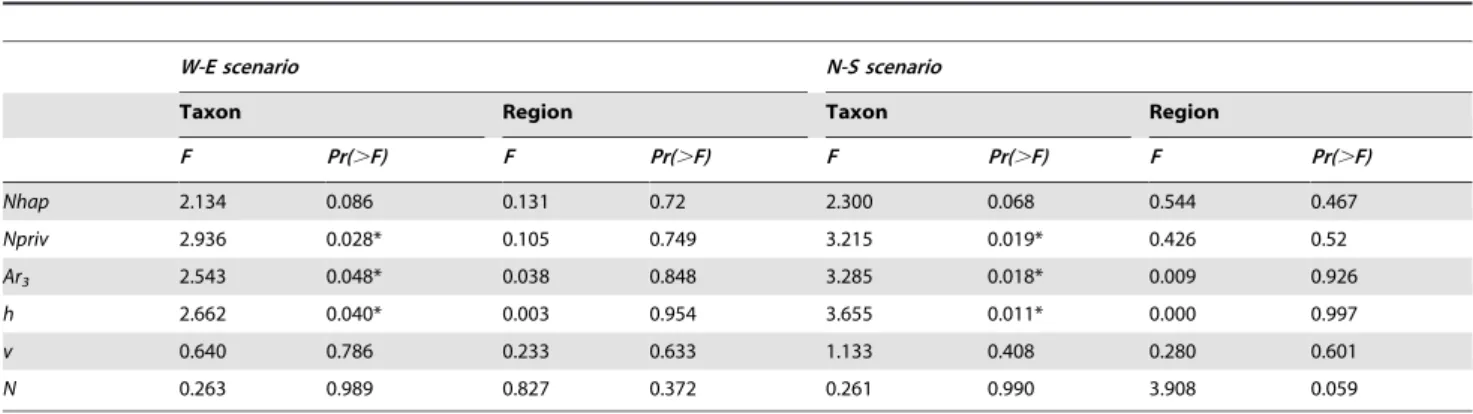
Table 3.Analysis of variance in 14 Afrotropical tree taxa under two evolutionary scenarios.
W-E scenario N-S scenario
Taxon Region Taxon Region
F Pr(.F) F Pr(.F) F Pr(.F) F Pr(.F)
Nhap 2.134 0.086 0.131 0.72 2.300 0.068 0.544 0.467
Npriv 2.936 0.028* 0.105 0.749 3.215 0.019* 0.426 0.52
Ar3 2.543 0.048* 0.038 0.848 3.285 0.018* 0.009 0.926
h 2.662 0.040* 0.003 0.954 3.655 0.011* 0.000 0.997
v 0.640 0.786 0.233 0.633 1.133 0.408 0.280 0.601
N 0.263 0.989 0.827 0.372 0.261 0.990 3.908 0.059
Fvalues and significance levels are given: *, P,0.05; **, P,0.01; ***, P,0.001.Nhap, number of haplotypes;Npriv, number of private haplotypes;Ar3, haplotype richness in a random sample of 3 sequences; genetic diversity with unordered (h) or ordered haplotypes (v);N, sample size.
doi:10.1371/journal.pone.0084307.t003
Table 4.Diversity estimates across 14 Afrotropical tree taxa under two evolutionary scenarios (dataset 1).
Population N Nhap Ar80 Npriv Arpriv80
W-E scenario West 118 39 33.3 27 22.2
East 103 36 32.9 24 22.0
N-S scenario North 95 36 34.0 21 21.0
South 126 42 33.8 27 20.8
N, sample size;Nhap, number of haplotypes;Ar80, rarefied haplotype richness in a random sample of 80 sequences;Npriv, number of private haplotypes; Arpriv80, rarefied private haplotype richness in a random sample of 80 sequences.
W-E scenario N-S scenario
West (coast) East (inland) North South
W-E environmental
gradient N h(SE) Nhap Ar Npriv Arpriv18N h(SE) Nhap Ar Npriv Arpriv18N h(SE) Nhap Ar3 Npriv Arpriv18N h(SE) Nhap Ar3 Npriv Arpriv18
Dataset 1
Anthonotha macrophylla 11 0.764(0.083) 4 2.34 3 6 0.800(0.122) 3 2.40 2 8 0.714(0.123) 3 2.21 3 9 0.556(0.165) 3 1.91 3
Baillonella toxisperma 3 0.667(0.314) 2 2.00 1 10 0.600(0.131) 3 1.98 2 6 0.733(0.155) 3 2.25 2 7 0.286(0.196) 2 1.43 1
Carapa parviflora 10 0.511(0.164) 3 1.83 3 7 0.857(0.102) 4 2.57 4 10 0.644(0.152) 4 2.10 2 7 0.905(0.103) 5 2.71 3
Ceiba pentandra 6 0.000(0.000) 1 1.00 0 5 0.000(0.000) 1 1.00 0 5 0.000(0.000) 1 1.00 0 6 0.000(0.000) 1 1.00 0
Coula edulis 14 0.143(0.119) 2 1.21 1 4 0.000(0.000) 1 1.00 0 6 0.333(0.215) 2 1.50 1 12 0.000(0.000) 1 1.00 0
Diospyros mannii 9 0.222(0.166) 2 1.33 1 5 0.400(0.237) 2 1.60 1 2 0.000(0.000) 1 nc 0 12 0.318(0.164) 3 1.50 2
Erythrophleum ivorense/ suaveolens
11 0.346(0.172) 3 1.55 3 9 0.806(0.120) 5 2.46 5 12 0.803(0.078) 5 2.45 4 8 0.643(0.184) 4 2.11 3
Greenwayodendron suaveolens
8 0.714(0.123) 3 2.21 1 8 0.714(0.123) 3 2.21 1 2 0.000(0.000) 1 nc 0 14 0.747(0.078) 4 2.31 3
Milicia excelsa 3 0.000(0.000) 1 1.00 0 13 0.538(0.060) 2 1.81 1 9 0.500(0.128) 2 1.75 0 7 0.286(0.196) 2 1.43 0
Panda oleosa 5 0.000(0.000) 1 1.00 0 7 0.000(0.000) 1 1.00 0 4 0.000(0.000) 1 1.00 0 8 0.000(0.000) 1 1.00 0
Scorodophloeus zenkeri 4 0.667(0.204) 2 2.00 2 9 0.778(0.110) 4 2.38 4 3 0.667(0.314) 2 2.00 1 10 0.867(0.071) 5 2.61 4
Strombosiopsis tetrandra 11 0.891(0.063) 6 1.68 5 5 0.000(0.000) 1 1.00 0 11 0.818(0.083) 5 2.49 4 5 0.600(0.175) 2 1.90 1
Symphonia globulifera 13 0.795(0.085) 6 2.43 5 6 0.933(0.122) 5 2.80 4 9 0.694(0.147) 4 2.20 4 10 0.778(0.137) 6 2.42 6
Trichoscypha acuminata 10 0.600(0.131) 3 1.98 2 9 0.000(0.000) 1 1.00 0 8 0.429(0.169) 2 1.64 0 11 0.345(0.172) 3 1.55 1
Average 8.43 0.451 2.79 1.68 1.93 7.36 0.459 2.57 1.80 1.71 6.79 0.453 2.57 1.88 1.50 9.00 0.452 3.00 1.78 1.93
N species with larger value West or North
9 4 5 4 5 4 7 4 7 4
N species with larger value East or South
4 7 5 7 5 10 5 6 3 6
Dataset 2
Greenwayodendron suaveolenssubsp.
suaveolens var. suaveolens (Engl. & Diels) Verdc.
80 0.648(0.036) 7 4.03 3 1.70 89 0.540(0.055) 7 4.03 3 1.71 61 0.585(0.059) 5 3.97 2 2.05 108 0.598(0.026) 8 3.61 4 1.70
Milicia excelsa(Welw.) C.C. Berg
28 0.349(0.090) 2 2 0 0.00 99 0.415(0.042) 3 2.18 1 0.18 85 0.266(0.056) 3 2.17 1 0.21 42 0.512(0.017) 2 2.00 0 0.05
Symphonia globuliferaL. f. 48 0.847(0.029) 14 7.98 12 6.61 18 0.909(0.044) 10 10 8 8.63 35 0.822(0.067) 8 6.48 7 6.03 31 0.805(0.042) 15 9.99 14 9.54
Trichoscypha acuminata
Engl.
31 0.582(0.093) 3 2.83 0 0.05 42 0.582(0.076) 5 4.30 2 1.52 34 0.451(0.060) 2 2 0 0.28 39 0.529(0.084) 5 4.14 3 2.43
N, sample size;h(SE), gene diversity and its standard error;Nhap, number of haplotypes;Ar, rarefied haplotype richness in a random sample of 3 sequences in dataset 1 or 18 sequences in dataset 2;Npriv, number of private haplotypes;Arpriv, rarefied private haplotypic richness; nc, not calculated.
doi:10.1371/journal.pone.0084307.t005
Tree
Phylogeo
graphy
in
Lower
Guinea
ONE
|
www.ploson
e.org
9
January
2014
|
Volume
9
|
Issue
1
|
haplotypes was found in ten out of fourteen taxa in dataset 1 and in all four species of dataset 2, evidenced by a significant negative regression slope of pairwise kinship,blog(Fij), on the logarithm of geographic distance (Table 2). Isolation by distance was also observed for ordered haplotypes, with the same taxa, except
Strombosiopsis tetrandra, showing a negative regression slope,blog(Nij). A phylogeographic structure was only observed in three taxa:
Erythrophleum ivorense/suaveolens, Greenwayodendron suaveolens subsp.
suaveolensvar.suaveolensandSymphonia globulifera.
Patterns of Endemism and Differentiation
In dataset 1, there was no significant difference of genetic diversity statistics between regions in any of the two evolutionary scenarios examined; however, some diversity statistics (h,Nprivand
Ar3) were found to differ significantly among taxa (Table 3). Genetic diversity, numbers of haplotypes and private haplotypes were generally similar between regions defined according to both evolutionary scenarios (Table 4, Table 5). Only in M. excelsain dataset 2, genetic diversity was larger in the S than in the N regions (non-overlapping 95% confidence intervals based on mean 61.96 * SE). In dataset 2, private rarefied allelic richnessArpriv18 was numerically larger in all four species in the E than in the W, whereas no common trend was observed in the N-S scenario. Negative regression slopes with latitude were observed for within-population allelic richness (Ar3) in M. excelsa and for within-population genetic diversity h in S. globulifera, i.e. southern
populations of these species had higher diversity statistics (Table S3). Differentiation estimated asFST orNST between regions in dataset 1 was significant (P,0.05) for four or five taxa in the W-E scenario and for three or four taxa in the N-S scenario (Table 6).
Erythrophleum ivorense/suaveolensandScorodophloeus zenkerishowed W-E but not N-S differentiation, andS. globuliferadisplayed strong N-S, but only weak W-E differentiation; patterns were less clear for the remaining species. In dataset 2, all four species showed significant N-S differentiation, but only two showed W-E differentiation (Table 6). A contribution of mutations to differen-tiation (NST.NST(perm.)) was detected in Erythrophleum ivorense/
suaveolensandAnthonotha macrophylla(W-E) and inG. suaveolens subsp. suaveolens var. suaveolens(N-S, dataset 2).
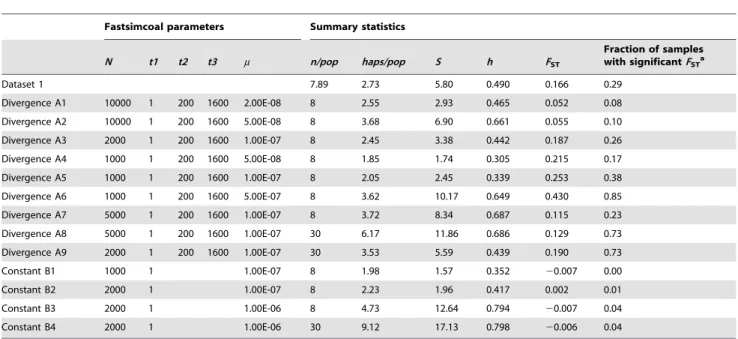
Simulations showed that a population divergence scenario with mean levels of diversity and differentiation similar to those in dataset 1 and sample sizes of n = 8 per deme, i.e. simulated scenario A3, would lead to 26% significant differentiation tests at a level ofa= 0.05 based onFST(Table 7, Table S4). In dataset 1,
29% (8 out of 28) differentiation tests were significant. If we assume that the variation associated to sampling different taxa is analogous to the stochastic variation in the coalescent process, this would suggest that dataset 1 had a detection power of population genetic structure similar to the one expected in a realistic differentiation scenario. In a differentiation scenario with larger sample sizes, n = 30 per deme (scenarios A8 or A9), the detection power of genetic differentiation rose to 73%, indicating that differentiation tests in dataset 2 were about three times more likely
Table 6.Differentiation patterns in 14 Afrotropical tree taxa under two evolutionary scenarios.
W-E scenario N-S scenario
Taxon FST NST P(NST.NST(perm)) FST NST P(NST.NST(perm))
Dataset 1
Anthonotha macrophylla 0.113 + 0.313 ** * 0.368 ** 0.336 **
Baillonella toxisperma 0.223 + 0.342 * 0.719 ** 0.316 **
Carapa parviflora 0.333 *** 0.139 ** 0.149 * 0.062
Ceiba pentandra nc nc nc nc nc nc
Coula edulis 20.130 0.000 nc 0.12 0.000 nc
Diospyros mannii 20.051 20.062 20.283 0.040
Erythrophleum ivorense/suaveolens 0.439 *** 0.660 *** * 0.081 0.062
Greenwayodendron suaveolens 0.048 0.102 0.196 0.192
Milicia excelsa 0.297 0.500 0.353 + 0.365 +
Panda oleosa nc nc nc nc nc nc
Scorodophloeus zenkeri 0.265 ** 0.349 ** 0.115 0.232 +
Strombosiopsis tetrandra 0.335 ** 0.280 + 0.074 0.257
Symphonia globulifera 0.098 + 0.146 + 0.263 *** 0.491 *** +
Trichoscypha acuminata 0.233 + 0.167 20.061 20.025
Number of tests with P,0.05 4 5 2 4 3 0
Number of tests with P,0.10 8 7 3 5 6 1
Dataset 2
Greenwayodendron suaveolenssubsp.suaveolens var. suaveolens(Engl.& Diels)Verdc.
0.180 *** 0.154 *** 0.186 *** 0.299 *** *
Milicia excelsa(Welw.) C.C. Berg 20.013 20.009 0.255 *** 0.220 ***
Symphonia globuliferaL. f. 0.111 *** 0.148 ** 0.185 *** 0.252 ***
Trichoscypha acuminataEngl. 20.005 20.013 0.079 * 0.156 ***
Estimates of differentiation statistics are followed by results from one-sided permutation tests for population structure.+,P,0.10; *,P,0.05; **,P,0.01; ***,P,0.001; ns, not significant; nc, not calculated.
to detect a differentiation signal than tests in dataset 1. In the modified A3 scenario (sampling four samples in each of four demes), inter-population differentiation was larger than differen-tiation between groups containing demes from distinct
popula-tions,FCT[(01)(23)].FCT[(02)(13)], in 58% of the cases andFCT[(01)(23)] $FCT[(02)(13)]in 98% of the cases. This suggested that the power of dataset 1 to distinguish differentiation patterns produced by alternative evolutionary scenarios was at least 58% (in 40% of cases no difference in differentiation patterns was detected, and in only 2% of cases a reversed differentiation pattern appeared). In simulations without genetic structure (B1–B4), only 0–4% of the tests detected a differentiation signal. This suggested a low level of false positive differentiation tests even for the small sample sizes of dataset 1.
Shared Spatial Patterns of Genetic Structure
The barrier density analysis based on the four species of dataset 2 identified a region of barrier co-location separating the N and the S of the LG study region between ca. 0 and 3u N, at the latitude of Equatorial Guinea, coinciding to some extent with the differentiation expected under the N-S scenario (Figure 5).
Discussion
This study shows that fourteen common Afrotropical rainforest tree taxa (dataset 1) exhibited variation in their patterns of genetic endemism and differentiation and did not show clear majority support for any of two simple evolutionary scenarios in response to physio-climatic features in the Lower Guinea, i.e., 1) the W-E environmental gradient or 2) the N-S seasonal inversion. This observation allows several possible interpretations: 1) absence of a common pattern, or non-detection of a common pattern because it was too weak to be detected with the available sample sizes; 2) existence of a common genetic structure pattern but only for a subset of the study taxa; or 3) a confounding effect due to sampling ill-defined taxonomic species. We applied coalescent simulations and complementary sampling in a sub-sample of four of the fourteen taxa in order to further examine these possible
Table 7.Simulation results showing summary statistics and the expected proportion of significant differentiation tests under divergence or constant population size scenarios for simulated deme sizes,N, and mutation rates,m, and their comparison to
observed data from dataset 1.
Fastsimcoal parameters Summary statistics
N t1 t2 t3 m n/pop haps/pop S h FST
Fraction of samples with significantFSTa
Dataset 1 7.89 2.73 5.80 0.490 0.166 0.29
Divergence A1 10000 1 200 1600 2.00E-08 8 2.55 2.93 0.465 0.052 0.08
Divergence A2 10000 1 200 1600 5.00E-08 8 3.68 6.90 0.661 0.055 0.10
Divergence A3 2000 1 200 1600 1.00E-07 8 2.45 3.38 0.442 0.187 0.26
Divergence A4 1000 1 200 1600 5.00E-08 8 1.85 1.74 0.305 0.215 0.17
Divergence A5 1000 1 200 1600 1.00E-07 8 2.05 2.45 0.339 0.253 0.38
Divergence A6 1000 1 200 1600 5.00E-07 8 3.62 10.17 0.649 0.430 0.85
Divergence A7 5000 1 200 1600 1.00E-07 8 3.72 8.34 0.687 0.115 0.23
Divergence A8 5000 1 200 1600 1.00E-07 30 6.17 11.86 0.686 0.129 0.73
Divergence A9 2000 1 200 1600 1.00E-07 30 3.53 5.59 0.439 0.190 0.73
Constant B1 1000 1 1.00E-07 8 1.98 1.57 0.352 20.007 0.00
Constant B2 2000 1 1.00E-07 8 2.23 1.96 0.417 0.002 0.01
Constant B3 2000 1 1.00E-06 8 4.73 12.64 0.794 20.007 0.04
Constant B4 2000 1 1.00E-06 30 9.12 17.13 0.798 20.006 0.04
Averages over 100 independent simulations are shown, see Figure 4 and Table S4. aThe fraction of samples with significantF
STconsiders the proportion of 1-sided tests withP,0.05. doi:10.1371/journal.pone.0084307.t007
Figure 5. Graphical representation of co-location of the three strongest genetic barriers (barrier density) observed across four Afrotropical tree species (dataset 2). Barriers (in blue) are based on the pair-wise differentiation (GST) among sampling locations.
interpretations and to clarify our results. Interestingly, the complementary sampling distinguished an N-S differentiation pattern shared among the four species with larger samples.
One caveat of our study is that the tree flora of Central African rainforests is not sufficiently well known to allow unambiguous species identification. The taxa considered in dataset 1 are species-level taxa according to current taxonomic classifications (except
Erythrophleum ivorense/suaveolens) but some are most probably complexes of species that cannot be distinguished easily in the field (see material and methods) and, in any case, it cannot be taken for granted that any of the taxa considered in dataset 1 matches the biological species concept. Our study approach should generally remain valid for species complexes because we make no assumption on whether evolutionary forces affecting diversification led to differentiated populations or to distinct species. Indeed, the genealogy of a non-recombinant DNA fragment, as studied here, is not directly dependent on speciation processes [47,76]. In species complexes, confounding effects on the phylogeographic pattern could arise from sampling bias associated to small sample sizes, or alternatively, from specific geographically circumscribed evolutionary processes, such as introgression in one of the range parts. It is however also possible that a morphological taxon harbours genetically well-differentiated biological species, and their inadvertent lumping in a single data set can cause misinterpretation of the phylogeographic pattern: because woody plant lineages experience generally slower diversification and speciation rates than herbaceous plants [77], sister species lumped together may actually have diverged before the Plio-Pleistocene. In this case, genetic footprints of ancient evolutionary history could erroneously be interpreted as resulting from recent (Plio-Pleisto-cene) demographic or adaptive processes.
Such confounding effects related to species discrimination problems are perhaps more likely for taxa with deep lineage divergence among haplotypes. We observed deep lineage diver-gence (see haplotype networks in Fig. 1) in Strombosiopsis tetrandra
and Anthonotha macrophyllawhich may potentially harbour distinct yet undescribed biological species (F.J. Breteler, pers. com.) suggesting that further research is needed on species delimitation within these taxa, and also in Erythrophleum ivorense/suaveolens.
Erythrophleum ivorense and E. suaveolens are sister species which cannot easily be distinguished based on vegetative characters and whose geographic ranges (coastal vs. inland) have only recently been inferred based on a phylogeographic study that compared the distribution of genetic diversity of vegetative specimens with the reproductive morphology in a few fertile specimens [34]. When we excluded the cited taxa to control for the possible confounding effects, we still did not find majority support for any of the two simple evolutionary scenarios (results not shown).
Our data did not find support for a common pattern of allelic endemism across species in dataset 1, as the numbers of private alleles were low and similar between regions in both scenarios. In dataset 2, there was a weak tendency for eastern locations to contain (numerically) more endemic alleles than western locations. This suggested that there was no general pattern in either region to harbour consistently older populations. If the W-E environmental gradient had enabled persistence of rainforest taxa in the moister Atlantic zone only during past climate oscillations [18,33], higher allele endemism would have been expected in the W only. Our results did not concur with this expectation.
Our simulation approach indicated that the power to detect a common differentiation pattern across taxa (with significant FST tests) wasca. 26% in dataset 1 andca. 73% in dataset 2, given the level of differentiation observed in our data. In dataset 1, three to five out of 14 taxa showed significant population differentiation
compatible with the proposed W-E or N-S scenarios, which was close to the expected proportion from simulations. The compar-ison of FCT values between the two alternative groupings of simulated demes indicated thatFCTwas (strictly) larger in the true differentiation scenario in 58% of the cases vs. only 2% in the false scenario in samples analogous to those of dataset 1. This approach, i.e., the comparison ofFST values between alternative groupings of our samples was therefore a more powerful approach to detect the correct scenario thanFSTtests. Our data displayed, respectively, six FST values larger in the W-E than in the N-S scenario, and six values larger in the reverse comparison. This suggested that, given the power of dataset 1, there was no majority support for neither of the two hypothesized scenarios. Simulations also showed that the strength of the differentiation signal had a strong effect on the power (Table 7): in the simulated scenario (A6) with meanFST= 0.43, sample sizes of n = 8 per deme had 85% power to detect differentiation. We can therefore conclude that our taxa from dataset 1 probably had idiosyncratic histories, or, if they had been exposed to the same evolutionary scenario, the differentiation effect was not strong enough, and/or there was too high population substructure, to make it detectable as a common pattern across taxa. In dataset 2, all four species exhibited N-S differentiation, but only two showed W-E differentiation. This suggests that a common N-S pattern might exist, at least across the four examined species, and this result was also supported by the barrier density analysis (see below). Simulations also indicated that we could confidently discard the hypothesis that all taxa would exhibit panmixia in the LG since the rate of false positive differentiation tests was low in simulations (0–4%).
The apparent idiosyncratic genetic structure patterns observed in dataset 1 could partially be explained by the lack of a common pattern of bottlenecks or postglacial expansion, which contrasts with comparative phylogeographic studies in other regions of the world [11,78]. The only common pattern across taxa that we could observe with some degree of confidence in dataset 1 was isolation by distance within taxa, which is expected when dispersal is limited in space [79]. Dataset 2 showed that IBD patterns were detected similarly in the corresponding taxa of both datasets, and the visual comparison of haplotype maps also suggested that the small datasets provided fair information on haplotype diversity and its geographic organization.
The power to detect differentiation patterns was considerably improved in dataset 2 (see above) and a common genetic break zone was identified by the barrier density analysis separating the N from the S of the LG for these taxa (G. suaveolenssubsp.suaveolens
their idiosyncratic climatic conditions [17]. These hypotheses await further testing.
More generally, it remains to be examined which is the importance of the climatic hinge or other physio-climatic features in structuring the genetic diversity of the LG flora. Our study, with the lack of a common pattern using small multi-taxa datasets, and congruent or partially congruent differentiation patterns according to two scenarios in larger datasets of fewer species, suggests that in-depth comparative phylogeographic work across a wide range of taxa requires a good understanding of evolutionary processes between closely related species and in species complexes. More detailed population genetic case studies are therefore necessary, including studies on species complexes, before specific physio-climatic or species-inherent features (e.g., physio-climatic tolerance, mating system or substrate affinity [13,80–82]) can be proposed as drivers of any shared phylogeographic patterns in African tropical rainforest trees.
Supporting Information
Table S1 Geographical location, sample and voucher information of the plant material included in dataset 1.
(XLSX)
Table S2 Life history traits of 14 African rainforest tree taxa.
(DOCX)
Table S3 Diversity gradients at thetrnC-ycf6region in four Afrotropical tree species.
(DOCX)
Table S4 Details on coalescent simulation results.
(XLSX)
Acknowledgments
We thank B. Senterre, Y. Issembe´, T. Ste´vart, members of the O.J. Hardy group and field assistants for help with sampling. S.C. Gonza´lez-Martı´nez and G. Nieto Feliner, as well as three anonymous reviewers and the editor Paul V. A. Fine provided helpful comments to previous versions of the manuscript. J. Martı´nez Ferna´ndez helped with Fig. 2.
Author Contributions
Conceived and designed the experiments: MH OJH. Performed the experiments: MH JD GD OJH. Analyzed the data: MH. Contributed reagents/materials/analysis tools: MH JD GD VS OJH. Wrote the paper: MH OJH. Contribution to analysis and interpretation of data: MH JD GD VS OJH. Critical revision of the manuscript: JD GD VS.
References
1. Myers N, Mittermeier RA, Mittermeier CG, da Fonseca GA, Kent J (2000) Biodiversity hotspots for conservation priorities. Nature 403: 853–858. 2. Ku¨per W, Sommer JH, Lovett JC, Mutke J, Peter H, et al. (2010) Africa’s
hotspots of biodiversity redefined. Annals of the Missouri Botanical Garden 91: 525–535.
3. Barthlott WB, Mutke JM, Rafiqpoor D, Kier G, Kreft H (2005) Global centers of vascular plant diversity. Nova Acta Leopoldina 342: 61–83.
4. Mayaux P, Holmgren P, Achard F, Eva H, Stibig H-J, et al. (2005) Tropical forest cover change in the 1990s and options for future monitoring. Philos Trans R Soc Lond B Biol Sci 360: 373–384.
5. Duveiller G, Defourny P, Descle´e B, Mayaux P (2008) Deforestation in Central Africa: Estimates at regional, national and landscape levels by advanced processing of systematically-distributed Landsat extracts. Remote Sens Environ 112: 1969–1981.
6. Plana V (2004) Mechanisms and tempo of evolution in the African Guineo-Congolian rainforest. Philos Trans R Soc Lond B Biol Sci 359: 1585–1594. 7. Knowles LL (2003) The burgeoning field of statistical phylogeography.
J Evolution Biol 17: 1–10.
8. Richards CL, Carstens BC, Knowles LL (2007) Distribution modelling and statistical phylogeography: an integrative framework for generating and testing alternative biogeographical hypotheses. J Biogeogr 34: 1833–1845.
9. Hickerson MJ, Stahl EA, Lessios HA (2006) Test for simultaneous divergence using approximate Bayesian computation. Evolution 60: 2435–2453. 10. Petit R, Aguinagalde I, de Beaulieu J-L, Bittkau C, Brewer S, et al. (2003)
Glacial refugia: hotspots but not melting pots of genetic diversity. Science 300: 1563–1565.
11. Andrew Jones F, Cero´n-Souza I, Hardesty BD, Dick CW (2013) Genetic evidence of Quaternary demographic changes in four rain forest tree species sampled across the Isthmus of Panama. J Biogeogr 40: 720–731.
12. Turchetto-Zolet A, Pinheiro F, Salgueiro F, Palma-Silva C (2013) Phylogeo-graphical patterns shed light on evolutionary process in South America. Mol Ecol 22: 1193–1213.
13. Alvarez N, Thiel-Egenter C, Tribsch A, Holderegger R, Manel S, et al. (2009) History or ecology? Substrate type as a major driver of spatial genetic structure in Alpine plants. Ecol Lett 12: 632–640.
14. Huntley B, Birks HJB (1983) An atlas of past and present pollen maps of Europe: 0–13000 years ago. Cambridge Univ Press Cambridge UK.
15. White F (1979) The Guineo-Congolian Region and its relationships to other phytochoria. Bulletin du Jardin Botanique national de Belgique 49: 11–55. 16. Barthlott W, Lauer W, Placke A (1996) Global distribution of species diversity in
vascular plants: Towards a World map of phytodiversity. Erdkunde 50: 317– 327.
17. Vande Weghe JP (2004) Forests of Central Africa. Lannoo Publishers, Tielt, Belgium.
18. Maley J (1996) Le cadre pale´oenvironnemental des refuges forestiers africains: quelques donne´es et hypothe`ses. In: Maesen LJG van der, Burgt XM van der, Rooy JM van M de, editors. The biodiversity of African plants. Proceedings XIVth AETFAT Congress, Wageningen, The Netherlands.Kluwer Academic Publishers, Dordrecht. 519–535.
19. Olson DM, Dinerstein E, Wikramanayake ED, Burgess ND, Powell GVN, et al. (2001) Terrestrial ecoregions of the World: A new map of life on Earth. BioScience 51: 933.
20. Letouzey R (1985) Notice de la carte phytoge´ographique du Cameroun au 1/ 500 000. IRA, Yaounde´, Cameroun & Institut de la Carte Internationale de la Ve´ge´tation, Toulouse, France.
21. Gartlan S (1989) La conservation des e´cosyste`mes forestiers du Cameroun. IUCN Gland, Switzerland and Cambridge, UK.
22. Linder H (2001) Plant diversity and endemism in sub-Saharan tropical Africa. J Biogeogr: 169–182.
23. Gonmadje CF, Doumenge C, McKey D, Tchouto GPM, Sunderland TCH, et al. (2011) Tree diversity and conservation value of Ngovayang’s lowland forests, Cameroon. Biodivers Conserv 20: 2627–2648.
24. Maley J, Brenac P (1998) Vegetation dynamics, palaeoenvironments and climatic changes in the forests of western Cameroon during the last 28,000 years B.P. Rev of Palaeobot Palyno 99: 157–187.
25. Sosef MS (1996) Begonias and African rain forest refuges: general aspects and recent progress. In: Maesen LJG van der, Burgt XM van der, Rooy JM van M de, editors. The biodiversity of African plants. Proceedings XIVth AETFAT Congress, Wageningen, The Netherlands. Kluwer Academic Publishers, Dordrecht. 602–611.
26. Hamilton AC, Taylor D (1991) History of climate and forests in tropical Africa during the last 8 million years. Climatic Change 19: 65–78.
27. Le´zine A-M (2007) Pollen records, postglacial. Africa. In: Elias SA, editor. Encyclopaedia of Quaternary Sciences Elsevier. Vol.4. Elsevier. 2682–2698. 28. Bonnefille R (2007) Rainforest responses to past climatic changes in tropical
Africa. In: Bush MB, Flenley JR, Gosling WD, editors. Tropical rainforest responses to climate change. Chichester: Praxis Publishing. 117–170. 29. Dupont L (2011) Orbital scale vegetation change in Africa. Quat Sci Rev 30:
3589–3602.
30. Sosef MS, Issembe´ Y, Bourobou Bourobou H, Koopman W (2004) Monts Doudou, Gabon. A floral and faunal inventory with reference to elevational distribution. Memoirs of the California Academy of Sciences 28: 308. 31. Tchouto MGP, de Wilde JJFE, de Boer WF, van der Maesen LJG, Cleef AM
(2009) Bio-indicator species and Central African rain forest refuges in the Campo-Ma’an area, Cameroon. Systematics and Biodiversity 7: 21–31. 32. Stevart T, Droissart V (2004) Diversity of Orchids in the Gamba Complex,
Gabon. Bulletin of the Biological Society of Washington: 275–284.
33. Anhuf D, Ledru M-P, Behling H, Da Cruz FW, Cordeiro RC, et al. (2006) Paleo-environmental change in Amazonian and African rainforest during the LGM. Palaeogeogr Palaeocl 239: 510–527.
34. Duminil J, Heuertz M, Doucet J-L, Bourland N, Cruaud C, et al. (2010) CpDNA-based species identification and phylogeography: application to African tropical tree species. Mol Ecol 19: 5469–5483.
35. Ibrahim KM, Nichols RA, Hewitt GM (1996) Spatial patterns of genetic variation generated by different forms of dispersal during range expansion. Heredity 77: 282–291.
vegetation history in the Guineo-Congolian region. Comptes rendus Geoscience 345: 284–296.
37. Gonmadje CF, Doumenge C, Sunderland TCH, Balinga MPB, Sonke´ B (2012) Analyse phytoge´ographique des foreˆts d’Afrique Centrale: le cas du massif de Ngovayang (Cameroun). Plant Ecology and Evolution 145: 152–164. 38. Dauby G, Duminil J, Heuertz M, Hardy OJ (2010) Chloroplast DNA
polymorphism and phylogeography of a Central African tree species widespread in mature rainforests:Greenwayodendron suaveolens(Annonaceae). Tropical Plant Biol 3: 4–13.
39. Koffi KG, Heuertz M, Doumenge C, Onana JM, Gavory F, et al. (2010) A combined analysis of morphological traits, chloroplast and nuclear DNA sequences withinSantiria trimera(Burseraceae) suggests several species following the Biological Species Concept. Plant Ecology and Evolution 143: 160–169. 40. Daı¨nou K, Bizoux J-P, Doucet J-L, Mahy G, Hardy OJ, et al. (2010) Forest
refugia revisited: nSSRs and cpDNA sequences support historical isolation in a wide-spread African tree with high colonization capacity, Milicia excelsa (Moraceae). Mol Ecol 19: 4462–4477.
41. Muloko-Ntoutoume N, Petit RJ, White L, Abernethy K (2000) Chloroplast DNA variation in a rainforest tree (Aucoumea klaineana, Burseraceae) in Gabon. Mol Ecol 9: 359–363.
42. Born C, Alvarez N, McKey D, Ossari S, Wickings EJ, et al. (2011) Insights into the biogeographical history of the Lower Guinea Forest Domain: evidence for the role of refugia in the intraspecific differentiation ofAucoumea klaineana. Mol Ecol 20: 131–142.
43. Lowe A, Harris D, Dormott E, Dawson I (2010) Testing putative African tropical forest refugia using chloroplast and nuclear DNA phylogeography. Tropical Plant Biol 3: 50–58.
44. Debout GDG, Doucet J-L, Hardy OJ (2011) Population history and gene dispersal inferred from spatial genetic structure of a Central African timber tree, Distemonanthus benthamianus(Caesalpinioideae). Heredity 106: 88–99.
45. Koffi KG, Hardy OJ, Doumenge C, Cruaud C, Heuertz M (2011) Diversity gradients and phylogeographic patterns in Santiria trimera (Burseraceae), a widespread African tree typical of mature rainforests. Am J Bot 98: 254–264. 46. Kenfack D (2011) A synoptic revision of Carapa (Meliaceae). Harvard Papers in
Botany 16: 171–231.
47. Duminil J, Kenfack D, Viscosi V, Grumiau L, Hardy OJ (2012) Testing species delimitation in sympatric species complexes: the case of an African tropical tree, Carapa spp. (Meliaceae). Mol Phylogenet Evol 62: 275–285.
48. Breteler FJ (2001) A new species of Strombosiopsis (Olacaceae ) from Gabon. Adansonia 23: 303–306.
49. Senterre B (2005) Recherches me´thodologiques pour la typologie de la ve´ge´tation et la phytoge´ographie des foreˆts denses d’Afrique tropicale. 50. Clark CJ, Poulsen JR (2001) The role of arboreal seed dispersal groups on the
seed rain of a lowland tropical forest. Wildlife Conservation 33: 606–620. 51. Davies A, Oates J, Dasilva G (1999) Patterns of frugivory in three West African
Colobine Monkeys. Int J Primatol 20: 327–357.
52. Gautier-Hion A, Duplantier J-M, Quris R, Feer F, Sourd C, et al. (1985) Fruit characters as a basis of fruit choice and seed dispersal in a tropical forest vertebrate community. Oecologia: 324–337.
53. Hardesty BD, Parker VT (2002) Community seed rain patterns and a comparison to adult community structure in a West African tropical forest. Plant Ecology: 49–64.
54. Mitani M (1999) Does fruiting phenology vary with fruit syndrome? An investigation on animal-dispersed tree species in an evergreen forest in south-western Cameroon. Ecol Res 14: 371–383.
55. Budde K, Gonza´lez-Martı´nez S, Hardy O, Heuertz M (2013) The ancient tropical rainforest treeSymphonia globuliferaL. f. (Clusiaceae) was not restricted to postulated Pleistocene refugia in Atlantic Equatorial Africa. Heredity 111: 66– 76.
56. Breteler FJ (2004) The genus Trichoscypha (Anacardiaceae) in Lower Guinea and Congolia: A synoptic revision. Adansonia 26: 97–127.
57. Doyle J, Doyle J (1987) A rapid DNA isolation method for small quantities of fresh tissues. Phytochemical Bulletin 19: 11–15.
58. Kress WJ, Wurdack KJ, Zimmer E a, Weigt L, Janzen DH (2005) Use of DNA barcodes to identify flowering plants. Proc Natl Acad Sci U S A 102: 8369–8374.
59. Demesure B, Sodzi N, Petit RJ (1995) A set of universal primers for amplification of polymorphic non-coding regions of mitochondrial and chloroplast DNA in plants. Mol Ecol 4: 129–131.
60. Lee C, Wen J (2004) Phylogeny of Panax using chloroplast trnC-trnD intergenic region and the utility of trnC-trnD in interspecific studies of plants. Mol Phylogenet Evol 31: 894–903.
61. Edgar RC (2004) MUSCLE: multiple sequence alignment with high accuracy and high throughput. Nucleic Acids Res 32: 1792–1797.
62. Librado P, Rozas J (2009) DnaSP v5: a software for comprehensive analysis of DNA polymorphism data. Bioinformatics (Oxford, England) 25: 1451–1452. 63. Nei M (1987) Molecular Evolutionary Genetics. MacIntyre RJ, editor. Columbia
University Press.
64. Watterson GA (1975) On the number of segregating sites in genetical models without recombination. Theor Popul Biol 7: 256–276.
65. Clement M, Posada D, Crandall K a (2000) TCS: a computer program to estimate gene genealogies. Mol Ecol 9: 1657–1659.
66. Pons O, Petit R (1996) Measuring and testing genetic differentiation with ordered versus unordered alleles. Genetics 144: 1237–1245.
67. Hardy OJ, Vekemans X (2002) SPAGeDi: a versatile computer program to analyse spatial genetic structure at the individual or population levels. Mol Ecol Notes 2: 618–620.
68. Excoffier L, Lischer HEL (2010) Arlequin suite ver 3.5: a new series of programs to perform population genetics analyses under Linux and Windows. Mol Ecol Resources 10: 564–567.
69. Kalinowski ST (2005) Hp-Rare 1.0: a computer program for performing rarefaction on measures of allelic richness. Mol Ecol Notes 5: 187–189. 70. Petit R, el Mousadik A, Pons O (1998) Identifying populations for conservation
on the basis of genetic markers. Conservation Biology 12: 844–855. 71. Ihaka R, Gentleman R (1996) R: A Language for Data Analysis and Graphics.
Journal of Computational and Graphical Statistics 5: 299–314.
72. Hardy OJ (2003) Estimation of pairwise relatedness between individuals and characterization of isolation-by-distance processes using dominant genetic markers. Mol Ecol 12: 1577–1588.
73. Excoffier L, Foll M (2011) fastsimcoal: a continuous-time soalescent simulator of genomic diversity under arbitrarily complex evolutionary scenarios. Bioinfor-matics 27: 1332–1334.
74. Manni F, Guerard E, Heyer E (2004) Geographic patterns of (genetic, morphologic, linguistic) variation: How barriers can be detected by using Monmonier’s algorithm. Human Biology 76: 173–190.
75. Jaramillo-Correa J, Grivet D, Terrab A, Kurt Y, De-Lucas A, et al. (2010) The Strait of Gibraltar as a major biogeographic barrier in Mediterranean conifers: a comparative phylogeographic survey. Mol Ecol 19: 5452–5468.
76. Fazekas AJ, Kesanakurti PR, Burgess KS, Percy DM, Graham SW, et al. (2009) Are plant species inherently harder to discriminate than animal species using DNA barcoding markers? Mol Ecol Resources 9: 130–139.
77. Petit RJ, Hampe A (2006) Some evolutionary consequences of being a tree. Ann Rev Ecol Evol Syst 37: 187–214.
78. Qiu Y-X, Fu C-X, Comes HP (2011) Plant molecular phylogeography in China and adjacent regions: Tracing the genetic imprints of Quaternary climate and environmental change in the world’s most diverse temperate flora. Mol Phylogenet Evol 59: 225–244.
79. Vekemans X, Hardy O (2004) New insights from fine-scale spatial genetic structure analyses in plant populations. Mol Ecol: 921–935.
80. Aguinagalde I, Hampe A, Mohanty A, Jordano P (2005) Effects of life-history traits and species distribution on genetic structure at maternally inherited markers in European trees and shrubs. J Biogeogr: 329–339.
81. Duminil J, Fineschi S, Hampe A, Jordano P, Salvini D, et al. (2007) Can population genetic structure be predicted from life-history traits? Am Nat 169: 662–672.