Brazilian Society of Plant Breeding. Printed in Brazil
1 Embrapa Gado de Corte, Rodovia BR 262, km 4, C.P. 154, 79.002-970, Campo Grande, MS, Brasil. *Email: [email protected]; 2 Embrapa Florestas, Rodovia BR 262, km 4, C.P. 154, 79.002-970, Campo Grande, MS, Brasil
Genotypic evaluation of accessions and individual
selection in Stylosanthes spp. by simulated BLUP
method
Rosangela Maria Simeão Resende1*, Marcos Deon Vilela de Resende2, Valdemir Antônio Laura1, Liana Jank1, andCacilda Borges do Valle1
Received 08 March 2006
Accepted 16 August 2006
ABSTRACT - Genetic improvement programs of perennial forage legumes in Brazil evaluate accessions in row plots without considering the genetic variability within accessions. Individual plant evaluations would not only allow for selection of the best accessions but also for the best individuals within accessions. This procedure is however more labor-intensive and expensive. The effectiveness of using the simulated individual BLUP selection method (BLUPIS) was assessed in a trial with Stylosanthes capitata and S. guianensis in a completely randomized block design with 35 accessions, six plants per plot and six and five replications, respectively. The method can be applied when only total plot yields are measured and provide selection at the individual plant level. Results showed a high correlation between selection by the traditional BLUP and the alternative BLUPIS methods. The latter is recommended for improving species in which individual plant evaluations are difficult.
Key words:BLUP/REML; plant breeding; forage legume; Stylosanthes capitata; Stylosanthes guianensis.
INTRODUCTION
Amongst tropical forage legumes several species of the genus Stylosanthes present outstanding qualities. In spite of Brazil being the center of origin and diversity of the most important cultivated species of this genus, more cultivars have been released in Australia and in several African and Asian countries, with a greater impact on the production system. In these countries, aside from the role as forage, Stylosanthes is used in numerous other systems, such as in agroforestry systems; in-between rows of annual crops; for soil
conservation and recovery purposes; as protein bank and as protein complement of processed or unprocessed feed for different types of domestic animals (Chakraborty 2004).
The main reasons for the failure of most
Stylosanthes cultivars released in Brazil are the poor seed production, which raises the seed cost for producers; the low persistence in association with grasses, determined by low survival and natural resowing rates and interspecific competition; and
anthracnose susceptibility. Nine cultivars were released in tropical America, of which four in Brazil, directly derived from germplasm collections (Andrade et al. 2004). However, seeds of only two of these cultivars are presently being sold in Brazil (Shelton et al. 2005).
The usual procedure of improvement of forage legumes, including Stylosanthes, consists of an evaluation of accessions and selection of those considered superior for release as novel cultivars. In this process, field experimentation is based on the evaluation of plot totals or means of two or three years, where neither data of individual plants nor families are recorded (Cameron et al.1997, Chakraborty 2004). Or selection among accessions can be performed at high intensity followed by selection among families of the selected accessions (Fernandes et al. 2004). This method is more indicated than mass selection for traits where the heritability is based on family means that exceed individual heritability, however it excludes excellent individuals of average families or accessions and does not emphasize selection of a greater number of individuals of the best families.
In perennial or semi-perennial species such as
Stylosanthes, Resende (2002) recommends a selection strategy based on individual genotypic values predicted by BLUP (Best Linear Unbiased Prediction), since it takes, simultaneously, information about the family, the individual, the experimental design and the accessions for selection into consideration. This allows an effective selection of individuals, by exploring all levels of genetic variability, and enables the best families and/or accessions to contribute with a greater number of individuals. Nevertheless, this method has not been used for Stylosanthes improvement due to the practical difficulties to obtain the necessary individual plant data in the experiment.
In other agricultural crops, where the evaluation of the genotypes is based on total or plot means, no sophisticated selection methods for individual selection have been used either, but rather mass selection or the selection of entire families (Chang and Milligan 1992, Barbosa and Pinto 1998, Mariotti et al. 1999, Bradshaw et al. 2003, Kimbeng and Cox 2003).
In the four species S. capitata, S. macrocephala, S. guianensis and S. scabra of importance for forage in Brazil, knowledge on the mode of inheritance of important agronomic traits, crossing rate and even about
the variability available for improvement, among and within accessions is somewhat restricted.
For Stylosanthes improvement, selection is to date based on information of accessions and individuals within accessions only, since the family structure within accessions is not available in germplasm banks or ongoing improvement programs.
Two important aspects must be considered in the conduction of an improvement program of species of this genus. The first is the logistical capacity of evaluation of hundreds of Stylosanthes accessions, with adequate sampling of individuals within accessions in several evaluations per year over at least two years, at various and representative sites of the area of cultivation. A second aspect is the time of duration of an evaluation, which has to be optimized.
Consequently, it is urgent to enhance the efficiency of Stylosanthes improvement with a practical procedure similar to the “best linear unbiased prediction” individual BLUP.
One selection strategy, called individual simulated BLUP (BLUPIS), has been proposed by Resende and Barbosa (2006) for the selection of superior individuals of full-sib sugarcane families. Without requiring an individual evaluation of each plant in the experiment, the method indicates the number of individuals to be selected per family, the total number of clones for gain with selection and the number of families involved with the selected individuals, thus optimizing selection. In the validation of the method the authors evidenced a correlation of 0.96 between individuals selected by BLUPIS versus true BLUP.
In this setting, the objectives of the present study were the following: i) validation of the individual simulated BLUP method in the determination of how many individuals are to be selected per accession in
Stylosanthes capitata and S. guianensis, based on BLUP for the genotypic effects of accessions and for the plot effects ii) an estimation of genetic and phenotypic parameters for the traits dry matter and seed yield in both species.
MATERIAL AND METHODS
Experimentation
Gado de Corte (Brazilian Agricultural Research Corporation, linked to the Ministry of Agriculture, Livestock and Food Supply). in Campo Grande, MS (lat 20° 28´ S, long 55° 40´ W, 530 m asl, Alic Latosol A, clayey texture) (Mothci et al. 1979). According to the Köppen classification, the climate is of the Aw type, wet tropical, with a rainy summer and dry winter.
Thirty-five accessions each of S. guianensis and
S. capitata were evaluated in five and six replications, respectively, in row plots with six plants, spaced 1 m x 1 m. The commercial cultivar Estilosantes Campo Grande was planted along plot borders.
Two months before sowing the soil pH was corrected with 2.5 t ha-1 dolomitic lime. Fertilization consisted of 350 kg ha-1 NPK 00-20-20, 60 kg ha-1 of micronutrients in the form of FTE BR16 and 40 kg ha-1 of elemental sulfur.
Plants of both species were sown in December 2003. The first evaluation cut was in July 2004. The traits dry matter yield (PMS) and seed production (PS), in grams, were evaluated for each plant in the plot.
Procedures of data analysis
The software for genetics and statistics SELEGEN – REML/BLUP (Resende 2002) Model 24 was used for the statistical analyses. This statistical model was worked out for the analysis of experiments in complete random blocks, for tests of accessions and several plants per plot. In this type of analysis the program is fed with the value of additive heritability within accessions ( ). Resende (2002) suggests that this information should be taken from literature; however, since there are no reports based on these parameters for Stylosanthes, a value of 0.20 was employed. This is considered a reasonable value since growth traits in perennial species present mean values of this magnitude. Lower values were simulated to evaluate the impact on selection. In this case, the ranking and genetic values of the selected individuals evidenced alteration, but the same individuals were selected independently of the value (data not shown). This demonstrates how the genotypic values of the accessions are determinant in the selection of individuals, corroborating the concept of BLUPIS.
The genotypic values of accessions and individuals within accessions for the traits evaluated were predicted by mixed model equations (Resende
2002). The variance components were obtained by the method of restricted maximum likelihood – REML and the genetic and genotypic values predicted by BLUP.
Mixed linear model (additive univariate model, multipopulations, without parentage)
y = Xb + Za + Wc + Qg+ e, where:
y, b, a, c, g, e: data vectors; of block effects (the same results arising in fixed or alternatively random); of genetic effects of the individuals (random); of plot effects (random); of effects of accessions (random) and of random errors within a plot, respectively.
X, Z, W and Q: matrices of incidence for b, a, c, g, respectively.
The distributions and structures of means and variances; mixed model equations and iterative estimators of the variance components by REML via Expectation-Maximization Algorithm are given by Resende (2002).
It was estimated:
coefficient of genotypic
determination of the effects of accessions
correlation due to the common
environment of the plot or determination coefficient of plot effects
where:
: genotypic variance among accessions
: individual additive genetic variance within accession
: variance among plots
: residual variance within plots
The components and were estimated
confoundedly , which did not affect and c2 estimates.
BLUPIS Method
µ + gj + gi/j, where µ is the general mean, gj is the genotypic effect of accession j and gi/j is the genotypic effect of individual i within accession j.
The individual genotypic value can be predicted in situations where an individual ij (yij) is phenotypically evaluated. In this case, the BLUPs of two distinct individuals ij and kl, of the accessions j and l, can be compared. Individual i of accession j is superior to individual k of accession l if:
. Note that the quantities and , that is, the fractions of y given by the heritability within accessions, do not depend on the genotypic values and of the accessions and are completely random. Therefore, and have the same mathematical expectation Thus, in mean or mathematical expectation, the individual of accession
j will be superior if, ,
that is, if if therefore,
if , or even if or if .
Thus, indicates a mean rate of superior individuals of accession j in relation to individuals of
accession l. For instance, if , twenty
individuals must be selected from accession l and 22 individuals of accession j so the worst individual of accession j has the same level as the worst individual of accession l. In this case, these 42 individuals must be near the 42 best individuals that would be selected by BLUP applied in the selection of individuals of the two accessions.
Summing up, a determination of the number of individuals to be selected in each accession, using the relation between the genotypic effects of the accessions, would simulate the selection by the individual BLUP procedure accordingly. The expression which, in the case of the evaluation of accessions of
Stylosanthes, determines the number nj ofindividuals selected in each accession l dynamically is given by nI= nI=(gI/gj)nj, where refers to the genotypic effect of the best accession and nj is equal to the number of individuals selected in the best accession.
Based on the number of individuals selected per plot by BLUP and on the plot effects, BLUPIS was simulated in order to validate the determination of the number of individuals that would be selected in each plot by this method.
The correlation coefficients of Pearson and of Spearman were used to evaluate the correspondence of individuals selected per accession and per plot through BLUP and BLUPIS. The results obtained for the two coefficients were nearly equal, so that only the first was presented.
RESULTS AND DISCUSSION
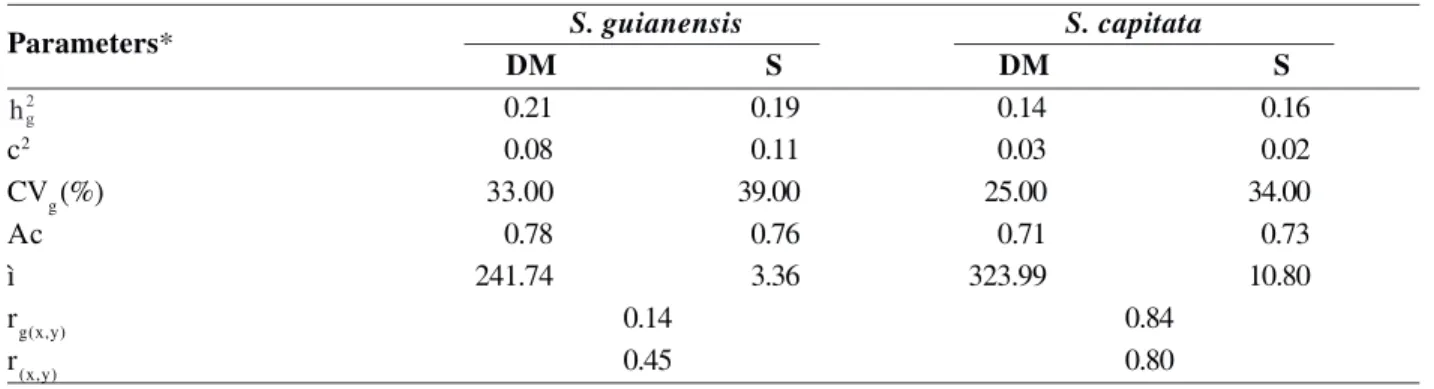
The coefficient of genotypic determination of the effects of accessions for both traits (total dry matter and seed yield) in the two species (S. guianensis and S. capitata) presented low magnitude (Table 1). Martins and Vello (1981) estimated this same parameter for the trait dry matter yield in 25 S. guianensis accessions, as being of moderate magnitude (0.45). In the present study however, a considerable genetic variability was expressed for the traits evaluated in the two species, appropriately represented by the genotypic variation coefficient, which varied from 25 to 34% in S. capitata
and from 33 to 39% in S. guianensis (Table 1).
The mean seed yield in S. guianensis was low (3.36 g plant-1), compared with S. capitata (10.80 g plant-1), whereas the genotypic variation coefficient for this trait in the former species was the highest, which allows for genetic gains with selection in this and the following generations. In practice, the best individual for seed yield in S. guianensis presented a genotypic value of 8.12 g plant-1, a gain of 141% in relation to the overall mean (Table 2). The estimated accuracy values were high, with magnitudes of over 0.70 (Table 1), which is indicated and adequate for effective selection in improvement programs (Resende 2002).
S. guianensis S. capitata DM S DM S
0.21 0.19 0.14 0.16
c2 0.08 0.11 0.03 0.02
CVg (%) 33.00 39.00 25.00 34.00
Ac 0.78 0.76 0.71 0.73
ì 241.74 3.36 323.99 10.80
rg(x,y) 0.14 0.84
r(x,y) 0.45 0.80
Table 1. Estimates of the genetics and phenotypic parameters for the traits dry matter (DM) and seed yield (S) in grams per plant, for 35 accessions of S. guianensis and of S. capitata evaluated in Campo Grande, MS
* genotypic determination coefficient of the accessions effects ( ), correlation due to the common environment of the plot (c2),genotypic
variation coefficient (CVg), accuracy of the genotypic evaluation (Ac), overall mean (µ) and genetic mean (rg(x,y)) and phenotypic correlations
(r(x,y)) between traits
Parameters*
Table 2. Genotypic effect (gj) and number of individuals selected from the j
th accession of S. guianensis and S. capitata with based
on BLUP (n) and individual simulated BLUP (nj) for the traits dry matter (DM) and seed yield (S), in grams per plant
S. guianensis S. capitata
DM S DM S Accession gj n nj Accession gj n nj Accession gj n nj Accession gj n nj
G 25 169.42 17 20 G29 2.38 21 16 C23 132.27 19 15 C6 5.01 11 12
G 11 115.03 6 14 G 8 1.72 7 11 C4 130.29 13 15 C23 4.69 17 11
G 3 108.37 8 13 G 18 1.61 13 11 C6 97.96 11 11 C9 3.96 11 10
G 21 103.02 16 12 G10 1.59 17 11 C2 85.81 15 10 C17 3.88 9 9
G 22 81.94 18 10 G12 1.33 7 9 C11 61.30 4 7 C4 3.88 7 9
G 20 76.10 7 9 G15 1.30 12 9 C20 51.81 8 6 C7 3.53 5 9
G 23 59.34 11 7 G25 1.27 8 8 C17 49.39 7 6 C20 2.90 14 9
G 26 51.84 6 6 G17 1.04 5 7 C9 48.08 7 5 C2 2.72 9 7
G 12 45.08 5 5 G30 0.97 5 6 C29 46.59 4 5 C11 2.49 3 7
G 34 22.66 2 3 G19 0.75 2 5 C19 45.34 6 5 C19 1.41 6 6
G 5 21.11 2 2 G21 0.57 3 4 C25 40.21 2 5 C3 1.21 1 3
G 10 15.78 2 2 G26 0.56 2 4 C3 38.31 0 4 C30 1.19 2 3
G 2 10.20 1 1 G22 0.36 0 2 C1 25.46 1 3 C25 1.10 1 3
G 29 9.54 3 1 G33 0.13 1 1 C18 21.84 1 2 C13 0.86 2 2
G 8 5.73 2 1 G11 0.03 1 0 C30 15.91 2 0 C10 0.44 4 2
Total 106 Total 104 Total 100 Total 102 r* 0.79 r 0.91 r 0.89 r 0.82
rp 0.71 rp 0.83 rp 0.69 rp 0.60
r*: Pearson correlation between the number of individuals per accession selected by the methods BLUP and BLUPIS; rp: Pearson correlation
between the number of individuals per plot selected by the methods BLUP and BLUPIS
The genetic and phenotypic correlations between traits (Table 1) were of high magnitude and positive in
S. capitata. These results suggested that the genes
an advantage for improvement since both are target traits.
For S. guianensis, however, the genetic correlation between the traits was positive, but of low magnitude. Therefore, the use of a selection index or the method of independent elimination levels aiming at concomitant gains is essential.
Under the present conditions, the most adequate selection scheme in Stylosanthes should involve the evaluation of accessions and selection of those with the best genotypic values, as well as individual selection, from mass selection based on permanent predicted phenotypic value obtained from repeated measures. After this selection, the next step could involve at least three strategies: i. the amplification of the number of individuals to be evaluated in the selected accessions (using leftover seeds); ii. selection of elite individuals with evaluation in a clonal test to form a synthetic population and selection gain in the short term; iii. development of open-pollinated families or (an)other type(s), with lower selection intensity, to establish the new improvement population, aiming at medium and long-term gains. An optimization in the allocation of individuals in the strategies ii and iii must be priority to enhance the selection efficiency and reduce costs of improvement programs.
The correlations between the number of selected individuals per accession by the BLUP method in the individual evaluation, and the number of those selected by BLUPIS were of high magnitude, with values of over 0.79 (Table 2). Results showed that: a) for a corresponding total number of individuals selected by the two methods, the number of the ones selected per accession by BLUPIS decreases progressively from the best accession until close to zero in the average accession, for all evaluated traits. Since this method depends on the relative difference among the genotypic effects of the accessions under evaluation, different numbers of individuals of each accession are selected, as by BLUP. This is an advantage in relation to the selection of accessions with all individuals, widely used in improvement of Stylosanthes (Chakraborty 2004) as well as in several forage legumes, even in temperate ones (Brummer 2005). BLUPIS automatically eliminates accessions with negative genotypic effects, that is, those below the overall mean of the experiment. This is reasonable in view of the low probability of developing a superior individual from these accessions; b) under
variable selection intensities within an accession it is possible to determinate, automatically, the number of individuals and from which accessions they are to be selected to compose the breeding population (lower intensity) and compose a synthetic population (higher intensity), with around 100 and 20 individuals, respectively. In this validation, BLUPIS indicated the individuals of different accessions that must continue in the program, which results in a greater selection efficiency and, certainly, in gains in subsequent cycles. BLUPIS can therefore be used routinely in the breeding of these forage legumes. The method provides relevant information: the number of individuals to be selected per accession; the number of accessions that contribute with selected individuals; the identification of the plots where these individuals grow and the number to be selected in each one (see item c). Thus, it is possible to evaluate a larger number of accessions in each experiment in a cheaper and less time-consuming way, increasing the efficiency of a breeding program and allowing that more effective strategies be used after this initial selection stage; c) another point that speaks for BLUP is that the method predicts the genotypic plot effects for each accession, expressed in . This provides the information in which plot or replication the superior genotypes of each accession are found. For example, for the best accession for dry matter yield in S. guianensis (accession 25), the genotypic plot effects were, approximately, 159; 210; 163; 167, and 191, for the five replications, respectively. So, in the selection of the 20 best individuals of this accession 3, 5, 4, 4, and 4 individuals should be obtained from the replications one to five, respectively. These values were given by
the proportion multiplied by the total
number of individuals to be selected per accession. It is noteworthy that the experiments should have a known and sufficient number of plants in the plot for selection within accessions and yet of an adequate effective size for evaluation of each accession. In the validation of the method in Stylosanthes, the correlations between the real number of individuals selected in each replication by BLUP and the number selected by BLUPIS varied from 60 to 83% (Table 2), which is considered satisfactory.
RESUMO - Os programas de melhoramento genético de leguminosas forrageiras perenes no Brasil realizam a avaliação de acessos em parcelas lineares, sem explorar a variabilidade genética dentro de acessos. A avaliação de plantas individuais permitiria a seleção não apenas dos melhores acessos, mas dos melhores indivíduos dentro de acessos. Entretanto tal procedimento é operacionalmente mais laborioso e caro. Visando solucionar essa questão avaliou-se a viabilidade de utilização do método BLUP individual simulado (BLUPIS) em um experimento com 35 acessos de Stylosanthes capitata e S. guianensis, delineado em blocos casualizados, seis e cinco repetições respectivamente, e seis plantas na parcela. Tal método pode ser aplicado quando avaliações do total de parcelas são realizadas e propicia a seleção de indivíduos. A alta correlação entre os métodos BLUP tradicional e BLUPIS na seleção de indivíduos permite recomendar a utilização do segundo no melhoramento de espécies em que a avaliação do total de parcelas é realizada.
Palavra chave: BLUP/REML, melhoramento genético vegetal, leguminosa forrageira, Stylosanthes capitata, S. guianensis.
REFERENCES
Andrade RP, Karia CT and Ramos AKB (2004) Stylosanthes as a forage legume at its centre of diversity. In: Chakraborty S (ed.)
High-yielding anthracnose-resistant Stylosanthes for agricultural systems. Australian Centre for International Agricultural Research, ACIAR, Canberra, p. 39-50.
Barbosa MHP and Pinto CABP (1998) Análise dialélica parcial entre cultivares de batata nacionais e introduzidas. Pesqui-sa Agropecuária Brasileira 33: 307-320.
Bradshaw JE, Dale MFB and Mackay GR (2003) Use of mid-parent values and progeny tests to increase the efficiency of potato breeding for combined processing quality and disease and pest resistance. Theoretical and Applied Genetics 107: 36-42. Brummer EB (2005) Thoughts on breeding for increased forage y i e l d . P r o c e e d i n g s o f t h e i n t e r n a t i o n a l g r a s s l a n d congress, 20. Wageningen Academic Publishers, Dublin, p. 6 3 .
Cameron DF, Trevorrow RM and Liu CJ (1997) Recent advances in studies of anthracnose of Stylosanthes. II. Approaches to b r e e d i n g f o r a n t h r a c n o s e r e s i s t a n c e i n S t y l o s a n t h e s i n Australia. Tropical Grasslands 31: 424-429.
C h a k r a b o r t y S ( e d . ) ( 2 0 0 4 ) H i g h y i e l d i n g a n t h r a c n o s e -resistant Stylosanthes for agricultural systems. Australian Centre for International Agricultural Research, ACIAR, Canberra, 268p.
Chang YS and Milligan SB (1992) Estimating the potential of sugarcane families to produce elite genotypes using univariate c r o s s p r e d i c t i o n m e t h o d s . T h e o re t i c a l a n d A p p l i e d Genetics 84: 662-671.
Fernandes CD, Chakraborty S, Grof B, Purcino HMA, Nasci-mento MDSB, Charchar MJA, Verzignassi JR and Marcelino Sobrinho J (2004) Regional evaluation of Stylosanthes germplasm in Brazil. In: Chakraborty S (ed.) High-yielding a n t h r a c n o s e - r e s i s t a n t S t y l o s a n t h e s f o r a g r i c u l t u r a l systems. Australian Centre for International Agricultural Research, ACIAR, Canberra, p. 127-134.
BLUP-predicted genotypic effects and not the genotypic values and much less the phenotypic mean of each accession. Apart from misleading, the determination of the number of individuals of the best accession based on these two latter statistics would come closer to mass selection.
Based on the results we suggest BLUPIS for the evaluation of accessions and sib-lines in Arachis spp.,
Cajanus cajan andother forage legumes of economic importance, where the evaluations are of plot totals. The method is also adequate in the evaluation of progeny tests with Panicum maximum and Brachiaria spp., where an individual evaluation in multiple evaluation cuts is highly labor-intensive and costly. In
all these cases, the individual BLUP and the simulated individual BLUP will increase selection efficiency and reduce costs in breeding programs.
ACKNOWLEDGEMENTS
The authors acknowledge the funding of the
Stylosanthes breeding program of Embrapa by the institutions Conselho Nacional de Desenvolvimento Científico e Tecnológico – CNPq; Fundação de Apoio ao Desenvolvimento de Ensino, Ciência e Tecnologia do MS – FUNDECT; Associação para o Fomento a Pesquisa de Melhoramento de Forrageiras Tropicais – UNIPASTO
Kimbeng CA and Cox MC (2003) Early generation selection of sugarcane families and clones in Australia: a review. Journal o f t h e A m e r i c a n S o c i e t y o f S u g a rc a n e Te c h n o l o g i s t s 23: 20-39.
Mariotti JA, Cuenya MI and Garcia de Salas MB (1999) Análisis de componentes familiares y intra-familiares en progenies derivadas de combinaciones biparentales de caña de azúcar (S a c c h a r u m s p p . ) . R e v i s t a I n d u s t r i a l y A g r í c o l a d e Tucumán 76: 55-60.
Martins PS and Vello NA (1981) Performance and variability of agronomic characters in populations of Stylosanthes guianensis
(Aubl.) Sw. In: Proceedings of the international grassland congress, 14. Westview Press, Lexington, p. 196-198. Mothci EP, Amaral JAM ands Santos RD (1979) L
evantamen-to de reconhecimenevantamen-to detalhado e aptidão agrícola dos solos da área do centro Nacional de Pesquisa de Gado de Corte, Mato Grosso do Sul. Embrapa-SNLCS, Rio de Janeiro, 225p. (Boletim Técnico, 59)
Resende MDV (2002) Genética biométrica e estatística no melhoramento de plantas perenes. Embrapa Informa-ção Tecnológica, Brasília, 975p.
Resende MDV and Barbosa MHP (2006) Selection via simulated individual BLUP based on family genotypic effects in sugarcane.
Pesquisa Agropecuária Brasileira 41: 421-429.