Jebmh.com
Original Article
J of Evidence Based Med & Hlthcare, pISSN- 2349-2562, eISSN- 2349-2570/ Vol. 2/Issue 54/Dec. 07, 2015 Page 8796
COEXISTENCE OF BACTERIAL INFECTION IN SPUTUM POSITIVE PULMONARY
TUBERCULOSIS
B. L. Shashi Bhushan1, C. Nagaraja2
1Associate Professor, Department of Pulmonary Medicine, BMCRI, Bangalore. 2Professor & HOD, Department of Pulmonary Medicine, BMCRI, Bangalore.
ABSTRACT
AIM AND OBJECTIVES
To study the coexistence of bacterial infection among patients with confirmed sputum positive pulmonary tuberculosis.
METHODS
Study conducted at department of pulmonary medicine Victoria Hospital Bangalore, Karnataka, India, from January 2015 to June 2015 in confirmed positive sputum pulmonary tuberculosis patient, all patients were subjected for sputum gram staining and culture and sensitivity and checked for bacterial growth.
RESULTS
Total 150 patients were confirmed to have sputum positive pulmonary tuberculosis from January 2015 to June 2015 both inpatient and outpatient were subjected to undergo sputum gram stain and culture and sensitivity with the following growth Klebsiella 40% E coli 15.33% Pseudomonas 9.33% Pneumococci 4.66% gram negative non fermenters 2.66% methicillin resistant Staphylococcus aureus 1.33% Citrobacter 1.33% Enterobacter 1.33%, Serratia/Staphylococci aureus/Proteus .66%.
CONCLUSION
The most common secondary infection observed out of 150 patients is Klebsiella which is seen in 60 patients followed by E coli in 23 patients, pseudomonas in 14 patients Pneumococci in 7 pt gram negative non fermenter 4 pt, Methicillin resistant Staph aureus, Citrobacter, Enterobacter in 2 patients each Serratia, Proteus, Staphylococcus aureus in 1 patient each.
KEYWORDS
PTB-Coexistence bacterial infection.
HOW TO CITE THIS ARTICLE: B. L. Shashi Bhushan, C. Nagaraja. “Coexistence of Bacterial Infection in Sputum Positive Pulmonary Tuberculosis”. Journal of Evidence based Medicine and Healthcare; Volume 2, Issue 54, December 07, 2015; Page: 8796-8798, DOI: 10.18410/jebmh/2015/1230
INTRODUCTION: Pulmonary tuberculosis is a one of the commonest disease in India and is the highest TB burden country with World Health Organization (WHO) statistics for 2011 giving an estimated incidence of 2.2 million cases of TB for India out of global incidence of 8.7 million cases. The estimated TB prevalence figure for 2011 is given 3.1million.1 It is estimated that about 40% of the Indian
population are infected with TB bacteria the vast majority have latent rather than active TB.
Patients admitted with complaints of cough, fever, loss of appetite suspected to be due to pulmonary TB are commonly initiated on broad spectrum antibiotics while awaiting for sputum TB confirmation may improve within few days and those patient without broad spectrum antibiotics may deteriorate now obvious question is to identify secondary bacterial infection through available investigations and treat accordingly along with ATT.
In current study we are trying to study most common bacterial organism causing secondary bacterial infection in sputum positive Pulmonary TB cases.
MATERIAL AND METHODS: This study was conducted at Victoria Hospital, a tertiary Government Hospital that serves urban and rural population of Bangalore city and surrounding rural areas. Adult patient including both inpatient and outpatient were enrolled at Victoria Hospital from January 2015 until June 2015, who were subsequently diagnosed with Pulmonary TB on sputum, and who also had concomitant sputum sent for gram stain and culture were eligible for study, informed consent obtained from study participants was taken. Patient details like age gender, clinical features (duration of cough fever) and laboratory data (HIV status, Diabetes Mellitus status, LFT, RFT) were collected.
A diagnosis of Pulmonary TB was based on the presence of acid-fast bacilli on the sputum smear together with compatible clinical and radiological features. The concurrent sputum specimens were Gram stained and cultured. Bacteria were identified according to standard microbiological techniques. The results of the Gram stain and culture were recorded.
Submission 27-11-2015, Peer Review 28-11-2015 Acceptance 02-12-2015, Published 07-12-2015. Corresponding Author:
Dr. B. L. Shashi Bhushan,
#45, 2nd Main Road, 3rd Stage, 3rd Block,
Jebmh.com
Original Article
J of Evidence Based Med & Hlthcare, pISSN- 2349-2562, eISSN- 2349-2570/ Vol. 2/Issue 54/Dec. 07, 2015 Page 8797
RESULTS: One hundred and fifty patients were recruited for study, of which 34 were females and 116 males. The median age was 60 yrs. (16-82). Out of 150 patients 117 patients had secondary bacterial infection out of which 85 patients were under cat 1 regimen of Rntcp, 32 patients were under cat 2 regimen of Rntcp, six patients are known to be infected with HIV, forty-four patients are known diabetic, nine patients with deranged liver function test and twenty-eight patients with deranged renal function test.
33 patients (22%) had normal commensals, 60(40%) patients had Klebsiella growth, E. coli in 23(15.3%) patients, 14(9.33%) patients had pseudomonas, pneumococci in 7(4.66%) patients.
Table 1 shows various bacterial growths,
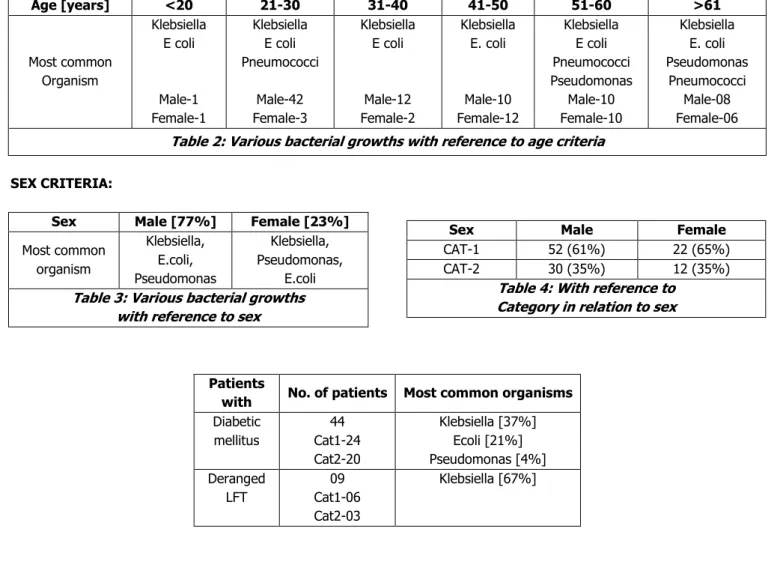
Table 2 & 3 shows various bacterial growths as per age & sex criteria.
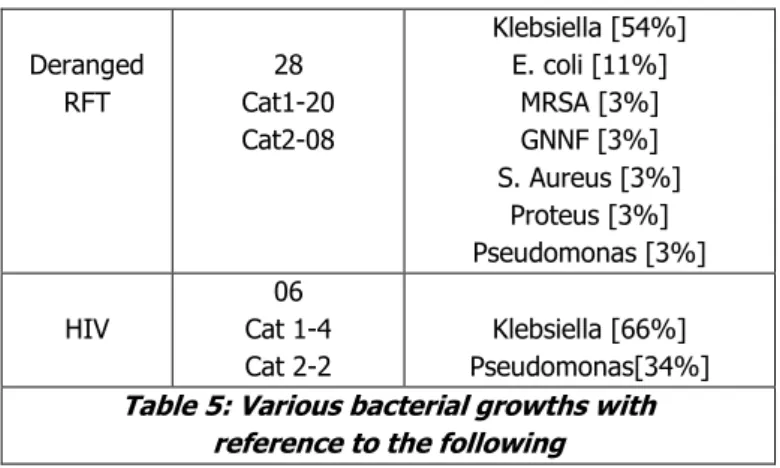
Table 4 shows bacterial growth with reference to DM, Deranged LFT & RFT & in HIV patients.
Bacterial growth Total no.
of sputum positive Patients
Normal
Commensal Klebsiella E coli Pseudomonas Pneumococci GNNF MRSA
Entero- Bacter Species
Citrobacter
Serratia/s aureus/ Proteus
150
33[22%] Cat 1-26 Cat2-7
60[40%] Cat1-46 Cat2-14
23[15%] Cat1-17 Cat2-06
14[9%] Cat1-10 Cat2-04
07[5%] Cat1-05 Cat2-02
04 [2%]
Cat 1-02
Cat 2-02
02 [1%]
Cat 1-01 Cat 2-01
02 [1%]
Cat 2-02
02 [1%]
Cat 2-02
01 1%]
Cat 2-01
Table 1: Various bacterial growth seen in study sample
AGE CRITERIA:
Age [years] <20 21-30 31-40 41-50 51-60 >61
Most common Organism
Klebsiella E coli
Male-1 Female-1
Klebsiella E coli Pneumococci
Male-42 Female-3
Klebsiella E coli
Male-12 Female-2
Klebsiella E. coli
Male-10 Female-12
Klebsiella E coli Pneumococci Pseudomonas
Male-10 Female-10
Klebsiella E. coli Pseudomonas
Pneumococci Male-08 Female-06
Table 2: Various bacterial growths with reference to age criteria
SEX CRITERIA:
Sex Male [77%] Female [23%]
Most common organism
Klebsiella, E.coli, Pseudomonas
Klebsiella, Pseudomonas,
E.coli
Table 3: Various bacterial growths with reference to sex
Sex Male Female
CAT-1 52 (61%) 22 (65%)
CAT-2 30 (35%) 12 (35%)
Table 4: With reference to Category in relation to sex
Patients
with No. of patients Most common organisms
Diabetic mellitus
44 Cat1-24 Cat2-20
Klebsiella [37%] Ecoli [21%] Pseudomonas [4%] Deranged
LFT
09 Cat1-06 Cat2-03
Jebmh.com
Original Article
J of Evidence Based Med & Hlthcare, pISSN- 2349-2562, eISSN- 2349-2570/ Vol. 2/Issue 54/Dec. 07, 2015 Page 8798
Deranged RFT
28 Cat1-20 Cat2-08
Klebsiella [54%] E. coli [11%]
MRSA [3%] GNNF [3%] S. Aureus [3%]
Proteus [3%] Pseudomonas [3%]
HIV
06 Cat 1-4 Cat 2-2
Klebsiella [66%] Pseudomonas[34%]
Table 5: Various bacterial growths with reference to the following
DISCUSSION & CONCLUSION: Coexistence of bacterial infection is quite commonly seen in HIV patients but other bacterial infections in sputum positive pulmonary tuberculosis patients is not known or studied here we did a study of coexistence of bacterial infection in sputum positive patients and found the most common secondary infection observed out of 150 patients is klebsiella which is seen in 60 patients followed by e coli in 23 patients, pseudomonas in 14 patients Pneumococci in 7 pt gram negative non fermenter 4 pt, Methicillin resistant staph aureus, Citrobacter, Enterobacter in 2 patients each Serratia, Proteus, staphylococcus aureus in 1 patient studied.
Among the patients studied 44 patients were diabetics, 28 deranged Renal Function Test, 9 deranged Liver Function Test and 6 HIV positive patients All the patients were treated with appropriate antibiotics repeat culture and sensitivity of all the patients were no growth.
Further we want to continue on the study to check if there was a early conversion of sputum AFB positive patients becoming sputum negative in these treated patients who were treated for tuberculosis and bacterial secondary infection.
In a study conducted by Md. Joynal Abedin khan & zakaria ahmed2 in Bangladesh they found in 450 TB
suspected patients, secondary bacterial infection was isolated commonest being klebsiella species.
In another study conducted by Dr Hayat Kadhum salman3 from Baghdad among the 50 patients enrolled 72
%( 36) there was positive secondary infections common infection being streptococcus pneumonia.
Not many studies are available in reference to sputum positive pulmonary tuberculosis co infection in comparison with HIV co infection so when underlying co infection is treated there is a possibility of effective anti-tubercular treatment
We are also checking on early sputum conversion in these patients results awaited.
REFERENCES:
1. Global tuberculosis control 2012,who,geneva 2012 www.who.int/tb/publications/global y report/ 2. Md Joynal, Abedin Khan & Zakaria Ahmed Study on
the current status of secondary infection of pulmonary tuberculosis patients in Bangladesh IASET vol 2 issue 2, May 2013, 11-16.