The effect of a high ambient temperature on the
apparent ileal digestibility of amino acids and
nitrogen in growing pigs
Vplyv vysokej teploty prostredia na zdanlivú
ileálnu stráviteľnosť aminokyselín a dusíka u
ošípaných
Matej BRESTENSKÝ, SoňaNITRAYOVÁ, Peter PATRÁŠ and Jaroslav HEGER
National Agricultural and Food Center, Research Institute of Animal Production Nitra, Institute of
Nutrition, Hlohovecká 2, 95141 Lužianky, Slovakia; *correspondence: [email protected]
Abstract
A total of 7 gilts (initial BW 50.5 ± 1.7 kg) fitted with a simple T-cannula in terminal part of ileum were used for the determination the effect of high ambient temperature on the apparent ileal digestibility (AID) of amino acids (AA) and nitrogen (N) and on the apparent total tract digestibility (ATTD) of N and dry matter (DM). After the 5 d adaptation period two 14 d experimental periods followed. After the 1st 14 d period when the animals were housed at thermo-neutral (TN) temperature (20.6 ± 0.1 ºC), the 2nd 14 d period followed at high temperature (HT) (30.4 ± 0.4 ºC). On d 7 and 14 of each experimental period, two 24 h collections of ileal digesta and 2 collections of faeces were performed. The pigs were fed twice a day in two equal doses at a daily rate of 90 g*kg BW -0.75. The content of AA in samples of diets and ileal digesta was determined by an automatic amino acid analyzer (AAA 400, Ingos, Prague) after previous acid hydrolysis in 6M HCl with the exception of methionine and cysteine which were determined after oxidative hydrolysis. Water was offered ad libitum. The ATTD of N and DM at TN was 84.9 and 85.3%, respectively and the ATTD at HT was 84.7% and 86.5% for N and DM, respectively. Apparent ileal digestibility of AA and N were similar at both TN and HT ambient conditions. High ambient temperature had no adverse effect on ATTD of N and DM nor on the AID of N and AA in pigs.
Keywords: ambient temperature, amino acid, digestibility, pig
Abstrakt
vysokých teplôt okolitého prostredia na zdanlivú ileálnu stráviteľnosť (AID)
aminokyselín (AA) a dusíka (N) a na celkovú stráviteľnosť (ATTD) sušiny (DM) a
dusíka. Po 5 dňovom adaptačnom období nasledovali dve 14 dňové experimentálne obdobia. Po prvom 14 dňovom experimentálnom období počas ktorého zvieratá boli umiestnené pri termoneutrálnej teplote (TN) prostredia (20,6 ± 0,1 ºC), nasledovalo
druhé 14 dňové obdobie počas ktorého boli zvieratá ustajnené pri vysokej teplote
(HT) prostredia (30,4 ± 0,4 ºC). Na 7. deň každej 14 dňovej periódy sme uskutočnili
dva 24 h odbery ileálneho chýmusu a 2 odbery výkalov. Ošípané sme kŕmili dva krát
denne v dvoch rovnakých dávkach v dennom množstve 90 g*kg BW -0,75 . Voda bola k dispozícii ad libitum. Zdanlivá celková stráviteľnosť dusíka a sušiny pri
termoneutrálnej teplote bola 84,9 a 85,3% a pri vysokej teplote prostredia 84,7 a 86,5%. Vysoká teplota prostredia nemala vplyv na celkovú stráviteľnosť dusíka a
sušiny ani na zdanlivú ileálnu stráviteľnosť dusíka a aminokyselín u ošípaných.
Kľúčové slová:aminokyseliny, ošípaná, stráviteľnosť, teplota prostredia
Detailný abstrakt
Vysoké teploty prostredia majú negatívny vplyv na produkciu hospodárskych zvierat. Pri vysokých teplotách prostredia, ktoré prevyšujú hornú kritickú teplotu organizmu dochádza k rastu telesnej teploty organizmu. Organizmus sa snaží rast telesnej teploty obmedziť a to buď ochladzovaním alebo znížením produkcie tepla. Produkciu tepla sa ošípané snažia znížiť poklesom príjmu krmiva. Tento pokles príjmu krmiva ovplyvňuje pokles príjmu energie, čo sa prejaví redukciou telesných prírastkov a zníženou produkciou zvierat. Využitie živín v organizme má tiež významný vplyv na produkciu hospodárskych zvierat. Aminokyseliny ako základné stavebné živiny organizmu majú významný vplyv na tvorbu prírastkov a okrem toho sa podieľajú na množstve biochemických funkcií v organizme. Informácie o vplyve teploty prostredia na stráviteľnosť aminokyselín u ošípaných sú nedostatočné. Preto, cieľom tejto práce
bolo stanoviť vplyv vysokej teploty prostredia na zdanlivú ileálnu stráviteľnosť aminokyselín a dusíka a na celkovú stráviteľnosť dusíka u rastúcich ošípaných. Na 7 prasničkách, ktoré mali v terminálnom úseku tenkého čreva voperovanú ileálnu
T-kanylu sme sledovali vplyv vysokých teplôt okolitého prostredia na zdanlivú ileálnu
stráviteľnosť aminokyselín a dusíka a na celkovú stráviteľnosť dusíka. Po 5 dňovom adaptačnom období nasledovali dve 14 dňové experimentálne obdobia. Po prvom 14 dňovom experimentálnom období počas ktorého zvieratá boli umiestnené pri
termoneutrálnej teplote (TN) prostredia (20,6 ± 0,1 ºC), nasledovalo druhé 14 dňové
obdobie počas ktorého boli zvieratá ustajnené pri vysokej teplote (HT) prostredia
(30,4 ± 0,4 ºC). Na 7. deň každej 14 dňovej periódy sme uskutočnili dva 24 h odbery
ileálneho chýmusu a 2 odbery výkalov. Ošípané sme kŕmili dva krát denne v dvoch
rovnakých dávkach v dennom množstve 90 g*kg BW -0,75. Voda bola k dispozícii ad
libitum.
stráviteľnosť aminokyselín a dusíka a celkovástráviteľnosť dusíka a sušiny nebola ovplyvnená rôznymi teplotami prostredia.
Introduction
A high environmental temperature adversely affects the growth performance in livestock production (Huynh et al., 2005). The best known reactions on the high ambient temperatures are a reduction of feed intake and subsequently a lower energy intake and average daily gain (Becker et al., 1992; Lopez et al., 1991). Reduction in feed intake the animals try to reduce the heat load by limiting a
thermogenesis (Quiniou et al., 2000) which results in lower growth performance (Le Bellego et al., 2002). But the information about the effect of high ambient
temperature on the nutrient digestibility is limited.
In the past, the effects of the high ambient temperature on the nitrogen (N) retention and total tract digestibility of N were studied in different categories of pigs
(Brestenský et al., 2012; Liao and Veum, 1994). There were reported that at the constantly high ambient temperatures the N retention decreased and the digestibility of N remained unchanged. There is a little information about the effect of the ambient temperature on the ileal digestibility of nutrients in pigs. The effect of the high
ambient temperatures on an ileal digestibility of amino acids (AA) was studied in broiler chickens (Wallis and Balnave, 1984; Zuprizal et al., 1993) and laying hens (Koelkebeck et al., 1998) and the results are inconsistent. Whereas in some studies (Wallis and Balnave 1984; Zuprizal et al., 1993) there was reported depressed ileal digestibility of most AA as a result of high ambient temperature, in the others
(Koelkebeck et al., 1998) there was found no adverse effect of high ambient
temperature on AA digestibility. The information about the effect of the high ambient temperature on the apparent ileal digestibility of AA in pigs is not available.
Therefore the aim of the present study was to investigate the effect of the high ambient temperature on the apparent ileal digestibility of AA and N.
Materials and methods
The study was performed at National Agricultural and Food Center - Research Institute of Animal Production Nitra and all the experimental procedures were reviewed and approved by the Animal Care Committee. The 7 gilts (White Meat x Landrace) with an initial body weight of 50.5 ± 1.7 kg from an experimental herd of Research Institute of Animal Production Nitra were used for the investigation the effect of the high ambient temperature on the apparent ileal digestibility (AID) of amino acids (AA) and nitrogen (N) and on the apparent total tract digestibility (ATTD) of N and dry matter (DM). The pigs fitted with an ileal T-cannula in terminal ileum were housed in experimental balance cages in a room with a climate controlled environment. The balance cages enabling individually housing of pigs are made of steel with a slatted floor, with a feeder and drinking bowl. After the 14 d post - surgery recovery period the 5 d adaptation period and two 14 d experimental periods were followed. During the 1st experimental period the pigs were housed at the ambient
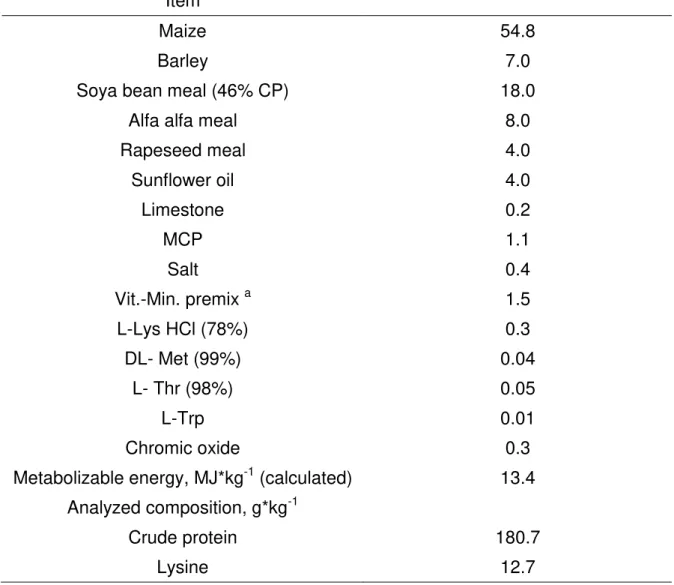
Ingredient and chemical composition of experimental diet is given in Table 1. The chromic oxide was used as an indigestible marker in an amount of 0.3%. The
animals were fed twice a day at 06:00 hours and 16:00 hours in a two equal doses in a daily amount of 90 g*kg of BW -0.75. Water was available ad libitum.
Table 1. Ingredient and chemical composition of experimental diet (as fed basis)
Tabuľka 1. Komponentné a živinové zloženie diéty (v pôvodnej hmote)
Item
Maize 54.8
Barley 7.0
Soya bean meal (46% CP) 18.0
Alfa alfa meal 8.0
Rapeseed meal 4.0
Sunflower oil 4.0
Limestone 0.2
MCP 1.1
Salt 0.4
Vit.-Min. premix a 1.5
L-Lys HCl (78%) 0.3
DL- Met (99%) 0.04
L- Thr (98%) 0.05
L-Trp 0.01
Chromic oxide 0.3
Metabolizable energy, MJ*kg-1 (calculated) 13.4
Analyzed composition, g*kg-1
Crude protein 180.7
Lysine 12.7
a
Supplemented per kg of diet: vit. A 9 000 IU, vit. D3 1 500 IU, α– tocopherol 35.0 mg, vit. B1 1.7 mg, vit. B2 6.0 mg, vit. B6 2.5 mg, Ca-panthothenate 15.0 mg, niacin 38.0 mg, vit. K3 2.0 mg, biotin 0.12 mg, cyanocobalamin 0.03 mg, choline 156 mg, Fe 103.0 mg, Zn 116.5 mg, Mn 49.0 mg, Cu 40.0 mg, I 1.2 mg, Co 0.4 mg, Se 0.3 mg.
a
Within the each 14 d experimental period, on d 7 and d 14, collection of ileal digesta and faeces was performed at the thermo-neutral temperature and at the high
temperature, as well. The ileal digesta was collected continuously every hour for 24 h. The collection started at 07:00 hours and was finished at 07:00 hours next day. The samples of the ileal digesta were collected into plastic containers and were acidified with 5M H2SO4 for minimizing the microbial activity. A total of 14 samples of
ileal digesta and 14 samples of faeces were obtained for the period at thermo-neutral temperature and 14 samples of ileal digesta and faeces at high temperature. The samples of ileal digesta and faeces were frozen and stored at - 20 ºC for
consequential analyzes.
In the samples of diets and the lyophilized and milled samples of ileal digesta and faeces the content of DM, total N (AOAC, 1990) and the content of chromic oxide (Williams et al., 1962) was analyzed. The content of AA in samples of diets and ileal digesta was analyzed by using of an automatic amino acid analyzer (AAA 400, Ingos, Prague) after previous acid hydrolysis in 6M HCl with the exception of methionine and cysteine. Methionine and cysteine were determined after oxidative hydrolysis.
The apparent ileal digestibility (AID) of AA and N was calculated according to Stein et al. (2007). Apparent total tract digestibility (ATTD) of nutrients was calculated
according to the following pattern:
ATTD, % = [1-(Nutrfaeces/AAdiet) x (Mdiet/Mfaeces)] x 100
where Nutrfaeces and Nutrdiet represent the nutrient concentrations (g*kg of DM-1) in
faeces and diet, respectively, and Mdiet and Mfaeces represent the marker
concentrations (g*kg of DM-1) in diet and faeces, respectively.
The statistical analyses of experimental data were performed using ANOVA of Statgraphic Plus package version 3.1. (1997). When a significant value for treatment effect (P < 0.05) was observed, the differences between means were assessed using Fisher's LSD procedure. Each animal was considered as an experimental unit.
Samples were pooled and compared for experimental periods at different ambient temperatures.
Results and discussion
At the beginning of the 1st experimental period, the average BW of pigs was 56.7 kg and at the end of the study it was 72.9 kg. It was expected, that this difference in body weight will not affect neither the ileal digestibility nor the apparent total tract digestibility of nutrients as reported Pedersen et al. (2015), and only environmental conditions will be a major factor which affect the digestibility of nutrients.
Table 2. Apparent total tract digestibility of dry matter and nitrogen at different ambient temperatures (%)
Tabuľka 2. Zdanlivá celková stráviteľnosť sušiny a dusíka pri rôznych teplotách
prostredia (%)
Item TNa HTa SEMb P-value
Dry matter 85.3 86.5 0.66 0.173
Nitrogen 84.9 84.7 0.32 0.556
a
During the period TN the pigs were housed at ambient temperature 20.6 ºC (n = 7); during the HT the
pigs were housed at ambient temperature 30.4 ºC (n = 7).
b
SEM – standard error of the means. a
Počas periódy TN boli ošípané ustajnené pri teplote prostredia 20,6 ºC (n = 7); počas periódy HT boli
ošípané ustajnené pri teplote prostredia 30,4 ºC (n = 7). b
SEM –stredná chyba priemeru.
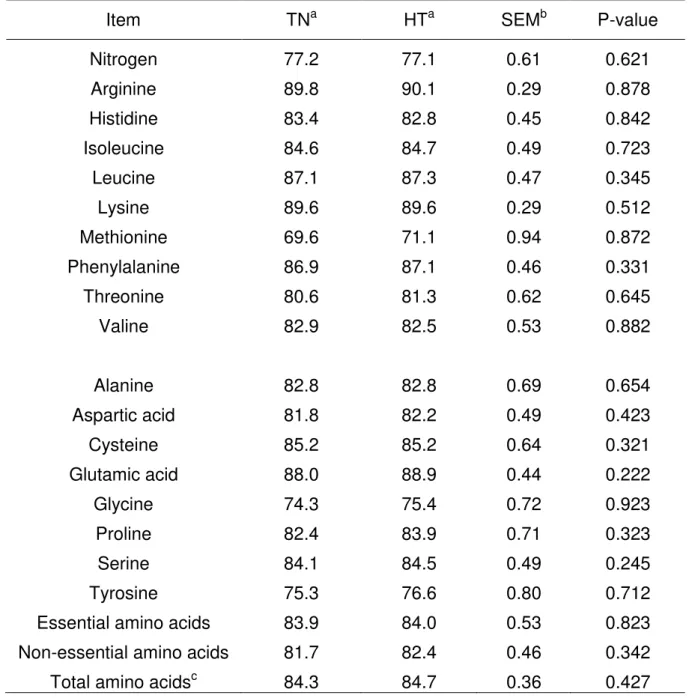
Table 3. Apparent ileal digestibility of nitrogen and amino acids at different ambient temperatures (%)
Tabuľka 3. Zdanlivá ileálna stráviteľnosť dusíka a aminokyselín pri rôznych teplotách
prostredia (%)
Item TNa HTa SEMb P-value
Nitrogen 77.2 77.1 0.61 0.621
Arginine 89.8 90.1 0.29 0.878
Histidine 83.4 82.8 0.45 0.842
Isoleucine 84.6 84.7 0.49 0.723
Leucine 87.1 87.3 0.47 0.345
Lysine 89.6 89.6 0.29 0.512
Methionine 69.6 71.1 0.94 0.872
Phenylalanine 86.9 87.1 0.46 0.331
Threonine 80.6 81.3 0.62 0.645
Valine 82.9 82.5 0.53 0.882
Alanine 82.8 82.8 0.69 0.654
Aspartic acid 81.8 82.2 0.49 0.423
Cysteine 85.2 85.2 0.64 0.321
Glutamic acid 88.0 88.9 0.44 0.222
Glycine 74.3 75.4 0.72 0.923
Proline 82.4 83.9 0.71 0.323
Serine 84.1 84.5 0.49 0.245
Tyrosine 75.3 76.6 0.80 0.712
Essential amino acids 83.9 84.0 0.53 0.823
Non-essential amino acids 81.7 82.4 0.46 0.342
Total amino acidsc 84.3 84.7 0.36 0.427
a
During the period TN the pigs were housed at ambient temperature 20.6 ºC (n = 7); during the HT the
pigs were housed at ambient temperature 30.4 ºC (n = 7).
b
SEM – standard error of the means. c
Values were calculated as the mean apparent ileal digestibility of all the amino acids. a Počas periódy TN boli ošípané ustajnené pri teplote prostredia 20
,6 ºC (n = 7); počas periódy HT boli
ošípané ustajnené pri teplote prostredia 30,4 ºC (n = 7). b
SEM –stredná chyba priemeru. cHodnoty boli vypočítané ako priemer
Using a carcass analysis, Ferguson and Gous (2002) reported greater utilization of tryptophan in piglets housed at the high temperatures, when the dietary tryptophan was limited. In the present study there was observed no effect of different ambient temperatures on the apparent ileal digestibility of AA and N. Similarly Koelkebeck et al. (1998) reported that the high ambient temperature had no adverse effects on ileal digestibility of AA, but in laying hens. Contrary to these results Elias and Cline (1991) reported lower digestibility of AA in pigs housed at the ambient temperature which exceeded the upper critical temperature of pigs. However, the digestibility in their study was measured as feacal digestibility. Amino acids in faeces are largely of a microbial origin, their amount and composition does not share undigested dietary AA presented at the end of a small intestine. Therefore, the most accurate method for determination of AA digestibility is the ileal digestibility (Stein et al., 2007).
Conclusions
The apparent ileal digestibility of AA and N and apparent total tract digestibility of N and DM was not affected by high ambient temperature at which the pigs were housed. There was observed no adverse effect of the high ambient temperature neither on the total tract digestibility of N and DM nor on the apparent ileal digestibility of N and AA.
Acknowledgements
This article was written during realization of the project "ZDRAVIE No. 26220220176" supported by the Operational Programme Research and Development funded from the European Regional Development Fund.
References
AOAC (1990) Official Methods of Analysis of AOAC International. 15th edition. Arlington, VA, USA: Association of Official Analytical Chemists.
Becker, B. A., Knight, C. D., Buonomo, F. C., Jesse, G. W., Hedrick, H. B., Baile, C. A. (1992) Effect of a hot environment on performance, carcass
characteristics, and blood hormones and metabolites of pigs treated with porcine somatotropin. Journal of Animal Science, 70 (9), 2732–2740. DOI:
1992.7092732x
Brestenský, M., Heger, J., Nitrayová, S., Patráš. P. (2012) Total tract digestibility of
nitrogen in pigs exposed to high environmental temperatures. Journal of Animal Science, 90 (Suppl 4), 101–103. DOI: 10.2527/jas.51697
Elias, T. F., Cline, T. R. (1991) Influence of environmental temperature on nitrogen retention apparent digestibility of protein and amino acids and energy
Ferguson, N. S, Gous, R. M. (2002) The response of growing pigs to amino acids as influenced by environmental temperature: tryptophan. Animal Science, 74, 103-110.
Huynh, T. T. T., Aarnink, A. J. A., Verstegen, M. W. A., Gerrits, W. J. J., Heetkamp, M. J. W. , Kemp, B., Canh, T. T. (2005) Effects of increasing temperatures on physiological changes in pigs at different relative humidities. Journal of Animal Science, 83 (6), 1385-1396. DOI: 2005.8361385x
Koelkebeck, K. W., Parsons, C. M., Wang, X. (1998) Effect of acute heat stress on amino acid digestibility in laying hens. Poultry Science, 77 (9), 1393–1396. DOI: 10.1093/ps/77.9.1393
Le Bellego, L., Van Milgen, J., Noblet, J. (2002) Effect of high temperature and low-protein diets on the performance of growing-finishing pigs. Journal of Animal Science, 80 (3), 691-701. DOI: 2002.803691x
Liao, C. W., Veum, T. L. (1994) Effects of dietary energy intake by gilts and heat stress from days 3 to 24 or 30 after mating on embryo survival and nitrogen and energy balance. Journal of Animal Science, 72 (9), 2369-2377. DOI:
1994.7292369x
Lopez, J., Jesse G. W., Becker, B. A., Ellersieck, M. R. (1991) Effects of temperature on the performance of finishing swine: I. Effects of a hot, diurnal
temperature on average daily gain, feed intake, and feed efficiency. Journal of Animal Science, 69 (5),1843–1849. DOI: 1991.6951843x
Pedersen, C., Almeida, J., Stein, H. (2015) Effect of weight on standardised ileal digestibility of protein and amino acids in pigs - a meta analysis. In: Proceedings of 13th Digestive Physiology in Pigs Symposium. Kliczków, Poland, May 19-21 2015, Poland.
Quiniou, N., Dubois, S., Noblet, J. (2000) Voluntary feed intake and feeding behaviour of group-housed growing pigs are affected by ambient
temperature and body weight. Livestock Production Science, 63 (3), 245– 253. DOI: 10.1016/S0301-6226(99)00135-9
Stein, H. H., Seve, B., Fuller, M. F., Moughan, P. J., De Lange, C. F. M. (2007). Invited review: Amino acid bioavailability and digestibility in pig feed
ingredients: Terminology and application. Journal of Animal Science, 85 (1), 172–180. DOI: 10.2527/jas.2005-742
Wallis, I. R., Balnave, D. (1984) The influence of environmental temperature, age and sex on the digestibility of amino acids in growing broiler chickens. British Poultry Science, 25 (3), 401-407. DOI: 10.1080/00071668408454880
Williams, C. H., David, D. J., Lismoa, O. (1962) The determination of chromic oxide in fecal samples by atomic absorption spectrophotometry. Journal of
Agriculture Science, 59 (3), 381-390. DOI: 10.1017/S002185960001546X
Zuprizal, M., Larbier, A., Chagneau, M., Geraert, P. A. (1993) Influence of ambient temperature on true digestibility of protein and amino acids of rapeseed and soybean meals in broilers. Poultry Science, 72 (2), 289–295. DOI: