2016
FACULDADE DE CIÊNCIAS
DEPARTAMENTO DE QUÍMICA E BIOQUÍMICA
Role of CFTR and TMEM16 for Regulated Cell Death
Filipa Bica Simões
Mestrado em Bioquímica
Especialização em Bioquímica Médica
Dissertação orientada por:
i
A
CKNOWLEDGMENTS
/A
GRADECIMENTOS
First of all, I would like to express my appreciation to my supervisors – Prof. Karl Kunzelmann and Prof. Margarida Amaral – for giving me the incredible opportunity of pursuing my studies in science while gaining new insight about life abroad. For all the guidance, support, help and knowledge, I truly thank Prof. Karl Kunzelmann. I also want to show my gratitude to Prof. Rainer Schreiber for being available to answer my questions, give new ideas and share his experience.
A special thank goes to Ji, who followed my work very close, always showing an energetic attitude, helping and pushing me to get the best out of my project. I will never forget all the technique and ‘small tricks’ that she taught me! To Inês, who introduced me the life in Regensburg and always kept a positive mind, making the craziest excuses to party all night long! Thank you for all the support, conversations and bell ringing every morning!! To Roberta, for all the true friendship with lots of love and kicking! Thank you for teaching me when compounds are frozen and for loving my açorda! – You will always be my ‘you-know-what’! To Kip, for being my essential companionship in the cell culture room, for always giving me tips about my cells and especially for never give up on trying to make me think positive! – I will always remember that! To Gam, for all the laughter, dinners, parties and lessons in the lab! To Joana, for all the morning coffees, opinions and Sunday afternoons doing experiments! All of you made my days easier and brought really funny and unforgettable moments into my life! I also want to show my appreciation to Brigitte, Tini, Susi, Patricia and Silvia for all the help and good mood in the lab!
Obrigada a toda a minha família pela atitude sempre positiva, por todo o apoio e pela boa disposição, mesmo nos momentos mais difíceis!
Aos meus pais, por me ensinarem a seguir os meus sonhos e a enfrentar os obstáculos na vida, crescendo com eles. À minha mãe, por me fazer sentir que nunca estive ausente, partilhando todos os momentos comigo e não passando uma única manhã sem me desejar um bom dia de trabalho! Ao meu pai, por, apesar da distância, manter sempre a naturalidade, pelos conselhos e por todas as músicas partilhadas! Ao Nuno, por todo o carinho, maluqueiras e parvoíces, conseguindo sempre pôr-me um sorriso na cara. És a prova de que um irmão pode ser um melhor amigo!
Um agradecimento muito especial a todos os meus avós, por me acompanharem sempre e me ensinarem a ser uma pessoa integra – o meu orgulho é eterno! Obrigada aos meus tios e primos, pelo apoio e carinho incondicionais. Ao Miguel por ser meu amigo, companheiro e segundo irmão!
Obrigada a todos os meus amigos pela amizade verdadeira, pelas brincadeiras e por me fazerem sentir que nunca estive longe! Em especial à Ana (Frafrá), por ter partilhado esta grande experiência comigo, por todas as gargalhadas, viagens, cervejas e companhia: sem ti tudo teria sido muito mais complicado!! Muito obrigada, também, por matares os bichos que apareciam no meu quarto! À Ana e ao André, por serem amigos incansáveis, honestos, bons ouvintes e conselheiros: a festa recomeça agora!!
ii
S
UMMARY
Regulated or programmed cell death is defined as an intracellular program that plays a complementary role to mitosis in maintaining a stable population of cells. Apoptosis is the main form of regulated cell death, allowing the silent elimination of harmed or aged cells without triggering any inflammatory response.
Anoctamin 6 (ANO6, TMEM16F) is a multifunctional protein from a family of ten members, identified as an endogenous Ca2+-activated Cl- channel (CaCC). Apart from its function as a CaCC,
ANO6 is also described as a volume-regulated and outwardly rectifying Cl- channel (ORCC), a
non-selective cation channel and a Ca2+-dependent phospholipid scramblase. It has an ubiquitous expression,
being involved in many physiological processes including apoptosis. Nonetheless, ANO6 role in this process is not entirely understood.
The Cystic Fibrosis Transmembrane conductance Regulator (CFTR) is a cyclic adenosine monophosphate (cAMP)-gated Cl- channel expressed in the apical membrane of epithelial cells from the
intestine, pancreas, airways and sweat glands, where it is responsible to maintain ion and fluid homeostasis. Moreover, it regulates the intracellular redox status, acidification and ceramide content in lipid rafts, three different functions that may explain CFTR involvement in apoptosis. Mutations in the CFTR gene are the cause for Cystic Fibrosis (CF), the most common life-threatening autosomal recessive disease in Caucasians.
Understanding ANO6 and CFTR role in regulated cell death may help to overcome the apoptotic dysfunction found in Cystic Fibrosis. Here it is shown that ANO6 is activated by ROS (Reactive Oxygen Species) during apoptosis, acting as a Ca2+-activated Cl- channel, non-selective cation channel and
phospholipid scramblase in different in vitro systems. The channel has a dual contribution for this process, transporting ions to the extracellular space and mediating phosphatidylserine (PS) exposure in the outer membrane leaflet. Furthermore, a CFTR contribution to ROS-mediated apoptosis was found in CFBE cells, a mechanism independent of pore opening and channel stimulation. Co-expression studies of ANO6 and CFTR in HEK293 cells revealed a functional relationship of these proteins during ROS-mediated apoptosis not only in terms of whole-cell current but also regarding phospholipid scrambling.
A possible interaction between ANO6 and CFTR is also proposed to explain why cells overexpressing both proteins have an enhanced spontaneous and ROS-induced apoptosis. Exposure of cells to oxidative stress and consequent ROS production leads to mitochondrial permeabilization, release of Ca2+ and pro-apoptotic proteins, responsible for caspase cleavage. These events terminate with ANO6
activation, which may support cell shrinkage and phospholipid scrambling, two apoptotic hallmarks enhanced in the presence of CFTR.
iii
R
ESUMO
A morte celular programada é um mecanismo homeostático que desempenha um papel complementar à mitose na manutenção de uma população estável de células nos tecidos e órgãos. Este programa é ativado diariamente, removendo milhões de células danificadas ou envelhecidas. A apoptose é considerada a forma predominante de morte celular programada, garantindo a eliminação silenciosa de células, isto é, sem ativação do sistema imune.
Durante a apoptose, as células sofrem uma grande variedade de modificações morfológicas e bioquímicas. Estas alterações são em grande parte mediadas por uma família de proteases conhecida por caspases. As caspases são normalmente expressas como precursores inativos ou procaspases, que adquirem atividade proteolítica na presença de um determinado estímulo. Depois de ativos, estes enzimas clivam outras procaspases, proteínas essenciais e ADN, sendo assim responsáveis pela amplificação da cascata apoptótica. A clivagem de todos estes substratos resulta na alteração fenotípica das células apoptóticas, as quais passam a apresentar uma redução no seu volume (shrinkage), condensação de cromatina e formação de protrusões na membrana plasmática (blebbing).
A composição fosfolipídica da membrana plasmática é também afetada durante a apoptose. Numa célula viável, a bicamada lipídica é assimétrica: a fosfatidilserina (PS) e a fosfatidiletanolamina (PE) estão presentes no folheto interno, enquanto a fosfatidilcolina (PC) e a esfingomielina (SM) localizam-se no folheto externo. Esta assimetria é destruída pelo transporte bidirecional de fosfolípidos através da membrana plasmática, mediado por scramblases (scrambling). Particularmente, durante a apoptose, a PS é movida do folheto interno para o folheto externo, o que serve de sinal para a fagocitose das células apoptóticas, um processo essencial para a manutenção da integridade do hospedeiro.
A Anoctamina 6 (ANO6) é uma proteína ubíqua e multifuncional pertencente a uma família proteica formada por dez membros homólogos entre si (ANO1-10; TMEM16 A-K). Esta é identificada como um canal de cloreto regulado por volume e ativado por cálcio (do inglês: Calcium activated Chloride Channel – CaCC), canal catiónico não seletivo, componente do ORCC (do inglês: Outwardly Rectifying Chloride Channel) e scramblase de fosfolípidos ativada por cálcio. A ANO6 participa numa enorme variedade de processos biológicos, tais como a coagulação sanguínea, desenvolvimento do esqueleto, regulação do volume e migração celular, entre outros. A identificação da ANO6 como uma scramblase de fosfolípidos levantou várias questões acerca do seu envolvimento na apoptose. Diferentes estudos indicam que esta proteína contribui para este processo como um canal iónico, participando eventualmente no shrinkage das células e na ativação de caspases. No entanto, no que diz respeito à sua função como scramblase, o papel da ANO6 é ainda incerto.
O CFTR (do inglês: Cystic Fibrosis Transmembrane conductance Regulator) é um canal de cloreto regulado por cAMP (Adenosina de monofosfato cíclico), expresso na membrana apical de células epiteliais do intestino, pâncreas, vias respiratórias e glândulas sudoríparas. Mutações no gene que codifica para esta proteína são a causa da Fibrose Quística, a doença mortal autossómica recessiva responsável pelo maior número de mortes na população caucasiana. Apesar da enorme diversidade de variantes de mutações identificadas (cerca de 1.500), a deleção de um resíduo de fenilalanina (F) no codão 508 localizado no cromossoma 7 (ΔF508) é encontrada em 90% dos pacientes com Fibrose Quística. Esta mutação resulta num folding aberrante do CFTR e consequentemente um defeito no seu tráfego do retículo endoplasmático para a membrana plasmática.
A Fibrose Quística é principalmente caracterizada por uma por uma perturbação da homeostase iónica e fluídica. De entre os variados sintomas encontrados nos pacientes afetados, destaca-se a
iv
produção excessiva de muco espesso, infeções persistentes nas vias respiratórias pela bactéria Pseudomonas aeruginosa, infertilidade masculina e insuficiência pancreática e intestinal. Apesar dos esforços contínuos em compreender o CFTR a um nível funcional e molecular, a Fibrose Quística continua a ser considerada uma doença letal. A atenuação dos sintomas permitiu aumentar a esperança média de vida para cerca de 37 anos. No entanto, a doença pulmonar crónica e a resultante perda de função pulmonar continuam a ser os principais problemas por resolver, sendo responsáveis por 80% da mortalidade.
Curiosamente, o CFTR foi previamente descrito como um regulador do estado redox intracelular, da acidificação do citoplasma e organelos e dos níveis de ceramida nas jangadas lipídicas, três processos determinantes para a apoptose e possivelmente responsáveis pela disfunção apoptótica encontrada na Fibrose Quística. Apesar de algumas observações não serem coerentes, a maioria dos estudos defende que mutações no CFTR aumentam a suscetibilidade das células para uma morte necrótica. Contrariamente ao que se sucede na apoptose, durante a necrose os componentes celulares são libertados para os tecidos circundantes e o sistema imune é ativado. Desta forma, especula-se que esta disfunção pode contribuir para as inflamações persistentes que caracterizam a Fibrose Quística.
A interação do CFTR com outros canais e proteínas transportadoras tem sido tópico de investigação ao longo dos anos. De entre as proteínas identificadas, destaca-se o ORCC, um canal inativo em células viáveis e envolvido no shrinkage e scrambling de fosfolípidos durante a apoptose. Em 2010 Martins et. al identificou a ANO6 como componente do ORCC, existindo uma possível interação entre esta proteína e o CFTR.
Tendo em conta todas estas evidências, o objetivo deste projeto foi o estudo da relação entre a ANO6 e o CFTR durante a morte celular programada. Particularmente, o trabalho focou-se na apoptose induzida por ROS (do inglês: Reactive Oxygen Species), uma vez que o CFTR é descrito como um regulador do estado redox intracelular.
A primeira fase deste projeto baseou-se no estudo do impacto dos ROS na atividade da ANO6, não só em termos de corrente elétrica, mas também no que diz respeito à sua função de scramblase. Com este objetivo, a expressão endógena da ANO6 foi manipulada em células HEK293 e HeLa e a sua função foi analisada por patch clamp ou citometria de fluxo, após tratamento com diferentes indutores de stress oxidativo. Os resultados demonstraram que a ANO6 é ativada por ROS, transportando cloreto e catiões para o espaço extracelular no início da apoptose, um evento que contribui para o shrinkage das células. À medida que a via apoptótica avança, a ANO6 passa também a funcionar como scramblase, movendo a PS para o folheto externo da membrana plasmática. Como o silenciamento da ANO6 não diminuiu a morte celular, é concluído que esta proteína não é absolutamente essencial para a apoptose mediada por ROS. No entanto, esta observação não é surpreendente, visto que a morte celular programada é um processo essencial em qualquer sistema biológico, dependendo de uma grande variedade de moléculas e componentes. Assim, é muito provável que uma célula que não expresse a ANO6 compense este defeito com outras proteínas.
A segunda parte deste trabalho focou-se na importância do CFTR para apoptose mediada por ROS e a identificação de uma possível interação funcional entre esta proteína e a ANO6. Estudos de co-expressão em células HEK293 revelaram que a presença das duas proteínas aumenta a corrente elétrica induzida por ROS e intensifica o scrambling de fosfolípidos durante a apoptose. Curiosamente, a co-expressão da ANO6 e do CFTR revelou ser suficiente para induzir uma apoptose significativa em condições controlo. Adicionalmente, a linha celular CFBE estavelmente transfetada com CFTR wt ou ΔF508 foi escolhida como uma ferramenta para o estudo da influência da mutação mais proeminente da
v Fibrose Quística na apoptose. A indução de stress oxidativo nas duas linhas celulares demonstrou que a expressão do CFTR wt intensifica a apoptose, um fenómeno independente da abertura do poro e ativação do canal.
Em suma, este estudo permitiu demonstrar que a ANO6 e o CFTR cooperam durante a apoptose mediada por ROS. Estas duas proteínas revelaram ter uma relação funcional no que diz respeito à ativação de uma corrente iónica e também ao scrambling de fosfolípidos. É especulado que a expressão do CFTR na membrana plasmática aumenta a atividade da ANO6, envolvida nestes dois fenómenos apoptóticos. No entanto, é também provável que o contrário seja verdade, visto que a ANO6 foi já identificada como componente das correntes induzidas por cAMP em células que expressam o CFTR. A compreensão do papel da ANO6 e do CFTR durante a morte celular programada pode servir de motor para obter uma nova visão acerca da disfunção apoptótica encontrada na Fibrose Quística e, eventualmente, desenvolver novas terapias como tentativa de atenuar o processo inflamatório.
vi
I
NDEX
ABBREVIATIONS x
1. INTRODUCTION 1
1.1REGULATED CELL DEATH –APOPTOSIS 1
1.2ANOCTAMIN 6–A UNIQUE MEMBER OF THE ANOCTAMIN FAMILY 3
1.2.1 Role of Anoctamin 6 in Apoptosis 4
1.3CFTR 5
1.3.1 CFTR and Cystic Fibrosis – An Overview 5
1.3.2 CFTR, Cystic Fibrosis and Apoptosis 6
1.4INTERACTION BETWEEN ANO6 AND CFTR 7
2. OBJECTIVES 8
3. MATERIALS AND METHODS 9
3.1CELL CULTURE 9
3.1.1 Mammalian Cell Lines and Culture Conditions 9
3.1.2 Transient Transfections 9
3.1.3 Apoptosis Induction 10
3.2PROTEIN ANALYSIS –WESTERN BLOT 10
3.3FLUORESCENCE MICROSCOPY 11
3.3.1 ROS Detection 11
3.4FLOW CYTOMETRY –APOPTOSIS DETECTION 12
3.4.1 Caspase-3 Activity Measurements 12
3.4.2 Annexin V and 7-AAD Labeling 13
3.5HOLOGRAPHIC MICROSCOPY 14
3.6CONDUCTANCE MEASUREMENTS 14
3.6.1 YFP Fluorescence Quenching Assay 14
3.6.2 Patch Clamp 15
3.7CALCIUM SIGNALING MEASUREMENTS –FURA-2AM 16
vii
4. RESULTS 17
4.1ANO6 IS ACTIVATED BY ROS 17
4.1.2 ANO6 plays a role in tBHP-induced apoptosis of HEK293 cells 17 4.1.3 ANO6 contribution to STS-mediated apoptosis of HEK293 and HeLa cells 21 4.2CFTR ENHANCES ANO6 EFFECT DURING ROS-MEDIATED APOPTOSIS 25
4.2.1 ΔF508 CFTR mutation partially rescues cells from apoptosis 27 4.2.2 CFTR contribution to apoptosis is not by GSH transport through the CFTR pore 28
5. DISCUSSION 30
5.1ANO6 PLAYS A ROLE DURING ROS-MEDIATED APOPTOSIS 30
5.1.1 ANO6 currents are prior to phospholipid scrambling 30
5.1.2 Mechanism of ANO6 activation by ROS 30
5.2CFTR PLAYS A ROLE DURING ROS-MEDIATED APOPTOSIS 32
5.3ANO6 AND CFTR ARE CO-WORKERS DURING REGULATED CELL DEATH 33
6. FUTURE PERSPECTIVES 35
7. REFERENCES 36
8. APPENDICES 41
APPENDIX I– CDNA 41
APPENDIX II-INHIBITION OF TBHP-INDUCED APOPTOSIS BY IDEBENONE 41
APPENDIX III–DOWNREGULATION OF ANO6 IN HEK293 AND HELA CELLS 42
APPENDIX IV–EFFECT OF ANO6 SILENCING ON TBHP-INDUCED APOPTOSIS OF HEK293 CELLS 43
APPENDIX V-EFFECT OF CFTR IN H2O2-INDUCED CELL DEATH OF CFBE CELLS 44
APPENDIX VI–EFFECT OF STS IN WT AND SCOTT B LYMPHOCYTES 45
APPENDIX VII-CACC-AO1 DOES NOT INHIBIT TBHP-INDUCED APOPTOSIS OF HEK293 CELLS 46
APPENDIX VIII-ANO6 IS ESSENTIAL FOR CA2+-INDUCED SCRAMBLING 47
APPENDIX IX–INTRACELLULAR CA2+ CONCENTRATION DURING ROS-MEDIATED APOPTOSIS 49
viii
I
NDEX OF
F
IGURES AND
T
ABLES
Figure 1.1. Representation of morphological transformations occurring during apoptosis and
engulfment of the dying cell by phagocytes. 1
Figure 1.2. Extrinsic and intrinsic apoptotic pathways. 2
Figure 1.3. Schematic representation of the function of flippases, floppases and scramblases. 3
Figure 1.4. Model of Anoctamin structure and ANO6 pore. 4
Figure 1.5. Scheme of CFTR structure. 6
Figure 3.1. Mechanism of ROS detection by H2DCFDA. 11
Figure 3.2. Mechanism of Caspase-3 activity detection by NucView™ 488 Caspase-3 substrate. 12
Figure 3.3. Schematic representation of dual staining with Annx V and 7-AAD. 13
Figure 3.4. YFP Fluorescence Quenching by Iodide (I-). 15 Figure 4.1. ROS production, cell shrinkage and caspase-3 activation by tBHP in HEK293 cells 18
Figure 4.2. tBHP activates an ANO6-dependent Cl- conductance. 19 Figure 4.3. ANO6 is activated by tBHP as a phospholipid scramblase. 20
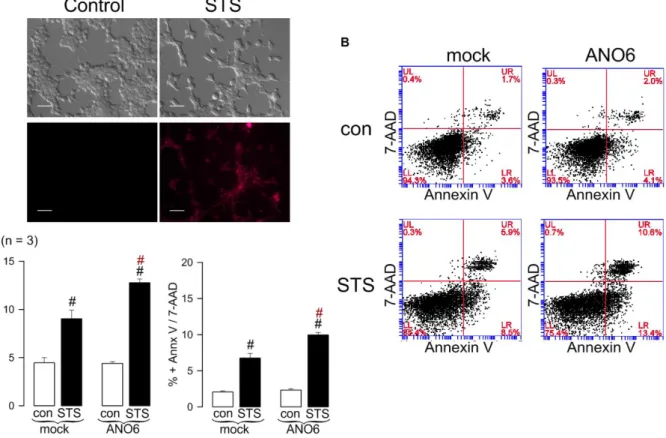
Figure 4.4. ANO6 contribution to PS exposure induced by the ROS-producer STS. 21
Figure 4.5. STS leads to ROS increase and caspase-3 activation, mediating PS exposure enhanced by
overexpressed ANO6 in HeLa cells. 22
Figure 4.6. Downregulation of ANO6 in HeLa cells does not inhibit Annx V positivity induced by STS.
23
Figure 4.7. STS activates ANO6 currents in HeLa cells. 24
Figure 4.8. CFTR enhances ANO6 contribution to apoptosis induced by STS in HEK293 cells. 25 Figure 4.9. Enhanced apoptotic whole-cell Cl- currents in cells expressing ANO6, CFTR and ANO6 +
CFTR. 26
Figure 4.10. Effect of CFTR in tBHP-induced cell death. 27
Figure 4.11. Persistent stimulation of CFTR is not sufficient to trigger spontaneous apoptosis. 28
Figure 4.12. CFTR inhibition does not reduce tBHP-induced cell death. 29
Figure 5.1. Proposed role of ANO6 and CFTR in apoptotic cell death. 34
Figure 8.1. Inhibition of tBHP-induced apoptosis by Idebenone. 41
Figure 8.2. Western Blot analysis of ANO6 expression. 42
ix
Figure 8.4. CFBE cells expressing wt CFTR have a higher susceptibility to H2O2-induced cell death.
44
Figure 8.5. STS induces a differential Annx V positivity in wt and Scott lymphocytes. 45
Figure 8.6. Effect of CaCC-AO1 in tBHP-induced apoptosis of HEK293 cells. 46
Figure 8.7. Ionomycin induces an ANO6-dependent phospholipid scrambling in HEK293 cells. 47
Figure 8.8. Ionomycin induces an ANO6-dependent phospholipid scrambling in HeLa cells. 47
Figure 8.9. Ionomycin induces an ANO6-dependent phospholipid scrambling in B lymphocytes. 48
Figure 8.10. ROS effect in intracellular Ca2+ concentration. 49 Figure 8.11. Arachidonic acid enhances tBHP-induced apoptosis. 50
Figure 8.12. LPL induces an ANO6-independent PS exposure in HEK293 cells. 51
Figure 8.13. Tannic acid inhibits tBHP-induced apoptosis. 52
x
A
BBREVIATIONS
[Ca2+] i Intracellular Ca2+ concentration µg Microgram (10-6 g) µL Microliter (10-6 L) µm Micrometer (10-6 m) µM Micromolar (10-6 M) 7-AAD 7-Aminoactinomycin D A AmpereABC ATP - binding cassette
Ac Acid ceramidase
ACA N-(p-Amylcinnamoyl)anthranilic Acid
AIF Apoptosis Inducing Factor
AM Acetoxymethyl
AMP Adenosine Monophosphate
Annx V Annexin V
ANO Anoctamin
ANOVA Analysis of variance
APAF 1 Apoptotic Peptidase Activating Factor 1
ArA Arachidonic acid
Asm Acid sphingomyelinase
ATP Adenosine Triphosphate
AVD Apoptotic Volume Decrease
B Lymph B Lymphocytes
bp Base pair
C Cytosine
C Celsius
Ca2+ Calcium ion
CaCC Ca2+-activated Cl- channels
cAMP cyclic AMP
CD8 Cluster of Differentiation 8
CF Cystic Fibrosis
CFBE Cystic Fibrosis Bronchial Epithelial (cell line)
CFTR Cystic Fibrosis Transmembrane conductance Regulator
Cl- Chloride ion
CO2 Carbon Dioxide
Con Control
C-terminal Carboxyl- terminal
Cyt c Cytochrome C
D Aspartic acid
xi
DIC Differential Interference Contrast
DMEM Dulbecco's Modified Eagle Medium
DMSO Dimethyl sulfoxide
DNA Deoxyribonucleic acid
EGTA Ethylene Glycol Tetraacetic Acid
ER Endoplasmic Reticulum
eYFP Enhanced Yellow Fluorescent Protein
F Phenylalanine
FBS Fetal Bovine Serum
FITC Fluorescein isothiocyanate
FK Forskolin
FRET Förster Resonance Energy Transfer
FSC Forward Scatter
G Guanine
G Glutamic acid
G Gram
GSH Glutathione
GSHEE Glutathione reduced Ethyl Ester
H Hour(s)
H Histidine
H2DCFDA 2',7'-dichlorodihydrofluorescein diacetate
H2O2 Hydrogen Peroxide
HEK293 Human Embryonic Kidney 293 (cell line)
HeLa Henrietta Lacks Cervical Carcinoma (cell line)
HRP Horseradish Peroxidase I Isoleucine I- Iodide IBMX 3-isobutyl-1-methylxanthine Ide Idebenone Iono Ionomycin K+ Potassium ion L Liter L Leucine
LPA Lysophosphatidic Acid
LPL Lysophospholipids
Lyso-PS Lyso-Phosphatidylserine
m Meter
M Molar
MEM Minimum Essential Medium
Mg2+ Magnesium ion
xii
mL Milliliter (10-3 L)
mm Millimeter (10-3 m)
mM Millimolar (10-3 M)
MMP Mitochondrial Membrane Permeabilization
MPTP Mitochondrial Permeability Transition Pore
MSD Membrane-spanning domain
mV Millivolt (10-3 V)
N- terminal Amino- terminal
nA Nanoampere (10-9 A)
NBD Nucleotide-binding domain
nhTMEM16 Nectria haematococca Trasmembrane Protein 16
nM Nanomolar (10-9 A)
nm Nanometer (10-9 m)
ORCC Outwardly Rectifying Cl- Channel
PBS Phosphate Buffered Saline
PC Phosphatidylcholine
PE Phosphatidylethanolamine
Pen Strep Penicillin-Streptomycin
PKA Protein Kinase A
PLA2 Phospholipase A2
PS Phosphatidylserine
PVDF Polyvinylidene fluoride
Q Glutamine
R Regulatory domain
RNA Ribonucleic acid
ROS Reactive Oxygen Species
rpm Rotations per minute
RPMI Roswell Park Memorial Institute medium
RVD Regulatory Volume Decrease
s Second(s)
scrmbld Scrambled
siRNA Small interfering RNA
SM Sphingomyelin
SSC Side Scatter
STS Staurosporine
TA Tannic Acid
tBHP Tert-butyl hydroperoxide
TMEM16 Transmembrane Protein 16
TNF Tumor Necrosis Factor
TNF-R Tumor Necrosis Receptor
xiii
V Valine
WB Western Blot
wt Wildtype
XkR8 Xk-related protein 8
1
1.
I
NTRODUCTION
1.1
R
EGULATEDC
ELLD
EATH–
A
POPTOSISMulticellular organisms maintain a stable population of cells during their lifespan, keeping a tight control between cell division and cell death. Every day the activation of an intracellular death mechanism leads to the elimination of billion harmed or aged cells, which are no longer needed. This process is known as regulated or programmed cell death and can be divided into several types, being apoptosis the most predominant and studied form1–5.
Apoptosis was named in 1972 by Kerr and co-workers6, after a Greek word used to describe the
dropping of leaves from trees, suggesting that cell loss is beneficial for the survival of the host. The authors intended to distinguish this process from a different type of cell death known as necrosis. Unlike apoptosis, where cell removal happens without compromising the whole organism, necrosis is a highly immunogenic mechanism. Furthermore, it is considered as the result of a persistent stimulus which leads to an accidental cell death, whereas apoptosis is genetically determined1,6–8.
The apoptotic pathway involves several molecules and organelles, which are believed to be conserved in all animals5. Inside this group, caspases play a major role. This family of proteases is
normally expressed as inactive precursors or procaspases, which acquire proteolytic activity in the presence of a specific stimulus. Once active, these enzymes amplify the apoptotic pathway by cleaving other procaspases and intracellular key prote ins at specific aspartic residues. Regarding apoptosis, caspases can be divided in two classes: initiator (caspase-2, 8, 9 and 10) and executioner (caspase-3, 6 and 7). The first group is responsible to activate the executioner caspases, which will then cleave a wide variety of substrates, leading to the final cell death1,8,9.
The phenotype of an apoptotic cell is mainly characterized by reduced volume, or shrinkage, chromatin condensation and membrane blebbing1,7,8,10,11. After these transformations, the cytoplasm and
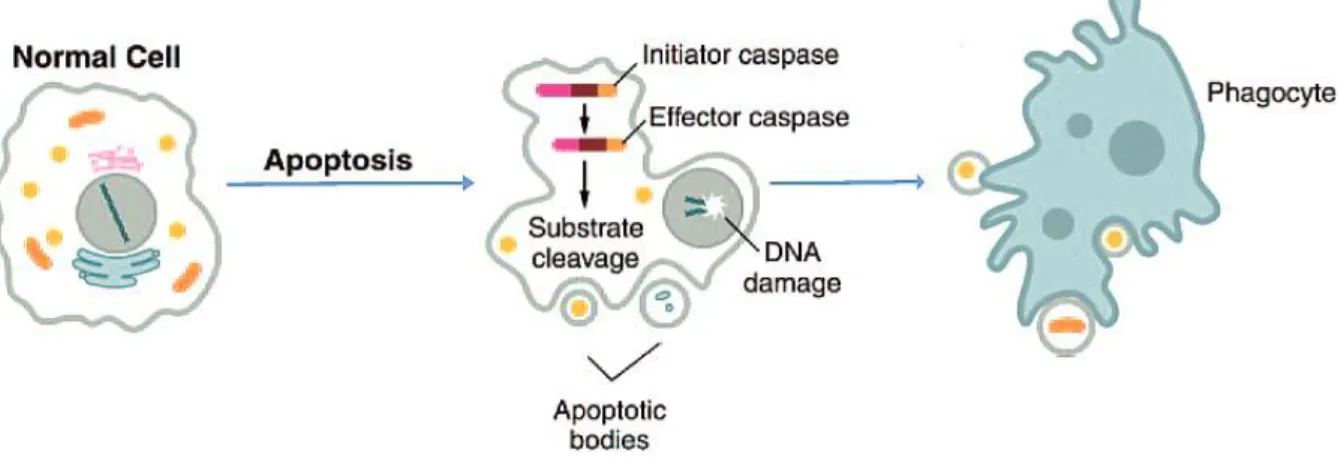
organelles are tightly condensed into apoptotic bodies, keeping their integrity. Once these structures are formed, they are quickly engulfed by phagocytes (Fig. 1.1) and digested in phagolysosomes, without production of anti-inflammatory cytokines. This allows the protection of the surrounding tissue from potential released proteases and oxidizing molecules, avoiding inflammation1,7.
Figure 0.1. Representation of morphological transformations occurring during apoptosis and engulfment of the dying cell by phagocytes. Initiator caspases activate executioner or effector caspases, able to cleave cellular substrates. As a consequence, the apoptotic cell shows reduced volume, DNA damage and fragmentation into apoptotic bodies, which are engulfed by phagocytes. Retrieved and adapted from Fink et. al8.
2
Apoptosis can be divided in two main signaling pathways: the intrinsic or mitochondrial pathway and the extrinsic or death receptor pathway. The first is activated when cells are exposed to inner stress forms, such as irradiation, heat shock or reactive oxygen species (ROS)1,2. During this mechanism, the
mitochondrial permeability transition pore (MPTP) is opened, leading to the loss of the mitochondrial transmembrane potential and a stop in the ATP (Adenosine Triphosphate) synthesis12. Pro-apoptotic
proteins are then released to the cytosol which can either function as activators of caspase-9 (e.g. cyt c – cytochrome c) or as mediators of DNA (Deoxyribonucleic acid) fragmentation (e.g. AIF – Apoptosis Inducing Factor)1. On the other hand, the extrinsic pathway is activated once specific ligands bind to
their complementary plasma membrane receptors, such as TNF (Tumor Necrosis Factor) to TNF-R (TNF Receptor) or Fas ligand to CD95 (Fas ligand receptor). In this mechanism caspase-8 and 10 are major players13. Both signaling pathways end with the activation of executioner caspases, which leads
to protein and DNA fragmentation and the consequent morphological transformations seen in apoptotic cells1. Caspase-3 is considered a key member of this group, being activated by caspase-8, 9 and 101 (Fig. 1.2).
.
Figure 0.2. Extrinsic and intrinsic apoptotic pathways. Ligand binding to transmembrane death receptors activates the extrinsic pathway, whereas intracellular stress triggers mitochondrial apoptosis. Both biochemical cascades begin with the activation of initiator caspases (caspase-8 and 9, respectively), which catalyze the proteolytic maturation of executioner caspases (caspase-3). The intrinsic pathway is characterized by mitochondrial membrane permeabilization (MMP), resulting in the release of pro-apoptotic proteins into the cytosol, such as cyt c. The innteraction of cyt c with the adaptor protein apoptotic peptidase activating factor 1 (APAF 1) and procaspase 9 form the apoptosome structure, responsible for the activation of caspase-9 and consecutively caspase-3. Retrieved and adapted from Galluzzi et. al14.
3 The activation of the apoptotic pathway is followed by modifications in the phospholipid composition of the plasma membrane. Normally, the inner leaflet consists of phosphatidylserine (PS) and phosphatidylethanolamine (PE), whereas phosphatidylcholine (PC) and sphingomyelin (SM) are present in the outer leaflet. Phospholipid transport across the plasma membrane is maintained by three different classes of proteins: flippases, floppases and scramblases. Flippases and floppases move phospholipids in a single direction against a concentration gradient, requiring ATP to maintain membrane asymmetry. The first class is responsible for the transport of PS and PE from the outer to the inner leaflet, whereas floppases move PC and SM in the opposite direction. Finally, scramblases are responsible for a bidirectional transport, acting according to the concentration gradient15,16 (Fig. 1.3).
The disruption of this asymmetry leads to the activation of immune cells17, coagulation cascade15,
exocytosis and apoptosis1,17. Particularly, during apoptosis, scramblases transport PS across the lipid
bilayer to the outer leaflet. This process is known as the “eat me signal”, since it serves as a platform for the engulfment of the dying cells by phagocytes1,15.
Figure 0.3. Schematic representation of the function of flippases, floppases and scramblases. Flippases move PS and PE from the outer to the inner leaflet, whereas floppases transport PC and SM in the opposite direction, using energy from ATP hydrolysis. Scramblases are ATP-independent and move phospholipids in both directions according to a concentration gradient.
1.2
A
NOCTAMIN6
–
A
UNIQUE MEMBER OF THEA
NOCTAMIN FAMILYAnoctamin 6 (ANO6, TMEM16F) is a particular member of the Anoctamins, a family of ten proteins (ANO1-10, TMEM16 A-K). ANO1, ANO2 and ANO6 have been identified as endogenous Ca2+
-activated Cl- channels (CaCC)18–20. It is a dimeric plasma membrane protein with ten transmembrane
α-helices and a pore loop21. ANO6 is homologous to ANO1, sharing a high sequence identity in the
putative transmembrane-spanning domains of the pore region22. Apart from its function as a CaCC,
ANO6 is also described as a volume-regulated23–25 and outwardly rectifying Cl- channel (ORCC)26, a
non-selective cation channel27 and a Ca2+-dependent phospholipid scramblase28,29. Because it is a
multifunctional protein and has an ubiquitous expression22, ANO6 became an interesting subject for
investigation.
Missense mutations in the TMEM16F gene and production of a defective ANO6 are the cause for the Scott Syndrome, a rare congenital bleeding disorder. Platelets from patients with Scott Syndrome are unable to scramble PS, a process required for the activation of coagulation factors and to keep a regular hemostasis29–31. Studies in mice revealed that knockout of the TMEM16F gene results in an
increased bleeding time due to a suppression of platelet activation27. Moreover, ANO6 is not only
4
regulation23,24, microparticle shedding22, innate immunity in macrophages35, breast cancer36, cell
blebbing35 and migration37.
Despite all the research, ANO6 mechanism of action is still not completely understood. Although it is clear that high intracellular Ca2+ concentrations are required, it is unknown if Ca2+ activates ANO6
directly or through another Ca2+-dependent molecule19. Another unresolved question is the structure of
this protein and how it is able to transport lipids through an ion-conductive pore. Interestingly, Whitlock et. al suggests that all anoctamins evolved from phospholipid scramblases and acquired ion channel activity after structural rearrangements. It is possible that the ANO6 pore has a dual molecular composition (lipid and protein) that allows the transport of amphipathic molecules, an idea known as the proteolipidic pore hypothesis. In this regard, the ANO6 ion currents are probably just the result of ions that flow across the plasma membrane together with phospholipids38. This model is supported by
crystallization of a fungal TMEM16 lipid scramblase homologue, nhTMEM16, a protein formed by ten transmembrane domains and a pore loop. It was found that the pore has a proteolipidic nature, having a hydrophilic region next to the lipid bilayer, surrounded by two transmembrane helices21,38 (Fig. 1.4).
Figure 0.4. Model of Anoctamin structure and ANO6 pore. A) Topology of the Anoctamin homologue in Nectria haematococca, nhTMEM16. This structure is formed by ten transmembrane domains with a pore loop (green) and the N- and
C-terminal domains in the cytosol (blue and red, respectively). Retrieved from Brunner et al.21. B) Cartoon showing the possible
proteoplypidic furrow of ANO6 pore, viewed from the extracellular space. The particular molecular composition of the pore allows the transport of phospholipids and ions across the plasma membrane – along with ions, phospholipid head groups interact with the protein content of the furrow, whereas acyl chains are projected into the hydrophobic bilayer. Retrieved from Whitlock
et.al.38
1.2.1 Role of Anoctamin 6 in Apoptosis
The identification of ANO6 as a Ca2+-dependent phospholipid scramblase28,29 raised questions about
the involvement of this protein in apoptosis. Remarkably, ANO6 has a marked expression in the surface of epithelial cells from mouse colon, which have a high apoptosis rate, compared to colonic crypt cells, known to have a fast proliferation26.
5 In this regard, ANO6 was found to be a component of the ORCC, an ubiquitous ion channel known to be inactive in healthy cells and activated during apoptosis, leading to cell shrinkage and phospholipid scrambling22,26. As a matter of fact, Martins et. al proved that stimulation of both intrinsic and extrinsic
apoptotic pathways activate ANO6-dependent currents in T Lymphocytes, human alveolar and airway epithelial cells. These currents were sensitive to the broad anoctamin inhibitors and completely abolished by ANO6 downregulation26. The same pattern was found in Xenopus Oocytes overexpressing
ANO6 after stimulation with Paraquat, a ROS donor22.
In parallel, Juul et. al observed a decrease in cisplatin-induced caspase-3 activity after knockdown of ANO6 in ELA cells23. This protein is known to be involved in RVD (Regulatory Volume Decrease)23– 25 and many channels important for this process are also relevant for AVD (Apoptotic Volume
Decrease). Therefore, it was speculated that ANO6 facilitates apoptosis by mediating cell shrinkage23.
Different studies show a clear contribution of ANO6 to apoptosis as an ion channel26,34. However,
investigations in B Lymphocytes revealed that this protein is not crucial to the PS exposure detected in apoptotic cells34. Cell death is a fundamental process in all living systems and it is very likely that other
proteins contribute for this process, compensating possible defects. It is now known that ANO3, 4, 7, 9 and 10 are also phospholipid scramblases22,39 and, aside from the anoctamin family, XkR8 (Xk-related
protein 8) is also reported to be responsible for phospholipid scrambling during apoptosis40.
1.3
CFTR
1.3.1 CFTR and Cystic Fibrosis – An Overview
Cystic Fibrosis (CF) is the most common life-threatening autosomal recessive disease in Caucasians, affecting around 70,000 people worldwide41. It is caused by mutations in the CFTR gene (Cystic Fibrosis
Transmembrane conductance Regulator) and is mainly characterized by an imbalance of ion and fluid homeostasis42. This gene encodes for a cyclic AMP (cAMP)-regulated Cl- channel expressed in the
apical membrane of epithelial cells from the intestine, pancreas, airways and sweat glands43.
Principal symptoms of CF include: production of thick mucus and subsequent infection by Pseudomonas aeruginosa in the airways; pancreatic insufficiency with obstruction of pancreas ducts and damage of the exocrine function; intestine impairment; elevated concentration of electrolytes in sweat and male infertility41,44.
So far around 1,500 variants of mutations in the CFTR gene have been identified. Despite this diversity, a deletion of phenylalanine (F) at codon 508 (ΔF508) on chromosome 7 is the main cause for CF, affecting 90% of patients. This mutation results in an abnormal folding of CFTR and a trafficking defect from the ER (Endoplasmic Reticulum) to the plasma membrane45.
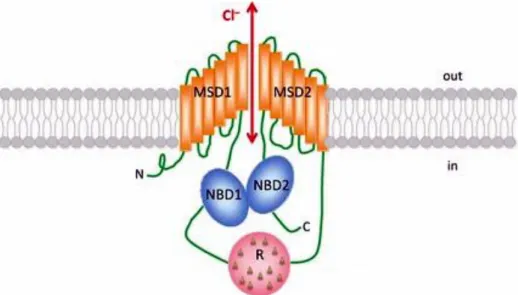
The predicted CFTR sequence contains 1,480 amino acids residues43 arranged in two
membrane-spanning domains (MSD), two nucleotide-binding domains (NBD) and one regulatory domain (R)46
(Fig. 1.5). CFTR evolved from the ATP-binding cassette (ABC) transporters, sharing a high sequence and structure similarity with these proteins42. Activation of CFTR requires phosphorylation of serine
residues in the R domain by the cAMP- dependent Protein Kinase A (PKA). ATP binding to the NBD domains and its subsequent hydrolysis allows the pore opening and provides enough energy to the transport of substances. Once the R domain is dephosphorylated by phosphatases CFTR returns to its closed status. Thus, the balance between kinase and phosphatase activity together with ATP levels are the main regulators of CFTR gating42,44,47.
6
Figure 0.5. Scheme of CFTR structure. CFTR is inserted in the plasma membrane and contains two MSD domains (MSD1, MSD2), two NBD domains (NBD1, NBD2) and one R domain with multiple phosphorylation sites. Retrieved and adapted from Farinha et.al.46.
Regardless the continuous efforts in understanding CFTR at its functional and molecular level, CF remain a lethal disease. By attenuating symptoms, life expectancy has been significantly increased to around 37 years-old. However, chronic lung disease and resulting loss of pulmonary function is still a major uncontrolled problem, being responsible for 80% of mortality41. Nowadays, different therapy
approaches are under development, either based on the identification of compounds that rescue the CFTR trafficking defect (correctors) or stimulators of channel activity (potentiators)45.
1.3.2 CFTR, Cystic Fibrosis and Apoptosis
As described before, apoptosis is a non-inflammatory fundamental process essential to the clearance of aged or harmed cells. Notably, CF disease is characterized by a defective apoptosis, a problem that may contribute to the ongoing inflammations. The involvement of CFTR in cell death has been studied over the years and, although some results are controversial, it seems clear that this Cl- channel is a
pro-apoptotic factor48.
CFTR has been described as a regulator of the redox status in the airways, mediating the transport of GSH (Glutathione) to the extracellular space49. GSH is a major antioxidant, responsible for
scavenging the ROS produced as a result of cellular metabolism50. Indeed, measurements in the lung
epithelial lining fluid of CF patients revealed a lower content in GSH compared to healthy individuals51.
Therefore, mutations in CFTR impair GSH efflux and leads to an increase of the oxidative stress in the airways52.
On the other hand, as GSH is transported, the intracellular level of this antioxidant decreases. Hence, cells expressing wt CFTR are less capable to buffer high concentrations of ROS and have a higher susceptibility to apoptosis. Indeed, a relationship between CFTR, GSH efflux and apoptosis was found in mice proximal tubules where this protein may be responsible for AVD and caspase-3 activation53. In
a different study HeLa cells were transfected with wt or ΔF508 CFTR and it was found an association among CFTR, GSH transport and Bax activation, a pro-apoptotic protein54.
Intracellular acidification is an essential phenomenon during apoptosis, required for caspase activation and DNA cleavage. Interestingly, CFTR is known to secrete not only Cl-, but also bicarbonate,
7 patients revealed the presence of high molecular DNA, which contributes to the increased viscosity. One explanation for this observation may be related to the apoptosis dysfunction found in CF epithelial cells55. Studies in Chinese hamster lung fibroblasts and mouse mammary epithelial cells proved an
association between DNA fragmentation and CFTR. Cells expressing ΔF508 CFTR have a higher intracellular pH, due to the lack of Cl- and bicarbonate transport. Thus, when these cells are exposed to
an apoptotic stimulus, the intracellular pH prevents nuclear condensation and DNA degradation55,56.
The apoptotic signaling cascade is complex, involving multiple molecules and signals. In this pathway ceramide acts as a messenger mediating the activation of apoptosis57. Ceramide intracellular
level is regulated by a balance in the activity of two different enzymes: acid sphingomyelinase (Asm) and acid ceramidase (Ac), responsible for ceramide production and degradation, respectively57,58. Asm
is triggered by Pseudomonas aeruginosa infection , leading to the increase of the ceramide content in lipid rafts59. Ceramide-enriched lipid rafts are required for pathogen elimination and apoptosis.
However, in 2008 a study concluded that ceramide accumulation also facilitates inflammation, cell death and infections in CF60. A high level of ceramide in the respiratory tract of uninfected CFTR-deficient
mice was found to be responsible for persistent inflammations and death of respiratory epithelial cells. When CFTR is mutated the intracellular vesicles have a higher pH, which leads to an imbalance of Asm and Ac activities and consequently to accumulation of ceramide in membrane lipid rafts. Therefore, by administrating acid sphingomyelinase inhibitors it is possible to stabilize ceramide levels and decrease inflammation61.
1.4
I
NTERACTION BETWEENANO6
ANDCFTR
The concept that CFTR may interact or regulate other Cl- channels and transporters has been around
for many years. Before the identification of CFTR, ORCC was thought to be the Cl- channel defective
in Cystic Fibrosis22. Nowadays, it is known that CFTR and ORCC are independent channels that share
functional relationships62. Interestingly, Martins et. al found that ANO6 is a component of the ORCC
channel and may also be regulated by CFTR26. However, it is unknown if these ion channels interact
directly or through other scaffold proteins63. Notably, ANO6 is responsible for ORCC activation during
apoptosis, a phenomenon that becomes enhanced in the presence of CFTR. Martins et. al also reported a decrease of the cAMP-activated whole-cell conductance in airway epithelial cells expressing CFTR after knockdown of ANO6, which suggests a contribution of ANO6 to CFTR currents26.
8
1. O
BJECTIVES
The aim of the present work was to study the relationship between ANO6 and CFTR during ROS-mediated apoptosis, using different in vitro systems.
The first objective was to understand the impact of ROS in ANO6 activity. To achieve this, HEK293 and HeLa cells were used either to overexpress ANO6 or downregulate the endogenous expression of this protein. In parallel experiments, B Lymphocytes immortalized from a Scott patient and a healthy control64 were useful to compare the presence and total absence of functional ANO6. The current
properties of ANO6 after ROS induction were studied by patch clamp. Moreover, the phospholipid scramblase function of this protein was monitored by flow cytometry using Annexin V labeling.
Because CFTR regulates the intracellular redox status49, the next question to address would be if
CFTR-mediated GSH depletion and consequent intracellular ROS increase explain a possible relationship between these two ion channels. In order to accomplish this, co-expression studies were done in HEK293 cells and the same techniques were applied. Additionally, the CFBE cell line stably transfected with wt or ΔF508 CFTR was used as a system to look for the influence in ROS-mediated apoptosis of the most predominant CFTR mutation found in CF patients.
The understanding of the role of ANO6 and CFTR in regulated cell death can be useful to get new insight about the apoptotic dysfunction that characterizes CF and eventually create new therapeutic approaches.
9
2. M
ATERIALS AND
M
ETHODS
3.1
C
ELL CULTURECell lines were grown inside an incubator, at 37°C in a 5% CO2-95% air humidified water-saturated
atmosphere. All cell culture was performed according to standard conditions, using sterile equipment. Every 2 to 5 days, cells were trypsinized (70-90% confluency) from 75 or 25 cm2 flasks (Greiner
bio-one - CELLSTAR®, Frickenhausen, Germany) and, if necessary, seeded in plastic plates (M&B Stricker
Laborfachhandel GbR, Bernried, Germany) at the required density to preform experiments.
3.1.1 Mammalian Cell Lines and Culture Conditions
HEK293 (Human Embryonic Kidney 293)65 and HeLa66 (Henrietta Lacks Cervical Carcinoma) cell
lines were cultured in Dulbecco's Modified Eagle Medium (DMEM; Life Technologies - gibco®,
Karlsruhe, Germany), supplemented with 10% Fetal Bovine Serum (FBS; Life Technologies - gibco®,
Karlsruhe, Germany).
HeLa–Kyoto cells stably transfected with eYFP67 (Enhanced Yellow Fluorescent Protein) with three
point mutations (H148Q, I152L, F46L) were cultured in MEM (Minimum Essential Medium), GlutaMAX™ (Life Technologies - gibco®, Karlsruhe, Germany), supplemented with 10% FBS, 1%
Penicillin-Streptomycin (Pen Strep; Life Technologies - gibco®, Karlsruhe, Germany) and 200 µg/mL
Hygromycin B (Promocell, Heidelberg, Germany).
B Lymphocytes, isolated from a patient with Scott Syndrome and a control subject64, were cultured
in Roswell Park Memorial Institute medium (RPMI; Life Technologies - gibco®, Karlsruhe, Germany),
supplemented with 10% FBS, 1% Pen Strep and 5 mM Hepes Buffer Solution (Life Technologies - gibco®, Karlsruhe, Germany).
CFBE cells68 (Cystic Fibrosis Bronchial Epithelial cells) stably transfected with wt or ∆F508 CFTR
were cultured in MEM, supplemented with 10% FBS and 2,5 µg/mL Puromycin (Life Technologies - gibco®, Karlsruhe, Germany).
To trypsinize adherent cells from flasks (HEK293, HeLa, HeLa-Kyoto, CFBE), cultured medium was first removed by aspiration and cells were washed with Dulbecco’s Phosphate Buffered Saline (PBS; Life Technologies - gibco®, Karlsruhe, Germany), without Ca2+ and Mg2+. Trypsin (Life
Technologies - gibco®, Karlsruhe, Germany) was added to culture flasks and incubated at 37°C, 5%
CO2 for 5 min (HEK293, HeLa, HeLa-Kyotto) or 15 min (CFBE). To stop the trypsinization process,
medium containing 10% FBS was added to cell suspension, which was then centrifuged at 20 000 rpm for 3 min. For B Lymphocytes, suspension cells were collected and centrifuged at 20 000 rpm for 5 min. In both cases, after the centrifugation step, supernatant was discarded and cells were resuspended in fresh culture medium.
3.1.2 Transient Transfections
All transient transfections were performed using Lipofectamine™3000 reagent (Invitrogen, Germany), according to manufacturer’s instructions. Lipofection is a particular method of transfection, where the genetic material is delivered to cells through a cationic lipid that forms liposomes and interacts with nucleic acid molecules (negatively charged). With lipofection it is possible to have a high uptake of the genetic material, allowing an easy overexpression of a protein of interest, using DNA, or a downregulation of a target gene, by siRNA (small interfering RNA)69,70.
10
HEK293 and HeLa cells were transfected with a pcDNA3.1 vector encoding for human ANO6. CFTR was transfected only in HEK293 cells, using a pIRES vector with the respective sequence coupled to a CD8 (Cluster of Differentiation 8) receptor, which was proved to be the available plasmid with the best transfection efficiency. In every experiment, an empty pcDNA3.1 vector (mock) served as a control and the same amount of plasmid was used in all transfections. When ANO6 and CFTR were co-expressed in HEK293 cells, a ratio of 1:2 µg was applied. Co-transfection protocol was controlled by co-expressing the mock plasmid either with ANO6 or CFTR (using the same ratio). For patch clamp measurements, all transfections were done using a plasmid containing ANO6 or CFTR sequence linked to a CD8 receptor. Experiments were performed between 48h and 72h after transfections. All the cDNA used is described in the Appendices section (Appendix I – Table 8.1).
ANO6 endogenous expression was downregulated in HEK293 and HeLa cells, using different siRNA’s (Invitrogen, Paisley, UK) and confirmed by Western Blot (WB). A negative control (Ambion®,
Darmstadt, Germany) with no sequence similarity for human, mouse or rat gene sequences was used to control the effects of the siRNA delivery. Experiments and collection of protein for WB were done between 24h and 72h after transfection.
3.1.3 Apoptosis Induction
Tert-Butyl Hydroperoxide (tBHP, Sigma, Taufkirchen, Germany) was diluted in deionized filtered water to a final concentration of 100 mM. HEK293 cells were incubated with 100 µM tBHP in OptiMEM (Life Technologies - gibco®, Karlsruhe, Germany), a reduced serum medium (2% serum).
CFBE cells were incubated with 100 µM tBHP diluted in MEM. Staurosporine (STS, Merck, Darmstadt, Germany) was dissolved in DMSO (dimethyl sulfoxide) to a final concentration of 1 mM. HEK293, HeLa and B lymphocytes were incubated with 1 µM STS diluted in OptiMEM, DMEM or RPMI, respectively. The appropriate volume of DMSO was added to non-treated controls. Hydrogen peroxide (H2O2, Riedel-de Haen, Seelze, Germany) was diluted in MEM to a final concentration of 900 µM and
incubated in CFBE cells. Lyso-phosphatidylserine (Lyso-PS, Avanti Lipid, Alabama, U.S.A) was dissolved in chloroform to a final concentration of 10 mM. HEK293 cells were incubated with 10 µM Lyso-PS for 2h diluted in DMEM. The appropriate volume of chloroform was added to non-treated controls. All compounds were incubated for the indicated periods of time at 37°C, 5% CO2, except
Ionomycin (Iono, Biomol, Hamburg, Germany) which was added to cells after cell detachment during experiments to a final concentration of 1, 5 or 10 µM. Inhibitors were purchased from Sigma (Taufkirchen, Germany) and pre-incubated for at least 30 min at 37°C, 5% CO2.
3.2
P
ROTEINA
NALYSIS–
W
ESTERNB
LOTANO6 expression was downregulated in HEK293 and HeLa cells (see section 3.1.2 – 3.1.2 Transient Transfections) and confirmed by WB. Additionally, ANO6 endogenous expression was detected in CFBE cells. In order to accomplish this, protein was collected from cells and kept in a lysis buffer (mM: 50 Tris-HCl, 150 NaCl, 50 Tris, 100 DTT, 0.5% NP-40, 1% protease inhibitor cocktail) - Roche, Germany. Then, protein content was separated in an 8,5% SDS-PAGE Polyacrylamide gel and separated proteins were transferred to a PVDF (Polyvinylidene fluoride) membrane (GE Healthcare Europe GmbH, Munich, Germany). To detect ANO6, the membrane was incubated with a primary antibody (rabbit antihuman ANO6 – David Technology, Germany) overnight at 4°C, using a dilution factor of 1:500 – 1:1000. Proteins were visualized using a horseradish peroxidase (HRP) - conjugated goat antirabit secondary antibody (Dilution Factor of 1:10000) and ECL Detection Kit (GE, Healthcare, Munich, Germany). Protein bands were detected using a FujiFilm LAS-3000 (FujiFilm, Tokyo, Japan).
11
3.3
F
LUORESCENCEM
ICROSCOPY3.3.1 ROS Detection
Intracellular ROS detection is possible using fluorescence assays. H2DCFDA
(2',7'-dichlorodihydrofluorescein diacetate, Molecular Probes, Invitrogen, Germany) is a non-fluorescent molecule able to cross plasma membranes. Once in the cytosol, this probe is deacetylated by intracellular esterases and, as a consequence, trapped inside the cell. In the presence of ROS, the deacetylated form is oxidized to a highly fluorescent form, DCF - 2',7'-dichlorofluorescein (Fig. 3.1). Thus, the fluorescence intensity is an index of intracellular ROS level.
Figure 2.1. Mechanism of ROS detection by H2DCFDA. H2DCFDA is able to cross the plasma membrane. Once inside the
cell, the probe is deacetylated by esterases, ensuring probe retention in the cytosol. In the presence of ROS, the non-fluorescent molecule is oxidized to DCF, which is highly fluorescent, allowing intracellular ROS detection.
Due to easy oxidation, H2DCFDA was dissolved shortly before experiments in DMSO to a final
concentration of 10 mM. To detect ROS, HEK293 and HeLa cells were seeded in 18 mm collagen/fibronectin-coated glass cover-slips overnight. Cells were loaded with a solution of 10 µM of H2DCFDA in PBS with Ca2+ and Mg2+ (Life Technologies - gibco®, Karlsruhe, Germany) for 30 min at
37°C, 5% CO2. After loading, the probe was washed 2 times with PBS and the ROS inducer was added
to cells (tBHP or STS) for the desired period of time. Fluorescence increase was detected with an ApoTome Axiovert 200M fluorescent microscope (Zeiss, Germany), using an excitation wavelength of 493 nm and emission of 520 nm.
Alternatively, ROS was detected using a fluorogenic cytosolic sensor, MAK142 (Taufkirchen, Germany), which becomes fluorescent in the presence of superoxide and hydroxyl radicals. In this case, HEK293 cells were plated in 18 mm collagen/fibronectin-coated glass coverslips overnight and treated with STS. After apoptosis induction, MAK142 was added to cells and fluorescence was monitored. Fluorescence increase was detected with the same microscope, using an excitation wavelength of 646 nm and emission of 654 nm.
12
3.4
F
LOWC
YTOMETRY–
A
POPTOSISD
ETECTIONFlow cytometry is a laser-based technology that allows single cell measurements. It is commonly used to get information about fluorescence of a pre-labeled population of cells. Once samples are injected into the flow cytometer, molecules are excited by a light source and fluorescence of single cells is detected. This is a multifunctional technique, which also allows the analysis of physical properties, such as cell size or granularity, two parameters given by forward (FSC) and side (SSC) scatter, respectively. To study regulated cell death in the present work, a four optical filter BD Accuri™ C6 Cytometer (BD Biosciences, Heidelberg, Germany) was used.
3.4.1 Caspase-3 Activity Measurements
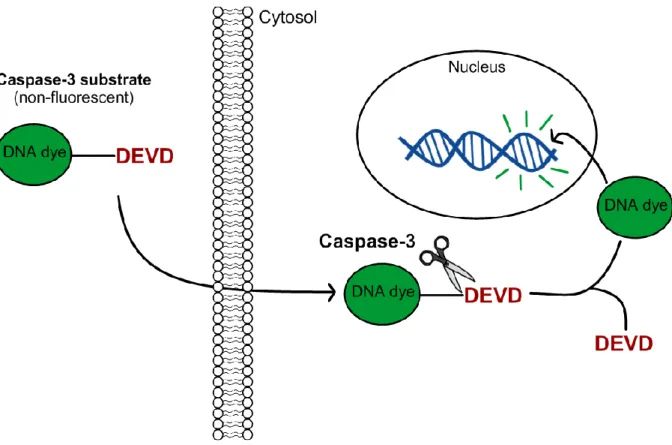
NucView™ 488 Caspase-3 substrate (Biotium, Fremont, USA) is a fluorogenic sensor used for the detection of caspase-3 activity. It is formed by a DNA marker linked to a peptide sequence (DEVD). Once this substrate crosses the cell membrane, the DEVD sequence is cleaved by caspase-3 and the DNA dye is free to stain the nucleus (Fig. 3.2). Therefore, by measuring the fluorescence intensity of the DNA marker it is possible to monitor caspase-3 activity.
Figure 2.2. Mechanism of Caspase-3 activity detection by NucView™ 488 Caspase-3 substrate. Caspase-3 substrate is formed by a peptide sequence (DEVD) linked to a DNA fluorogenic sensor. Once inside the cell, the substrate is cleaved at the DEVD sequence by caspase-3, releasing the DNA dye, which is then free to stain the nucleus.
In order to detect caspase-3 activation after ROS induction, HEK293 and HeLa cells were seeded overnight and incubated as desired for the indicated periods of time. Following treatment, the media was collected and cells were washed with PBS. After, adherent cells were detached with accutase (Capricorn Scientific GmbH, Ebsdorfergrund, Germany), incubated for 3 to 5 min, at 37°C, 5% CO2. Then, the
reaction was stopped with DMEM, supplemented with 10% FBS and suspension cells were centrifuged 2 times for 10 min (1500 rpm, 4°C). Cells were resuspended in a solution of caspase-3 substrate diluted in PBS (2.5 µL substrate in 100 µL of PBS / sample) and incubated for 30 min at room temperature,
13 protected from light. Before measurements, DNA labeling was stopped with PBS (300 µL/ sample) and fluorescence was detected by flow cytometry, using filter 1 (excitation - 488nm; emission - 530 nm).
3.4.2 Annexin V and 7-AAD Labeling
As described in the Introduction chapter, exposure of phosphatidylserine is one of the apoptosis hallmarks. Annexin V (Annx V) belongs to the annexin family of proteins, having the particularity of being able to bind specifically to PS in the presence of millimolar concentrations of Ca2+ 71. Thus, by
conjugating Annx V with the fluorophore FITC (Fluorescein isothiocyanate) it became possible to monitor PS exposure by flow cytometry.
Annx V labeling is usually coupled to 7-AAD (7-Aminoactinomycin D), a membrane impermeable DNA marker with high affinity for G-C regions72. By combining these two dyes it is possible to
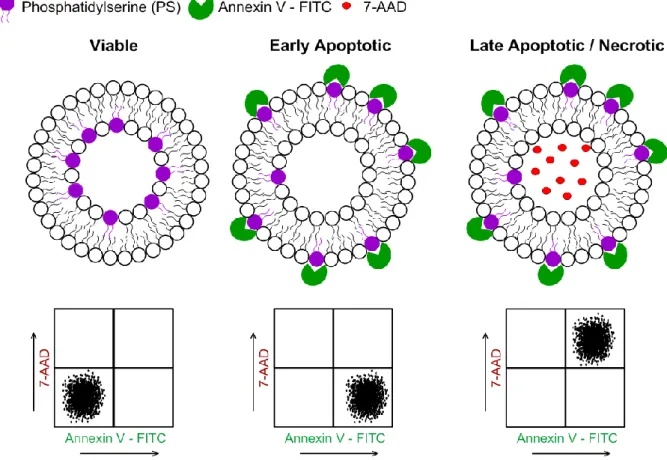
distinguish between early/late apoptosis and necrosis: PS exposure is an early event in apoptosis, whereas changes in the plasma membrane permeability are characteristic from late apoptotic stages or necrosis. Therefore, fluorescence intensity in an early apoptotic cell will be positive for Annx V and negative for 7-AAD, whereas a late apoptotic or necrotic cell will be positive for both dyes.
By flow cytometry it is possible to measure Annx V and 7-AAD fluorescence intensity and conclude about cell viability. Both parameters can be compared in a 4-quadrants plot, representing either positivity or negativity for Annx V (x axis) and/or 7-AAD (y axis). The quadrants setting is defined with viable cells which maintain the plasma membrane asymmetry and integrity and thus are negative for both dyes (Fig. 3.3).
Figure 2.3. Schematic representation of dual staining with Annx V and 7-AAD. In a viable cell the plasma membrane is intact and asymmetric, therefore Annx V and 7-AAD fluorescence intensity is negative (lower-left quadrant). In an early apoptotic cell PS moves from the inner to the outer membrane leaflet, which allows Annx V binding (lower-right quadrant). Once cells enter in late apoptosis/ necrosis, the plasma membrane permeability is compromised and 7-AAD can enter the cell. Thus, cells become positive for both markers (upper-right quadrant).
14
In order to detect membrane modifications during apoptosis, cells were treated according to the previous section and media was collected after the indicated time points. Adherent cells (HEK293, HeLa and CFBE cells) were then washed with PBS and detached with accutase for 3-15 min at 37°C, 5% CO2.
After cell detachment, accutase reaction was stopped with DMEM/MEM, supplemented with 10% FBS. Suspension cells (B Lymphocytes) were collected after apoptosis induction. In both cases, cells were centrifuged 2 times for 10 min at 1 500 rpm (4°C). Following centrifugations, each sample was incubated in a solution of 5 µL Annx V and 2,5 µL 7-AAD, diluted in 100 µL Annexin V-binding buffer (BioLegend, Fell, Germany) for 10 min at room temperature, protected from light. After labeling, the reaction was stopped with PBS (400 µL/sample). For each experiment, 10 000 events were collected and fluorescence was detected by flow cytometry, using filter 1 for Annx V (excitation – 488 nm; emission - 530 nm) and filter 3 for 7-AAD (excitation – 488 nm; emission – 670 nm). The emission spectra of Annx V and 7-AAD overlap at some extent. Therefore, to avoid a false positive, the signal was always compensated using a pre-determined value.
3.5
H
OLOGRAPHICM
ICROSCOPYHolographic microscopy is a non-invasive label-free method used to monitor adherent cells. The HoloMonitor™ M2 (Phase Holographic Imaging AB, Lund, Sweden) is a microscope that uses digital holography to acquire and quantify information about cell shape, volume, area, confluence and thickness73. For this purpose, the microscope is placed inside an incubator at 37C with a humidified
atmosphere saturated with 5% CO2, where cells can be monitored over time.
This method was useful to follow cellular morphology after apoptosis induction in HEK293 cells. In order to accomplish this, cells were seeded one or two days before experiments in collagen/fibronectin-coated petri-dishes and monitored for the desired period of time in the presence or absence of ROS inducer.
3.6
C
ONDUCTANCEM
EASUREMENTS3.6.1 YFP Fluorescence Quenching Assay
The Yellow Fluorescent Protein (YFP) is particularly interesting due to its sensibility to surrounding halide concentrations. This sensor has a cavity formed by a specific binding site for halide ions, such as iodide (I-) or chloride (Cl-)74. Binding of anions to this cavity leads to a decrease in the YFP fluorescence
intensity over the time (quenching).
HeLa-Kyoto cells stably expressing eYFP were used to measure anion conductance during apoptosis. In this cell line the YFP sequence is modified with three different point mutations (H148Q, I152L and F46L), which enhance the halide affinity74. Briefly, cells were seeded in
collagen/fibronectin-coated transparent 96 well-plates (Thermo Fisher Scientific, Darmstadt, Germany) and incubated at 37°C, 5% CO2 with STS diluted in Ringer -40 mM Cl-solution (mM: 105 NaCl; 0,4 KH2PO4; 1,6
K2HPO4.3H2O; 5 Glucose; 1 MgCl2.6H2O; 1,3 Ca-Gluconate.1H2O; 40 Na-Gluconate; pH 7.4). After
incubation, YFP fluorescence was measured at 37°C by a Microplate Reader (BMG LABTECH, Offenburg, Germany; excitation – 485 nm; emission – 520 nm) each second, during 30 seconds. Following this, a Ringer solution was injected containing NaI to a final concentration of 20 mM (mM: 105 NaCl; 0,4 KH2PO4; 1,6 K2HPO4.3H2O; 5 Glucose; 1 MgCl2.6H2O; 1,3 Ca-Gluconate.1H2O; 40 NaI;
15 Thus, by using this method it is possible to study channel activity: when ion channels are closed, injection of I- does not interfere with YFP fluorescent signal; however, once ion channels are opened, I
-is able to cross the plasma membrane and bind to YFP, quenching its fluorescence (Fig. 3.4).
Figure 2.4. YFP Fluorescence Quenching by Iodide (I-). When ion channels are closed, I- cannot cross the plasma membrane
and YFP remains fluorescent. However, if ion channels are opened, the I- is able to permeate through the channel pore and bind
to YFP cavity, quenching the fluorescent signal.
3.6.2 Patch Clamp
Patch clamp allowed a sensitive measurement of the basal current activated by ROS. In order to accomplish this, HEK293 and HeLa cells were grown in collagen/fibronectin - coated 18 mm glass coverslips and transfected according to section 3.1.2 Transient Transfections, in the presence of the CD8 receptor. After transfection, HEK293 and HeLa cells were treated with tBHP or STS at 37°C, 5% CO2
for the desired period of time. Following exposure to ROS, cells were incubated 1-2 min with Dynabeads CD8 (Invitrogen, Germany), a step that allowed the identification of the transfected cells.
Coverslips were then mounted in a chamber on the stage of an inverted microscope (IM35, Zeiss, Germany) where whole-cell current was measured. The bath was perfused continuously at 37°C with Ringer solution (mM: 145 NaCl; 0,4 KH2PO4; 1,6 K2HPO4.3H2O; 5 Glucose; 1 MgCl2.6H2O; 1,3
Ca-Gluconate.1H
2O; pH 7.4). In order to prove that the detected current results from Cl- movement, Ringer
was replaced with a 5 mM Cl- solution (mM: 5 NaCl; 0,4 KH
2PO4; 1,6 K2HPO4. 3H2O; 5 Glucose; 1
MgCl2.6H2O; 8 Ca-Gluconate.1H2O, 140 Na-Gluconate; pH 7.4). Regarding tBHP experiments, the
ROS inducer was diluted in the bath solution to ensure the presence of the compound during measurements. The patch pipette was filled with a solution containing 95 mM K-Gluconate, 30 mM KCl, 1.2 mM NaH2PO4.H2O, 4.8 mM Na2HPO4.2H2O, 5 mM Glucose, 2.38 mM MgCl2.6H2O, 1 mM
EGTA (Ethylene Glycol Tetraacetic Acid) and 0.726 mM Ca-Gluconate.1H
2O, with freshly added 3