Tracking narrative change in the context of extremism and terrorism:
Adapting the Innovative Moments Coding System
Raquel da Silva
a,b,g,⁎, Pablo Fernández-Navarro
c, Miguel M. Gonçalves
c, Catarina Rosa
d,
Joana Silva
e,fa
INTERNATIONAL Development DEPARTMENT, University of BIRMINGHAM, UK b
INTERNATIONAL Development DEPARTMENT, MUIRHEAD Tower, University of BIRMINGHAM, EDGBASTON, B15 2TT BIRMINGHAM, UK c CIPsi – Psychology R
ESEARCH Center, School of Psychology, University of Minho, ESCOLA de PSICOLOGIADA UNIVERSIDADE do Minho, CAMPUS de GUALTAR, 4710-057 BRAGA, PORTUGAL
d D
EPARTMENT of EDUCATIONAND Psychology, University of Aveiro CINTESIS.UA - Centre for HEALTH Technology AND Services RESEARCH, University of Aveiro, DEPARTAMENTO de EDUCAÇão e PSICOLOGIA, CAMPUS Universitário de SANTIAGO, 3810-193 Aveiro, PORTUGAL
e CIPsi – D
EPARTMENT of Psychology AND EDUCATION, University PORTUCALENSE, INPP - PORTUCALENSE Institute for HUMAN Development - Psychology RESEARCH Centre, School of Psychology, University of Minho, 4200-072 Porto, PORTUGAL
f D
EPARTAMENTO de PSICOLOGIA e EDUCAÇão, UNIVERSIDADE PORTUCALENSE, RUA Dr. António BERNARDINO de ALMEIDA, 541, 4200-072 Porto, PORTUGAL
g Instituto Universitário de L
ISBOA (ISCTE-IUL), Centro de Estudos INTERNACIONAIS, LISBOA, PORTUGAL
Keywords: Radicalisation Deradicalisation Methodology Risk assessment Risk management A B S T R A C T
Existing models of deradicalisation, countering violent extremism (CVE), and counter-terrorism (CT) have lacked a clear theory of change, as well as robust empirical methodologies. This paper proposes an empirically-based systematic and transparent methodology – the Innovative Moments Coding System (IMCS) – which is empirically sensitive, ethically defensible, and can be of use in the context of research to inform practitioner contexts. Through a case study of former violent militants, we explore the adaptation and usage of this instrument to identify and track self-narrative change in the processes of engagement and disengagement, as well as radica- lisation and deradicalisation in the context of violent extremism and terrorism. We illustrate how this metho- dology has the potential to bring benefits to the work of researchers involved in producing guidelines for dis- engagement, deradicalisation or risk-reduction interventions.
1. Introduction
In the past few years, both national and international countering violent extremism (CVE) and counter-terrorism (CT) e⁎ orts have given relevancy to deradicalisation and risk-reduction interventions. Some examples of such a move are: the creation, in September 2011, of the Radicalisation Awareness Network (RAN) by the European Commission, which brings together practitioners, academics, and po- liticians working on counter-terrorism; the expansion of the European Union's counter-terrorism strategy in 2014, which called on member states to put into place deradicalisation programs, as well as to closely evaluate them (EU, 2014, p.11); or the Resolution 2178 passed by the United Nations Security Council also in 2014, calling for reintegration programs for foreign fighters returning from Syria and Iraq (UNSC, 2014).
However, these interventions have been deemed to lack two key
ingredients: a clear and coherent theory of change (Williams & Kleinman, 2014) and consistent evaluation e⁎ orts (Bjørgo & Horgan, 2009; Koehler, 2017; Rabasa, Pettyjohn, Ghez, & Boucek, 2010). This scenario has an obvious impact on creating better programs or re- working already existing ones in order to yield better outcomes (Cherney, 2018).
This paper aims to tackle the need for a clear theory of change ac- companied by a suitable and reliable methodology for its assessment in the context of violent militancy, being both individual/context-specific and evidence-based, following good-practice standards for operational procedures. In this sense, we put forward the Innovative Moments Coding System (IMCS; Gonçalves, Ribeiro, Mendes, Matos, & Santos, 2011) as a methodological tool that has proved to be a reliable and systematic method to track transtheoretical markers of narrative transformation.
analysis of individuals' self-narrative transformation across a variety of life transition situations (see Cardoso, Gonçalves, Duarte, Silva, & Alves, 2016; Cardoso, Silva, Gonçalves, & Duarte, 2014; Esposito, Ribeiro, Alves, Gonçalves, & Freda, 2017; Meira, Salgado, Sousa, Ribeiro, & Gonçalves, 2018). However, considering the di erences among the contexts in which IMCS has been used (clinical research, vocational counselling, and spontaneous change) and the context in which we intend to apply it, we took an illustrative case study ap- proach. Two life-story interviews of former politically violent militants with contrasting views of their time of militancy were analysed re- garding two continuums: engagement vs. disengagement with politi- cally violent organisation (PVO) and radicalisation vs. deradicalisation. This analysis entailed two main goals:
1. Examining the possibility of adapting the IMCS methodology and use it to analyse self-narrative change in life-story interviews of former politically violent militants.
2. Examining the possibility of using IMCS results to distinguish the level of self-narrative transformation in two di erent cases of former politically violent militants.
In the following pages, we begin by situating this study in the re- levant literature regarding the design and evaluation of existing dera- dicalisation and risk-reduction interventions. We subsequently outline the IMCS methodology and present our case study. In the discussion and conclusion that follow, we consider the adaptability of the IMCS and its usefulness in tracking self-narrative change in former militants' life stories, particularly in relation to the continua engagement vs. disen- gagement and radicalisation vs. deradicalisation. We equally present recommendations for the integration of this methodological tool in the context of research on disengagement, deradicalisation, or risk-reduc- tion interventions.
1.1. WHAT does CHANGE look like?
The lack of evaluation of interventions in the context of CVE and CT might be related to the fact that, as defended by Koehler (2017, p. 1) “the handful of academic experts and experienced practitioners in the field are still engaged in fundamental debates about terminology, scope of programmes and e ect measurement”. Essentially, there is no clarity regarding what change looks like in deradicalisation and risk-reduction interventions. One of the reasons for this scenario might be the absence of clarity regarding what can be realistically achieved with such in- terventions and, particularly, how concepts such as disengagement and deradicalisation are perceived and applied.
Like the use of the term terrorism, the use of terms such as radi- calisation and deradicalisation tends to assume “pejorative connota- tions” and can be “promiscuously overused” (Jackson et al., 2011, p.108). Moreover, the very use of such terms can act as a labelling tool at the service of whoever is using them and contribute to the illegi- timacy of claims made by individuals engaged in political violence (Herring, 2008), limiting the scope of interrogation with regard to “the actions and motives of those who use violence” (Mac Ginty, 2013, p.217). Thus, it is important to use these terms and explore the issues they involve without criminalising or pathologizing political beliefs or dissent, particularly when freedom of thought is considered to be an inviolable human right in democratic and pluralist contexts.
In this vein, we di erentiate between radicalisation and engage- ment, as well as between deradicalisation and disengagement. We agree with McCauley and Moskalenko (2008) that radicalisation is a process which comprises a revolutionary positioning that may lead to the pursuit of political ends through violent actions. As Horgan and Bradock (2010, p. 279) put it, it is a “social and psychological process of incrementally experienced commitment to extremist political or re- ligious ideology”. Thus, it is important to note that while radicalised views may open a path to politically motivated violence, they are not
criminal or harmful in themselves and do not dictate certain engage- ment with a PVO (Expert Group on Violent Radicalisation, 2012).
Concerning disengagement vs. deradicalisation, we concur with Reinares (2011, p. 780) that “disengagement focuses on behavioural modification”, implying that violent acts are no longer committed, whereas deradicalisation “emphasizes an attitudinal change”. However, for Reinares (2011) deradicalisation implies a process of ideological transformation, whose essential characteristic is the abandonment of the belief that violence is a privileged tool at the service of the political struggle. This position has been challenged in the literature. For in- stance, Horgan (2009, p. 153) views deradicalisation as “the social and psychological process whereby an individual's commitment to, and in- volvement in, violent radicalisation is reduced to the extent that they are no longer at risk of involvement and engagement in violent ac- tivity”. Thus, as stated by Gøtzsche-Astrup (2018), “[it] would be simplistic to assume that de-radicalisation is simply the reverse of ra- dicalisation” (p. 98).
Moreover, one of the findings of Cherney's (2018) ethnographic study of PRISM (the Proactive Integrated Support Model), a pilot in- tervention targeting radicalised prisoners in New South Wales, Aus- tralia, is the unrealistic and counterproductive nature of expecting of- fenders to renounce their commitment to certain religious beliefs to prove they are no longer radicalised. One of his interviewees explained that, for instance, the concept of jihad is an important pillar of his faith, which does not mean that he will engage in terrorism. In this sense, it seems more accurate to expect individuals to stop committing political violence (to disengage) and to reject violence as a personal legitimate tactic, than to expect a full make-over of their belief systems.
Thus, we consider that self-narrative change in the context of poli- tically motivated violence is a process embodied by thoughts, emotions, actions, and experiences that distance the individual from the com- mission of politically violent acts, cementing a self-narrative of con- tinued, and committed disengagement.
1.2. How HASCHANGE been EVALUATED?
The lack of evaluation of deradicalisation and risk-reduction inter- ventions might be actually increasing the threat and risk of terrorism, instead of doing the opposite by: applying incorrect methods based on inadequate needs assessment; failing to detect high-risk cases; giving away critical counter-argumentation techniques; and helping com- mitted extremists and terrorists to re-enter a society without raising the authorities' suspicion (Koehler, 2017). Thus, the question is not whe- ther genuine deradicalisation can occur (see Kruglanski, Gelfand, & Gunaratna, 2010), but whether specific deradicalisation and risk-re- duction interventions are e ective and what makes them so (Horgan, 2008).
Feddes and Gallucci (2015) carried out a review of the literature on evaluations of programs aimed at preventing radicalisation between 1990 and July 2014. One of their main conclusions pointed out that “primary empirical data is relatively scarce and evaluations of inter- ventions are mainly of anecdotal nature” (p. 23). In this vein, from the 135 samples identified in the 55 studies included in their study, the authors only found 16 samples where interventions had been empiri- cally evaluated and primary data had been reported.
An example of such an evaluation is the study carried out by Kruglanski, Gelfand, Bélanger, Gunaratna, and Hetiarachchi (2014), which runs systematic quantitative assessments of a deradicalisation program administered to detained members of the Liberation Tigers of Tamil Eelam (LTTE) in Sri Lanka. They aimed to understand (1) whe- ther the beneficiaries changed in the course of their participation in the rehabilitation program, (2) whether the change was uniform for bene- ficiaries assumed to be more versus less involved with the LTTE orga- nisation, and (3) what may have produced the change if it indeed oc- curred (Kruglanski, Gelfand, Bélanger, Gunaratna, & Hetiarachchi, 2014, p.189). In order to do so, they administered three di erent self-
206
report measures at two points in time (at the beginning of detention and nine months later) to 1906 individuals (169 women and 1737 men) who were detained in six di erent rehabilitation centres in North East Sri Lanka. The measures administered were: (1) a measure of organi- zational embeddedness, which adapted six items derived from Mitchell and colleagues' Job Embeddedness Scale (Mitchell et al., 2001), and aimed at determining the degree of personal involvement with the LTTE, (2) a measure of their perceived friendliness on the part of the centres' personnel, and (3) their degree of support for armed struggle against the Sinhalese. The latter two measures were constituted by two di erent 7-point Likert scales developed for the purpose of the study. Despite being able to measure change between the two moments of time and yielding very interesting and promising results (see Kruglanski, Gelfand, Bélanger, Gunaratna, & Hetiarachchi, 2014), this study was not able to discern what produced and influenced the change process. Although the authors tried to investigate the findings further, they admit that they are still carrying out additional analysis, taking into consideration, for instance, the developmental trajectories of change in individual detainees (Kruglanski, Gelfand, Bélanger, Gunaratna, & Hetiarachchi, 2014).
More than examining whether an intervention is e ective in pro- ducing an expected outcome or hypothesised change, it appears crucial to uncover the mechanisms that allow such change to occur (Greenberg, 1986). Change Process Research has an extensive research tradition in the field of psychotherapy and psychological interventions (Elliot, 2010), allowing to improve interventions' quality and e cacy and to prevent unchanged outcomes. Departing from the participant's narra- tive accounts (therapeutic, life interviews), the Innovative Moments Coding System, described in the next section, o ers a way to under- stand and measure the process of change.
1.3. The INNOVATIVE Moments model of NARRATIVECHANGE
In this study, we propose the application of the Innovative Moments Coding System (IMCS) to track change in life-story interviews with former politically violent militants. Theoretically, this methodological tool is grounded in the narrative assumption that when individuals develop a dominant and rigid framework of understanding and ex- periencing the world, which constraints their feelings, thoughts, and actions, the information and skills available for responding e ectively and adaptively to the demands and challenges of a continuously changing environment are limited. This leads individuals, frequently, to experience maladaptation and psychological distress. From a narrative point of view, an intentional intervention (e.g., psychotherapy, voca- tional counselling, promotion of academic achievement) is perceived as a changing opportunity that when successful, allows the person to de- velop a more flexible and alternative framework of meaning construc- tion, promoted by the emergence and proliferation of exceptions to the original problematic self-narrative. These exceptions or novelties in individuals' actions, thoughts, and feelings in the context of an in- flexible self-narrative have been termed Innovative Moments (IMs) (Gonçalves et al., 2011). Empirical research has identified di erent types of IMs (for a thorough review see Gonçalves et al., 2017), which seem to be organised into three major levels: level 1 IMs (when the person distances him/herself from the problem), level 2 IMs (when the person elaborates on change) and level 3 IMs (when the person ap- propriates the ongoing changes and showcases a sense of authorship). Thus, IMs research has been supporting a model of narrative change in which level 1 IMs are crucial at the beginning of the change process, allowing the individuals to distance themselves from the departing self- narrative by starting to act, feel, and think di erently, opening the way for a new self-narrative to emerge. However, for sustained change to take place, level 2 and level 3 IMs need to develop, potentiating and being potentiated by level 1 IMs, validating, fertilizing, and allowing the individual to truly author the new unfolding self-narrative. Thus,
this empirically supported model of narrative change has emphasised the importance of level 2 IMs, and specifically of level 3 IMs, as markers of change processes (Alves et al., 2014; Fernández-Navarro et al., 2018; Gonçalves et al., 2012; Gonçalves, Ribeiro, Silva, Mendes, & Sousa, 2016; Matos, Santos, Gonçalves, & Martins, 2009; Mendes et al., 2010). The latter may be conceived as a special form of insight (Castonguay & Hill, 2007) which encompasses a contrast between a past (usually problematic) facet of the person and a present more adjusted facet (contrasting self), and a description of the processes that allowed this change to occur (change process), allowing the individual to assume a meta-position that may be central to achieving and authoring mean- ingful narrative change.
A consistent profile of IMs has been found in successful psy- chotherapy (see Gonçalves, Ribeiro, et al., 2017): a) higher overall presence of IMs; b) higher diversity of IMs; and c) higher presence of level 2 and level 3 IMs. For the purpose of this paper, we highlight the use of levels, especially level 2 and level 3 IMs, considering their in- creased focus on the elaboration of change (for a review see Gonçalves, Ribeiro, et al., 2017). Furthermore, recent longitudinal studies using mixed-modelling analyses have suggested that not only the pattern of IMs is distinctive in regard to the level of change achieved by in- dividuals throughout the transformation process but also that level 2 and level 3 IMs predict change, leading to the hypothesis that IMs are probably not mere products but may also be part of the change process (Fernández-Navarro et al., 2018; Gonçalves et al., 2016; Gonçalves et al., 2017).
1.4. The INNOVATIVE Moments Coding System (IMCS)
Unlike other narrative qualitative systems, the IMCS (Gonçalves et al., 2011) does not track narratives as units of analysis, but rather analyses the subjects' full discourse (Gonçalves, Ribeiro, et al., 2017). The IMCS identifies three developmental levels (that include seven di erent types of IMs, see Gonçalves, Ribeiro, et al., 2017 for a detailed review). In Table 1, we define IMs' levels and give examples of each level.
The original coding procedure, designed to assess the process of change throughout psychotherapy or analogous counselling contexts, demands two independent coders, who depart from the video, audio, or transcript recordings of therapy sessions and analyse it intensively through three main steps:
1. Identification of the initial problematic self-narrative;
2. Identification of exceptions to this problematic departing framework (i.e., IMs), delimitating its beginning and end; and
3. Categorisation of IMs (considering the three levels).
Thus, the IMCS provides two descriptive measures or outputs for subsequent analyses of the target material. On the one hand, the ab- solute frequency of IMs (calculated by counting the number of IMs) or, more commonly, the proportion of IMs (i.e., the proportion of time or words involved in each IM relative to the total amount of time or words of the session). Each one of these computations can be calculated for the overall number of IMs for each specific category. On the other hand, the quality of the IMs, which can be measured by their categorisation into levels as referred in Table 1. The reliability of such categorisation is checked through the calculation of inter-coder agreement —the degree of agreement between coders in IMs' identification and delimitation— and the calculation of Cohen's k —the degree of agreement between coders in IMs' categorisation. Recent studies (Gonçalves et al., 2016; Gonçalves, Ribeiro, et al., 2017) have reported inter-coder agreement of 89.9% to 90% and a Cohen's k from 0.91 to 0.94. Coding disagreements between the two judges are discussed and resolved through consensus. For an extensive review on coding procedures see Gonçalves et al. (2011).
Table 1
IMs' levels definition and examples.
Level Definition Examples from an individual with an initial problematic framework centred on
depression 1 Meaning exceptions centred in challenging, di erentiating, recognising or
distancing from the problematic experience
Includes moments of critique, thoughts, intentions, interrogations, doubts, desires, strategies, and/or behaviours which focus on dealing with the problems brought to therapy
2 Self-observing process centred in giving meaning to the emerging changes (what changed? or how/why is change occurring?)
Includes new aims, experiences, activities, projects, emotional shifts, elaborations upon change and its consequences, new or re-emerging self-versions, new learnings, etc.
3 Meta-reflective process description implying a sense of authorship. Requires a shift between two self-positions and some access to the process underlying this transformation
I realise that what I was doing was just not humanly possible because I was pushing myself and I never allowed myself any free time.
I am doing all the things that were impossible for me to do before. I am working again and now I have the time to enjoy my life with my children.
I feel di erent nowadays. I don't worry about what others think about what I'm saying. I discovered that I need to respect my needs and opinions, even if other people disagree with me. I used to be in constant conflict with myself, thinking one thing, saying another, just to prevent any disagreement with others.
208
1.5. The present study 1.5.1. CASE study PARTICIPANTS
Data from this study was drawn from a broader research on the narratives of former militants in Portugal (da Silva, 2019). A convenient sample of two cases was drawn from the broader pool of data collected for the original study (N = 28) and selected for analysis in the present study. One of the participants is a woman and the other is a man, with ages ranging from 55 to 65 at the time of the interviews (February 2013). The participants were named, respectively, Julia and Jaime, in order to preserve their identity. The decision to select these two cases was based on their clearly contrasting features, making them interesting examples to examine using the framework of IMCS (Gonçalves et al., 2011) regarding the two processes to be studied: disengagement and deradicalisation. Both cases shared a past of militancy within the same PVO —the FP-25 (FORÇAS POPULARES – 25 de Abril, i.e., Popular Forces – 25th April). The FP-25, created in 1980, was composed of left-wing radical activists who were disappointed with the social and political pathway brought by the counter-revolution of November 25th (1975), which from their perspective was the cause of serious social injustices, happening particularly in the workplace (Costa, 2004). The FP-25 was designed as a clandestine component of a legal political structure, the
GLOBAL Project, to fight against the extreme-right, which was perceived
as confiscating the power and violently secluding the left in the country (Ventura & Nascimento, 2001), justifying militants' rights to take justice into their own hands and continue the revolutionary struggle. FP-25 members were divided into small cells based around the country, which initiated a series of violent acts, including the recuperation of funds to support the organisation (essentially through bank robberies), and the attempts on the life of certain individuals through the firing of weapons or the detonation of explosive devices (Costa, 2004). Such acts resulted in several deaths and injuries, mainly of factory administrators, who were seen as abusive towards their employees (e.g., unpaid wages, unjust redundancies), enabling FP-25 to claim they supported the working class by setting the example both to the workers —encouraging them to fight against injustices— and to the administrators —dis- couraging them to ignore their employees' rights (Vilela, 2005). The FP- 25 was totally dismantled by the police with the collaboration of three repented members of the organisation in 1983 (Ventura, 1999). How- ever, FP-25 remained active until its total dissolution in 1989, even though between 1985 and 1987 the majority of its militants were ar- rested or sought refuge abroad (Ventura, 1999). Julia and Jaime were disengaged from the organisation at the time of its dismantling, serving time in prison. They developed an intimate relationship during their engagement with the organisation, had two children (one was born while they were committed members of the organisation and the other one was born in prison) and have remained a couple until the time of the interview. Despite the similarities in their social, political, and personal pathways, at the time of the interview the two participants displayed very di erent perspectives regarding violence as a solution to social issues. In a previous study (da Silva, Fernández-Navarro, Gonçalves, Rosa, & Silva, 2018), Julia's narrative was analysed throughout three di erent periods of time (before, during, and after engagement in the FP-25), suggesting a considerable self-narrative change throughout her processes of disengagement and deradicalisa- tion. Julia does not regret her violent militancy, but she critically ex- amines the organisation's ideology and strategies, concluding that vio- lence is not enough to achieve socio-political changes. On the contrary, previous research suggests that Jaime's level of radicalisation remained stable throughout these three time periods (da Silva, 2019). Despite assuming that due to his age and family commitment he will not re- engage in violent activities, Jaime still believes that, in certain cir- cumstances, violence is a legitimate strategy at the service of political actors. Thus, although these two participants were disengaged from militancy at the time of the interview, they might be perceived as contrasting cases regarding
radicalisation perspectives. This makes them suitable cases to study similarities and di erences in the parallel processes of disengagement and deradicalisation.
1.5.2. CASE study NARRATIVE content: interview procedure
After providing informed consent, the interviewees participated in an audio-recorded semi-structured life-story interview conducted by the first author. For this e ect, a semi-structured interview schedule, which can be provided upon request, was developed in order to arouse auto- biographical memories related to the processes involved in three main temporal frameworks: engagement with, life within and disengagement from a PVO. Questions included how and why personal engagement with the PVO occurred (e.g., weight of personal experiences, role of ideology, recruitment process, views on violent and non-violent strug- gles), how life was lived within the PVO (e.g., interpersonal and gender dynamics, decision-making processes, personal and organizational jus- tifications underlying violent activities), how and why disengagement occurred (e.g., forced vs. voluntary disengagement, disengagement from the organisation vs. disengagement from the organisation's ideals), and how the past is perceived in the present (e.g., the organi- sation, the comrades, the ideology, the activities carried out, personal areas where there has been continuity and discontinuity). However, it is important to note that the semi-structured interview schedule was used in a very flexible way, allowing, on the one hand, interviewees to lead the course of the conversation and to choose what to recount and how to recount it and, on the other hand, the researcher to probe certain answers in order to prompt further reflection and to obtain more
details. Therefore, each interview had its own dynamic, interviewees spoke for as long as they wished (with interviews lasting between 45 and 240 min), the order of the questions varied from interview to in- terview, and often some questions were not asked because the inter- viewees would answer them along the flow of their narrations. This kind of interview procedure allowed interviewees to tell thorough, multi-layered stories about their lives and their involvement with a PVO, creating rich storied accounts.
1.5.3. IMCS coding ADAPTATIONS
The audio-recorded interviews (previously transcribed by the first author, see da Silva, 2019) from Julia and Jaime, two former FP-25 militants, were analysed according to the IMCS (Gonçalves et al., 2011), aiming to capture markers of change and narrative transformation in two processes: engagement vs. disengagement from a PVO and radi- calisation vs. deradicalisation. Considering that this methodological tool has mainly been used in clinical research, or analogous counselling contexts, some adaptations to the original coding procedure of the IMCS were required in order to accommodate not only the di erences in the characteristics of the population analysed but also in the aims, subject, and format of narratives to be examined in the current study. In this study, all the original steps from the coding procedure (above de- scribed) were implemented, with some modifications to step 1.
Step 1: Defining departing self-narrative A. From a narrative perspective, in a counselling context, maladaptation or psychological distress may arise when individuals develop an inflexible and proble- matic self-narrative, which constrains their way of thinking, feeling, behaving, and experiencing the world. Usually this problematic fra- mework of meaning generates discomfort or subjective su ering, mo- tivating individuals' search for therapy. Thus, when analysing a tran- script of a clinical process, coders usually have no di culties in identifying individuals' discursive references to a problematic self-nar- rative right from the initial sessions. Departing from this initial self- narrative, coders try to identify cognitive, behavioural, or emotional exceptions or markers of change —IMs. However, in the present study, we were not interested in grasping clinical change, but in tracking change markers in processes of engagement with a PVO and radicali-
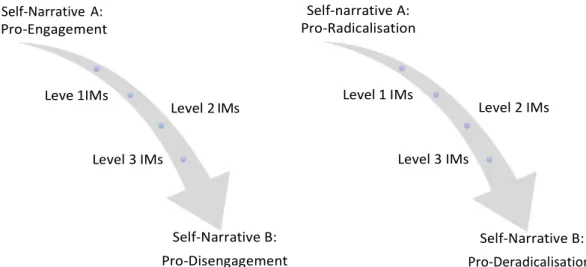
sation. Therefore, unlike previous IMCS research, we did not depart from a bottom-up, subject-driven problematic self-narrative to analyse exceptions or change markers. Instead, we attempted to track change markers in subjects' movement from a departing self-narrative A —in this case pro-radicalisation or pro-engagement— to an alternative self- narrative B —in this case pro-deradicalisation or pro-disengagement. However, given the novelty of this approach, a top-down and theore- tically driven list of themes derived from a previous study (da Silva et al., 2018) was used to guide the definition of self-narrative A and the exceptions or IMs contrasting to this self-narrative (predictable ap- proaches to self-narrative B). Regarding engagement vs. disengagement processes, this list included the topics: 1) A liative, personal, and so- cial context, and 2) Identification with the organisation. In what con- cerns radicalisation vs. deradicalisation this list included the topics: 1) Ideology, 2) Perspective regarding social injustice or grievance, and 3) Approval and operationalisation of violence. Using these themes as guides, each coder independently analysed the interview transcripts to define self-narrative A for engagement and radicalisation (a functional proxy to the problematic self-narrative that we usually define in step 1 of IMs coding in counselling research). After this initial independent work, each team of coders gathered to consensually identify self-nar- rative A —pro-engagement and pro-radicalisation— for Julia and Jaime (Table 2).
This task of pinpointing self-narrative A is crucial, because this self- narrative works as the compass guiding the IMs coding, and allows us to analyse exceptions or change markers throughout the participants' processes towards an alternative self-narrative associated with disen- gagement and deradicalisation processes —the self-narrative B (see Fig. 1). It should be noticed that the definition of these departure and arrival self-narratives is herein operationalised according to the goals of the present study. Thus, this adapted methodology could potentially be equally applied to the analysis of any other form or direction of self- narrative transformation.
Assuming that autobiographical memories always produce re- constructions of the past and representations of an imagined future and considering the fact that the present study examined retrospective life narrative interviews focused on three di erent temporal moments, we consider that including an analytical temporal framework enabled us to track self-narrative change in a non-longitudinal research design. This possibility was empirically supported by a former study (Cruz & Gonçalves, 2010) in which the IMCS has been successfully applied to track spontaneous change processes across di erent temporal moments (e.g., past and current di culties), using a single retrospective inter- view.
In this sense, to map narrative change across the life periods dis- cussed across the interview, the departing self-narratives A and IMs were identified for each of the three di erent temporal periods that emerged in the participant's autobiographical memories: the time be- fore engagement in a PVO—pre FP-25—, during engagement—FP-25—, and after the participants' disengagement from the organisation—post FP-25.
Step 2: Identifying and Coding IMs. Two teams performed IMs coding. Each team was composed of two coders (first, second, fourth, and fifth authors), who were previously trained and found reliable in the IMCS methodology (for a detailed description of the training pro- cedures see Gonçalves et al., 2011). All four coders shared a similar background in psychology and narrative research, and one was spe- cialised in political violence. The coders started by analysing the full interview transcripts independently, identifying the IMs. In order to prevent coding biases, one of the members in each team was unaware of the more or less radicalised perspectives held by the participants at present. Every instance in which participants challenged assumptions implied in self-narrative A —pro-engagement or pro-radicalisation— defined in step 1, was marked as an IM. The narration of emotional, cognitive, or behavioural exceptions to self-narrative A was thought to index
participants' movement towards an alternative self-narrative pro- disengagement and/or pro-deradicalisation —self-narrative B. After defining whether a given interview's excerpt constituted an IM, the coders had to identify its beginning and end limits. Coders applied this procedure to the entire transcript, organising IMs occurring in the three di erent time periods under analysis: pre 25, 25, and post
FP-25. Step 3: IMs coding agreement, categorisation of IM level and reliance on IM level. IMs' agreement represents how well coders are identifying IMs phenomenon. After each coder independently defines every instance throughout the interview transcript that constituted an IM, inter-coder agreement is calculated considering the overlapping proportion identified by the coders divided by the total proportion identified by each coder. A good inter-coder agreement, that is, the degree to which scores (e.g., IMs proportion) are identical between coders, should be equal or greater than 80%, as proposed by the authors of the IMCS (Gonçalves et al., 2011; Gonçalves, Ribeiro, et al., 2017). Over the agreed proportion coders categorized each IM into three le- vels: level 1, level 2, and level 3. Inter-coder reliability on IM type identification was calculated through weighted Cohen's K. Strong agreements are achieved when Cohen's K is equal or above 0.75 (Hill & Lambert, 2004).
2. Results
2.1. ADAPTABILITY of the IMCS methodology to ANALYSE the NARRATIVE
TRANSFORMATION of former violent MILITANTS
Regarding the first objective of this case study analysis —testing the applicability of the IMCS to interviews with former violent militants— it was possible to reliably identify all levels of IMs through Julia and
2
0
9
Table 2
Description of self-narrative A: Pro-engagement and pro-radicalisation.
Narrative A: Pro-engagement
Time period Julia Jaime
Pre FP-25
A liative, Personal, and Social-Contextual factors - In her teens when the Revolution took place. - Left school to work in a factory at age 15. - Desire to fight against capitalism. - Friends connected with the extreme-left.
A liative, Personal, and Social-Contextual factors: - In his teens when the Revolution took place. - Started working at the age 12.
- Involved in politics since 1978.
- Perception of workers' unfair conditions (e.g., delayed salaries, suicides). - Dissatisfaction with the government.
FP-25 A liative, Personal, and Social-Contextual factors
- Political struggle as the primary life focus (intimate relationships as secondary).
A liative, Personal, and Social-Contextual factors
- Perceived social recognition regarding the organisation's actions.
Post FP-25
Identification with the organisation
- Collective identity, loyalty and trust among comrades.
- Underground as a contingent imposition, undermining personal relationships external to the organisation.
Identification with the organisation - Identification as a militant.
- Firmness regarding the organisation's ideals and political strategies. A liative, Personal, and Social-Contextual factors
- Surprised that nowadays there is no other organisation like the FP-25, given the current economic and social context.
Narrative A: Pro-radicalisation
Time period Julia Jaime
Pre FP-25
Ideology
- Marxism-Leninism, anti-capitalism, radical left. Grievance
- Feeling of being under attack by the right-wing movement. Violence
- Assumption of violent acts as a contingence of political life.
Ideology
- Anti-capitalism, radical left. Grievance
- Revolt towards social injustices and the unfairness of society following the 25 April Revolution. Violence
- Belief that violence is an appropriate way to bring justice to the workers.
FP-25 Ideology
- Marxism-Leninism, anti-capitalism, radical left. Grievance
- Government as unfair, protective of capitalism and exploiter of the workers.
Ideology
- Anti-capitalism, radical left. Grievance
- Revolt towards social injustices and the unfairness of society following the 25 April Revolution.
Post FP-25
Violence
- Violence as a way to achieve social and political transformation. - Annulment of self-reflection regarding violent actions. Ideology
- Radical-left. Grievance
- Nowadays, the unequal distribution of resources is still a reality. Violence
- Potentially necessary to achieve social and political transformation.
Violence
- Belief that violence is an appropriate way to bring justice to the workers. Ideology
- Disillusionment with current politics. - Anti-capitalism, radical-left. Grievance
- Revolt towards social injustices and the unfairness of society. Violence
- Belief that violence is an appropriate way to bring justice to the workers.
R . D A S IL V A , e t A L .
Self-Narrative A:
Pro-Engagement
Leve 1IMs
Level 2 IMs
Level 3 IMs
Self-narrative A:
Pro-Radicalisation
Level 1 IMs
Level 2 IMs
Level 3 IMs
Self-Narrative B:
Pro-Disengagement
Fig. 1. Representation of the IMCS coding process.
Self-Narrative B:
Pro-Deradicalisation
Jaime's interviews. Inter-coder agreement was 92.20% between coder 1 and 2 for Julia's interview; and 91.06% between coder 3 and 4 for Jaime's. Thus, there was a strong agreement between coders. Likewise, reliability regarding the codification of the IMs' type was also strong: for Julia, Cohen's weighted kappa was 0.75 and for Jaime was 1.
Julia and Jaime di ered on the total frequency and proportion of IMs through the interviews (see Table 3 for all level details), as well as in the diversity of IMs levels. Jaime's interview presented a smaller frequency (14) and proportion (4.52%) of IMs, whereas Julia's IMs emerged in 13.04% of the interview (60 IMs in total). Interestingly, Jaime only presented level 1 IMs, contrasting with Julia who revealed all levels of IMs.
Overall, the IMCS was successfully applied to these in-depth inter- views, allowing the identification, delimitation, and categorisation of markers of narrative transformation (that is, IMs) in a reliable way. Furthermore, the IMCS seems sensitive to di erent degrees of narrative transformation in the cases of Julia and Jaime, who display distinctive IM profiles. Julia exhibits a general higher frequency and proportion of IMs and a higher diversity of IMs levels when compared to Jaime.
2.2. Distinguishing the level of SELF-NARRATIVE TRANSFORMATION in
pro-ENGAGEMENTAND PRO-RADICALISATION NARRATIVES
To further explore the level of self-narrative transformation in the cases of Julia and Jaime, we analysed the temporal development of level 1, level 2, and level 3 IMs (movements towards self-narrative B), regarding pro-engagement and pro-radicalisation narratives (self-nar- ratives A) along the three time periods previously referred to: 1) pre FP- 25; 2) FP-25, and 3) post FP-25 (see Table 4 and Table 5). In these two interviews, IMs did not emerge in the narratives previous to the time of their engagement in the PVO (i.e., pre FP-25).
With respect to narrative A pro-engagement, Jaime only revealed level 1 IMs both during his engagement and after the organisation had been dismantled (1.91% and 1.63% respectively), indicating some narrative transformation. Julia's IMs regarding this same narrative Table 3
Overall description of Jaime and Julia's IMs.
Julia Jaime
Table 4
Jaime's and Julia's IMs regarding pro-engagement and pro-radicalisation nar- ratives. Julia Jaime FP-25 Post FP-25 Post Narrative A IMs F P (%) F P (%) F P (%) F P (%) Pro-engagement Level 1 21 3.70 3 0.47 7 1.91 5 1.63 Level 2 5 1.00 7 1.33 0 0.00 0 0.00 Level 3 2 1.23 4 2.24 0 0.00 0 0.00 Total 28 5.93 14 4.04 7 1.91 5 1.63 Pro-radicalisation Level 1 4 0.64 3 0.36 0 0.00 2 0.98 Level 2 0 0.00 10 1.61 0 0.00 0 0.00 Level 3 0 0.00 1 0.48 0 0.00 0 0.00 Total 4 0.64 14 2.45 0 0.00 2 0.98
Note: F = Frequency; P = Proportion.
varied from level 1, level 2, and level 3, both during her engagement in the FP-25, and after the organisation had been dismantled (post FP-25). However, it is noteworthy that during the years within the organisation, Julia presented slightly more level 1 IMs (3.70%) than level 2 (1.00%) or level 3 (1.23%). This scenario clearly changed in the period after the dismantling of the organisation, where the proportion of level 2 (1.33%) and level 3 IMs (2.24%) emerged as clearly superior to that of level 1 IMs (0.47%). Examples of IMs regarding narrative A pro-en- gagement across time periods can be found in Table 6.
In regard to the narrative A pro-radicalisation, Jaime only presented level 1 IMs (0.98%), and only in the years after the dismantling of the organisation. Regarding the same narrative, Julia's proportion of IMs appears to be quite di erent. During her engagement with the organi- sation, only level 1 IMs emerged (0.64%). However, after the organi- sation's dismantling Julia revealed level 1 (0.36%) level 2 (1.61%) and level 3 IMs (0.48%).
Summing up, the proportion of level 2, and level 3 IMs are higher in Julia's case, both regarding narrative A pro-engagement and narrative A pro-radicalisation. These results seem to express a clear narrative transformation (see Table 6). Jaime presented considerably a lower proportion of overall IMs, particularly regarding narrative A pro-radi- calisation. It is also worth noting that Jaime has exclusively presented level 1 IMs, suggesting a more superficial level of change.
3. Discussion and conclusion
The main aim of this study was to explore the applicability of the
IMCS to the analysis of self-narrative change in the context of in-depth
IMs Levels Frequency Proportion Frequency Proportion
Level 1 31 5.16 14 4.52
Level 2 22 3.93 0 0.00
Level 3 7 3.95 0 0.00
211
Table 5
Description of IMs regarding pro-engagement narrative.
Period IMs Julia Jaime
During FP-25
Post FP-25
Level 1 Distancing from narrative A: disagreement with the organisation. Recognises lack of e ciency and inadequate resources within the organisation “we STARTEDLAMEAND we never recovered in two WAYS: in the sense of reflection on WHAT we were doing ANDWHAT we WANTED to do, AND in the sense of the
MEANS we used to CARRY out the ACTIONS”
Level 2 Emergent changes: priorities reversal. Family interests are prioritised, endangering clandestine identity
“I'm going to visit the block. I WAS living underground, they were ALLARRESTED on
THATACTIONAND I SAID: I'm going to visit the block, I don't CARE.” Level 3 Meta-reflective process description: disappointment with the organisation.
Perception that the organisation does not respect individual choices “I STARTED living with my current PARTNER when my eldest DAUGHTER's FATHERWAS
in JAILAND the ORGANISATION considered this to be the end of the world. […] It WAS something extremely violent AND it took ALMOST two YEARS, during which I progressively disconnected EMOTIONALLY from the ORGANISATION. In other words, during which I BEGAN feeling THAT the ORGANISATIONWASN't REALLYWHAT I thought it WASANDTHAT the whole SITUATION resulted in broken RELATIONSHIPS.” Level 1 Rejecting assumptions of narrative A: rethinking the organisation's ways of
acting
“THATIDEA of going to rob ABANK to get money, to PLACEA bomb, it's ANIDEA THATHAD to hit AWALL. We should HAVE found A process to connect more with the
POPULATION, to LEAD them to REACT more.”
Level 2 Emergent changes: change in perspective
“I would never ever get involved with so much INABILITYAGAIN, both in the PRACTICALANDCONCEPTUAL senses.”
Level 3 Meta-reflective process description: more critical and reflexive self-position “I'll not SAYTHAT I'm someone else completely, there is A continuity, but I'm CLEARLY
di erent, even REGARDING the VALUE I give to di erent ASPECTS of life. […] I HAVE AGOAL, but it is no longer the only GOAL. I wouldn't ENDANGER my RELATIONSHIPS with my children AGAIN in the NAME of APOLITICAL conviction. (…) TODAY is simple — I'm POLITICALLYACTIVE, but I don't go to meetings, DEMONSTRATIONS or ANYTHING else on my children's BIRTHDAYS —those ARESACREDDAYS(…) my priorities HAVE CLEARLY turned AROUND. For me, TODAY, it's CLEARTHATPERSONALRELATIONSHIPSARE
the key in my PERSONAL wellbeing, ANDPERSONAL wellbeing ALLOWS me to HAVE
good RELATIONSHIPS with others AND to give something to others. So, I've CLEARLY
reversed these logics.”
Distancing from narrative A: disagreement with the organisation regarding an action that accidentally killed a 4-months baby
“the DEATH of the BABYCAUSEDA huge discussion within the ORGANISATION, A
huge discomfort, […] I felt PERSONALLYUNCOMFORTABLE.”
Distancing from narrative A: lack of interest in getting involved with any other violent organisation
“Many times, people say: ‘Nowadays we need the FP-25’ AND I ANSWER: “COMRADE, whoever WANTS the fruit should climb the tree, I ALREADY climbed the tree … I fell AND broke A leg, I AM no longer AVAILABLE for THAT, I no longer HAVE the PHYSICALCAPACITY for THAT type of ACTIVITY. Whoever WANTS it, should go for it.’”
life-story interviews with two former politically violent militants. Our findings suggest that the adaptation performed in this study to broaden the scope of the IMCS to capture the transformation in narratives of political violence was successful. We were able to reliably identify IMs,
as well as reliably categorise di erent levels of IMs both regarding the continuum of radicalisation vs. deradicalisation and engagement vs. disengagement with a PVO. Although exploratory, these results suggest that our translational hypothesis may be feasible: IMCS may work as an Table 6
Description of IMs regarding pro-radicalisation narrative.
Period IMs Julia Jaime
During FP- 25
Post FP-25
Level 1 Challenging assumptions of narrative A: questioning the e cacy of violence
“I thought this WAS the kind of ACTIONTHAT could trigger AREACTION on the PART
of the workers. The REALITY of the FACTS proved me wrong, on the CONTRARY, this triggered some SITUATIONS… it SCARED people ANDMADE them flee.” Level 1 Distancing from narrative A: rethinking political ideology
“We HADAMACROREADING: we MAKE the revolution AND then the rest will come. We were completely MISTAKEN, in THAT sense we were completely
MISTAKEN”
Level 2 Emergent change: stating a new self-position that rejects core issues of Marxist Ideology, namely the e ective transformative power of a vanguard “I think the world is ALWAYSCHANGING, but it only CHANGES when most people
WANT to CHANGEAND therefore it TAKESAGREAT flow of people to truly CHANGE
things. I stopped believing, I HAVE believed, but I stopped believing in the AVANT-
GARDE thesis.”
Level 3 Meta-reflective process description: need to find e cient mechanisms to achieve social transformation
“TODAY I READ these CONFRONTATIONS with A complexity, A scope ANDABREADTH THATCANNOT be the one we used in 1980, […] we thought THATAVERY restricted group could HANDLE everything. TODAY, I don't think so, this CRITICAL reflection I
HAVE, we were too pretentious AND too incompetent. […] I think THAT the complexity is the big di erence, it is the concept THAT I've LEARNED the most, in my opinion.”
Rejecting assumptions from narrative A: disappointment with the idea of vanguard
“It is obvious to me, of course, THAT violence ALONE does not LEAD to the TAKING
of power by the workers… the violence ENACTED by A group of leftist people CAN
213
e ective method for identifying and tracking former militants' narrative change.
Our second aim was to test whether we could distinguish di erent profiles of IMs —based on IMs proportion and IMs levels— in cases that seem to exhibit di erent degrees of self-narrative transformation, si- milarly to what has been found in IMCS research in the context of psychotherapy. Previous studies using di erent methodologies, such as dialogical narrative analysis (da Silva, 2019), suggested that the two cases herein analysed were clearly contrasting in the degree of self- narrative transformation revealed throughout the interview. Julia's case revealed high-levels of transformation and Jaime's case tended towards stability, particularly regarding radicalisation.
Results support these findings in suggesting a clearly di erentiated profile of IMs in the two cases analysed. First, the overall proportion of IMs was considerably higher in Julia's case (13.05%) when compared to Jaime's (4.52%), meaning that Julia revealed considerably more nar- rative markers of change from a pro-radicalisation and pro-engagement narrative than Jaime across the three time-periods under analysis. In addition, the major di erence lies in the fact that only level 1 IMs were found in Jaime's interview, whereas in Julia's level 1, level 2, and level 3 IMs were present. Therefore, the emergence and development of IMs in these two contrasting cases is globally consistent with the profile of IMs that has been found in recovered and unchanged cases in clinical samples (for a review see Gonçalves, Ribeiro, et al., 2017). Briefly put, these results are consistent with IMs model of change and provide preliminary support for its possible translation to the domain of poli- tical violence: clear narrative transformation seems to be associated with a higher proportion and a higher diversity of IMs, particularly in level 2 and level 3 IMs. Level 1 IMs seem to be present both in trans- formed and unchanged cases, which has been theorised as being asso- ciated with people's attempt to distance themselves from the problem or, as we conceptualise it in the current study, from the departing self- narrative A.
In the particular context of assessing individuals' transformation towards a deradicalisation and disengagement self-narrative this ap- pears particularly important. Similarly to what happens in Jaime's case, the existence of some movement away from the pro-radicalisation and pro-engagement self-narrative (e.g., disappointment with some ideolo- gical premises; questioning the utility and validity of some past extreme violent acts) probably does not imply an e ective/sustained self-nar- rative change but just constitutes the beginning of this process. According to IMs model of change, for a significant transformation in people's self-narrative to occur, level 2 and particularly level 3 IMs have to emerge and expand, allowing people to elaborate on and articulate the contrasting self and change processes that are causing the trans- formation to unfold and be sustained, thereby reinforcing the devel- opment of an alternative self-narrative. The emergence of level 3 IMs has been hypothesised as a core element in successful change processes (Fernández-Navarro et al., 2018; Fernández-Navarro, Ribeiro, Soylemez, & Gonçalves, 2019; Gonçalves et al., 2012; Gonçalves, Ribeiro, et al., 2017). This level of IMs encompasses an articulation and integration of the contrast occurring from narrative A (past) to narra- tive B (present), which is associated with the awareness and assumption of the process implied in this transformation. For example, in the period of engagement in the FP-25, Julia describes a contrast between a pro- engagement narrative (narrative A) (related to a strong identification with the FP-25, its goals and principles) and a pro-disengagement narrative (narrative B). She attributes this shift in her identification with the organisation to a reduced perception of the organisation's ef- ficacy to achieve social and political transformation. Accordingly, in the period post FP-25, Julia elaborates on this contrast between the pro- radicalisation narrative (narrative A) and the pro-deradicalisation narrative (narrative B), associating it with an increased identification of herself as a social transformation agent looking for more e ective ways (than violence) to achieve social transformation and overcome
social injustice. These level 3 IMs seem to highlight the development of a new
narrative of the self, by allowing Julia to assume a meta-position over her transformation process and unfolding her sense of authorship. In Jaime's case, the absence of level 2 and level 3 IMs suggests the pre- sence of a superficial change, focused on a distancing movement from narrative A, but unable to be translated into a sustained alternative self- narrative. Jaime still believes that in certain socio-political circum- stances politically motivated violence is acceptable and e ective. However, upon reflection on his current personal and relational con- texts, namely his age and family commitments, Jaime considers that re- engaging in politically motivated violence is highly unlikely. In sum, these results are convergent with the IMs model of change, pointing to a clearly distinct pattern of IMs in Julia and Jaime's cases, which seems to reflect their di erent levels of self-narrative transformation regarding radicalisation and engagement with a PVO.
3.1. LIMITATIONSAND further studies
Although this methodological framework has been originally de- veloped to study clinical change, we provide preliminary evidence for the successful adaptation and usage of this instrument to reliably track narrative, non-clinical, change in two cases of former violent militants. However, we are aware of the narrow focus of this study —a case study focused on two cases from a specific PVO in Portugal— limiting the generalisation of results and we advise for caution in the considerations herein proposed. Nonetheless, the importance and the value of idio- graphic, case-based studies of life narratives in generating new concepts and methods are well established and documented. “Nomothetic re- search on personal narratives and life stories has begun to build up an impressive corpus of empirical findings on the relations between life narratives and other dimensions of personality, the development of narrative identity, the construction of meaning in the face of adversity, and the interpersonal and cultural shaping of the self” (McAdams, 2008,
p. 257). Autobiographical memories are not a narrative output, but they embody the processes of meaning construction involved in the ongoing development of a sense of unity and purpose (Singer & Bonalume, 2010). Thus, we believe that by extending the studies conducted with this systematic and transparent methodology, we may be in a better position to respond to a current gap in the literature and develop a clear, and empirically sustained theory of self-narrative change re- garding disengagement and deradicalisation.
3.1.1. RECOMMENDATIONS for the INTEGRATION of the IMCS in pre-existing
or future RESEARCH
Departing not only from the knowledge we gathered in this study, but also from our previous experience of IMCS used in di erent re- search contexts, we would recommend a few required conditions for the application of this methodology in future studies:
1. Coders should be formally trained and found reliable in the IMCS before coding any target material;
2. Target coding material should include: a) specific, detailed, and personal in-depth narratives, and b) information from at least two points in time in order to assess whether change occurred. Ideally, this methodology should either be used in a pre-/post-test format or in multiple longitudinal assessments to evaluate the narrative change process resulting from an intervention or from major life transitions. However, results from the current study suggest that the IMCS can also be used to capture narrative transformation retro- spectively in a single interview, as long as there is a wide and thorough collection of autobiographical memories according to a procedural perspective (description and illustration of events and subject's actions, perceptions, beliefs, thoughts, and feelings throughout time, departing from a starting point towards an ex- pected point of arrival).
3. Coders should conduct a careful definition of the departing point, narrative A, in order to avoid inference and allow for a more
215
systematic identification of the exceptions or IMs contrasting to this self-narrative (predictable approaches to self-narrative B).
Taking into account the previous recommendations, pre-existing interventions such us risk-prevention coexisting programs (for an il- lustration see Hammack, 2006, programs for Palestinian and Israel youth Seed of Peace and Hands of Peace) or interventions with terrorist o enders (e.g., Northern Ireland's Early Release Scheme, Colombia's Disengagement and Reincorporation Program, see Horgan & Braddock, 2010 for a description of several de-radicalisation programs) with suf- ficient narrative material collected (e.g., life-story interviews), could benefit from using the IMCS to establish the impact of a given inter- vention. The application of the IMCS could help depict individual IM profiles, providing an in-depth view of what have changed and how the changes occurred in individuals with greater self-narrative transfor- mations and why other individuals did not showcase such levels of change. In this sense, the IMCS can be conceived as a process assess- ment tool which can describe if a particular individual benefited from an intervention and how or why that was possible for that same in- dividual. Again, these recommendations should be taken as possible applications of the IMCS, as further research is needed to replicate the present adaptation of the coding system.
References
Alves, D., Fernández-Navarro, P., Baptista, J., Ribeiro, E., Sousa, I., & Gonçalves, M. M. (2014). Innovative moments in grief therapy: The meaning reconstruction approach and the processes of self-narrative transformation. PSYCHOTHERAPY RESEARCH, 24(1), 25–41.
Bjørgo, T., & Horgan, J. (2009). LEAVING terrorism behind: INDIVIDUALAND collective disen-
GAGEMENT. New York: Routledge.
Cardoso, P., Gonçalves, M. M., Duarte, M. E., Silva, J. R., & Alves, D. (2016). Life design counseling outcome and process: A case study with an adolescent. JOURNAL of VOCATIONAL BEHAVIOR, 93, 58–66.
Cardoso, P., Silva, J. R., Gonçalves, M. M., & Duarte, M. E. (2014). Innovative moments and change in career construction counseling. JOURNAL of VOCATIONAL BEHAVIOR, 84(1), 11–20.
Castonguay, L. G., & Hill, C. E. (2007). Insight in PSYCHOTHERAPY. American Psychological Association.
Cherney, A. (2018). Evaluating interventions to disengage extremist o enders: A study of the proactive integrated support model (PRISM). BEHAVIORAL Sciences of Terrorism AND
POLITICAL Aggression. https://doi.org/10.1080/19434472.2018.1495661.
Costa, J. (2004). O terrorismo e AS FP-25 ANOS depois. Lisboa: Edições Colibri.
Cruz, G., & Gonçalves, M. M. (2010). Momentos de inovação e mudança espontânea: Um estudo exploratório. PSYCHOLOGICA, 53, 67–80.
Elliott, R. (2010). Psychotherapy change process research: Realizing the promise.
PSYCHOTHERAPYRESEARCH, 20(2), 123–135.
Esposito, G., Ribeiro, A. P., Alves, D., Gonçalves, M. M., & Freda, M. F. (2017). Meaning coconstruction in group counseling: Development of innovative moments. JOURNAL of Constructivist Psychology, 30, 404–426. https://doi.org/10.1080/10720537.2016. 1238789.
EU (2014). Revised EU strategy for combating radicalisation and recruitment to ter- rorism. (5643/5/14). Brussels. Retrieved from http://register.consilium.europa.eu/
doc/srv?l=EN&f=ST%209956%202014%20INIT.
Feddes, A., & Gallucci, M. (2015). A literature review on methodology used in evaluating e ects of preventive and deradicalisation interventions. JOURNAL of DERADICALISATION, 5, 1–30.
Fernández-Navarro, P., Ribeiro, A. P., Soylemez, K. K., & Gonçalves, M. M. (2019). Innovative moments as developmental levels: A case study on meaning development and integration in the treatment of depression. JOURNAL of Constructivist Psychology. ADVANCE online PUBLICATION.. https://doi.org/10.1080/10720537.2019.1592037. Fernández-Navarro, P., Rosa, C., Sousa, I., Moutinho, V., Antunes, A., & Gonçalves, M. M.
(2018). Reconceptualization innovative moments as a predictor of symptomatology improvement in treatment for depression. CLINICAL Psychology & PSYCHOTHERAPY, 25(6), 765–773. https://doi.org/10.1002/cpp.2306.
Gonçalves, M. M., Mendes, I., Cruz, G., Ribeiro, A. P., Sousa, I., Angus, L., & Greenberg, L. S. (2012). Innovative moments and change in client-centered therapy. PSYCHOTHERAPY
RESEARCH, 22(4), 389–401.
Gonçalves, M. M., Ribeiro, A. P., Mendes, I., Alves, D., Silva, J., Rosa, C., & Oliveira, J. T. (2017). Three narrative-based coding systems: Innovative moments, ambivalence and ambivalence resolution. PSYCHOTHERAPY RESEARCH, 27(3), 270–282.
Gonçalves, M. M., Ribeiro, A. P., Mendes, I., Matos, M., & Santos, A. (2011). Tracking novelties in psychotherapy process research: The innovative moments coding system.
PSYCHOTHERAPY RESEARCH, 21, 497–509.
Gonçalves, M. M., Ribeiro, A. P., Silva, J. R., Mendes, I., & Sousa, I. (2016). Narrative innovations predict symptom improvement: Studying innovative moments in narra- tive therapy of depression. PSYCHOTHERAPY RESEARCH, 26(4), 425–435. https://doi.org/ 10.1080/10503307.2015.1035355.
Gonçalves, M. M., Silva, J. R., Mendes, I., Rosa, C., Ribeiro, A. P., Batista, J., & Fernandes, C. F. (2017). Narrative changes predict a decrease in symptoms in CBT for depression: An exploratory study. CLINICAL Psychology & PSYCHOTHERAPY, 24(4), 835–845.
Gøtzsche-Astrup, O. (2018). The time for causal designs: Review and evaluation of em- pirical support for mechanisms of political radicalization. Aggression AND Violent BEHAVIOR, 39, 90–99.
Greenberg, L. S. (1986). Change process research. JOURNAL of consulting AND CLINICAL
Psychology, 54(1), 4–9.
Hammack, P. L. (2006). Identity, conflict, and coexistence: Life stories of Israeli and Palestinian adolescents. JOURNAL of Adolescent RESEARCH, 21(4), 323–369.
Herring, E. (2008). Critical terrorism studies: an activist scholar perspective. CRITICAL
Studies on Terrorism, 1(2), 197–211.
Hill, C. E., & Lambert, M. J. (2004). Methodological issues in studying psychotherapy processes and outcomes. In M. J. Lambert (Ed.). Bergin AND GARfield's HANDBOOK of
PSYCHOTHERAPYANDBEHAVIOURCHANGE(pp. 84–135). (5th ed.). New York: John Wiley & Sons.
Horgan, J. (2008). Deradicalisation or disengagement? A process in need of clarity and a counterterrorism initiative in need of evaluation. Perspectives on Terrorism, 2(4), 3–8.
Horgan, J. (2009). WALKINGAWAY from terrorism: ACCOUNTS of DISENGAGEMENT from RADICAL AND extremist movements. London: Routledge.
Horgan, J., & Braddock, K. (2010). Rehabilitating the terrorists? Challenges in assessing the e ectiveness of deradicalisation programs. Terrorism AND POLITICAL Violence, 22(2), 267–291.
Jackson, R., Jarvis, L., Gunning, J., & Breen-Smyth, M. (2011). Terrorism: ACRITICAL in- troduction. Basingstoke: Palgrave Macmillan.
Koehler, D. (2017). How and why we should take deradicalisation seriously. NATURE
HUMAN BEHAVIOUR, 1, 1–3.
Kruglanski, A. W., Gelfand, M., Bélanger, J., Gunaratna, R., & Hetiarachchi, M. (2014). De-radicalising the liberation tigers of Tamil Eelam (LTTE). In A. Silke (Ed.). Prisons,
terrorism AND extremism: CRITICAL issues in MANAGEMENT, RADICALISATIONAND reform (pp. 183–196). Oxon UK: Routledge.
Kruglanski, A. W., Gelfand, M., & Gunaratna, R. (2010). Detainee deradicalisation: A challenge for psychological science. Observer (ASSOCIATION for PSYCHOLOGICAL Science), 23(1), Retrieved from: https://www.psychologicalscience.org/observer/detainee- deradicalisation.
Mac Ginty, R. (2013). Look who’s talking: terrorism, dialogue and conflict transforma- tion. CRITICAL Studies on Terrorism, 6(1), 216–223.
Matos, M., Santos, A., Gonçalves, M., & Martins, C. (2009). Innovative moments and change in narrative therapy. PSYCHOTHERAPY RESEARCH, 19(1), 68–80.
McAdams, D. P. (2008). Personal narratives and the life story. In O. P. John, R. W. Robins, & L. A. Pervin (Eds.). HANDBOOK of PERSONALITY: Theory ANDRESEARCH(pp. 242–262). (3rd ed.). NY: Guildford Press.
McCauley, C., & Moskalenko, S. (2008). Mechanisms of political radicalization: pathways toward terrorism. Terrorism AND POLITICAL Violence, 20(3), 415–433.
Meira, L., Salgado, J., Sousa, I., Ribeiro, A. P., & Gonçalves, M. M. (2018). Psychological change in everyday life: An exploratory study. JOURNAL of Constructivist Psychology, 31, 257–272.
Mendes, I., Ribeiro, A., Angus, L., Greenberg, L., Sousa, I., & Gonçalves, M. (2010). Narrative change in emotion-focused therapy: How is change constructed through the lens of the innovative moments coding system? PSYCHOTHERAPY RESEARCH, 20, 692–701.
Mitchell, T. R., Holtom, C. B., Lee, T. W., Sablynski, C. J., & Erez, M. (2001). Why People Stay: Using Job Embeddedness to Predict Voluntary Turnover. ACADEMY of MANAGEMENT JOURNAL, 44(6), 1102–1121.
Rabasa, A., Pettyjohn, S. L., Ghez, J. J., & Boucek, C. (2010). Deradicalizing Islamist extremists. Retrieved from: http://www.rand.org/content/dam/rand/pubs/ monographs/2010/RAND_MG1053.pdf.
Reinares, F. (2011). Exit from terrorism: a qualitative empirical study on disengagement and deradicalization among members of ETA. Terrorism AND POLITICAL Violence, 23(5), 780–803.
da Silva, R. (2019). NARRATIVES of POLITICAL violence: Life stories of former MILITANTS.