Phillip Michael Chalk(1)
(1)Embrapa Solos, Rua Jardim Botânico, no 1.024, Jardim Botânico, CEP 22460-000 Rio de Janeiro, RJ, Brazil. E-mail: [email protected]
Abstract – Brazilian scientists have played a pioneering role in developing and applying stable isotope methodologies, in terms of natural abundance and enriched levels, to trace carbon and nutrient flows in terrestrial ecosystems, including natural and agroecosystems. Significant contributions have been made in the areas of biological N2 fixation, carbon dynamics in soil, synthesis and evaluation of labeled fertilizers, and food science.
These contributions have originated from several decentralized units of Embrapa, from research institutions, and from federal or state universities. In order to capitalize the existing Brazilian expertise, it is necessary to provide, at an institutional level, analytical facilities for stable isotope research, aiming to strengthen national capacity and to maintain the international competitiveness of the research.
Index terms: biological N2 fixation, fertilizer use efficiency, food science, labeled fertilizer, soil carbon, stable
isotopes.
Da produção ao consumo: traçando a dinâmica de C, N e S nos
agroecossistemas brasileiros com uso de isótopos estáveis
Resumo – Pesquisadores brasileiros têm tido um papel pioneiro no desenvolvimento e na aplicação das metodologias de isótopos estáveis, em termos de abundância natural e de níveis enriquecidos, para traçar os fluxos de carbono e nutrientes em ecossistemas terrestres, que incluem os naturais e os agroecossistemas. Contribuições significativas têm sido feitas nas áreas de fixação biológica de N2, de dinâmica de carbono nos
solos, de síntese e avaliação de fertilizantes marcados, e da tecnologia dos alimentos. Essas contribuições têm se originado de diversas unidades decentralizadas da Embrapa, de institutos de pesquisa e de universidades federais ou estaduais. Para capitalizar a experiência brasileira existente, é necessária a provisão, nas instituições, de instalações analíticas para pesquisa com isótopos estáveis, a fim de fortalecer a capacidade nacional e manter a competitividade internacional das pesquisas.
Termos para indexação: fixação biológica de N2, eficiência de uso de fertilizantes, tecnologia de alimentos,
fertilizante marcado, carbono do solo, isótopos estáveis.
Introduction
The Brazilian climate is predominantly tropical and subtropical, in marked contrast to the temperate or colder regions of Europe and North America.
Therefore, the soils within the country are, in general, more highly weathered and support a greater variety of both intensive and extensive agricultural enterprises.
Despite this, Brazilian soils share a similar set of problems encountered in their northern hemisphere counterparts, namely loss of soil organic matter and declining fertility under arable cropping. Stable isotope tracers have played a crucial role in gaining insight into carbon, nitrogen, and sulfur cycling in agroecosystems,
including the estimation of fertilizer use efficiency
and the contribution of biological N2 fixation to
the N nutrition of legumes and C4 grasses. In the
globalization era of agricultural products of plant and animal origin, the public is demanding accountability
and authenticity of the external description on food
and beverage packaging. In this case, stable isotopes are being used to detect adulteration and to verify geographic origin and mode of production, such as organic vs. conventional systems.
The objective of this review was to highlight
contributions that Brazilian science has made and continues to make to the global efforts to trace carbon
window or aperçu, from the perspective of an outsider, who, nevertheless, has been fortunate to be involved in Brazilian stable isotope research and review since
1979.
This review addresses key examples, mainly but not exclusively, from agroecosystems, but does not attempt to make an extensive coverage of all relevant
Brazilian literature. Recognition has been given to
published papers in which the research was conducted and analytical services were provided in the country, irrespectively of the national or international affiliations
of the scientists involved. Although considerable
expertise exists in Brazil, this review does not cover aquatic environments (except for one example of fish
production regime), microbial and plant ecology, plant and animal physiology, and pure and applied sciences, such as entomology, zoology, hydrology, geochemistry, paleontology, and related disciplines.
Absolute (x) and relative (δ) values of isotopic abundance
The lighter elements of interest in biological sciences, that is, H, C, N, O, and S, have naturally
occurring stable isotopes: two, in the case of H, C, and N; three, in that of O; or four, in that of S (Table 1). The absolute abundance of each isotope, expressed
as mole fraction, is given in Table 1. These values are equivalent to the atom fraction of an element, x(iE),
which is defined as the amount of a specified atom
(isotope) of an element divided by the total amount of
atoms of the element within the mixture (Coplen, 2011). Therefore, for an element with two stable isotopes, such as N, the absolute value is expressed by the equation:
atom fraction 15N, x(15N) = amount of 15N/amount of
14N + 15N
If a sample is artificially enriched in an isotope, the excess over natural abundance is expressed as an excess atom fraction, x, which is the difference between
the mole fraction of an isotope of an element in a substance and that of a reference (Coplen, 2011). For
N, for instance, the isotopic enrichment is expressed
by the equation:
excess atom fraction 15N, x(15N)
sample/reference =
x(15N)
sample – x(15N)reference
in which the reference is air, which has a 15N mole
fraction equal to 0.003 663.
The range of natural variations in isotopic
abundances, expressed as mole fraction, in terrestrial materials is also given in Table 1. However, it is more common to express small variations in natural abundance as relative (δ) rather than absolute (x)
values. The relative value is the isotope ratio (R) of a sample, relative to the isotope ratio of the international standard for the element, as in the equation:
δ(iE) = (R
sample/Rstandard) – 1.
For N, R is the ratio of 15N/14N. The international
standard is air, with an R value equal to 0.003 676 47 and, by definition, a δ15Νor xE(15N) value equal to
zero (Chalk et al., 2015b). In order to avoid fractions,
δ values have traditionally been expressed in per mil
(‰), by multiplying the right hand side of the equation
of the isotope ratio by 1,000. Values of δ15N can be
negative or positive depending on whether the sample
isotope ratio is, respectively, less than or greater than the isotope ratio of air.
A full description of the source, availability, and properties of primary and secondary international reference materials for isotope-ratio analysis is given in Brand et al. (2014).
Biological N2 fixation (BNF)
Short-term measurements of the ability of legumes
or actinorhizal plants to fix atmospheric N2 can be
performed by exposure of the whole plant or root
Table 1. Isotopic composition of the important elements in biological sciences. Adapted from Berglund & Wieser (2011).
Element Atomic number
Stable isotope(1)
Mole fraction Abundance(2) Natural variation(3)
Hydrogen 1 1H 0.999 844 26 0.999 816–0.999 974 2H 0.000 155 74 0.000 026–0.000 184
Carbon 6 12C 0.988 922 0.988 53–0.990 37 13C 0.011 078 0.009 63–0.011 47
Nitrogen 7 14N 0.996 337 0.995 79–0.996 54 15N 0.003 663 0.003 46–0.004 21
Oxygen 8 16O 0.997 620 6 0.997 38–0.997 76 17O 0.000 379 0 0.000 37–0.000 40 18O 0.002 000 4 0.001 88–0.002 22
Sulfur 16 32S 0.950 407 4 0.944 54–0.952 81 33S 0.007 486 9 0.007 30–0.007 93 34S 0.041 959 9 0.039 76–0.047 34 36S 0.000 145 79 0.000 13–0.000 19 (1)Superscript is mass number. (2)Best measurement from a single terrestrial
system to an atmosphere containing enriched 15N 2
(De-Polli et al., 1977). Although the method is direct,
it poses many practical difficulties in relation to the
containment of the labeled gas and to the maintenance
of plants in an enclosure, which is why it is seldom
attempted.
Indirect methods, commonly used to estimate legume symbiotic dependence, such as the proportional
contribution of biologically-fixed N2 to the N nutrition
of the legume, involve paired treatments of a legume and a non-legume reference plant. The latter is required to estimate the ratio of labeled to unlabeled N derived from the soil by the N2-fixing plant.
The 15N enrichment (E) method involves the addition
of a fertilizer or organic material artificially enriched
in 15N to the soil in the paired plots. The proportional
dependence (Patm) of the legume on biologically-fixed
N is estimated by isotope dilution, using the following
equation: Patm = 1 – (xE(15N)legume/xE(15N)reference plant).
The E methodology was reviewed by Chalk &
Ladha (1999).
The 15N natural abundance (NA) method is based
on the same principle, but isotopic discrimination, i.e., the B value, during N2 fixation must be additionally
measured, usually by growing the legume in an N-free
medium. Symbiotic dependence is estimated according to the equation: Patm = [(δ(15N)reference plant – δ(15N)legume)/
δ(15N)
reference plant – B] .
The NA methodology was reviewed by Unkovich
et al. (2008).
Endophytic BNF
Brazilian and visiting scientists working with Dr. Johanna Döbereiner, at Embrapa Agrobiologia, were the first to recognize the importance of diazotrophic bacteria in endophytic associations with tropical C4
Gramineae. The first isotope dilution field measurement to quantify endophytic BNF was also carried out at Embrapa Agrobiologia with Paspalum notatum Flugge (Boddey et al., 1983). Since these pioneering studies,
endophytic BNF has been quantified by both the E
and NA methods in several C4 forage grasses and in
sugarcane (Saccharum officinarum L.) (Table 2). This
research has unequivocally shown the importance of
endophytic BNF to the N nutrition of C4 plants. For
example, in a four-year study, Urquiaga et al. (2012)
found that Patm values varied from 43 to 61% among
nine varieties of sugarcane.
Legume BNF
In Brazil, symbiotic dependence has been estimated for grain and forage legumes in agroecosystems, using the E and NA methods, and for native leguminous shrubs and trees at undisturbed sites in the Cerrado and Caatinga biomes, using the NA method. Some
examples are given in Table 3.
Hungria & Vargas (2000) suggested that high
temperature, water stress, and soil acidity were the main
abiotic constraints to BNF in tropical grain legumes in
the country. However, this conclusion was based on an examination of the literature in which qualitative
data, such as nodulation parameters or assays on
acetylene reduction activity, were reported instead of
quantitative data on legume symbiotic dependence. Isotope-based methodologies have played an important role in identifying both biotic and abiotic constraints
to legume performance in Brazil. For example, the E methodology was used to identify the critical growth
stages of common bean (Phaseolus vulgaris L.) during
which water stress had a large negative impact on yield and BNF. Similarly, by reviewing the published studies in which the E methodology was used, Chalk
Table 2. Brazilian studies of Embrapa Agrobiologia, using 15N-based methodologies to quantify endophytic N
2 fixation in C4
forages and in sugarcane (Saccharum officinarum).
Species(1) Reference plant Scale Method(2) Duration P
atm x 100 (%)(3) Chronological reference
'Batatais' Bahia grass 'Pensacola' Bahia grass Field E 357 days 12 (4 harvests) Boddey et al. (1983) Guinea grass, 25 ecotypes 'IRI 442' Urochloa arrecta Pots E 350 days 16–39 Miranda et al. (1990) Signal grass, 5 species Variety with>xE(15N) Field E 5 months 4–23 Reis et al. (2001)
Elephant grass, 3 sites, 5 varieties Weeds Field NA 2 years 18–70 Morais et al. (2012) Sugarcane, 9 varieties Weeds and Sorghum sp. Field NA 4 years 43–61 Urquiaga et al. (2012)
(1)Bahia grass, Paspalum notatum; Guinea grass, Panicum maximum; signal grass, Urochloa brizantha, U. decumbens, U. humidicola, U. ruziziensis, and U. arrecta; elephant grass, Pennisetum purpureum; and sugarcane, Saccharum officinarum. (2)E, 15N enrichment;and NA, 15N natural abundance. (3)P
atm,
et al. (2010) were able to identify temperature, water,
salinity, sodicity, acidity, and mineral nutrition as major abiotic factors affecting legume BNF globally.
Moreover, biotic factors – such as the absence of indigenous rhizobia or arbuscular mycorrhizal fungi (Ibijbijen et al., 1996) – and legume genotype can also affect legume symbiotic dependence. A comprehensive
review of this subject was published by Chalk et al.
(2006).
BNF dynamics
Apart from the quantification of legume BNF, a
suite of indirect 15N methodologies has been developed
to estimate the transfer of BNF or legume N (LN) to
companion non-legume species, as reviewed by Chalk
et al. (2014b). Other 15N-based methods have been
developed to quantify the transfer of LN or BNF to an array of crops in sequential rotations. A frequently used method involves the application of a 15N-labeled crop
residue obtained from a particular source to unlabeled
plots in a subsequent experiment, which might be
separated in space and time from the original source.
Primo et al. (2014), for example, measured cumulative
recoveries of 15N-labeled Gliricidia sepium (Jacq.)
Kunth biomass in a pot experiment, in three subsequent
crops of corn (Zea mays L.), cotton (Gossypium
hirsutum L.), or cowpea [Vigna unguiculata (L.) Walp.], obtaining values of 28, 35, and 41%, respectively. In an attempt to overcome the obvious limitations of such
an approach, an in situ method based on 15N natural
abundance was proposed by Perin et al. (2006), who estimated that corn following sunn hemp (Crotalaria
juncea L.) green manure derived 15% of its grain N content from N2 fixed by the preceding sunn hemp
crop.
Organic carbon dynamics in soil
For carbon, the relative isotopic abundance is
expressed by the isotope ratio equation, in which R is
the ratio of 13C/12C. The international standard, in this
case, is Vienna Pee Dee Belemnite (VPDB), which has a δvalue of -0.030 031.
It is well known that 13C isotopic fractionation
occurs during photosynthesis, so that plant organic C is naturally depleted in 13C, when compared with
atmospheric CO2 (δ13CO2 = -8‰). Different CO2
assimilation pathways between C3 (the Calvin cycle),
C4 (the Hatch-Slack pathway), and CCAM (Crassulacean
acid metabolism) plants result in markedly different
bulk δ13C signatures of photosynthetic plants, mainly
due to diffusion and enzymatic effects. The ranges in
the δ13C values for C
3, C4, and CCAM plants are -22 to
-30‰, -9 to -13‰, and -10 to -20‰, respectively.
In undisturbed natural ecosystems, the δ13C
signature of surface soil organic matter is similar to
that of the native vegetation from which it was derived. Many of the soils used in agriculture were originally
under C3 forest and, therefore, had very negative δ13C
Table 3. Brazilian field studies using 15N dilution to quantify symbiotic N
2 fixation in legumes(1).
Legume species(1) Reference plant(2) Method(3) Duration P atm x 100
(%)(4)
Reference
Grain legumes
Common bean, 5 varieties Wheat E 60–90 days 38–65 Ruschel et al. (1982) Soybean Nn soybean E 92 days 81–85 Boddey et al. (1984) Groundnut Weeds, 3 species NA 98 days 52–70 Okito et al. (2004)
Forage or green manure legumes
Centrosema, Galactiastriata, and Desmodiumovalifolium C4 grasses, 3 species E 97 days 37–65 Viera-Vargas et al. (1995)
Crotalaria juncea and Mucuna niveum Weeds, 5 species NA 75 days 70–75(5) Ramos et al. (2001)
Native legumes
Cratylia mollis, dry and wet seasons, 4 sites Nnlegume, 2 speciesNeighboring dicots NA Spot samples 8–22 and
42–52(5, 6) Teixeira et al. (2006)
Mimosablanchetii, M. gemmulata, and M. ulbrichiana 38, 51, 60 Reis Junior et al. (2010)
(1)Common bean, Phaseolusvulgaris; soybean, Glycine max; and groundnut, Arachis hypogaea. (2)Wheat, Triticum aestivum; Nn, non-nodulating; Weeds,
Digitaria horizontalis, Sorghum arundinaceum, and Cenchrus echinatus; C4 grasses, Urochloa brizantha, U. arrecta, and Panicum maximum; Weeds, Sorghum sp., Zea mays, Cynodon dactylon, Cyperus rotundus, and Sida glaziovii; and Nnlegume, the non-nodulating legumes Bauhinia cheilanta and
Cae-salpiniapyramidalis. (3)E, 15N enrichment; andNA, 15N natural abundance. (4)P
atm, proportional dependence of the legume on biologically-fixed N. (5)B value
values. With the introduction of sugarcane and tropical forage grasses, such as C4 species (Table 2), the
above-ground C input into the ecosystem had a much higher
δ13C signature, and, over time, the δ13C value of the
soil organic matter became less negative (Vitorello
et al., 1989; Moraes et al., 1996; Pinheiro et al., 2010)
(Table 4).
An innovative methodology to estimate the proportions of soil C from the original and introduced
vegetation is based on the shift in the δ13C signature
of soil C and was developed by Cerri et al. (1985) at
Centro de Energia Nuclear na Agricultura (Cena), the
center for nuclear energy in agriculture of Universidade de São Paulo (USP). The proportion of organic C in a
soil layer derived from the introduced C4 vegetation
(PC4soil) was expressed by the following equation: PC4soil
= δ(13C)
C4soil – δ(13C)C3soil)/(δ(13C)C4plant – δ(13C)C3soil)],
in which δ(13C)
C4soil is the δ13C value of a soil layer
under C4 vegetation; δ(13C)C3soil is the δ13C value of a
soil layer under the original C3 vegetation; and δ(13C)
C4plant is the δ13C value of the C4 vegetation. PC4soil
increased with increasing years under C4 pasture or
sugarcane (Table 4), and Moraes et al. (1996) reported that the original C3 signal in the 0–10-cm soil layer had
disappeared after 81 years under C4 pasture.
The concentrations of soil organic C and δ13C values
are not constant with soil depth (Sisti et al., 2004). Organic C concentrations generally decrease with soil depth. However, in C3 forest, soil δ13C values increased
with depth, although, in soil under C4 pasture or
sugarcane, these values also decreased with depth due
to the decreasing effect of the C4 pasture with depth
(Vitorello et al., 1989; Moraes et al., 1996; Pinheiro
et al., 2010).
Management factors can affect the dynamics of C
when the system is undergoing interchange between
C3- and C4-dominant vegetation. For instance, the
tillage system (zero vs. conventional) under different
long-term crop rotations was shown to affect the decay
of the original C3-derived soil organic C to a depth
of 100 cm (Sisti et al., 2004). Balieiro et al. (2008)
showed that the stocks of soil C and δ13C signatures
to 10-cm depth were affected by the reintroduction of two C3-forest species, Eucalyptusgrandis W.Hill and
Pseudosamanea guachapele Harms, the latter being a N2-fixing tree. The site had formerly supported C4
Panicum maximum Jacq. for ten years. The rate of
replacement of soil C by new forest C after five years was much faster under a mixed plantation of trees
rather than under pure plantations of either species (Balieiro et al., 2008).
There is an increasing interest worldwide in the
use of soil additives, such as biochars, due to their potential to sequester soil C. In a 30-day laboratory
incubation study with three biochars derived from C3
oilseed residues added to a sandy soil containing C4
carbon, Rittle et al. (2015) found that respired CO2
came principally from the biochars and that these decelerated the mineralization of the indigenous C (negative priming effect). Therefore, there may be both direct and indirect effects of biochar addition on C sequestration.
Synthesis and evaluation of labeled fertilizers
Scientists at Cena of USP have been involved for
many years in the synthesis of labeled fertilizers
using ion exchange chromatography (Bendassolli et al., 1997). They have also developed new methods
Table 4.δ13C signatures of Brazilian soils under forest and after a number of years of C
4 pasture or sugarcane (Saccharum
officinarum) established on cleared forest.
Chronological reference Location Soil PC4soil(1)
Municipality State Coordinates USDA order
Depth (cm)
Vegetation Time (y)
δ13C
(‰)
Vitorello et al. (1989) Piracicaba São Paulo 22º43’S
47º38’W Oxisol 0−30
Forest - -25.1 -Sugarcane 12 -22.8 0.17
50 -20.4 0.41 Moraes et al. (1996) Nova Vida Roraima 10º10’S
62º49’W Ultisol
0−5 Forest - -28.0
-0−10 C4 pasture 81 -14.3 1.0
Pinheiro et al. (2010) Usina Lagrisa,
Linhares Espírito Santo
19º18’S
40º19’W Ultisol 0−10
Forest - -28.0 -Brachiaria + sugarcane 3 + 14 -18.0 0.56
for the isotope-ratio analysis of labeled plants and
soils (Carneiro et al., 2008). Some examples of
labeled fertilizers synthesized at Cena are given in Table 5. The isotopic enrichment of the product is largely determined either by the isotopic enrichment of the source materials or by the degree of isotopic
fractionation during ion exchange chromatography.
By using isotopically-labeled fertilizers, it is possible to determine the recovery in the plant-soil system. The proportion of 15N-enriched fertilizer recovered by a
plant, for example, can be calculated according to the
equation: proportional N recoveryplant = (mass Nplant×
xE (15N)
plant/mass Nfertilizer× xE (15N)fertilizer).
in which xE(15N)
plant/xE(15N)fertilizer is the fraction of plant
N derived from the fertilizer. The same procedure is used to determine the recovery of fertilizer in the soil, and fertilizer loss from the plant-soil system can be calculated by mass balance.
Many studies have been undertaken with different
crops and strategies of N fertilizer application, in
order to estimate N fertilizer efficiency. Recovery by annual crops seldom exceeds 60%, and the cumulative residual value of the N fertilizer in two subsequent crops is usually <10%. Some examples of recoveries
of 15N- and 34S-labeled fertilizers in plant tops are
given in Table 5.
In addition to studies with labeled synthetic
(industrially manufactured) N fertilizers, such as urea
and ammonium-based forms, efficiency studies have also been performed with labeled organic sources,
including composts (Chalk et al., 2013) and animal
excreta (Primo et al., 2014), or with labeled slow- or
controlled-release products (Chalk et al., 2015a). It is
also possible to trace the dynamics of N from source (fertilizer) to product (food) in agroecosystems using
15N natural abundance (Chalk et al., 2014a).
Food and beverage authentication
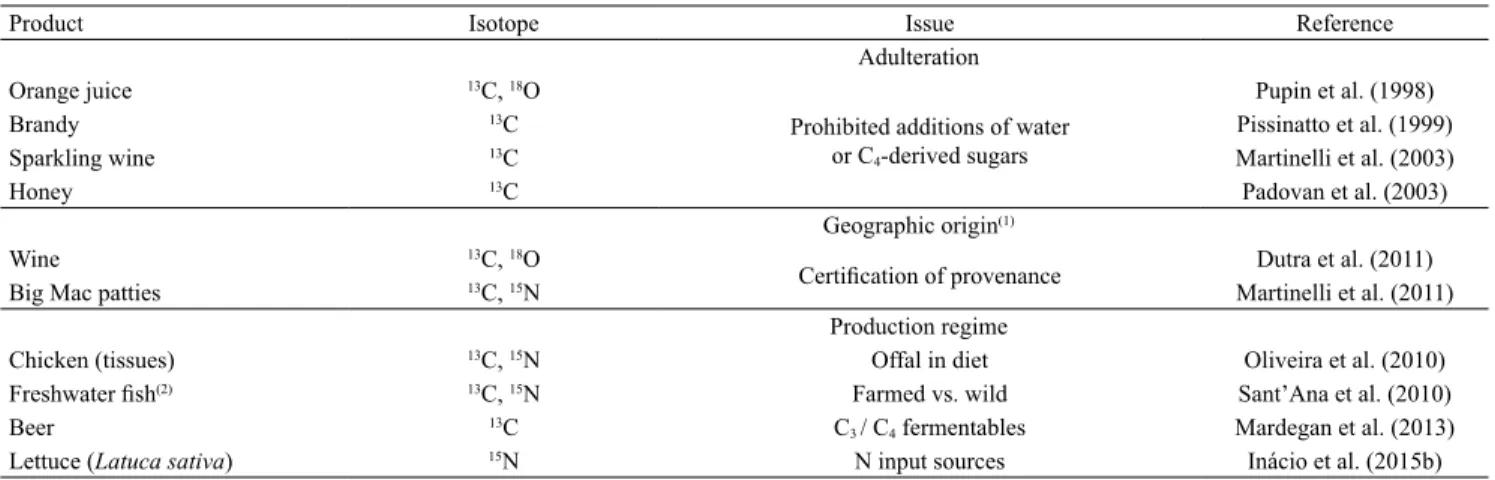
In the globalization era of agricultural products of plant and animal origin, the public is demanding authenticity and accountability in food and beverage
labelling. Stable isotopes are playing an expanding role
in detecting adulteration and in verifying geographic
origin and production regime. Some examples of
research carried out in Brazil are summarized in
Table 6, of which several will be outlined in some
detail.
Adulteration
Marked differences are observed in the δ13C
signatures between sugars derived from C3 and C4
plants. This makes it possible to detect the presence of C4 sugar or C4 ethanol in a product ostensibly derived
from a C3 source. Therefore, it allows identifying, for
instance, the sources of ethanol in Brazilian brandy
(Pissinatto et al., 1999) or sparkling wine (Martinelli et al., 2003), or whether C4 sugar has been added to
freshly-squeezed orange juice (Pupin et al., 1998) or to honey (Padovan et al., 2003).
Honey is produced from the nectar collected by bees
from flowering plants, mainly from C3 plants, and, to
a lesser extent, from C4 and CCAM plants. The δ13C
signature of the protein extract of honey will reflect the dominant source from which the honey was derived,
e.g. -22 to -33‰ for C3 plants, -10 to -20 for C4 plants,
Table 5. Synthesis of labeled fertilizers at Centro de Energia Nuclear na Agricultura of Universidade de São Paulo, as well
as fertilizer use efficiency.
Fertilizer x(iE) Crop(1) Yield or recovery(2) (%) Reference
Synthesis Ca34SO
4.2H2O 0.058 5
Not applicable
95 Rossete et al. (2006) CO(15NH
2)2
0.90 77 Sant Ana Filho et al. (2012) (15NH
4)2SO4 - Máximo et al. (2013)
Use efficiency
Na234SO4 0.143
Rice 27 (122)
Trivelin et al. (2002) Sunn hemp 15 (72)
(15NH
4)2SO4 0.0302 Sugarcane 29 (363) Ambrosano et al. (2005)
0.0207 Coffee 55 (366) Fenilli et al. (2008) 69 (731)
(1)Rice, Oryza sativa; sunn hemp, Crotalaria juncea; sugarcane, Saccharum officinarum; and coffee, Coffea arabica. (2)Recovery in plant tops, in which data
and -11 to -13.5 for CCAM plants (Padovan et al., 2003).
Adulteration of pure honey with cheap C4 sugars, such
as cane or corn syrup, has become an international
problem. It can be detected by δ13C analysis of the bulk
honey and of the protein extracted from the honey,
although the latter is not affected by the adulteration. A
difference of 1 δ indicates 7% of C4 sugar added, which
is the limit tolerated worldwide (Padovan et al., 2003).
Geographic origin
The most useful indicators of the geographic origin
or provenance of terrestrial plants are the δ18O or δ2H
values of stem water. At a given geographic location, the relationship between δ18O and δ2H of meteoric water,
i.e., water from precipitation, is linear, referred to as the meteoric water line. δ18O is defined by the isotope
ratio equation, in which R is the ratio of 18O/16O. The
primary international standard, in this case, is Vienna
Standard Mean Ocean Water (VSMOW), which, by definition, has δ18O and δ2H values of zero (Brand
et al., 2014).
The isotopic composition of meteoric water is
affected by physical phenomena such as condensation
and evaporation, with temperature being the main variable that affects isotopic fractionation. The δ18O
and δ2H composition of meteoric water follows a
predictable geographic pattern that is related to latitude, altitude, amount of precipitation, and distance from the
ocean. The annual mean δ18O in meteoric water ranges
from +2 to -2‰, in equatorial regions, to as low as
-22‰ in the north-polar region. It should be noted that
there is no isotopic fractionation during water uptake by terrestrial plants and, therefore, stem water has the same signature as the water source, regarding access to deep vs. shallow water.
The three main wine producing regions in the
state of Rio Grande do Sul could be differentiated
on the basis of δ18O signatures of water in the wines
(Table 7) (Dutra et al., 2011), but not in the wine
ethanol. These authors speculated that the variation
in δ18O among regions may be due to differences in
local meteorological conditions, such as rainfall and temperature, but that altitude and distance to the ocean may also play a role. A more intensive data analysis
of site-specific and regional climate and geography is
necessary to separate these variables.
Geographic origin may also be differentiated by
differences in δ13C signatures. For example, a survey
of δ13C signatures of Big Mac hamburger patties from
outlets in Brazil and Great Britain showed extreme
median values of -11.1 and -25.4‰, respectively, indicating the predominant C4 (tropical grasses) or C3
(temperate species) diet of the beef cattle (Martinelli et al., 2011).
Both δ13C and δ15N signatures have also been
successfully used to differentiate the regional production of the illegal drug marijuana (Cannabis
sativa L.) in Brazil (Shibuya et al., 2006). From the
known producing areas of the states of Pernambuco and
Bahia (dry region) and of Mato Grosso do Sul and Pará
(wet region), mean δ15N values of the samples seized
from the dry region varied from +1 to +2‰, whereas
Table 6. The use of stable isotope δvalues to authenticate Brazilian foods and beverages.
Product Isotope Issue Reference
Adulteration Orange juice 13C, 18O
Prohibited additions of water
or C4-derived sugars
Pupin et al. (1998)
Brandy 13C Pissinatto et al. (1999)
Sparkling wine 13C Martinelli et al. (2003)
Honey 13C Padovan et al. (2003)
Geographic origin(1)
Wine 13C, 18O
Certification of provenance Dutra et al. (2011)
Big Mac patties 13C, 15N Martinelli et al. (2011)
Production regime
Chicken (tissues) 13C, 15N Offal in diet Oliveira et al. (2010)
Freshwater fish(2) 13C, 15N Farmed vs. wild Sant’Ana et al. (2010)
Beer 13C C
3 / C4 fermentables Mardegan et al. (2013)
Lettuce (Latuca sativa) 15N N input sources Inácio et al. (2015b) (1)The geographic origin of the seized samples of the illicit drug marijuana has also been determined by stable isotope (13C, 15N) analysis (Shibuya et al.,
those from the wet region were higher, varying from +5 to +6.8‰. The mean δ13C values for the dry region
were of -26 to -26.5‰, differing from those of the wet region, which varied from -29.2 to -30.2‰. This
information provides the basis for the allocation of police resources to intercept shipments from the source to the largest population of consumers in the city of São Paulo, in the state of São Paulo.
Production regime
The δ13C signature of the feces or body tissues
of domestic animals is a robust indicator of diet composition. For instance, in another study, the 13C
natural abundance of cattle manure was an effective
predictor of the proportion of legume in a diet consisting of legume (Desmodium ovalifolium Wall.) + grass [Urochloa dictyoneura (Fig. & de Not.) Veldkamp (Syn. Brachiaria dictyoneura)] forage (Macedo et al.,
2010). Colleta et al. (2012) were able to separate barn vs. free-range chicken according to their diet, in which
the latter had more C4 in their diet and higher δ15N
values, which the authors attributed to the ingestion of
animal protein.
The presence of poultry offal meal, i.e., a product derived from the entrails and internal organs of poultry, in broiler diets is a potential threat to the
large Brazilian export market in chicken meat due to concerns regarding contamination with Salmonella or Escherichia coli. Both δ13C and δ15N have shown
promise under controlled experimental conditions as
a diagnostic tool to identify the presence of offal in broiler diets (Oliveira et al., 2010), but, by themselves,
cannot be used as a conclusive proof. Despite this, δ13C
values showed clear differences between a species of farmed and wild freshwater fish (Cachara) from the
Alta Floresta region in the Amazon (Sant’Ana et al.,
2010). This was observed both in the wet and dry
seasons, with mean values varying from -23.6 to -24‰ for farmed fish and from -29.1 to -30‰ for wild fish.
Furthermore, δ13C composition is also a good
index of the ingredients used in the brewing process
of Brazilian beers (Mardegan et al., 2013). Large
breweries use a relatively high proportion of C4 corn
resulting in a mean δ13C value of -20‰, whereas small
artisanal (boutique) breweries use a higher proportion
of C3 cereals, resulting in a mean δ13C value of -25‰.
These differences are driven by the need of small
brewers to market a product distinctive in quality from mass-produced beer, and also by the need to use fewer ingredients of lower cost, more rapid fermentation, and higher alcohol content, which corn provides.
The use of stable isotopes to differentiate organic
vs. conventional plant and animal products was reviewed by Inácio & Chalk (2015) and Inácio et al.
(2015a), respectively. In a study of conventionally and organically produced lettuce (Lactuca sativa L.) in the state of Rio de Janeiro, Inácio et al. (2015b) concluded
that the δ15N signatures of lettuce were an indicator of
the principal N inputs (BNF, organic or manufactured
fertilizer) instead of a definitive indicator of the
production regime.
Brazilian institutions involved in stable isotope applications in agroecosystems
The precise measurement of isotopic abundance of the lighter elements requires an isotope-ratio mass spectrometer (IRMS). Computer-controlled, automated sample processing and analysis is a feature
of modern instruments, which are equipped with multiple inlet and collector systems, allowing for the
simultaneous measurement of several ions differing in
mass-to-charge ratio. IRMS is a mature but somewhat expensive technology, requiring a relatively large initial
capital investment and on-going technical support and maintenance costs.
Several Brazilian research institutions have been involved in stable isotope research for many years,
and their increasing number testifies to the importance of this technology. The known Brazilian institutions involved in stable isotope research are identified in
Table 8.
Several educational institutions, including Cena
of USP, or institutions affiliated with Universities, such as, Embrapa Agrobiologia and Universidade
Federal Rural do Rio de Janeiro, have strong
post-Table 7. δ18O in water and δ13C in ethanol in wines from
three regions of the state of Rio Grande do Sul, Brazil (Dutra et al., 2011)(1).
Region δ18O (‰) δ13C (‰)
Serra Gaúcha +0.05±0.12a +28.1±0.1a Serra do Sudeste +2.28±0.16b +29.1±0.2b Campanha +1.29±0.24c +29.2±0.1b
(1)Means followed by equal letters do not differ by Tukey’s test, at 5%
graduate research training and teaching programs in stable isotope applications. Therefore, Brazilian
scientists are well equipped to participate not only
in national programs but also in international ones involving stable isotope applications in soil, plant, food, and animal sciences. Among the opportunities for Brazilian scientists, are possible contributions to the research programs of the Division of Nuclear Techniques in Food and Agriculture of the Joint
Food and Agriculture Organization of the United
Nations/International Atomic Energy Agency (FAO/ IAEA) and to the technical cooperation programs of IAEA, either as project participants or as institutional employees. The programs in food and agriculture cover the areas of plant breeding and genetics, soil
and water management and crop nutrition, insect pest
control, animal production and health, and food and environmental protection (Iaea, 2015). Participation
in such programs raises the international profile of the important work being undertaken in Brazil.
Conclusions
Brazilian scientists have made significant original
contributions, through stable isotope tracing, for better understanding of carbon and nutrient cycling
in agroecosystems, as well as in food and beverage authentication. There is an increasing awareness of the
importance of stable isotope research in many branches
of science, for which IRMS is an essential piece of
equipment that is best provided at institutional level. The less desirable and often impractical alternative
is to rely on expensive fee-for-service laboratories or to collaborate with a sister institution that has IRMS
facilities. In this sense, one of the main impediments to a more innovative research in nutrient cycling in natural and agroecosystems in Brazil is the obstacle created by the current paucity of IRMS facilities in the national institutions.
New or emerging technologies in the agricultural sector will require the application of stable isotope techniques to follow the dynamics of C, N, and S in the soil-plant-animal-atmosphere continuum. For example, for the introduction of new legume species or cultivars, as well as of new crop rotations, including legumes or new inoculants, it will be necessary to assess the
contribution of BNF to N balance in agroecosystems.
Similarly, the efficacy of new slow- or controlled-release fertilizers or chemical inhibitors will need to be
evaluated using stable isotope techniques. The effect of innovative agronomic practices, such as the use of
biochar, will require the strategic application of stable
isotopes to verify the sequestration of C, N, and S. The alternative use of radioactive tracers (e.g. 14C and 35S)
is generally precluded due to restrictions imposed by
environmental and safety issues, whereas the half-life
of 13N of 9.97 min is too short to be of practical value.
Stable isotopes have a role in characterizing negative
interactions between agriculture and the environment,
such as methane emissions from ruminants and rice paddies, and also fertilizer-induced emissions
of nitrous oxide. Scientists in Brazil are in a unique
position to assess innovative technologies to enhance
resource-use efficiency across a wide range of soils
Table 8. Brazilian institutions involved in stable isotope research in terrestrial and agroecosystems(1).
Acronym Institution IRMS(2) Location (City, State)
Unesp Centro de Isótopos Estáveis Ambientais of Universidade Estadual Paulista Yes Botucatu, São Paulo
Cena-USP Centro de Energia Nuclear na Agricultura of Universidade de São Paulo Several Piracicaba, São Paulo Embrapa Agrobiologia Embrapa Agrobiologia Several Seropédica, Rio de Janeiro
UFRRJ Universidade Federal Rural do Rio de Janeiro No Seropédica, Rio de Janeiro Embrapa Solos Embrapa Solos No Gávea, Rio de Janeiro
USP Universidade de São Paulo Yes Ribeirão Preto, São Paulo
UFP Departament of Nuclear Energy of Universidade Federal de Pernambuco Yes Recife, Pernambuco Embrapa Arroz e Feijão Embrapa Arroz e Feijão Yes Santo Antônio de Goiás, Goiás Embrapa Agrossilvipastoril Embrapa Agrossilvipastoril Yes(2) Sinop, Mato Grosso
UFV Laboratory of stable isotopes from the Department of Soil Science of
Universidade Federal de Viçosa Yes Viçosa, Minas Gerais
UB Universidade de Brasília Yes Brasília, Distrito Federal
UFBA Laboratory of stable isotopes of Universidade Federal da Bahia Yes Salvador, Bahia
Unicamp Universidade Estadual de Campinas No Campinas, São Paulo
and climatic conditions, extending from the humid
tropics to temperate regions.
Acknowledgements
To Embrapa colleagues, for constructive comments
on the manuscript; to Fundação de Amparo à Pesquisa do Estado do Rio de Janeiro (Faperj), for financial support (grant No. 102.515/2009, 101.466/2014); and to University of Melbourne, for assistance with travel expenses.
References
AMBROSANO, E.J.; TRIVELIN, P.C.O.; CANTARELLA, H.; AMBROSANO, G.M.B.; SCHAMMASS, E.A.; GUIRADO, N.; ROSSI, F.; MENDES, P.C.D.; MURAOKA, T. Utilization of
nitrogen from green manure and mineral fertilizer by sugarcane. Scientia Agricola, v.62, p.534-542, 2005. DOI: 10.1590/S0103-90162005000600004.
BALIEIRO, F. de C.; PEREIRA, M.G.; ALVES, B.J.R.; RESENDE, A.S. de; FRANCO, A.A. Soil carbon and nitrogen in pasture soil reforested with eucalyptus and guachapele. Revista Brasileira de Ciência do Solo, v.32, p.1253-1260, 2008. DOI: 10.1590/S0100-06832008000300033.
BENDASSOLLI, J.A.; TRIVELIN, P.C.O.; CARNEIRO JUNIOR, F. Stable sulfur isotope fractionation by anion exchange
chromatography. Production of compounds enriched in 34S. Journal of the Brazilian Chemical Society, v.8, p.13-17, 1997. DOI: 10.1590/S0103-50531997000100004.
BERGLUND, M.; WIESER, M.E. Isotopic compositions
of the elements 2009 (IUPAC Technical Report). Pure and Applied Chemistry, v.83, p.397-410, 2011. DOI: 10.1351/PAC-REP-10-06-02.
BODDEy, R.M.; CHALK, P.M.; VICTORIA, R.; MATSUI,
E. Nitrogen fixation by nodulated soybean under tropical field conditions estimated by the 15N isotope dilution technique. Soil Biology and Biochemistry, v.16, p.583-588, 1984. DOI: 10.1016/0038-0717(84)90076-2.
BODDEy, R.M.; CHALK, P.M.; VICTORIA, R.; MATSUI, E. The 15N-isotope dilution technique applied to the estimation of
biological nitrogen fixation associated with Paspalum notatum cv.
batatais in the field. Soil Biology and Biochemistry, v.15, p.25-32, 1983. DOI: 10.1016/0038-0717(83)90114-1.
BRAND, W.A.; COPLEN, T.B.; VOGL, J.; ROSNER, M.;
PROHASkA, T. Assessment of international reference materials
for isotope-ratio analysis (IUPAC Technical Report). Pure and Applied Chemistry, v.86, p.425-467, 2014. DOI: 10.1515/pac-2013-1023.
CALVACHE, A.M.; REICHARDT, K. Efeito de épocas de deficiência hídrica na eficiência do uso do nitrogênio da cultura
do feijão cv. Imbabello. Scientia Agricola, v.53, p.343-353, 1996. DOI: 10.1590/S0103-90161996000200025.
CARNEIRO, J.M.T.; ROSSETE, A.L.R.M.; BENDASSOLLI, J.A.
Isotopic determination of silicon by mass spectrometry in plants
and soils labeled with 30Si. Analytical Letters, v.41, p.1640-1647,
2008. DOI: 10.1080/00032710802122305.
CERRI, C.C.; FELLER, C.; BALESDENT, J.; VICTORIA, R.;
PLENNECASSAGNE, A. Application du traçage isotopique naturel en 13C à l’ètude de la matière organique dans les sols. Comptes Rendus de l’Académie des Sciences Paris, t.300, série II, p.423-428, 1985.
CHALK, P.M.; ALVES, B.J.R.; BODDEy, R.M.; URqUIAGA,
S. Integrated effects of abiotic stresses on inoculant performance,
legume growth and symbiotic dependence estimated by 15N
dilution. Plant and Soil, v.328, p.1-16, 2010. DOI: 10.1007/ s11104-009-0187-7.
CHALK, P.M.; CRASWELL, E.T.; POLIDORO, J.C.; CHEN, D. Fate and efficiency of 15N-labelled slow- and controlled-release
fertilizers: a review. Nutrient Cycling in Agroecosystems, v.102, p.167-178, 2015a. DOI: 10.1007/s10705-015-9697-2.
CHALK, P.M.; INáCIO, C.T.; CRASWELL, E.T.; CHEN, D. On
the usage of absolute (x) and relative (δ) values of 15N abundance. Soil Biology and Biochemistry, v.85, p.51-53, 2015b. DOI: 10.1016/j.soilbio.2015.02.027.
CHALK, P.M.; INáCIO, C.T.; MAGALHãES, A.M.T. From
fertilizer to food: tracing N dynamics in conventional and organic farming systems using 15N natural abundance. In: HENG, L.K.;
SAKADEVAN, K.; DERCON, G.; NGUyEN, M.L. (Ed.).
International symposium onmanaging soils for food security and climate change adaptation and mitigation. Rome: Food and
Agriculture Organization of the United Nations, 2014a. p.339-348. CHALK, P.M.; LADHA, J.K. Estimation of legume symbiotic dependence: an evaluation of techniques based on 15N dilution. Soil Biology and Biochemistry, v.31, p.1901-1917, 1999. DOI: 10.1016/S0038-0717(99)00095-4.
CHALK, P.M.; MAGALHãES, A.M.T.; INáCIO, C.T. Towards
an understanding of the dynamics of compost N in the soil-plant-atmosphere system using 15N tracer. Plant and Soil, v.362,
p.373-388, 2013. DOI: 10.1007/s11104-012-1358-5.
CHALK, P.M.; PEOPLES, M.B.; MCNEILL, A.M.; BODDEy, R.M.; UNKOVICH, M.J.; GARDENER, M.J.; SILVA, C.F.; CHEN, D. Methodologies for estimating nitrogen transfer between legumes and companion species in agro-ecosystems: a review of
15N-enriched techniques. Soil Biology and Biochemistry, v.73,
p.10-21, 2014b. DOI: 10.1016/j.soilbio.2014.02.005.
CHALK, P.M.; SOUzA, R. de F.; URqUIAGA, S.; ALVES,
B.J.R.; BODDEy, R.M. The role of arbuscular mycorrhiza in legume symbiotic performance. Soil Biology and Biochemistry, v.38, p.2944-2951, 2006. DOI: 10.1016/j.soilbio.2006.05.005.
COLLETA, L.D.; PEREIRA, A.L.; COELHO, A.A.D.; SAVINO, V.J.M.; MENTEN, J.F.M.; CORRER, E.; FRANÇA, L.C.;
MARTINELLI, L.A. Barn vs. free-range chickens: differences in their diets determined by stable isotopes. Food Chemistry, v.131, p.155-160, 2012.
COPLEN, T.B. Guidelines and recommended terms for
Communications in Mass Spectrometry, v.25, p.2538-2560, 2011. DOI: 10.1002/rcm.5129.
DE-POLLI, H.; MATSUI, E.; DöBEREINER, J.; SALATI, E.
Confirmation of nitrogen fixation in two tropical grasses by 15N 2
incorporation. Soil Biology and Biochemistry, v.9, p.119-123, 1977. DOI: 10.1016/0038-0717(77)90047-5.
DUTRA, S.V.; ADAMI, L.; MARCON, A.R.; CARNIELI, G.J.; ROANI, C.A.; SPINELLI, F.R.; LEONARDELLI, S.; DUCATTI,
C.; MOREIRA, M.z.; VANDERLINDE, R. Determination of the
geographical origin of Brazilian wines by isotope and mineral
analysis. Analytical and Bioanalytical Chemistry, v.401, p.1571-1576, 2011. DOI: 10.1007/s00216-011-5181-2.
FENILLI, T.A.B.; REICHARDT, K.; FAVARIN, J.L.; BACCHI, O.O.S.; SILVA, A.L.; TIMM, L.C. Fertilizer 15N balance in a coffee
cropping system: a case study in Brazil. Revista Brasileira de Ciência do Solo, v.32, p.1459-1469, 2008. DOI: 10.1590/S0100-06832008000400010.
HUNGRIA, M.; VARGAS, M.A.T. Environmental factors
affecting N2 fixation in grain legumes in the tropics, with emphasis
on Brazil. Field Crops Research, v.65, p.151-164, 2000. DOI: 10.1016/S0378-4290(99)00084-2.
IAEA. INTERNATIONAL ATOMIC ENERGY AGENCY.
Joint FAO/IAEA programme: nuclear techniques in food and
agriculture. 2015. Available at: <http://www-naweb.iaea.org/ nafa/>. Accessed on: Jul. 16 2015.
IBIJBIJEN, J.; URqUIAGA, S.; ISMAILI, M.; ALVES, B.J.R.;
BODDEY, R.M. Effect of arbuscular mycorrhizal fungi on growth,
mineral nutrition and nitrogen fixation of three varieties of common
beans. New Phytologist, v.134, p.353-360, 1996. DOI: 10.1111/
j.1469-8137.1996.tb04640.x.
INáCIO, C.T.; CHALK, P.M. Principles and limitations of stable isotopes in differentiating organic and conventional foodstuffs: 2. Animal products. Critical Reviews in Food Science and Nutrition, online, 2015. DOI: 10.1080/10408398.2014.887056.
INáCIO, C.T.; CHALK, P.M.; MAGALHãES, A.M.T. Principles
and limitations of stable isotopes in differentiating organic and conventional foodstuffs: 1. Plant products. Critical Reviews in
Food Science and Nutrition, v.55, p.1206-1218, 2015a. DOI:
10.1080/10408398.2012.689380.
INáCIO, C.T.; URqUIAGA, S.; CHALK, P.M.; MATA, M.G.F.; SOUzA, P.O. Identifying N fertilizer regime and vegetable
production system in tropical Brazil using 15N natural abundance.
Journal of the Science of Food and Agriculture, v.95,
p.3025-3032, 2015b. DOI: 10.1002/jsfa.7177.
MACEDO, R.; TARRÉ, R.M.; FERREIRA, E.; REzENDE, C. de P.; PEREIRA, J.M.; CADISCH, G.; ROUWS, J.R.C.; ALVES, B.J.R.; URqUIAGA, S.; BODDEy, R.M. Forage intake and
botanical composition of feed for cattle fed Brachiaria/legume
mixtures. Scientia Agricola, v.67, p.384-392, 2010. DOI: 10.1590/ S0103-90162010000400002.
MARDEGAN, S.F.; ANDRADE, T.M.B.; SOUSA NETO, R. de S.;
VASCONCELLOS, E.B. de C.; MARTINS, L.F.B.; MENDONÇA,
T.G.; MARTINELLI, L.A. Stable carbon isotopic composition of
Brazilian beers – a comparison between large- and small-scale
breweries. Journal of Food Composition and Analysis, v.29, p.52-57, 2013. DOI: 10.1016/j.jfca.2012.10.004.
MARTINELLI, L.A.; MOREIRA, M.z.; OMETTO, J.P.H.B.; ALCARDE, A.R.; RIzzON, L.A.; STANGE, E.; EHLERINGER, J.R. Stable carbon isotopic composition of the wine and CO2
bubbles of sparkling wines: detecting C4 sugar additions. Journal
of Agricultural and Food Chemistry, v.51, p.2625-2631, 2003.
DOI: 10.1021/jf026088c.
MARTINELLI, L.A.; NARDOTO, G.B.; CHESSON, L.A.; RINALDI, F.D.; OMETTO, J.P.H.B.; CERLING, T.E.;
EHLERINGER, J.R. Worldwide stable carbon and nitrogen isotopes of Big Mac® patties: an example of a truly “glocal” food.
Food Chemistry, v.127, p.1712-1718, 2011. DOI: 10.1016/j.
foodchem.2011.02.046.
MáxIMO, E.; SANT ANA FILHO, C.R.; TRIVELIN, P.C.O.;
BENDASSOLLI, J.A. Isotope separation of nitrogen by
ion exchange chromatography in a cascade system. Solvent Extraction and Ion Exchange, v.31, p.743-762, 2013. DOI: 10.1080/07366299.2013.810912.
MIRANDA, C.H.B.; URqUIAGA, S.; BODDEy, R.M. Selection
of ecotypes of Panicum maximum for associated biological nitrogen
fixation using the 15N isotope dilution technique. Soil Biology and Biochemistry, v.22, p.657-663, 1990. DOI: 10.1016/0038-0717(90)90012-O.
MORAES, J.F.L. de; VOLKOFF, B.; CERRI, C.C.; BERNOUx, M. Soil properties under Amazon forest and changes due to pasture installation in Rondônia, Brazil. Geoderma, v.70, p.63-81, 1996. DOI: 10.1016/0016-7061(95)00072-0.
MORAIS, R.F. de; qUESADA, D.M.; REIS, V.M.; URqUIAGA,
S.; ALVES, B.J.R.; BODDEy, R.M. Contribution of biological
nitrogen fixation to Elephant grass (Pennisetum purpureum
Schum.). Plant and Soil, v.356, p.23-34, 2012. DOI: 10.1007/ s11104-011-0944-2.
OKITO, A.; ALVES, B.J.R.; URqUIAGA, S.; BODDEy, R.M. Nitrogen fixation by groundnut and velvet bean and residual benefit to a subsequent maize crop. Pesquisa Agropecuária Brasileira, v.39, p.1183-1190, 2004. DOI: 10.1590/S0100-204X2004001200004.
OLIVEIRA, R.P.; DUCATTI, C.; PEzzATO, A.C.; DENADAI, J.C.; CRUz, V.C.; SARTORI, J.R.; CARRIJO, A.S.; CALDARA,
F.R. Traceability of poultry offal meal in broiler feeding using
isotopic analysis (δ13C and δ15N) of different tissues. Revista Brasileira Ciência Avícola, v.12, p.13-20, 2010. DOI: 10.1590/ S1516-635X2010000100002.
PADOVAN, G.J.; DE JONG, D.; RODRIGUES, L.P.; MARCHINI,
J.S. Detection of adulteration of commercial honey samples by the
13C/12C isotope ratio. Food Chemistry, v.82, p.633-636, 2003.
DOI: 10.1016/S0308-8146(02)00504-6.
PERIN, A.; SANTOS, R.H.S.; URqUIAGA, S.S.; CECON, P.R.;
GUERRA, J.G.M.; FREITAS, G.B. de. Sunnhemp and millet as
green manure for tropical maize production. Scientia Agricola, v.63, p.453-459, 2006. DOI: 10.1590/S0103-90162006000500006.
PINHEIRO, É.F.M.; LIMA, E.; CEDDIA, M.B.; URqUIAGA, S.;
sugarcane plantation in the Brazilian Atlantic forest region. Plant and Soil, v.333, p.71-80, 2010. DOI: 10.1007/s11104-010-0320-7.
PISSINATTO, L.; MARTINELLI, L.A.; VICTORIA, R.L.;
CAMARGO, P.B. de. Stable carbon isotopic analysis and the botanical origin of ethanol in Brazilian brandies. Food Research International, v.32, p.665-668, 1999. DOI: 10.1016/S0963-9969(99)00143-X.
PRIMO, D.C.; MENEzES, R.S.C.; SAMPAIO, E.V. de S.B.;
GARRIDO, M. DA S.; JúNIOR, J.C.B.; SOUzA, C.S. Recovery
of N applied as 15N-manure or 15N-gliricidia biomass by maize,
cotton and cowpea. Nutrient Cycling in Agroecosystems, v.100, p.205-214, 2014. DOI: 10.1007/s10705-014-9638-5.
PUPIN, A.M.; DENNIS, M.J.; PARKER, I.; KELLy, S.; BIGWOOD, T.; TOLEDO, M.C.F. Use of isotopic analyses
to determine the authenticity of Brazilian orange juice (Citrus
sinensis). Journal of Agricultural and Food Chemistry, v.46,
p.1369-1373, 1998. DOI: 10.1021/jf970746p.
RAMOS, M.G.; VILLATORO, M.A.A.; URqUIAGA, S.; ALVES, B.J.R.; BODDEy, R.M. quantification of the contribution of biological nitrogen fixation to tropical green manure crops and the residual benefit to a subsequent maize crop using 15N-isotope
techniques. Journal of Biotechnology, v.91, p.105-115, 2001. DOI: 10.1016/S0168-1656(01)00335-2.
REIS JUNIOR, F.B. dos; SIMON, M.F.; GROSS, E.; BODDEy,
R.M.; ELLIOTT, G.N.; NETO, N.E.; LOUREIRO, M. de F.;
qUEIROz, L.P. de; SCOTTI, M.R.; CHEN, W.-M.; NORÉN, A.;
RUBIO, M.C.; FARIA, S.M. de; BONTEMPS, C.; GOI, S.R.;
yOUNG, J.P.W.; SPRENT, J.I.; JAMES, E.K. Nodulation and
nitrogen fixation by Mimosa spp. in the Cerrado and Caatinga biomes of Brazil. New Phytologist, v.186, p.934-946, 2010. DOI:
10.1111/j.1469-8137.2010.03267.x.
REIS, V.M.; REIS JUNIOR, F.B. dos; qUESADA, D.M.;
OLIVEIRA, O.C.A. de; ALVES, B.J.R.; URqUIAGA, S.; BODDEY, R.M. Biological nitrogen fixation associated with tropical pasture grasses. Functional Plant Biology, v.28, p.837-844, 2001. DOI: 10.1071/PP01079.
RITTLE, T.F.; NOVOTNy, E.H.; BALIEIRO, F.C.; HOFFLAND, E.; ALVES, B.J.R.; KUyPER, T.W. Negative priming of native soil organic carbon mineralization by oilseed biochars of contrasting quality. European Journal of Soil Science, v.66, p.714-721, 2015. DOI: 10.1111/ejss.12257.
ROSSETE, A.L.R.M.; BENDASSOLLI, J.A.; MÁxIMO, E.;
SANT ANA FILHO, C.R.; IGNOTO, R. de F. de. Production of
34S-labeled gypsum (Ca34SO
4.2H2O). Scientia Agricola, v.63,
p.399-404, 2006. DOI: 10.1590/S0103-90162006000400012.
RUSCHEL, A.P.; VOSE, P.B.; MATSUI, E.; VICTORIA, R.L.;
TSAI SAITO, S.M. Field evaluation of N2-fixation and N-utilization
by Phaseolus bean varieties determined by 15N isotope dilution. Plant and Soil, v.65, p.397-407, 1982. DOI: 10.1007/BF02375060.
SANT ANA FILHO, C.R.; ROSSETE, A.L.R.M.; TAVARES,
C.R.O.; PRESTES, C.V.; BENDASSOLLI, J.A. Synthesis
of 15N-enriched urea (CO(NH
2)2) from 15NH3, CO, and S in
a discontinuous process. Brazilian Journal of Chemical Engineering, v.29, p.795-806, 2012. DOI: 10.1590/S0104-66322012000400011.
SANT’ANA, L.S.; DUCATTI, C.; RAMIRES, D.G. Seasonal
variations in chemical composition and stable isotopes of farmed
and wild Brazilian freshwater fish. Food Chemistry, v.122, p.74-77, 2010. DOI: 10.1016/j.foodchem.2010.02.016.
SHIBUyA, E.K.; SARKIS, J.E.S.; NEGRINI NETO, O.;
MOREIRA, M.z.; VICTORIA, R.L. Sourcing Brazilian
marijuana by applying IRMS analysis to seized samples. Forensic Science International, v.160, p.35-43, 2006. DOI: 10.1016/j. forsciint.2005.08.011.
SISTI, C.P.J.; SANTOS, H.P. dos; KOHHANN, R.; ALVES, B.J.R.; URqUIAGA, S.; BODDEy, R.M. Change in carbon and
nitrogen stocks in soil under 13 years of conventional or zero tillage in southern Brazil. Soil and Tillage Research, v.76, p.39-58, 2004. DOI: 10.1016/j.still.3003.08.007.
TEIxEIRA, F.C.P.; REINERT, F.; RUMJANEK, N.G.; BODDEy,
R.M. quantification of the contribution of biological nitrogen
fixation to Cratylia mollis using the 15N natural abundance
technique in the semi-arid Caatinga region of Brazil. Soil Biology and Biochemistry, v.38, p.1989-1993, 2006. DOI: 10.1016/j. soilbio.2005.11.013.
TRIVELIN, P.C.O.; BENDASSOLLI, J.A.; MURAOKA,
T.; CARNEIRO JUNIOR, F. Sulfur utilization by rice and
Crotalaria juncea from sulphate-34S applied to the soil. Scientia
Agricola, v.59, p.205-207, 2002. DOI: 10.1590/S0103-90162002000100030.
UNKOVICH, M.; HERRIDGE, D.; PEOPLES, M.; CADISCH, G.; BODDEy, B.; GILLER, K.; ALVES, B.; CHALK, P. 15N
natural abundance method. In: UNKOVICH, M.; HERRIDGE, D.; PEOPLES, M.; CADISCH, G.; BODDEy, R.; GILLER, K.; ALVES, B.; CHALK, P. Measuring plant-associated nitrogen
fixation in agricultural systems. Canberra: ACIAR, 2008. p.131-162. (Monograph, 136).
URqUIAGA, S.; xAVIER, R.P.; MORAIS, R.F. de.; BATISTA,
R.B.; SCHULTz, N.; LEITE, J.M.; MAIA e Sá, J.; BARBOSA,
K.P.; RESENDE, A.S. de; ALVES, B.J.R.; BODDEy, R.M.
Evidence from field nitrogen balance and 15N natural abundance
data for the contribution of biological N2 fixation to Brazilian
sugarcane varieties. Plant and Soil, v.356, p.5-21, 2012. DOI: 10.1007/s11104-011-1016-3.
VIERA-VARGAS, M.S.; SOUTO, C.M.; URqUIAGA, S.;
BODDEY, R.M. quantification of the contribution of N2 fixation
to tropical forage legumes and transfer to associated grass. Soil Biology and Biochemistry, v.27, p.1193-1200, 1995. DOI: 10.1016/0038-0717(95)00022-7.
VITORELLO, V.A.; CERRI, C.C.; VICTóRIA, R.L.; ANDREUx, F.; FELLER, C. Organic matter and natural carbon-13 distribution
in forested and cultivated Oxisols. Soil Science Society of America Journal, v.53, p.773-778, 1989. DOI: 10.2136/
sssaj1989.03615995005300030024x.