PEDOGENESIS AND SOIL CLASSIFICATION OF AN EXPERIMENTAL FARM
IN MOSSORÓ, STATE OF RIO GRANDE DO NORTE, BRAZIL
1LUNARA GLEIKA DA SILVA RÊGO2*, CAROLINA MALALA MARTINS2, EULENE FRANCISCO DA SILVA2,
JÉSSIA JULIANA ALVES DA SILVA2, REBECA NAIRONY DA SILVA LIMA2
ABSTRACT - The Rafael Fernandes experimental farm is located in the Alagoinha district, northwest of
Mossoró, State of Rio Grande do Norte, Brazil, over two pedogenic formations of different edaphic characteristics, thus needing a more detailed description of its soil types, since this area hosts several experimental fields for researches on agriculture. The objective of this work was to characterize the morphological, physical, chemical and mineralogical features of the most representative soils of this farm, in
order to understand its pedogenesis and define its classifications. The whole area was surveyed in order to assess its more representative pedogenic formations. Three soil profiles were classified and described, from which samples were collected in all horizons for physical, chemical and mineralogical analysis. The parent materials and the relief were the determining factors for pedogenic processes of desilication, podzolization and laterization, generating the three main soil types of the area, which were classified up to the 4th categorical level
and described as: Typic Rhodustults (P1), Rhodic Haplustox (P2) and Typic Plinthustalfs (P3).
Keywords: Semiarid region. Weathering. Pedogenic processes. Barreiras Group.
PEDOGÊNESE E CLASSIFICAÇÃO DE SOLOS DA FAZENDA EXPERIMENTAL “RAFAEL FERNANDES” NO MUNICÍPIO DE MOSSORÓ, RN
RESUMO- A fazenda experimental Rafael Fernandes está localizada no distrito de Alagoinha e inserida entre
duas pedoformas da região noroeste do município de Mossoró-RN, apresentando características edáficas
distintas, o que gera a necessidade de descrições mais detalhadas acerca das classes de solos existentes na área, uma vez que a mesma dispõe de diversos campos experimentais com pesquisas na área de ciências agrárias. Assim, a realização do presente trabalho teve como objetivo a caracterização morfológica, física, química e mineralógica dos solos mais representativos da fazenda a fim de compreender a pedogênese e definir sua classificação. Foram realizadas viagens de reconhecimento de toda a área para a decisão das pedoformas mais representativas e assim definidos três perfis de solo, os quais foram descritos e coletadas as amostras em todos
os horizontes para a realização das análises físicas, químicas e mineralógicas. Os resultados permitiram concluir que o material de origem e o relevo foram os fatores determinantes para a ocorrência dos processos
pedogenéticos de latolização, podzolização e plintitização, gerando a identificação de três classes de solo principais na Fazenda Experimental que, classificados em 4° nível categórico, definiram-se como:
Argissolo Vermelho Distrófico Típico (P1), Latossolo Vermelho Distrófico Argissólico (P2) e Plintossolo Argiluvico Eutrófico Típico (P3).
Palavra chaves: Semiárido. Intemperismo. Processos Pedogenéticos. Grupo Barreiras.
_____________________ *Corresponding author
1Received for publication in 05/03/2016; accepted in 07/01/2016.
Paper extracted from the completion of course work First author's undergraduate.
Rev. Caatinga
INTRODUCTION
The soil is part of the landscape and its distribution is subject to topographical and lithological variations. Different soil types in different reliefs can be related by analyzing the
landscape. The soil distribution in a landscape is dependent, in part, by the rocks, climatic conditions and relief, which define the main soil characteristics and morphological properties.
The natural variability of soil types in a landscape is the result of complex interactions between various formation factors: parent material,
relief, climate, organisms and time (RESENDE et al., 2014). Soil formation factors and
processes define their physical, chemical and mineralogical properties, as well as the agricultural potential of each soil type. Thus, studies involving soil characterization are fundamental for solving
problems related to its physical, chemical and morphological processes.
Most of the soils of Mossoró, State of Rio
Grande do Norte, Brazil, were formed by associations between the Plio-pleistocene (Barreiras
Formation) and Cretaceous (Jandaira Formation) reliefs, with geological composition consisting mainly of limestone of the Jandaira Formation, which forms part the Mesozoic deposits in the Cretaceous period, associated with sedimentary sandstone rocks of the Barreiras Group (CPRM, 2010). The main soil types found in Mossoro are: Ultisols, Aridisols, Alfisols, Vertisols, Molisols, Inceptisols and Oxisols.
The Mossoro northwest region has two distinct pedogenic formations: a large area with
Oxisols of medium texture and plain relief in the coast area, and a small area with Ultisols of clayey texture and plain relief in the Chapada do Apodi (SNCLS, 1971). The Rafael Fernandes experimental farm is located between these two pedogenic formations of different edaphic characteristics, thus needing a more detailed description of its soil types. This description is very important for future researches in this area, which hosts several
experimental fields for researches on agriculture.
Thus, the objective of this work was to characterize the morphological, physical, chemical and mineralogical features of the most representative
soils of this farm, in order to understand its pedogenesis and define their classification. The
whole area was surveyed in order to assess its more representative pedogenic formations.
MATERIAL AND METHODS
The study area was located at the Rafael Fernandes experimental farm, in the district of Alagoinha (5º03'37"S, 37º23'50"W), northwest of
Mossoró, State of Rio Grande do Norte, Brazil, which has approximately 400 hectares. According to
Carmo Filho and Oliveira (1995) and the classification of Köppen, the local climate is BSwh',
dry and very hot, with a dry season, often from June to January, and a wet season from February to May, annual average precipitation of 673.9 mm and average relative humidity of 68.9%. The region vegetation type is (Eas) open arborous Caatinga (RADAMBRASIL, 1979).
The whole area of the experimental farm was surveyed in order to assess the more representative pedogenic formations. Three locations were selected
and trenches were opened to define their soil profiles. The soils, which were under native vegetation in good preservation conditions, were
described and disturbed samples were collected in all horizons according to Santos et al. (2013a), and classified up to the 4th categorical level, according to
the Brazilian System of Soil Classification (SANTOS et al., 2013b). The main morphological
evaluations considered the horizons height and transition, color, structure, consistency through the
profiles, lithology, climate, vegetation, relief and altitude, as described by Santos et al. (2013a). The samples were air dried, ground and sieved in a 2-mm
mesh sieve, in order to obtain the air-dried ground
soil (ADGS).
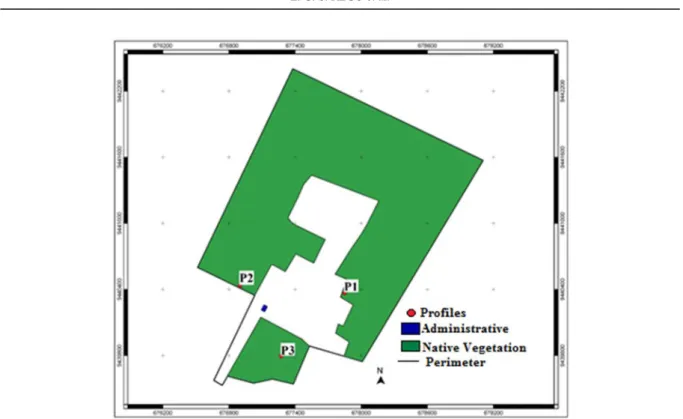
Table 1. Location of the described soil profiles
Profiles Coordinates Altitude
Profile 1 (P1) 5º 3’ 39,8’’ S e 37° 23’ 44,6” O 78 m Profile 2 (P2) 5° 3’ 37,7” S e 37° 24’ 15,4” O 90 m
Figure 1. Map of location of soil profiles of experimental farm "Rafael fernandes".
Physical analyzes of the ADGS were performed with three replications. The granulometry was evaluated by the pipette method, according to Donagema et al. (2011).
Chemical analyzes of the ADGS were carried out with three replications, evaluating the pH in water and KCl (1:2.5), P-available extracted with
Mehlich-1 and determined by colorimetry, Ca2+ and
Mg2+ extracted with KCl 1 mol L-1 and determined by atomic absorption spectrophotometry, K+
extracted with Mehlich-1 and determined by flame
spectrophotometry, exchangeable Al3+ extracted with
KCl 1 mol L-1 and determined by titration, and H + Al extracted with calcium acetate 1 mol L-1 and determined by titration with NaOH 0.025 mol L-1. The total organic carbon (TOC) was determined by the method proposed by Yeomans and Bremner (1988). These analyzes provided the indices of cation exchange capacity at pH 7.0 (T), base saturation (V%) and exchangeable aluminum saturation (m%) (DONAGEMA et al., 2011). Fe was extracted by sulfuric digestion according to the methodology proposed by Vettori (1969), and determined by atomic absorption spectrophotometry.
The mineralogical characterization was carried out by separating the granulometric fractions (Donagema et al., 2011), using only the clay fraction. The identification of the minerals in this granulometric fraction was carried out by X-ray
diffractometry (XRD) using a diffractometer (SHIMADZU XRD–6100) and applying the kα1 emission of cooper. The source potential used was 40 kV and the electric current was 30 mA. The scan rate applied was 0.02º per second. Scanning range (2θ) was 5 to 70°. The identification of peaks was
performed with the software X-ray 1.0.0.37 and the
minerals were identified according to Chen (1977).
RESULTS AND DISCUSSION
The morphological, physical, chemical and mineralogical characteristics of the soil profiles evaluated showed the influence of the formation factors parent material and relief in the pedogenic processes, which generated more developed soils, even under their semiarid climatic conditions; expressed by chemical weathering processes, consequently forming more resistant clay minerals. Three main soil types were found in the experimental farm, which were classified up to the 4th categorical
level: Typic Rhodustults (P1), Rhodic Haplustox (P2) and Typic Plinthustalfs (P3), which are formations from the pedogenic processes of podzolization, desilication and laterization, respectively.
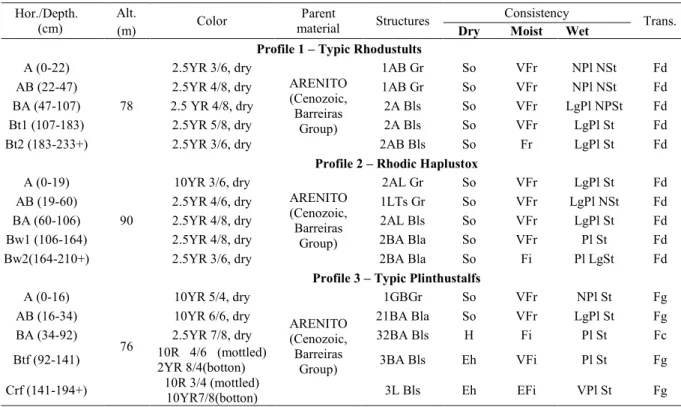
The morphological attributes had distinct pedogenic characteristics in the studied profiles. P1 showed structures that remains granular in the surface horizons, and changes to subangular blocks in its subsurface horizons due to clay translocation, which changes its structure type (Table 2). The main pedogenic process of the P2 and P3 was not podzolization, however, they also had an increased clay in the subsurface, which classified the P2 in the argisolic sub-group (4th categorical level), and the P3
in the Argiluvic sub-order (2nd categorical level).
Rev. Caatinga
accumulation, its plasticity and stickiness were changed, especially in the subsurface horizons. The wet consistency in P2 indicated plasticity and tackiness from the surface to the deepest horizons, showing that the desilication significantly alters inorganic compounds, forming more stable clay mineral (clay 1:1 and Fe oxides and Al oxides) from the first centimeters of the soil, making the Oxisol characterized by a homogeneity of horizons.
A marked change in consistency was found in the P3, especially in the plinthic horizon, with hard, very hard and extremely hard consistencies, both in dry and wet soils, due to the presence of plinthite, which are formed from the weathering of rocks rich in Fe. The accumulation of Fe oxides, which forms the plinthite, can be identified by a red, yellow-red or
dark red mottled material, (SANTOS et al., 2013 b). These mottled material indicate the occurrence of alternating cycles of wetting and drying, that significantly express the geochemical conditions to which the P3 profile is subjected, which is also
confirmed by the clear transition between the BA and the Btf horizon. This profile was the only one that had no diffuse transition.
Regarding the parent material, the experimental farm is located over sandstones of the Cenozoic age, known as sediments of the Barreiras Group. The reddish color of the studied soils, with hue of 2.5 YR in most horizons of the P1 and P2 profiles (Table 2) can be explained by the presence of Fe oxides. The color of the P3 differed from the other profiles, with yellowish color mottled material in the surface and intense reddish in the Btf horizon, probably due to the influence of the slightly relief difference of this area, whose altitude is lower compared to the other profiles (Table 2). This lower area may have cyclically accumulated more water, making the environment periodically hydromorphic, segregating the Fe in the subsurface, which is confirmed by the intense presence of plinthite from the depth of 90 cm.
Table 2. Morphological attributes of soil profiles of an Experimental Farm "Rafael fernandes" in Mossoró.
Structures: 1 – weark; 2 – moderate; 3 – strong; Ts: too smal; L: little; A: average; B: big; Gr: granular; Bla: angular blocks; Bls: subangular blocks. Consistency: So: softly; Eh: extremely hard; H: hard; Vh: Very hard; VFi: Very firm; Fr: friable; Fi - firm; EFi: Extremely Firm; N: No; V: Very; Lg: lightly; Pl: plastic; St: Sticky. Transition: F: flat; d: diffuse; c: clear; g: gradual.
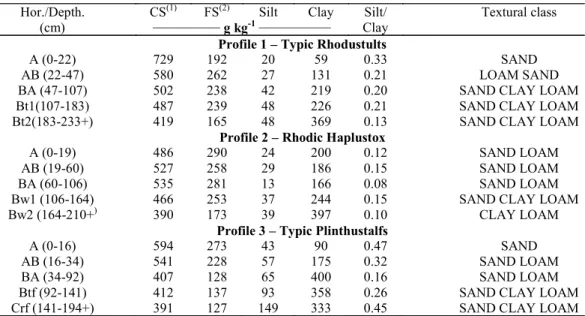
The granulometric composition of the P1 showed sandy and loamy sand textures in the surface horizons, and sandy clay loam texture in the subsurface; P2 showed sandy loam texture in the surface horizons, and sandy clay loam and sandy clay in the subsurface; and P3 showed textures
varying from sandy to sandy loam in the surface, and sandy clay loam texture in the subsurface (Table 3). These compositions contributed to identify the pedogenic processes that occurred in the profiles by understanding the vertical movement of the thinner material that generated more clayey textures in the
Hor./Depth. (cm)
Alt.
Color Parent
material Structures
Consistency
Trans.
(m) Dry Moist Wet
Profile 1 – Typic Rhodustults
A (0-22)
78
2.5YR 3/6, dry
ARENITO (Cenozoic, Barreiras
Group)
1AB Gr So VFr NPl NSt Fd
AB (22-47) 2.5YR 4/8, dry 1AB Gr So VFr NPl NSt Fd
BA (47-107) 2.5 YR 4/8, dry 2A Bls So VFr LgPl NPSt Fd
Bt1 (107-183) 2.5YR 5/8, dry 2A Bls So VFr LgPl St Fd
Bt2 (183-233+) 2.5YR 3/6, dry 2AB Bls So Fr LgPl St Fd
Profile 2 – Rhodic Haplustox
A (0-19)
90
10YR 3/6, dry
ARENITO (Cenozoic, Barreiras
Group)
2AL Gr So VFr LgPl St Fd
AB (19-60) 2.5YR 4/6, dry 1LTs Gr So VFr LgPl NSt Fd
BA (60-106) 2.5YR 4/8, dry 2AL Bls So VFr LgPl St Fd
Bw1 (106-164) 2.5YR 4/8, dry 2BA Bla So VFr Pl St Fd
Bw2(164-210+) 2.5YR 3/6, dry 2BA Bla So Fi Pl LgSt Fd
Profile 3 – Typic Plinthustalfs
A (0-16)
76
10YR 5/4, dry
ARENITO (Cenozoic, Barreiras
Group)
1GBGr So VFr NPl St Fg
AB (16-34) 10YR 6/6, dry 21BA Bla So VFr LgPl St Fg
BA (34-92) 2.5YR 7/8, dry 32BA Bls H Fi Pl St Fc
Btf (92-141) 10R 4/6 (mottled)
2YR 8/4(botton) 3BA Bls Eh VFi Pl St Fg
Crf (141-194+) 10R 3/4 (mottled)
subsurface and sandier textures in the surface, even in the P2, whose predominant process was desilication. The silt-to-clay ratio, used as an
indicator of soil weathering stage, was lower than 1 in all profiles, indicating very weathered soils.
Table 3. Physical attributes of soil profiles of an Experimental Farm "Rafael fernandes" in Mossoró.
Hor./Depth. CS(1) FS(2) Silt Clay Silt/ Textural class (cm) _______________
g kg-1________________ Clay
Profile 1 – Typic Rhodustults
A (0-22) 729 192 20 59 0.33 SAND
AB (22-47) 580 262 27 131 0.21 LOAM SAND
BA (47-107) 502 238 42 219 0.20 SAND CLAY LOAM
Bt1(107-183) 487 239 48 226 0.21 SAND CLAY LOAM
Bt2(183-233+) 419 165 48 369 0.13 SAND CLAY LOAM
Profile 2 – Rhodic Haplustox
A (0-19) 486 290 24 200 0.12 SAND LOAM
AB (19-60) 527 258 29 186 0.15 SAND LOAM
BA (60-106) 535 281 13 166 0.08 SAND LOAM
Bw1 (106-164) 466 253 37 244 0.15 SAND CLAY LOAM
Bw2 (164-210+) 390 173 39 397 0.10 CLAY LOAM
Profile 3 – Typic Plinthustalfs
A (0-16) 594 273 43 90 0.47 SAND
AB (16-34) 541 228 57 175 0.32 SAND LOAM
BA (34-92) 407 128 65 400 0.16 SAND LOAM
Btf (92-141) 412 137 93 358 0.26 SAND CLAY LOAM
Crf (141-194+) 391 127 149 333 0.45 SAND CLAY LOAM
1Coarse sand; 2Fine sand.
The profiles showed acid reaction in all horizons evaluated (Table 4). The pH in KCl were lower than the pH in H2O, resulting in a negative
ΔpH in all profiles, indicating a predominance of negative charges on the colloid surfaces. The total organic carbon (TOC) contents were relatively low in all profiles and horizons (Table 4), due to the semiarid climate, little primary biomass and low and irregular precipitation, which make the plant material decomposition a fast process.
P1 and P2 showed low base saturation (V<50%) in the subsurface horizons, denoting its dystrophic character, while P3 showed high base saturation (V>50%), denoting its eutrophic character (Table 4). Soil from quartz sandstones tend to have little bases, with low nutrient reserves, especially under humid climates, in which the material permeability favors the leaching (KAMPF; CURI, 2009). All soil profiles showed aluminum content below the amount established by the Brazilian System of Soil Classification to characterize them as aluminc or alitic, however, they presented high acidity potential, with low soil pH, especially in the P2. Kampf and Curi (2009) reported that negative charges of clay mineral surfaces are compensated by H+ and Al3+, in a base leaching condition caused by
weathering.
The Fe2O3 contents found by sulfuric
digestion (Table 4) confirmed the richness of Fe oxides in the soils, especially in horizons Btf (46.6 g kg-1) and Crf (62.1 g kg-1) of the P3, which showed the highest content of Fe2O3, due to its wetting and
drying cycles that caused Fe segregation and consequently, Fe accumulation in subsurface horizons.
The mineralogical composition of the clay fraction of the studied profiles showed that the soils are, basically, kaolinitic-oxidic. In general, the
minerals found were similar in all profiles, even in soils that underwent different pedogenic processes. The soil mineralogy is directly connected to the parent material composition, therefore, the fact that all soil profiles described had the same parent material (Table 2) explains this mineral similarity.
The three soil profiles showed well-defined
peaks of kaolinite (Kt) (Figure 2), showing a more advanced level of crystallization, which is normal for sediments of soils of the Barreiras Group, due to the intense weathering that the parent material underwent and climatic conditions (MELO et al., 2001). Illite (Il) was found in all profiles, indicating that these soils also have less-weathered minerals,
which can be explained by the climatic factor and because illite is a partially expansive, 2:1 mineral.
Goethite (Gt) and hematite (Hm) were found in P1 and P2, with different peaks (Figure 2), explaining the reddish color of these soils. Fe oxides are the main pigment agents in many tropical soils, compared to other mineral groups, regardless of their
concentration (MELLO; ALLEONI, 2009).
However, less-defined peak formations were found
Rev. Caatinga
Table 4. Chemical attributes of soil profiles of an Experimental Farm "Rafael fernandes" in Mossoró.
(1)TOC – Total organic carbon; (2) T – Cation exchange capacity; V – Base saturation.
Figure 2. X-ray diffractometry (XRD) the clay fraction profiles of diagnostics horizons in: Typic Rhodustults (P1); Rhodic Haplustox (P2) e Typic Plinthustalfs (P3). Ct: kaolinite; Il: Illite; Gt: Goethite; Hm: Hematite.
Hor. pH pH ∆pH TOC K+ Ca2+ Mg2+ Al3+ (H+Al) T P V m Fe2O3
(H2O) (KCl) g kg
-1 __________________
cmolc kg-1__________________ mg kg-1 ______(%)______ g kg-1
Profile 1 – Typic Rhodustults
A 4.5 3.1 -0.8 17.6 0.1 0.3 0.2 0.2 2.7 3.2 3.0 17 23 8.1
AB 4.6 3.6 -0.1 6.8 0 0.8 0.2 0.4 3.3 4.3 2.6 24 26 1.2
BA 3.6 3.7 -0.9 4.0 0 0.8 0.3 0.4 2.9 4.3 2.8 29 26 30.5
Bt1 3.8 3.6 -0.2 2.5 0 0.6 0.3 0.4 2.6 3.1 2.3 29 30 28.9
Bt2 3.6 3.8 -0.2 1.4 0.1 0.6 0.3 0.8 2.6 3.5 2.7 27 46 43.1
Profile 2 – RHODIC HAPLUSTOX
A 4.0 3.5 -0.5 4.7 0.1 3.8 0.1 0.8 5.4 9.2 2.5 42 17 22.9
AB 4.6 3.7 -0.8 3.3 0.1 1.8 0.2 0.7 5.2 7.2 2.5 28 26 22.8
BA 4,6 3.8 -0.8 2.9 0.1 0.8 0.1 0.7 5.0 5.8 1.9 15 45 29.7
Bw1 4.3 3.7 -0.6 2.9 0 2.7 0.4 0.8 5.0 8.1 2.3 39 20 29.2
Bw2 4,6 3.8 -0.7 2.7 0.1 1.4 0.4 1.0 5.6 7.4 2.6 26 36 44.9
Profile 3 – Typic Plinthustalfs
A 4.9 3.9 -1.0 8.4 0.1 1.3 0.4 0.8 0.3 2.1 0.7 84 31 10.3
AB 4.5 3.8 -0.7 5.8 0.2 1.0 0.4 1.0 0.4 1.9 1.4 80 39 16.7
BA 4.6 3.8 -0.5 5.3 0.1 1.1 0.4 1.4 0.5 2.1 0.9 78 46 37.7
Btf 4.3 4.0 -0.6 4.3 0 0.8 0.3 0.5 0.4 1.6 1.7 77 29 46.6
CONCLUSIONS
The morphological, physical, chemical and mineralogical characteristics of the soil profiles evaluated showed the influence of the formation factors paternal material and relief in the pedogenic processes, which generated more developed soils, even under their semiarid climatic conditions. The three soil types found in the studied experimental farm were Typic Rhodustults (P1), Rhodic Haplustox (P2) and Typic Plinthustalfs (P3). The profiles showed, in general, a structure that remains granular in the surface horizons and changes to sub-angular blocks in the subsurface horizons. The
textures found in the soil profiles showed surface horizons with sandier texture and subsurface horizons with more clayey texture. The chemical attributes showed total organic carbon (TOC) contents relatively low, dystrophic character in P1 and P2 and eutrophic character in P3. The clay fraction of the soil profiles showed mineralogical composition with predominance of kaolinite, illite and presence of the Fe oxides goethite and hematite.
REFERENCES
CARMO FILHO, F.; OLIVEIRA, O. F. Mossoró: um município do semi-árido nordestino,
caracterização climática e aspecto florístico.
Mossoró: ESAM, 1995. 62 p. (Coleção Mossoroense, Série B).
CHEN, P.Y. Table of key lines in X-ray powder
diffraction patterns of minerals in clays and associated rocks: Geological Survey Occasional Paper 21. Bloomington: Indiana Geological Survey Report. 1977. v. 3, p. 67.
DONAGEMA, G. K. et al. Manual de métodos de análise de solos. Rio de Janeiro: Embrapa Solos, 2011. v. 2, p. 230, (Embrapa Solos. Documentos, 132).
KAMPF, N.; CURI, N. Formação e Evolução do Solo: Pedogênese. In: KER, J.C.; CURI, N.; SCHAEFER, C.E.R. & TORRADO, P.V., eds.
Pedologia: Fundamentos. Viçosa, MG: Sociedade Brasileira de Ciência do Solo, 2009. v. 1 cap. 7, p. 207-302.
MELO, V.F.; SINGH, B.; SCHAEFER, C.E.G.R.; NOVAIS, R.F.; FONTES, M.P.F. Chemical and mineralogical properties of kaolinite-rich Brazilian
soils. Soil Science Society of America Journal, Madison, v. 65, n. 4, p. 1324-1334, 2001.
MELLO, V. F.; ALLEONI, L. R. F., Química e Mineralogia do Solo, parte 1: Óxidos de ferro. ed. 1
Viçosa, MG: Sociedade Brasileira de Ciência do Solo, 2009. p. 695.
PROJETO RADAMBRASIL. Levantamento de
Recursos Naturais. ed. 23, Folhas SB.24/25
Jaguaribe/ Natal. Rio de Janeiro: Ministério das Minas e Energia, 1981. p. 739.
RESENDE, M.; Curi, N., Rezende, S.B. & CORRÊA, G.F. Pedologia: base para distinção de ambientes. Lavras, MG: Editora UFLA, 2014. v. 6,
Cap. 5, p. 109-147.
SANTOS, H. G. et al. Sistema brasileiro de classificação de solos. 3. ed. Brasília: Embrapa, 2013b. p. 353.
SANTOS, R. D. et al. Manual de descrição e coleta de solo no campo. 6. ed. Viçosa: Sociedade
Brasileira de Ciência do Solo, 2013a. p. 100.
SERVIÇO GEOLÓGICO DO BRASIL – CPRM.
Geodiversidade do estado do Rio Grande do Norte. Recife, 2010. p. 227.
SERVIÇO NACIONAL DE LEVANTAMENTO E
CONSERVAÇÃO DE SOLOS-EMBRAPA.
Levantamento Exploratório – Reconhecimento de solos Rio Grande do Norte (Área de atuação da SUDENE), Boletim Técnico nº 60. Recife, 1971. 531 p.
VETTORI, L. Métodos de análise de solo.(Boletim
Tecnico.7).Rio de Janeiro: Equipe de Pedologia e Fertilidade do Solo, 1969. p. 34.
YEOMANS, J. C., BREMNER, J. M. A rapid and precise method for routine determination of carbon in soil. Communications in Soil Science and Plant Analysis, Nova Iorque, v. 19, n. 13, p. 1467-1476,