UNIVERSIDADE DE LISBOA
FACULDADE DE PSICOLOGIA
GENERALIZATION OF AVERSIVE MEMORIES:
PROBING THE INFLUENCE OF STIMULUS TYPE AND
SLEEP
Marta Filipa de Oliveira e Pereira
MESTRADO INTEGRADO EM PSICOLOGIA
Área de Especialização em Cognição Social Aplicada
UNIVERSIDADE DE LISBOA
FACULDADE DE PSICOLOGIA
TÍTULO DA DISSERTAÇÃO DE MESTRADO
Nome do Candidato
MESTRADO INTEGRADO EM PSICOLOGIA
Área de Especialização em [designação da área de especialização]
Ano
UNIVERSIDADE DE LISBOA
FACULDADE DE PSICOLOGIA
GENERALIZATION OF AVERSIVE MEMORIES:
PROBING THE INFLUENCE OF STIMULUS TYPE AND
SLEEP
Marta Filipa de Oliveira e Pereira
Dissertação orientada pela Professora Doutora Ana P. Pinheiro e Professora Doutora Ana Luísa Raposo
MESTRADO INTEGRADO EM PSICOLOGIA
Área de Especialização em Cognição Social Aplicada
Acknowledgments (in Portuguese)
Nos próximos parágrafos, gostaria de agradecer a todos aqueles sem os quais a
conclusão deste trabalho não seria possível. Os momentos que partilhámos ficarão
guardados na minha memória, de uma forma particularmente vívida e precisa. Agradeço…
Às minhas orientadoras, Professora Doutora Ana P. Pinheiro e Professora Doutora
Ana Luísa Raposo, por me acolherem neste projeto e por confiaram em mim desde o
primeiro dia. Por me guiarem ao longo deste percurso e incentivarem a fazer mais e
melhor. Por todo o apoio nos momentos de maior frustração. E, principalmente, por serem
um exemplo de trabalho, de dedicação e de entusiasmo pela investigação.
A todos os colegas do Voice, Affect and Speech Lab, por todo o incentivo ao
longo deste ano. Um agradecimento especial à Maria Amorim pelos conselhos preciosos
no início da fase de escrita.
Ao Miguel Domingues e ao João Delgado, por todo o apoio e por terem sempre
uma palavra amiga, principalmente no período de recolha de dados.
A todos os participantes deste estudo, que disponibilizaram o seu tempo para o
avançar do conhecimento científico.
À Ana, à Inês e à Mariana, as minhas companheiras nestes últimos 5 anos. Por
toda a ajuda, todos os conselhos, pela motivação e disponibilidade constantes. No fundo,
Aos meus pais, por todo o amor, pela presença constante e apoio incondicional.
Obrigada por acreditarem sempre. À minha irmã, por tentar sempre compreender e me
ajudar a encontrar a solução. À minha avó Lila, pelo carinho e incentivo nesta caminhada.
Ao meu sobrinho, ainda tão pequenino, por alegrar as tardes de escrita com a sua
gargalhada. A toda a minha família, por serem a base que me permitiu chegar até aqui.
Por fim, ao meu João, por ser a maior fonte de motivação e inspiração. Por ter a
capacidade de me transmitir serenidade nos momentos mais difíceis. Por me apoiar
Abstract
Previous studies suggested that an emotional learning experience, based on Pavlovian conditioning, enhances memory for the conditioned stimuli (Dunsmoor et al., 2015; Oyarzún et al., 2016; Patil et al., 2017). Critically, that memory improvement can be generalized for conceptually related neutral stimuli presented before (retroactive effect; Dunsmoor et al., 2015; Patil et al., 2017) and after (proactive effect; Dunsmoor et al., 2015; Oyarzún et al., 2016) the experience. However, the occurrence of these effects is not consistent across studies; it appears to depend on the specific experience that induces the memory enhancement. Still, it is not clear if the differences rely on the nature of the emotional experience – aversive or rewarding – or if the specific emotional stimulus used to create the experience is the promoter. Besides, although both proactive and retroactive effects seem to depend on a period of consolidation, Dunsmoor et al. (2015) suggested that the proactive effect, mediated by an aversive learning experience, might be dependent on sleep. With the aim of unravelling these questions, the present study replicated that procedure followed by Dunsmoor et al. (2015). However, while the authors administrated an electric shock to create the aversive experience, in the present study an environmental naturally aversive sound was used. It was found that the memory enhancement for pictures conditioned with the aversive sound was not generalized to previously stored conceptually related items but was generalized to subsequently presented pictures. However, this later proactive effect, although dependent on a period of consolidation, did not occur in a memory test performed after a night of sleep. Therefore, the study demonstrates that the generalization of enhanced emotional memory is modulated by the specific stimulus used to create the aversive experience. It also suggests that sleep promotes a memory pruning, in which less important memories are not further strengthened.
Keywords: emotional memory, episodic memory; fear conditioning, aversive sound; sleep, consolidation
Resumo Alargado
As memórias episódicas referentes a eventos emocionais são recordadas de forma mais precisa e vívida do que memórias neutras (Bradley et al., 1992; Cahill & McGaugh, 1998; Kensinger & Corkin, 2003; Sharot & Phelps, 2004). Este fenómeno parece ocorrer, principalmente, por ação do grau de ativação fisiológica provocado pela experiência emocional. De acordo com esta hipótese, a ativação emocional origina a libertação de hormonas de stress (cortisol e adrenalina) que levam à ativação da amígdala. Através de projeções desta região cerebral para outras envolvidas no processamento da memória, como o complexo hipocampal, a amígdala teria um papel modulatório na consolidação das memórias emocionais (Cahill & McGaugh, 1998; McGaugh, 2000, 2004, 2018). De facto, estudos de neuroimagem sugerem que a atividade da amígdala durante a codificação de estímulos emocionais correlaciona-se com a atividade do hipocampo (Hamann et al, 1999) e com a memória subquente para esses estímulos (Cahill et al., 1996; Canli et al., 2000; Hamann et al, 1999). Para alem disso, uma vez que o processo de consolidação ocorre gradualmente ao longo tempo (McGaugh, 2000; Squire & Alvarez, 1995), o facto de o efeito das experiências emocionais na memória aumentarem com o tempo parece corroborar a referida hipótese (Kleinsmith & Kaplan, 1963; LaBar & Phelps, 1998; Sharot & Phelps, 2004). Assim, a existência de mecanismos específicos para a consolidação de memórias emocionais parece corresponder a uma explicação parcimoniosa para a vantagem mnésica dos eventos emocionais. No entanto, estes também podem ser explicados pela influência de outros fatores cognitivos na codificação. Por exemplo, em comparação com estímulos neutros, os eventos emocionais são mais distintivos, podendo captar mais recursos atencionais; partilham, por norma, uma organização temática mais forte, que pode funcionar como um esquema para facilitar a codificação; e podem originar um processamento mais elaborado (Talmi, 2013). Estas características, apesar de não serem específicas para estímulos emocionais, podem facilitar a sua codificação, potenciando a memória. Assim, não é claro se o benefício mnésico para estímulos emocionais se deve a um efeito do grau de ativação na consolidação das memórias ou se está relacionado com outras características, que embora não sendo específicas para estímulos emocionais, facilitam a codificação. Uma forma de clarificar esta questão, seria recorrer a um procedimento em que se atribuiria saliência emocional a um estímulo que de outra forma seria neutro (Dunsmoor & Kroes, 2019). Se posteriormente a memória para esse estímulo fosse superior à de outros a que não se
atribuiu relevância, tal não poderia ser explicado pelas características intrínsecas do estímulo. Isto é, os estímulos neutros não possuem, por exemplo, as características mais distintivas associadas aos materiais emocionais. Desta forma, seria possível argumentar a favor de um efeito específico da emoção na melhoria da memória para informação neutra que adquire saliência emocional. O condicionamento aversivo surge como um possível procedimento a partir do qual um evento neutro (i.e., estímulo condicionado), ao ser emparelhado com um evento aversivo (i.e., estímulo não-condicionado) adquire saliência emocional (refletida na resposta condicionada; LeDoux, 2000).
Dunsmoor e colaboradores (2012) desenharam uma tarefa de condicionamento aversivo, em que eram apresentadas aos participantes imagens de duas categorias de objetos. As imagens de uma categoria eram emparelhadas com um choque elétrico (categoria CS+) enquanto as de outra categoria não o eram (categoria CS-). Posteriormente, os autores verificaram que a memória das imagens da categoria CS+ era superior à memória das imagens da categoria CS-. Com o objetivo de explorar se este efeito na memória era generalizado para imagens conceptualmente semelhantes, não diretamente associadas ao condicionamento, a mesma equipa apresentou outras imagens das mesmas categorias numa fase anterior e posterior à aprendizagem emocional (Dunsmoor et al., 2015). Verificaram que o aumento da memória para itens da categoria CS+ vs. CS-, observado na fase de condicionamento, era generalizado para as imagens apresentadas antes (i.e., efeito retroativo) e após (i.e., efeito proativo) o condicionamento. Ambos os efeitos mostraram depender de um período de consolidação, uma vez que não foram observados num grupo que realizava o teste de memória imediatamente após a codificação. O efeito retroativo, em particular, sugere que o aumento da memória emocional deverá, de facto, relacionar-se com mecanismos de consolidação mediados pela emoção. Uma melhor memória para estímulos CS+ apresentados antes do condicionamento, em comparação com itens CS-, não pode ser explicada por um viés no momento de codificação. No entanto, o efeito proativo foi apenas observado num grupo que realizava o teste após uma noite de sono. Diversos estudos sugerem que as memórias emocionais são potenciadas após um período de tempo que envolve sono, em comparação com um mesmo período de tempo em que se permanece acordado (Hu et al., 2006; Nishida et al., 2009; Payne et al., 2008; Wagner et al., 2001). O sono parece, assim, ter um papel importante na consolidação de memórias emocionais. Os resultados relativos aos efeitos proativos indicam que poderá, também, ser importante na generalização das memórias emocionais.
No entanto, quando os efeitos proativos e retroativos foram explorados por ação de uma experiência emocional recompensadora, ao invés de aversiva, o padrão de resultados mostrou-se distinto (Oyarzún et al., 2016; Patil et al., 2017). Assim, surge a questão de se estes efeitos são dependentes da natureza da experiência emocional (aversiva vs. recompensadora) ou se estão relacionados com o tipo específico de estímulo utilizado para criar a experiência. Com o objetivo de responder a esta questão, o presente estudo replicou o procedimento seguido por Dunsmoor et al. (2015), em que se explorou os efeitos de uma experiência de aprendizagem aversiva nos efeitos de memória. No entanto, enquanto os autores utilizaram um choque elétrico para criar a experiência aversiva, no presente estudo utilizou-se um som ambiental naturalmente aversivo, especificamente a gravação de um garfo a raspar numa travessa de alumínio, com duração de 1 segundo. A diferença entre os estímulos reside no facto de representarem modalidades sensoriais distintas (somatossensorial vs. auditiva) e de apresentarem graus de intensidade também distintos (o choque elétrico tem uma intensidade elevada, enquanto o som tem um nível de intensidade normal para estímulos ambientais).
Os participantes codificaram incidentalmente imagens de duas categorias de objetos (animais e utensílios), em três fases consecutivas (pré-condicionamento, condicionamento e pós-condicionamento). Na fase de condicionamento uma das categorias foi parcialmente emparelhada com o som aversivo. Nas fases de pré e pós-condicionamento, o som não era apresentado. Imediatamente, 6 horas ou 24 horas após a codificação, os participantes realizaram um teste de reconhecimento surpresa, em que eram apresentadas as imagens que visualizaram nas três fases de codificação e outras imagens novas. A existência dos três grupos de retenção permitiu comparar os resultados no teste de memória após um período de consolidação com e sem sono.
Verificou-se que os estímulos da categoria CS+, apresentados durante a fase de condicionamento, foram reconhecidos de forma mais precisa do que os da categoria CS-, mas apenas quando o teste de memória ocorreu após um período de retenção (6 ou 24 horas). Este resultado apoia a hipótese de que o benefício da memória emocional ocorre, sobretudo, por mecanismos associados à consolidação. Notoriamente, esta melhoria na memória não foi generalizada para itens conceptualmente semelhantes apresentados na fase de pré-condicionamento, isto é, não foi observado um efeito retroativo. No entanto, ocorreu generalização para as imagens apresentadas na fase de pós-condicionamento, isto é, um efeito proativo. Contudo, este último efeito, apesar de ser dependente de um período de consolidação (i.e., foi observado no grupo que realizava o teste 6 horas após a
codificação, mas não no grupo que o realizava de imediato), não foi observado no grupo que realizava o teste 24 horas após a codificação, ou seja, após uma noite de sono. Estes resultados diferem dos reportados por Dunsmoor et al. (2015).
Assim, o presente estudo demonstra que os efeitos de generalização do aumento da memória emocional são modulados pelo estímulo específico utilizado para criar a experiência aversiva. Adicionalmente, os resultados relativos aos efeitos proativos sugerem que o sono promove um aprimoramento da memória, em que eventos não tão importantes (i.e., não diretamente associados a um contexto aversivo) não continuam a ter uma vantagem mnésica.
Palavras-chave: memória emocional, memória episódica, condicionamento aversivo, som aversivo, sono, consolidação
Contents
Introduction ... 1
Episodic emotional memory ... 1
Using fear conditioning to explore episodic emotional memory ... 3
Generalization of emotional memory enhancement: proactive and retroactive effects . 5 Benefits of sleep on emotional memory ... 6
Different emotional experiences, different memory effects? ... 7
Different aversive stimuli, different memory effects? ... 9
The current study: goals, hypothesis and relevance ... 10
Method ... 11
Participants ... 11
Materials ... 12
Pictures. ... 12
Aversive Sound. ... 12
Scales and Questionnaires. ... 14
Experimental Design ... 15
Procedure ... 15
Incidental-encoding session ... 16
Recognition memory test ... 19
Statistical analyses ... 20
Results ... 21
Encoding tasks ... 21
Recognition memory test ... 21
Discussion ... 24
Relevance and limitations of the present study ... 28
Future directions ... 29
1 Introduction
Episodic emotional memory
Emotions are a constant presence in meaningful events of our daily lives. They are present when we succeed in publishing an important manuscript, when we stumble on the sidewalk while everyone is watching, when the neighbours’ angry dog runs towards us and even when we eat a delicious ice-cream. Remembering these events might help us in guiding our future behaviour. Consequently, from an evolutionary perspective, it would not be surprising if memory systems were biased towards remembering emotional experiences. The effects of emotion on memory have been largely studied within the context of declarative memory research, with an emphasis on episodic memory.
Declarative memory is “the kind of memory that is meant when the term ‘‘memory’’ is used in everyday language” (Squire, 2004, p. 173). It is a long-term memory system that involves conscious recollection of facts and events (Eysenck & Keane, 2010; Squire, 2004). Tulving (1972) argued that declarative memory might be separated into episodic and semantic memory systems. Semantic memory refers to our general knowledge about facts and concepts (e.g., knowing that a hammer is a tool), while episodic memory is concerned with knowledge of the contextual and temporal details of past events (e.g., yesterday I used a hammer to drive a nail; Tulving, 2002). When those events have an emotional tone (e.g., I dropped a hammer on my toe), a typical finding is that the emotional episodic memory is enhanced when compared to memories for neutral events. Laboratory studies have supported this effect, by demonstrating that emotional stimuli are remembered more accurately (e.g., Sharot & Phelps, 2004), with more vivid details (e.g., Kensinger & Corkin, 2003) or in higher proportion (e.g., Bradley, Greenwald, Petry, & Lang, 1992) than neutral ones.
Emotional stimuli are often characterized along two orthogonal affective dimensions: valence and arousal (Lang, Greenwald, Bradley, & Hamm, 1993; Russell, 1980). Valence refers to the pleasantness of a stimulus and varies from unpleasant (negative) to pleasant (positive), whereas arousal refers to the degree of activation a person feels towards a stimulus and varies from calm to excitement. Although both dimensions seem to influence emotional memory (Kensinger, 2004), arousal appears to play a more critical role in the memory improvement observed for emotional materials (Bradley et al., 1992; Hamann, Ely, Grafton, & Kilts, 1999; Kensinger & Corkin, 2003).
2 This memory enhancement can be explained, at least in part, by hormonal (Cahill & McGaugh, 1998) and neural (Hamann, 2001) mechanisms engaged specifically by emotionally arousing stimuli. Studies with rodents have suggested that stress hormones, such as epinephrine and corticosterone (cortisol in humans), released by arousing experiences, play a critical role in memory enhancement for emotionally arousing stimuli, by mediation of the amygdala (for review, see McGaugh, 2004). In a chain of events, stress hormones activate adrenergic receptors in the amygdala that, through its efferent projections to other brain regions involved in memory processing, such as the hippocampal complex, modulate the consolidation of emotional memories (Cahill & McGaugh, 1998; McGaugh, 2000, 2004, 2018). Human studies are consistent with these findings (for a review, see McGaugh, 2004). For example, post-learning administration of epinephrine enhanced memory in human participants (Cahill & Alkire, 2003). Conversely, administration of a β-adrenergic blocker impaired memory for emotional materials, but not for non-emotional materials (Cahill, Prins, Weber, & McGaugh, 1994). However, the major findings concerning these effects in human research are not directly related to the specific influence of hormonal mechanisms, but to the role of the amygdala in modulating emotional memory consolidation. Neuroimaging studies have demonstrated that activation of the amygdala during encoding correlates with hippocampal activation (Hamann et al., 1999) and with subsequent memory for emotional but not for non-emotional stimuli (Cahill et al., 1996; Canli et al., 2000; Hamann et al., 1999). This suggests that the amygdala enhances emotional episodic memory by modulating hippocampal-dependent consolidation processes (Hamann, 2001). Consolidation is the process through which recently acquired labile memories become stable and resistant to disruption in long term-memory (Eysenck & Keane, 2010; Phelps, 2004). The hippocampus seems to play a critical role in memory consolidation (Squire & Alvarez, 1995). However, this process appears to involve several stages that occur gradually over time (McGaugh, 2000; Squire & Alvarez, 1995). Therefore, although the exact duration of consolidation is not well defined (Hamann, 2001), the arousal effects on memory should increase over time. Indeed, a common finding in emotional episodic memory research is that the emotional memory benefits are only observed, or are enhanced, in delayed memory tests (Kleinsmith & Kaplan, 1963; LaBar & Phelps, 1998; Sharot & Phelps, 2004).
Importantly, although the proposed mechanisms for emotional memories account for the observed enhanced memory effects, these effects can also be explained by the
3 influence of other cognitive factors, not specific for emotional materials, in encoding. For example, when compared to neutral stimuli, emotional events are more distinctive and thereby capture more attentional resources, usually share a closer thematic link that can work as a facilitating processing schema, and can elicit more elaborate processing (Talmi, 2013). These characteristics, although inherent, are not specific to emotional events in the same manner that arousal is. It is then difficult to disentangle if the memory advantage for emotional stimuli is mainly due to an emotion-mediated effect or if it is related to other characteristics of the stimuli, that albeit not specific to emotional materials, facilitate encoding. According to Dunsmoor and Kroes (2019), a procedure by which otherwise neutral information comes to acquire emotional salience would help to solve this problem. If memory for that seemingly neutral information is later enhanced, it cannot be explained by its intrinsic features (i.e., neutral materials, contrarily to emotional, do not have inherent characteristics that capture more attentional resources during encoding). Therefore, it would be possible to argue for a specific effect of emotion on the memory improvement for neutral information that becomes emotionally charged. Notwithstanding, emotional memory research might have a strong candidate to a procedure by which a neutral stimulus acquires affective properties: fear conditioning.
Using fear conditioning to explore episodic emotional memory
Fear (or aversive) conditioning is a form of Pavlovian conditioning that involves learning the association between a neutral stimulus and an aversive event (Maren, 2001). It represents a type of emotional learning within the non-declarative (implicit) memory domain (Squire & Zola, 1996) and its mechanisms are highly conserved across species (LeDoux, 2000; Lonsdorf et al., 2017; Maren, 2001).
Usually, in fear conditioning paradigms, a neutral stimulus – conditioned stimulus (CS) – is paired with an aversive stimulus – unconditioned stimulus (US) – during the acquisition phase (Lonsdorf et al., 2017). The latter has biological significance and produces, by itself, an automatic and defensive response – unconditioned response (UR) (LeDoux, 2000). After the CS-US association is learned, the CS alone will elicit a physiological and behavioural response similar to the UR – the conditioned response (CR) (LeDoux, 2000). The CR is a learned response because it would not be elicited by the CS before its association with the US. The CS can then serve as a cue to predict an aversive event (Dunsmoor & LaBar, 2013).
4 Different stimuli, from different modalities, can be used as CS and US (Lonsdorf et al., 2017). Sensory information about the CS and the US is transmitted to the amygdala (LeDoux, 2000; Maren, 2001). The amygdala is composed of several interconnected nuclei and receives multiple afferent projections from different brain regions, including sensory systems and higher order association cortices (LeDoux, 2000; Maren, 2001). The amygdala also has multiple efferent projections that might modulate information processing in other brain regions (Dunsmoor & LaBar, 2013), for example, the hippocampus, as discussed above. The central, basal, accessory basal and lateral nuclei of the amygdala are thought to be very important for fear conditioning (Dunsmoor & LaBar, 2013; LeDoux, 2000). The last three are often referred to as the basolateral complex: it integrates information from different domains and is thought to be the receiving site for US and CS sensory information, being engaged in the learning of its association. The central nuclei receives projections from the basolateral complex and it is through its efferent projections to the brainstem and hypothalamus that the CR is initiated (Dunsmoor & LaBar, 2013; LeDoux, 2000; Maren, 2001).
The CR can take several forms, such as a defensive behaviour (e.g. freezing, flight), an autonomic (e.g. heightened heart rate, blood pressure) or a reflex (fear-potentiated startle) response (LeDoux, 2000). Typically, in experiments with humans, the USs are not strong enough to elicit a behavioural defensive response for ethical reasons (Lonsdorf et al., 2017). Therefore, the effectiveness of fear conditioning is usually evaluated with psychophysiological measures of peripheral nervous system responses, such as the skin conductance response (SCR) and the fear-potentiated startle reflex (Lonsdorf et al., 2017). Nevertheless, other techniques, such as event-related potentials (ERP) of the electroencephalogram, might be useful to assess aversive conditioning in human participants (Bacigalupo & Luck, 2018).
In summary, fear conditioning represents a mechanism through which an otherwise neutral stimulus (CS) acquires affective properties, which is manifested in the CR (LeDoux, 2000). Thus, if memory for the CS is tested, in comparison with memory for a neutral stimulus not paired with the US, the specific effects of emotional arousal on memory can be examined. However, as highlighted by Dunsmoor and Kroes (2019), although episodic memories can be formed during fear conditioning tasks, these tasks tend to be low in cognitive demands. Usually, during the acquisition phase, a single CS is repeatedly paired with an US, whereas other stimuli that differ from the CS on a basic sensory feature (e.g., colour) are not paired with the US (e.g., Bacigalupo & Luck, 2018).
5 Thus, since only a single CS item is presented, it is difficult to assess how the conditioning mechanism alters the corresponding episodic memory strength. To overcome this difficulty, Dunsmoor, Martin and LaBar (2012) designed a fear conditioning task that increases the demands on episodic memory. The task involves a category-conditioning design, in which the CSs are trial-unique images from two semantic categories. One category (e.g., tool) is paired with the US (i.e., the CS+ category), and the other category (e.g., animal) is never paired with the US (i.e., the CS- category). Since each image is never repeated, each trial represents an isolated event that can remain neutral or acquire emotional salience through direct pairing with the US or through pairing of other examples of the same category with the US. Critically, it is possible to test memory for each trial and to explore differences between CS+ and CS- items (Dunsmoor & Kroes, 2019).
Using the category-conditioning design task, with an electric shock as US and partial CS+-US pairings (i.e., half CS+ were directly paired with the shock, half were not paired with the shock), Dunsmoor and collaborators (2012) found that recognition memory on a 24h-delayed test was enhanced for CS+ items regardless of whether a specific exemplar was paired with the shock. Thus, it was the association between the category and the US, and not the presence of the US itself, that contributed to the memory advantage. Since participants learned the contingencies of the CS-US association, the expectation of receiving the shock in CS+ items might have been enough to elicit physiological arousal (Dunsmoor et al., 2012). The memory enhancement cannot be explained by the stimulus intrinsic characteristics (e.g., thematic link), since the CS+ and CS- items were both basic level objects. However, the uncertainty of receiving the shock could also have enhanced attention to CS+ items (Dunsmoor et al., 2012). Therefore, attentional resources could also explain why CS+ items were more accurately remembered (Talmi, 2013).
Generalization of emotional memory enhancement: proactive and retroactive effects
After stablishing that an aversive learning experience enhanced memory for associated stimuli, Dunsmoor, Murty, Davachi and Phelps (2015) explored the extent to which these memory effects generalized to conceptually related items presented before or after the emotional experience. They presented items belonging to the CS+ and CS- categories before and after the conditioning phase. Comparing immediate, 6h-delayed
6 and 24h-delayed memory tests, they found a CS+ memory enhancement for items presented during conditioning, replicating the previous results (Dunsmoor et al., 2012). Critically, they also found a recognition memory enhancement for items of the CS+ category presented before and after fear conditioning, when no US presentation occurred. Thus, the selective memory enhancement for CS+ items was generalized to conceptually related neutral items presented before and after the US-CS association was learned. These findings support the arousal-mediated memory enhancement hypothesis (McGaugh, 2000, 2004), since the memory advantage for CS+ items presented before the learning of the CS-US association is not related to encoding demands, such as heightened attention. Importantly, this retroactive memory enhancement was only observed in the 6h and 24h-delayed memory tests and not in the immediate test, suggesting that it is dependent on a period of consolidation. However, the proactive memory enhancement only occurred after a 24h delay. This finding raises the question of whether an extended period of consolidation is required for the proactive memory advantage for CS+ items or if it reflects a mechanism of sleep-dependent consolidation.
Benefits of sleep on emotional memory
The beneficial role of sleep in memory has been widely studied (for a review, see Walker & Stickgold, 2006). In their seminal work, Jenkins and Dallenbach (1924) demonstrated that memory retention for nonsense syllables was improved following a period of sleep compared to after an equivalent amount of time awake, as assessed through free recall. At the time, the memory advantage was thought to result from a lack of sensory interference during sleep. Nowadays, it is acknowledged that the role of sleep in memory retention is an active process and that its underlying physiological mechanisms play a critical role in memory consolidation (Rasch & Born, 2013; Walker & Stickgold, 2006).
Sleep is thought to play a selective role in memory retention, determining which information is retained and which is forgotten (Stickgold & Walker, 2013). One example of this selectivity is the enhanced consolidation of emotional memories during sleep. For example, after an overnight 12h period with sleep, but not after an equivalent amount of daytime awake, an enhancement in recognition accuracy was observed for emotional pictures when compared to neutral ones (Hu, Stylos-Allan, & Walker, 2006). The same study demonstrated that the recognition accuracy for emotional pictures after a sleeping
7 period was enhanced when compared to recognition for emotional pictures after the same amount of time awake. Nonetheless, the specific contribution of sleep to emotional memory consolidation is not fully understood. There is evidence that the rapid eye movement (REM) phase of sleep might be particularly important for emotional memory consolidation (for a review, see Ackermann & Rasch, 2014). For example, memory for emotionally arousing text materials relative to neutral ones was enhanced after three hours of late night REM sleep, but not after an equivalent amount of time awake or in early night slow wave sleep (Wagner, Gais, & Born, 2001).
Given the importance of sleep in memory consolidation in general, and in emotional memory in particular, the possibility of the generalized emotion-mediated memory enhancement depending differently on sleep (Dunsmoor et al., 2015) is an intriguing one. However, sleep might not be the only factor influencing the memory advantage. Studies exploring the role of reward on generalization effects of emotional memory improvement suggest that the effects might not match those found when an aversive experience is used (Oyarzún, Packard, Diego-Balaguer, & Fuentemilla, 2016; Patil, Murty, Dunsmoor, Phelps, & Davachi, 2017). Thus, the nature (positive vs. negative) of the emotional learning experience also seems to be relevant for the memory enhancement effects.
Different emotional experiences, different memory effects?
The proactive and retroactive generalization of the memory enhancement observed for emotional stimuli might not be the same when a different emotional learning experience occurs. Oyarzún and collaborators (2016) used the category-conditioned design task (Dunsmoor et al., 2015) to explore if the retroactive and proactive memory enhancement for neutral stimuli is driven by motivated and appetitive encoding. Therefore, they used a monetary reward as US; instead of being paired with an electric shock, CS+ items were partially associated with the picture and sound of a coin. The authors found that recognition memory for pictures presented during conditioning phase was enhanced for CS+ items, in an immediate memory test and in a 24h-delayed test. They also found a CS+ enhancement for items presented after the conditioning phase, when no reward was provided – a proactive memory effect – but only in the 24h-delayed memory test, replicating the results of Dunsmoor et al. (2015). However, the authors did not observe a retroactive memory enhancement for CS+ items. Patil and collaborators
8 (2017) also explored the generalization of the emotional memory enhancement using rewarding instead of aversive stimuli. In their study, during conditioning, participants had to perform a delayed match-to-sample task in which the correct responses could be rewarded with a large or a small monetary bonus, as indicated by feedback after the response. CS+ items were associated with the high monetary compensation and CS- items with the low monetary compensation. In an immediate memory test, the authors did not observe any reward-mediated memory effects. However, they found a memory enhancement for CS+ items presented during conditioning and a retroactive memory enhancement for CS+ items presented before the conditioning, when no feedback was provided, after a 24h delay. In this study, proactive memory enhancement effects were not examined.
Whereas both studies used a reward as US, one found a proactive memory enhancement (Oyarzún et al., 2016) and the other found a retroactive memory enhancement (Patil et al., 2017) after a period of sleep. Note that when an electric shock was administered, both retroactive and proactive memory enhancement effects were found after a 24h-delayed memory test (Dunsmoor et al., 2015). Thus, the type of emotional experience (positive vs. negative) appears to lead to different generalization effects of enhanced emotional memory. However, it is important to highlight that the reward studies used not only a different rewarding US stimulus, but also a different encoding task. Oyarzún and collaborators (2016) used the same encoding task as Dunsmoor and collaborators (2015), allowing for a more direct comparison. Yet, they found a different pattern of results.
The divergences between studies using aversive and rewarding stimuli are not surprising considering that aversive and appetitive stimuli elicit different behavioural and physiological responses. A study with rodents demonstrated that distinct neurons in the basolateral complex of the amygdala respond specifically to appetitive and aversive stimuli, whose activation elicits a different and specific innate behavioural (freezing) and physiological (heart and respiration rate) response (Gore et al., 2015). In the same direction, a study with human participants comparing appetitive and aversive USs in a conditioning task, demonstrated that CSs associated with appetitive USs led to a startle response attenuation and more positive valence ratings when compared to CS-, whereas CSs associated with an aversive US led to a startle response potentiation and more negative valence ratings. On the other hand, there were no differences in SCRs between appetitive and aversive CS+ (Andreatta & Pauli, 2015). Thus, since the emotional
9 experience is different, its effects on memory might reflect differences in the underlying neurobiological mechanisms.
However, since not all aversive experiences elicit the same response (e.g., the response to an angry dog running is different from the response elicited when a finger is burned on the stove) this hypothesis raises a different question: is the nature (appetitive or aversive) of the experience the only cause of mixed results or would a different aversive stimulus lead to different generalization effects of enhanced emotional memory?
Different aversive stimuli, different memory effects?
In human fear conditioning paradigms, the most frequently used USs are electric shocks and white noise bursts (Sperl, Panitz, Hermann, & Mueller, 2016). However, as highlighted by Neumann and Waters (2006), this type of USs comprises several limitations. For instance, due to their high intensity, the stimuli might not be appropriate for use with special populations, such as children or patients. Besides, the administration of electric shocks requires specific and expensive equipment. Due to these restrictions, the authors explored if a naturally occurring sound perceived to be unpleasant (not because of its intensity but because of its intrinsic features) could be an alternative to those commonly used USs. In a fear conditioning experiment, they compared physiological measures (heart rate, SCR and startle blink reflex), US expectancy and affective subjective ratings elicited by an electric shock, a loud tone and a naturally aversive sound, specifically, a 3 second recording of a fork scraped over slate. The authors found support for the use of an unpleasant environmental sound as US, as indexed by a significant conditioning effect in all the measures. This result has been replicated in other studies with special populations (Neumann, Waters, & Westbury, 2008; Neumann, Waters, Westbury, & Henry, 2008).
Although conditioning effects were observed for all types of stimuli, in the study of Neumann and Waters (2006) the unpleasant sound was rated as more unpleasant than the shock and the loud tone, and as arousing and interesting as the shock. However, the shock elicited a larger SCR than the sound. The authors suggested that the electric shock might be an aversive stimulus due to its unpleasant physical effects on the body, since its intensity is calibrated individually below the pain threshold, whereas the sound might be aversive due to its unpleasant psychological effects.
10 Which neurobiological mechanisms could account for these differences? The amygdala receives sensory information from all sensory modalities (LeDoux, 2000). However, this information can be transmitted to the amygdala through two separate neural pathways. One is a slow cortical pathway that projects from the thalamus to the primary sensory cortex, then to higher level associate cortex, and finally to the amygdala, while the other is a faster subcortical pathway connecting the thalamus directly to the amygdala (Dunsmoor & LaBar, 2013). Sensory information about the electric shock can be conveyed to the amygdala through the subcortical pathway, which allows a very fast detection of threatening objects and generates automatic fear responses (Dunsmoor & LaBar, 2013). Information about the naturally occurring aversive sound, due to its more complex nature, putatively reaches the amygdala through the cortical route (Kumar, von Kriegstein, Friston, & Griffiths, 2012).
Although both the electric shock and the unpleasant sound can lead to the successful conditioning of a neutral stimulus, they are processed differently in the brain. This may lead to differences in the emotional experience of the participants, which might explain the slightly different responses reported by Neumann and Waters (2006). Therefore, its effects on episodic memory for associated CSs might also be different. The present study aims to probe this hypothesis.
The current study: goals, hypothesis and relevance
The aim of the current study was to probe if the generalization effects of enhanced emotional memory depend on the specific emotional learning experience that originates that enhancement, and to explore the influence of sleep on the generalization effects.
We replicated the procedure followed by Dunsmoor and collaborators (2015), which explored the impact of an aversive learning experience on the memory effects. However, while the authors used a high intensity stimulus to create the aversive experience, specifically an electric shock, the current study used an aversive stimulus whose aversiveness rely on its inherent features (Neumann & Waters, 2006), specifically a naturally aversive environmental sound. The unpleasant sound shares the aversive nature with the electric shock but differs from it not only on the intensity level, but also on the sensory modality (somatosensory vs. auditory).
Participants incidentally encoded pictures of two semantic categories (i.e., tools and animals) in three consecutive phases. In the second encoding phase, one of the
11 categories was partially paired with the naturally aversive environmental sound, specifically a 1 second recording of a fork scrapping on an aluminium tray. Immediately, 6h or 24h after encoding, participants performed a surprise recognition memory test, allowing a comparison between consolidation with and without sleep.
Previous studies have demonstrated successful aversive conditioning with a similar naturally unpleasant sound (Neumann & Waters, 2006; Neumann et al., 2008; Neumann, Waters, Westbury et al., 2008), indicating that a neutral stimulus can acquire affective properties when paired with the sound. Therefore, according to the well characterized effect of enhanced memory for emotional materials (Bradley et al., 1992; Hamann et al., 1999; Kensinger & Corkin, 2003; Sharot & Phelps, 2004) we expected to replicate previous findings (Dunsmoor et al., 2015; Oyarzún et al., 2016; Patil et al., 2017) and observe an enhanced memory for items belonging to the category associated with the sound (CS+ items), presented during the conditioning phase.
Concerning the proactive and retroactive memory enhancement effects, two competing hypotheses were tested. On the one hand, if the effects depend solely on the nature of the emotional learning experience, the retroactive memory enhancement in delayed memory tests and the proactive memory enhancement in the 24h-delayed memory test, observed by Dunsmoor and collaborators (2015), should be replicated. On the other hand, if the effects depend on the specific stimulus used to create the emotional experience, there might be differences when a different aversive stimulus (environmental sounds vs. electric shock) is used as US.
Importantly, since the aversive sound occurs naturally in the environment and its unpleasantness is due to its inherent features and not its high intensity, in contrast with the electric shock used by Dunsmoor and collaborators (2015), the aversive stimulus used in the current study is more ecologic. Thus, it might contribute to a broader understanding of how aversive events that occur in daily life impact our cognitive functions.
Method Participants
A total of 88 healthy adults, native speakers of Portuguese with normal or corrected-to-normal vision and with no auditory problems were recruited to participate in the study. Two participants were removed from the analysis as they did not return to the laboratory to complete the memory test. The final sample included 86 participants
12 (Mage=20.40; DPage= 5.025; 78 females). Participants were randomly assigned to one of
three groups: immediate retrieval (n = 30, 30 females), 6h retrieval (n = 28, 24 females), or 24h retrieval (n = 28, 24 females). Sample size followed Dunsmoor et al. (2015). Table 1 presents the characteristics of the three experimental groups.
All participants provided verbal informed consent and were given a course credit or a voucher in exchange for voluntary participation.
Materials
Pictures.
As in Dunsmoor et al. (2015), a total of 360 pictures of basic-level objects representing animals and tools were presented on a computer screen. One-hundred and eighty pictures of animals and 180 pictures of tools were selected from publicly available images on the internet. The pictures were divided into two sets, with 90 pictures of animals and 90 pictures of tools, each. One of the sets was presented during both encoding and recognition (old pictures) while the other set was only presented during recognition (new pictures). They were counterbalanced across participants. This ensures that any potential difference in recognition between old and new images does not depend on the specific set of pictures.
Since the encoding session comprised three consecutive encoding phases, with different pictures in each phase, each set was divided into three lists, with 30 pictures of animals and 30 pictures of tools, each. The order of the lists’ presentation in the encoding phase was counterbalanced across participants.
Aversive Sound.
The unconditioned stimulus (US) used in the current study was a naturally aversive sound, specifically, a 1 second recording of a fork scraping on an aluminium tray, with a maximum intensity of 83 dBA. Participants heard the sound through a pair of Philips SHP2500 headphones.
Sound selection was based on a previous validation study where several aversive, neutral and positive sounds were presented and subjectively rated on affective dimensions thought to contribute to the subjective aversiveness of a sound - valence, arousal, pain
13 and avoidance. The study was conducted through an online survey developed using Qualtrics platform (Qualtrics, Provo, UT) and disseminated through social media. A total of 55 participants (who did not participate in main experiment) filled in the survey. Aversive sounds were obtained through the recording of unpleasant grinding sounds produced by a metal fork scraping on a clay tray, a metal fork scraping on an aluminium tray or a metal fork scraping on a copper bowl. Neutral sounds were produced by the same objects, but the fork only slightly touched the different materials. The recordings were conducted in a sound-isolated studio, using a Roland R26 Portable Professional Sound Recorder. Audacity software was used for noise reduction and for segmentation. The repetition of aversive sounds could lead to habituation, which could diminish the subjective aversive experience. Since this might have led to lower aversive ratings for aversive sounds, positive sounds were also included in the survey as filler items. Those were selected from the International Affective Digitized Sounds battery (IADS-2), adapted for European Portuguese (Soares et al., 2013), and corresponded to musical instruments sounds. Participants were asked to subjectively rate each sound on four 9-point Likert scales: 1) Valence (How pleasant is the sound? 1- Not at all pleasant, to 9- Totally pleasant), 2) Arousal (How aroused do you feel when listening to the sound? 1- Not at all aroused, to 9- Totally aroused), 3) Pain (How painful is the sound? 1- Not at all painful, to 9- Totally painful) and 4) Avoidance (If possible, how much would you avoid hearing the sound again? 1- Would not avoid at all, to 9- Would totally avoid). One particular sound of a fork scraping on a aluminium tray was rated, on average, as the least pleasant sound (M = 1.57; SD = 1.01), the most painful sound (M = 7.18; SD = 2.26), the sound participants would avoid the most (M = 7.49; SD = 1.99) and the most arousing of the aversive sounds (M = 5.29; SD = 3.00). Therefore, that sound was selected to be used as the aversive sound in the present study. However, since its duration (1611 ms) was much longer than the electric shock’s (200 ms) in Dunsmoor et al. (2015), the sound was reduced to 1000 ms. To guarantee that the sound was enough to elicit an unconditioned response, sound intensity was artificially enhanced using Praat script software, but in a way in which its maximum peak was 83 dBA, which is within the normal range for environmental sounds (Neumann & Waters, 2006). Previous studies have successfully used similar aversive sounds, with a peak intensity of 83 dBA, as US in aversive conditioning paradigms (Neumann & Waters, 2006; Neumann et al., 2008; Neumann, Waters, Westbury, et al., 2008).
14 Scales and Questionnaires.
The participants’ mood state was assessed in the beginning and in the end of each experimental session, using an adapted version of the Positive and Negative Affect Schedule (PANAS; Watson, Clark, & Tellegen, 1988) for the Portuguese Population (Galinha & Pais-Ribeiro, 2005). PANAS is a brief measure of Positive and Negative Affect that assesses two independent and distinctive affect dimensions (Watson et al., 1988). PANAS provides two separate scores, one for Positive Affect (PA) and one for Negative Affect (NA), each with a minimum score of 10 and maximum score of 50. A high PA score represents a state of high enthusiasm, energy and pleasurable engagement, whereas a low PA score represents low affective intensity, associated with sadness and lethargy. A high NA score represents a state of distress and unpleasurable engagement, whereas a low NA score represents a state of calmness (Watson et al., 1988).
Since previous studies have suggested that sleep might have an impact on the generalized memory enhancement explored in the present study (Dusnmoor et al., 2015; Oyarzún et al., 2016; Patil et al., 2017), sleep-related measures were collected, namely subjective sleep quality, daytime sleepiness and chronotype. Sleep quality was evaluated with an adapted version of The Pittsburgh Sleep Quality Index (PSQI; Buysse, Reynolds III, Monk, Berman, & Kupfer, 1989).PSQI evaluates subjective sleep quality over the previous month, considering aspects related to subjective sleep quality, sleep latency, sleep duration, habitual sleep efficiency, sleep disturbances, use of sleep medication and daytime dysfunction. The total score varies between 0 and 21, with higher scores indicating worse sleep quality. General daytime sleepiness was assessed using an adapted version of The Epworth Sleepiness Scale (ESS; Johns, 1991) that provides a total score between 0 and 24, with higher scores indicating a higher level of daytime sleepiness. Chronotype, that can be defined as the daytime preference to be active or asleep (Loureiro & Garcia-Marques, 2015), was evaluated using an adapted version of the Morningness-Eveningness Questionnaire (MEQ; Horne & Östberg, 1976). MEQ distinguish between morning-types (“larks” - more active in the morning) and evening-types (“owls” - more active in the evening). It provides a total score between 16 and 86, with lower scores indicating definitely eveningness and higher scores indicating definitely morningness.
15 Experimental Design
The experimental task followed a mixed factorial design with Phase (pre-conditioning, (pre-conditioning, post-conditioning) and Conditioned Stimuli (CS+, CS-) as within-subject measures, and retrieval group (immediate-retrieval; 6h-retrieval, 24h-retrieval) as a between-subject measure. The dependent variable was recognition memory accuracy, with four levels of confidence (definitely old, maybe old, maybe new or definitely new).
Procedure
For replication purposes, the present study followed the procedure presented by Dunsmoor et al. (2015), with some additional modifications discussed below. Participants took part in two experimental sessions: an incidental-encoding session and a surprise recognition memory test. The recognition memory test occurred immediately after encoding in the immediate-retrieval group (in a single session), six hours after encoding in the 6h-retrieval group (with both sessions in the same day) and 24 hours after encoding in the 24h-retrieval group (with the two sessions taking place in consecutive days). Encoding and recognition tasks’ construction, stimulus presentation and data collection were controlled by E-Prime 2.0 software (www.psnet.com). Sessions were run individually.
At the beginning and at the end of each session, participants completed the PANAS (adapted for the Portuguese Population; Galinha & Ribeiro, 2005). There were no statistically significant differences in PA and NA scores between groups (Table 1). At the end of the first experimental session in the 6h and 24h-retrieval groups and at the end of the single session in the 0h-retrievel group, participants completed an adapted version of the PSQI (Buysse et al., 1989), ESS (Johns, 1991) and MEQ (Horne & Östberg, 1976), and they also provided subjective estimations of the number of hours slept the preceding night. Table 1 shows group means and p-values for group comparisons for all the measures.
16 Table 1
Descriptive statistics of the immediate-retrieval (0h), 6h-retrieval (6h) and 24h-retrieval (24h) group
0h n=30 6h n=28 24h n=28 Group Comparisons (p-value) M (SD) M (SD) M (SD) 0h vs. 6h 0h vs. 24h 6h vs. 24h Age 18.93 (1.96) 22.14 (5.22) 20.21 (6.52) .044* .969 .435 PA.1 a 21.47 (5.90) 23.25 (6.56) 23.14 (5.56) .788 .876 >.9 NA.1a 12.40 (3.30) 11.50 (2.32) 11.79 (2.32) .624 >.9 >.9 PA.2 b 19.20 (7.29) 20.04 (7.52) 21.96 (6.70) >.9 .440 .954 NA.2 b 10.83 (1.49) 11.61 (4.53) 11.04 (1.37) .909 >.9 >.9
PA.3 c n.a. 21.36 (8.11) 21.89 (6.99) n.a. n.a. .792
NA.3 c n.a. 11.54 (2.84) 11.32 (2.79) n.a. n.a. .777
PA.4 d n.a. 20.54 (8.95) 21.04 (7.24) n.a. n.a. .819
NA.4 d n.a. 10.79 (1.73) 10.79 (1.57) n.a. n.a. >.9
PSQI 5.67 (2.54) 7.57 (3.10) 5.50 (2.60) .03* >.9 .018*
ESS 9.73 (3.64) 9.46 (4.24) 9.14 (3.69) >.9 >.9 >.9 MEQ 50.47 (8.33) 45.75 (7.78) 45.93 (7.24) .072 .089 >.9 h Slept 1e 7.11 (1.28) 6.30 (1.37) 7.44 (1.07) .047* .966 .003*
h Slept 2f n.a. n.a. 7.15 (1.07) n.a. n.a. n.a.
Note. PA, Positive Affect Score; NA, Negative Affect Score; PSQI, Pittsburgh Sleep Quality Index Score; ESS, Epworth Sleepiness Scale Score; MEQ, Morningness-Eveningness Questionnaire Score, n.a.; Non-applicable
ab Scores obtained in the beginninga and in the endb of the first experimental session for the 6h
and 24h groups, and of the unique session for the 0h group
cd Scores obtained in the beginningc and in the endd of the second experimental session
e Number of hours slept on the night before the experimental sessions for the 0h and 6h groups,
and before the first experimental session for the 24h group
f Number of hours slept on the night before the second experimental session for the 24h group * Statistically significant for p < .05.
Incidental-encoding session
The incidental-encoding session included three consecutive phases: pre-conditioning, conditioning and post-conditioning (Fig.1). In each phase, 30 novel pictures of animals and 30 novel pictures of tools were presented on a white background. Stimulus order was pseudo-randomized such that no more than three pictures from the same category appeared consecutively.
17 Figure 1. Illustration of the incidental encoding procedure. Participants incidental encoded 180 pictures, during three consecutive phases. In the pre-conditioning and post-conditioning phase, participants classified each picture as an animal or a tool. During the conditioning phase, an aversive sound was paired with 20 out of 30 animal or tool pictures (counterbalanced) and participants indicated sound expectation in each trial. Volume icon represents the occurrence of the aversive sound.
In the pre-conditioning and post-conditioning phases, participants made a two-alternative forced-choice picture identification task, in which they were asked to classify each picture as an animal or a tool by pressing a key on a keyboard in each trial (1 – “animal” and 2 – “tool”, counterbalanced across participants). There was no explicit motivation or instruction to remember the pictures. Each picture was presented for 2.5 s, with a 6 ± 2 s variable inter-stimulus interval (ISI), during which a fixation cross was presented on a white background. Response accuracy was collected to ensure that participants were paying attention to the task. The pre-conditioning and post-conditioning phases lasted approximately 8.5 min each.
The conditioning phase immediately followed pre-conditioning. Importantly, in this phase, one object category (animal or tool, counterbalanced across participants) was designated the conditioned stimulus (CS+). Therefore, the pictures of that category were conditioned by being partially reinforced (66.6% of times) with an aversive sound (US). Specifically, the sound consisted of a 1 s recording of a fork scraping on an aluminium tray that did not exceed a peak intensity of 83 dBA. The pictures of the other category (i.e., unconditioned stimulus, CS-) were not paired with the sound. The US was presented in 20 out of the 30 CS+ pictures in the end of the trial, co-terminating with the picture. The specific pictures associated with the sound were randomly determined.
+ Pre-conditioning Animal or Tool? Animal or Tool? Sound or no sound? 2.5 s 6 +/- 2s 2.5 s 6 +/- 2s 6 +/- 2s 2.5 s Conditioning Post-conditioning + + + + + + + +
18 Before starting the conditioning phase, participants were told that in the following task they would hear an aversive sound that should be unpleasant but not physically painful. They were asked to place the headphones on, the sound was presented, and they were asked to indicate whether the sound was physically painful. This procedure aimed to ensure that, although the sound was aversive, participants were comfortable with the US.
After the presentation of the sound, the task began. During this phase, participants made a two-alternative forced-choice sound expectancy rating, in which they were asked to rate whether they expected to hear the sound or not, by pressing a key in every trial (1 – sound, 2 – no sound). There was again no explicit motivation or instruction to remember any pictures. Participants were also not instructed about the contingencies between conditioned-unconditioned stimuli. They were told that they had to find out in which pictures the sound would co-occur. In other words, they had to learn the association between the pictures of a certain category and the sound, by experience. Participants were also explicitly told that the key presses did not have any effect on whether the sound would appear. Response accuracy was collected to evaluate if participants learned the correct sound-category association.
Pictures were presented for 2.5 s, with a 6 ± 2 s variable ISI as in the other two phases. In contrast, in Dunsmoor et al. (2015), during conditioning, pictures were presented for 4.5 s with a variable ISI of 8 ± 2s. This occurred as skin conductance responses (SCR’s) were recorded as a measure of effective fear-conditioning, which required longer stimulus duration in this phase than in the other phases. In the present study, no SCR’s were collected, and stimulus presentation time was kept constant across all encoding phases. This ensures that any difference in recognition between pictures presented during conditioning and pictures presented during pre- and post-conditioning phases cannot result from a longer encoding duration. The total duration of conditioning was approximately 8.5 min.
After conditioning, participants were asked to remove the headphones, and to subjectively rate the sound on four 9-point Likert scales regarding Valence (How pleasant is the sound? 1- Not at all pleasant, to 9- Totally pleasant), Arousal (How aroused do you feel when listening to the sound? 1- Not at all aroused, to 9- Totally aroused), Pain (How painful is the sound? 1- Not at all painful, to 9- Totally painful) and Avoidance (If possible, how much would you avoid hearing the sound again? 1- Would not avoid at all, to 9- Would totally avoid). One participant failed to rate the sound, due to experimental
19 error. Table 2 shows the group means for each rating scale. There were no differences between groups in rating scales. After the subjective ratings, the post-conditioning phase started.
Table 2
Mean ratings (and standard deviation) of the aversive sound on Valence, Arousal, Pain and Avoidance per group
0h n=29 6h n=28 24h n=28 Group Comparisons (p-value) M (SD) M (SD) M (SD) 0h vs. 6h 0h vs. 24h 6h vs. 24h Valence 2.28 (1.10) 2.25 (1.21) 2.25 (1.08) >.9 >.9 >.9 Arousal 6.55 (1.45) 6.79 (1.34) 6.75 (1.43) >.9 >.9 >.9 Pain 3.86 (2.37) 3.39 (2.30) 4.29 (2.26) >.9 >.9 .456 Avoidance 7.07 (1.85) 7.07 (2.00) 7.29 (2.09) >.9 >.9 >.9
Recognition memory test
Before starting the recognition memory test, all participants answered to two questions: “Do you have any expectations regarding the next task in the experiment: yes or no?”. Participants were then told that the next experiment was a memory test for the pictures seen in the previous tasks, and were asked to rate on a 5-point Likert scale “How surprised are you with the memory test?” from 1 (Totally surprised, I did not expect a memory test) to 5 (Not surprised, I knew it would be a memory test). The mean response was 2.46 (SD=1.21). Eight participants responded “yes” to the first question, indicating they had an expectation regarding the upcoming task, and guessed correctly about the memory test (responded “4” or “5” to the second question). Previous studies that used the same paradigm excluded these cases from the analyses (Dunsmoor et al., 2015; Oyarzún et al., 2016). However, in the current study, its inclusion did not alter the global pattern of results. For that reason, those eight participants were not excluded from the analyses.
After the questions, the memory test started. The recognition memory test included the 90 pictures of animals and the 90 pictures of tools seen in the encoding session, as well as 90 novel pictures of animals and 90 novel pictures of tools. Thus, in the recognition test, participants were presented with 90 old CS+, 90 old CS-, 90 new CS+ and 90 new CS- pictures.
Participants had to decide whether each picture was old or new and rate their confidence on the response by selecting one of four options: definitely old, maybe old,
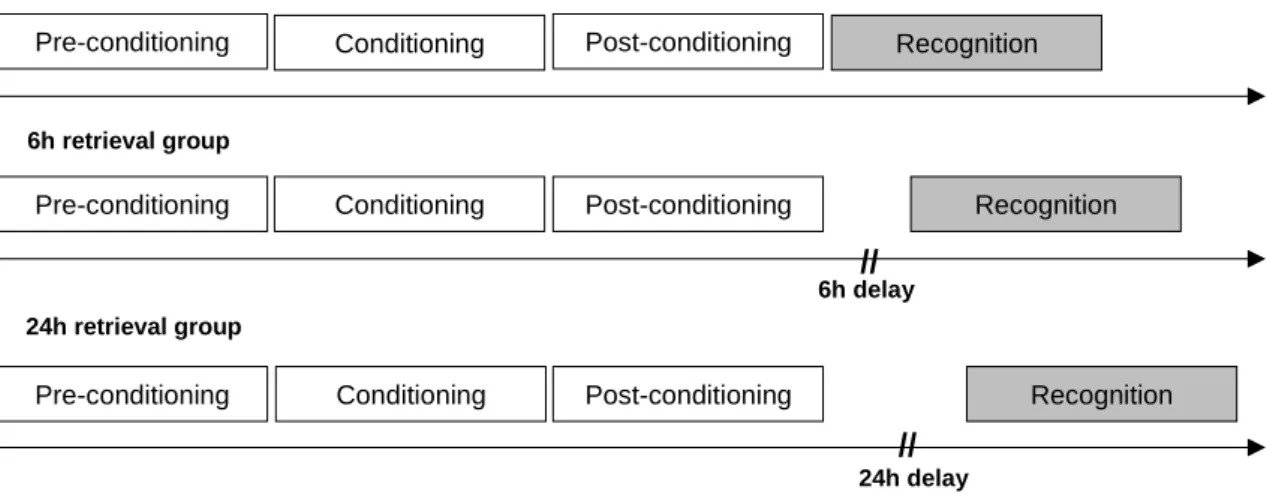
20 maybe new or definitely new. Responses were self-paced, and pictures were followed by a variable 2 ± 1 s ISI, during which a fixation cross was presented on a white background. As mentioned above, the recognition memory test took place either immediately after encoding, 6 hours after encoding or 24 hours after encoding (Fig.2).
Figure 2. Schematization of experimental sessions for each retrieval group. All participants went through three consecutive encoding phases (pre-conditioning, conditioning, post-conditioning). Those were followed by a surprise recognition test immediately (immediate retrieval group), 6 hours (6h retrieval group) or 24h hours (24h retrieval group) after encoding.
Statistical analyses
The statistical analyses were performed using IBM SPSS Statistics software. First, to ensure that the pictures presented during the encoding session were encoded, and that the US-CS contingencies were learned, a one-way analysis of variance (ANOVA) was run on response accuracy for the encoding tasks with group (immediate, 6h and 24h) as between-subjects factor.
Then, to probe the selective memory enhancement for items associated with a naturally occurring aversive sound, its generalization for conceptually related neutral items and the role of retrieval-delay on the effects, a repeated-measures ANOVA was run on recognition memory, with CS (CS+, CS-) and Phase (pre-conditioning, conditioning, post-conditioning) as repeated measures, and retrieval group (immediate, 6h and 24h) as
Pre-conditioning
6h delay
24h delay
Conditioning Post-conditioning Recognition
Pre-conditioning Conditioning Post-conditioning Recognition
Pre-conditioning Conditioning Post-conditioning Recognition
//
Immediate retrieval group
6h retrieval group
24h retrieval group
21 between-subjects factor. Main effects were followed by pairwise comparisons, using the Bonferroni correction for multiple comparisons.
Following Dunsmoor et al. (2015), recognition memory was calculated using a corrected recognition index (Hit rates minus False Alarm rates to the corresponding category). Previous studies have revealed that the memory-enhancing effects of emotion are observed on recollection processes that translate into high confidence recognition responses, rather than on familiarity processes that translate into low confidence recognition responses (for a review, see Yonelinas & Ritchey, 2015). For this reason, we restricted the analyses to high confidence trials (“Definitely old”, for old items) and calculated corrected recognition by subtracting high confidence false alarms (“Definitely old”, for new items). Additionally, as in Dunsmoor et al. (2015), the omnibus test was followed by planned separate ANOVAs for each retrieval group and planned t-tests. When necessary, analyses were corrected for sphericity violations using the Greenhouse-Geisser adjustment.
Results Encoding tasks
For all retrieval groups, responses on the task performed during the pre-conditioning and post-pre-conditioning phases (i.e., deciding whether the object presented denoted an animal or a tool) were highly accurate (> 97% in all cases). This demonstrates that participants were paying attention to the task and to the pictures, allowing its encoding.
Response accuracy on the task performed during the conditioning phase (i.e., indicating whether they expected an aversive sound) suggests that participants successfully learned the contingencies between the aversive sound and the conditioned category. Responses had a mean accuracy of 79% (SD = 15%) for the immediate-retrieval group, 76% (SD = 14%) for the 6h-retrieval group and 75% (SD = 19%) for the 24h-retrieval group, with no significant differences between groups [F (2, 83) = .439, p = .646, ηp2 = .01].
Recognition memory test
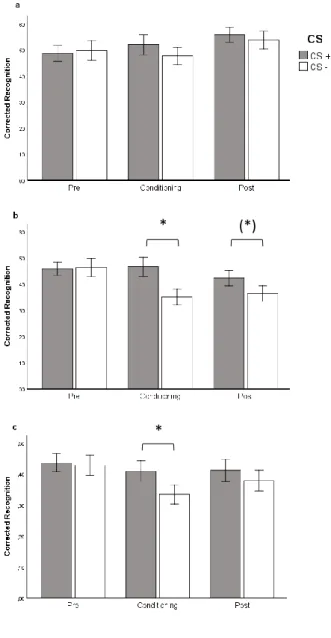
Results revealed a main effect of CS [F(1, 83) = 6.955, p = .01, ηp2 = .077], Phase