A Work Project, presented as part of the requirements for the Award of a Master Degree in Management from the NOVA – School of Business and Economics.
CORPORATE ENTREPRENEURSHIP
A measurement framework for generating and integrating innovations in corporations
Mark Raihlin
Master student number: 2909
A Project carried out on the Master Management Program, under the supervision of: Miguel Muñoz Duarte
I
Abstract
The soaring success of start-ups forces corporations to rethink their innovation approach and become more entrepreneurial. While corporate venturing is a popular way of accessing innovations, large companies often fail at implementing them. This work project identifies, under which conditions companies successfully generate and integrate innovations. Using data from literature and expert interviews, 30 fundamental influencing factors are formulated in terms of leadership, structure or culture. A questionnaire based on this framework allows corporate managers to measure the extent to which the factors are perceived by employees inside the organization. Consequently, radar charts support managers in designing appropriate innovation strategies.
Keywords: Corporate Entrepreneurship, Corporate Venturing, Innovation Model, Measurement Framework
II
Table of Contents
Abstract ... I Table of Contents ... II
1 Introduction ... 1
2 The Domain of Corporate Entrepreneurship ... 3
2.1 Defining Corporate Entrepreneurship ... 3
2.2 The Need to Innovate Beyond Corporate Venturing ... 5
3 Research Outline ... 8 3.1 Research Question ... 8 3.2 Methodology ... 9 4 Research Results ... 9 4.1 Literature Review ... 9 4.1.1 Leadership ... 10 4.1.2 Structure ... 12 4.1.3 Culture ... 15 4.2 Exploratory Interviews ... 19 4.3 Measurement Framework ... 21 5 Conclusion ... 23 References ... III Appendices (Separate Document) ... IV
Introduction
1
1 Introduction
The pace of change experienced by markets across all nations and industries is undoubtedly shifting, as technological advances and the liberalisation of economies pave the way for an unprecedented redistribution of economic power. Markets that have once been dominated by established corporations with rich histories have been reshaped by the birth of countless start-ups, each offering novel solutions to customer needs, and some creating entirely new markets. Nowadays, the five “most valuable tech-companies in the world are former digital start-ups.” (Capgemini Consulting 2016, 4) As a consequence, corporations experience a significant loss of market share and begin searching for ways to counteract these disruptive trends. While corporate managers consider the impact of start-ups as a serious threat, they do realize that solutions are to be found in the approximation of the „two worlds‟, rather than through distance. The goal has become to seize benefits from the distinct qualities of innovative and agile start-ups, which unleashed the search for concepts that are able to connect the two systems.
A popular methodology for developing products and businesses, The Lean Start up by Eric Ries, has transformed the way founders create new ventures. Based on short iterative development cycles of building, measuring and learning, start-ups are able to be lean, fast and close to the customer. While the implementation of these incremental changes has failed in larger companies, “they are still driven by the desire to incorporate the degrees of freedom and the agility of start-ups.” (Capgemini Consulting 2016, 5) Thus, innovation centres, such as incubators and accelerators, have become a main address for corporations to pursue these goals. With around 7000 such facilities worldwide – and a growing trend – there is a strong pull-effect for both supply and demand of innovative ideas, “boosting billion dollar venture capital budgets”. (Capgemini Consulting 2016, 6)
Introduction
2 Although these innovation centres do develop methodologies targeted at large corporations, the partnerships tend to be rather limited in time and scope, mainly focussing on exploratory activities and often failing to integrate small start-ups or new technologies within the larger organization. A reason for the troubled long-term compatibility is a fundamental gap between their „languages‟ and mindsets. The Nestholma Accelerator exemplifies how corporations and start-ups have varying perceptions of fundamental terms. (See Appendix A) As companies grow, they are urged to balance an increasing amount of key objectives, such as revitalizing the market, products, resources, systems and culture, which leads to more bureaucratic, conservative and inflexible behaviour. (Paunovic and Ioan C. 2014, 271) Therefore, growing corporations find themselves torn between expanding their economy of scales – the advantage of large enterprises – and maintaining organizational flexibility – the advantage of small enterprises. (Paunovic and Ioan C. 2014, 272) The benefits of more entrepreneurial behaviour at all organizational levels have been broadly discussed and confirmed throughout research. An emphasis on creating new business models, for instance, has arguably helped companies grow their operating margins faster than the competition. (Wolcott and Lippitz 2007, 75) This work project aims at creating a clear picture of what corporate entrepreneurship means today and under which conditions large enterprises can not only identify attractive synergies with the start-up ecosystem, but also maintain them. Building on previous research, the core of this thesis is the compilation of fundamental influencing factors that allow to measure a firm‟s ability to change and innovate, as prerequisites for remaining competitive in the dynamic „new economy‟. As John Chambers, CEO of Cisco Systems, argues: “The corporations who win in the future will be those that thrive on change. Companies that build a culture of accepting change, that build a process implementation that allows for rapid change and standardization are uniquely positioned to take advantage of market transitions.” (Purewal and Seidle 2004)
The Domain of Corporate Entrepreneurship
3
2 The Domain of Corporate Entrepreneurship
While the idea of corporate entrepreneurship is gaining momentum in the attention of businesses, its context is rather old and has accordingly broadened with time. As a generic term, the phenomena of corporate entrepreneurship can be analysed from various angles. For instance, identifying effects on the functional levels may yield different results than segmenting by the unit level, i.e. individuals, teams or whole organizations. Furthermore, the understanding of corporate entrepreneurship can vary depending on the observer, as different stakeholders may take distinct views on its meaning. Given the large amount of perspectives on the topic, it is necessary to limit the domain relevant for this work project. The following chapter will define the term corporate entrepreneurship for the scope of this thesis and outline the problem that will be targeted by the subsequent research.
2.1 Defining Corporate Entrepreneurship
The notion of corporate entrepreneurship has been discussed in literature throughout the past three decades, and despite a rapidly growing interest in the topic, there has been no consensus on how to define the term. (Guth and Ginsberg 1990, 6) Before looking at the corporate level, it is necessary to understand the meaning of entrepreneurship itself. In 1934, Schumpeter defined it as the “identification of market opportunity and the creation of combinations of resources to pursue it.” (Guth and Ginsberg 1990, 5) This concept of new resource combinations, detailed by Guth and Ginsberg as new patterns and magnitudes of resource deployment, has since remained the theoretical core of entrepreneurial activities. (Guth and Ginsberg 1990, 6) A rather modern definition by Paunovic and Dima, for instance, illustrates the timelessness and cross-functionality of this concept, describing entrepreneurship as the “process that involves all functions, activities and actions associated with perceiving opportunities and creating business organization to pursue them.” (Paunovic and Ioan C. 2014, 270) Overall, the literature converges on entrepreneurship involving all processes that
The Domain of Corporate Entrepreneurship
4 contribute to the identification of opportunities, as well as combining new resources to pursue them, generally undertaken by an individual market player – the entrepreneur.
Corporate entrepreneurship (CE), in its broadest sense, is the holistic attempt of implementing these entrepreneurial processes within an established organization. This field of research has been handled with various labels and has quickly broadened during the past decade, due to new methods and approaches to entrepreneurial behaviour in corporations, including accelerators, open innovation and positive organizational culture. One of the labels is Lumpkin‟s and Dess‟ Entrepreneurial Orientation, which emphasizes the process of entrepreneurship (“How to undertake a new entry?”) rather than its strategic content (“What business shall we enter?”). (Lumpkin and Dess 1996, 136) Among the most widely used related terms is Intrapreneurship. Coined by Pinchot in 1978, it simply describes “the practice of entrepreneurship within large firms”. (Haskins and Williams 1987, 2) According to Haskins and Williams, intrapreneurship embraces three perspectives: (1) internal entrepreneurs, and ways to identify, train and motivate them; (2) approaches to direct the entrepreneurial potential towards profitable and significant contributions; and (3) entrepreneurial company climates that encourage new ideas. (Haskins and Williams 1987, 2– 3) While the goal is typically new product development, “intrapreneurial activity can also be aimed at cultural change, cost reduction, new processes, improvements in operating efficiency, new market support, product modification and so on.” (Haskins and Williams 1987, 2) Nowadays, the term is predominantly being associated with the individual intra-organizational entrepreneur.
Until today, CE has remained a diversified field of study and is considered a generic term for various activities. Across the literature, it is being referred to as processes or behaviour targeted at obtaining competitive advantage through innovation, leveraged by resources of the parent organization and aimed at all organizational levels. (Wolcott and Lippitz 2007, 75)
The Domain of Corporate Entrepreneurship
5 Rather than just new product development, it may address innovations in services, channels, brands, businesses, structures and cultures. (Paunovic and Ioan C. 2014, 270) In practice, this comprises several phenomena. Starting with the individual employee and their intrapreneurial behaviour that might lead to small scale innovations, up to entrepreneurial organizational dynamics that facilitate the rapid creation of new products, processes and entire businesses, CE has numerous facets.
For the scope of this thesis, corporate entrepreneurship will be defined as a company‟s capability to generate and integrate innovations across all levels of an organization. While generating refers to the creation of new products, businesses and processes, integrating means sustaining them as healthy components of the business as well as adapting to “imported” innovations, such as acquired start-ups, licensed technologies or new strategic partnerships.
2.2 The Need to Innovate Beyond Corporate Venturing
Corporate entrepreneurship has never been as much in the focus of large companies as it is today. The early success stories from the Silicon Valley have been sparking inspiration in entrepreneurial teams worldwide. Within a short period of time, cities across the globe began to evolve into innovation hubs, attracting founders, investors and talent. The growth of these start-up ecosystems became alerting to large companies, whose market shares started to suffer from disruptions in their respective industries. As an example, Facebook‟s messaging service was predicted to disrupt 38% of SMS revenues of telecommunication firms globally in 2017, not to mention the impact of other competing online messaging services. (Diamandis 2015) As a result, the companies need to reassess their competitive position and adjust their innovation strategies. Based on Miller‟s and Friesen‟s contributions during the early research of CE, an innovation strategy can be located in between two major approaches. The
conservative model of innovation implies low risk taking and innovation efforts, while the entrepreneurial model of innovation considers innovation as a central part of the corporate
The Domain of Corporate Entrepreneurship
6 strategy and thus regards change as the firm‟s overriding goal. (Miller and Friesen 1982, 3–7) These firms “innovate boldly and regularly, while taking considerable risks in their product and market strategies.” (Miller and Friesen 1982, 3–7) As many firms attempted to incorporate a more innovation-driven strategy, corporate venturing became a popular way to identify promising start-ups and capitalize on market advantages gained through innovation. (Paunovic and Ioan C. 2014, 270)
A recent report by Capgemini Consulting analyses the German landscape of so-called
corporate innovation centres in order to identify their motivation, setup and success factors.
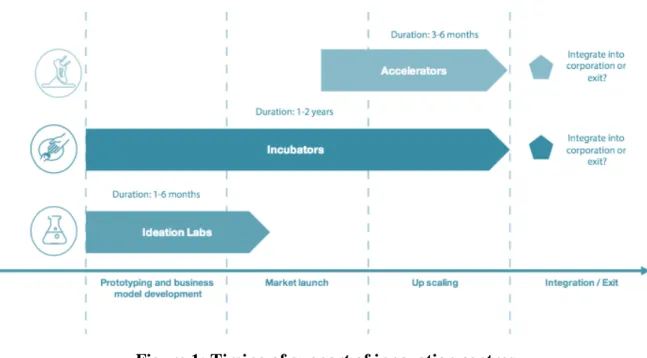
(Capgemini Consulting 2016, 7) Innovation centres, such as accelerators, incubators and innovation labs, all provide “an autonomous environment for innovative people with a campus to team up, in contrast to lone wolf entrepreneurs.” (Capgemini Consulting 2016, 6) As shown in Figure 1, these forms of innovation centres have different purposes in the context of firm maturity.
At the earliest stages of a business idea, innovation labs provide resources to create and improve new concepts both in terms of technological (prototyping) and market (business
Figure 1: Timing of support of innovation centres Source: (Capgemini Consulting 2016, 6)
The Domain of Corporate Entrepreneurship
7 model) validation, during a period of one to six months. On the contrary, accelerators help scale up existing, validated businesses, within programmes of usually three to six months. Incubation programmes can take up to two years, as they may accompany young businesses throughout the ideation, market launch, and scaling phases. The three main reasons to set up a corporate innovation centre, according to corporate managers, were (1) growing the network in the ecosystem, (2) gaining insights on market trends and (3) improving the speed of generating and testing new ideas. (Capgemini Consulting 2016, 11) This suggests that these venturing initiatives are rather exploratory endeavours than targeted at concrete results, such as increasing market shares by a certain percentage or developing a new product. Although there are many variables for the format of innovation centres, they all share a similar set of services, including work spaces, equipment, networking platforms, mentoring, business support services and sometimes capital. (Capgemini Consulting 2016, 7) Regarding the origin of new enterprises, independent venture-backed start-ups have been observed since decades to yield higher returns than their corporate, internal counterparts, being able to “reach profitability twice as fast and end up twice as profitable”. (Guth and Ginsberg 1990, 8) Axel Springer, for instance, simultaneously set up both an incubator with internal employees and the Plug & Play accelerator for external start-ups. Eventually, the superior outputs and benefits created by Plug & Play have been convincing enough to terminate the internal incubator overall. (Capgemini Consulting 2016, 14) As a bottom line, the report endorses the effectiveness of such innovation centres, recommending “every large and midsized company [to consider] the option as part of their innovation and digital strategy.” (Capgemini Consulting 2016, 17)
Despite the attractiveness of corporate venturing initiatives, organizations should not enter this increasingly attractive space without careful strategic consideration. Given that most innovation centres are still at the beginning of their learning curve and often experience
Research Outline
8 negative short-run performance, “it is certainly too early to make a résumé of their success.” (Capgemini Consulting 2016, 16) While the Capgemini report praises the effectiveness of innovation centres for setting up a generative environment separate from the mother organization, it overlooks the ultimate need of being able to integrate the results of those entrepreneurial ecosystems, such as new technologies and acquired start-ups. In other words, companies fail to walk the extra mile. The most mentioned concerns by managers of innovation centres hint towards that problem: (1) lack of commitment and resources from mother company, (2) poor start-up and idea assessment and (3) low level of alignment and intensity of collaboration with mother company. These results suggest that, if corporations aspire to establish a constant connection to the start-up ecosystem, changes at a more fundamental level can help narrow the long-lived gap. After all, as Haskins puts it, “the entrepreneur and the stereotyped corporate manager are strange bedfellows." (Haskins and Williams 1987, 1) Accordingly, a holistic approach is indispensable to understand why a firm needs to become more entrepreneurial as well as how to approach that objective.
3 Research Outline
Given the defined scope and problem covered by this work project, the following chapter will briefly formulate the research question as well as the methodology used to obtain results.
3.1 Research Question
The purpose of this thesis is to help companies identify their current capabilities in conducting corporate entrepreneurial activities. While most companies‟ aspirations to establish long-term connections with start-ups can be regarded as a step into the right direction, a more holistic approach is necessary to create an environment of change-orientation and adaptability. The scattered picture of former research regarding the influencing factors for such entrepreneurial environments has failed to provide an actionable system to rely upon.
Research Results
9 Aiming to establish such a system, the research question of this work project is: “Under which conditions are large companies capable to generate and integrate innovations successfully?”
3.2 Methodology
In order to encompass a wide range of potential influencing factors, this research includes both a literature analysis and exploratory interviews with three experts on the topic of corporate innovation. Given the theoretical and practical input, the most important influencing factors have been identified and grouped into categories. Based on these factors, a measurement framework is set up, with the aim to assess the suitability of any given corporation to generate and integrate innovations at all organizational levels. Using an employee questionnaire, corporate managers may determine the performance of their companies along the established categories. Ultimately, the company‟s current situation is visualized on radar charts for three perspectives, as a tool for strategic planning and for facilitating the deduction of operative measures to be taken.
4 Research Results
The following chapter accumulates insights from the literature review and conducted interviews, by describing and combining popular approaches of systemizing corporate entrepreneurship. While the literature shows the development of the theoretical research, the interviews intend to provide a practical view on corporate entrepreneurial projects.
4.1 Literature Review
The sources reviewed for this paper reflect the large scope of the domain of corporate entrepreneurship. Starting with Miller‟s and Friesen‟s early studies of entrepreneurial firms, up to a recent influx of guidelines to foster intrapreneurship, most success cases revolve around a set of similar qualities of entrepreneurial firms. This section will give an overview of these qualities, referred to as influencing factors on CE. To present the findings in an
Research Results
10 organized manner, the theme will be approached from three different perspectives, based on the CE systematization by Paul Burns: leadership, structure and culture. The two latter categories have been described frequently across the board, realizing that new structures intend to foster CE by design changes, but they will not lead to a successful transformation, unless paired with an appropriate entrepreneurial culture. (Paunovic and Ioan C. 2014, 275) On top of that, Burns emphasizes the need for a certain type of leadership, whose entrepreneurial mindset and commitment to change the structure and culture critically impact the success of corporate entrepreneurial behaviour. (Burns 2012) While strategy may arguably be another area of corporate entrepreneurship, on the contrary, creating a more entrepreneurial architecture should be part of a firm‟s strategy.
4.1.1 Leadership
The success of corporate entrepreneurship has always been heavily dependent on the characteristics, values and visions of the strategic leaders, (Guth and Ginsberg 1990, 8) with Steve Jobs being among the most striking examples. Just as investors perceive founders to be a crucial factor for the success of a start-up, it is necessary for corporations to create management teams that think more like entrepreneurs rather than corporate managers. According to Burns, the leadership of entrepreneurial corporations must be visionary, transformational and diffused.
A visionary leadership promotes bright large-scale ideas about the organization‟s future, creating a coherent internal image of the company and its purpose. The visionary alignment of all staff members enhances the perceived momentum of change and raises overall motivation.
Transformational leadership involves actively reinforcing change and innovation. Unlike
conservative managers “who may view innovation as costly and disruptive to production efficiency”, (Miller and Friesen 1982, 2) entrepreneurial managers regard regular and extensive innovation as a vital part of their strategy, willing to take calculated risks. Finally, a
Research Results
11
diffused leadership creates a feeling of responsibility for the company‟s success throughout all
members of the organization. On one hand, this means delegating decisions to roles with the highest power of judgement on a given issue, in other words, trusting the staff. On the other hand, it enables employees to understand the reasons behind strategic decisions made by top management. They are willing to align with the outcome, regardless of whether they personally agree.
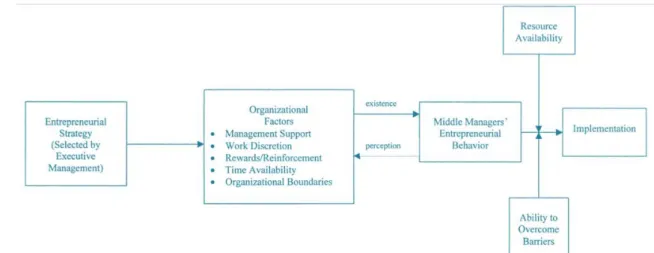
Given the broad strategic directions from top management, middle managers find themselves responsible for turning them into operational realities inside their departments and teams. In order to allow an appropriate implementation of corporate entrepreneurial planning, (Paunovic and Ioan C. 2014, 271) middle managers ought to establish practices, such as dedicating work time for reflecting innovative processes, as well as methods for new idea generation and opinion collection, including quality circles or suggestion systems. (Paunovic and Ioan C. 2014, 273) Hornsby was among the few to identify common internal factors that may foster middle managers‟ CE activity, and confirmed their existence in his results: (Hornsby, Kuratko, and Zahra 2002, 254)
Management support Work discretion
Organizational boundaries Rewards / Reinforcement Time availability
Management support involves resources, expertise or protection provided by senior management for entrepreneurial activities in the corporation. Work discretion describes an autonomous environment that encourages risk taking and a tolerance for failure. The organizational boundaries are shaped by mechanisms which evaluate, choose and implement ideas. An effective reward system considers goals and feedback, emphasizes individual
Research Results
12 responsibility and gives results-based incentives. Finally, time availability of middle managers for innovative activities is crucial to encourage a more experimental and risk-friendly environment.
As shown in Figure 2, Hornsby emphasizes the meaning of middle managers‟ perception of these factors, as it directly affects their behaviour in the entrepreneurial context. Along with the extent of resource availability and the ability to overcome barriers, middle managers‟ behaviour determines the success of the implementation of the entrepreneurial strategy. Hornsby‟s results indicate significant differences between the perceptions of those key factors by upper and lower middle managers, suggesting that leaders do have a certain degree of subjectivity, and are in misalignment towards the internal environment of corporate entrepreneurship. (Hornsby, Kuratko, and Zahra 2002, 269)
4.1.2 Structure
The structure of a company is the „backbone‟ designed to hold its parts together and encompasses more than just its formal reporting hierarchy. As a company passes through its growth and maturity stages, it tends to become more “bureaucratic and conservative” and loses its “entrepreneurial spirit as a main engine of sustainable economic growth”. (Paunovic and Ioan C. 2014, 270) Among the oldest, yet most propagated distinctions in this research
Figure 2: Middle manager’s perception of the internal environment for corporate entrepreneurship
Research Results
13 field is the idea of organic versus mechanistic structures. Being less centralized and less formal, organic structures are usually found in entrepreneurial companies. They emphasize lateral interactions and the “equal distribution of knowledge throughout the organizational network”, while mechanistic structures interact rather vertically and differentiate heavily between functions. (Lumpkin and Dess 1996, 155)
These lateral interactions are best achieved by granting teams and departments at all management levels a certain degree of autonomy. The freedom to act independently allows for more flexible and efficient decision-making processes, where “all employees […] can contribute […] to the reliable solutions of existing and potential problems within their field of responsibility and expertise.” (Paunovic and Ioan C. 2014, 274) In a sense, autonomous structures do empower themselves, as removing organizational constraints and delegating authority supports the employees‟ ability and willingness to be “self-directed in the pursuit of opportunities”, (Lumpkin and Dess 1996, 140) which fosters trust and uncoils even more productive autonomy.
In his early research, Haskins has described the structure of entrepreneurial organizations to be characterised by a “physical layout designed to facilitate communication” across functional or hierarchical boundaries.” (Haskins and Williams 1987, 53) Although the ways to communicate have drastically shifted in the past decades, proper communication has remained a key to successful CE. Besides lateral internal communication between autonomous teams, research has increasingly highlighted the importance of external exchange of knowledge, with its most recognized conceptualization being the open innovation.
Chesbrough defines the term as “the use of purposive inflows and outflows of knowledge to accelerate internal innovation, and expand the markets for external use of innovation, respectively.” (Chesbrough, Lim, and Ruan 2007, 3) Thus, it deals with the targeted exchange of knowledge with external partners to boost innovation in the organization. These partners
Research Results
14 may be any stakeholders of a company, including customers, suppliers and the competition. For instance, in the recently formed Partnership on AI, six leading technology companies, including Amazon, Google and Microsoft, collaborate to “study and formulate best practices on [artificial intelligence]”, arguably one of the most important technologies of the present time. (Partnership on AI 2016) The fundamental idea of open innovation (OI) steams from the rising market requirements for faster innovation cycles and shorter time-to-market. Besides building their core competencies and protecting their intellectual property, companies are increasingly facing the challenge of marketing their products faster than the competitors. As a response to these requirements, OI offers an approach based on the finding that external cooperation supports the innovativeness and reduces the time-to-market. Companies without external exchange of knowledge tend to fall behind with their ability to create such connections in the long run. Chesbrough distinguishes three core processes of open innovation. (Enkel, Gassmann, and Chesbrough 2009, 312–13) The outside-in process describes flows of information from customers, suppliers, competitors and research facilities into the company. In this case, the innovation network‟s main purpose is building the knowledge basis of the company. The opposite approach is called the inside-out process: Internal know-how is shared with external partners, spreading new technological advancements into a broader market in the form of licensing, joint ventures or spin-offs. Given multiple sources of income, this may generate higher revenues than merely internal usage of new technologies. The third core process is a combination of the two above. In the
coupled process, innovations are developed and marketed in cooperation, allowing the
company to gain external knowledge, while bringing own ideas onto the market.
Organic structures with autonomous groups and more liberal treatment of information do indicate and enhance the degree of entrepreneurialism in a company, but are not to be regarded as simply applicable formulas on top of any organization. The evolvement of
Research Results
15 mechanistic structures inside growing companies is the consequence of the need to efficiently manage their increasingly complex resource framework through high-level segmentation and standardisation of processes. This modus operandi in turn impedes the flexibility of the structure, meaning that a successful transformation must occur gradually, with the involvement of all members of the organization. The following section shows why cultural alignment on the individual and collective level can facilitate structural change.
4.1.3 Culture
While structure describes the formal setup of a corporation‟s activities, culture can be seen as the sum of assumptions and behaviours that determine the practical usage of the structural framework. For instance, the setup of a dedicated communication channel between two separate departments does not necessarily imply that it is being exploited effectively by individuals, as they could perceive this communication to be unnecessary and a waste of time. In this case, there would be a lack of involvement between levels, in which either the employees do not understand the big picture of the managers‟ decision, or the managers did not sufficiently consider the employees‟ expertise in their decision making. “Organizational culture refers to a system of shared meaning held by members” of an organization, (Robbins and Judge 2013, 512) describing a collectively manifested mindset. A strong culture consists of employees who largely agree on the company‟s mission and values, “providing standards for what employees should say and do.” (Robbins and Judge 2013, 516) As it facilitates the understanding and coordination of activities, culture may effectively replace certain written procedures and other formal coordination mechanisms. (Paunovic and Ioan C. 2014, 272) According to Robbins, there are five major functions that organizational culture performs: (Robbins and Judge 2013, 516)
1. Defining a boundary between one organization and others 2. Conveying a sense of identity for its members
Research Results
16
3. Facilitating commitment to something larger than individual goals 4. Enhancing the stability of the social system
5. Providing a control mechanism to shape employees‟ attitudes and behaviour
The shared perceptions of employees about their company and work environment, a sense of “team spirit at the organizational level”, are referred to as organizational climate. (Robbins and Judge 2013, 516) The importance of stimulating an intrapreneurial climate has been stated since the early stages of this research field. The goal is to enable employees to express and implement their own ideas of all kinds. (Haskins and Williams 1987, 2) In order to achieve that, Paunovic emphasizes the necessity to “develop an entrepreneurial spirit and innovative climate at all organizational levels”. (Paunovic and Ioan C. 2014, 271)
Entrepreneurial firms had always shared a sense of creativity and viewing challenges as an inevitable part of doing business. Haskins and Williams pioneered this field with a set of “crucial aspects of an innovative climate”: (Haskins and Williams 1987, 53)
Mutual trust and confidence Support for ideas
Challenge, dynamics and motivation Tension and pluralism
Freedom in the organization Freedom in the job
The consequent literature that has been reviewed reveals a common set of cultural influencing factors on CE. One key element is the basic willingness to engage in new ideas and overcome the state of the art, in any given area. This “innovativeness is a predisposition to engage in creativity and experimentation through the introduction of new products.” (Jong et al. 2011) Rather than just inventing new concepts, innovativeness includes the aim to actualize and monetize them as valuable components of the business. As mentioned in the previous section,
Research Results
17 open innovation facilitates the external exchange of knowledge, one of the main factors of the entrepreneurial process. A culture that is based on continuous learning helps complementing the structural setup of OI endeavours. According to Paunovic, “the learning organization facilitates and encourages systematic problem solving, introduction of new approaches, learning from past experience, best practice as well as knowledge transfer.” (Paunovic and Ioan C. 2014, 273) Mike Giersch, former vice president of strategy at IBM, highlights the need to be flexible and take risks, by explaining that “corporate entrepreneurship is fundamentally a learning process”. (Wolcott and Lippitz 2007, 82) A proactive and risk-friendly corporate culture encourages employees to conduct experiments at calculated risk and in turn generates data to reinforce the learning mentality, regardless of the outcome.
In order to reach a high degree of innovativeness, learning and proactivity, the management has to place the right incentives for all participants involved. A concept that helps narrow the focus is the so-called positive organizational culture, which is one that builds on employee strengths, emphasizes rewards – rather than punishment – and besides organizational effectiveness also aims at individual growth. (Robbins and Judge 2013, 527) Since culture is the result of a collective mindset inside a company, it is crucial to understand and target the characteristics and motivations of the most important individual player in the process of corporate entrepreneurship – the intrapreneur.
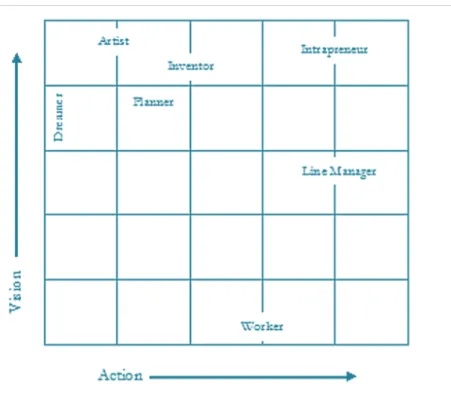
Figure 3 maps out different types of employees along the dimensions Action and Vision. Intrapreneurs are those who score highest on both of them, leading to Pinchot‟s prominent description of intrapreneurs as “dreamers who do”. (Haskins and Williams 1987, 2) In practice, corporations‟ interest in identifying, motivating and developing intrapreneurs has been existent for over 30 years. (Haskins and Williams 1987, 3) Unlike entrepreneurs, intrapreneurs act within the boundaries of an enterprise and are supported by it, exposing them to a much lower risk level and a different type of achievement. (Haskins and Williams
Research Results
18 1987, 98) In practice, entrepreneurial organizations in particular mostly value attributes such as action-orientation, willingness and the ability to turn ideas into practice. (Paunovic and Ioan C. 2014, 273) To promote such intrapreneurial drive, incentivizing individuals in the appropriate way is the crucial.
Besides tangible factors, such as increasing salaries, bonuses or profit distribution for exceptional commitment, the role of intangible factors must not be underestimated. These include an interesting, pleasant and flexible work environment, personal development through broader responsibilities and the perception of fair treatment in general. (Paunovic and Ioan C. 2014, 274) According to Haskins, intrapreneurs are driven by “autonomy, access to corporate resources, challenge, opportunity to develop new things, learning by doing, advancement and recognition.” (Haskins and Williams 1987, 10) These incentives suggest that intrapreneurs intrinsically „love what they do‟ and are best motivated by removing any barriers that detach them from their creative core activities. Regarding conventional financial incentives, the motivation is rather limited. “New financial incentives”, however, including early ideas such
Figure 3: The intrapreneurial grid Source: {Pinchot 1985 #18: 44}
Research Results
19 as seed money and bonuses coupled with the intraprise‟s performance can turn out as an effective driver. (Haskins and Williams 1987, 11) Finally, Haskins points out the importance of providing the right form of collaboration, and supporting the intrapreneurs with appropriate skills, since complementing the intrapreneurs‟ ambitions with proper resources is essential to unleash their true innovative potential. As Richard Branson, founder of the Virgin Group, points out, “Virgin could never have grown into the group of more than 200 companies it is now, were it not for a steady stream of intrapreneurs who looked for and developed opportunities, often leading efforts that went against the grain.”
4.2 Exploratory Interviews
In order to complement the theoretical view described above with insights from today‟s practices, three exploratory interviews have been conducted on the topic of innovation and entrepreneurship inside large corporations.
The first interview was conducted with Ricardo Marvão, Co-founder and Head of Global Resources at Beta-i in Lisbon. The non-profit organization creates and stimulates a culture of entrepreneurship and innovation in Lisbon‟s ecosystem with various programmes, including its 3-months acceleration programme for technology start-ups and innovation consultancy for corporations. While the accelerator aims at matching start-ups with companies to find solutions to specific problems, the corporate innovation branch supports companies in rethinking their innovative process on various levels, including questioning the very paradigms that determine their work flow.
The main learning is that companies which successfully approach corporate entrepreneurship are characterized by a much deeper understanding of their problems and the proposed technologies to solve them. This is only achievable through active participation of all key agents, especially the top-level leadership. Regarding accelerator programmes, companies do see the urge to invest in such formats, but often lack the necessary expertise to design a
Research Results
20 sophisticated programme internally, and thus provide the wrong incentives to those responsible for success. Above that, a merely internal setup does not induce the necessary change of the thinking process, which promotes a lean design of solutions. For that reason, independent accelerators are gaining popularity with large enterprises across all industries. The second interview took place at Fabrica de Startups in Lisbon, which hosts both an incubation and an acceleration programme for corporations. The incubation programme targets start-ups in various development phases, from creating teams and business models up to those in market launch and growth phases. The acceleration programme is designed for start-ups in more developed phases and includes a series of services, such as an ideation week, cooperation with large companies (e.g. EDP) and the accelerator‟s own validation methodology. Rita Lucena, Head of Acceleration Programmes, explained that large companies usually run both an innovation department and an R&D department in parallel, each based on a different method for innovating. While R&D departments start with the client requirements and create solutions in a secretary environment, innovation departments mean to empower creative processes throughout the organization and generate multiple sources of innovation in a discontinuous, rather radical manner. Above that, most activities of innovation departments are subject to high publicity, as firms need to build an image of a visionary and future-oriented business. The most important goal of such initiatives remains the generation of strong network effects which facilitate the aggregation of potential growth opportunities. Similar to the first interview, the most essential conditions to ensure a successful implementation are (1) a clear identification of the problem, (2) the readiness to test and fail rather than sticking with invalidated assumptions, and (3) the participation and commitment of everyone involved.
The final interview was conducted with Hugo Froes, Head of UX at the Lisbon-based design thinking and user experience firm Hi-Interactive. As corporations try to explore and adapt
Research Results
21 new ways of problem solving, the interest in design thinking companies has increased heavily in the recent years. Hugo Froes has consulted and coached companies on the principles of design thinking to create solutions for different types of industries and functions.
While he stresses the importance of autonomous work groups, he points out that it requires a certain duality in the relationship between management and employees. On one hand, leaders need to be ready to delegate more authority to their staff, according to their role and expertise. “Safeguards” – different kinds of control mechanisms – may unnecessarily hinder the development of promising initiatives. On the other hand, it is just as important that lower level workers can relate to managerial decisions, by getting access to the larger picture, and understanding their individual role in achieving organizational goals. Therefore, involving the CEO in brainstorming sessions, for instance, can help solidify the alignment between high and low level decision-making and foster well-functioning group autonomy. Beyond that, Hugo Froes emphasized the tolerance for mistakes as an important driver for a risk-friendly environment. Google, for example, officially grants 20% of their employees‟ work time to be spent on independent projects, which had so far led to the creation of some of their flagship products, such as Gmail and Google Maps. Although its practice may differ strongly from the intention, policies like this help establish an overall more innovative and daring culture. Finally, as both of the interviewees above had already mentioned, the precise definition of objectives for any CE initiative is crucial to reach a cross-level determination towards these goals. Importantly, an agile approach also means that the objectives may be adjusted as progress is made, just as decision makers should not fall for the sunk cost fallacy, when considering cancelling an arguably unsuccessful project.
4.3 Measurement Framework
Given the theoretical and practical insights from the literature review and the conducted interviews, a total of 95 influencing factors on corporate entrepreneurship have been listed.
Research Results
22 This initial set has been filtered by sorting out less relevant factors and duplicates, resulting in 79 distinguished factors considered for the framework. (See Appendix B) Based on each factor‟s context, they have been summarized and grouped as shown in Table 1. The measurement framework contains 30 influencing factors – ten for every perspective – with each factor assigned to one of eleven broader categories.
Perspective Category Factor
Leadership
Mind Set Encouragement
Participation Management support Expertise Protection Resources Time Incentives
Rewards For Creativity Individual Growth Responsibility
Non-Monetary Rewards
Structure
Autonomy Freedom Of Procedures Freedom Of Decision Resources
Resource Authority Resource Flexibility Resource Amount Open Innovation Confidentiality
External Knowledge Role Composition Task Variety Innovation Ownership Dynamic Objectives Culture
Risk Taking Recognition Of Initiatives Acceptance Of Failure Proactivity Opportunity Orientation Growth Orientation Prioritizing Tasks Innovativity Creation Adaptation Communication Knowledge Exchange Open Communication Cross-Level Alignment Table 1: Measurement framework for corporate entrepreneurship
Conclusion
23 In order to assess the influencing factors in practice, a set of Likert-style questions has been formulated for each category. All questions have a 7-point scale, ranging from “entirely disagree” to “entirely agree”, which directly represents the extent to which a particular influencing factor is perceived to be present inside the company. The full questionnaire can be seen in Appendix C, and the entire framework in Appendix D, including a URL to view it as a spread sheet. Consequently, the results can be plotted on radar charts to visualize the company‟s capability to generate and integrate innovations in terms of leadership, structure and culture. Appendix E shows randomized sample plots for the three perspectives, to illustrate how the data is represented for each factor.
Overall, the questionnaire is designed to provide general insights into a company‟s conditions in regards to CE. It should be answered by employees across all functional departments and levels. The answers may be consolidated to obtain specific results on the team, department or corporate levels. Different samples can be compared by layering them on the same radar chart, e.g. when comparing two departments. While the questions do cover the essential influencing factors on CE, they intend to draw a rough outline of the firm‟s current situation rather than portray a detailed picture about the mechanics behind their CE performance. The results of the questionnaire help top managers identify weak spots in the company‟s overall entrepreneurial architecture as well as provide them a basis to select a complementing innovation and change strategy.
5 Conclusion
Corporate entrepreneurship has become a field of increasing attention both in research and practice. As drastic market changes dominate the strategic outlooks of corporations, countless start-ups are thriving to become noteworthy market participants. The amount and variety of platforms that connect the two ecosystems has inflated enormously within just a decade. As a
Conclusion
24 result, corporations are seeking help from firms that run incubation or acceleration programmes, hoping to identify innovative technologies, developed by small teams, to invest in. Although there have been attempts of creating in-house incubation programmes, the frequent failure of such initiatives stems from more fundamental characteristics of corporations. Unlike start-ups, most corporations have established an innovation approach that contradicts the „credo‟ of their entrepreneurial counterparts. Rather than using innovations as a constant source of change and incremental development, large firms often view them as disruptors of efficiency and producers of excess cost. However, corporate entrepreneurship involves the ability to both generate and integrate innovations inside companies, which is why the mere identification and acquisition of firms and technologies does not provide a sufficient basis for sustainable corporate entrepreneurship. Therefore, corporations need to establish appropriate, rather modern leadership, structure and culture that facilitate change at all levels of the organization, which, in the context of an increasingly dynamic market environment, is crucial to stay competitive.
A screening of relevant literature in the research field of corporate entrepreneurship as well as practical insights from three exploratory expert interviews yielded a large variety of potential influencing factors on the performance of corporate entrepreneurial activities. Out of 95 influencing factors identified, eleven common categories have been established, each being part of the leadership, structural or cultural perspective. Based on this, a questionnaire of 30 questions, targeted at employees at all levels and functions, has been formulated to allow corporate managers assess the extent to which the influencing factors of each category are present within an organization. Plotting the results on radar charts for various samples gives an overview of a team‟s, department‟s or organization‟s strengths and weaknesses in regards to corporate entrepreneurship. Corporate managers are encouraged to utilize the results in
Conclusion
25 order to define appropriate innovation strategies, which leverage upon the identified strengths and overcome the drawbacks in either category.
As for the limitations of this research, it assumed a certain definition of corporate entrepreneurship, based on the ability to generate and integrate innovations inside corporations, but regardless of the specific target of innovation, such as products, processes or markets. Therefore, the picture provided by the framework is to be seen as a holistic one, best to be applied to large samples inside organizations, in order to determine the overall CE capabilities of a company. Furthermore, the isolated factors have been picked from a variety of sources across a time frame of 20 years. That does support a rather fundamental perspective on the topic, but excludes information on trends and how these factors may vary in the future, as new methods may be developed. Finally, choosing the perspectives of leadership, structure and culture is merely one way of segmenting the influencing factors and may not fully explain certain other disparities, such as between individual and collective CE performance, for instance.
Regarding future research, the framework presented in this thesis may be applied on and altered for various cases, such as detailed analyses of certain industries. In particular, it is of high interest to observe traditional sectors that undergo drastic changes induced by high technology, for instance automotive, banking or real estate. Moreover, any application of the framework would allow refining certain elements that may prove rather irrelevant in practice. An important addition to the framework would be a closer analysis of each of the influencing factors, enhanced by multiple, more detailed questions for each factor, resulting in a more accurate measurement of each category and eventually more revealing conclusions for top management.
References
III
References
Burns, Paul. 2012. Discussions on Entrepreneurship, Corporate Entrepreneurship. YouTube: University of Bedfordshire.
Capgemini Consulting. 2016. “Insights into the German Landscape of Corporate Innovation Centers.” Capgemini Consulting.
https://www.de.capgemini-consulting.com/resources/german-corporate-innovation-centers-summary.
Chesbrough, Henry, Kwanghui Lim, and Yi Ruan. 2007. Open innovation and patterns of
R&D competition.
Diamandis, Peter. 2015. 12 Industries Disrupted by Tech Companies Expanding Into New Markets.
https://singularityhub.com/2015/10/26/12-industries-disrupted-by-tech-companies-expanding-into-new-markets/ (accessed 06.01.17).
Enkel, Ellen, Oliver Gassmann, and Henry Chesbrough. 2009. “Open R&D and open innovation: exploring the phenomenon.” R&D Management, 39(4): 311–16.
Guth, William D. and Ari Ginsberg. 1990. “Guest Editors' Introduction: Corporate Entrepreneurship.” Strategic Management Journal, 11: 5–15.
Haskins, Gay and Roy Williams. 1987. Intrapreneurship in Action. Successful European
Company Practices. Special Report No.1099. London: Economist Publications.
Hornsby, Jeffrey S., Donald F. Kuratko, and Shaker A. Zahra. 2002. “Middle managers' perception of the internal environment for corporate entrepreneurship. Assessing a measurement scale.” Journal of Business Venturing, 17(3): 253–73.
Jong, J.P.J. de, S. K. Parker, Wennekers S., and Wu C. 2011. “Corporate
Entrepreneurship at the Individual Level:. Measurement and Determinants.” Panteia. Lumpkin, G. T. and Gregory G. Dess. 1996. “Clarifying the Entrepreneurial Orientation
Construct and Linking It to Performance.” The Academy of Management Review, 21(1): 135–72.
Miller, Danny and Peter H. Friesen. 1982. “Innovation in Conservative and Entrepreneurial Firms. Two Models of Strategic Momentum.” Strategic Management Journal, 3: 1–25. Partnership on AI. 2016. Partnership on AI to benefit people and society.
https://www.partnershiponai.org.
Paunovic, Svetislav D. and Ioan C. 2014. “Organizational culture and corporate
Entrepeneurship.” Annals of the University of Petrosani - Economics, 14(1): 269–76. Purewal, Dave and Russell Seidle. 2004. “Innovative Tension for Present and Future
Success. Encouragine Corporate Entrepreneurship in the Modern Organization.” ESADE
MBA Business Review, 2.
Robbins, Stephen P. and Tim Judge. 2013. Organizational behavior. 15th ed. Boston: Pearson.
Ruiz, Daniel C. 2016. 7 differences between startups and corporations.
http://nestholma.com/blog/7-differences-between-startups-and-corporations/#.WG-4gnf4y8o (accessed 06.01.17).
Wolcott, Robert C. and Michael J. Lippitz. 2007. “The Four Models of Corporate Entrepreneurship.” MIT Sloan Management Review, 49(1): 75–82.
Appendices (Separate Document)
IV