POT IRRIGATION CONTROL THROUGH THE CLIMATOLOGIC SEQUENTIAL WATER BALANCE
Adilson Nunes da Silva1, Rafael Pivotto Bortolotto1, Halan Vieira de Queiroz Tomaz1, Letícia Grigolon Reis1, Ricardo Alves de Olinda2, Lília Sichmann Heiffig-del Aguila3, Klaus Reichardt4
1Escola Superior de Agricultura “Luiz de Queiroz”, Universidade de São Paulo (ESALQ/USP), C.P. 09, CEP 13418-900, Piracicaba, SP, E-mails: [email protected], [email protected], [email protected], [email protected] 2
Universidade Estadual da Paraíba (CCT/UEPB), Campus I - Centro de Ciências e Tecnologia. Departamento de Estatística. Avenida das Baraúnas 351, CEP 58101-001, Campus Universitário - Bodocongó - Campina Grande, PB, E-mail: [email protected]
3
Embrapa Clima Temperado, BR 392 km 78 - Cx. Postal 403, CEP: 96010-971, Pelotas, RS. E-mail: [email protected].
4Centro de Energia Nuclear na Agricultura, Universidade de São Paulo (CENA/USP), Lab. de Física do Solo, Av. Centenário, 303, CEP 13400-970, Piracicaba, SP, E-mail: [email protected]
ABSTRACT
Ratings of crop behavior under different soil water conditions are very important to improve agricultural management, a difficult task to be carried out in greenhouses due to the lack of simple methodologies of low cost and of easy implementation. This article evaluates the efficiency of using a computational program of Sequential Water Balance, to study the response of the Jatropha curcas crop under different irrigation levels. Pots of large size (1.0 m high and 0.3 m in diameter), difficult to be weighed, were used in a greenhouse, from June to December 2009, in Piracicaba, SP, Brazil, with plants grown in a substrate of 50% sandy soil and 50% cured manure. The experimental design consisted of randomized blocks with treatments corresponding to water depths of 100%, 75% and 50% of the maximum available water capacity (AWC), with 16 replicates. Measuring only air temperature and knowing substrate AWC it was possible to control the soil water conditions over the whole experimental period, which were checked at the end of the experiment. Data indicate that this simple method that avoids weighing heavy containers in large number is very suitable for water control in pots arranged in a greenhouse.
Keywords: protected environment, control of irrigation; Excel spreadsheets
CONTROLE DE IRRIGAÇÃO DE VASOS ATRAVÉS DO BALANÇO HÍDRICO CLIMATOLÓGICO SEQUENCIAL
RESUMO
Avaliações sobre o comportamento de culturas a diferentes lâminas de água no solo são de extrema importância para a produção agrícola, no entanto em ambiente protegido ocorre o inconveniente da falta de metodologias mais simples e com menores custos para a realização desta prática. O objetivo deste artigo foi avaliar a eficiência do uso de um programa de Balanço Hídrico Sequencial na resposta da cultura de Jatropha curcas (pinhão-manso), submetida a diferentes lâminas de irrigação em vasos e em ambiente protegido. O estudo foi realizado em casa de vegetação durante os meses de junho a dezembro de 2009, em Piracicaba, SP, Brasil. Plantas de pinhão-manso foram cultivadas em substrato contendo 50% de solo arenoso e 50% de esterco em vasos de 1,0 m de altura e 0,3 m de diâmetro, de difícil pesagem. Com 16 repetições cada, estudaram-se os tratamentos, correspondentes a lâminas de irrigação de 100%, 75% e 50%
atribuídas pela capacidade de água disponível do solo (CAD). Percebe-se que o programa de Balanço Hídrico e a metodologia deste trabalho são eficientes na realização do balanço hídrico. Os dados indicam que este método simples pode evitar a pesagem de recipientes pesados, sendo bastante adequado para o controle da água em vasos dispostos em casa de vegetação.
Palavras-chave: ambiente protegido; controle de irrigação; planilhas Excel INTRODUCTION
Studies on plant response to different irrigation water levels are of extreme importance for the establishment of real plant water requirements and also for a more efficient use of the added water contributing to the sustainability of the system. To accomplish this, it is necessary to calculate or establish water balances of the soil or substrate (in the case of pots or containers) on which the plants grow.
Burt (1999) points out that the water balance (WB) is fundamental for rational decision making in soil management and conservation projects. The WB is an accounting system to monitor soil water based on the mass conservation principle applied to a control volume of soil (PEREIRA et al., 1997). Furthermore, the changes in soil water storage in a given time interval represent the balance between the water in and out flows of this control volume.
The climatologic water balance (CWB) was first developed by Thornthwaite & Matter (1955) to determine local climatic regimes without the need of direct measurements of the soil water status. To establish this balance only three basic elements are needed, air temperature, rainfall plus irrigation, and the soil water holding capacity, so that the evapotranspiration loss can be estimated for a chosen period besides giving values to soil water retention, deficit or excess (PEREIRA, 2005). The method also needs the local latitude to estimate the length of the day and, thereafter calculates the reference evapotranspiration.
The direct establishment of WBs in the field is very laborious, time consuming and costly due to the need of sophisticated equipment (SILVA et al., 2006). Under controlled conditions like greenhouses when pots are used to grow plants, similar difficulties arise, mainly when soil volumes are large. Lysimeters, tensiometers or other soil water control instruments, scales to weigh pots, etc, are expensive, many times unavailable and difficult to operate. Therefore, the use of the indirect CWB to control soil water status under these conditions seems to be an excellent opportunity.
To avoid weighing a large number of heavy pots very frequently, this study introduces the use of the sequential climatologic water balance (SCWB) to control the water status of these pots under a greenhouse condition, using as a test crop the physic nut plant.
MATERIAL AND METHODS
This study was carried out in a greenhouse, using a randomized blocks design with three treatments and 16 replicates. To grow physic nut (Jatropha curcas L.) plants, large cylindrical PVC containers (diameter 0.3 m, height 1.0 m and internal volume of 0.07065 m3) were used. They were filled with a substrate consisting of 50% sandy soil (medium clayey texture, with 22 g kg-1 silt, 702 g kg-1 sand and 276 g kg-1 clay) and 50% of cured cow manure, resulting a bulk density of about 1000 kg m-3 and a weight of 70.65 Kg. Such large weight is very difficult to be evaluated daily using a scale, inside the greenhouse. Three water
levels were tested: T1 – maintaining 100% of the water holding capacity WHC of the substrate; T2 – 75% of the WHC; and T3 - 50% of the WHC.
For the determination of the WHC substrate samples were submitted to pressure heads of 10; 33 and 1500 kPa in a Richards Pressure apparatus to determine the field capacity FC (average data of 10 kPa and 33 kPa points) and the permanent wilting point WP (1500 kPa point). For the above described treatments, the WHCs corresponded to: T1 - 140 mm; T2 - 105 mm; and T3 – 70 mm.
Physic nut plants were grown from seeds, using three seeds per pot and leaving only one plant for the development of the experiment. Irrigation was made manually replacing the respective treatment evapotranspiration losses calculated according to Thornthwaite & Mather (1955).
At the beginning all containers were watered in excess to attain the maximum WHC and left 3 days for free drainage. Thereafter pots lost water by evapotranspiration until reaching the respective treatment water levels, i.e. 100; 75; and 50 % of their WHC. This was made calculating ET losses using a SWB program based on the Thornthwaite & Matter (1955) method (ROLIM et al., 1998) using initially as temperature (T) input the maximum air temperature inside the greenhouse, because the experiment started in the cold autumn/winter days when the average air temperature would underestimate soil water losses inside the greenhouse. When all pots were at their respective treatment water levels, the experiment really started (July 20, 2009) by seeding them and maintaining them in the range of these water levels, i.e. irrigating each treatment after loosing about 14 mm (1 L per pot), estimated through the WB program.
During plant development the following measurements were taken: 1. plant height
(PH), from substrate surface to apical gem; 2. stem diameter (SD), measured close to substrate surface with a digital caliper rule; 3. number of leaves per plant (NL); 4. presence of flowers and fruits (FF); 5. number of branching per plant (NB); 6. characterization of growth stages.
Data were subjected to analysis of variance and comparison of means was analyzed by the Tukey test at the 5% probability level, using the SAS software ® (SAS, 2003).
RESULTS AND DISCUSSION
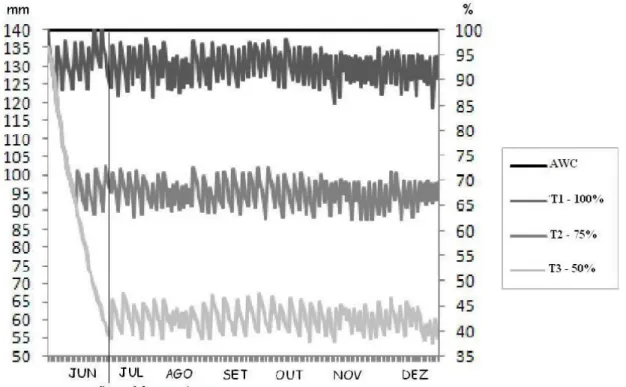
The sequential water balance for the treatments during the experimental period (Figure 1) indicates that seeding had to be delayed for one month in order to have all treatments at their defined initial water content, because substrates started at saturation. It can also be seen that treatments did not return after each irrigation exactly to their defined storages.
According to the calculation of each irrigation depth they actually reached 140, 105 and 70 mm, but the lag of one day in the balance right after each irrigation that was performed in the mornings gave rise to these discrepancies. It can however be seen that the differences in the treatments were very well kept along the experimental period, showing that this method of pot water control is very adequate under such experimental conditions. Due to the relatively small diameter of the pots, it was avoided to directly sample the soil during the development of the plants for soil water content evaluations.
Frequent samplings around plants would strongly affect their development and influence the experimental results in terms of the plant characteristics evaluated for treatment comparisons.
Figure 1. Sequential water balance evolution of the soil available water capacity (AWC) for the treatments 100, 75 and 50 % obtained through the computational water balance program developed according to Thornthwaite & Matter (1955).
At the end of the experiment (December 2009) the root systems were so well developed in the first 30 cm of the pots that it was difficult to evaluate the water contents at this time, but the results indicate a water treatment tendency (T 100% = 11.44%; T 75% = 10.96%; T 50% = 9. 55%).
Plants developed very well during the experimental period presenting at the end a large fresh green mass. The analysis of variance (Table 1) shows significant differences for most of the variables in relation to treatments, with exception to NB. It can be noted that this variable is not influenced by the available water in the soil. However, SD, PH and NL were affected by the water quantity.
Data also indicate significant differences in relation to the month in which they were evaluated, including NB. This
means that plant responses oscillated along time.
In relation to the interaction month x treatment it can be seen that they were significant only for PH and NL, demonstrating that these were the variables that most differed along time in relation to treatments.
Analysis of the test for averages shows that T100 was the treatment in which most measured variables had the best performance and that for some of them there was no difference from one or more treatments (Table 2). This was expected because in this treatment the soil was kept very close to 100% of the AWC, therefore offering better conditions for plant development, in our case the physic nut.
It is common to consider the physic nut as a drought resistant plant that survives under arid conditions of 200 to 300 mm y-1, however, studies carried out by Maes et al.
(2009) show important information when making the natural distribution of this nut in Central America, indicating that this crop is not common in arid and semi-arid regions and not where the yearly rainfall is less than 944 mm. The authors discuss that in the rainfall range of 900 to 1200 mm y-1 physic nut crop productivities were observed as of about the double of those of dryer areas, thus confirming our results for T100.
Under warm and dry conditions Ye et al. (2009) observed an increase in PH of the order of 10 cm in the first year and 20 to 40 cm in the second and third year. On the other hand, under wet conditions they observed
differences of 40 to 50 cm in the first year and above 100 in the second.
Kheira & Atta (2008) also studied the response of the physic nut to irrigation water depths calculated from Class A pan evaporation data and their weekly water consumption was close to our T100, thus confirming that the physic nut develops better under high soil water levels. The increased availability of water in the soil resulted in greater efficiency of water use by Jatropha plants, which resulted in higher production in treatments with higher levels of replacement (SOUZA et al., 2011).
Table 1. Variance analysis for stem diameter (SD), plant height (PH), number of leaves per plant (NL) and number of branches per plant (NB).
Estatística F Factor CD PH NL NB Block 1.39 ns 2.75 ns 2.58 ns 0.39 ns Month 179.68 * 405.60 * 222.94 * 55.94 * Treatment 25.88 * 13.08 * 5.03 * 1.92 ns MonthxTreat 1.02 ns 3.14 * 1.31 * 1.23 ns CV (%) 7.85 7.44 7.7 26.26
*significant at the 5% probability level. ns: not significant at the same level.
Table 2. Average test for treatments of 100, 75 and 50% of the irrigation water depth for the variables: Stem diameter (SD), plant height (PH), number of leaves per plant (NL) and number of branches per plant (NB).
Treatment (%) CD PH NL NB
T1: 100 40.82 a 84.50 a 9.66 a 0.50 a
T2: 75 34.89 a 79.03 b 9.05 b 0.54 a
T3:50 36.61 b 71.64 c 8.84 b 0.56 a
Values followed by the same letter in a column do not differ significantly at the 5% probability level.
CONCLUSIONS
The sequential water balance combined to the methodology employed in this study is a viable and efficient alternative for water control;
The maintenance of the soil water status close to 100% of the available water capacity leads to the best results in terms of the development of the physic nut.
ACKNOWLEDGEMENTS
To FAPESP and CNPq for the granted fellowships.
REFERENCES
BURT, C.M. 1999. Irrigation water balance fundamentals. In: USCID: Conference on benchmarking irrigation system performance using water measurement and water balances, San Luis Obispo, Proceedings. p. 1-13, mar.
KHEIRA, A.A.A.; ATTA, N.M.M. 2008. Responsive of Jatropha curcas L. to water deficits: Yield, water use efficiency and characteristics. Biomass and bioenergy, v. 33, p.343-350
MAES, W.H.; TRABUCCO, W.H.; ACHTEN, W.M.J. MUYS, B. 2009. Climatic conditions of Jatropha curcas L. Biomass and Bioenergy, v.33, p.1481-1485
PEREIRA, A.R. 2005. Simplificando o balanço hídrico de Thornthwaite-Mather. Bragantia, v.64, p.311-313
PEREIRA, A.R.; VILLA NOVA, N.A.;
SEDIYAMA, G.C. 1997.
Evapo(transpi)ração. Piracicaba: FEALQ, 183p.
ROLIM, G.S.; SENTELHAS, P.C.; BARBIERI. V. 1998. Planilhas no ambiente ExcelTM para os cálculos de balanços hídricos: normal, sequencial, de cultura e de produtividade real e potencial. Revista Brasileira de Agrometeorologia, Santa Maria, v.6, p.33-137
SAS INSTITUTE. 2003. SAS System: SAS/STAT Version 9.1 (software). Cary. SILVA, A.L.; ROVERATTI, R.; BACCHI,
O.O.S.; TIMM, L.C.; BRUNO, I. P.; OLIVEIRA, J.C.M.; DOURADO NETO, D. 2006. Variability of water balance components in a coffee crop in Brazil, Scientia Agricola, v.63, p.105-114
SOUSA, A.E.C.; GHEYI, H.R.; SOARES,
F.A.L.; MEDEIROS, E.P.;
NASCIMENTO, E.C.S. 2011. Teor de óleo no pinhão manso em função de lâminas de água residuária. Pesquisa Agropecuária Brasileira, Brasília, v.46, Jan, n.1, p.108-111
THORNTHWAITE, C.W.; MATHER, J.R. 1955. The water balance. Centerton: Drexel Institute of Technology, Laboratory of Climatology. Publications in Climatology, v. 8, n. 1. 104p.
YE, M.; CAIYAN, L.; FRANCIS, G.; MAKKAR, H.P.S. 2009. Current situation and prospects of Jatropha curcas as a multipurpose tree in China. Agroforest System, v.76, p.487-497
Recebido em: 11/03/2013 Aceito para publicação em: 18/08/2013