THE REVERSE COATTAIL EFFECT REVISITED: INTRA-PARTY LINKAGES AND ELECTORAL PERFORMANCE IN BRAZIL, 1996-2010 ABSTRACT This paper analyzes the reverse coattail effect on Brazilian elections, a term originally coined by Ames (1994). More specifically, it deals with the ability of local party organizations to transfer votes to upper levels party candidates by concentrating on the causal electoral effect of electing a mayor over subsequent statewide proportional elections. To identify the effect of electing a mayor, it employs a regression discontinuity design (RDD) focusing on observations in which the electoral difference between the elected mayor and the runner-up is very tight. The use of a large dataset, covering elections between 1996 and 2010, allows exploring parties’ heterogeneity in both cross-section and temporal analyses. Main results show that the positive effect of electing a mayor on party performance in subsequent proportional election holds for the entire period. Another finding is that Brazilian parties show different capabilities in getting votes from their mayors, pointing that intra-party linkages may vary among parties. Finally, the impact of electing a mayor vary along the years KEYWORDS Political parties, elections, party organization, decentralization
Party activity at multiple territorial levels of government has increased with political decentralization. Though one should expect decentralization to impose greater coordination challenges on political parties, as these last have to manage the interaction among local and national electoral arenas, we still have limited understanding about how parties operate at different levels.
How parties organize themselves at different levels and how they manage partisan linkages between politicians at different levels? As it is well known, the ability parties demonstrate to integrate actions in different levels will say much about the nature of the party system. If multilevel party systems develop differently throughout the territory, then different local parties should lead to an excessive fractionalization at the national level, which should turn on making and managing governments in a difficult task to accomplish.1 On the other hand, the decline in electoral volatility opens an opportunity for the stabilization of party competition at different government levels.2 In this last case, the presence of similar parties in national and local party systems will demand organizational ability from party leaders to create organizational linkages and cooperation across party levels.3
The type of intra-party linkages will depend on how parties are organized;4 specifically, the level of party centralization. For instance, in centralized parties, the national leadership centralizes crucial party decisions such as the membership recruitment, candidate selection, and coalitions strategy. In this type of party, intra-party conflicts should be low, as integration among electoral arenas is defined ex-ante by party statutes. In more decentralized parties, local organizations retain some autonomy facing national leaders, and cooperation among different party levels will be a consequence of intense negotiations between national and local leaderships. This paper is concerned with one type of intra-party linkages, the reverse coattail electoral effect that goes from local party organizations to upper levels of electoral competition. Studies about coattails electoral effects are common in the US political science literature, but rare in other countries. It can be understood as the capability of a party top-level candidate to transfer 1 See Lima Jr. (1983) for a first approach on Brazilian regional party systems for the period between 1945-64. 2 According to Mainwaring and Torcal (2006), the average electoral volatility for Brazil between 1982 and 2002 was 24.1%, a median value for a set of 39 countries, mostly from Europe and Americas. 3 We avoid using the term “coordination” as introduced by Cox (1997, 1999, and 2005). This author does refer to comparisons of party system fractionalization at different levels; yet, his primary concern is with strategic solutions to the problem of more candidates than seats in dispute. Though strategic solutions proposed by Cox require intra-party linkages, this last issue is not considered as a specific problem. 4 For a more detailed analysis see Deschouwer (2003 and 2006), and Thorlakson (2009 and 2011).
votes to her party candidates on lower levels. The most common example in US politics correlates the vote for president with the vote for legislative seats in a district.
Reverse coattails electoral effects also refer to an intra-party transfer of votes, but this time observed from a bottom-up perspective. More specifically, it deals with the ability of local party organizations to transfer votes to upper levels party candidates. Contrary to the usual coattail effect, we assume that this type of vote transfer does not depend on a charismatic majoritarian candidate, but on local party relations within local communities. In an integrated party, these relations will enable local members to customize party message to local voters in a way to maximize the party electoral performance at all levels.
This paper analyzes whether mayors are able to transfer votes for their party candidates for state and federal legislative seats. Some authors have argued for a reverse coattail effect in Brazil before; yet, scholars have never focused their attention to mayors as an important electoral piece for party performance in subsequent statewide and proportional elections.5
Main results strengthened the suspicion that local party organizations matter in Brazilian elections; a case of reversal coattail effect. Results show that the positive effect of electing a mayor on party performance in subsequent proportional election holds for the entire period. Results were robust after constraining the margin of victory to only 3%, and also to different model specifications. Another finding is that Brazilian parties show different capabilities in getting votes from their mayors, in a pattern consistent with the one proposed by Guarnieri (2011) for party organizations. After this short introduction, the paper has five more sections. The first section describes the Brazilian political system; particularly, its electoral calendar, which provides the opportunity do explore the discontinuity that is at the core of the methodological approach. The next section focuses on the role of mayors and their ability to transfer votes to their party’s candidates. The third section clarifies our dataset and the methodological procedure. The fourth section present and discuss main results. Finally, the fifth section summarizes and concludes. 5 On reversed coattail effects referred to the Brazilian case, see Ames (1994), which deals with the effect of local party organization on presidential vote in the 1989 election, and Samuels (2000a and 2000b), who is concerned with the relationship between the number of candidates competing for governor and the number of lists competing in the legislative proportional elections. For a former analysis employing the same research strategy, but with a limited dataset, see Avelino et al (2012).
2. BRAZILIAN POLITICAL SYSTEM: FEDERALISM AND PARTY ORGANIZATION
Although Brazilian electoral system presents a rare combination of electoral formulas, the electoral calendar has acquired considerable stability when compared to the country’s past, and elections have been regularly held every two years. Accordingly, national and estate elections are held concurrently, with a two-year lag from municipal elections.
In national and state elections, presidents and state governors are elected for four-year terms through a two-round majority method, with a runoff between the two top finishers if no candidates reaches more than 50% of votes in the first round. Members of both the federal Chamber of Deputies and State Assemblies are elected, also for four-year terms, in a statewide open-list proportional representation system. Finally, senators are also elected in statewide elections for eight-year terms in a plurality system with a single round; the Senate is renewed every four years, in a one-third, and two-thirds basis, through a plurality system also held concurrently with presidential and state elections. Reelection is limited to two consecutive terms for all executive positions (president, governors, and mayors). On the other hand, all legislative positions (senators, federal and state deputies, and member of municipal councils) have no reelection restriction.
Municipal elections are held every four years electing mayors and city councilors for four-year terms. In most municipalities the mayor is elected through a single round plurality system, and municipal councilors slots are filled in through an open list proportional system.6 In municipalities with more than 200 thousand registered voters, mayors are elected through the same two-round with runoff, majority system that rules elections for president and state governor. Reelections for the municipal level follows the same rule described for state and national elections as well.
Contrarily to most federations, which are organized through the relationship between a central government and states/provinces, Brazilian federalism is organized as a three-level government, as municipalities are also recognized as autonomous sources of political power. Due to this peculiarity of Brazilian federalism, mayors enjoy authority over policies within their jurisdiction, which have increased their importance, as the decentralization promoted by the 1988 Constitution delegated to municipalities the implementation of important public policies
6 In municipalities with more than 200 thousand registered voters, mayors are elected through the same two-round,
such as education and health. As a result, municipal offices are coveted, and municipal arenas have increased their importance as loci of political competition.
In face of this type of federal arrangement, it is not surprising that Brazilian parties show low levels of party centralization. Typically, parties have a decentralized structure based on municipal sections, which are in charge of the party daily affairs, such as the recruitment of new membership. Although there have been some occasional top-down interventions, municipal conventions have considerable autonomy on decisions about municipal campaigns such as the selection of candidates to the municipal executive and legislative seats, definition of policy proposals, coalition strategy, etc. Finally, municipal conventions also select municipal delegates to the party state convention, which decide about the same issues on state level and selects state delegates to the national party convention
According to most of the literature, federalism implies that state politics matters, voters and candidates will have incentives to link their efforts across districts within their states, and these linkages define the party system as composed by either state or national parties. In the Brazilian federation this implies that municipalities must be taken into account in considering those linkage efforts; as argued, these autonomous local powers are paralleled by strong municipal sections of parties, which also enjoy considerable autonomy regarding party leadership at upper levels.
In this sense, what may distinguish Brazil from other countries is that the geographical space that defines the primary unit of party organization corresponds to a constitutionally delimited source of political authority, selected through competitive elections. This local political authority may work as a focal point to influence voters’ decision on subsequent statewide legislative elections. The occurrence of this type of reversed coattails effect, even after a two-year period, would be an evidence of party vertical integration.
3. MAYORS AND STATEWIDE LEGISLATIVE ELECTIONS
Several reasons explain how winning the municipal executive would be able to influence voters’ decision. By winning the municipal executives, a party has access to considerable resources. First, there is the power to hire and fire, as public employees may represent a significant share of local employment, and voters whose income depends on local government may constitute a reliable group of supporters. Second, as discussed above, local government are in charge of implementing most public policies; particularly, in the Brazilian federation, where
most public policies have a shared responsibility of all three levels of government, making it hard to disentangle the role of each level. Despite the usual dependency of Brazilian municipalities on state and federal transfers, this characteristic strengthens the role of mayorship as the most important channel through which upper level governments’ policies are implemented at street level, and this interaction with service users renders credit easier to be claimed.
Mayors may also influence local voters because these last consider them as “locals”, and as such, mayors’ promises usually have more credibility than their party ones. This greater credibility stems from the better information and experience of the party municipal section about how to mobilize voters, which can be reached through daily interactions with voters allowed by the implementation of local public policies. As the municipal party leader, mayors can lend credibility to the promises made by their party candidates in statewide elections.
This source of credibility is very important in an open list proportional representation electoral system that allows parties to launch a large number of candidates.7 As voters have just one vote and many candidates running for the state and federal chambers they might resort to their local sources of information to select their candidate. In other words, within this complex electoral scenario, mayors – the most important local authority – may work as a focal point to where local voters look to get information on candidates before casting their vote.
To sum up, electing the mayor can get a considerable advantage to party candidates in proportional elections two years later. This advantage came from mayors’ access to public resources, their role either as implementing local public policies or as an intermediate of state and federal transfers, or even by lending credibility to their party electoral promises. This means that we should expect a significant and positive (reverse) electoral coattail effects between municipal and statewide elections as far as parties matter. If parties do not matter, the mayor may employ her electoral assets in favor of any candidate. This is the reason why the reverse coattail can be considered as an evidence of party relevance. To make this link, however, it is necessary to present evidence that electing a mayor causes more votes for party’s representative in the subsequent election.8 7 In São Paulo, the largest state of the federation, there were more than one thousand candidates competing for the seventy seats for federal representatives in the 2010 elections. 8 At this point, it is important to stress that the paper’s goal is limited to present evidence of an intra-party effect, a reverse coattail effect, which would shed a new light on the performance of Brazilian parties during elections. The concluding section explores consequences of the papers’ findings and alternative explanations for them.
4. DATA SOURCES AND IDENTIFICATION STRATEGY
Election data used in this paper comes from Tribunal Superior Eleitoral (TSE – Superior Electoral Court), which is the public office responsible for managing all elections in the country. We have detailed information on both municipal election in 1996, 2000, 2004 and 2008 and federal and state elections in 1998, 2002, 2006 and 2010. We started from ballot data for every candidate that was then aggregated by municipality and type of candidate by party.9 We then keep in each municipality just parties that either won the mayoral election in 2008 or were runners-up, ending (potentially) with two parties for each municipality. We have also eliminated municipalities with second round elections (with more than 200 thousand registered voters) and municipalities with just one competitor for the mayoral election.10
Furthermore we collect demographics data from IBGE, fiscal data from the national treasury, and number of party affiliates in the municipality from TSE. Those variables are used to test the robustness of the results and also to check for possible heterogeneity among results (see below).
To identify if there is some party internal coordination in Brazil we explore one opportunity from Brazilian electoral rules, discussed earlier in this paper. In Brazil, since 1992, there are elections every other year alternating between local elections (1992, 1996, etc.) and Federal and State elections (1994, 1998, etc.). We hypothesize that if parties are not relevant in selecting mayor candidates, i.e. candidates would choose any party that opens space for her, the election of a mayor from one party would not have (causal) impact on the votes for the party in the subsequent election.
We do not dispute the claim by Carneiro and Almeida (2008) that correlations between votes for the same party in different elections are evidence that parties may perform an important role in Brazilian elections. Compared to these authors, our claim is that if there is no internal cooperation within parties, we should not expect a mayor election to increase party votes in the subsequent proportional elections. Consequently, our goal is to uncover causal mechanisms, and if we find evidence of causality between electing a mayor and increasing party
9 As discussed earlier, for municipal elections there are two types of candidates (mayor and city councilors -
"vereadores").
10 For the sample including four elections, there are 388 cases in which the elections had a second round, and 68
cases in which the election had just one candidate. Additionally, 409 elections were excluded, as it was not possible to identify a candidate’s party, ending up with 21,643 elections to analyze (i.e. 43,286 observations).
votes in the subsequent elections, we will interpret this result as evidence that parties do matter in Brazilian elections.
The fundamental identification problem in generating unbiased estimates of a pure party effect arises from the likelihood that party votes in a given municipality is determined by local traits that are unobserved by the econometrician. A strong party in one municipality may have a large share of the votes in any election with no intra-party coordination. To deal with this endogeneity issue, we compare cities where the party barely won an election with cities where the party barely lost. Lee (2008) demonstrates that this strategy provides quasi-random variation in party winners, because for narrowly decided races, which party wins is likely to be determined by pure chance as long as there is some unpredictable component on the vote behavior.
We estimate variations of the following functional form:
(1)
where Vm,p,t+2 represents the proportion of votes in municipality m to federal or state deputies from party p in the state wide election subsequent to the municipal election held in t; dm,p,t is a mayor election dummy variable that takes on a value of 1 if party p won the election in municipality m in year t and 0 if it got the second position; yt represents a vector of dummy
variables taking on value 1 if the year is t (t = 1996, 2000 or 2004) and 0 otherwise; xm,p,t
represents the margin of victory in the mayoral election i.e. the proportion of votes to the most voted mayor minus the proportion of votes for the second most voted mayor in municipality m, year t; V(•;•) is a smooth non-linear continuous function11 on the margin of victory and the mayor election dummy parameterized by β; represent a covariate k related to characteristics of municipality m, party p in year t; represent a subset of which we interact with the mayor election dummy to check for heterogeneity; represent a covariate k related to characteristics of municipality m in year t (i.e. for variables that do not vary among parties) and represent a subset of interacted with the mayor election dummy. For the 11 Different functions were used to avoid confusion between discontinuity and non-linearity. € vm, p,t +2 =α+δdm, p,t+τtyt +τdtytdm, p,t+ V (xm, p,t,dm, p,t;β) + γkzm, p,t k k=1 Z
∑
+ λkz m, p,t k dm, p,t k=1 Z∑
+ µkwm,t k k=1 W∑
+ πkw m,t k dm, p,t k=1 W∑
€ zm, p,tk € z m, p,tk € zm, p,tk € wm,t k € w m,t k € wm,t ksake of generality we kept the possibility of Z covariates varying in all three dimensions (municipality party and time) and W covariates varying in just two dimensions (municipality and time). The subsets of variables that we interact with the mayor election dummy are also arbitrary set (as far as ). Finally, ηm,p,t is an error term with the usual (desired) attributes.
α, δ, τs, βs, γs, λs, µs and πs are parameters to be estimated by the regression.
Ignoring selection bias and interaction terms it is straightforward that δ identifies the party effect on subsequent election votes. In other words, given specification (1) δ estimates E[v/d=1]-E[v/d=0] where E[•] is the expectancy operator and, for the sake of simplicity we omit all the subscripts. If we can control for all sorts of selection bias with observable (by the econometrician) variables or if we can notice a discontinuity around a very low margin of victory we can claim that this difference is causal. We attempt a selection on observables approach using variables to control for the power of the party in the municipality, namely (i) the proportion of votes for municipal councilors, and (ii) the proportion of party affiliates in the population. The definition of the running variable (x) is different from the variable typically adopted in the literature. We define the margin of victory as the difference between the proportion of votes for the party wining election and the runner-up. So, we eliminate any other party from the analysis concentrating just on the first and second positions. It is not possible to adopt the definition used in the US in Brazil since we have a multi-party system as described in the introduction. When we focus on those two parties we are claiming that those parties are the main actors in the municipality. Also, when we restrict the sample to very narrow margin of victory we are claiming that the winner party has won by chance.
Other variables that might be correlated both with the dependent variable and the mayor election dummy were included to improve the control and add robustness to the findings. We control for total municipal revenues, fiscal dependency (proportion of total revenues that is from other jurisdictions’ grants) and population. We have also interacted those variables with the mayor election dummy in order to check for possible heterogeneity among results. Although we allow for a large class of functions in specification (1), we just report a 4th level polynomial function12. We interacted the polynomial with the mayor election dummy to allow for different patterns before and after the discontinuity. 12 Results available upon request. € Z ≤ Z and W ≤ W
5. RESULTS
Parties that won elections (treated) have systematically a larger share of municipal votes for Federal Congressmen than runner-up parties (control). This is valid for any year considered and also for the whole sample pooled together. A simple mean comparison will certainly not reject the null hypothesis that both averages are the same. However, this is a very imprecise way to test the hypothesis.
The difference between averages is around 4.4% starting at 3.3% on 1998 picking up to 5.5% on 2010 (2002 and 2006 are right in the average of the period). However, when we consider the impact of mayor election over the baseline (i.e. the average party share of municipal votes for Federal Congressmen), this difference is quite large representing an impact of more than 25% depending on the way one measures the baseline.13 Ignoring statistical significance at this point, the impact is quite large for any group considered. Electing a mayor may increase votes for Federal Congressmen from 19% up to 45% depending on the year and on the baseline considered. We interpret this result as evidence that party matters. Once elected, the mayor would be working for her party in order to have more representation in the national Congress. We cannot say very much about the reasons why and how the mayor is influencing the votes but it seems revealing that the averages are systematically different and at an economic significant size. The main problem, however, is that we may be confounding the mayor effect with some other differences between the first and the second parties in the municipality. It may be the case that the first party is also more powerful in all instances.
5.1 DO PARTIES MATTER? POOLED ANALYSIS.
To increase efficiency we just adopt a parametric approach, namely, ordinary least square (OLS). As discussed in section 4, we regress the party share on Federal Congressmen votes on a dummy variable that will takes the value of one if the party won previous municipal election. To solve for the endogeneity problem we adopt two approaches. First we add variables that might be able to control for the general power of the party in the municipality. Second we adopt a Regression Discontinuity Design in order to deal with unobservable sources of endogeneity.
13 Evidently, using the average control group as baseline would increase the impact, while using the treatment group
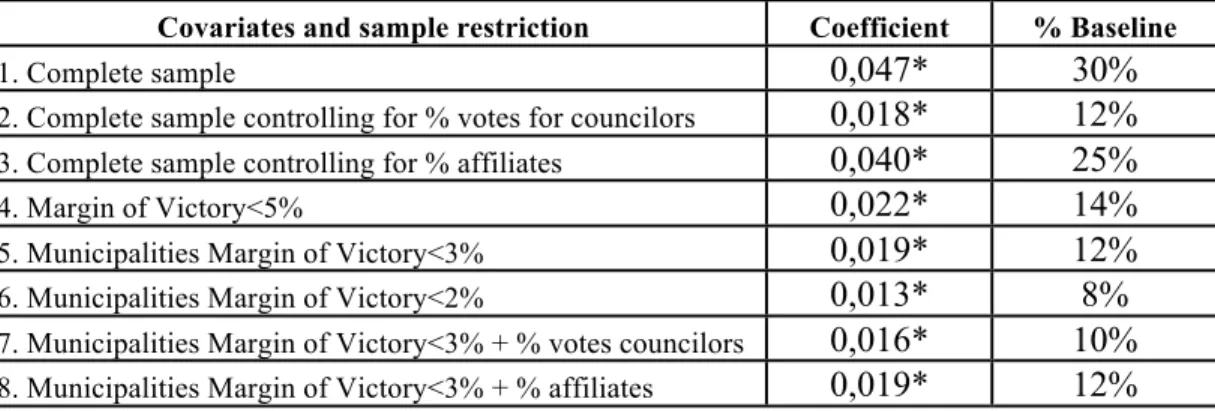
Working initially with the pooled sample we can see that the impact is statistically significant. As discussed in section 4, we control for a 4th degree polynomial form on the margin of victory in order not to confound the possible discontinuity with other non-linarites. The first row shows that the impact using a simple regression is exactly the same as comparing means, 4.7% difference that represents 30% compared to the average baseline.
We then proceed to test whether this result is casual or it is just revealing correlation between one election and the subsequent election. The first approach is the classical selection in observables hypothesis, i.e., we hypothesized that adding controls for the power of the party in the municipality would be enough to correct for the bias in the estimate. We start controlling for the party share of votes for municipal council. In the second row we can see that the impact is dramatically reduced but it is still statistically significant. It is also substantive since a 12% increase in the party share of votes for Federal Congressmen is quite relevant for the party performance.
We feel, however that this variable may be over controlling and that the impact might be actually larger. Votes for the mayor and for the council might be correlated not only through the power of the party in the municipality but rather through other electoral mechanisms that we may not want to control. To check this possibility we attempt another control, the share of party affiliates in the number of registered voters, using the percentage of affiliates as a proxy for the party strength in the municipality. Interestingly, the third row of table 1 shows that results for controlling for party affiliates in the municipality are closer to results of entering no control for party power, which are in the first row of the same table. It can be the case that this variable is not a good proxy for the power of the party in the municipality.14
We proceed with testing the possible causal relationship between electing a mayor and the performance of the party in the (subsequent) statewide proportional elections by reducing the sample to elections where the party barely wins the election. Considering that we are controlling for a 4th degree polynomial function on the margin of victory (that defines the discontinuity when it moves from negative to positive), restricting the sample to municipalities for which the margin is very small is equivalent of a regression discontinuity design (RDD). The advantage of RDD is that we do not have to worry about finding the ideal proxy for party power in the municipality nor we have to worry about unobservable variables. We restrict the sample to 14 It is difficult to hypothesize that this variable has a strong measurement error as some scholars has claimed since the variable is highly significant and with the expected sign.
municipalities for which the margin is less than 5%, 3% and 2%. As a matter of fact, the impact is again dramatically reduced but it is still statistically significant increasing the confidence that mayors are indeed working for their party. Based on this analysis we are very confident that electing a mayor would increase party share in votes for Federal Congressmen at least by 8% that is still very meaningful.
It is interesting to notice that the impact for very close elections is more or less the same as the impact we got controlling for the percentage of votes for councilors. So, we add the party share on votes for councilors to the specification restricted to municipalities where the difference between the first and the second candidate was bellow 3% in line 7. Even though an RDD approach does not need controls to guaranty that the coefficient is unbiased, adding controls correlated with the dependent variable might increase the precision of the estimate. When we add the share of votes for councilors to the regression using close elections (3% difference) the estimated impact would be reduced to 10% compared to 12% if we do not control for this variable (compare lines 5 and 7 on Table 1). When we control for the proportion of party affiliates instead of the party share on votes for councilors the impact of the mayor on the party share of votes for Federal Congressmen is exactly the same as not controlling for any other variable (line 8).
All in all, we can say that in the last decade electing a mayor is probably increasing the party share on subsequent proportional elections. The size of the impact is certainly lower than that estimated by comparing the means but it is still substantive. Increasing the share by 10% is not negligible at all. This result is robust when we constrain the sample to municipalities where the margin of victory was below 3% and it is also robust to the addition of control variables. So, we interpret this result as evidence that parties, as organizations, matter for electoral results. 5.2. RESULTS BY YEAR Although the general result is quite revealing, we would like to go deeper into it. We are interested first in possible differences among years. Table 2 shows the results from a RDD design (3% difference). The main result from this decomposition is that the result is much more intense and significant in 2010 than in any other year included in our analysis. For 1998 and 2002 the coefficient is significant just at 5% and at 10% respectively and for 2006 it is not significant at usual levels.
We have one suspicion to explain this result. On 2007 a new electoral law intended to reduce party switching was enacted (informally called “party fidelity law”). It is not clear why 2006 was not significant and this is certainly an area for further research but one possible guess is that candidates anticipated the party fidelity law and party switching was increased on 2006. On the other hand it may be the case that party switching actually decreased, i.e. the 2007 law did work. Finally it is possible that parties as organizations were actually improving during the decade and are more mature in 2010, although the reversion in 2006 does not support this optimistic view.
We will go back to this issue shortly but we still can just speculate about the origins of these differences in time. To really understand this phenomenon we need to study the migration of mayors among parties in our time frame. Tracking the party would allow us to understand if the problem was connected to measurement errors, if the party switching law was able to change politician's behavior after 2007, or even if it represents a longer trend.
5.3. WHICH PARTY DOES MATTER?
The results presented above have not considered possible specificities of the parties involved. As discussed in the introduction, the Brazilian democracy resulted in a multi-party system. In the period analyzed in this paper, for instance, there were 29 parties that won at least one municipal election besides around half a dozen of parties that have not won any municipal election in the period and, consequently, are out of our analysis. Some of this parties disappear during the period and most of them have no relevance whatsoever in the country politics. Consequently, to understand the phenomenon we are studying by party we decide to use just seven parties to analyze them more carefully. Empirically, those parties represent more than 80% of our sample and have a relevant presence in any year. In more theoretical terms, these parties were the same set analyzed by Carneiro e Almeida (2008) and Guarnieri (2011), an author that has delved into organizational features of Brazilian parties. Table 3 presents the number of municipalities in which the party won or was the second runner by year. It is important to notice that some parties on the list have changed their name during the period.15
PMDB is the most relevant party regarding municipal elections. Although the party has not participate with own candidates in the presidential elections since 1998 it is very stable in its
15 The Partido Progressista Brasileiro (PPB) changed its name to Partido Progressista (PP) in 2003. The Partido
Liberal (PL) incorporated the Partido da Reedificação da Ordem Nacional (PRONA), and became the Partido da República (PR) in 2006. Finally, in 2007, the Partido da Frente Liberal (PFL) changed its name to Democratas (DEM).
dominance at the municipal level. PMDB followed MDB the only opposition party during the dictatorship period. PFL/DEM that used to be the second main player at the municipal level has been considerably reducing its participation. PFL is a right wing party founded in 1985 under the name of Liberal Front Party (Partido da Frente Liberal, PFL) from a dissidence of the defunct Democratic Social Party (PDS), successor to the National Renewal Alliance (Arena), the official government party during the military dictatorship of 1964–1985. It changed to its current name in 2007. In 2008, DEM has less than half municipalities that it used to have in 2000, when it was still part of the national government. Not surprisingly, the main parties during dictatorship were still the main parties in 1998.
On the other hand, PSDB that is the main opposition party disputing the presidency against PT since 1994 has been losing space in the municipal sphere as well but at a slower pace. It seems that (not surprisingly) being in the opposition makes it harder to the party in local elections. The opposite is also true for government parties. PT has more than tripled the number of municipalities where it is competitive. DEM that is in the opposition since 2002 has been going down at a fast pace. PMDB that has never leave the government is quite stable. In any case, we believe that there is more than just being in the opposition or in the government in defining the performance of the parties in local elections. Since our results indicate that parties matter, we believe that this performance is also connected to the internal organization of each party.
Table 4 shows the average party share in votes for Federal Congressmen by year. Once again, PMDB is very stable and have a quite large participation in the municipalities where it got the first or the second position in local elections. PT, PFL/DEM and PSDB have also a high average but it is not as stable as PMDB. In particular PT have oscillated from 15% to 24% in the period. It is interesting to notice that the main parties in the previous table are also the parties that have the largest share. Table 4 also suggests some connection between having the presidency and the electoral performance of Congressmen. PSDB and PFL reduced their share in 2010 while PT increased it. As a matter of fact, PSDB has the presidency from 1995 to 2002 while PFL and PMDB were the main parties in the coalition, while PT got the presidency since 2003 and PMDB is its main allied. PDT and PTB have a very low share compared to other parties and this share is quite uniform in the period.
On Table 5 we check the impact of wining local election on the subsequent election by party with the same (econometric) strategy adopted for the whole sample (see Table 1). To do this analysis we add a set of dummy variables that would equal one for the party under analysis.
We left PMDB out of the analysis to avoid perfect multicolinearity. Consequently, the coefficient on the discontinuity represents its (direct) impact while for other parties we report the coefficient on the interaction between the party dummy and the discontinuity variable. It means that the coefficient reported will be significant if the impact for this party is larger or lower than PMDB´s impact. When we report the impact relative to the baseline we sum up the coefficient of PMDB to the coefficient on the party dummy to get the actual relative impact.16 We estimate the impact controlling for the share of votes for councilors and reducing the samples for elections with a lower margin of victory (10%, 5% and 3%).17 The impact is (again) significant for any specification considering just the seven parties pooled showing that the result obtained for the full sample is the same when we restrict the sample to the seven parties. It is also significant for PMDB in any specification, though in this case, the result lost part of its significance when we restricted the margin of victory to 3% (with this sample, PMDB is significant just at 10%).
Looking at other parties we can notice that just PT is significantly positive in the first two specifications while PTB and PFL/DEM are significantly negative for the first specification (controlling for the party share in votes for Councilors). The impact of winning local election for PFL/DEM is significantly (at 5%) higher than PMDB just when we restrict the sample to municipalities that this party has won the election by a margin that is lower than 10%. PT impact is still significantly higher than PMDB for elections with a margin lower than 10%. There is no significant coefficient for tighter elections (5% and 3% margin). We are suspicious that reducing the sample gives us too little observations to analyze the impacts by party specially when we attempt to make the analysis by year. Consequently we opt to do the analysis by year just controlling by the party share of votes for councilors. As discussed we may be over controlling but we adopt this “conservative” strategy of identification on Table 6.
We can see that the impact is significant at 1% for PMDB in any year considered. This result contrasts with the result observed for the whole sample where the impact is not significant for 2006. It may be the case that those small parties eliminated from the sample were just adding noise to the analysis. It is also important to notice the size of the impact. The impact of PMDB has being growing steadily since 1998 from 8% up to 18% in 2010. Actually the impact in 2006 is not much lower than the impact on 2010. This result shows that the hypothesis that parties were
16 That is, we sum up the coefficients presented in Table 5 for PMDB and the party and then divide it by the average
share of the party reported on Table 4.
17 When we constrain the sample to low margins of victory we control for the percent of voters that are affiliated to
improving their organization skills over the years may still be considered. It is still likely that the Party Fidelity Law has also played a role in the results but we may not discard the trend interpretation as the analysis for all parties pooled together suggested.
We can also see that the impact of PT is significantly higher than the impact of PMDB just in 2010. PDT on the other hand has an impact significantly lower than PMDB in any year considered while PTB has also a significant lower impact since 2002. PSDB impact is significantly lower than PMDB just in 2010. This result may be connected to the fact that the party is currently the main opposition party but it may also be connected to some sort of internal lack of organization inside the party.
These results reinforce the classification of Brazilian political parties suggested by Guarnieri (2011). Based on the number of municipal party organizations and the centralization of party decisions, parties are classified in three groups. At one extreme is the “polyarchic” group that is defined by parties with a large number of municipal organizations, and a decentralized decision-making; this group comprises PT and PMDB. At the other extreme is the “monocratic” group, which is defined by a limited number of municipal organizations with a very centralized decision-making; this group comprises PTB and PP. At the middle is the “oligarchic” group, which is defined by its mixed characteristics regarding either the number of municipal organizations or the centralization of party decisions; this group comprises PSDB, PDT, and DEM. Our results, however, would move PDT to the “monocratic” group, and the PP to the intermediary one.
Using the suggested party classification to reinterpret table 6, we could say that “Polyarchic” parties with a large number of strong municipal organizations, such as PT and PMDB, are more capable to extract votes from winning the municipal election, strengthening our claim that party organization matters for electoral performance. ”Monocratic” parties, with a more centralized party organization, will not be able to use their municipal base to extract votes. Finally, parties in the “Oligarchic” group would be able to extract votes from their mayors, but probably less than the “Polyarchic” group.
6. CONCLUSION AND FURTHER STEPS
This paper extended a previous analysis of the electoral effects of intra-party linkages, an important aspect to understand most federative political systems. Again, it focused on a peculiarity of the Brazilian federation to explore reverse coattails effects from municipal mayors
to statewide legislative elections, as a way to analyze the influence of party organizations on electoral performance.
Comparing with Avelino et al (2012), we employed a larger dataset with data from the 1996 to the 2010 elections. Our findings reinforce our former evidence of reverse coattail electoral effect, calling attention to the importance of municipal party organizations to understand statewide legislative electoral results.
Results from the pooled sample of observations reassured us that our previous findings could be generalized for the entire period. Though effects are somewhat weaker, electing a mayor would probably increase the party share of votes in subsequent proportional elections. These results were also significant when we analyzed them by year; except for the 2006 election, which loses statistical significance, all years included in the sample showed the correct sign and statistical significance.
Finally, we explored the possible variation between Brazilian parties in their ability to reach some level of intra-party cooperation. Using a classification of party organizations, we uncover interesting relations, as more organized parties are more capable to extract votes on subsequent proportional elections from having a mayor. Additionally, the ability of parties to extract votes at local level seems do vary along the years, suggesting increasing or decreasing trends over time. This paper’s findings also uncover several paths for future research. One path is to further analyze the conditions that may favor or hinder the capability of the mayor to transfer her votes to party candidates in legislative elections. In other words, how a mayor is able to transfer votes for her party candidates in subsequent proportional and statewide elections? In order to answer this question, we need to explore the mechanisms that allow mayors to transfer votes to party’s Congressmen candidates. One possible mechanism is the role of mayor as a focal point that coordinates municipal voters. Brazilian voters have a sole vote, but are exposed to high number of candidates per seat in proportional elections, and this abundance of options may require some informational shortcut to render a choice possible. Another way mayors can influence party performance is more indirect: by increasing the number of local party affiliates, who would be responsible for the increasing votes for party candidates in the proportional elections. Finally, Congressmen from mayor’s party would be bringing pork to the municipality and would use the mayor to claim the credits for that pork.
Considering the outstanding result for 2010, the only year with party fidelity, we need a better understanding of party switching. Besides the noise it brings to data analysis, party switching, particularly among mayors, seems to contradict the main argument of this paper concerning the importance of party organizations to party’s electoral performance. However, of switching party, the mayor also changes her support to the new party this would be even stronger evidence that party matters.
REFERENCES
AMES, B. "The Reverse Coattails Effect: Local Party Organization in the 1989 Brazilian Presidential Election." American Political Science Review, v. 88, n. 1, p. 95-111, 1994.
AVELINO, G., C. BIDERMAN and L. BARONE “Articulações Intrapartidárias e Desempenho Eleitoral no Brasil”. Revista Dados, 2012.
BOHN, S. R. e PAIVA, D. "A Volatilidade Eleitoral nos Estados; Sistema Partidário e Democracia no Brasil." Revista de Sociologia e Política, v. 17, n. 33, p. 187-208, 2009.
CARNEIRO, L. P. e ALMEIDA, M. H. T. "Definindo a arena política local: sistemas partidários municipais na federação brasileira." Dados, v. 51, p. 403-432, 2008.
COX, G. W. Making votes count: Strategic coordination in the world's electoral systems. Cambridge, U.K; New York, Cambridge University Press, 1997.
______. "Electoral Rules and Electoral Coordination." Annual Review of Political Science, v. 2, n. 1, p 145-161, 1999.
______. Electoral Institutions and Political Competition; coordination, persuasion and
mobilization. Handbook of New Institutional Economics. C. Ménard and M. M. Shirley, Springer:
69-89, 2005.
DESCHOUWER, K. "Political Parties in Multi-Layered Systems." European Urban and
Regional Studies, v. 10, n. 3, p. 213-226, 2003.
______. Political Parties as Multi-Level Organizations. Handbook of Party Politics. R. S. Katz and W. Crotty. London: Sage Publications, 2006.
GUARNIERI, F. “A Força dos Partidos ‘Fracos’.” Dados, v. 54, p. 235-258, 2011.
LEE, D. S. "Randomized experiments from non-random selection in U.S. House elections."
Journal of Econometrics, v. 142, n. 2, p. 675-697, 2008.
LIMA JR., O.B. Partidos Políticos Brasileiros; a experiência federal e regional: 1945/64. Rio de Janeiro: Edições Graal, 1983.
MAINWARING, S. "Electoral Volatility in Brazil." Party Politics, v. 4, n. 4, p. 523-545, 1998. ______. Rethinking party systems in the third wave of democratization: The case of Brazil. Palo Alto: Stanford University Press, 1999.
______ e TORCAL, M. Party System Institutionalization and Party System Theory After the
Third Wave of Democratization. Handbook of Party Politics. R. S. Katz and W. Crotty. London: Sage
PERES, P.; RICCI, P.; e RENNÓ, L. “A Volatilidade Eleitoral no Brasil.” Latin American
Research Review, 46, n. 3, p. 46-68.
RIKER, W. H. Federalism: origin, operation, significance. Boston: Little, 1964.
SAMUELS, D. J. "The Gubernatorial Coattails Effect: Federalism and Congressional Elections in Brazil." The Journal of Politics, v. 62, n. 1, p. 240-253, 2000a.
______."Concurrent Elections, Discordant Results: Presidentialism, Federalism, and Governance in Brazil." Comparative Politics, v. 33, n. 1, p. 1-20, 2000b.
THORLAKSON, L. "Patterns of Party Integration, Influence and Autonomy in Seven Federations." Party Politics, v. 15, n. 2, p. 157-177, 2009.
______. "Measuring vertical integration in parties with multi-level systems data." Party Politics,
TABLES
Table 1: Impact of Mayor Election (1996 to 2008) on Subsequent (1998 to 2010) Federal
Congressman's Votes for Different Specifications/Samples
Covariates and sample restriction Coefficient % Baseline
1. Complete sample 0,047* 30%
2. Complete sample controlling for % votes for councilors 0,018* 12%
3. Complete sample controlling for % affiliates 0,040* 25%
4. Margin of Victory<5% 0,022* 14%
5. Municipalities Margin of Victory<3% 0,019* 12%
6. Municipalities Margin of Victory<2% 0,013* 8%
7. Municipalities Margin of Victory<3% + % votes councilors 0,016* 10%
8. Municipalities Margin of Victory<3% + % affiliates 0,019* 12%
* significant at 1%; ** significant at 5%; *** significant at 10%. Baseline considered as the average percentage of votes for Federal Congressman by Party for the two runners Regressions controlling for a 4th degree polynomial equation on the margin of victory Source: Tribunal Superior Eleitoral (TSE)
Table 2: Impact of Mayor Election on Subsequent Federal Congressman's Vote by Year
Year Coefficient % Baseline
1998 0,0163** 11%
2002 0,0137*** 8%
2006 0,0068 4%
2010 0,0411* 28%
* significant at 1%; ** significant at 5%; *** significant at 10%. Regressions controlling for a 4th degree polynomial equation on the margin of victory (coefficients omitted) restricted to municipalities for which the margin of victory was bellow 3%. Source: Tribunal Superior Eleitoral (TSE) and IBGE
Table 3: Number of Municipalities with Less than Two Hundred Thousand Voters for which the Party
Won Municipal Election or was the Second Runner by Party and Year
Party 1996 2000 2004 2008 Total PMDB 2536 2453 2086 2264 9339 PPB/PP 1243 1147 1015 996 4401 PDT 837 614 563 716 2730 PT 292 465 909 1052 2718 PTB 718 801 840 765 3124 PFL/DEM 1900 2010 1490 990 6390 PSDB 1684 1740 1595 1454 6473
Source: Tribunal Superior Eleitoral (TSE)
Table 4: Party Share of Votes for Federal Congressmen in Municipalities with Less than Two Hundred
Thousand Voters for which the Party Got the First or Second Position in Municipal Elections by Party and Year Party Data Pooled Year 1998 2002 2006 2010 All 17% 16% 19% 17% 16% PMDB 21% 20% 21% 23% 21% PPB/PP 16% 13% 17% 16% 17% PDT 8% 6% 9% 9% 8% PT 21% 15% 24% 19% 23% PTB 7% 6% 7% 7% 8% PFL/DEM 21% 23% 24% 18% 13% PSDB 19% 18% 22% 20% 16%
Table 5: Impact of Mayor Election on Subsequent Federal Congressman's Vote by Party for Different
Specifications
Party % Vote Council Margin < 10% Margin < 5% Margin < 3%
Coeff. Impact Coeff. Impact Coeff. Impact Coeff. Impact
All 0,019* 11% 0,026* 14% 0,023* 14% 0,020* 12% PMDB 0,027* 13% 0,024* 11% 0,022* 10% 0,014*** 6% PPB/PP -0,003 16% -0,003 13% -0,011 7% -0,023 -6% PDT -0,027* 1% -0,013 13% -0,007 19% -0,005 11% PT 0,016* 21% 0,018** 20% 0,009 15% 0,018 15% PTB -0,025* 4% -0,005 26% -0,007 21% 0,008 30% PFL/DEM -0,004 11% 0,014** 18% 0,015 18% 0,025 20% PSDB -0,007 11% -0,002 11% 0,002 13% 0,013 14%
* significant at 1%; ** significant at 5%; *** significant at 10%. Coefficient and Significance for PMDB reflects the impact of electing the mayor; Coefficient and significance for other parties is relative to PMDB; Impacts are the net impact on Congressman’s election. Regressions controlling for a 4th degree polynomial equation on the margin of victory
Source: Tribunal Superior Eleitoral (TSE) and IBGE
Table 6: Impact of Mayor Election on Subsequent Federal Congressman's Vote by Party and Year
Party 1998 2002 2006 2010
Coeff. Impact Coeff. Impact Coeff. Impact Coeff. Impact
PMDB 0,017* 8% 0,028* 13% 0,032* 14% 0,036* 17% PPB/PP -0,008 7% -0,003 14% 0,003 22% -0,006 17% PDT -0,020*** -4% -0,029** -1% -0,026*** 7% -0,032* 5% PT -0,008 6% -0,022 3% 0,013 23% 0,025* 26% PTB -0,010 12% -0,032* -6% -0,035* -4% -0,025** 14% PFL/DEM 0,005 10% -0,001 11% 0,001 18% -0,024** 9% PSDB 0,006 12% -0,003 11% -0,011 11% -0,023* 8%
* significant at 1%; ** significant at 5%; *** significant at 10%. Coefficient and Significance for PMDB reflects the impact of electing the mayor; Coefficient and significance for other parties is relative to PMDB; Impacts are the net impact on Congressman’s election. Regressions controlling for party share on % of votes for councilors and a 4th degree polynomial equation on the margin of victory Source: Tribunal Superior Eleitoral (TSE) and IBGE