Braz. J. of Develop.,Curitiba, v. 6, n. 3,p.16290-16302 mar.. 2020. ISSN 2525-8761
Netafim D-NET
TM7595 performance and uniformity with and without
teeth of diffusion arm
Desempenho e uniformidade de aplicação do aspersor Netafim D-NET
TM7595 com e sem dentes do braço difusor
DOI:10.34117/bjdv6n3-485
Recebimento dos originais: 29/02/2020 Aceitação para publicação: 31/03/2020
Lis Tavares Ordones Lemos
Autor Correspondente Mestre em Recursos Hídricos Instituição: Universidade Federal de Lavras
Endereço: Rua José Demetrio Coelho, 730, apto 402 – Centro, Carmo do Cajuru – MG, Brasil
E-mail: [email protected]
Virgílio Henrique Barros Nogueira
Mestre em Recursos Hídricos Instituição: Universidade Federal de Lavras
Endereço: Rua Dr Genésio Botelho Pereira, 149, Alfavile, Lavras MG E-mail: [email protected]
Ricardo Chaves Neto
Doutorando em Recurso Hídricos Instituição: Universidade Federal de Lavras
Endereço: Campus Universitário, UFLA, Aquenta Sol, Lavras - MG, 37200-900 E-mail: [email protected]
Maurício Pinheiro de Pinho Machado
Bacharel em Engenharia Agrícola Instituição: Universidade Federal de Lavras
Endereço: Rua das Palmeiras, 31 apto 203, Jardin Eldorado, Lavras-MG E-mail: [email protected]
Renan Teixeira Delfino
Mestrando em Engenharia Agrícola Instituição: Universidade Federal de Lavras
Endereço: Rua Treze de Outubro, 30 - Centro, Lavras - MG, Brasil E-mail: [email protected]
Pr. Dr. Fábio Ponciano de Deus
Doutor em Engenharia Agrícola
Endereço: Campus Universitário, UFLA, Aquenta Sol, Lavras - MG, 37200-900 Instituição: Universidade Federal de Lavras
Braz. J. of Develop.,Curitiba, v. 6, n. 3,p.16290-16302 mar.. 2020. ISSN 2525-8761
ABSTRACT
The artificial water application through irrigation systems can provide uneven applications, causing excess or deficit in part of the cultivating area. The companies that supply irrigation equipment have been investing in the development of products that optimize the efficiency of application, and consequently the cost of production. The objective of this study was to evaluate the influence of the structural modification of the 3D diffusion arm on the performance and uniformity of a Netafim ™ D-Net ™ 9575 sprinkler. The structural modification made by the company was to allocate bulkheads (teeth) in the diffusion arm, in order to optimize water distribution. In Lavras, state of Minas Gerais, Brazil the experiment was performed, assays with teeth (WT) and no teeth (NT), at three pressures (200, 300 and 400 kPa), with three repetitions. The evaluation of the sprinkler performance was based on the determination of the radial profile of each combination, Christiansen uniformity coefficient (CUC), application intensity, and sprinkler flow. The results indicated that the average application intensities (Ia) of each pressure with the teeth (WT) and without the teeth (NT) of the diffuser are coherent compared to the values indicated in the catalog. The Ia values for all NT tests and for some WT pressures are slightly above that recommended by the Netafim ™ catalog. Overall the diffuser arm WT reduces the range of the water jet. The CUC uniformity coefficient with 300 kPa working pressure for the WT and NT tests achieved the best results according to the objective.
Keywords: Uniformity Coefficient; Intensity of Application; Conventional Sprinkler
Irrigation.
RESUMO
A aplicação de água artificial através de sistemas de irrigação pode ter distribuição de água desigual, causando excesso ou déficit em parte da área de cultivo. As empresas que fornecem equipamentos de irrigação têm investido no desenvolvimento de produtos que otimizam a eficiência da aplicação e, consequentemente, o custo de produção. O objetivo deste estudo foi avaliar a influência da modificação estrutural do braço difusor 3D no desempenho e na uniformidade do aspersor Netafim ™ D-Net ™ 9575. A alteração estrutural feita pela empresa foi alocar anteparos (dentes) no braço difusor, a fim de otimizar a distribuição da água. Em Lavras, Minas Gerais, Brasil, foi realizado o experimento, ensaios com dentes (WT) e sem dentes (NT), a três pressões (200, 300 e 400 kPa), com três repetições. A avaliação do desempenho do aspersor foi baseada na determinação do perfil radial de cada combinação, coeficiente de uniformidade de Christianen (CUC), intensidade da aplicação e vazão do aspersor. Os resultados indicaram que as intensidades de aplicação médias (Ia) de cada pressão de serviço com os dentes (WT) e sem os dentes (NT) do difusor são coerentes em comparação com os valores indicados no catálogo. Os valores de Ia para todos os testes de NT e para algumas pressões de WT estão ligeiramente acima dos recomendados pelo catálogo Netafim ™. No geral, o braço difusor WT reduz o alcance do jato de água. O coeficiente de uniformidade CUC com pressão de trabalho de 300 kPa para os testes WT e NT obteve os melhores resultados de acordo com o objetivo.
Palavras-chave: Coeficiente de Uniformidade; Intensidade de Aplicação; Irrigação por
Braz. J. of Develop.,Curitiba, v. 6, n. 3,p.16290-16302 mar.. 2020. ISSN 2525-8761
1 INTRODUCTION
Irrigation is one of the techniques of agricultural production sectors that allows significant increases in yield and guarantees stability in agricultural production is irrigation, especially in periods of water deficit (Faria et al., 2009). Irrigated agriculture has achieved high productivity worldwide with an irrigated harvested area of more than 346 million hectares, representing 20.6% of cultivated area (Fao, 2016).
However, irrigation is considered by the market as one of the main water consuming agricultural activities. Because it affects the quality and the yield of the cultivated crop, the irrigation systems must be properly designed, presenting adequate coefficients of uniformity of water application, associated with the correct irrigation management having a positive return for the producer (Maroufpoor et al., 2019).
Therefore, it is essential to adopt measures that enables the proper use of available water resources. In sprinkler irrigation, the system needs to be evaluated after the project implementation, in order to verify if its performance is in accordance with what was previously established, allowing, if necessary, adjustments to improve its performance and, periodically, to evaluate the quality of system maintenance and management (Rocha et al., 2018).
The uniformity coefficient represents the variability of the irrigation depth on the soil surface and is mainly influenced by sprinkler spacing, wind speed and operating pressure (Rocha et al., 2018). Christiansen uniformity coefficient (CUC) is the most well-known and, for its simplicity, the most widely used coefficient (Rocha et al., 2018). It has been considered by many authors, the main parameter to calculate the uniformity of irrigation, measuring the spatial variability of the water depth applied by the irrigation system. As Martins et al. (2011) exemplified a system with 80% CUC means that approximately 80% of the area will receive a water depth greater than or equal to the average application depth.
The objective of this work was to evaluate the performance and uniformity of surface water distribution of conventional sprinkler impact sprinkler irrigation, D-NetTM 9575, from NETAFIM with 3 pressures and to compare sprinkler performance with and without the teeth (bulkheads) in its 3D diffusion arm.
2 METHODOLOGY
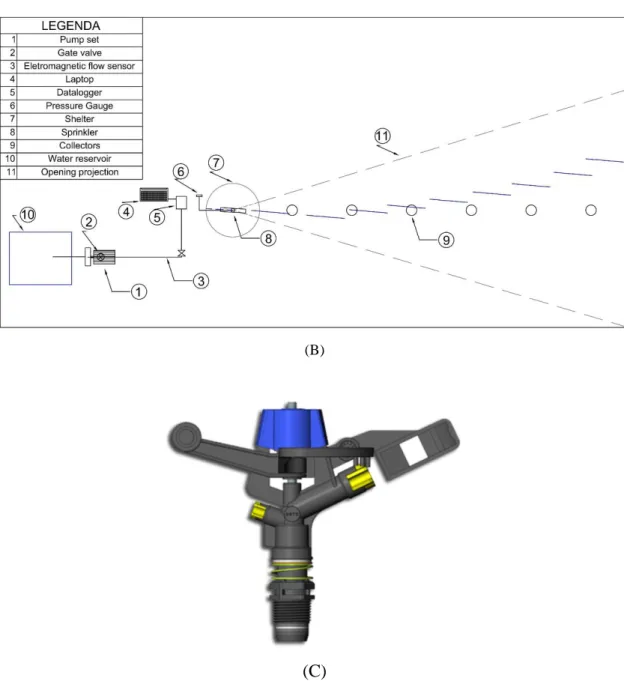
The tests were performed in an experimental module (Figure 1) in the city of Lavras, in the state of Minas Gerais, Brazil (21°14’06’’S latitude, 45°00’00” W longitude) at 910 m of altitude, composed of the following equipment (Figure1): pump set, connected to a constant
Braz. J. of Develop.,Curitiba, v. 6, n. 3,p.16290-16302 mar.. 2020. ISSN 2525-8761 water level reservoir, and regulated using frequency inverter and gate valve; an electromagnetic flow sensor (Signet 2536, Georg Fischer Piping Systems Ltda., São Paulo, SP), whose data were recorded in Campbell datalogger (CR10 model) and monitored on a Laptop; an analog pressure gauge, connected to the sprinkler rising tube and positioned at the same height as the largest nozzle of the sprinkler tested; a shelter with 23 ° opening used to direct the jet; collectors (20 centimeters high and 18 centimeters in diameter) arranged radially to the bell opening, spaced 1 meters apart from each other and the first collector, 0.5 meters from the sprinkler, placed on a metal grid to avoid rebound droplets from the floor (ABNT, 1999), a Netafim (Model D - NetTM 9575) impact sprinkler, consisting of two nozzles (grey - 4.36 mm and yellow - 2.50 mm), with 24° of trajectory angle and 360° of rotation angle, allocated to a height of 1 m, avoiding lateral vibrations. Table 1 shows the performance specifications of the tested sprinkler.
Figure 1: Schematic of the assembly of the experimental module, with detail of the side view (A), and the top view (B); Detail of the sprinkler with the 3D diffusion arm of the (NetafimTM) (C).
Braz. J. of Develop.,Curitiba, v. 6, n. 3,p.16290-16302 mar.. 2020. ISSN 2525-8761
(B)
(C)
Table 1: Netafim (Model D-NetTM 9575) Sprinkler Performance Specifications for Grey / Yellow Nozzle Combinations1 P (kPa) Q (m³ h-1) D (m) IA (mm h-1) Spacing (m x m) 12x15 12x16 12x17 12x18 15x15 15x16 15x17 200 1,306 23 7,3 6,8 6,4 6,0 5,8 5,4 5,1 250 1,460 25 8,1 7,6 7,2 6,8 6,5 6,1 5,7 300 1,600 25 8,9 8,3 7,9 7,4 7,1 6,7 6,3 350 1,727 26 9,6 9,0 8,5 8,0 7,7 7,2 6,8 400 1,846 26 10,3 9,6 9,1 8,6 8,2 7,7 7,3
Braz. J. of Develop.,Curitiba, v. 6, n. 3,p.16290-16302 mar.. 2020. ISSN 2525-8761 The structural modification performed by the company was to allocate bulkheads in the diffusion arm of the sprinkler, which is claimed to provide better water distribution. In order to verify the probable increase in distribution uniformity, the experiment was initially carried out with bulkhead (teeth) sprinkler (called "WT"), and then the tests without bulkhead (NT) were performed, after taking them off manually.
The tests were performed in the combination of sprinklers with (WT) and without bulkheads (NT), with three pressures covering the manufacturer's recommended range (200, 300 and 400 kPa), with three repetitions. The duration of each trial was 1 hour.
Flow and pressure data were collected at 10-minute intervals. Water temperature was determined using a mercury thermometer, also at 10-minute intervals, the average temperature for the assays were 22 °C and 23 °C for the 200 kPa and the 400 kPa, WT and NT tests respectively, and 22 °C and 24 °C for the 300 kPa WT and NT tests respectively.
The quantification of water evaporation inside the laboratory was performed by varying the mass of three water containers randomly placed inside the laboratory, the average evaporation for during the test were 0,06 mL and 0,08 mL for the 200 kPa WT and NT tests respectively, 0,06 mL for both the assays at 300 kPa and for the 400 kPa assay were 0,07 mL for the WT test and 0,06 mL for the NT .
To calculate the water depth applied along the distribution profile, the water mass in each collector was determined using a precision digital scale, correcting the specific water mass as a function of the measured temperature.
The parameters used for comparison were the water distribution profiles and the Christiansen uniformity coefficients (CUC) generated for each combination. Through the data stored during the tests, the parameters of distribution uniformity, flow and overlap spacing according to the pressures worked were determined using the software for processing data resulting from the radial sprinkler distribution test. Developed at the International Network of Irrigation Testing Laboratories (INITL), the software uses the Grade 2 Lagrange interpolator polynomial, as cited by Camargo et al. (2014) and is available at: https://www.feagri.unicamp.br/labhidraulica/ initl / index.html
The method used in the uniformity analysis (CUC) was according to equation 1 proposed by Christiansen (1942).
Braz. J. of Develop.,Curitiba, v. 6, n. 3,p.16290-16302 mar.. 2020. ISSN 2525-8761 CUC=100* [1- ∑ |qi- q| n i=1 ne*q ] 1 qi = emitter flow, L h-1;
q = average emitter flow, L h-1; ne = number of emitters.
The adjustment of the reconstituted sprinkler flow was determined according to ISO 15886-3 (2012), (Equation 2) comparing the results of water flow from those obtained by the tests.
Qrec, reconstructed water flow;
dr, represents the distance between collectors, which must be the same throughout the entire range of the sprinkler;
ri, distance from the collector i from the sprinkler; xi water depth in collector I;
t, duration of the test or collection time.
To determine the pulverization parameters and the pulverization of the jet, equations 3 and 4 were used, as described by Pereira (2003).
Pd= H 10q0.4 3 Gp= H d 4 Pd, pulverization; H, working pressure (m); Q, sprinkler flow (m3 s-1); d, nozzle diameter (mm). Qrec = ∑(2πridrxi)) t 2
Braz. J. of Develop.,Curitiba, v. 6, n. 3,p.16290-16302 mar.. 2020. ISSN 2525-8761
3 RESULTS AND DISCUSSION
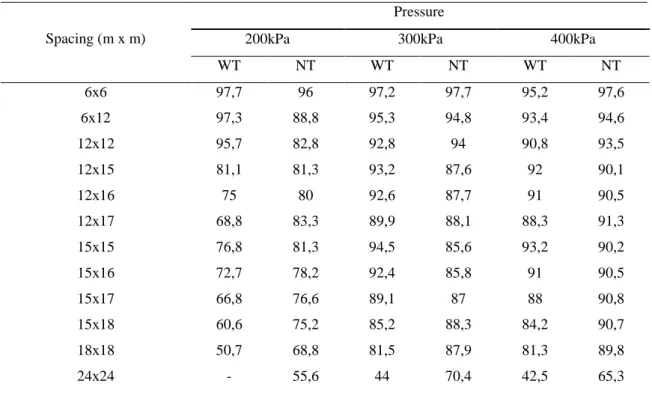
Table 2 shows the mean values of CUC generated in the INITL program for the used spacings (6x6, 6x12, 12x12, 12x15, 12x16, 12x17, 15x15, 15x16, 15x17, 15x18, 18x18, 24x24m). 200 kPa, 300 kPa and 400 kPa for the sprinkler with and without the teeth of the diffuser. CUC values can be classified according to Bernardo et al. (2006), as excellent (greater than 90%), good (80-90%), fair (70-80%) and poor (below 60%). The manufacturer's catalog also says that uniformity is considered excellent when greater than 92%, good when it is between 92 and 88%, average, 88 to 86% and poor when less than 86%.
Table 2: Christiansen uniformity coefficient considering rectangular sprinkler arrangement
Spacing (m x m)
Pressure
200kPa 300kPa 400kPa
WT NT WT NT WT NT 6x6 97,7 96 97,2 97,7 95,2 97,6 6x12 97,3 88,8 95,3 94,8 93,4 94,6 12x12 95,7 82,8 92,8 94 90,8 93,5 12x15 81,1 81,3 93,2 87,6 92 90,1 12x16 75 80 92,6 87,7 91 90,5 12x17 68,8 83,3 89,9 88,1 88,3 91,3 15x15 76,8 81,3 94,5 85,6 93,2 90,2 15x16 72,7 78,2 92,4 85,8 91 90,5 15x17 66,8 76,6 89,1 87 88 90,8 15x18 60,6 75,2 85,2 88,3 84,2 90,7 18x18 50,7 68,8 81,5 87,9 81,3 89,8 24x24 - 55,6 44 70,4 42,5 65,3
For the pressure 200 kPa the WT sprinkler presented better CUC only in the 6x6, 6x12 and 12x12m spacing, being the only values considered by Bernardo et al. (2006), as excellent. For this pressure, and larger spacings the NT sprinkler presented higher CUC values, which can be explained by the fact that from 8 m away the applied water depth was larger to that of the WT sprinkler, as shown in Figure 2. Although this pressure class presented better uniformity for spacings smaller than 12x12 in the WT tests, the CUC values were classified as good or regular according to Bernardo et al. (2006).
Braz. J. of Develop.,Curitiba, v. 6, n. 3,p.16290-16302 mar.. 2020. ISSN 2525-8761
Figure 2: Average WT and NT radial profiles with the repetitions at 200 kPa (a), at 300 kPa (b) and 400 kPa (c).
At 300 kPa operating pressure the WT sprinkler presented 7 values out of 12 tested spacings with greater uniformity than the NT sprinkler, where the spacings of 6x12, 12x15 and 12x16m were rated as excellent. It can be seen from Figure 2 that the difference in application intensity between the sprinkler with and without the teeth of the diffusion arm is reduced, thus the uniformity values were similar.
At 400 kPa only 4 spacings WT were rated as excellent and resulted in better uniformities than those calculated for NT sprinkler. According to Figures 2, it is possible to
Braz. J. of Develop.,Curitiba, v. 6, n. 3,p.16290-16302 mar.. 2020. ISSN 2525-8761 observe that as of 9 m from the sprinkler the application intensity of the NT emitter was slightly higher than the WT. This behavior explains the fact that for the 15x17, 15x18 and 18x18 m spacings, the CUC was close to 90% for the NT sprinkler.
The increase in working pressure was determinant for the greater uniformity of profile distribution for both WT and NT tests. It is possible to infer from Table 2 that the greater the spacing between sprinklers the smaller the CUC for the WT in comparison to the NT. For the 200kPa tests, this difference can be observed from the 12 by 15 meters spacing, for the 300kPa pressure this behavior can be observed from 15 by 18 meters spacing, and for the 400kPa working pressure this can be observed from the 15 by 17 meters spacing. This behavior is possibly due to the fact that the bulkheads in the diffusion arm reduce the range of the water jet specially for the smaller working pressure.
For all pressures CUC values are higher for smaller spacings, a fact also reported by Rezende et al. (1998), Faria et al. (2009), Martins et al. (2012) and Martins et al. (2014). Additionally, for the sprinkler without the teeth of the diffusion arm, the increased pressure provided an improvement in CUC for all spacings tested due to the increased depth applied near the sprinkler. Thus, the higher the pressure, the smaller the influence of the bulkheads in the CUC. Similarly, Martins et al. (2012), concluded in their study on the radial profile of the NaanDanJain 427 sprinkler, that the deflector has a direct influence on water distribution because there is greater spraying of the jet, and found an increase in CUC as a result of increased pressure.
According to ABNT (1999), the precipitation intensity in each collector must be greater than 0.25 mm h-1 to be consider as the sprinkler wet radius. Therefore, the range of the sprinkler jet without the teeth of the diffuser was larger than the with teeth sprinkler, indicating influence of the bulkheads of the diffuser on water distribution.
The average application intensities (Ia), in millimeters per hour, of each pressure WT and NT and the values given in the catalog were consistent. For the 200kPa WT test, only the spacings between 12 and 15 differed from that indicated by Netafim ™. As can be seen in Table 3, the values of Ia for all NT tests and for the other pressures, WT were slightly higher than those in the catalog.
Braz. J. of Develop.,Curitiba, v. 6, n. 3,p.16290-16302 mar.. 2020. ISSN 2525-8761
Table 3: Application Intensity for different spacings, and for the sprinkler operating with and without the teeth of the diffuser and the corresponding D-Net ™ 9575 sprinkler catalog values.
Spacing (m x m)
200 kPa 300 kPa 400 kPa
WT NT WT NT WT NT
Test Catalog Test Test Catalog Test Test Catalog Test
12x15 7,2 7,3 7,7 9,0 8,9 9,2 10,4 10,3 10,6 12x16 6,8 6,8 7,2 8,4 8,3 8,6 9,7 9,6 9,9 12x17 6,4 6,4 6,8 7,9 7,2 8,1 9,2 9,1 9,4 15x15 5,8 5,8 6,1 7,2 7,1 7,4 8,3 8,2 8,5 15x16 5,4 5,4 5,8 6,8 6,7 6,9 7,8 7,7 8,0 15x17 5,1 5,1 5,4 6,4 6,3 6,5 7,3 7,3 7,5 15x18 4,8 - - 6,0 5,9 6,1 6,9 6,9 7,1
*The spacings presented are only the ones indicated in the manufacturers catalog. WT: With the teeth of the diffuser arm; NT: Without the teeth of the diffusion arm.
This difference can be explained in Table 4. The average flow measured in the 200 kPa WT test varied only 0.5% from the catalog, which explains the fact that the application intensity differed only in the 12 x 15 spacing. For the same pressure test for NT, a 5.7% deviation was obtained, which explains the largest difference between Ia.
Table 4: Average flow rate (m3/h) of each test, with and without the teeth of the diffuser arm, in comparison with the flow rate in the D-Net™ 9575 sprinkler catalog.
Pressure
200kPa 300kPa 400kPa
Diffuser arm WT NT WT NT WT NT
𝑥̅ FR 1,3 1,38 1,62 1,66 1,87 1,91
Reconstituted 𝑥̅ FR 1,3 1,28 1,56 1,58 1,8 1,76
Catalog flow rate 1,31 1,31 1,60 1,60 1,85 1,85
Deviation (reconstituted and
measured) 1.05% 6.89% 3.38% 4.93% 3.3% 7.96%
Deviation
(catalog and measured) 0,5% 5,7% 1,3% 3,7% 1,3% 3,5%
Deviation
(catalog and reconstituted) 0,5% 2,0% 2,5% 1,3% 2,5% 4,7%
Braz. J. of Develop.,Curitiba, v. 6, n. 3,p.16290-16302 mar.. 2020. ISSN 2525-8761 Koech et al. (2016) states that according to ISO 15886-3 (2012) for test results to be valid, the deviation between the reconstituted flow and the measured flow rate should not be greater than 5% for sprinklers with flow rates greater than 0.141 L s-1 or 0.53 m3 h-1. Therefore, the NT tests for pressures of 200 and 400 kPa should be invalid, as they obtained a deviation of 5.7% and 7.96% respectively.
Possible explanations for these variations are the asymmetric impact sprinkler coverage, which is directly linked to its rotation speed, and uncertainties at the time of data collection, which was also observed by Koech et al. (2016). As in the authors' experiment, the sprinkler used in these trials was new and the pressures in each trial were maintained as recommended by the manufacturer, making the expected results different from those obtained. The uncertainty of the devices used to measure flow, pressure, water depth may add to the explanation of the deviations in Table 4.
4 FINAL CONSIDERATIONS
The bulkheads (teeth) in the diffusion arm decreases the water jet range for all pressures tested (200,300 and 400 kPa), although the intensity of application is similar to the catalog. The 300 kPa pressure CUC were excellent for the with teeth diffusion arm tests and higher than the no teeth tests, for the manufacturer's recommended 12x15, 12x16, 15x15, 15x16 spacings. The results show that the greater the spacing analyzed, the lower the CUC for all tests.
REFERENCES
ABNT - Associação Brasileira de Normas Técnicas. Equipamentos de irrigação agrícola: Aspersores rotativos. Parte 1: Requisitos para projetos e operação. Projeto 04:015.08-012. Parte 2: Uniformidade de distribuição e métodos de ensaio. Projeto 04:015.08-013. Rio de Janeiro: ABNT, 1999. 22p.
Bernardo, S; Soares, A. A.; Mantovani, E. C. Manual de irrigação. Viçosa: UFV, 2006. 625 p. Camargo, A.P.; Molle, B.; Tomas, S.; Pinto, F. M.; Frizzone, J. A. Aplicação web para processamento de dados do ensaio de distribuição radial de aspersores. 2014.In: II INOVAGRI International Meeting, 2838-2847, Fortaleza.
Christiansen, J.E. Irrigation by sprinkling. Berkeley: California Agricultural Station. 1942. 124p. Bulletin, 670.
Braz. J. of Develop.,Curitiba, v. 6, n. 3,p.16290-16302 mar.. 2020. ISSN 2525-8761 FAO (2016) AQUASTAT: FAO’s global water information system, the land and water division. www.fao.org/nr/aquastat. 2016.
Faria, L. C.; Colombo, A.; Oliveira, H. F. E. de; Prado, G. Simulação da uniformidade da irrigação de sistemas convencionais de aspersão operando sob diferentes condições de vento. Engenharia Agrícola, v.29, p.19-27, 2009.
ISO. (2012). Agricultural irrigation equipment—Sprinklers. Part 3: Characterization and test methods. ISO 15886-3, Geneva
Koech, R. et al. Intercomparison testing and evaluation of sprinklers within the INITL. Journal of Irrigation and Drainage Engineering, v. 142, n. 2, p. 04015048, 2015.
Maroufpoor, S. et al. Modeling the sprinkler water distribution uniformity by data-driven methods based on effective variables. Agricultural water management, v. 215, p. 63-73, 2019. Martins, C. A. da S.; Reis, E. F. Dos; Passos, R. R.; Garcia, G. de O. Desempenho de sistemas de irrigação por aspersão convencional na cultura do milho (Zea mays L.). IDESIA, Chile, v.29, n.3. p.65-74 Set-Dez, 2011. Disponível em: < https://scielo.conicyt.cl/pdf/idesia/v29n3/art10.pdf> . Acesso em: 02 nov. 2018.
Martins, P. E. S. et al. Uniformity of Precipitation and Radial Profile of the Super 10 Sprinkler at Different Operating Pressures. Journal of Water Resource and Protection, v. 6, n. 11, p. 951, 2014.
Martins, P. ES et al. Perfil radial e uniformidade de precipitação do aspersor NaanDanJain 427, em função da regulagem do defletor. Revista Brasileira de Engenharia Agrícola e Ambiental, 2012.
Pereira, G. M. Aspersão convencional. In: Miranda, J.H. de; Pires, R.C. de M. Irrigação. Piracicaba, SP: FUNEP/ SBEA, 2003. v.2, 703 p.
Rezende, R.; Frizzone, J. A.; Gonçalves, A. C. A.; Freitas, P. S. L. de. Influência do espaçamento entre aspersores na uniformidade de distribuição de água acima e abaixo da superfície do solo. Revista Brasileira de Engenharia Agrícola e Ambiental, v.2, p.257-261, 1998.
Rocha, E. M. M; Costa, R.N.T.; Mapurunga, S.M.S. Castro, P. T. Uniformidade de distribuição de água por aspersão convencional na superfície e no perfil do solo. Revista Brasileira de Engenharia Agrícola e Ambiental, Campina Grande, v.3, n.2, p. 154-160, 1999. Disponível em: http://www.agriambi.com.br. Acesso em: 02 nov. 2018.