I
UNDERSTANDING THE RECEPTIVITY OF USERS
TOWARDS A MARKETING CAMPAIGN ON TINDER
Marta Casaca Mealha
75600MM2
Dissertação submetida como requisito parcial para obtenção do grau de Mestre em Marketing
Orientador:
Doutor Paulo Miguel Rasquinho Ferreira Rita, Professor Catedrático de Marketing, Nova Information Management School (NOVA IMS), Universidade Nova de Lisboa
Co-Orientador:
Ricardo Filipe Carreira Ramos, Professor convidado, Universidade Autónoma de Lisboa (UAL)
II
A
A
N
Á
L
ISE
D
O
E
FE
IT
O
D
A
E
MISS
Ã
O
DE
T
ÍT
U
L
O
S
N
O
V
A
L
O
R
D
A
E
MPRE
S
A
M
a
rt
a
C
a
sa
ca
M
ea
lha
III
UNDERSTANDING THE RECEPTIVITY OF USERS
TOWARDS A MARKETING CAMPAIGN ON TINDER
Marta Casaca Mealha
75600MM2
Dissertação submetida como requisito parcial para obtenção do grau de Mestre em Marketing
Orientador:
Doutor Paulo Miguel Rasquinho Ferreira Rita, Professor Catedrático de Marketing, Nova Information Management School (NOVA IMS), Universidade Nova de Lisboa
Co-Orientador:
Ricardo Filipe Carreira Ramos, Professor convidado, Universidade Autónoma de Lisboa (UAL)
IV
Abstract: In a world driven by Social Media, marketers have shifted their focus to digital marketing. Consequently, the exhaustive amount of advertising on the most successful Social Media networks has been caused fatigue to its users, and therefore, the need to create unique advertising has been a major key success factor when it comes to marketing planning. In this study, the Social Media app Tinder, holding around 300 million of users worldwide, was tested as a possible marketing tool for digital advertising – to avoid the mass advertising present on the most popular social networks. This study aims to analyze Tinder users’ responsiveness towards a marketing campaign promoting a Portuguese clothing website. A total of 411 users’ reactions were obtained and put under text mining analysis to calculate each reaction on a sentiment scale. The results showed a large acceptability towards the clothing website marketing campaign on the app, an encouragement to marketers to think ahead of the most obvious Social Media platforms when it comes to marketing strategies.
Keywords: Social media marketing; text mining; user feedback; Tinder. JEL Classification System: M300 Marketing: General; M310 Marketing
Resumo: Num mundo impulsionado pelas redes sociais, os marketers alteraram o seu foco para o marketing digital. Consequentemente, a quantidade exaustiva de publicidade nas redes sociais mais bem-sucedidas começa a causar fatiga aos seus usuários, portanto a necessidade de criar anúncios únicos tem sido um fator importante de sucesso quando se trata de planeamento de marketing. Neste estudo, a rede social Tinder, que detém cerca de 300 milhões de usuários globalmente, foi testada como uma possível ferramenta de marketing para publicidade digital – de modo evitar a publicidade em massa presente nas redes sociais mais populares. Este estudo pretende analisar a recetividade dos utilizadores do Tinder perante uma campanha de marketing a promover uma loja de roupa online em Portugal. Um total de 411 reações foram obtidas e colocadas sob análise de mineração de texto para calcular cada reação numa escala de sentimentos. Os resultados apresentam uma grande aceitação em relação à campanha de marketing na aplicação, um incentivo para os marketers refletirem além das redes sociais mais óbvias quando se trata de estratégias de marketing.
Palavras-chave: Social media marketing; text mining; user feedback; Tinder. JEL Classification System: M300 Marketing: General; M310 Marketing
V Table of contents: Acknowledgements: ... VI Executive summary: ... VI 1. Introduction ... 1 2. Literature Review ... 2
2.1. Social Media Marketing ... 2
2.2 Tinder ... 5
3. Methodology ... 7
4. Results and discussion ... 9
VI
Acknowledgements:
I thank my two mentors who provided insight, expertise and time to assist the present research, who have always been available to advise and assist me, notably Professor Ricardo Ramos. I show my greatest gratitude to my family and closest friends, for the patience and immense support given for these past couple of years, whom without I would not have been able to overcome this chapter of my academic route.
Executive summary:
This paper aims to contribute to the understanding of Tinder users receptivity towards a marketing campaign on the app, promoting a clothing website, as a method of test the opportunity of usage of different and barely used Social Media platforms as marketing tools when it comes to advertising, to avoid the mass advertising on the most popular Social Media networks.
The research draws attention to the entertainment factor in advertising is key for engagement and consumers’ willingness of interaction, becoming then, a lead to success. The campaign executed, meaning to be entertaining for the dating app’s users, allowed us to obtain positive and accepting results towards it. Particularly, generations of 18-24 and 25-34 were highly acceptant of the campaign, a greater factor, for those are the core aged individuals making use of dating apps. Moreover, older generations, did not show strong negativity towards the marketing execution and were willing to interact with it. Further investigation revealed the direct feedback given by the users during and after the campaign is an asset when it comes to understanding their feelings to reach and exceed their expectations in the future.
The rise of Social Media advertising, and the lack of entertaining content, on the daily networks has become nonchalant for its users. The research evaluates this issue and concludes that it is imperative for marketers to consider attentively the option of creating entertaining and captivating marketing activities which internet users nowadays are nearly desperate to obtain. Creativity can be explored in many more social platforms than just Facebook and Instagram.
It is recommended to companies to invest their time on exploring different Social Media, experimenting different approaches, creating entertaining content and take in
VII
great consideration feedback from users, which is continuously valuable. It is crucial to make use of the Internet for it is an immense market of opportunities, where most people spend the majority of their time.
1
1. Introduction
In a world driven by Social Media (SM) where communication between people is fundamental, marketers have taken it into an advantage to procure new relationships between brands, potential customers, and developing existing ones (He, Wang, & Zha, 2014). On this less tangible and sophisticated era, individuals have changed their roles as consumers, for they take an autonomous role in seeking for information about products/services of their interest, and, with a simple “click”, it is possible to acquire nearly everything (Yahia, Al-Neama, & Kerbache, 2018). On a global scale, among the more than a half 7 billion habitants, 2.25 billions of those make use of SM on a daily basis (Statista, 2017). The average adult (18+) spent about 2 hours and 25 minutes on their daily quotidian, navigating on SM in 2017, Millennials taking the biggest portion of said daily usage, with around 3 hours and 72 minutes (Statista, 2017). Similarly, the age group of 25-34 possesses the major share of online dating activity with a value of 42.2%, with a total of 279.2 million worldwide users in 2017, and a forecast to reach 331.3 users by 2022 (Statista, 2018). This shift in consumer behavior entails companies to reconsider their marketing strategies inside the digital world, by turning their head to relationship-based interactions with their target market, in order to improve marketing engagement (Tiago & Verissimo, 2014). As a result, marketers have transformed their roles as well, amidst a great increase of focus on the usage of digital marketing channels, therefore, in 2017, around one-third of global advertising expenditure was placed on digital channels (Stephen, 2016). In this paradigm, there are two main SM platforms marketers tend to focus on when they decide to invest in digital marketing: Facebook and Instagram (Voorveld et al., 2018). Therefore, there is a saturation of advertising that fatigues the users, becoming more difficult to create unique advertising, to affect and influence the modern era consumers (Bright et al., 2015), and to avoid possible unnecessary sunk costs on the most popular SM platforms, an unconventional, and still not considered as a major marketing tool came into consideration – Tinder™. This mobile application launched in 2012 was developed to be a SM mobile application to meet and interact with new people (David & Cambre, 2016).
Although a few marketing campaigns have been executed on Tinder, up until now, academia has not developed efforts to understand the receptivity of Tinder as a marketing
2
tool. Therefore, this study aims to contribute to the understanding of user reactions and emotions towards an unpaid marketing campaign placed on Tinder, by promoting a Portuguese clothing website. To achieve this objective, 411 user reactions were collected after the application of the clothing marketing campaign, which consisted of the corpus of analysis. Topic modeling for sentiment analysis was used to analyze the collected data and reveal the outcome. This paper intends to bring valuable insights into the matter for the literature and assist managers and marketers to develop strategies to take advantage of the Internet, as a valuable place for consumption.
2. Literature Review
2.1. Social Media Marketing
The reason marketers have begun to consider SM as one of the most valuable marketing channels is their inexpensive characteristic to engage and communicate with their audience: social network users (Ashley & Tuten, 2015; Jaakonmaki, Muller, & Vom Brocke, 2017). Firms who take advantage and invest on SM marketing consider it an ongoing corporate communication channel more effective than company-sponsored messages (Clark, Black, & Judson, 2017), and it counts with a goal to generate content engaging enough to lure social network users into interacting with it, in order to create digital exposure (Ashley & Tuten, 2015). This digital exposure opportunity grew much greater due to recent innovations in technology, for SM marketing has additionally become wireless, caused by mobile marketing and the rise of smartphone usage; therefore, the opportunity to connect, create and bringing customer value became greater and much easier to obtain (Vrontis, Thrassou, & Amirkhanpour, 2017).
Thus, SM networks have become indispensable, bringing up a revolution on how SM affects peoples’ views and participation on political and civil life, in terms of marketing campaigns surrounding political and social causes (Boulianne, 2015). Promotion via SM channels has become a technique pursued by marketers, by a simple share of a picture or by creating a contest to win a prize or a reward (Kiráľová & Pavlíčeka, 2015). Certainly more relevant to our search, in the area of beauty and clothing, SM is exhausted with innumerous apparel advertising, mainly Facebook, therefore the creation of rather different and/or unique advertising is a valuable option for a company’s sought success(Taylor, Johnston, & Whitehead, 2016).
3
Due to humans’ relationship towards their own unconscious emotions, marketing campaigns whose backbone is to reach consumers’ vulnerability and their emotional side turn almost immediately into a success, for such feelings related to said advertising get effortlessly retained on the audience’s mind (Hudson, Roth, Madden, & Hudson, 2015; Schivinski & Dabrowski, 2016). Such content influences consumers’ willingness to recommend and comment said experiences with the advertising to their peers (Hudson et al., 2015).
Consumers’ emotions respecting SM advertising can differ, as seen in Knoll’s (2016) review over several studies regarding SM users’ attitudes towards SM advertising, which emphasized some of the most valuable conclusions obtained: advertising can be bothersome, specifically when disrupting an activity that was being executed on said SM platform, although excessiveness is not an issue. The participants noted that advertising, which features nothing more than a simple link, is often not engaging; thus, the respective authors recommended that advertising on SM should be mostly concerned about interaction and co-creation between companies and the SM users (Sashittal, Sriramachandramurthy, & Hodis, 2012). Moreover, studies such as Yang’s (2014) and McCoy et al.’s (2017) regarding negative acceptance towards advertising on social platforms, concluded that ads apparently invasive and/or distractive play a negative influence regarding users’ attitudes towards them; although such consequence taking a much smaller influence compared to the positive influence resulted from advertising’s entertainment aspect. Expanding with time, SM users tend to be more accepting of the vast amount of advertising, coupled with the need to create credible, entertaining, interactive, trust-worthy and personalized marketing activities (Alalwan, Rana, Dwivedi, & Algharabat, 2017; Knoll, 2016).
Furthermore, several studies determined the highly positive value of entertainment’s influence on positive attitudes towards SM advertising: when comparing to information, entertainment took up four times more influence (Knoll & Matthes, 2017; Saxena & Khanna, 2013). Set on Killian et al. (2015) research, several senior managers responsible for the digital planning of their respective companies were asked to recognize the four key customer engagement strategies regarding SM networks’ purposes. Once more, entertainment was claimed to be the most critical factor, for entertaining SM activity will easily enhance users’ engagement and curiosity. Such influential aspect was highly considered during the construction process of the campaign analyzed and studied
4
on this research, alongside with the importance of surprising the audience to reach their emotional subconsciousness, granting the users an unconventional, memorable and original experience.
Further, it is crucial for marketers to invest their time in being attentive to feedback and emotions given by users on their SM platforms, for marketing advertising should be a result of a constant co-creation process and it is imperative for firms to be conscious of their audiences’ deliberation towards their marketing activities (Bernabé-Moreno et al., 2015; Hartmann, Wieland, & Vargo, 2018).
Table 1 - Systematized table of SM Marketing literature review
Key points Author(s)
With mobile marketing and the rise of smartphone usage, the opportunity to connect, create and bringing customer value became more valuable.
Vrontis et al.(2017)
Popular SM networks are exhausted with innumerous apparel advertising, the creation of unique advertising becoming necessary for a company’s sought success.
Taylor et al.(2016)
Due to humans’ unconscious emotions, marketing campaigns whose essence is to reach consumers’ vulnerability, turn almost immediately into a success, influencing consumers’ willingness to recommend and comment said experiences.
Hudson et al. (2015), Schivinski & Dabrowski (2016)
For SM users, advertising can be bothersome, specifically when disrupting an activity that was being executed on said SM platform.
Knoll (2016)
Advertising that features nothing more than a simple link, is often not engaging. It is recommended that advertising on SM should be mostly concerned about interaction and co-creation between companies and the users.
Sashittal et al.(2012)
Advertising apparently invasive and/or distractive can play a negative influence regarding users’ attitudes towards them.
5 SM users are more accepting of the vast
amount of advertising when the content is entertaining, interactive, trust-worthy and personalized.
Alalwan et al. (2017), Knoll (2016)
When comparing to information, entertainment takes up four times more influence.
Knoll & Matthes (2017), Saxena & Khanna (2013)
Entertainment is the most critical factor regarding customer engagement strategies, for entertaining SM activity enhances users’ engagement and curiosity.
Killian & McManus (2015)
Marketers must invest their time on being attentive to feedback given by users, for marketing advertising should be a result of a constant co-creation process.
Bernabé-Moreno et al. (2015), Hartmann et al. (2018)
2.2 Tinder
Since its beginning, the app has been a high success among the digital dating world, which captured digital marketers’ attention: Tinder’s boundless advertising and its mobile marketing potential (Duguay, 2017). With this, a few popular brands have taken advantage of it, using Tinder to promote their most successful and creative ad campaigns, for a mobile application on which users swipe right and left about 1.5 billion times per day, cannot go unnoticed (March, Grieve, Marrington, & Jonason, 2017).
An average Tinder user logs onto the app 9 to 11 times per day (LeFebvre, 2017). Males take up 62% of users and females 38% , and 85% of the total number of users are aged between 18 and 34, with an average user of 27 years old (Smith & Anderson, 2018). To look through Tinder users and to communicate with them, it is immediate, and possible to choose between a few filter preferences, such as age, gender and location of the users (Regan, 2017).
Launched in 2012, Tinder was set to be simply a SM platform, rather than an app exclusive for dating. Tinder is a mobile application free of download and use, once the quick process of creating a profile, an almost endless list of potential partners (matches) are presented to the user, within 160 kilometers. Its game-like format and simplicity were an idea developed by Tinder’s creators, Sean Rad, and Justin Madteen, making its
6
navigation accessible and entertaining. A user profile can include several pictures, the users’ first name, age, education, employment, as well as a maximum of 500-character biography; such information (excluding the biography) can automatically be imported from the users’ Facebook account and/or Instagram profile, if the user wishes to connect those accounts with Tinder’s. With the information provided above, the app automatically locates profiles who have high chances to match with one another, based on sexual orientation, gender, and age, and therefore, the user is set right away to initiate their navigation on Tinder (LeFebvre, 2017).
Characteristically, female users tend to spend 8.5 minutes and males 7.2 minutes when swiping during one single session: swiping right to a profile indicates that the user has interest on that other user while swiping left means no interest for that user profile, making the respective profile disappear. Unlike swiping left, swiping right indicates interest on the profile, creating the chance to make a match with said profile, therefore, if the other profile swipes right as well there is the opportunity to chat privately with the person matched. A recent feature enables the user to send a “Super Like” to a user to let them know they have a great interest in them, but it is available exclusively every 12 hours (LeFebvre, 2017). The game-like swiping characteristic of the app makes its navigation almost addictive, resulting in placing Tinder into the entertaining app category (Sumter, Vandenbosch, & Ligtenberg, 2017).
On LeFebvre’s study (2017), where it was asked the participants (Tinder users) what were the main reasons for downloading the app, and the results got showed that the principal motive was mass marketing popularity, more specifically, peers’ influence, for individuals hear about the app abundantly, awakening their curiosity to investigate it; followed by the simplistic game-like design, interpersonal relationships and simple curiosity. With a very small percentage, the participants indicated that Tinder was downloaded for sexual purposes.
In the present research, the marketing campaign executed on Tinder was to promote a website clothing shop. With it, we pursue to shed some light on the important opportunity that Tinder brings to SM marketing, for consumers nowadays prefer more interactive and social experiences online, that entertains and stimulates their senses (Osatuyi & Qin, 2018), using the reactions obtained as constant feedback from the audience, information quite valuable as well as constructive for the present and future research.
7
3. Methodology
For this empirical research, the reactions towards a marketing campaign promoting a hypothetical Portuguese clothing website on the dating app Tinder were collected. For the campaign, it was used the existing clothing website nortemoda.pt to give the research a physical backbone and credibility. A clothing advertising was thought of, for apparel is only a physical matter for individuals, many times to impress others, and Tinder users’ navigation is very superficial, for they base their “likes” simply on pictures. A total of 411 users’ reactions were collected by the end of the campaign execution. Since such reactions obtained were completely genuine due to the rapidity of response, they become valuable feedback, prosperous to put under various forms of analysis.
To set up the campaign, two Tinder profiles were created, a woman and a man, who were the faces of the campaign, the ones engaging with Tinder’s users. These two individuals were fictional characters, whose Tinder profile pictures were taken from a free stock photograph website, for commercial purposes. Carlos and Maria, respectively the male and female accounts, had their location setting set to its maximum, the age gap for potential matches from 18 to 55+ years old, and their sexual preference as heterosexual. The type of communication used towards the dating app users was formal, along with some nuances of classic Portuguese, for it is highly uncommon and certainly entertaining for the users in a scenery that is usually quite ordinary. For it to be possible, a script was drawn (Table 1).
Table 2 - script used on Tinder's users
Step Script
1st
[If the user is smiling in any of their profile pictures] It was pointed out to me your
striking and endless smile, therefore I succumbed to the urge to contact you. How have you been?
[If the user is not smiling] Greetings, dear gentleman/madam. How have you been?
or
[If a user starts a conversation first without a “how are you?”] Greetings, dear
gentleman/madam. How have you been?
[If a user starts a conversation with a “how are you?”] Greetings, dear
gentleman/madam. I am afraid to declare that my heart has lived better days. How have you been?
2nd
[When the user answers to how are they] I’m quite glad to hear so.
[When the user asks “how are you?”] I am afraid to declare that my heart has lived
better days.
[Reason:] This untiring struggle to find a love with fashion sense has been leaving
8 3rd
[When the user comments and says reassuring things] Thank you for your words. [If the user asks to meet, we skip to the 4th question.]
[If the user asks to contact via Instagram or WhatsApp] I’d prefer if we talked
via this platform for now. [Then proceeding to the 4th question.] 4th May I ask what brings you to this quite modern application?
5th [The user answers the question and then we tell them our own reason:] The
pursuit of such human being of exquisite tastes and special fashion sense. 6th
[The user will say something and regardless, we reply:] What would you tell me
if right now you were being part of a marketing campaign? I’m currently studying Tinder’s users’ receptivity towards a marketing campaign; therefore, I created this fictional account to promote a Portuguese clothing website. nortemoda.pt
The script developed was implemented by both accounts, and the dialog was kept considering the users’ answers, never allowing the conversation slide away from the friendly and more professional side. The creation of the script was based on the need for it to be entertaining, credible, interactive and personalized, to capture the users’ attention since the first interaction, as throughout the entire conversation. Since the objective of this unstructured survey was to acquire the reactions of users after letting them know the conversation was part of a marketing campaign, the capture of responses was proceeded, along with retaining the age and gender of each user. All 411 reactions were afterward transcripted onto an Excel document, one user reaction on each line, with age and gender set as two different columns on that same line. On the table below, it can be found the gender characterization of the sample, where 375 out of 411 users were male, and 36 out of 411 were female (Table 2).
Table 3 - sample characterization (missing ages)
Number of users
Male users 375
Female users 36
Total of users 411
Ages of respondents ranged from 18 to 58 years old (M = 30.26 years; 58% were from 18 to 29 years old, 40% from 30 to 49 years old and 2% from 50 to beyond). From a total of 411 respondents, 91% were males and 9% were females. Such discrepancy of genders exists since Tinder users are generally males and “swipe right” much quicker and more frequently than female users (Ward, 2017), therefore, most reactions obtained were from the female account used, for heterosexual men have no hesitation in engaging and initiating conversations on the app.
9
The next step was to analyze the total reactions obtained to then conclude their acceptability towards the marketing campaign. RStudio, a free and open software of data analysis of the R community, used for programming of graphs and analytic calculus, functioned as the sentiment extracting tool from the users’ reactions gotten. The RStudio’s package used was run to analyze the 411 users responses via a scale of sentiments’ script and then export all values into the Excel document previously mentioned. Sentiments can be negative, neutral, or positive, and in the present research values above zero count as positive, values below than zero are negative and the values equal as zero are neutral. Text mining and sentiment analysis have gained popularity for the past few years for the importance of customers’ online reviews have increased (Gan, Ferns, Yu, & Jin, 2017). These two fields of study make use of data mining and natural language processing procedures to improve, regain and refine the immense textual information from reviews, opinions, and data from the online world. It is crucial for marketing processes to be aware of how meaningful the role of consumers is regarding creating experience and respective opinions, in order to achieve success (Morente-Molinera et al., 2018). Sentiment analysis and text mining can be defined as computational studies of sentiments, emotions, opinions, and attitudes stated towards an entity (Calheiros et al., 2017), constituting the reason why the software was chosen as a tool for the present study. The reactions obtained from the users function perfectly as feedback/reviews, therefore it was crucial for them to be analyzed in such way.
4. Results and discussion
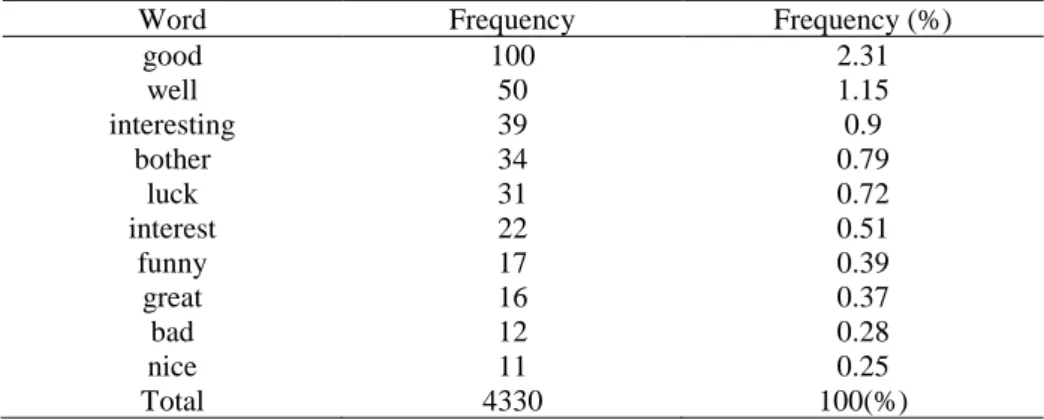
Firstly, it was proceeded to examine the frequency of words from all users’ responses to be able to get more insight and scrutinize the vast information got in text. As it can be found in Table 3 ahead, the 10 most frequently used objectives are displayed. From the ones that are considered negative, there were only two found – “bother”, with a frequency of 0,79% and “bad” with 0.28%. On the other hand, we can find “good”, “well”, “interesting”, “luck”, “interest”, “funny”, “great” and “nice” as positive words, the most relevant ones with the frequencies of 2,31% (“good”) and 0,9% (“interesting”). As stated by Berger (2014), positive influence is a key driver to SM users/consumers react by commenting their opinion on the subject, in opposition to negative feelings, giving the audience lack of motivation to comment and simply leading them to ignore such experience.
10
Table 3 - word frequency
Word Frequency Frequency (%)
good 100 2.31 well 50 1.15 interesting 39 0.9 bother 34 0.79 luck interest funny great bad nice 31 22 17 16 12 11 0.72 0.51 0.39 0.37 0.28 0.25 Total 4330 100(%)
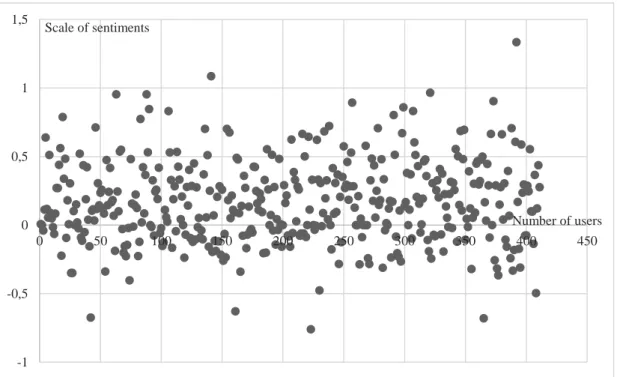
As mentioned previously, our main method of analysis was to use a text mining software to acquire the values, using the sentiment analysis scale, of all 411 users’ reactions, to conclude if Tinder users’ responses were significantly more positive than negative towards the marketing campaign and how. The range of sentiment values got was between -0.76 and 1.34, correspondingly the negative and positive poles. With those values, we proceeded immediately to calculate the absolute mean, the mean of all positive values and negative values. It is significant to reference the variance between both positive and negative means: the mean of positive values being rather higher than the mean of negative values. The results achieved presented the absolute mean to be positive, with a relatively high value regarding the sentiments scale used, as it can be found on the table below (Table 4).
Table 4 - means obtained based on the scale of sentiments
Absolute Mean 0.15
Mean of positive values 0.33
Mean of negative values -0.16
It was important to calculate the difference between positive and negative values in percentage, as well as to determine how many neutral values we obtained. Neutral sentiments towards the campaign (values equal to zero on the scale) were of 4% and they can be considered quite optimistic, for only very few people felt “nothing” towards the marketing campaign. The percentage of positive reactions and negative reactions were of 66 % and 30%, respectively – a great discrepancy between both values, as proven by Table 5. More than half of Tinder users’ emotions towards the campaign were quite
11
positive, therefore this fact takes an imperative role when it comes to supporting the objective of the present research (Rauniar, Rawski, Yang, & Johnson, 2014).
Table 5 - percentage of values above, equal and below zero
Values above zero (%) 66%
Values equal to zero (%) 4%
Values below zero (%) 30%
On the scatter plot from Figure 1, it can be found a visual view of all users’ reactions towards the marketing campaign. As a first note, it can be clearly noticed from the scatter plot that it is considerably more condensed above the x-axis, the positive scale of sentiments’ area, as expected, for 66% of the values obtained were above zero.
Figure 1 - scatter plot including all 411 users' reactions
It is also noticeable how different the dispersion from the positive and negative areas are, for the positive area’s dispersion has a bigger constancy and higher values, meaning a large acceptance of the marketing campaign. Regarding the negative users’ reactions dispersion, it contains its most consistency ranged between significantly low values, explaining low negative feelings towards the campaign. The two dispersions are not only diverse from each other, but they also confirm that even though a user did not appreciate the campaign, generically speaking, but they also did not show strong negativity towards it. Most of the negative emotions’ values stand between 0 and -0.2 in
-1 -0,5 0 0,5 1 1,5 0 50 100 150 200 250 300 350 400 450 Scale of sentiments Number of users
12
the scale of sentiments, which is meaningfully low. Facts that provide us the knowledge that many Tinder users are receptive while coming across a marketing campaign, widening the range of opportunities that can be taken when creating advertising.
The 5th most positive and the 5th most negative rated reactions from each age group were extracted and presented in Table 6. Individuals of different ages react to and inside SM in dissimilar ways, such as older generations tend to feel less at ease towards the online world (Hur, Lee, & Choo, 2017). Although the most positive reactions extracted from each age group are similar between all the age ranges, some keywords are more present in some than others, creating a quite significant impact when it comes to the sentiment scale. Both age groups of 18-24 and 25-34 have the highest acceptance rate of the marketing campaign, as it can be justified by the frequent use of the most positively valuable words “interesting”, “good” and “funny”, those objectives less used on the other two age groups, as it can be noticed on Table 6 ahead.
Table 4 - 5th most positive and most negative rated reactions for each age group
The 5th most positive rated reactions (18-24) The 5th most negative rated reactions (18-24)
“I would not know what to say, but I found it interesting.”
“I would give the sincere congratulations for the commitment and creativity.”
“I found it very funny. Very well played!” “Thank you for making me have much fun! It is a pretty funny campaign.”
“I'd say you marketing guys are geniuses! I found very interesting. Very clever as well.”
“Terrible. I have a special odium for fake profiles.” “I would say that capitalism is coming to depressing places.”
“Seriously? Very strange. But it is alright!” “I would say that it would not be at all the right place and that it would be a rather tedious attempt
to attract customers.”
“I would say it is a marketing campaign that is cheap for the company!”
The 5th most positive rated reactions (25-34) The 5th most negative rated reactions (25-34)
“I would not say anything, but I found it quite interesting.”
“I found it very cool, super interesting.”
“Very well, that's a good strategy.”
“It is a good start for business and stuff like that. I also want to use it for my work. It is brilliant!” “Each person uses the tools he has for his own benefit, without usurping the freedom and respect of the other. It was very clever of you. Good luck.”
“The idea is original, but annoying.”
“I would say it would be annoying.” “I would say that it is ridiculous and that only an idiot does not notice anything from marketing and social networks thinks that an approach with a misleading purpose would be a good idea.” “I did not expect to be caught up in a marketing campaign, quite unusual in such an application.” “I really hate capitalism.”
The 5th most positive rated reactions (35-44) The 5th most negative rated reactions (35-44)
“Very well done!”
“I think it does work very well, but it should not be the ideal place. Good luck!”
“I'd say it is a disappointment. But I wish you good luck!”
13
“I would like to congratulate you on the initiative and wish you success!”
“I would say that it is indeed a new and different approach. And I really enjoyed the conversation.” “I would say it is the funniest message I received
at Tinder, I was curious! Pretty cute.
Congratulations to the creatives.”
“Poor marketing campaign ... Incidentally, for the brand is terrible the image you are going through. Abort this!”
“I find that ridiculous and does not make much sense.”
“Linking a product or website to a "mistake" is silly. No one likes to be cheated, even more for commercial purposes.”
The 5th most positive rated reactions (45+) The 5th most negative rated reactions (45+)
“I'm interested, I liked the site. Although I like going to physical stores more, this campaign is very well launched.”
“I thought it was very good, I'm an entrepreneur and I know how important it is for marketing. Congratulations.”
“Congratulations! May it succeed. I am making a healthy food application.”
“I think it is super smart, who remembered this is to be congratulated! Very nice, the first person I speak here that has a lot of culture. I hope you get lucky!”
“I think very well. I would like to know what the conclusions are. Marketing is everything, and everything is marketing.”
“I see the clothes, I like them. But you could have started differently, it did not look like you were selling.”
“I'm indifferent, but that's not what I'm in Tinder for.”
“I do not think so. Fraudulent profile is the term. People here are not looking for clothes. But I believe it brings brand awareness.”
“I think it is a good idea, but I also believe that some people might feel cheated. But it seems confusing if the logic is to promote the clothing site this is not understood.”
“It does not bother me at all, but I do not think it is a big hit either.”
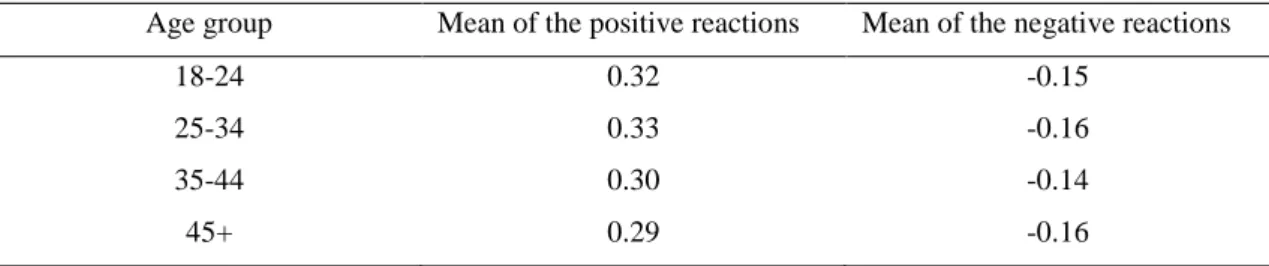
Adding to the previous, Table 7 below presents both positive and negative reactions’ means, for each age group. Accordingly, to the conclusions made from Table 6, there are significant differences between the several age groups (18-24, 25-34, 35-44, 45+) regarding the types of reactions obtained.
Table 5 - positive and negative means for each age group
Age group Mean of the positive reactions Mean of the negative reactions
18-24 0.32 -0.15
25-34 0.33 -0.16
35-44 0.30 -0.14
45+ 0.29 -0.16
Concerning the results obtained, from all the positive reactions’ means, the highest one is from the age group of 25-34, the same age group with one of the most negative reactions. Consequently, we can say that the age group of 25-34 is the one with the most varied opinions, as expected, for that group involves both young adults and adults,
14
individuals highly accepting of technology, but tending to focus primarily on app usefulness before app playfulness (Hur et al., 2017). Taking into consideration the ratio between negative and positive means of each age group, we can conclude that the most accepting group of the marketing campaign is 18-24, for it has the highest value comparing both the positive and negative means. The second most accepting one being the age group of 25-34. The results are according with previous findings, that younger generations tend to seek for the most entertaining side of advertisement, searching for unique experiences that have a great impact on them (Yu, Tsai, Wang, Lai, & Tajvidi, 2018). On the other side, the age group who is less accepting is 45+, with the lowest values, followed by the group of 35-44. Hence, these values show us that the youngest generations were more accepting comparing with the older ones, as predicted (Hur et al., 2017), for youngest generations make more use of dating apps, take it more casually (they also use it just to simply have a conversation, not only with romantic or sexual purposes), and simply to entertain themselves, than the older generations, for most of them make use of it to find love (Sumter et al., 2017).
5. Conclusions, limitations and future research
In an era where SM marketing is an everyday reality and routine, where mobile advertising seems to be disguised on SM feeds, and where people seek to encounter entertainment experiences and content online (Hudson et al., 2015), it is important to focus on experimenting different and impactful approaches when it comes to creating marketing campaigns, for there is a large number of different SM platforms that are not crowded with advertising, especially on smartphones, that people use it every day and for much more time than they care to admit so.
This study aimed to analyze Tinder users’ responsiveness towards a marketing campaign promoting a Portuguese clothing website, making use of a text mining analysis using a sentiment scale, and therefore the results show: Tinder users have positive feelings towards the marketing campaign. Firstly, not only the percentage of positive reactions was of 66% and the negative ones of 30%, but also the difference of the range of values of both polos was significant: the mean of the positive reactions was of 0.33, much higher than the negative reactions mean of -0.16, which concludes us that, even though there were more positive emotions than negative ones towards the campaign, the values are
15
generally high and the negative reactions are low. For the larger percentage of Tinder users range from 18 to 34 years old, the generations who make more use of smartphones and SM and the ones who feel the most need to share their feedback with the company and/or with other consumers (Poushter, 2016), the study further concluded that users of the age group of 18-24, followed by the 25-34, are those with the most positive feelings toward the marketing campaign. For it can be stated that age, affects the receptivity of the Tinder users when it comes to facing a marketing campaign on the app. Therefore, the opportunity to reach younger generations is greater than for older generations, even though the latter has grown fonder of SM advertising lately, and with creativity and boldness, this fact widens the opportunity to influence an even more substantial audience. The campaign executed, allowed us to gain live feedback, equally positive and negative, which can be taken into consideration to rethinking the campaign’s implementation, as well as to improve it for future marketing plans to create advertising as suitable for the audience’s needs as possible. Regarding marketing activities’ aspects that influence positively users/consumers’ engagement towards the campaign, as stated in the literature review, entertainment, uniqueness and interactivity are imperative when it comes to marketing strategies, thus it was concluded that Tinder’s campaign executed proved so. Concerning the negative factors referred on the literature review, advertising can be bothersome when disrupting an activity that was being executed by the user, and seemingly distractive, can be admitted as a couple of the few reasons why the campaign did not please some of the users. In future research, means to develop less distractive and bothersome marketing campaigns should be investigated, taking in consideration the users’ opinions regarding such matter. Nevertheless, the positive results achieved with the campaign executed for this research, prove that the opportunity to create entertaining and disruptive content is wide.
This study, where an analysis of sentiments divergence of 411 users reactions towards a campaign on Tinder, via text mining techniques, has given a few deeper perceptions regarding the role of SM in digital marketing. This research contributes to the literature by mainly showing how acceptant Tinder users were towards the marketing campaign, especially younger generations (18-24 and 25-34) that are precisely the ones who mostly make use of mobile SM and the core age gap of the dating app. Additionally, also the ones who tend to seek and engage with entertaining and interactive experiences online, such as mobile applications (Ashley & Tuten, 2015; Vrontis et al., 2017), such as
16
Tinder, for each user logs into the app up to 11 times a day (LeFebvre, 2017). Therefore, the results match the statement of entertainment being a key to engagement and positive emotions towards advertising (Killian & McManus, 2015), alongside with consumers’ age gap that makes the most use of SM and the biggest entertainment seekers. It is crucial to point out the most accepting users were inside the age gap of the ones who make the most use of dating apps (Statista, 2018), a big opportunity for a larger, accepting and willing to give feedback target for future research. The chance to get feedback from users during and after the campaign can be used as constructive insight for future research and/or marketing campaign, especially from the age gap of 25-34, the ones who made use of the most positive words. Regarding negative words, academia and marketers can learn from the negative aspects concerning the study/campaign being developed on Tinder, to later improve the users’ experience.
Tinder not only contributes to marketing by proving that its users are accepting towards marketing activities on the app, expressly younger generations, but also that SM marketing is not limited to the most popular platforms, for there are numerous and smaller SM networks waiting to be explored, as the hedonic value that can be put into marketing activities is extremely valuable when capturing consumers’ attention, generate engagement and most importantly, develop positive attitudes towards it (Knoll, 2016).
In regard to the results attained on the present research, online clothing companies can benefit from the exposure obtained by the number of active users present on Tinder and its possible segmentations: regarding age, the most accepting users were the youngest generations (18-24, 25-34), predominantly males, if the account that is executing the campaign is set as female with either heterosexual or bisexual preferences. Clothing firms can shift their focus from Facebook and Instagram, and creatively engage with Tinder users, for they are open to communicate with everyone and seek, above all, to be entertained.
The present research contains various limitations that can be imperative for future research as well as for a deeper understanding of this study. For future research the approach should be conducted in an informal way, to certify if users’ reactions would differ considerably and ascertain if the campaign’s acceptability would increase, decrease or undergo no significant change.
17
Furthermore, it is critical to have in consideration the type of product/service that is going to be advertised on Tinder, to verify if it somehow connects with the concept of the app, trying to avoid incongruency. It would be interesting to apply a similar marketing campaign to not only fashion related, but a different kind of service/product, such as the launch of a new app, a new video game, awareness of some medical service, job recruiting process or to share an event. Hence, the acceptance towards the marketing campaign on the dating app might be affected in a scenery with a different culture, for such statement should be validated in a future study.
The abysmal difference between the number of answers of both genders must do with the diverse behaviors they pursue while navigating on dating applications. For example, male users have very little criteria when it comes to “swiping right”, while female users are very particular and demanding while doing so (Ward, 2017). Nevertheless, for future research, a more balanced sample in terms of gender would be of great worth to examine any possible differences of emotions towards the campaign. It equally applies to the age groups, for the 45+ was smaller compared to the others – it is still quite valid, for younger generations make much more use of dating apps than the older ones (Hobbs, Owen, & Gerber, 2017). Additionally, still regarding gender, in future research, a similar study in which the users are not heterosexual would be valuable to investigate any possible difference concerning their reactions. The data analysis process while using the text mining analysis and respective sentiment classification to analyze the reactions has the limitations of not being able to detect sarcasm, which was sometimes present in a few users’ reactions. However, these possible limitations do not inflict the results of the present study regarding the potential found on Tinder for future successful marketing campaigns, simultaneously with other SM platforms on which marketing activities are uncommon or nonexistent.
References:
Alalwan, A. A., Rana, N. P., Dwivedi, Y. K., & Algharabat, R. (2017). Social media in marketing: A review and analysis of the existing literature. Telematics and
Informatics, 34(7), 1177–1190. https://doi.org/10.1016/j.tele.2017.05.008
Ashley, C., & Tuten, T. (2015). Creative Strategies in Social Media Marketing: An Exploratory Study of Branded Social Content and Consumer Engagement.
18
Berger, J. (2014). Word of mouth and interpersonal communication: A review and directions for future research. Journal of Consumer Psychology, 24(4), 586–607. https://doi.org/10.1016/j.jcps.2014.05.002
Bernabé-Moreno, J., Tejeda-Lorente, A., Porcel, C., Fujita, H., & Herrera-Viedma, E. (2015). CARESOME: A system to enrich marketing customers acquisition and retention campaigns using social media information. Knowledge-Based Systems,
80, 163–179. https://doi.org/10.1016/J.KNOSYS.2014.12.033
Boulianne, S. (2015). Social media use and participation: a meta-analysis of current research. Information, Communication & Society, 18(5), 524–538.
https://doi.org/10.1080/1369118X.2015.1008542
Bright, L. F., Kleiser, S. B., & Grau, S. L. (2015). Too much Facebook? An exploratory examination of social media fatigue. Computers in Human Behavior, 44, 148–155. https://doi.org/10.1016/j.chb.2014.11.048
Calheiros, A. C., Moro, S., & Rita, P. (2017). Sentiment Classification of Consumer-Generated Online Reviews Using Topic Modeling. Journal of Hospitality
Marketing & Management, 26(7), 675–693.
https://doi.org/10.1080/19368623.2017.1310075
Clark, M., Black, H. G., & Judson, K. (2017). Brand community integration and satisfaction with social media sites: a comparative study. Journal of Research in
Interactive Marketing, 11(1), 39–55. https://doi.org/10.1108/JRIM-07-2015-0047
David, G., & Cambre, C. (2016). Screened Intimacies: Tinder and the Swipe Logic.
Social Media + Society, 2(2). https://doi.org/10.1177/2056305116641976
Duguay, S. (2017). Dressing up Tinderella: interrogating authenticity claims on the mobile dating app Tinder. Information, Communication & Society, 20(3), 351–367. https://doi.org/10.1080/1369118X.2016.1168471
Gan, Q., Ferns, B. H., Yu, Y., & Jin, L. (2017). A Text Mining and Multidimensional Sentiment Analysis of Online Restaurant Reviews. Journal of Quality Assurance in
Hospitality & Tourism, 18(4), 465–492.
https://doi.org/10.1080/1528008X.2016.1250243
Hartmann, N. N., Wieland, H., & Vargo, S. L. (2018). Converging on a New Theoretical Foundation for Selling. Journal of Marketing, 82(2), 1–18. https://doi.org/10.1509/jm.16.0268
He, W., Wang, F.-K., & Zha, S. (2014). Enhancing social media competitiveness of small businesses: insights from small pizzerias. New Review of Hypermedia and
Multimedia, 20(3), 225–250. https://doi.org/10.1080/13614568.2014.889225
Hobbs, M., Owen, S., & Gerber, L. (2017). Liquid love? Dating apps, sex, relationships and the digital transformation of intimacy. Journal of Sociology, 53(2), 271–284. https://doi.org/10.1177/1440783316662718
Hudson, S., Roth, M. S., Madden, T. J., & Hudson, R. (2015). The effects of social media on emotions, brand relationship quality, and word of mouth: An empirical study of music festival attendees TT -. Tourism Management TA, 47, 68–76.
Hur, H. J., Lee, H. K., & Choo, H. J. (2017). Understanding usage intention in innovative mobile app service: Comparison between millennial and mature
19
consumers. Computers in Human Behavior, 73, 353–361. https://doi.org/10.1016/j.chb.2017.03.051
Jaakonmaki, R., Muller, O., & Vom Brocke, J. (2017). The Impact of Content , Context , and Creator on User Engagement in Social Media Marketing. Hawaii
International Conference on System Sciences, HICSS-50, (November 2016), 1152–
1160. https://doi.org/10.24251/HICSS.2017.136
Killian, G., & McManus, K. (2015). A marketing communications approach for the digital era: Managerial guidelines for social media integration. Business Horizons,
58(5), 539–549. https://doi.org/10.1016/j.bushor.2015.05.006
Kiráľová, A., & Pavlíčeka, A. (2015). Development of Social Media Strategies in Tourism Destination. Procedia - Social and Behavioral Sciences, 175, 358–366. https://doi.org/10.1016/j.sbspro.2015.01.1211
Knoll, J. (2016). Advertising in social media: A review of empirical evidence.
International Journal of Advertising, 35(2), 266–300.
https://doi.org/10.1080/02650487.2015.1021898
Knoll, J., & Matthes, J. (2017). The effectiveness of celebrity endorsements: a meta-analysis. Journal of the Academy of Marketing Science, 45(1), 55–75.
https://doi.org/10.1007/s11747-016-0503-8
LeFebvre, L. E. (2017). Swiping me off my feet. Journal of Social and Personal
Relationships, 35(9), 026540751770641.
https://doi.org/10.1177/0265407517706419
March, E., Grieve, R., Marrington, J., & Jonason, P. K. (2017). Trolling on Tinder® (and other dating apps): Examining the role of the Dark Tetrad and impulsivity.
Personality and Individual Differences, 110, 139–143.
https://doi.org/10.1016/J.PAID.2017.01.025
McCoy, S., Everard, A., Galletta, D. F., & Moody, G. D. (2017). Here we go again! The impact of website ad repetition on recall, intrusiveness, attitudes, and site revisit intentions. Information and Management, 54(1), 14–24.
https://doi.org/10.1016/j.im.2016.03.005
Morente-Molinera, J. A., Kou, G., Peng, Y., Torres-Albero, C., & Herrera-Viedma, E. (2018). Analysing discussions in social networks using group decision making methods and sentiment analysis. Information Sciences, 447, 157–168.
https://doi.org/10.1016/j.ins.2018.03.020
Osatuyi, B., & Qin, H. (2018). How vital is the role of affect on post-adoption behaviors? An examination of social commerce users. International Journal of
Information Management, 40, 175–185.
https://doi.org/10.1016/j.ijinfomgt.2018.02.005
Poushter, J. (2016). Climate Change 2013 - The Physical Science Basis. (Intergovernmental Panel on Climate Change, Ed.) (Vol. 22). Cambridge: Cambridge University Press. https://doi.org/10.1017/CBO9781107415324.004
Rauniar, R., Rawski, G., Yang, J., & Johnson, B. (2014). Technology acceptance model (TAM) and social media usage: An empirical study on Facebook. Journal of
https://doi.org/10.1108/JEIM-20
04-2012-0011
Regan, P. (2017). The mating game: a primer on love, sex, and marriage (3rd ed.). SAGE PublicationsSage UK: London, England. Retrieved from http://trove.nl
Sashittal, H. C., Sriramachandramurthy, R., & Hodis, M. (2012). Targeting college students on Facebook? How to stop wasting your money. Business Horizons,
55(5), 495–507. https://doi.org/10.1016/j.bushor.2012.05.006
Saxena, A., & Khanna, U. (2013). Advertising on Social Network Sites: A Structural Equation Modelling Approach. Vision: The Journal of Business Perspective, 17(1), 17–25. https://doi.org/10.1177/0972262912469560
Schivinski, B., & Dabrowski, D. (2016). The effect of social media communication on consumer perceptions of brands. Journal of Marketing Communications, 22(2), 189–214. https://doi.org/10.1080/13527266.2013.871323
Smith, A., & Anderson, M. (2018). Social Media Use 2018: Demographics and
Statistics. Pew Research Center. Retrieved from
http://www.pewinternet.org/2018/03/01/social-media-use-in-2018/
Statista. (2017). Global time spent on social media daily. Retrieved July 26, 2018, from https://www.statista.com/statistics/433871/daily-social-media-usage-worldwide/
Statista. (2018). Online Dating Worldwide. Retrieved July 26, 2018, from
https://www.statista.com/outlook/372/100/online-dating/worldwide#market-age
Stephen, A. T. (2016). The role of digital and social media marketing in consumer behavior. Current Opinion in Psychology, 10, 17–21.
https://doi.org/10.1016/j.copsyc.2015.10.016
Sumter, S. R., Vandenbosch, L., & Ligtenberg, L. (2017). Love me Tinder: Untangling emerging adults’ motivations for using the dating application Tinder. Telematics
and Informatics, 34(1), 67–78. https://doi.org/10.1016/J.TELE.2016.04.009
Taylor, J., Johnston, J., & Whitehead, K. (2016). A Corporation in Feminist Clothing? Young Women Discuss the Dove ‘Real Beauty’ Campaign. Critical Sociology,
42(1), 123–144. https://doi.org/10.1177/0896920513501355
Tiago, M. T., & Verissimo, J. (2014). Digital marketing and social media: Why bother?
Business Horizons, 57(6), 703–708.
Voorveld, H. A. M., van Noort, G., Muntinga, D. G., & Bronner, F. (2018).
Engagement with Social Media and Social Media Advertising: The Differentiating Role of Platform Type. Journal of Advertising, 47(1), 38–54.
https://doi.org/10.1080/00913367.2017.1405754
Vrontis, D., Thrassou, A., & Amirkhanpour, M. (2017). B2C smart retailing: A consumer-focused value-based analysis of interactions and synergies.
Technological Forecasting and Social Change, 124, 271–282.
https://doi.org/10.1016/j.techfore.2016.10.064
Ward, J. (2017). What are you doing on Tinder? Impression management on a
matchmaking mobile app. Information Communication and Society, 20(11), 1644– 1659. https://doi.org/10.1080/1369118X.2016.1252412
21
commerce in social media platforms: Importance of trust, social support and the platform perceived usage. Journal of Retailing and Consumer Services, 41, 11–19. https://doi.org/10.1016/j.jretconser.2017.10.021
Yang, H. (Chris), & Liu, H. (2014). Prior negative experience of online disclosure, privacy concerns, and regulatory support in Chinese social media. Chinese Journal
of Communication, 7(1), 40–59. https://doi.org/10.1080/17544750.2013.816756
Yu, C.-H., Tsai, C.-C., Wang, Y., Lai, K.-K., & Tajvidi, M. (2018). Towards building a value co-creation circle in social commerce. Computers in Human Behavior. https://doi.org/10.1016/j.chb.2018.04.021