Vol.47, n. 2 : pp. 219-224, June 2004
ISSN 1516-8913 Printed in Brazil BRAZILIAN ARCHIVES OF
BIOLOGY AND TECHNOLOGY
A N I N T E R N A T I O N A L J O U R N A L
Composition of
ω
ω
ω
ω
-3 and
ω
ω
ω
ω
-6 Fatty Acids in Freeze-Dried
Chicken Embryo Eggs with Different Days of Development
Célia Maria Teixeira de Campos1∗, Antônio José Simões Hamad1, Jane Mara Block1, José
Carlos Fiad Padilha1, Paulo José Ogliari1, Daniel Barreira-Arellano2 and Rosana Nogueira
Cavalcanti Moreira2
1 Universidade Federal de Santa Catarina - UFSC;CIF/CCS, CAL/CCA, ZOT/CCA, INE/CTC; Campus
Universitário Trindade; [email protected]; C. P. 476; 88010-970; Florianópolis - SC - Brazil. 2 Universidade
Estadual de Campinas - UNICAMP; FEA; Laboratório de Óleos e Gorduras; Campinas - SP - Brazil
ABSTRACT
Fatty acids ω--3 and ω--6 composition and specially DHA were determined in freeze-dried chicken embryo eggs with pre-determined incubation periods. Fertile and embryo eggs presented palmitic (23.18 + 0.54%), stearic (7.70 + 0.28%), palmitoleic (3.00 + 0.19%), oleic (36.28 + 0.58%), linoleic (22.18 + 0.34%), linolenic (1.08 + 0.04%), arachidonic (2.04 + 0.03%), docosahexaenoic (0.91 + 0.03%), total ω-3 acids (2.26 + 0.10%) and total ω-6 acids (24.62 + 0.33%). There were no significant differences in total contents of ω-3 fatty acids (p=0.1226) between freeze-dried chicken embryo eggs with different incubation periods (3, 5, 7, 9, and 11 days) and fertile freeze-dried chicken eggs (day 0). However, there were significant differences in total medium contents of ω-6 fatty acids (p=0.0001). There was also a strong statistical evidence that quadratic model was related with expected values of DHA content (p= 0.0013).
Key words: Chicken embryo eggs, fatty acids ω-3 and ω-6, DHA
∗ Author for correspondence
INTRODUCTION
Since ancient times chicken embryo eggs, fertile eggs and unfertilized eggs have been used by humans as food and also in the treatment of diseases. From the nutrition point of view, eggs have been always one of the most complete foods available for man (Thapon and Bougeois, 1994). Besides vitamins and mineral elements, eggs can provide three essencial elements for a good diet: proteins, lipids and carbohydrates (Beig and Garcia, 1986).
In recent times, cardiovascular diseases in occidental populations have increased and,
of memory capacity, visual development, and formation of cerebral tissue (Park et al., 1997). Nettleton (1995) reported that ω-3 fatty acids family have shown therapeutic effects also in diabetes Type II. They offer a benefic potential effect because they reduced the triglycerides rates and, interrelation between glucose and lipid oxidation, which acted on prostaglandins and insulin secretion.
ω-3 fatty acids, therefore, are considered benefic and researches have been trying to increase their quantity in food, specially eicosapentaenoic (EPA), or docosapentaenoic (DPA) and docosahexaenoic (DHA) (Stadelman and Pratt, 1989). Ferrier et al. (1995) mentioned that eating eggs enriched with ω-3 fatty acids produced significant increase in docosahexaenoic acid (DHA) concentration and other polyunsaturated ω -3 fatty acids in phospholipid fraction of human blood.
Lin et al. (1991) recommended including ω-3 and
ω-6 in food for children. They pointed out that when only α-linolenic acid was present in diet, it could be deficient in the reserves of DHA in the brain and the retina. Health and Welfare Canada recommend to ingest ω-3 fatty acids daily for all ages people, 1.1 g/day for women and 1.5 g/day
α-linolenic acid for men (Ferrier et al., 1995). ω-3 fatty acids are essential in human pregnancy and childhood. DHA is transferred to fetus by the placenta during pregnancy and it is present in human milk along with other ω-3 fatty acids including α-linolenic (Connor, 2000).
Embryo chicken eggs could be a natural source of
ω-3 fatty acids, mainly of DHA, because several studies have demonstrated that embryo’s fatty acids and lipids composition is completely different from original yolk, from which embryo is derived (Speake et al., 1998).
MATERIALS AND METHODS
Preparation of sample units
Chicken embryo eggs (Gallus gallus domesticus L.) were obtained from Isabrown fertile eggs, incubated at 39oC + 0.5oC for 0, 3, 5, 7, 9 and 11 days. The Isabrown hens were bred in intensive outdoor raise system, according to Salatin (1993). The shell of incubated eggs was removed
aseptically in sterile plates and the stage of development of the embryo was verified.
The remaining content was homogenized, fronzen and freeze-dried using a BagMixer (Interscience, France), a plate freezer (Frigostrella, Brazil) and Micromodulyo Freeze Dryer (Edwards, E-C Apparatus, USA). The freeze-dried product was packed in 30g plastic flasks, sealed and labeled. Samples of the flasks were selected for analysis using random numbers (Vieira and Hoffmann, 1989).
Fatty acids composition
Fatty acids were determined by gas chromatography (AOCS - Ce 1f - 96) adapted by Abril and Barclay (1999), in which fatty acids are identified by comparison of pattern retention times and quantified by areas standardization, using a gas chromatograph (Perkin Elmer 8420) and a capillary silica column (CP-Sil-88, N° 985132, 50 m x 0,25 mm).
Statistical design
For analyzing the statistical data variance analysis with contrasts and regression analysis was applied using software Statistica for Windows version 5.1 and SAS System for Windows version 6.12.
RESULTS AND DISCUSSION
Fatty acids composition in freeze-dried chicken embryo eggs with different incubation periods could be observed at Table 1.
Table 1 - Average of fatty acids composition in sample units of freeze-dried chicken embryo eggs (Gallus gallus
domesticus L.) with different incubation periods.
Fatty acids (%) 0 3 5 7 9 11
C14:0 Miristic 0.32 0.30 0.36 0.32 0.32 0.27
C16:0 Palmitic 23.91 23.11 23.11 23.27 22.27 23.43
C16:1 Palmitoleic 3.00 3.02 3.19 3.00 3.14 2.64
C18:0 Stearic 7.66 7.87 7.37 7.77 7.43 8.12
C18:1 Oleic (ω - 9) 35.78 36.59 35.68 36.13 37.25 36.26
C18:2 Linoleic (ω - 6) 21.90 22.14 22.71 22.13 22.39 21.78
C18:3 Linolenic (ω - 3) 1.11 1.01 1.09 1.10 1.11 1.05
C20:3 Eicosatrienoic (ω - 6) 0.45 0.40 0.41 0.38 0.37 0.40
C22:0 Behenic 0.26 0.25 0.27 0.28 0.27 0.26
C20:4 Arachidonic (ω - 6) 2.02 2.09 2.04 2.05 2.00 2.05
C22:5 Docosapentaenoic (ω - 3) 0.22 0.16 0.37 0.30 0.30 0.30
C22:6 DHA (ω - 3) 0.95 0.89 0.86 0.90 0.91 0.94
Total of ω-3 acids 2.28 2.06 2.32 2.30 2.32 2.29
Total of ω-6 acids 24.37 24.63 25.16 24.56 24.76 24.23
Operating conditions: gas chromatograph - Perkin Elmer 8420; capillary silica column - CP-Sil-88, No 985132, 50 m x 0,25 mm; oven temperature: 160oC-10 min, 160-200oC (4oC/min), 200oC-20 min; detector temperature: 300oC; injector temperature: 270 oC; 1,0 µL injection; helium carrier gas (He): 45 psi - gas flow 0,98mL/min; Split: 1:55.
Fig. 1 shows the contents of ω-3 and ω-6 fatty acids according to incubation periods in freeze-dried chicken embryo eggs. Results indicated that fertile and embryo eggs could represent a source of polyunsaturated fatty acids, including ω-3 fatty acids.
0 5 10 15 20 25 30
0 3 5 7 9 11
Time (days)
T
e
n
o
rs
(%
)
ω−3 ω−6
Figure 1 - Content of ω-3 and ω-6 fatty acids versus development period in freeze-dried chicken embryo eggs.
Table 2 shows the variance analysis with contrasts in which there are comparisons of total medium contents of fatty acids ω-3 and ω-6 in fertile eggs (day 0) with those in embryo eggs (3, 5, 7, 9, and 11).
Table 2 - Variance analysis with contrasts of total content in ω-3 and ω-6 fatty acids in freeze-dried chicken embryo eggs with different incubation periods.
source of variation
F p-value
linear 0,13 0,7347
quadratic 31,99 0,0013*
There are no significant differences in total medium contents of ω-3 fatty acids (p=0.1226), between freeze-dried chicken embryo eggs with different incubation periods (3, 5, 7, 9, and 11 days) and fertile freeze-dried chicken eggs (day 0) (Table 2). These embryo eggs presented a medium content of these acids 0.022% less than fertile eggs. However, there were significant differences in total medium contents of ω-6 fatty acids (p=0.0001), between freeze-dried chicken embryo eggs with different incubation periods and freeze-dried fertile eggs. Embryo eggs presented a medium content of these acids 0.294% more than fertile eggs.
than 90% of total energy required by embryo is supplied by β-oxidation of fatty acids derived from yolk lipids (Noble and Cocchi, 1990; Cherian and Sim, 1993 and Speake et al., 1998). Maldjian et al.. (1995) reported that arachidonic acid ω-6 was relatively resistant to β-oxidation during the development of the chicken embryo. Cherian et al. (1997) also suggested that concentration of arachidonic acid and docosahexaenoic acid (DHA) were different during incubation. These acids presented a pattern of transference of yolk to embryo different from others and they depended on supply from yolk.
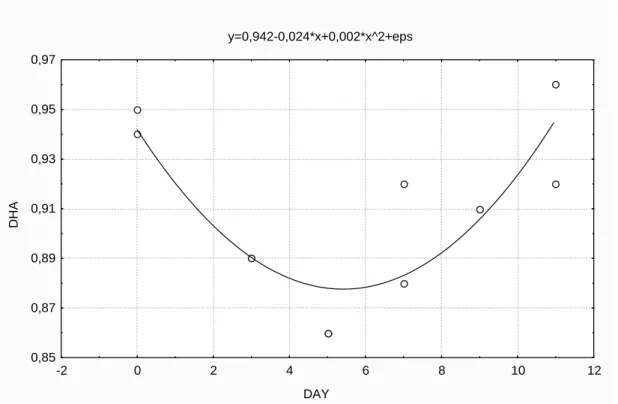
Table 3 and Fig. 2 represented regression analysis and scatter diagram of DHA content in freeze-dried chicken embryo eggs with different
incubation periods. There was strong statistical evidence that quadratic model was related to expected values of DHA content (p=0.0006) and it originated the following equation:
% DHA = 0,942 - 0,02days + 0,0022 days2
Table 3 - DHA content regression analysis in freeze-dried chicken embryo eggs with different incubation periods.
contrast estimate F p-value
ω-3 - 0,022 3,23 0,1226
ω-6 0,294 617,40 0,0001*
y=0,942-0,024*x+0,002*x^2+eps
DAY
D
H
A
0,85 0,87 0,89 0,91 0,93 0,95 0,97
-2 0 2 4 6 8 10 12
Figure 2 - Scatter diagram of DHA medium content (%) in sample units of freeze-dried chicken embryo eggs with different incubation periods.
A probable explanation for this model was that: at the 5th day of development, the phospholipids fractions which contained DHA were preferably removed from the yolk sack before the largest period of the embryo’s growth. On the 5th day of development the yolk sac was already complete and it surrounded the whole yolk. The yolk sack was one of the extra-embryo structures that had the function to remodel lipids structures related to
the DHA contents. (Noble and Cocchi, 1990; Speake et al., 1998).
of the embryo’s circulation (Farkas et al., 1996; Cherian et al., 1997; Speake et al., 1998).
Results allowed to deduce that chicken embryo development among 0 and 11 days of incubation didn't change the medium totals contents of ω-3 acids, but they changed the medium totals contents of ω-6 acids. Starting from 5th day of incubation, DHA was preferably removed from the yolk before the largest period of the embryo’s growth, for being associated to the growth and the development of the tissues and organs of the nervous system. And so, fertile and embryo eggs could be useful in human diet as sources of long chain ω-3 (DHA) ω-6 (arachidonic acid) fatty acids.
RESUMO
No presente trabalho, foi determinada a composição em ácidos graxos ω-3, ω-6 e, em especial, o DHA em ovos de galinha embrionados e liofilizados com períodos de incubação pré-estabelecidos. De acordo com os resultados obtidos, os ovos férteis e embrionados apresentaram a seguinte composição média de ácidos graxos saturados: palmítico (23,18 + 0,54%) e esteárico (7,70 + 0,28%); insaturados: palmitoléico (3,00 + 0,19%), oléico (36,28 + 0,58%), linoléico (22,18 + 0,34%), linolênico (1,08 + 0,04%), araquidônico (2,04 + 0,03%) e DHA (0,91 + 0,03%); total de ácidos ω-3 (2,26 + 0,10%) e total ácidos ω-6 (24,62 + 0,33%). Verifica-se que não há diferenças significativas nos teores médios totais de ácido graxos ω-3 (p=0,1226), entre os ovos embrionados liofilizados com diferentes dias de incubação (3,5,7,9, e 11 dias) e ovos férteis liofilizados (dia 0). Porém, há diferenças significativas nos teores médios totais de ácidos graxos ω-6 (p=0,0001). Também, há uma forte evidência estatística que o modelo quadrático está associado com os valores esperados do teor de DHA (p=0,0013).
REFERENCES
Abril, R. and Barclay, B. (1999), Fatty acid analysis of poultry eggs as methyl esters. OmegaTech. Bolder, Co. Método OT-GCPE, Rev. 3.1. 24/03/99.
AOCS (1996), Official methods and recommended practices of de American Oil Chemists’ Society. 4th ed.
American Oil Chemists’ Society, Champaign II. Bragagnolo, N. and Turatti, J. M. (1999), Evaluation of
“light” eggs in Brazil. Paper presented at VIII European Symposium on the Quality of Eggs and Eggs Products, Bologna, Itália. Associazione
Italiana di Avicoltura Scientifica, Instituto di
Zootecnia, 2, 177-181.
Beig, D. and Garcia, F. C. M. (1986), O embrião de galinha. Campo Grande : UFMS/ Imprensa
Universitária.
Cherian,G. and Sim, J. S. (1993), Net transfer and incorporation of yolk n-3 fatty acids into developing chick embryos. Poultry Science, 72, 98-105.
Cherian, G.; Gopalakrishnan, N.; Akiba, Y. and Sim, J. S. (1997), Effect of maternal dietary n-3 fatty acids on the accretion of long-chain polyunsaturated fatty acids in the tissues of developing chick embryo.
Biology of Neonate, 72, 165-174.
Connor, W. E. (2000), Importance of n-3 fatty acids in health and disease. American Journal of Clinical Nutrition, 71, 171S-175S. Suppl.
Farkas, K.; Noble, R. C.; Speake, B. K (1996), Development changes in the levels of molecular species of triacylglicerol that contain docosahexaenoic acid in adipose tissue of chick embryo. Comparative Biochemistry and Physiology
B-Biochemistry and Molecular Biology, 115, 1-6. Ferrier, L. K.; Caston, L. J.; Leeson, S.; Squires, J.;
Weaver, B. J. and Holub, B.J. (1995), α-linolenic acid - and docosahexaenoic acid - enriched eggs from hens fed flaxseed: influence on blood lipids and platelet phospholipid fatty acids in human. The
American Journal of Clinical Nutrition, 62, 81-86. Lin, D. S.; Connor, W. E. and Anderson, G. J. (1991),
The incorporation of n-3 and n-6 essential fatty acids into chicken embryo from eggs yolks having vastly different fatty acid compositions. Pediatric Research, 29, 601-605.
Maldjian, A.; Falkas, K.; Noble, R. C.; Cocchi, M. and Speake, B. K. (1995), The transfer of docosahexaenoic acid from the yolk to the tissues of chicken embryo. Biochimica et Biophysica Acta, 1258, 81-99.
Nettleton, J. A. (1995), Omega-3 fatty acids and health.
Chapman and Hall, New York.
Noble, R. C. and Cocchi, M. (1990), Lipid metabolism and the neonatal chicken. Prog. Lipid Res., 29, 107-140. Park, Y. K; Koo, M. H. and Carvalho, P. O. (1997),
Recentes Progressos dos Alimentos Funcionais. Bol.
SBCTA, 31.
Salatin, J. (1993), Pastured poultry profits. Polyface
Swoope, Virginia.
Speake, B. K.; Murray, A. M. B. and Noble, R. C. (1998), Transport and transformations of yolk lipids during development of avian embryo. Prog. Lipid
Stadelman, W. J. and Pratt, D. E. (1989), Factors influencing composition the hen’s egg. World’s Poultry Science Journal, 45, 247-261.
Thapon, J. L. and Bourgeois C. M. (1994), L’oeuf et les ovoproduits. Lavoisier -Technique et Documentation, Paris.
Vieira, S. and Hoffmann, R. (1989), Estatísitica
experimental. São Paulo : Atlas.