Printed version ISSN 0001-3765 / Online version ISSN 1678-2690 www.scielo.br/aabc
Hawkmoth fauna (Sphingidae, Lepidoptera) in a semi-deciduous rainforest remnant: composition, temporal fluctuations, and new records for northeastern Brazil
LUIS M. PRIMO1, JOSÉ A. DUARTE2 and ISABEL C. MACHADO3
1Programa de Pós-Graduação em Biologia vegetal, universidade Federal de Pernambuco, departamento de Botânica,
Av. Prof. Moraes Rego, s/n, Cidade Universitária, 50372-970 Recife, PE, Brasil
2Núcleo de Pesquisa Educacionais do Rio Grande do Norte/NUPERN,
BR 101, Km 0, Centro Administrativo, Lagoa Nova, 59064-901 Natal, RN, Brasil
3departamento de Botânica, universidade Federal de Pernambuco,
Av. Prof. Moraes Rego, s/n, Cidade Universitária, 50372-970 Recife, PE, Brasil
Manuscript received on July 16, 2012; accepted for publication on March 15, 2013
ABSTRACT
We carried out a qualitative and quantitative inventory of the hawkmoth fauna (Sphingidae) of an area of semi-deciduous seasonal rainforest in the state of Pernambuco (Tapacurá Ecological Station), northeastern
Brazil. hawkmoths were sampled monthly from October 2004 to February 2007 (27 months). We recorded
31 species from 16 genera, three tribes, and three families. Macroglossinae was the most abundant subfamily
and represented ca. 71% of all species. Out of the 277 individuals collected, 88.4% were males. Five
new records were made for northeastern Brazil: Enyo gorgon (Cramer, 1777), Perigonia stulta (Herrich-Schäffer, [1854]), Eupyrrhoglossum sagra (Poey, 1832), Nyceryx coffaeae (Walker, 1856) and Xylophanes chiron (drury, 1773). Eight further species were recorded for the first time for the Pernambuco Endemism
Center, showing the important role played by Tapacurá Station in preserving the biodiversity of this insect group. Species richness and abundance were directly related to rainfall: about 70% of all individuals were captured during the rainy season. Changes in Sphingidae populations may, however, be caused by other factors that directly affect either larvae and adults of those insects, such as matrix effect and forest fragment
size, which influence migration processes and the presence of predators.
Key words: dry forest, Pernambuco Endemism Center, phenology, seasonality, Sphingidae abundance and richness, sphingophily.
Correspondence to: Isabel Cristina Machado E-mail: [email protected]
INTRODUCTION
Sphingidae (Lepidoptera, Bombycoidea) have a pantropical distribution with approximately 1,200 species (Kitching and Cadiou 2000), from which 75% occur in tropical regions (Haber 1983). In Brazil, this family is represented by 29 genera and 210 species. However, this number is probably higher as the available data are still poor (Duarte et al. 2008).
turn, are polyphagous-nectarivorous generalists, which forage on flowers of many species (Kieslev et al. 1972, Haber and Frankie 1989, Darrault and Schlindwein 2002), and may be responsible for 5 to 10% of the pollination of the tropical flora (Bawa et al. 1985, haber and Frankie 1989, Oliveira et al. 2004, Primo 2008).
The Atlantic Forest located to the north of São Francisco River is known as the Pernambuco Endemism Center (sensu Prance 1987); faunal inventories in its remnants are of high biogeographic interest. However, there are only two studies on the sphingid fauna in this ecosystem: Duarte and Schlindwein (2005a) and Lopes et al. (2006), both in rainforest areas, but none in dry forest areas (sensu Gentry 1995). Five other inventories have been carried out in northeastern Brazil in other ecosystems, such as Caatinga (Duarte et al. 2001, Duarte and Schlindwein 2005b, Gusmão and Creão-Duarte 2004), Ombrophilous Montane Forest - “Brejo de Altitude” (Gusmão and Creão-Duarte 2004) and Tabuleiro (Darrault and Schlindwein 2002).
Considering that hawkmoths play a vital role in the stability of ecosystems, acting on the pollination and reproduction of plant species, the main purpose of our study was to improve the basic knowledge on these lepidopterans by answering the following questions: What is the composition and abundance of sphingids in the area? Is the phenology of this group seasonal? We also aimed to test whether there was a direct relationship between richness and abundance of sphingids and rainfall in the dry forest (sensu Gentry 1995), as it has been observed in other ecosystems.
This information is essential not only to improve the biogeographic research on this insect group, but also for the management and conser-vation of natural environments, mainly dry forests, which are fast becoming degraded, as they are located in sites of flat relief that are eminently suitable for agriculture (Janzen 1988a,b, 1997).
MATERIALS AND METHODS
STUDY SITE
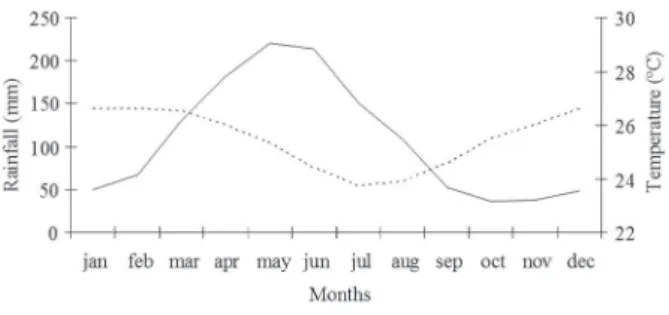
The present study was carried out in Tapacurá Ecological Station (Estação Ecológica do Tapacurá), São Lourenço da Mata municipality, 50 km from the coast of Pernambuco State (08°01´S, 35°11´W), northeastern Brazil. The region’s annual rainfall is ca. 1,300 mm and the average temperature is 25.5 °C. There are marked seasons: the rainy season occurs from March to August and the dry season between September and February (ITEP-LAMEPE) (Fig. 1).
Fig. 1 - Multiannual rainfall and temperature at the Tapacurá Ecological Station, Pernambuco, Brazil. Source: ITEP (Instituto de Tecnologia de Pernambuco), São Lourenço da Mata (barragem Tapacurá) station (historical average of 30 years). __________
Rainfall - - - Temperature
The forest remnant area is approximately 400 ha and it is surrounded by a matrix of sugar cane plantations and pastures. The vegetation is classified as semi-deciduous seasonal rainforest, as the variation between dry (six months with rainfall below 100 mm) and rainy seasons imposes seasonality on the dominant tree species (Andrade-Lima 1960, Veloso et al. 1991). Although there is a floristic similarity with the rainforest near the Atlantic coast, the semi-deciduous forest shows a relatively less diverse and structurally simpler community (Rodal et al. 2005).
SPHINGID SURVEYS
To sample the moths, we used a light trap composed of a mercury vapor lamp (250 watts) in a vertical position two meters above the ground in front of a white cloth of 3 x 2 m. We always set the trap in the same site: an open area that allowed the light to shine across a large forest area.
Sphingids were collected by hand, using an entomological net, killed with an injection of ethyl acetate ventrally between the thorax and the abdomen, conserved in individual wax-paper envelopes, and later dry-pinned, labeled and deposited in the collection of the Laboratory of Floral and Reproductive Biology (Laboratório de Biologia Floral e Reprodutiva), at the Botanical Department of Universidade Federal de Pernambuco, Recife, Brazil. Species were identified using Kitching and Cadiou (2000) and additional literature (D´Abrera 1986, Moré et al. 2005). We determined the sex of each individual by the morphology of the frenulum (a brush of bristles in the female, a single strong bristle in the male) (Kitching and Cadiou 2000).
STATISTICAL ANALYSIS
To test for differences in species richness and abundance between dry and rainy seasons, as well as the relationship between population size of the most abundant species and annual rainfall, we used Pearson’s correlation. Calculations were made using the package BioStat 5.0 (Ayres et al. 2007). The relative abundance of hawkmoth species was calculated as a percentage of number of individual collected monthly in relation to the total of captured individuals. The normality of the data was checked using the Liliefors’ test (Sokal and Rohlf 1995).
RESULTS
COMPOSITION OF ThE SPHINGID FAUNA
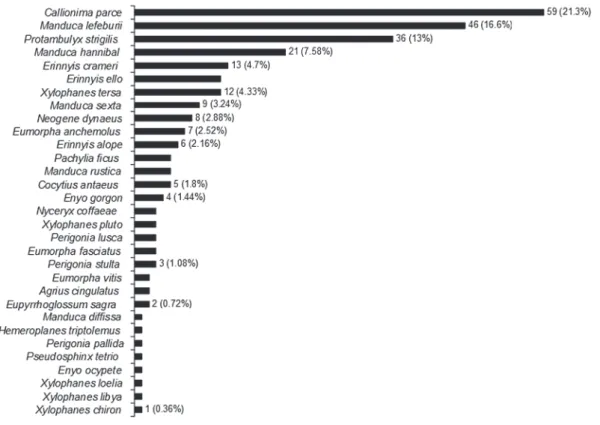
We captured 277 sphingids of 16 genera and 31 species (Table I). The subfamily Macroglossinae was most abundant (22 species, 70.96%) followed by Sphinginae (eight species, 25.8%) and Smerinthinae (one species, 3.22%). Eight species were represented by only one individual (Table I). The most abundant
TABLE I
Hawkmoth (Lepidoptera: Sphingidae) species recorded at the Tapacurá Ecological Station, Pernambuco, Brazil, from October 2004 to February 2007.
Species Male Female Total Proboscis length ± SD (mm)
Smerinthinae Ambulycini
Protambulyx strigilis (Linnaeus, 1771)
35 1 36 28.48 ±1.85
Sphinginae Sphingini
Cocytius antaeus (Drury, 1773)
4 1 5 104.18 ±22.95
Manduca diffissa tropicalis (Rothschild. & Jordan, 1903) 1 0 1 61
Manduca hannibal hannibal (Cramer, 1779) 20 1 21 76.23 ±5.84
Manduca lefeburii lefeburii (Guérin-Méneville, [1844]) 42 4 46 54.75 ±4.33
Manduca rustica rustica (Fabricius, 1775) 4 1 5 125.56 ±8.77
Manduca sexta paphus (Cramer, 1779) 8 1 9 80.72 ±9.61
Neogene dynaeus (Hübner, [1827]-[1831]) 7 1 8 21.52 ±5.38
Acherontiini
Agrius cingulata (Fabricius, 1775) 1 1 2 99.15 ±19.02
Macroglossinae Dilophonotini
Callionima parce (Fabricius, 1775)
species were Callionima parce (Fabricius, 1775),
Manduca lefeburii (Guérin-Méneville, 1844),
Protambulyx strigilis (Linnaeus, 1771) and
Manduca hannibal (Cramer, 1779) (Fig. 2).
In addition to the species captured with the light trap, we also recorded, though not systematically, the diurnal species Aellopus titan (Cramer 1777) (Macroglossinae, dilophonotini) visiting flowers of Caesalpinia echinata Lam. (Caesalpinoideae),
Psychotria capitata Ruiz & Pavon (Rubiaceae) and
Casearia hirsuta Sw. (Flacourtiaceae).
The sex ratio was 7.5:1, male to female (239 males and 32 females). The distribution of individuals and species by tribes, as well as their variations between dry and rainy seasons, are expressed in Figure 3. Proboscis length varied
from 13.1 mm (Perigonia pallida) to 125.56 mm (Manduca rustica) (Table I).
The species accumulation curve (Fig. 4) showed an apparent stabilization at twenty species, between December 2005 and February 2006, but then there was an increment of 11 species at the end of the sampling.
SEASONALITY ANd ABUNDANCE
We collected 69.7% of the specimens during the rainy season (March-August), which indicates a positive relationship with annual rainfall (richness: r = 0.65, abundance: r = 0.67).
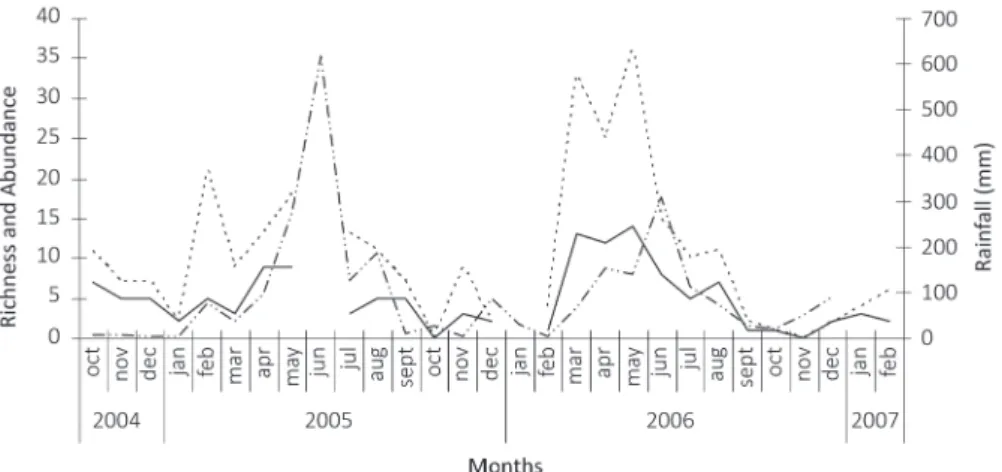
May 2006 had the highest abundance (36 specimens) and richness (14 species) of hawkmoths, whereas in October 2005 and November 2006 TABLE I (contiuation)
Species Male Female Total Proboscis length ± SD (mm)
Enyo gorgon (Cramer, 1777) 3 1 4 24.8 ±1.66
Enyo ocypete (Linnaeus, 1758) 1 0 1 25.3
Erinnyis alope alope (Drury, 1773) 2 4 6 40.95 ±2.28
Erinnyis crameri (Schaus, 1898) 6 7 13 34.05 ±2
Erinnyis ello ello (Linnaeus, 1758) 7 5 12 33.44 ±2.48
Eupyrrhoglossum sagra (Poey, 1832) 2 0 2 18.65 ±0.49
Hemeroplanes triptolemus (Cramer, 1779) 1 0 1 18.6
Nyceryx coffaeae (Walker, 1856) 3 0 3 12.6 ±0.56
Pachylia ficus (Linnaeus, 1758) 5 0 5 49.89 ±5.02
Perigonia lusca lusca (Fabricius, 1777) 3 0 3 17.15 ±2.19
Perigonia pallida Rothschild & Jordan, 1903 1 0 1 13.1
Perigonia stulta Herrich-Schäffer, [1854] 3 0 3 19.1 ±1.17
Pseudosphinx tetrio (Linnaeus, 1771) 1 0 1 48
Philampelini
Eumorpha anchemolus (Cramer, 1779) 6 1 7 45.06 ±5.77
Eumorpha fasciatus fasciatus (Sulzer, 1876) 2 1 3 43.73 ±1.1
Eumorpha vitis vitis (Linnaeus, 1758) 2 0 2 40.8 ±2.54
Macroglossini
Xylophanes chiron nechus (Cramer, 1777) 1 0 1 40.04
Xylophanes libya (Druce, 1878) 1 0 1 54
Xylophanes loelia (Druce, 1878) 1 0 1 35.6
Xylophanes pluto (Fabricius, 1777) 2 1 3 31.11
Xylophanes tersa tersa (Linnaeus, 1771) 12 0 12 31.15 ±1.37
Fig. 2 - Individuals number of Hawkmoth (Lepidoptera: Sphingidae) and relative abundance recorded at the Tapacurá Ecological Station, Pernambuco, Brazil, from October 2004 to February 2007.
Fig. 4 - Species accumulation curve of hawkmoths (Lepidoptera: Sphingidae) during the study, at the Tapacurá Ecological Station, Pernambuco, Brazil.
Fig. 5 - Seasonal variability of abundance and richness of Hawkmoth (Lepidoptera: Sphingidae) and precipitation during the study period at the Tapacurá Ecological Station, Pernambuco, Brazil (June 2005 and January 2006 were not sampled).
_ _ _ _ _ _ Abundance _________ Richness _ .. _ .. _ .. _ .. _ Rainfall
(dry months) no sphingids were collected (Fig. 5). Twelve species were captured only during the rainy season and four only in the dry season, whereas the other 15 species occurred in both seasons (Table II).
The seven most abundant species were collected in both seasons, whereas the eighth most frequent species, Manduca sexta, was collected only in the rainy season. When analyzing each species separately, the cyclic behavior in relation to rainfall varied (Fig. 6). Only three species exhibited a positive correlation with rainfall: Callionima parce (r = 0.62), Erinnyis crameri (r = 1) and M. sexta (r = 0.81).
DISCUSSION
Although the present study has recorded the largest number of sphingid species for any study so far in northeastern Brazil, the distribution of individuals among the subfamilies corroborates Duarte et al. (2008), who noted that in all sphingid fauna inventories in Brazil, Macroglossinae has the highest number of individuals, and that over 50% belong to the tribes Dilophonotini and Macroglossini.
Species J F M A M J J A S O N D Total moths/
Individuals/ especie
Manduca lefeburii lefeburii 3 19 14 4 6 5 46
Erinnyis ello ello 1 4 2 1 1 3 6 12
Hemeroplanes triptolemus 1 1 1
Perigonia lusca lusca 1 1 1 3 3
Manduca hannibal hannibal 3 9 2 3 1 1 1 1 8 21
Callionima parce 7 7 4 10 12 4 4 1 8 2 10 59
Nyceryx coffaeae 1 1 1 3 3
Enyo gorgon 1 1 2 3 4
Manduca rustica rustica 1 2 1 1 4 5
Manduca diffissa tropicalis 1 1 1
Neogene dynaeus 2 4 1 1 4 8
Erinnyis alope alope 1 1 1 3 4 6
Erinnyis crameri 1 1 7 2 1 1 6 13
Pachylia fícus 1 1 1 2 4 5
Eumorpha anchemolus 2 3 2 3 7
Eumorpha fasciatus fasciatus 1 1 1 3 3
Perigonia pallida 1 1 1
Protambulyx strigilis 6 6 2 7 10 1 1 3 9 36
Manduca sexta paphus 1 4 3 1 4 9
Xylophanes tersa tersa 3 4 1 1 2 1 6 12
Eumorpha vitis vitis 1 1 2 2
Agrius cingulata 2 1 2
Perigonia stulta 3 1 3
Xylophanes chiron nechus 1 1 1
Xylophanes libya 1 1 1
Cocytius antaeus 2 1 2 3 5
Enyo ocypete 1 1 1
Eupyrrhoglossum sagra 1 1 2 2
Xylophanes loelia 1 1 1
Xylophanes pluto 3 1 3
Pseudosphinx tetrio 1 1 1
Total species/moths 4 5 13 14 17 8 6 10 5 8 6 7
Total individuals 277
TABLE II
Seasonality of hawkmoth (Lepidoptera: Sphingidae) monthly collected with a light trap at the Tapacurá Ecological Station, Pernambuco, Brazil, during 27 months from October 2004 to February 2007. The moths were organized from the collections in January (hatched months correspond to the rainy season).
Perigonia stulta, Eupyrrhoglossum sagra, Nyceryx coffaeae and Xylophanes chiron. Apart from these, eight other species were recorded for the first time for the Pernambuco Endemism Center: Callionima
parce, Erinnyis crameri, Xylophanes pluto, Agrius cingulata, Eumorpha vitis, Perigonia lusca,
Perigonia pallida and the subspecies Manduca
of Tapacurá Station, an example of a dry forest, as a refuge for those insects.
Furthermore, some species that are rarely collected in northeastern Brazil were abundant in Tapacurá Ecological Station, such as Manduca lefeburii (the second most frequent species, with 46 individuals). This species had previously only been known from a single record of an individual collected in the open Atlantic rainforest of the state of Alagoas (Lopes et al. 2006). Likewise,
Manduca hannibal, very abundant in Tapacurá (21 individuals), has been recorded only once in the Atlantic Forest of the state of Pernambuco, where three individuals were collected (Duarte and Schlindwein 2005a). Finally, E. crameri, which had only one record with two individuals in the “Tabuleiros” (Savanna areas) of the state of Paraíba (darrault and Schlindwein 2002), was the fifth most abundant in Tapacurá, where 12 individuals were recorded. Again, this demonstrates the important role played by the Tapacurá Ecological Station to preserve and to maintain this insect group.
However, when comparing species abundance and richness among sites, it must be acknowledged that sampling methods have not been standardized in all inventories in northeastern Brazil, either in terms of number and time of sampling, total of sampling hours or the type of light trap used.
Despite the major difference in the time established to end captures (in most studies captures were carried out until 5 or 6 am, whereas in the present study captures ended at 2 am), we have obtained in Tapacurá Station the highest number of sphingid species for northeastern Brazil. Maybe this was a consequence of greater sampling effort in the present study: 486 h (27 sampling sessions). Other studies had sampling efforts of 308 h (14 sessions) (Duarte and Schlindwein 2005a), 288 h (12 sessions) (Gusmão and Creão-Duarte 2004), 264 h (12 sessions) (Duarte and Schlindwein 2005b), 144 h (12 sessions) (Darrault and Schlindwein 2002), 72 h (six sessions) (Duarte et al. 2001) and 16 h
(four sessions) (Lopes et al. 2006). The apparent stabilization of the species accumulation curve evident in the middle of the present sampling period may also have happened in other studies, leading to an interruption of sampling. Probably, an increase in hours and in number of sampling sessions could have raised species richness, as in Tapacurá.
In spite of the large sampling effort, species richness in Tapacurá may be even higher than recorded in the present study, given that there was an increment of one species one month before the last month of sampling (even after five sampling sessions without any new inclusion).
In tropical ecosystems, the change between well-marked dry and rainy seasons imposes cycles of leaf availability of host plants to the larvae of hawkmoths, which, according to Haber and Frankie (1989), then determines the seasonal occurrence of adults. In a similar way, Janzen (1988b) found seasonality in the leaf-cutting activity of lepidopteran caterpillars, which hardly occurs in the dry season.
As observed in Tapacurá, a positive relationship between the rainy season and the maximum richness and abundance of Sphingidae has been recorded in several ecosystems, such as dry forests of Costa Rica (Haber and Frankie 1989) and the Atlantic Forest of the state of Paraná, Southern Brazil (Laroca and Mielke 1975).
The seasonality analysis of each species reveals cyclic patterns that remain unnoticed when the phenology of the sphingid community is analyzed as a whole. In only two species, Erinnyis crameri and
Manduca sexta, the temporal distribution seems to follow the annual rainfall cycle. An exception can be noted for Callionima parce, which exhibits a positive correlation with rainfall, but shows regularity in its activities, since it was captured in almost all months. In turn, Manduca lefeburii and M. hannibal, which have no relationship with rainfall, exhibited evident regularity; there was a demographic increment three or four months before rainfall peaks. Possibly the marked population cycle of these two species is related to the phenology of the larvae’s host plants in the study area or its surroundings. According to Moré et al. (2005), the host plants of M. lefeburii belong to the genus
Casearia of the Salicaceae, a family that has not been sampled in our study area (Rodal et al. 2005). There are some records of larval hosts for M. hannibal mostly in Solanaceae (eg. Solanum campaniforme Roem. & Schult.) and Verbenaceae, as in Clerodendrum fragrans (Vent.) Willd. (Moss 1920; see Daniel Janzen’s website for Costa Rican Lepidoptera).
No period seems to be more or less favorable for Protambulyx strigilis, Xylophanes tersa and
Erinnyis ello. Seasonality analysis for the other species was not possible because of the low number of individuals collected.
It is premature to propose a comprehensive hypothesis regarding the cause of Sphingidae seasonality in Tapacurá Ecological Station, as the host plant community of the larvae and its phenology are unknown. However, the correlation between rainfall and occurrence of adult sphingids offers at least a plausible partial explanation for the seasonal phenology of this insect group, and suggests that many other variables are involved. Haber and Frankie (1989) and Cruz-Neto et al. (2011) observed a relationship between seasonality of sphingid abundance and flowering phenology of plants pollinated by them. Similarly, Lopes et al.
(2006) proposed a hypothesis that the reduction or disappearance of sphingid populations in small fragments of Atlantic Forest may occur due to the decrease of sphingophilous plants. However, in Estação Ecológica do Tapacurá there seems to be no positive relationship between sphingid abundance and number of flowering sphingophilous plants (Primo 2008).
Apart from food availability for larvae (host plants) and adults (sphingophilous plants), variations in sphingid populations can be influenced by several other factors acting together. Among these factors might be, for example, the effect of the matrix, the size of the forest fragment, migration, and the presence of predators of larvae or adults. Therefore, more studies are necessary to determine the complex causes of hawkmoth seasonality.
ACKNOWLEDGMENTS
To Mr. Paulo Martins (Universidade Federal Rural de Pernambuco) for logistical support and permission for the development of the field work at Tapacurá Ecological Station; to Edinaldo Mendes da Silva, Airton Torres Carvalho and Eduardo Oliveira Barros for help with some of the samples. To Ivano Bonamici and Tarcila Nadia for their help with the graphics. Financial support was provided by Coordenação de Aperfeiçoamento de Pessoal de Nível Superior (CAPES, PhD fellowship to LMP - Graduate Student Program Agreement - PEC/PG/CAPES) and Conselho Nacional de desenvolvimento Científico e Tecnológico (CNPq, Research Grant to ICM).
RESUMO
Nós analisamos o inventário qualitativo e quantitativo
da fauna de mariposas esfingídeas (Sphingidae) de uma área de floresta úmida semi-decidual no estado
de Pernambuco (Estação Ecológica de Tapacurá),
Nordeste do Brasil. Os esfingídeos foram amostrados mensalmente de Outubro de 2004 a Fevereiro de 2007
16 gêneros, três tribos e três famílias. Macroglossinae foi a sub-família mais abundante, representada por ca. 71% de todas as espécies. Dos 277 indivíduos coletados, 88.4% foram machos. Cinco novos registros foram obtidos para o Nordeste do Brasil: Enyo gorgon
(Cramer, 1777), Perigonia stulta (Herrich-Schäffer, [1854]), Eupyrrhoglossum sagra (Poey, 1832), Nyceryx coffaeae (Walker, 1856) and Xylophanes chiron (Drury,
1773). Outras oito species foram registradas pela
primeira vez para o Centro de Endemismo Pernambuco, mostrando o importante papel desempenhado pela Estação de Tapacurá na preservação da biodiversidade
desse grupo de insetos. Riqueza e abundância das
espécies apresentaram relação direta com a precipitação: cerca de 70% de todos os indivíduos foram capturados durante a estação chuvosa. Variações nas populações de Sphingidae, entretanto, podem ser causadas por outros fatores que afetam diretamente as larvas e adultos daqueles insetos, como o efeito da matriz e do tamanho
do fragmento florestal, que influenciam os processos de
migração e a presença de predadores.
Palavras-chave: floresta seca, Centro de Endemismo
Pernambuco, fenologia, sazonalidade, abundância e riqueza de Sphingidae, esfingofilia.
REFERENCES
ANDRADE-LIMA D. 1960. Estudos fitogeográficos de Pernambuco. Arq IPA 5: 305-341.
AYRES M, AYRES JuNIOR M, AYRES DL AND SANTOS AA.
2007. BIOESTAT – Aplicações estatísticas nas áreas das
ciências bio-médicas. Belém: Ong Mamiraua, 324 p. BAWA KS, PERRY DR AND BEACH JH. 1985. Reproductive
biology of tropical lowland rain forest trees. I. Sexual systems and incompatibility mechanisms. Am J Bot 72: 331-345.
CRUz-NETO O, MAChAdO IC, DUARTE JA AND LOPES AV. 2011.
Synchronous phenology of hawkmoths (Sphingidae) and
Inga species (Leguminosae-Mimosoideae): implications for the restoration of the Atlantic forest of northeastern Brazil. Biodiv Conserv 20: 751-765.
D´ABRERA B. 1986. Sphingidae Mundi: Hawkmoth of the world, Faringdon, Oxon: E. W. Classey, 225 p.
DARRAULT RO AND SCHLINDWEIN C. 2002. Esfingídeos
(Lepidoptera, Sphingidae) no Tabuleiro paraibano, Nordeste do Brasil: abundância, riqueza e relação com plantas esfingófilas. Rev Bras zool 19: 429-443.
DUARTE JA, MOTTA C AND VARELA-FREIRE AA. 2001.
Sphingidae (Lepidóptera) da Estação Ecológica do Seridó, Serra Negra do Norte, Rio Grande do Norte, Brasil. Entomol Vet 8: 341-347.
DUARTE JA AND SCHLINDWEIN C. 2005a. Riqueza, abundância e sazonalidade de Sphingidae (Lepidoptera) num fragmento de Mata Atlântica de Pernambuco, Brasil. Rev Bras zool 22: 662-666.
DUARTE JA AND SCHLINDWEIN C. 2005b. The highly seasonal hawkmoth fauna (Lepidoptera: Sphingidae) of the Caatinga of northeast Brazil: a case study in the state of Rio Grande do Norte. J Lepid Soc 59: 212-218.
DUARTE M, CARLIN LF AND MARCONATO G. 2008. Light-attracted hawkmoths (Lepidoptera: Sphingidae) of Boracéia, municipality of Salesópolis, state of São Paulo, Brazil. Check List 4: 123-136.
GENTRY AH. 1995. diversity and floristic composition of
neotropical dry forests. In: BuLLOCK Sh, MOONEY HA AND MEDINA E (Eds), Seasonally dry forests, Cambridge: Cambridge University Press, p. 146-194. GuSMãO MAB AND CREãO-DUARTE AJ. 2004. Diversidade e
análise faunística de Sphingidae (Lepidoptera) em área de Brejo e Caatinga no estado da Paraíba, Brasil. Rev Bras zool 21: 491-498.
HABER WA. 1983. Checklist of insects. Checklist of Sphingidae. In: JANzEN DH (Ed), Costa Rican Natural History, Chicago and London: University of Chicago Press, p. 645-650. HABER WA AND FRANKIE GW. 1989. A tropical hawkmoth
community: Costa Rican dry forest Sphingidae. Biotropica 21: 155-172.
JANzEN DH. 1988a. Management of habitat fragments in a tropical dry forest: growth. Ann Missouri Bot Gard 75: 105-116.
JANzEN DH. 1988b. Ecological characterization of a Costa Rican dry forest caterpillar fauna. Biotropica 20: 120-135. JANzEN DH. 1997. Florestas tropicais secas. In: WILSON EO
(Org), Biodiversidade, São Paulo: Editora Nova Fronteira, p. 166-176.
KISLEV ME, KRAVIz z AND LORCh J. 1972. A study of hawkmoth pollination by a palynological analysis of the proboscis. Isr J Bot 21: 57-75.
KITCHING IJ AND CAdIOu JM. 2000. Hawkmoth of the world: An annotated and illustrated revisionary checklist (Lepidoptera: Sphingidae), Ithaca: Comell University Press, 227 p.
LAROCA S AND MIELKE Ohh. 1975. Ensaios sobre ecologia de comunidade em Sphingidae na Serra do Mar, Paraná, Brasil (Lepidoptera). Rev Bras Biol 35: 1-19.
LOPES AV, MEdEIROS PC, AGUILAR-NETO AV AND MAChAdO
ICS. 2006. Esfingídeos. In: PORTO KC, CORTEz JA
ANd TABARELLI M (Org), diversidade biológica e conservação da floresta Atlântica ao norte do Rio São Francisco, 1a ed., Brasília: Ministério do Meio Ambiente, p. 228-235.
MOSS AM. 1920. Sphingidae of Para, Brasil. Early stages, food plants, habits, etc. Novit zool 27: 27: 333-415.
OLIVEIRA PE, GIBBS PE AND BARBOSA AA. 2004. Moth pollination of woody species in the Cerrados of central Brazil: a case of so much owed to so few? Plant Syst Evol 245: 41-54.
PITTAWAY AR. 1993. The hawkmoths of the Western Palaearctic, London: Harley Books, 240 p. and http:// tpittaway.tripod.com/sphinx/list.htm.
PRANCE GT. 1987. Biogeography of neotropical plants. In: WhITMORE GT ANd PRANCE G (Eds), Biogeography and quaternary history in tropical America. Oxford: Clarendon Press, p. 175-196.
PRIMO LM. 2008. Guilda de plantas esfingófilas e quiropterófilas
em remanescente de floresta Atlântica Estacional Semidecidual em Pernambuco: Sazonalidade de recursos e biologia reprodutiva. Thesis, Universidade Federal de Pernambuco.
ROdAL MJN, LUCENA MFA, ANDRADE KVSA AND MELO
AL. 2005. Mata do Toró: uma floresta estacional
semidecidual de terras baixas no nordeste do Brasil. Hoehnea 32: 283-294.
SOKAL RR AND ROhLF JF. 1995. Biometry. San Francisco, WH, 887 p.
VELOSO HP, RANGEL-FILhO ALR AND LIMA JCA. 1991.