Printed version ISSN 0001-3765 / Online version ISSN 1678-2690 http://dx.doi.org/10.1590/0001-3765201620150202
www.scielo.br/aabc
Intestinal and liver morphometry of the Yellow Tail Tetra
(
Astyanax altiparanae
) fed with oregano oil
POLLYANNA M.F. FERREIRA, DÉBORA W. CALDAS, ANA LÚCIA SALARO, SIRLENE S.R. SARTORI, JERUSA M. OLIVEIRA, ALEX J.S. CARDOSOand JENER A.S. ZUANON
Departamento de Biologia Animal, Universidade Federal de Viçosa/UFV, Av. PH Rolfs, s/n, 36570-900 Viçosa, MG, Brasil
Manuscript received on April 6, 2015; accepted for publication on August 20, 2015
ABSTRACT
This study aimed to evaluate the effect of oregano oil on the intestinal and liver morphometry of yellow tail tetra, Astyanax altiparanae. Fish (1.46 ± 0.09 g) were kept in a 60-L aquaria, at a stocking density of 0.5 fi sh L-1. Six diets containing varying amounts of oregano oil were evaluated (0.0; 0.5; 1.0; 1.5; 2.0 and 2.5 g of oregano oil kg-1
). At the end of 90 days, the fi sh were euthanised. Four intestines and four livers were collected per treatment, which were fi xed in Bouin and embedded in resin. For height and width folds, the absorption surface area and thickness of the muscular layer a positive linear effect of oregano oil was observed. A decrescent linear effect on the total number of goblet cells was also observed. For the cytoplasmic percentage of hepatocytes and liver glycogen, a positive linear effect of oregano oil was observed. There was a decreasing linear effect on the percentage of nuclei in the hepatocytes and capillaries. Thus, the oregano essential oil promotes increased absorption areas, modulates the amount of goblet cells involved in protecting the intestinal mucosa and promotes cytoplasmic increase with greater deposition of liver glycogen in yellow tail tetra.
Key words: carvacrol, growth promoter, intestinal histology, liver histology, Origanum vulgare, thymol.
Correspondence to: Jener Alexandre Sampaio Zuanon E-mail: [email protected]
INTRODUCTION
Knowledge of gut histology and the digestion and absorption processes of nutrients is essential for understanding fi sh physiology and nutrition. This knowledge can contribute to the formulation of fi sh diets and the feeding management for these animals, resulting in increased productivity and reduced production costs (Castro et al. 2002, Faccioli et al. 2014). In addition, the nutrients of diet can directly affect the function and morphology of the liver as an important organ in energy metabolism, emulsification of lipids, and participate in the body’s detoxifi cation (Bombardelli et al. 2009).
related to the presence of phenolic compounds, fl avonoids and terpenoids (Zheng et al. 2009); 3) improving digestion by stimulating the secretion of digestive enzymes (Lee et al. 2004); and 4) improving absorption capacity of nutrients due to their benefi cial effects on the height villus and depth crypt of the intestinal epithelium (Petrolli et al. 2012, Zanini et al. 2012).
One of the essential oils that has a great poten-tial for use as a growth promoter in animal diets is oregano oil (Fukayama et al. 2005), due to its an-tibacterial (Burt and Reinders 2003, Souza et al. 2006, Oliveira et al. 2009), antifungal (Sartoratto et al. 2004, Cleff et al. 2010), antioxidant (Zheng et al. 2009), anti-infl ammatory (Ocaña-Fuentes et al. 2010), anthelminthic (Force et al. 2000) and pro-di-gestive (Basmacioğlu Malayoğlu et al. 2010, Hash-emipour et al. 2013) properties. The oregano essen-tial oil contains over 34 active compounds, and their properties are attributed to the presence of the main components: carvacrol, thymol, and their precursors
γ-terpinene and ρ-cymene (Bampidis et al. 2005). Among the many species of fi sh, tetras have received signifi cant market interest because they can be used as live bait for sport fi shing, like fried snacks, and still have the potential to be canned. The yellow tail tetra (Astyanax altiparanae) has a wide distribution in South America (Martinez et al. 2012) and therefore can be raised without the risk of introducing exotic species into the natural environment. This species has a great aquaculture potential due to its high reproductive rate, short production cycle (Porto-Foresti et al. 2005) and omnivorous (Adrian et al. 2001), while having a good acceptance of processed diets. Thus, the present study aimed to evaluate the effects of oregano oil on the intestinal and liver morphometry of yellow tail tetra (Astyanax altiparanae).
MATERIALS AND METHODS
The Ethics Committee in Animal Use of the Animal Science Department at the University Federal
de Viçosa approved this research project under number 31/2012 on September 4, 2012.
ANIMALSAND EXPERIMENTAL CONDITIONS
The experiment was conducted using a completely randomised design with six treatments and four replicates. The treatments consisted of six isoni-trogenous (350 g crude protein/kg) and isocaloric (4272 kcal gross energy/kg) diets containing 0.0, 0.5, 1.0, 1.5, 2.0 and 2.5 g/kg of oregano oil.
We used the commercial oregano essential oil (LASZLO® – Brazil), extracted from Origanum vulgare. The oregano oil was mixed with soybean oil and then mixed with the other ingredients. The mixture was pelleted, kiln dried with forced ventilation (30°C for 48 h), crushed, sieved and stored in a freezer at -20°C.
Juvenile yellow tail tetra (Astyanax altipara-nae), weighing an average of 1.46 ± 0.09 g, were kept in 60-L aquaria, equipped with aeration, bio-logical fi lters, temperature control via heaters and thermostats (27 ± 0.5°C), at a stocking density of 0.5 fi sh L-1 of water. Fish were fed to satiation three
times daily for 90 days. At the end of the experi-ment, the fi sh were euthanised using excess anaes-thetic (clove oil 400 mg L-1) for the collection of samples.
HISTOMORPHOMETRY
The histomorphometry was performed by collecting samples from the liver and anterior gut of four fi sh per treatment. The samples were held in Bouin’s fi xative solution for 12 hours. The liver and anterior intestine were dehydrated in an ascending series of alcohols, before being embedded in resin. Sections of the tissues were cut on microtomes in a semi-serial fashion, obtaining sections with a thickness 3 µm. Two histological glass slides were prepared from each tissue, with 10 cuts in each.
gut sections were stained with periodic acid-Schiff (PAS) combined with alcian blue (AB), pH 2.5, be-fore being counter-stained with haematoxylin. For the morphometric analysis, the liver sections were stained with haematoxylin and eosin. For the pres-ence of glycogen, the periodic acid-Schiff (PAS) histochemical method was used.
The histological glass slides were photo docu-mented with the Olympus BX53 light microscope with an attached Olympus DP73 camera. In addi-tion, the software Image Pro-Plus® was used. Five pictures per glass slide were obtained from the in-testine (20 pictures per treatment) in a 4x objective for morphometry of the folds. For the morphom-etry of the muscular layer, other fi ve pictures were obtained per glass slide, using a 20x lens. To count the goblet cells, fi ve pictures per glass slide of mu-cous secretions were obtained using a 20x lens and PAS-AB staining.
In the morphometric analysis of the gut sec-tions, the following variables were measured: folds height (FH) from its base to the apex, measuring three folds of each photo; folds width (FW) using the same three folds at two points, one near the apex and the other near the base; and muscle layer thickness (MLT) from the inner to the outer mus-cular layer. The absorption surface area (ASA) was calculated according to Kisielinski et al. (2002) formula, adapted as follows: ASA = (width of the folds x height of the folds)/(width of the folds/2)2.
For the histochemical detection of glycocon-jugates in the intestine, the number of goblet cells producing neutral mucin (magenta), the number of cells producing acidic mucin (blue) and the number of cells producing both types of mucins (purple) were counted throughout the area photos. We also calculated the total number of goblet cells from the sum of these different types of cells.
For the liver morphometric analysis, images were superimposed with a grid, that included 255 numbered points (intersections of lines) on the nu-clei, cytoplasm and blood capillaries. Based on the
number of matching points, the core percentages of the cytoplasm and blood capillaries were cal-culated. We measured the diameter of 10 nuclei of each picture, totalling 100 nuclei per treatment. To determine the glycogen density in the cytoplasm of hepatocytes, a scale was established ranging from 1 (low glycogen) to 5 (very high glycogen), based on the staining of glycogen granules. Three indepen-dent evaluators issued the scores, and an average of the three scores was used for our analysis.
STATISTICAL ANALYSIS
The evaluation of the effects of oregano oil on the morphometric variables was performed using an analysis of variance and a polynomial regression at 5% probability. The Lilliefors test was used to check the assumption of normality of the errors. A Bartlett test was used to assess the homogeneity of variances of the errors among the treatments. To choose the regression model, the signifi cance of the regression coefficient was considered, as well as the behaviour of the variables studied and the magnitude of the coeffi cient of determination, calculated using the sum of squares regression/ square sum treatments.
RESULTS
TABLE I
Effects of oregano oil in the diet on the intestinal morphology of yellow tail tetra (Astyanax altiparanae).
Variables Oregano oil levels in the experimental diets (g/kg) CV (%)
0.0 0.5 1.0 1.5 2.0 2.5
Fold height (FH) (µm)¹ 263.38 288.90 526.79 716.89 544.90 751.62 68.80
Fold width (FW) (µm)² 107.18 92.79 117.47 138.82 135.74 127.62 33.81
Absorption surface area (ASA) (µm²)3
10.15 12.99 18.33 19.78 16.64 23.80 55.68
Muscle layer thickness (MLT) (µm)4 20.61 23.26 24.89 25.16 30.65 38.25 38.55 ¹ FH = 194.25x + 272.61, R2
= 77.79% (p = 0.01). ² FW = 14.424x + 101.91, R2 = 57.94% (p = 0.01). ³ ASA = 4.6099x + 11.188, R2
= 78.2% (p = 0.01). 4
MLT = 6.3237x + 19.231, R2
= 86.39% (p = 0.01).
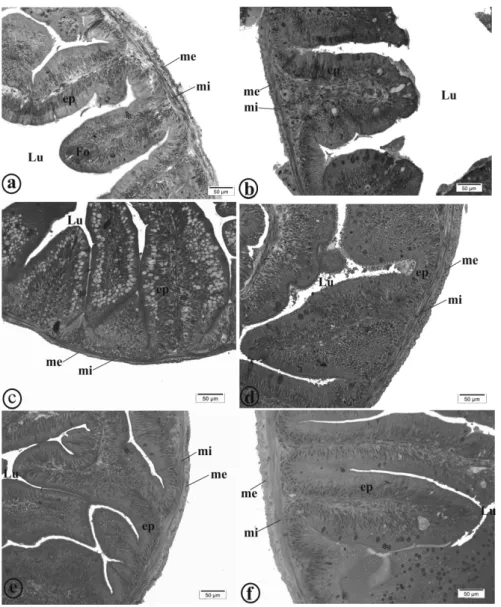
Figure 1 - Photomicrographs of structural organization of gut of yellow tail tetra (Astyanax altiparanae). a: Animals fed 0.0 g kg-1; b: Animals fed 0.5 g kg-1; c: Animals fed 1.0 g kg-1
; d: Animals fed 1.5 g kg-1
; e: Animals fed 2.0 g kg-1
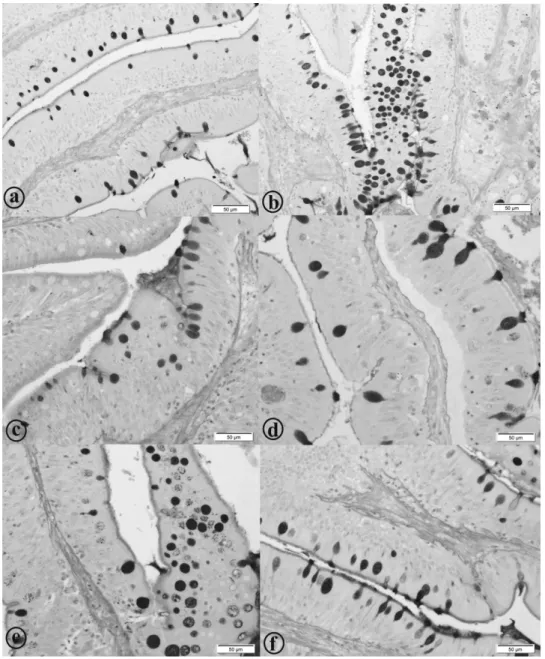
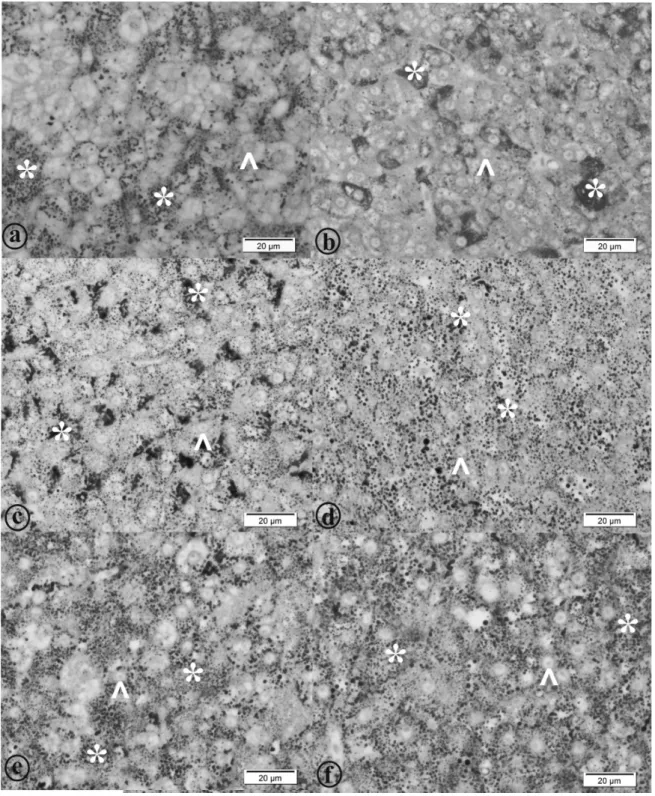
For the total number of goblet cells, a quadrat-ic effect of the oregano oil was observed, with an estimated value to minimise this variable equal to 1.39 g kg-1 of oregano oil. There was no signifi cant effect of oregano oil on the number of goblet cells
producing neutral, acid and mixed mucins (Table II, Fig. 3).
The liver histological analysis revealed hepa-tocytes with large and rounded nuclei, predomi-nantly located in the central region with prominent
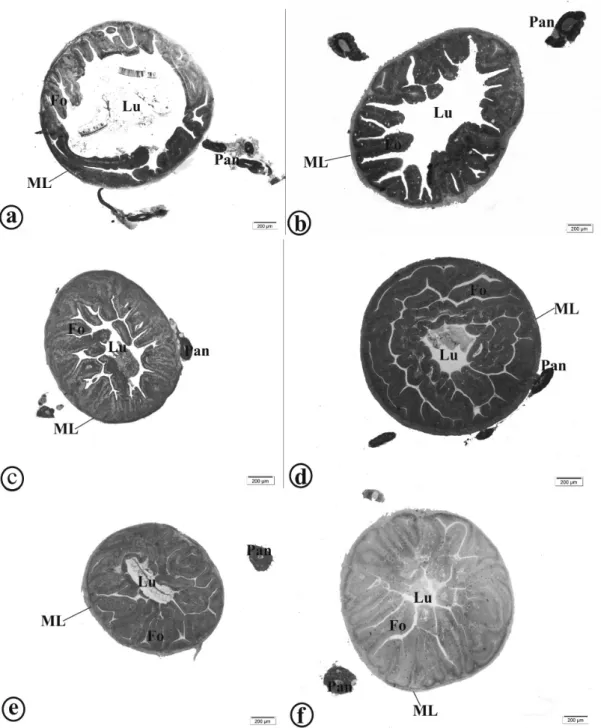
Figure 2 - Intestinal morphology of yellow tail tetra (Astyanax altiparanae). a: Animals fed 0.0 g kg-1
; b: Animals fed 0.5 g kg-1
; c: Animals fed 1.0 g kg-1
; d: Animals fed 1.5 g kg-1
; e: Animals fed 2.0 g kg-1
; f: Animals fed 2.5 g kg-1
TABLE II
Oregano oil effects on the number of goblet cells of the intestinal mucosa of the yellow tail tetra (Astyanax altiparanae).
Variables Oregano oil levels in the experimental diets (g/kg) CV (%)
0.0 0.5 1.0 1.5 2.0 2.5
Total number of goblet cells (GC)1
32.10 38.05 20.70 20.30 30.00 31.25 49.180
Goblet cells secreting mixed mucin (MM)ns
25.10 39.85 12.50 14.05 22.90 21.80 75.000
Goblet cells secreting neutral mucin (NM) ns
2.90 3.25 5.10 3.45 3.65 6.75 168.18
Goblet cells secreting acidic mucin (AM) ns 4.10 3.85 3.10 2.80 3.45 2.70 85.250 1
CG= 6.05x2
– 16.771x + 35.832, R2
= 40.23% (p = 0.01). ns
not signifi cant by analysis of variance at 5% probability.
Figure 3 - Goblet cells of the intestinal mucosa of the yellow tail tera (Astyanax altiparanae). a: Animals fed 0.0 g kg-1; b: Animals fed 0.5 g kg-1; c: Animals fed 1.0 g kg-1; d: Animals fed 1.5 g kg-1; e: Animals fed 2.0 g kg-1
; f: Animals fed 2.5 g kg-1
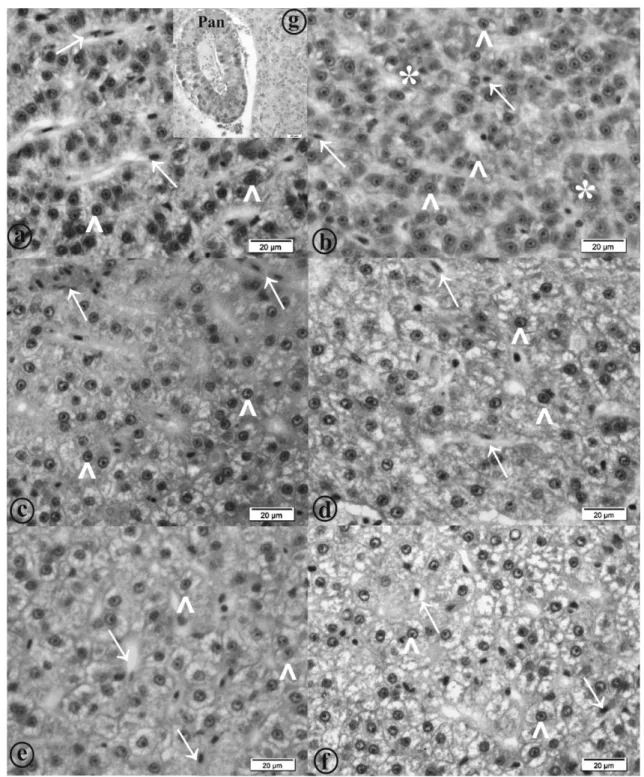
nucleoli. Among the hepatocytes, sinusoidal capil-laries with erythrocytes were observed (Fig. 4). In the liver parenchyma, exocrine pancreatic tissue was also observed. The exocrine pancreas consists of acinar serous cells that are rich in zymogen gran-ules in the cytoplasm (Fig. 4g). These cells are typi-cally basophilic when staining near the bottom, and eosinophilic closer to the apex of the cell. There were no melanomacrophage centres in A. altipara-nae’s liver.
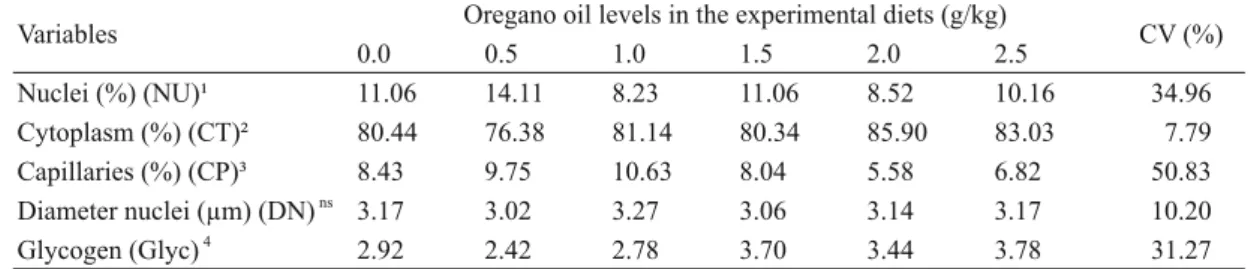
For the percentage of nuclei and blood capil-laries, there was a decreasing linear effect of the oregano oil. For the cytoplasmic percentage of he-patocytes and liver glycogen density, there was an increasing linear effect of oregano oil (Table III, Fig. 4 and Fig. 5). There was no signifi cant effect of oregano oil on the diameter of the nucleus.
DISCUSSION
The increased height, width and absorption surface area of the folds may be related to the antimicrobial activity of oregano oil (Burt and Reinders 2003, Sartoratto et al. 2004, Souza et al. 2006, Oliveira et al. 2009, Cleff et al. 2010), causing a reduction of unwanted bacteria (Kirkpinar et al. 2011, Giannenas et al. 2012) and a consequent reduction of mucosal damage. Thus, the reduction in energy expenditure for cell replacement in the intestinal mucosa may have allowed its greater development.
The increased surface area of the pleats promoted by the oregano oil can improve the digestive and absorptive processes, resulting in more effi cient use of nutrients, and ensuring improved productive performance of the animals, as noted by Zheng et al. (2009), Ahmadifar et al. (2011), and Ferreira et al. (2014).
The increased thickness of the muscular layer may contribute to increased motility, and conse-quently, to the elimination of intestinal parasites. Bona et al. (2012), evaluating a plant compound containing the essential oils of oregano, rosemary, cinnamon and red pepper, observed an increase in villus height in the duodenum and jejunum of broil-ers, and a reduction of the number of Clostridium perfringens colonies in the cecum of birds, when compared to the control group.
The mucosa exhibited epithelium interspersed with goblet cells that were PAS-positive (neutral mucin), AB-positive pH 2.5 (acid mucins) and PAS/ AB-positive (mixed mucins), with a predominance of cells with mixed secretions (AB/PAS-positive). This indicated the presence of neutral and acidic glycoproteins. In general, the mucus secreted by the goblet cells promotes protection and lubrication necessary to facilitate the passage of food (Car-rassón et al. 2006). Furthermore, the mucus con-tains immunoglobulin A (IgA) and peptides with antimicrobial activity, which may facilitate the elimination of pathogens (Hasnain et al. 2013). The
TABLE III
Oregano oil effects on liver morphometry of yellow tail tetra (Astyanax altiparanae).
Variables Oregano oil levels in the experimental diets (g/kg) CV (%)
0.0 0.5 1.0 1.5 2.0 2.5
Nuclei (%) (NU)¹ 11.06 14.11 8.23 11.06 8.52 10.16 34.96
Cytoplasm (%) (CT)² 80.44 76.38 81.14 80.34 85.90 83.03 07.79
Capillaries (%) (CP)³ 8.43 9.75 10.63 8.04 5.58 6.82 50.83
Diameter nuclei (μm) (DN) ns
3.17 3.02 3.27 3.06 3.14 3.17 10.20
Glycogen (Glyc) 4
2.92 2.42 2.78 3.70 3.44 3.78 31.27
1
NU = - 1.0248x + 11.8934, R2
= 19.40% (p = 0.01). 2
CT = 2.3247x + 78.2995, R2
= 47.30% (p = 0.01). 3
CP = - 1.3247x + 9.8647, R2 = 44.70% (p = 0.01). 4
Glyc = 0.4751x + 2.5774, R2
= 65.44% (p = 0.01). ns
acids glycoconjugates are more resistant to the
ac-tion of bacterial glycosidases (Makela et al. 1971)
and therefore, contribute to increased protection of
the intestinal mucosa, since the neutral mucins can
provide the co-factors necessary for the enzymatic
breakdown of food nutrients (Anderson 1986).
Figure 4 - Liver morphometry of yellow tail tetra (Astyanax altiparanae). a-g: Animals fed 0.0 g kg-1
The reduction in the total number of goblet cells may indicate that oregano was effective in
controlling microorganisms and intestinal
para-sites, since goblet cell hyperplasia can occur with intestinal infections by bacteria, virus and parasites
(Kim and Khan 2013). However, further studies
Figure 5 - Liver morphometry of yellow tail tetra (Astyanax altiparanae). a: Animals fed 0.0 g kg-1
are needed to evaluate the effect of oregano oil on the goblet cells of fi sh intestines when dealing with microbial and parasitic challenges.
The increase in the percentage of hepatocyte cytoplasm may be associated with hepatic glycogen accumulation, considering that the flavonoids present in oregano oil (naringin and naringerin) have hypoglycaemic activity (Ong and Khoo 2000, Perez-Gutiérrez et al. 2000, Hilaly and Lyoussi 2002). One of the mechanisms fl avonoid action is the binding to insulin receptors (Agullo et al. 1997), promoting glucose utilisation in the peripheral tissues and the liver. This supports the increased synthesis of glycogen by hepatocytes. Fernandes et al. (2009) observed an increase in liver glycogen levels in diabetic rats receiving naringerin in the diet. Oliveira et al. (2010) observed that tilapia fed with passion fruit (Passifl ora edulis) extract showed increased cytoplasmic area and decrease nuclei amounts. These authors attribute the increased glycogen accumulation to the presence of fl avonoids (vitexin) in passion fruit extract.
The results of this study demonstrate that oreg-ano essential oil promotes increased absorption surface area and modulates the number of goblet cells involved in protecting the intestinal mucosa. Furthermore, oregano essential oil promotes cyto-plasmic increases with greater deposition of liver glycogen in yellow tail tetra, Astyanax altiparanae.
ACKNOWLEDGMENTS
The authors would like to thank the Fundação de Amparo à Pesquisa do Estado de Minas Gerais (FAPEMIG, Brazil), for funding this project and for granting the fi rst author’s scholarship. In addi-tion, the authors are also very grateful the Guabi Nutrição Animal, Brazil, for its support in success-fully performing these experiments.
RESUMO
O objetivo do presente estudo foi avaliar o efeito do óleo de orégano sobre a morfometria intestinal e hepática do
lambari-do-rabo-amarelo, Astyanax altiparanae. Os pei-xes (1,46 ± 0,09 g) foram distribuídos em aquários con-tendo 60 L, na densidade de 0.5 peixes L-1. Foram ava-liadas seis dietas práticas contendo quantidades variadas de óleo de orégano (0,0; 0,5; 1,0; 1,5; 2,0 e 2,5 g de óleo de orégano kg-1
). Ao fi nal de 90 dias, os peixes foram eutanasiados. Foi realizada a coleta de 4 intestinos e 4 fígados por tratamento, que foram fi xados em Bouin e incluídos em resina. Foi observado efeito linear cres-cente do óleo de orégano sobre a altura das vilosidades, largura das vilosidades, área de superfície de absorção e espessura da camada muscular. Também foi observado efeito linear decrescente sobre o número total de células caliciformes. Houve efeito linear crescente da porcen-tagem citoplasmática e glicogênio hepático. Para a por-centagem de núcleos dos hepatócitos e capilares houve efeito linear decrescente. Dessa forma, o óleo essencial de orégano promove o aumento da área de absorção e modula a quantidade de células caliciformes envolvidas na proteção da mucosa intestinal e promove o aumento citoplasmático, com maior deposição de glicogênio he-pático no lambari-do-rabo-amarelo.
Palavras-chave: carvacrol, promotor de crescimento, histologia intestinal, histologia hepática, Origanum vul-gare, timol.
REFERENCES
ADRIAN IF, SILVA HBR AND PERETTI D. 2001. Dieta de
Astyanax bimaculatus (Linnaeus, 1758) (Characiformes, Characidae), da área de influência do reservatório de Corumbá, Estado de Goiás, Brasil. Acta Sci 23: 435-440.
AGULLO G, GAMET-PAYRASTRE L, MANET S, VIALA C,
REMESY C, CHAP H AND PAYRASTRE B. 1997.
Rela-tionship between flavonoids structure and inhibition of phosphatidylinositol-3-kinase: A comparison with tyrosine kinase and protein kinase on inhibition. Biochem Pharma-col 53: 1649-1657.
AHMADIFAR E, FALAHATKAR B AND AKRAMI R. 2011.
Ef-fects of dietary thymol-carvacrol on growth performance, hematological parameters and tissue composition of juve-nile rainbow trout, Oncorhynchus mykiss. J Appl Ichthyol 1: 1-4.
ALY SM AND MOHAMED MF. 2010. Echinacea purpurea and
Allium sativum as immunostimulants in fish culture using Nile tilapia (Oreochromis niloticus). J Anim Physiol Anim Nutr94: e31-39.
ANDERSON TA. 1986. Histological and cytological structure
tricuspidata (Pisces, Kyphosidae), in relation to diet. J Morphol 190: 109-119.
ANDREOTTI R AND NICODEMO MLF. 2004. Uso de
Antimi-crobianos na Produção de Bovinos e Desenvolvimento de Resistência, 1a
ed., Campo Grande: Embrapa Gado de Cor-te, 50 p.
BAMPIDIS VA, CHRISTODOULOU V, FLOROU-PANERI P,
CHRISTAKI E, SPAIS AB AND CHATZOPOULOU PS. 2005.
Effect of dietary oregano leaves supplementation on performance and carcass characteristics of growing lambs. Anim Feed Sci Technol 121: 285-295.
BASMACIOĞLU MALAYOĞLU H, BAYSAL S, MISIRLIOGLU
Z, POLAT M, YILMAZ H AND TURAN N. 2010. Effects of oregano essential oil with or without feed enzymes on growth performance, digestive enzyme, nutrient digest-ibility, lipid metabolism and immune response of broilers fed on wheat-soybean meal diets. Br Poult Sci 52: 67-80.
BOMBARDELLI RA, HAYASHI C, NATALI MRM, SANCHES
EA AND PIANA PA. 2009. Desempenho reprodutivo e zootécnico e deposição de lipídios nos hepatócitos de fêmeas de tilápia-do-nilo alimentadas com rações de diversos níveis energéticos. R Bras Zootec 38(8): 1391-1399.
BONA TDMM, PICKLER L, MIGLINO LB, KURITZA LN,
VASCONCELOS SP AND SANTIN E. 2012. Óleo essencial
de orégano, alecrim, canela e extrato de pimenta no con-trole de Salmonella, Eimeria e Clostridium em frangos de corte. Pesq Vet Bras 32(5): 411-418.
BURT SA AND REINDERS RD. 2003. Antibacterial activity
of selected plant essential oils against Escherichia coli
O157:H7. Lett Appl Microbiol 36: 162-167.
CARRASSÓN M, GRAU A, DOPAZO LR AND CRESPO S. 2006.
A histological, histochemical and ultrastructural study of the digestive tract of Dentex dentex (Pisces,Sparidae). Histol Histopathol 21: 579-593.
CASTRO EF, FONSECA CC AND MENIN E. 2002. Identificação de células endócrinas no aparelho digestório de
Prochilodus marggravii Walbaum, 1792 (Pisces, Teleostei, Characiformes, Prochilodontidae). Arq Ciênc Vet Zool UNIPAR 5(1): 71-78.
CLEFF MB, MEINERS AR, XAVIER M, SCHUCH LF, MEIRELES
MCA, RODRIGUES MRA AND MELLO JRB. 2010. In vitro
activity of Origanum vulgare essential oil against candida species. Braz J Microbiol 41: 116-123.
FACCIOLI CK, CHEDIDA RA, AMARALA AC, VICENTINIA
IBF AND VICENTINI CA. 2014. Morphology and
histo-chemistry of the digestive tract in carnivorous freshwater
Hemisorubim platyrhynchos (Siluriformes: Pimelodidae). Micron 64: 10-19.
FERNANDES AAH, NOVELLI ELB, JUNIOR AF AND
GALHARDI CM. 2009. Effect of Naringerin on Biochemical
Parameters in the Streptozotocin-Induced Diabetic Rats. Braz Arch Biol Technol 52(1): 51-59.
FERREIRA PMF, NASCIMENTO LS, DIAS DC, MOREIRA
DMV, SALARO AL, FREITAS MBD, CARNEIRO APS AND
ZUANON JAS. 2014. Essential Oregano Oil as a Growth
Promoter for the Yellowtail Tetra, Astyanax altiparanae. J World Aquacult Soc 45(1): 28-34.
FORCE M, SPARKS WS AND RONZIO RA. 2000. Inhibition of enteric parasites by emulsified oil of oregano in vivo. Phytother Res 14(3): 213-214.
FUKAYAMA EH, BERTECHINI AG, GERALDO A, KATO RK
AND MURGAS LDS. 2005. Extrato de orégano como
aditi-vo em rações para frangos de corte. R Bras Zootec 34(6): 2316-2326.
GIANNENAS I, TRIANTAFILLOU EL, STAVRAKAKIS
S, MARGARONI M, MAVRIDIS S, STEINER T AND
KARAGOUNI E. 2012. Assessment of dietary
supplementa-tion with carvacrol or thymol containing feed additives on performance, intestinal microbiota and antioxidant status of rainbow trout (Oncorhynchus mykiss). Aquacult 350-353: 26-32.
HASHEMIPOUR H, KERMANSHAHI H, GOLIAN A AND
VELDKAMP T. 2013. Effect of thymol and carvacrol feed
supplementation on performance, antioxidant enzyme ac-tivities, fatty acid composition, digestive enzyme activi-ties, and immune response in broiler chickens. Poult Sci 92: 2059-2069.
HASNAIN SZ, GALLAGHER AL, GRENCIS RK AND
THORNTON DJ. 2013. A new role for mucins in immunity:
Insights from gastrointestinal nematode infection. Int J Biochem Cell Biol 45: 364-374.
HILALY JE AND LYOUSSI B. 2002. Hypoglicemic effect of
the lyophilised aqueus extract of Ajuga iva in normal and streptozotocin diabetic rats. J Ethnopharmacol 80: 109-113.
KALEMBA D AND KUNICKA A. 2003. Antibacterial and
anti-fungal properties of essential oils. Curr Med Chem 10(10): 813-829.
KIM JJ AND KHAN WI. 2013. Goblet Cells and Mucins: Role in Innate Defense in Enteric Infections. Pathogens 2: 55-70.
KIRKPINAR F, BORA ÜNLÜ H AND GÜVEN ÖZDEMIR. 2011.
Effects of oregano and garlic essential oils on performance, carcase, organ and blood characteristics and intestinal microflora of broilers. Livest Sci 137: 219-225.
KISIELINSKI K, WILLIS S, PRESCHER A, KLOSTERHALFEN
B AND SCHUMPELICK V. 2002. A simple new method to
calculate small intestine absorptive surface in the rat. Clin Exp Med 2: 131-135.
LEE KW, EVERTS H AND BEYNEN AC. 2004. Essential oils in broilers nutrition. Int J Poult Sci 3(12):738-752.
MAKELA V, KORHONEN LK AND LILIUS G. 1971.
MARTINEZ ERM, ALVES AL, SILVEIRA SM, FORESTI F AND
OLIVEIRA C. 2012. Cytogenetic analysis in the incertae
sedis species Astyanax altiparanae Garutti and Britzki, 2000 and Hyphessobrycon eques Steindachner, 1882 (Characiformes, Characidae) from the upper Paraná river basin. Comp Cytogen 6(1): 41-51.
OCAÑA-FUENTES A, ARRANZ-GUTIÉRREZ E, SEÑORANS
FJ AND REGLERO G. 2010. Supercritical fluid extraction
of oregano (Origanum vulgare) essentials oils: Anti-inflammatory properties based on cytokine response on THP-1 macrophages. Food Chem Toxicol 48: 1568-1575.
OLIVEIRA JLTM, DINIZ MFM, LIMA EO, SOUZA EL,
TRAJANO VN AND SANTOS BHC. 2009. Effectiveness of
Origanum vulgare L. and Origanum majorana L. Essential oils in Inhibiting the Growth of Bacterial Strains Isolated from the Patients with Conjunctivitis. Braz Arch Biol Technol 52(1): 45-50.
OLIVEIRA RHF, PEREIRA-DA-SILVA EM, BUENO RS AND
BARONE AAC. 2010. O extrato de maracujá sobre a
mor-fometria de hepatócitos da tilápia do Nilo. Cienc Rural 40(12): 2562-2567.
ONG KC AND KHOO HE. 2000. Effects of myricetin on gly-cemia and glycpgen metabolism in diabetic rats. Life Sci 67: 1675-1705.
PEREZ-GUTIÉRREZ RM, CERVANTES CH, ZAVALA SMA,
SANCHEZ AJ, PEREZ GS AND PEREZ GC. 2000. Isolation and hypoglycemic activity of 5, 7, 3’-tryhydroxy-3,6,4’-trimetoxiflavona from Brickellia veronicaefolia. Phyto-medicine 7: 25-29.
PETROLLI TG, ALBINO LFT, ROSTAGNO HS, GOMES PC,
TAVERNARI FC AND BALBINO EM. 2012. Herbal extracts
in diets for broilers. R Bras Zootec 41(7): 1683-1690.
PORTO-FORESTI F, CASTILHO-ALMEIDA RB AND FORESTI
F. 2005. Biologia e criação do lambari-do-rabo-amarelo (Astyanax altiparanae). In: Baldisseroto B and Gomes LC (Eds), Espécies nativas para piscicultura no Brasil, Santa Maria: Editora UFSM, Santa Maria, RS, p. 105-120. RAO YV, DAS BK, JYOTYRMAYEE P AND CHAKRABARTI
R. 2006. Effect of Achyranthes aspera on the immunity and survival of Labeo rohita infected with Aeromonas hydrophila. Fish Shellfish Immunol 20: 263-273.
SAHU BS, DAS BK, MISHRA BK, PRADHAN J AND SARANGI
N. 2007. Effect of Allium sativum on the immunity and survival of Labeo rohita infected with Aeromonas hydrophila. J Appl Ichthyol 23: 80-86.
SARTORATTO A, MACHADO ALM, DELARMELINA C,
FIGUEIRA GM, DUARTE MCT AND REHDER VLG. 2004.
Composition and antimicrobial activity of essential oils from aromatic plants used in Brazil. Braz J Microbiol 35: 275-280.
SOUZA EL, STAMFORD TLM AND LIMA EO. 2006. Sensitivity of spoiling and pathogen food-related bacteria to Origanum vulgare l. (Lamiaceae) essential oil. Braz J Microbiol 37: 527-532.
ZANINI SF, SILVA MA, PESSOTTI BMSS, COLNAGO GL,
NUNES LC AND RODRIGUES MRA. 2012. Suplementação
de vitamina E e/ou de óleo essencial de aroeira na dieta de frangos de corte sobre o desempenho e morfometria intestinal. Arch Vet Sci 17(1): 76-81.
ZHENG ZI, TAN JYW, LIU HY, ZHOU XH, XIANG X AND