Printed in Brazil - ©2005 Sociedade Brasileira de Química 0103 - 5053 $6.00+0.00
Article
* e-mail: [email protected]
# To the memory of Dr. Wagner Magno Teles (1971-2004)
Synthesis and Spectroscopic Characterization of Tin(II) and Tin(IV) Complexes Containing
2,3,5,6-Tetrakis(
αα
α
α
α
-pyridyl)pyrazine as a Bridging Ligand
#Rodrigo S. Bitzera, Wagner M. Telesb, Anuar Abrasc, José Domingos Ardissond
and Carlos A. L. Filgueiras*,a
a
Instituto de Química, Universidade Federal do Rio de Janeiro, CP 68563, 21945-970 Rio de Janeiro - RJ, Brazil b
Departamento de Química-ICE, Universidade Federal de Juiz de Fora, 36036-330 Juiz de Fora - MG, Brazil
c
Departamento de Física-ICEx, Universidade Federal de Minas Gerais, 30161-970 Belo Horizonte - MG, Brazil d
Centro de Desenvolvimento da Tecnologia Nuclear-CNEN, 31270-910 Belo Horizonte - MG, Brazil
Neste trabalho foram investigadas as reações entre o ligante heterocíclico nitrogenado 2,3,5,6-tetraquis(α-piridil)pirazina, TPP, e seis precursores de estanho, a saber: SnCl2, SnX4 (X = Cl ou Br), SnRCl3 (R = Ph ou Me) e SnPh2Cl2. Os produtos foram caracterizados por microanálise (C, H, N e Sn), espectroscopia no infravermelho (4000-200 cm-1), RMN de 1H, 13C{1H}, 13C-CP/MAS, 119Sn e 119Sn-MAS, bem como por espectroscopia Mössbauer de 119Sn. Todas as reações levaram ao isolamento de complexos bimetálicos, nos quais o TPP se comportou como um ligante bis-bidentado em ponte, ligando-se a cada centro metálico através de dois átomos de nitrogênio piridínicos. Este modo de coordenação é ainda raro na literatura e, pela primeira vez, é observado em complexos de TPP com um metal representativo.
In this work we investigated the reactivity of the nitrogen heterocyclic ligand 2,3,5,6-tetrakis(α-pyridyl)pyrazine, TPP, towards six tin-containing reagents, namely SnCl2, SnX4 (X = Cl or Br), SnRCl3 (R = Ph or Me), and SnPh2Cl2. The products were characterized by microanalysis (C, H, N, and Sn), IR spectroscopy (4000-200 cm-1), 1H, 13C{1H}, 13C-CP/MAS, 119Sn, and 119Sn-MAS NMR spectroscopy, as well as by 119Sn Mössbauer spectroscopy. All reactions yielded bimetallic adducts, in which TPP behaved as a bis-bidentate bridging ligand, binding to each metallic center through two pyridine nitrogen atoms. This coordination mode is so far quite rare and, for the first time, is reported for main group metal-TPP complexes.
Keywords: Sn(II), Sn(IV), bimetallic complexes, 2,3,5,6-tetrakis(α-pyridyl)pyrazine
Introduction
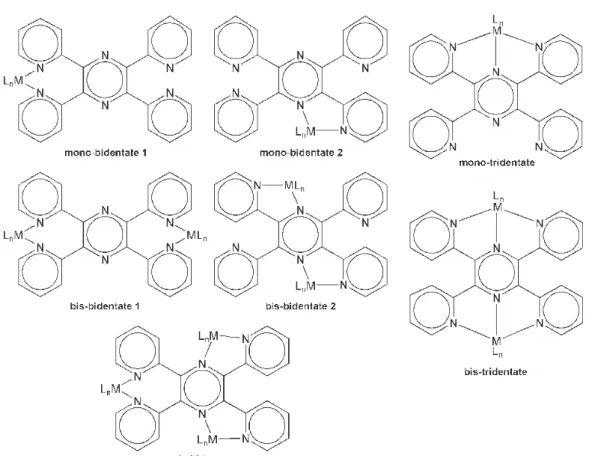
2,3,5,6-tetrakis(α-pyridyl)pyrazine, TPP, is a versatile ambidentate ligand containing six Lewis-basic nitrogen sites and at least seven different coordination modes with transition metals.1-16 The seven chelating modes hitherto
encountered for TPP are illustrated in Figure 1. The reactivity of this ligand towards transition metal species has attracted considerable attention over the past twenty years.1-16 However, studies of reactions between TPP and
main group metal compounds are absent in the literature. Owing to this paucity of information, we decided to investigate the reactivity and coordinating behavior of
TPP towards Sn(II) and Sn(IV) compounds, namely SnCl2, SnX4 (X = Cl or Br), SnRCl3 (R = Ph or Me), and SnPh2Cl2. The various complexes thus produced were characterized by a number of different spectroscopic methods.
The coordination chemistry of tin, particularly that of organotin compounds, is quite rich.17-19 However, this work
shows that the stannylated products described herein are all bimetallic adducts and exhibit a similarity of structural behavior. Regardless of the stannylated reagent, TPP coordinates each tin atom through two pyridine nitrogen atoms, in the bis-bidentate 1 chelating mode (Figure 1). This sort of TPP coordination mode was first reported for
the cationic part of the salt {[Pt(PEt3)Cl]2-μ
-TPP}[Pt(PEt3)(SnCl3)4]12 and is reproduced in the present
Experimental
General procedures
All reactions were carried out under an Ar or N2
atmosphere using Schlenk glassware and vacuum/inert-gas line manipulation techniques. Solvents were dried by standard procedures and distilled immediately prior to use. 2,3,5,6-tetrakis(α-pyridyl)pyrazine (TPP) was synthesized according to Goodwin & Lions’s method.20 All other
chemicals were obtained from commercial sources (Strem or Aldrich) and used as received.
Physical measurements
Decomposition points were determined on a Mel-Temp II (Lab. Devices, Inc.) apparatus. Elemental analyses (C, H, and N) were conducted on a Perkin-Elmer 2400 CHN Elemental Analyzer. Tin was analyzed on a Hitachi Z-8200 atomic absorption spectrophotometer. IR spectra were recorded either on a 283B Perkin-Elmer or on a Magna-IR760 FTIR Nicolet spectrometer. The IR spectra were obtained in the 4000-200 cm-1 range using CsI pellets. 1H
and 13C{1H} NMR spectra in solution were acquired from
a Bruker DRX200 instrument operating at 200.00 and 50.30 MHz, respectively. The solution 119Sn NMR spectra
were obtained from a Bruker DRX400 spectrometer
operating at 149.17 MHz. Both 13C-CP/MAS and 119
Sn-MAS spectra were recorded on a Bruker DRX300 spectrometer operating at 75.47 and 111.92 MHz, respectively. In order to obtain the isotropic chemical shift values, the sample was spun at 6 and 7.5 kHz in the
13C-CP/MAS spectra and also at 8 kHz in the 119Sn-MAS
spectra. All NMR studies were performed at room temperature, and the chemical shift values were determined in relation to SiMe4 for the 1H and 13C nuclei and to an
external reference of SnMe4 for the 119Sn nucleus. 119Sn
Mössbauer spectra were obtained from a constant acceleration spectrometer moving a CaSnO3 source at room
temperature. The samples were analyzed at liquid N2
temperature, and the isomer shift values are given with respect to that source. All Mössbauer spectra were computer-fitted assuming Lorentzian lineshapes.
Synthesis of [(SnCl
4)2-μ-TPP] (1) and [(SnBr4)2-μ-TPP](2)
A solution of SnX4 (X = Cl: 0.20 mL, 0.46 g, 1.76 mmol; X = Br: 0.23 mL, 0.77 g, 1.76 mmol) was added under constant magnetic stirring to a suspension of TPP (0.34 g, 0.88 mmol) in EtOH (35 mL). When X = Cl, 1 immediately precipitated as a white solid. When X = Br, the resulting solution was refluxed for 2h and cooled to room
temperature, leading to the formation of 2 as a yellow powder. Both 1 and 2 were filtered off, washed with EtOH
and Et2O, and dried under vacuum. The products were
recrystallized from a 1:1 mixture of EtOH and MeCN, yielding 0.60 g of 1 (75%) and 0.69 g of 2 (63%).
Data for 1. mp: 283 oC (dec.). Anal. Calc. for
C24H16N6Cl8Sn2: C, 31.7; H, 1.8; N, 9.2; Sn, 26.1%. Found: C, 32.4; H, 1.7; N, 9.1; Sn, 26.2%. IR νmax/cm
-1: ν(CH),
3060 (m); ν(CC/CN), 1594 (s), 1570 (s), 1485 (s), 1390 (s);
δ(CH), 771 (s), 740 (s); ν(Sn-N), 409 (w); ν(Sn-Cl), 279 (s).
1H NMR (DMF-d
7), δ (ppm): 8.57 (4H, m, H6); 8.36-8.24
(8H, m, H3, H4); 7.96 (4H, m, H5). 13C{1H} NMR
(DMF-d7), δ (ppm): 157.3 (C2, pyrazine ring); 154.2 (C2); 151.8 (C6); 143.5 (C3); 139.2 (C4); 130.3 (C5).
Data for 2. mp: 257 oC (dec). Anal. Calc. for
C24H16N6Br8Sn2: C, 22.8; H, 1.3; N, 6.6; Sn, 18.8%. Found: C, 23.4; H, 1.4; N, 6.8; Sn, 19.5%. IR νmax/cm
-1: ν(CH),
3064 (m); ν(CC/CN), 1590 (s), 1573 (s), 1489 (s), 1393 (s);
δ(CH), 778 (s), 745 (s); ν(Sn-N), 394 (w). 1H NMR (CD
3CN),
δ (ppm): 8.54 (4H, m, H6); 8.38-8.27 (8H, m, H3, H4); 7.91 (4H, m, H5). 13C{1H} NMR (CD
3CN), δ (ppm): 156.2 (C2,
pyrazine ring); 152.7 (C2); 151.4 (C6); 142.3 (C3); 140.8 (C4); 131.6 (C5).
Synthesis of [(SnPhCl3)2-μ-TPP] (3), [(SnMeCl3)2-μ-TPP] (4), and [(SnPh2Cl2)2-μ-TPP] (5)
To a suspension of TPP (0.15 g, 0.39 mmol) in EtOH (30 mL), the appropriate organotin chloride, SnR4-nCln (n = 3, R = Ph: 0.13 mL, 0.24 g, 0.78 mmol; n = 3, R = Me: 0.19 g, 0.78 mmol; n = 2, R = Ph: 0.27 g, 0.78 mmol), was added under vigorous magnetic stirring. Each reaction mixture was kept under reflux for 6h, and then, reduction of the volume to 2 mL was performed. The precipitation of the products was induced by addition of a 2:1 mixture of THF:hexane. The products were separated by filtration, washed with EtOH and Et2O, and dried under vacuum. The isolated complexes were recrystallized from a 1:1:2 mixture of DMF:hexane:EtOH, yielding 0.23 g of 3 (60%), 0.21 g of 4 (61%), and 0.24 g of 5 (58%).
Data for 3. mp: 270 oC (dec). Anal. Calc. for
C36H26N6Cl6Sn2: C, 43.6; H, 2.6; N, 8.5; Sn, 23.9%. Found: C, 44.3; H, 2.7; N, 8.9; Sn, 24.3%. IR νmax/cm
-1: ν(CH),
3085 (m), 3068 (m); ν(CC/CN), 1610 (s), 1576 (s), 1490 (s), 1450 (s); δ(CH), 772 (s), 730 (s); ν(Sn-N), 410 (w);
ν(Sn-Cl), 270 (s). 1H NMR (DMF-d
7), δ (ppm): 8.51 (4H, m,
H6); 8.38-8.25 (8H, m, H3, H4); 7.95 (4H, m, H5); 7.89 (4H, m, Ho, Ph); 7.55-7.47 (6H, m, Hm, Hp, Ph). 13C{1H}
NMR (DMF-d7), δ (ppm): 157.1 (C2, pyrazine ring); 154.5 (C2); 152.3 (C6); 143.8 (C3); 140.6 (C4) 130.8 (C5); 142.6 (Cipso); 134.8 (Co); 131.3 (Cp); 128.1 (Cm).
Data for 4. mp: 256 oC (dec). Anal. Calc. for
C26H22N6Cl6Sn2: C, 35.9; H, 2.6; N, 9.7; Sn, 27.3%. Found: C, 37.7; H, 2.8; N, 10.2; Sn, 27.0%. IR νmax/cm
-1: ν(CH),
3060 (m), 2913 (m); ν(CC/CN), 1599 (s), 1572 (s), 1486 (s), 1380 (s); δ(CH), 776 (s), 739 (s); ν(Sn-N), 408 (w);
ν(Sn-Cl), 273 (s). 1H NMR (CD
3CN), δ (ppm): 8.53 (4H, m,
H6); 8.34-8.21 (8H, m, H3, H4); 7.92 (4H, m, H5); 1.27
(6H, Me). 13C{1H} NMR (CD
3CN), δ (ppm): 156.5 (C2,
pyrazine ring); 153.3 (C2); 152.4 (C6); 142.7 (C3); 141.3 (C4); 130.6 (C5); 28.7 (Me).
Data for 5. mp: 210 oC (dec). Anal. Calc. for
C48H36N6Cl4Sn2: C, 53.6; H, 3.4; N, 7.8; Sn, 22.1%. Found: C, 51.9; H, 3.1; N, 7.6; Sn, 21.6%. IR νmax/cm
-1: ν(CH),
3080 (m), 3061 (m); ν(CC/CN), 1596 (s), 1576 (s), 1478 (s), 1400 (s); δ(CH), 796 (s), 732 (s), 719 (s); ν(Sn-N), 402 (w); ν(Sn-Cl), 270 (s). 1H NMR (CD
3CN), δ (ppm): 8.50
(4H, m, H6); 8.43-8.29 (8H, m, H3, H4); 7.93 (4H, m, H5); 7.85 (8H, m, Ho, Ph); 7.57-7.45 (12H, m, Hm, Hp, Ph). 13C{1H}
NMR (CD3CN), δ (ppm): 155.1 (C2, pyrazine ring); 153.1 (C2); 152.5 (C6); 144.6 (C3); 140.1 (C4); 129.5 (C5); 141.2 (Cipso); 135.5 (Co); 132.7 (Cp); 127.6 (Cm).
Synthesis of [(SnCl2)2-μ-TPP] (6)
Solid TPP (0.36 g, 0.93 mmol) was added under vigorous magnetic stirring to a solution of anhydrous SnCl2 (0.41 g, 2.17 mmol) in EtOH (25 mL). A yellow solid immediately precipitated. The reaction mixture was kept under stirring for two additional days at room temperature. The yellow solid was then isolated by filtration, washed with EtOH and MeOH, and dried under vacuum. After
drying, product 6 became orange and was stored under
argon. The yield of 6 was 0.50 g (70%).
Data for 6. mp: 190 oC (dec). Anal. Calc. for
C24H16N6Cl4Sn2: C, 37.6; H, 2.1; N, 11.0; Sn, 30.9%. Found: C, 39.6; H, 1.7; N, 11.2; Sn, 30.7%. IR νmax/cm
-1:
ν(CH), 3074 (w), 3031 (w); ν(CC/CN), 1592 (s), 1569 (w), 1525 (w), 1482 (m), 1446 (m), 1397 (vs); δ(CH), 797 (m), 747 (m); ν(Sn-N), 456 (w), 416 (m); ν(Sn-Cl), 253 (s), 229
(m). 1H NMR (CD
3CN), δ (ppm): 8.47 (4H, d, JHH = 4.5 Hz,
H6); 8.05-7.96 (8H, m, H3, H4); 7.59 (4H, m, H5). 13
C-CP/MAS, δ (ppm): C2-pyrazine ring: not observable;
150.3 (C2); 147.9 (C6); 143.7 (C3); 140.6 (C4); 128.0
(C5). Due to the low solubility of 6 in commom
deuterated solvents and decomposition in DMF-d7 and
DMSO-d6, its solution 13C{1H} and 119Sn NMR spectra
could not be measured.
Because of their importance for the present study, the
119Sn NMR and Mössbauer spectroscopic data are
Results and Discussion
Elemental analyses agree with the supposition that all products are bimetallic adducts of general formula [(SnLn)2TPP], in which SnLn stands for the different stannylated precursors. The analytical and spectroscopic data point to the fact that complexes 1 to 5 have two hexacoordinate Sn(IV) sites, whereas complex 6 has two tetracoordinate Sn(II) centers.
In the IR spectra, the ν(CC/CN) bands were shifted from 1590-1390 cm-1 in free TPP to higher wavenumbers in the
products. Additionally, new ν(Sn-N) bands appeared in the low-frequency region of the spectra, as expected. Moreover, the ν(Sn-X) (X = Cl or Br) bands were shifted to lower wavenumber values in relation to the free stannylated reagents.
The coordination of TPP is also indicated by the 1H
and 13C{1H} (or 13C-CP/MAS in the case of 6) NMR data.
With no exception, the NMR signals assigned to the H and C atoms of TPP in the products moved to higher δ values with respect to those of the free ligand. Moreover, the number and integration of the 1H signals imply that there
are no uncoordinated pyridine rings in 1 to 6, suggesting that TPP may be symmetrically attached to both metallic centers in each adduct. Thus, on the basis of the 1H and 13C
NMR spectra, only the bis-bidentate 1 or bis-tridentate chelating modes (Figure 1) can occur in 1 to 6.
Table 1 shows the 119Sn NMR and 119Sn Mössbauer
spectral data collected for the products and for other tin compounds. Our six adducts exhibit only one sharp 119Sn
NMR signal. This indicates that both tin atoms in each bimetallic product are chemically and magnetically equivalent in the NMR time scale. Except for 2, the 119Sn
chemical shift values, δ(119Sn), for the products are
significantly lower than those for their precursors. An important feature of 119Sn chemical shifts is that an increase
in coordination number normally leads to lower values of
δ(119Sn) due to shielding effects.19 This shift upon
complexation has been repeatedly shown in work by this group and by others.23,28-31 If one takes SnCl
4, its values of
δ(119Sn) are -150 and -601 ppm as the neat compound and
in its MeOH solution, respectively (Table 1). This difference suggests that in MeOH the metal is hexacoordinate due to solvation. In fact, the value of δ(119Sn) observed for SnCl
4
in MeOH is analogous to that measured for 1 (Table 1). A
more striking case arises when one compares 1 with
[SnCl4(DPS)]31 (DPS = di(2-pyridyl)sulfide), in which
δ(119Sn) is -636 ppm in DMF-d
7 and the ligand DPS forms
an N,N-bonded chelate. The similarity between the δ(119Sn)
values for both [(SnCl4)2-μ-TPP] and [SnCl4(DPS)] suggests that in the former each Sn(IV) center is hexacoordinate and thus, TPP binds to each stannylated site through two pyridine nitrogen atoms, according to the bis-bidentate 1 coordination mode (Figure 1). The same interpretation can be made by comparing δ(119Sn) of 2 (-485 ppm) with that
of [SnBr4(DPS)] (-502 ppm).31 Curiously, the value of
δ(119Sn) of SnBr
4 (Table 1) is lower than that measured for
2. It has been pointed out that, for adducts obtained from SnBr4, there appears to be no obvious relationship between the coordination number of tin and the value of δ(119Sn).28
In 3 to 5 the upfield shift in the values of δ(119Sn) (Table 1),
in relation to their precursors, also suggests the formation of hexacoordinate Sn(IV) compounds.
Summing up the discussion in terms of the NMR results, of the seven coordinating possibilities so far reported for TPP (Figure 1), only the symmetrical bis-bidentate 1 and bis-tridentate are possible for 1 to 6. Both afford equivalent tin centers; nevertheless, the former leads to hexacoordinate Sn(IV) and tetracoordinate Sn(II) centers, whereas the latter leads to heptacoordinate Sn(IV) and pentacoordinate Sn(II) products. Heptacoordinate Sn(IV) complexes, however, have much lower 119Sn chemical shifts than those obtained for 1
to 5.30,32 Therefore, the 119Sn NMR results point to
hexacoordinate tin centers in the Sn(IV) products. With respect to complex 6, since only a few data about 119
Sn-MAS NMR spectra of Sn(II) compounds are available for comparison with our result, a discussion concerning the coordination mode of TPP in 6 will be centered on its 119Sn
Mössbauer spectrum. In turn, the 119Sn Mössbauer data of
the Sn(IV) adducts corroborate the conclusions from the
119Sn NMR spectra. This shows that TPP acts as a
bis-bidentate 1 ligand in both solution and the solid state and leads to the conclusion that no dissociation of complexes 1
to 5 in coordinating solvents (DMF-d7 or CD3CN) occurred.
Table 1. 119Sn NMR and Mössbauer spectral data
119Sn NMR 119Sn Mössbauer
Compound δ (ppm) δ (mm s-1) ∆E Q (mm s
-1)
SnCl4 -150a, 21 0.8521 0.00
-601b, 22
SnBr4 -638c, 21 1.1521 0.00
SnCl2 -358d, 21 4.06(2)24 0.66(4)
CsSnCl3 -30e, 21 3.4025 1.22
SnPhCl3 -63f, 23 1.1026 1.80
SnMeCl3 +20g, 23 1.2027 1.99
SnPh2Cl2 -32f, 23 1.4026 2.80
(1) -631h 0.49(1) 0.32(2)
(2) -485i 0.81(1) 0.38(2)
(3) -675h 0.68(1) 2.10(2)
(4) -610i 0.79(1) 2.08(2)
(5) -640i 1.23(1) 3.45(1)
(6) -584j 3.44(5) 1.14(6)
a neat; b in MeOH; c in CS 2;
d in DMSO; e in CH
2Cl2/C6D6; f in CD
2Cl2; g in CDCl
3;
h in DMF-d 7;
i in CD 3CN;
Table 1 gives the 119Sn Mössbauer parameters for the
precursors and products. Both isomer shifts (δ) and
quadrupole splittings (∆EQ) show great variation upon complexation. Invariably, the isomer shift values of 1 to 6
are lower than those of their precursors. Furthermore, the
presence of only one doublet in the 119Sn Mössbauer
spectra also indicates the existence of just one type of tin atom in each dinuclear adduct.
119Sn Mössbauer δ values are directly dependent upon
the 5s-electron density at the Sn nucleus.17-19,21 Thus, an
increase in the coordination number of tin leads to a decrease in the δ value. 119Sn Mössbauer spectroscopy can
also be reliably used to distinguish between the 2+ and 4+ oxidation states of tin. Usually, δ values in the interval from -0.5 to 2.1 mm s-1 are expected for Sn(IV) compounds,
and Sn(II) complexes present δ values ranging from +2.5 to 5.0 mm s-1.21 Based on this, our Mössbauer data are
consistent with the presence of Sn(IV) sites in complexes
1 to 5 and Sn(II) centers in 6. ∆EQ parameters relate to a change in the symmetry of electron density distribution around the Sn nucleus. 17-19,21 The three inorganic precursors
have ∆EQ values of zero (SnCl4 and SnBr4) or very low (SnCl2). After complexation, the ∆EQ values of 1, 2, and 6
became higher than those of their precursors, showing an increase in electron density asymmetry around the Sn centers. A similar increase in ∆EQ values also takes place upon coordination of the three organotin reagents.
In all the Sn(IV) complexes the 5s-electron density at
tin was reduced from about 25% (sp3 hybrid) in the
precursors to ca. 17% (sp3d2 hybrid, supposing
hexacoordinate tin) in the complexes, entailing a reduction in the δ values. Regarding the actual isomer shifts, it is interesting to draw attention to the change observed when one compares SnCl4 (0.85 mm s-1) with [SnCl
4(DPS)] (0.48
mm s-1)31 and [(SnCl
4)2-μ-TPP] (0.49 mm s
-1). Also, a similar
change is verified comparing SnBr4 (1.15 mm s-1) with
[SnBr4(DPS)] (0.74 mm s-1)31 and [(SnBr
4)2-μ-TPP] (0.81
mm s-1). These results indicate not only an increase in the
coordination number of tin, from four to six, in 1 and 2, but also similar coordinating environments around tin in
the DPS and TPP complexes of SnCl4 and SnBr4. Other
analogies arise when one takes the δ values of [(SnPhCl3)2
-μ-TPP] (0.68 mm s-1) and [SnPhCl
3(bipy)] (bipy =
2,2’-bipyridine) (0.87 mm s-1),33 [(SnMeCl
3)2-μ-TPP] (0.79 mm
s-1) and [SnBuCl
3(bipy)] (0.87 mm s
-1),33 as well as the δ
values of [(SnPh2Cl2)2-μ-TPP] (1.23 mm s-1),
[SnPh2Cl2(bipy)] (1.22 mm s-1),26 and [SnPh
2Cl2(bipym)]
(bipym = 2,2’-bipyrimidine) (1.23 mm s-1).34 Insofar as
[SnPhCl3(bipy)], [SnBuCl3(bipy)], [SnPh2Cl2(bipy)], and [SnPh2Cl2(bipym)] have hexacoordinate tin atoms attached to pyridine (or pyrimidine) nitrogen atoms, 3, 4, and 5
should also be hexacoordinate and in these complexes the tin atoms should be coordinated to the pyridine nitrogen atoms of TPP. In the bipym complex [SnPh2Cl2(bipym)] the value of ∆EQ is 3.43 mm s-1, and its X-ray structure
shows that the two Ph groups are trans to each other.34 In
[(SnPh2Cl2)2-μ-TPP], 5, ∆EQ = 3.45 mm s-1. This proximity
in the values of ∆EQ suggests similar geometries for both complexes, thereby pointing that in 5 the two Ph groups must also be trans to each other. Indeed, ∆EQ can be used as a powerful tool for the assignment of structures of cis
and trans diorganotin compounds of the SnR2Cl2(LL) type, in which LL stands for a bidentate ligand.19 It is expected,
therefore, that trans complexes show ∆EQ values of about 4.0 mm s-1, whereas cis isomers exhibit ∆E
Q values twice
as smaller. Our conclusion is that 5 is likely to have the two Ph groups trans to each other.
In solid anhydrous tin(II) chloride, the tin atom is surrounded by nine chlorine atoms, leading to a facially capped trigonal prismatic arrangement.21,35 Of the nine
Sn-Cl distances in solid SnSn-Cl2, three are very short and the others are longer and of variable length. In view of this, it is not possible to clearly state the coordination number of tin in solid SnCl2. Thus, it is difficult to discuss the coordination number of tin in 6 solely from a comparison between its Mössbauer parameters and those of SnCl2. On the other hand, in the related compound [SnCl2(pyridine)2]
δ is 3.02 mm s-1.36 The δ value of 6,3.44 mm s-1, is very
similar to that of [SnCl2(pyridine)2], suggesting similar tin environments in both complexes. Thus, we propose that in
6 TPP also coordinates each stannylated center at two
pyridine nitrogen atoms, according to the bis-bidentate 1 chelating mode.
It is important to mention that the bis-bidentate 1, as well as the mono-bidentate 1 chelating modes of TPP do not lead to planar metallacycles, as Figure 1 might suggest. In fact, due to rotation about the single bonds uniting the pyridine rings and the central pyrazine ring, the adjacent pyridine rings of TPP acquire a non-planar configuration upon coordination through the mono- or bis-bidentate 1 bonding modes.12,13
Conclusions
Acknowledgements
The authors are grateful to the Brazilian agencies CAPES, CNPq, FAPERJ, and FUJB for financial support.
References
1. Thummel, R.P.; Chirayil, S.; Inorg. Chim. Acta1988, 154, 77. 2. Ruminski, R.; Kiplinger, J.; Cockroft, T.; Chase, C.; Inorg.
Chem. 1989, 28, 370.
3. Ruminski, R.R.; Letner, C.; Inorg. Chim. Acta1989, 162, 175.
4. Ruminski, R.R.; Kiplinger, J.; Inorg. Chem. 1990, 29, 4581. 5. Vogler, L.M.; Scott, B.; Brewer, K.J.; Inorg. Chem. 1993, 32,
898.
6. Graf, M.; Greaves, B.; Stoeckli-Evans, H.; Inorg. Chim. Acta 1993, 204, 239.
7. Brewer, R.G.; Jensen, G.E.; Brewer, K.J.; Inorg. Chem. 1994,
33, 124.
8. Vogler, L.M.; Brewer, K.J.; Inorg. Chem. 1996, 35, 818. 9. Tondreau, V.; Leiva, A.M.; Loeb, B.; Boys, D.; Stultz, L.K.;
Meyer, T.J.; Polyhedron1996, 15, 2035.
10. Graf, M.; Stoekli-Evans, H.; Escuer, A.; Vicente, R.; Inorg. Chim. Acta1997, 257, 89.
11. Lee, J.-D.; Vrana, L.M.; Bullock, E.R.; Brewer, K.J.; Inorg. Chem. 1998, 37, 3575.
12. Teles, W.M.; Speziali, N.L.; Filgueiras, C.A.L.; Polyhedron 2000, 19, 739.
13. Chen, X.; Femia, F.J.; Babich, J.W.; Zubieta, J.; Inorg. Chim. Acta2001, 315, 66.
14. Carranza, J.; Brennan, C.; Sletten, J.; Clemente-Juan, J.M.; Lloret, F.; Julve, M.; Inorg. Chem. 2003, 42, 8716. 15. Lalrempuia, R.; Govindaswamy, P.; Mozharivskyj, Y.A.;
Kollipara, M.R.; Polyhedron2004, 23, 1069.
16. Chanda, N.; Sarkar, B.; Kar, S.; Fiedler, J.; Kaim, W.; Lahiri, G.K.; Inorg. Chem. 2004, 43, 5128.
17. Filgueiras, C.A.L.; Quim. Nova1998, 21, 176. 18. Gielen, M.; J. Braz. Chem. Soc. 2003, 14, 870.
19. Davies, A.G.; Smith, P.J. In Comprehensive Organometallic Chemistry: The Synthesis, Reactions and Structures of
Organometallic Compounds; Wilkinson, G.; Stone, F.G.A.; Abel, E.W., eds.; Pergamon Press: Oxford, 1982, ch. 11. 20. Goodwin, H.A.; Lions, F.; J. Am. Chem. Soc. 1959, 81, 6415. 21. Wardell, J.L. In Encyclopedia of Inorganic Chemistry; King, R.B., ed.; John Wiley & Sons: Chichester, 1994, p. 4160-4166.
22. Burke, J.J.; Lauterbur, P.C.; J. Am. Chem. Soc. 1961, 83, 326. 23. Smith, P.J.; Tupiauskas, A.P.; Annu. Rev. NMR Spectrosc. 1978,
8, 291.
24. Birchall, T.; Dean, P.A.W.; Gillespie, R.J.; J. Chem. Soc. A 1971, 1777.
25. Parish, R.V.; Coord. Chem. Rev. 1982, 42, 1. 26. Smith, P.J.; Organomet. Chem. Rev. (A)1970, 5, 373. 27. Lima, G.M.; Filgueiras, C.A.L.; Abras, A.; Hyperfine
Interactions1994, 83, 183.
28. Wrackmeyer, B.; Annu. Rep. NMR Spectrosc. 1985, 13, 118. 29. Barbieri, R.S.; Beraldo, H.O.; Filgueiras, C.A.L.; Abras, A.; Nixon, J.F.; Hitchcock, P.B.; Inorg. Chim. Acta1993, 206, 169.
30. Allain, L.R.; Filgueiras, C.A.L.; Abras, A.; Ferreiras, A.G.; J.
Braz. Chem. Soc. 1996, 7, 247.
31. Teles, W.M.; Fernandes, N.G.; Abras, A.; Filgueiras, C.A.L.;
Trans. Met. Chem. 1999, 24, 321.
32. Blunden, S.J.; Searle, D.; Smith, P.J.; Inorg. Chim. Acta1986,
116, L31.
33. Mullins, F.P.; Can. J. Chem. 1970, 48, 1677.
34. Caruso, F.; Giomini, M.; Giuliani, A.M.; Rivarola, E.; J. Organomet. Chem. 1994, 466, 69.
35. Donaldson, J.D.; Prog. Inorg. Chem. 1968, 8, 287. 36. Ebsworth, E.A.V.; Rankin, D.W.H.; Cradock, S.; Structural
Methods in Inorganic Chemistry; Backwell Scientific Publications: Oxford, 1991, ch. 7.
Received: November 5, 2004