J. Braz. Chem. Soc., Vol. 16, No. 3B, 662-665, 2005. Printed in Brazil - ©2005 Sociedade Brasileira de Química 0103 - 5053 $6.00+0.00
Short Report
* e-mail: [email protected]
Chemical Constituents of
Cordia piauhiensis
– Boraginaceae
Renata Paiva dos Santos
a, Telma L. G. Lemos
a, Otilia Deusdênia L. Pessoa*
,a, Raimundo Braz-Filho
b,
Edson Rodrigues-Filho
c, Francisco Arnaldo Viana
dand Edilberto R. Silveira
aa
Departamento de Química Orgânica e Inorgânica, Centro de Ciências, Universidade Federal do Ceará, CP 12200, 60021-970 Fortaleza - CE, Brazil
b
Setor de Química de Produtos Naturais - LCQUI - CCT, Universidade Estadual do Norte Fluminense, 28015-620 Campos - RJ, Brazil
c
Departamento de Química, Universidade Federal de São Carlos, 14040-970 São Carlos - SP, Brazil
d
Universidade do Estado do Rio Grande do Norte, 59610-210 Mossoró - RN, Brazil
Uma nova saponina triterpênica monodesmosídica, caracterizada como ácido 3E-O-D -L-ramnopiranosil-(1→2)-E-D-glicopiranosil pomólico, foi isolada de Cordia piauhiensis Fresen (Boraginaceae). Sua estrutura foi determinada através de extensiva análise de métodos de RMN, incluindo os experimentos 1H, 1H-COSY, HMQC, HMBC e NOESY. Os triterpenóides ácido
quinóvico, ácido cinchólico, ácido 3E-O-6-deoxi-E-D-glicopiranosídeo cinchólico e 3E-O-E -D-glicopiranosídeo quinóvico foram também isolados.
A new monodesmoside triterpenoid saponin characterized as 3E-O-D -L-rhamnopyranosyl-(1→2)-E-D-glucopyranosyl pomolic acid, was isolated from Cordia piauhiensis Fresen (Boraginaceae). Its structure was determined by extensive NMR analysis, including 1H, 1H-COSY,
HMQC, HMBC, and NOESY experiments. In addition, four known triterpenoids: quinovic acid, cincholic acid, cincholic 3E-O-6-deoxy-E-D-glucopyranoside acid and quinovic 3E-O-E -D-glucopyranoside acid were also isolated.
Keywords:Cordia piauhiensis, Boraginaceae, triterpenes, saponins
Introduction
The genus Cordia (Boraginaceae), a known source of
benzoquinones,1 naphthoquinones,2 hydroquinones,
cromenes,3 triterpenes,4 sesquiterpenes,5 polyphenols,6 and
flavonoids7 comprises about 250 species distributed
throughout the New World.8 Many compounds originally
isolated from Cordia species have been reported as
presenting several biological activities such as antifungal, larvicidal, anti-inflammatory and anti-androgenic.2,4,6,7
As part of our current interest in Cordia species from
Northeastern Brazil flora we have investigated C.
piauhiensis Fresen (syn.: Cordia rufescens A. DC.), an endemic shrub distributed in the South, Southeast and Northeast regions of Brazil.8 In a previous paper we
reported the isolation and characterization of a triterpenoid
bidesmoside saponin from the stems of this plant.9
Continuing with our phytochemical research we now report
the isolation and structural elucidation of 3E-O-D
-L-rhamnopyranosyl-(1→2)-E-D-glucopyranosyl pomolic
acid (1), a novel monodesmoside saponin, along with four triterpenoids and other known compounds.
Results and Discussion
Compound1 was isolated as an amorphous solid, mp
218-220 °C. The ESIMS (negative ion mode) showed a molecular ion peak at m/z 779 ([M]-), consistent with a
molecular formula C42H68O12, which was confirmed by its
1H and 13C NMR spectral data (Tables 1). Its IR spectrum
showed strong absorption bands at Qmax 3428 (hydroxyl)
and 1695 cm-1 (carboxyl). The 13C NMR BB and DEPT
663 Chemical Constituents of Cordia piauhiensis – Boraginaceae
Vol. 16, No. 3B, 2005
a trisubstituted double bond (G 129.6 and 140.1), a
carboxylic acid group (G 182.6), an oxymethine carbon (G
90.5), an oxygenated non-hydrogenated carbon (G 73.9)
and seven methyl groups between G 16.2 and 28.7,
consistent with an aglycone, which was established to be the 3E,19D-dihydroxyurs-12-en-28-oic acid, also known as pomolic acid, after appropriate NMR and mass spectrometry (negative ion peak at m/z 471) analysis, and comparison with literature data.10 The two sugar units were
evidenced by two anomeric carbon signals at G 105.7 and 102.0 correlated with the proton signals at G 4.41 (d, J7.2 Hz) and 5.36 (d, J 1.3 Hz), respectively, in the HMQC spectrum. To determine the identity of each monosaccharide interglycoside linkage, as well as to establish the linkage of the disaccharide chain to the
aglycone, 1H and 13C NMR assignments were
unambiguously made by a combination of several 2D
experiments such as 1H, 1H-COSY, HMQC, HMBC and
NOESY. In the 1H NMR spectrum of 1 the presence of a
glucose unit was supported by the anomeric proton signal atG 4.41 and two double doublets for the oxymethylene protons at G 3.66 and 3.83. Similarly, the presence of a
rhamnose unit was readily supported by the characteristic methyl doublet at G 1.21 and by the anomeric proton signal at G 5.36.11 The anomeric configurations for the sugar
moieties were defined as E for the glucose and D for the rhamnose from their coupling constants of 7.2 and 1.3 Hz, respectively and by comparison with data from literature.11
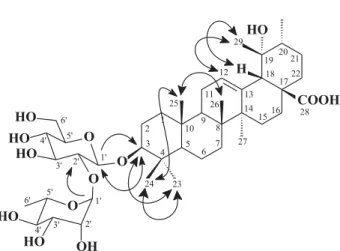
The linkage between the two sugar units was established from the HMBC correlation between the signals of the anomeric proton of the rhamnose at G 5.36 and the carbon signal of the glucose at G 79.1 (C-2). The attachment of the disaccharide chain was particularly determined based on the relevant correlation between C-1’ (G 105.7) and H-3 (G
3.18) in the HMBC spectrum, and by NOE correlation between H-1’(G 4.41) and H-3 (G 3.18), observed in the NOESY experiment as shows in Figure 1. This also was confirmed by the conspicuous deshielding of C-3 (G 90.5) as well as by analogy with the NMR data of the known saponins.9,12 Thus, the structure of 1 was determined as the
3E-O-D-L-rhamnopyranosyl-(1→2)-E-D-glucopyranosyl pomolic acid.
The known triterpenoids were identified by spectroscopic analysis and comparison with published data
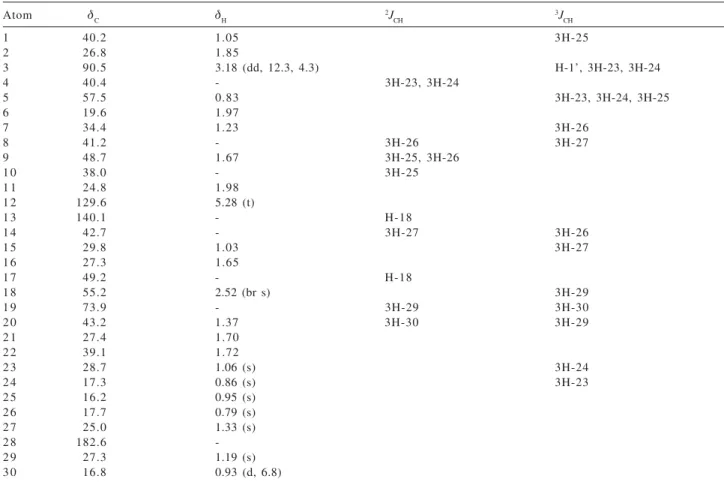
Table 1.1H (300 MHz) and 13C NMR (75 MHz) assignments for the aglycone moiety of 1 by DEPT, HMQC and HMBC
Atom GC GH
2J CH
3J CH
1 40.2 1.05 3H-25
2 26.8 1.85
3 90.5 3.18 (dd, 12.3, 4.3) H-1’, 3H-23, 3H-24
4 40.4 - 3H-23, 3H-24
5 57.5 0.83 3H-23, 3H-24, 3H-25
6 19.6 1.97
7 34.4 1.23 3H-26
8 41.2 - 3H-26 3H-27
9 48.7 1.67 3H-25, 3H-26
1 0 38.0 - 3H-25
1 1 24.8 1.98
1 2 129.6 5.28 (t)
1 3 140.1 - H-18
1 4 42.7 - 3H-27 3H-26
1 5 29.8 1.03 3H-27
1 6 27.3 1.65
1 7 49.2 - H-18
1 8 55.2 2.52 (br s) 3H-29
1 9 73.9 - 3H-29 3H-30
2 0 43.2 1.37 3H-30 3H-29
2 1 27.4 1.70
2 2 39.1 1.72
2 3 28.7 1.06 (s) 3H-24
2 4 17.3 0.86 (s) 3H-23
2 5 16.2 0.95 (s)
2 6 17.7 0.79 (s)
2 7 25.0 1.33 (s)
2 8 182.6
-2 9 27.3 1.19 (s)
3 0 16.8 0.93 (d, 6.8)
664 dos Santos et al. J. Braz. Chem. Soc.
to be quinovic acid (3) and cincholic acid (4),13 obtained
as a 3:1 mixture, respectively, cincholic 3E-O-6-deoxy-E -D-glucopyranoside acid (5)13 and quinovic 3E-O-E
-D-gluycopyranoside acid (6).14 Mannitol15 (2) and E
-sitosterol-E-D-glucoside (7)16 were also isolated.
Experimental
General experimental procedures
Melting points were determined using a digital Mettler Toledo FP90 apparatus. The optical rotations were
measured on a Perkin-Elmer 341 digital polarimeter. IR spectra (KBr pellets) were recorded using a Perkin-Elmer FT-IR 1000 spectrometer. ESIMS were measured on a Micromass Quatro LC instrument. NMR spectra were
recorded on a Bruker Avance DRX-500 (500 MHz for 1H
and 125 MHz for 13C) or DPX-300 (300 MHz for 1H and 75
MHz for 13C) spectrometers using pyridine-d
5, CD3OD or
D2O as solvents. Chemical shifts, given on the G scale, were referenced to internal DSS for D2O solution, and to the residual undeuterated portion of the deuterated organic solvent, for proton (pyridine, GH 8.74, 7.58, 7.22; CD3OD,
GH 2.31), and the center peak of the deuterated solvent
(pyridine,GC 150.35, 135.91, 123.87; CD3OD,GC 49.15).
Column chromatography was run using silica gel 60 (70 -230 mesh, Vetec) and Sephadex LH-20 (Pharmacia). TLC was performed on precoated silica gel poliester sheets (kieselgel 60 F254, 0.20 mm, Merck). Saponins were detected by spraying with vanillin/perchloric acid/EtOH solution followed by heating at 120 °C, while the sugar was detected by spraying the orcinol reagent.
Plant material
Cordia piauhiensis was collected in August 1999, from Barreiro Grande – Crato County, State of Ceará, and identified by Prof. Edson Paula Nunes. A herborized specimen (# 29.104) has been stored at the Herbario Prisco Bezerra (EAC) of the Departamento de Biologia, Universidade Federal do Ceará.
Extraction and isolation
Air-dried and powdered roots (2.8 Kg) and stems (1.7 Kg) were individually extracted exhaustively with EtOH at room temperature. After evaporation of the solvents under reduced pressure the crude extracts were obtained. Upon concentration of the EtOH extract from roots a precipitate was obtained, which was filtered and washed successively with acetone and EtOH to yield 2 (15 g). The remaining EtOH liquors were evaporated (198 g) and coarsely fractionated over silica gel by elution with n-hexane, CHCl3 followed by EtOAc and finally MeOH. The
Table 2.1H (300 MHz) and 13C NMR (75 MHz) assignments for the sugar moieties of 1 by DEPT, HMQC and HMBC
Atom GC GH Atom GC GH
Glc 1 ’ 105.7 4.41 (d, 7.2) Rha 1” 102.0 5.36 (d, 1.3)
2 ’ 79.1 3.41 (t, 7.3) 2” 73.8 3.96 (br s)
3 ’ 79.6 3.47 (t, 8.8) 3” 72.3 3.75 (dd, 9.5, 3.3)
4 ’ 72.1 3.30 4” 74.1 3.39 (t, 9.5)
5 ’ 77.7 3.20 (m) 5” 70.1 3.99 (m)
6 ’ 62.9 3.83 (d, 11.6), 3.66 (dd, 11.6, 5.1) 6” 18.1 1.21 (d, 6.2)
Experiments in CD3OD; Chemical shifts (d) in ppm; Coupling constants (J) in Hz. Figure 1. Selected HMBC (single arrows,
t
) and NOESY (double665 Chemical Constituents of Cordia piauhiensis – Boraginaceae
Vol. 16, No. 3B, 2005
EtOAc fraction (27 g) was subjected to silica gel CC eluting with n-hexane-EtOAc (8:2, 6:4, 4:6, 2:8 and 0:10) followed by EtOAc-MeOH gradients (8:2, 5:5 and 0:10). A precipitate was obtained from a n-hexane-EtOAc (4:6) subfraction, which was filtered and recrystallized from MeOH to yield a binary mixture of 3 and 4 (102 mg). The EtOAc subfraction was further chromatographed over silica gel to give 5 (95 mg) and 6 (450 mg) by elution with n-hexane-EtOAc (1:9) and EtOAc, respectively. Similarly, the EtOH extract of the stems (103 g) was fractionated
over silica using CHCl3, EtOAc, acetone and MeOH as
eluent. The EtOAc fraction (8.1 g) was chromatographed over silica gel eluting with CH2Cl2, CHCl3-EtOAc gradients (8:2, 5:5, 3:7 and 0:10) and MeOH. The subfraction CHCl3 yielded a precipitate which was purified by
recrys-tallization in MeOH to yield 3 (21 mg). Likewise
compound7(32 mg) was isolated from subfraction CHCl3 -EtOAc (3:7). The acetone fraction (39.7 g) was dissolved in H2O-MeOH (8:2) and partitioned with EtOAc and n -BuOH. The EtOAc fraction (10.9 g) was subjected to silica gel CC eluting with EtOAc-MeOH (3:7, 5:5 and 0:10). Subfraction EtOAc-MeOH (3:7, 590 mg) was chroma-tographed twice over Sephadex LH-20 eluting with MeOH to afford 1 (43 mg).
3E-O-D-L-rhamnopyranosyl-(1→2)-E-D-glucopyranosyl pomolic acid (1)
White amorphous solid; mp 218-220 °C; [D]D20 - 0.44°
(c 0.05, MeOH); IR (KBr) Qmax/cm-1 : 3428, 2932, 2883,
1695, 1653, 1457, 1131, 1050; 1H (300 MHz) and 13C
NMR (75 MHz) data, see Table 1.
Acknowledgments
The authors thank Prof. Edson P. Nunes (Departamento de Biologia – UFC) for plant identification. This work was supported by grants from the Brazilian National Agencies CAPES/CNPq/FUNCAP and PRONEX.
References
1. Moir, M.; Thomson, R. H.; J. Chem. Soc. Perkin Trans. I
1973, 1352.
2. Ioset, J. R.; Marston, A.; Gupta, M. P.; Hostettmann, K.;
Phytochemistry1998,47, 729.
3. Manners, G. D.; J. Chem. Soc. Perkin Trans. I1983, 39. 4. Kuroyanagi, M.; Seki, T.; Hayashi, T.; Nagashima, Y.;
Kawahara, N.; Sekita, S.; Satake, M.; Chem. Pharm. Bull. 2001,49, 954.
5. Menezes, J. E. S. A.; Lemos, T. L. G.; Silveira, E. R.; Braz-Filho, R.; Pessoa, O. D. L.; J. Braz. Chem. Soc.2001,12, 787. 6. Marston, A.; Zagorski, M. G.; Hostettmann, K.; Helv. Chim.
Acta1998,71, 1210.
7. Sertié, J. A. A.; Basile, A. C.; Panizza, S.; Matida, A. K.; Zelnik, R.;Planta Med.1990,56, 36.
8. Taroda. N.; Gibbs, P.; Hoehnea1987,14, 31.
9. Santos, R. P.; Viana, F. A.; Lemos, T. L. G.; Silveira, E. R.; Braz-Filho, R.; Pessoa, O. D. L.; Magn. Reson. Chem.2003,
41, 735.
10. Ahmad, V. U.; Rahman, Atta-ur.; Handbook of Natural Products Data, Pentacyclic Triterpenoids, Elsevier: Amsterdam, 1994,
p. 816, vol. 2.
11. Agrawal, P. K.; Phytochemistry1992,31, 3307.
12. Ouyang, M. A; Liu, Y. Q; Wang, H. Q.; Yang, C. R.;
Phytochemistry1998,49, 2483.
13. Sanchez, A. R.; Vazquez, P.; Phytochemistry1991,30, 623. 14. Aquino, R.; de Simone F.; Pizza, C.; de Mello, J. F.;
Phytochemistry1989,28, 199.
15. Pouchert, C. J.; Behnke, J.; The Aldrich Library of 13C and 1H FT NMR Spectra, 1st ed., 1993, p. 289, vol. 1.
16. Macari, P. A. T.; Emerenciano, V. P.; Ferreira, Z. M. G. S.;
Quim. Nova1990,13, 260.
Received: June 10, 2004
Published on the web: March 15, 2005