Introduction
Sports talents in judo and swimming
CDD. 20.ed. 796.07 796.81 797.2
http://dx.doi.org/10.1590/1807-55092016000300637
Florio Joaquim SILVA FILHO* Tatiana Barros MEIRA* Leandro Carlos MAZZEI* Flávia da Cunha BASTOS* Maria Tereza Silveira BÖHME*
*Escola de Educa-ção Física e Esporte, Universidade de São Paulo, São Paulo, SP, Brasil.
Winning medals in major world sports events such as the Olympic Games is the fi nest wish of many athletes, and in order to achieve the best results in these competitions the effi cient interplay of a great number of factors is fundamental1-2.
Accordingly, the last years have seen an increase in scientifi c research aimed at the understanding and highlighting of the factors responsible for the achievement of success in international sports3-8.
One of the points these researches commonly recommend is the emphasis on the existence of a comprehensive system for the eff ective development of athletes from the initiation stages to the high-performance brackets.
In countries with high international sports profiles such as the U.S., China, Great Britain, Germany, Italy, Australia and Russia, it is possible to identify national structures that focus on the implementation and monitoring of sports categories through programs that seek to develop sports in their
many expressions9. In spite of their many economic,
political, social and cultural differences these countries share a resemblance when it comes to the fostering of sports development to attain great results in major international competitions2-4, 10-11. The
existence of national programs that identify, select and promote sports talents favor the emergence and consolidation of high-performance athletes in each country, which ensues for them consistent, long-term sports achievements12.
In the last 10 years Brazil has hosted a number of sports events, and right now the country receives the Summer Olympics of 201613-14. At the same time,
Brazilians wish to achieve better sports results not only to justify the honor of hosting the Olympics but also to foster an increased interest in high-performance sports in the country.
Brazil’s reality shows two systems of organization of sports at national level: one is governmental, with the Ministry of Sports carrying out the actions
Abstract
This paper purported to establish the existence of a system for the development of talented Brazilian athletes judo and swimmers, as well as to describe how coaches in both sports see this process occurring in practical terms. An exploratory and descriptive research was conducted by means of interviews with 18 high-performance coaches (11 swimming coaches and 7 judo coaches). The participating coaches answered to 10 semi-structured questions concerning the development of sports talents in Brazil. The polled results were analyzed through the “Discourse of the Collective Subject” (DCS) method. According to 77% of those coaches, there is no established national guidelines for the development of talents in either one of these sports categories, and 66% of the interviewed stated that the development of the athletes falls entirely to each sporting association they belong with. The opinions of the interviewed coaches indicate that the government offi ces in charge of sports administration produce no comprehensible national guidelines for judo and swimming in Brazil, which leaves to institutions such as Sports Clubs, Associations and Municipal Sports Authorities the full responsibility for the development of athletes in both categories.
that concern high-performance sports through its National Department for High-Performance (SNEAR), and the other is non-governmental, where the main provisions that pertain to high-performance sports are made by the Brazilian Olympic Committee (COB) and the Olympic Federations8. Regardless of the system they belong
to, these organizations may contribute to the establishment of guidelines and actions that concern high-performance sports in Brazil.
Although Brazil is not counted among the world sports powers, Brazilian athletes in diff erent categories obtain expressive results, even when their country has not a structured and comprehensive system for the development of sports talents15.
Among the sports in which Brazil achieves signifi cant international results, judo and swimming stand out. In total, both sports won 16 olympic medals from Sidney 2000 to the London Olympics in 2012, which accounts for 30% of the 54 medals Brazil obtained in that period16. Such a success qualifi ed these sports to be included in a special support program dubbed Brazil Medals Plan 2016 (Plano Brasil Medalhas 2016)14, destined to the sports with the greatest probability of winning medals in the Rio Olympic Games. Notice that, in comparison with the collective sports categories, judo and swimming also show good results in other international events.
Th e Brazilian Judo Federation (CBJ) reports that up to 2012 Brazilian judo has won 19 olympic medals (3 gold, 3 silver and 13 bronze) and 28 medals in major world championships (4 gold, 7 silver and
Method
Sampling
17 bronze)17 - highlighting the State of São Paulo as home of the majority of judo clubs, where the greatest number of olympic medalists in the sport come from18. Among the participants of Brazil’s National Judo Team in London 2012, about 65% of the athletes were affi liated with clubs and institutions from the State of São Paulo. In addition, along nine editions of the Grand Prix Interclubes (a national competition among Brazilian judo clubs) São Paulo has won seven male fi ghter titles and other three titles in the seven editions held for female athletes17.
In the swimming , the 6 last Olympic Games (from 1992 to 2012) and Pan-American Games (2010/2007/2003/1999/1995) saw strong performances by Brazilian swimming teams, especially as they compare to other sports. In this period, Brazilian swimmers won 13 olympic medals and 145 Pan-American medals16. When it comes to results obtained by sporting clubs with swimming teams, for example, 5 out of the 10 top-ranking clubs in 2013 were based in the State of São Paulo19.
Such results show how important São Paulo is for both sports in Brazil.
Considering the international achievements by Brazilian judo and swimming and how the programs to identify, select and promote sports talents are important for the development of athletes, this paper intends to establish the existence of a system to build up potentially accomplished Brazilian judo athletes and swimmers, as well as to describe how their development is handled in practice - according to the outlook of the coaches involved.
Th is is a cross-sectional descriptive study of the survey type20. Th e data submitted and analyzed were gathered through the research project “Analysis of the quality of programs to identify, select and promote sports talents within Brazilian reality”, which had as one of its purposes to detect whether or not the most relevant aspects for the development of elite sports in an international context were present therein as recommended by the studies specifi c to the discipline3-4, 6-7 - one of those aspects being the analysis of the system for the development of talents.
Although the above mentioned research project was developed in three stages, this paper focuses on the results relating to one of the 10 questions that were proposed in its second stage. Th e choice of
Since many of the technically top-ranking clubs in both judo and swimming are in São Paulo, the present research was circumscribed to this State. Coaches of São Paulo’s sports institutions (Clubs and Municipal Sports Associations) with the best results in 2010’s national adult judo and swimming competitions were invited to participate.
Th e answers obtained to the theme question fthat were analyzed through the “Discourse of the Collective Subject” method, as proposed by Lefèvre and Lefèvre22. Th is method of analysis has three phases in which are detected:
a) Keywords: words or full phrases in the discourse that are highlighted by the researchers and that reveal the gist of the statement;
b) Central ideas: language expression which describes precisely, concisely and accurately the meaning of each of the discourses analyzed and that will subsequently originate the Discourse of the Collective Subject;
c) Discourse of the Collective Subject: the synthesis of the discourse, expressed in the fi rst person singular and which is composed by the keywords that share the same central idea.
Analysis of data
TABLE 1 - Characterization of sampling: interviewed coaches’ age, length of professional career and time period spent in formal education.
Minimum Maximum Average
Age 26 55 35.50
Length of professional career as a coach 5 31 15.90
Time period spent in formal education 13 30 18.36
Th e participation of these coaches in the research is explained by their fundamental role in the development of the athletes, from sports initiation to high-performance level21. Th e coach performs a vital part in the preparation of the athlete, as well as in the communication with the family and the sports administrators.
Th e sampling numbered 18 coaches in full (11 swimming coaches and 7 judo coaches). Some of the clubs/associations were represented by more than one of their coaches. Among the coaches interviewed,
Procedures
Th e research contributors were reached by telephone and/or e-mail for the scheduling of interviews. Semi-structured interviews were conducted with the coaches, audio-recorded and later transcripted in full. Th e proposed questions were based on the 10 most relevant aspects for the development of elite sports in an international context as recommended by the studies specifi c to the discipline3-4, 6-7, to wit:
1) A clear understanding of the roles of the diff erent agents involved and an eff ective communication within the network upholding the sports system:
2) Simplicity administration through sports initiatives and common policies;
3) An eff ective system for the statistical identifi cation and monitoring of the progress of talented elite athletes;
4) Th e provision of services in the fi eld of sports that help foster a culture of excellence in which all those involved (athletes, coaches, administrators, sports scientists) may interact with one another both formally and informally;
5) Well-structured competition programs, favoring international exchange;
6) Well-developed and specific facilities, prioritizing the access for elite athletes;
7) Focused allocation of the available resources for a relatively restricted group of sports categories, favoring those more likely to actually succeed on international level;
8) Clear and appropriate planning for the needs of each sports category;
9) Recognition of the costs involved in sports excellence, with proper and fi tting funding being destined to infrastructure and personnel;
10) Support for the athlete’s life and professional qualifi cation after his/her sports career is over.
Th e present paper introduces results for the judo and swimming that refer to the third item in the research’s second stage, namely “Eff ective system for the statiscal identifi cation and monitoring of the progress of talented elite athletes” which were analyzed through the twofold question: “Is there a system for the development of sports talents in Brazil from initiation to high-performance? If the answer is affi rmative, how does it function?”
60% worked in clubs with the best results in 2010’s national competitions such as judo’s Grand Prix Interclubes and swimming’s Maria Lenk Brazil Cup.
Th e details about the interviewed coaches are presented on TABLE 1.
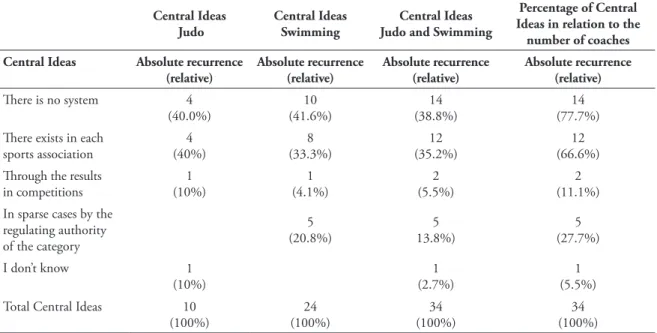
TABLE 2 - Characterization of central ideas (CIs), number of CIs, absolute and relative recurrence in relation to the total number of CIs and to the number of responses of swimming (11) and judo (7) coaches to the question: “Is there a system for the development of sports talents in Brazil from initiation to high-performance? If the answer is affi rmative, how does it function?”?”.
Results
TABLE 2 presents the results obtained through the Discourse of the Collective Subject method.
Considering both sports together a total of 34 central ideas were detected, from which four collective
discourses could be drawn up. Described below are the Discourses of the Collective Subject (DCSs) produced for each Central Idea (CI) with basis on the joint answers of the coaches in both categories.
Central Ideas Judo
Central Ideas Swimming
Central Ideas Judo and Swimming
Percentage of Central Ideas in relation to the
number of coaches
Central Ideas Absolute recurrence (relative)
Absolute recurrence (relative)
Absolute recurrence (relative)
Absolute recurrence (relative)
Th ere is no system 4
(40.0%)
10 (41.6%)
14 (38.8%)
14 (77.7%)
Th ere exists in each sports association
4 (40%)
8 (33.3%)
12 (35.2%)
12 (66.6%)
Th rough the results in competitions
1 (10%)
1 (4.1%)
2 (5.5%)
2 (11.1%)
In sparse cases by the regulating authority of the category
5 (20.8%)
5 13.8%)
5 (27.7%)
I don’t know 1
(10%)
1 (2.7%)
1 (5.5%)
Total Central Ideas 10
(100%)
24 (100%)
34 (100%)
34 (100%)
DSC 1 - (77% of coaches’ answers and 38% of the total central ideas) -
Central Idea: “There is no system”
DSC 2 - (66.6% of coaches’ answers and 35.2% of the total central ideas) - Central Idea: “There exists in each sports association”
My opinion is that no, there is no organized eff ort, no specifi cally designed work for the end. In what concerns public entities, the Government, the Olympic Committee, the Federations and Leagues, there is nothing. As for a national policy, there is no such thing, I never saw anything of the kind. Unfortunately, it doesn’t exist. Th ere should be, but there is none for swimming. Th ere is no comprehensive, defi ned or research-backed policy to help us detect any sizeable amount of talents. Even with the Brazil 2016 Olympics only 6 years away, one can’t see anything being done, at least not for the time being.
What prevails is this process of natural selection
among the athletes. Th e fi nest individuals are gleaned that way, but there is no organization, no system in place. You have calendars from junior grade on where youngsters participate and I think this is how the natural selection of talents takes place. Th ose athletes that remain and carry on in the category gain way to the competitions in which they are more proffi cient, and if they display any particular talent their results should qualify them to move on to the more important
DSC 3 - (11.1% of coaches’ answers and 5.5% of the total central ideas) - Central idea: “Through the results in competitions”
DSC 4 - (27.76% of coaches’ answers and 13.8% of the total central ideas) -
Central idea: “In sparse cases by the regulating authority of the category” - verifi ed only for swimming coaches
I’m aware of the Confederation’s many incentive clinics, its many incentive eff orts, but none of that is offi cialized or consistently cyclic. Th e Paulista (São Paulo’s) Aquatic Sports Federation also carries this kind of work for junior teams, to introduce them to the statewide contests scene. In the case of competitive swimming the Brazilian Confederation has scouting and talent-developing projects, but these are altogether too sparse, too localized and hardly likely to lead to a widespread , mass practice of swimming.
Discussion
Although both sports have athletes with relevant international results, the judo and swimming coaches’ opinion is that the development of talents in either fi eld doesn’t happen through a comprehensively structured system. According to these professionals, the emergence of nationally outstanding athletes depends on isolated initiatives by sports associations and on those athlete’s achievements in competitions.
77% of the coaches’ views indicate that there is not a Brazilian system for the development of athletes of judo or swimmers, as it reads in the DCS 1’s phrase “...As for a national policy, there is no such thing, I never saw anything of the kind...”. Th is supports the audit report issued by the Union’s Court of Auditors (TCU)23, which identifi ed an
absence of eff ective action by government sports entities in charge of the development of athletes from initiation to post-career period.
Th e non-existence of a nationwide system for the development of athletes, as quoted by the interviewed coaches, may be linked to the scant number of public policies and programs to promote sports and leisures in Brazil. A few initiatives are devised especially to attend to the interests of clubs and high-performance athletes already in the adult stage, after they have achieved signifi cant sports
results24. Consequentially, the country lacks in
eff ective actions aimed at the sports initiation stages, particularly in what concerns the identifi cation and development of new young brazilian athletes25-27.
In some of the countries that are recognized as international sports powers there is a whole organized sports structure in place, which is based on a nationwide system for the development of sports talents3-4, 6, 10, 12, 28-30. Such a nationwide system
for the development of talents may contribute to establish the guidelines and actions which shall drive the process of detection, selection and promotion of athletes, fostering a consistent structure with capacity for long-term objectives9.
In this scope we may highlight the national programs of detection and selection of sports talents that exist in China and Australia31. In the
case of China, that country has a national program for the selection and promotion of sports talents through which children initiate practice around 6 years old, getting worked through a controlled and comprehensive selective system that will eventually lead them to the high-performance stages.
Australia proposes a system of sports preparation ranging from initiation to high-performance upkeep that is dubbed Foundations, Talent, Elite
the thinking of the Brazilian Confederation and the Paulista (São Paulo’s) Federation, they expect the clubs to do the scouting that will lead to talent breakthroughs.
and Mastery (FTEM). Especifically in what respects the detection and selection of talents such system is composed of four stages: in stage one are detected individuals with any physical, motor or psychological “talents” that usually rate above 90%
of their peers, which remain to be verifi ed in the next stage. In stage two the youngsters are immersed in a trial period of observation within the specifi cities of an environment of practicing and competition so as to determine their capacities and abilities, allowing for the checking out of the initially observed potentials. In stage three the athletes must commit to training and investing on a high volume of specifi c practice, striving for continued performance improvement and keeping their focus on achieving the references for the next stage. In stage four the athletes get professional support for continued development (such as scholarships at universities, institutes or sports colleges) or join a
professional team or elite preparation group. Th us embedded the athletes are much more likely to be noticed and supported by their sports fi eld and/or
the high-performance scene they belong in32.
According to 66.6% of the coaches interviewed, the most usual form of development of Brazilian judo athletes and swimmers is through isolated eff orts by each institution of sports practice, as it is read in DCS 2 “...Today I believe this work falls almost entirely to the clubs and to some gyms...”. In Brazil, high-performance sports are traditionally practiced in clubs, most of them privately-owned and situated in the south and southeastern parts of the country, which restricts the access to sports initiation to a relatively small portion of the national population23. In addition to that, many of these are social clubs, and their institutional purposes and physical facilities attend to the general membership rather than prioritize the development of sports33.
So, given the absence of a national set of structured guidelines, each sports institution establishes its own system for the development of sports talents. Th is is in accordance with article 217 of the Federal Constitution, which states that sports clubs, sports associations and sports organizations are granted full autonomy in their pursuits and criteria for the preparation and development of athletes34. Notwithstanding that, the consolidation of national sports guidelines is something that could greatly favor the communication, exchange and interplay among all the entities involved, and consequently contribute to the development and fi xation of high-performance athletes in the country4, 12.
Further in accordance with article 217 of the Brazilian Constitution, public fi nancing’s priority should be directed to educational sports and - in specifi c cases - to high-performance sports34. Investments on school grade could favor a wide number of children and adolescents - noting that the dedicated literature states that childhood and adolescence are the best stages for the development of specific skills and motor and psychological capacities for the prospective high-performance athletes35-38. However, what is noticed is the inexistence of actions to approach the identifi cation and promotion of potential sports talents in Brazilian schools23. Meanwhile, in some of the countries with the best sports achievements there is a close and eff ective relationship between educational and high-performance sports28, 33.
It is possible to observe some localized actions aimed at bringing together sports development and school in Brazil, such as the “Second Half Program” (Programa Segundo Tempo), the “Athletes at School Program” (Programa Atleta na Escola) and the “School Games” (Jogos Escolares), which are examples of efforts promoted by the Ministry of Sports, the Ministry of Education and the Brazilian Olympic Committee (COB)14. Th e eff ective contribution of such programs for the development of high-performance athletes remains to be determined, though.
Some federal laws were recently passed that intended to advance the development of high-performance sports in Brazil, such as the Sports Incentive Act (Lei do Incentivo ao Esporte) and the Athletes’ Endowment Program (Programa Bolsa Atleta), as well as the Brazil Medals Plan (Plano Brasil Medalhas) - specifi cally devised with sights
on the Rio 2016 Olympics14. Notwithstanding these
initiatives, there is no consistent communication among the sports entities that could favor the joint drafting and execution of actions to forward the development of sports and athletes in the country, given the fact that many of these projects overlap without the benefi t of any actual coordination that might bring together these eff orts by the promoting agencies8. Yet another evidence that indicates how fragile Brazilian formative sports are is the number of projects approved through the Sports Incentive Act in the period from 2007 to 2010, from which only a scant 19% were intended for sports formation26.
way to the competitions in which they are more proffi cient, and if they display any particular talent their results should qualify them to move on to the more important contests...”. So the coaches state that the competition system makes it possible for the better athletes to stand out and to move on into the more advanced levels of preparation. In this way, local, regional and interschool competitions, among others, can also be regarded as a means to detect and select new talents in both categories.
Th is characteristic of using competitions for the selection of athletes has also been observed in the study by Parra39, whose interviews with Brazilian swimming club coaches revealed that the criteria for the selection of swimmers in diff erent levels is based on their competitive performances. Still according to this author, 89% of the interviewed coaches mentioned the lack of a nationwide system of guidelines for the identifi cation and promotion of talents.
Th e existence of an organized national competitive system is one of the key points in a country’s organized sports structure. In such a context nationwide competition allows athletes to gauge their individual or collective performances, helping their prospects for success in international sports4, 10.
United States and China are examples of countries whose respective competition systems stimulate international sports success in many categories. In these countries, periodical regional and national tournaments and championships are venues for the detection of talents for their national teams, constituting necessary steps within their system for the development of athletes2-3, 28, 33, 40. In Brazil the scattered tournaments are the principal stages to select the individuals that will proceed in the process of promotion of athletes41-42. Granted the importance of competition along the athlete’s development, this shouldn’t be the only way to select young athletes, unless if it is accompanied by a comprehensive approach and management of many factors, like for instance the physical and psychological aspects of the preparation.
Anotherway for the development of young athletes was mentioned in DCS 4, in which 27.7% of the swimming coaches cited that the CBDA (Brazilian Confederation of Aquatic Sports) sporadically promotes programs aimed at developing talents in the category. Besides swimming, CBDA is in charge of water-polo, synchronyzed swimming, marathon swimming and diving. Just as the coaches were being interviewed a project dubbed Brazil Swimming Program (Programa Brasil Natação) was going on, with the objective of identifying potential swimming
talents through anthropometric measurement, monitoring of biological data and scouting of results on national and international levels, although as of since nothing could be heard about the continuity of the program43. In what concerns this kind of CBDA’s projects the coaches state in their DCS that: “... (they) are altogether too sparse, too localized and hardly likely to lead to a widespread , mass practice of swimming...”.
Although none of the judo coaches interviewed mentioned the existence of some program or project developed by the CBJ (Brazilian Judo Confederation), the institution’s website lists a social project jointly promoted with Infraero (Brazil’s Airports Authority) dubbed Forward Judo (Avança Judô), which seeks to help underprivileged children who live in the vicinity of the airports overlooked by Infraero through the practice of judo17. It is a worthy eff ort, but as a social project it carries no priority of identifying and developing potential high-performance athletes.
Th e results this study yields show that as far as the outlook of the interviewed swimming and judo coaches is concerned, there is no structured nationwide system that aims at the development of talented athletes in either category in Brazil, possibly due to the absence of any eff ective governmental policy for sports.
Th e main initiatives for the development of athletes are carried out through sporadic actions by sports clubs and gyms. Also key to the achievement of success in either category are the better results obtained at major competitions.
Thus, it remains clearly indicated that, as the principal entities in charge of the country’s sports organization and structure, it is up to the Ministry of Sports, the Brazilian Olympic Committee and the Sports Confederations the establishment of eff ective communications that would favor the integration of local, statewide and nationwide programs, as well as the drafting of comprehensive public policies, especially in what respects sports in the formative stages.
1. De Bosscher V, De Knop P, Van Bottenburg M, Shibli S, Bingham J. Explaining international sporting success: an international comparison of elite sport systems and policies in six countries. Sport Manag Rev. 2009;12:113-36. 2. Houlihan B, Green M. Comparative elite sport development: systems, structures and public policy. London: Elsevier; 2008. 3. Digel H. A comparison of competitive sport systems. New Stud Athl. 2002;17:37-50.
4. Green M, Oakley B. Elite sport development systems and playing to win: uniformity and diversity in international approaches. Leis Stud. 2001;20:247-67.
5. Van Rossum JHA. Perceptions of determining factors in athletic achievement: an addendum to Hyllegard et al. Percept Mot Skills. 2003;98:81-5.
6. De Bosscher V, De Knop P, Van Bottenburg M, Shibli S, Bingham J. Explaining international sporting success: an international comparison of elite sport systems and policies in six countries. Sport Manag Rev. 2009;12:113-36.
7. Böhlke N, Robinson L. Benchmarking of elite sport systems. Manag Decis. 2009;47:67-84.
8. Meira TB, Bastos FC, Böhme MTS. Análise da estrutura organizacional do esporte de rendimento no Brasil: um estudo preliminar. Rev Bras Educ Fís Esporte. 2012;26:251-62.
9. Meira TB, Mazzei LC, Böhme MTS. Programas de desenvolvimento de talentos esportivos nas pesquisas comparativas internacionais sobre esporte de alto rendimento e na realidade brasileira. Rev Min Educ Fis. 2012;20:37-72. 10. De Bosscher V, Bingham J, Shibli S. Sports policy factors leading to international sporting success. Aachen: Meyer & Meyer; 2008. 11. Green M. Changing policy priorities for sport in England: the emergence of elite sport development as a key policy
concern. Leis Stud. 2004;23:365-85.
12. Rütten A, Ziemainz HO. Analisys of talent identifi cation and development systems in diff erent countries. III Interna-tional Forum on Elite Sport; 9 Set-9 Nov 2003; Loughborough, UK. Barcelona: ASPC; 2003. Available from: http:// sportperformancecentres.org/sites/default/fi les/11a_Looking_to_the_Future_Heiko_Ziemaiz-Alfred_Rutten.pdf. 13. Comitê Olímpico Brasileiro. Sobre o COB. Rio de Janeiro: COB; 2015 [cited 2015 Mar 5]. Available from: www.cob.org.br.
References
consequently contribute to the improvement of the country’s sports achievements.
In this manner, we suggest a that a probe should be conducted to evaluate the eff ect of sports laws
and programs deployed in the period between the gathering of these data and the present moment, in order to investigate how these initiatives contributed to sports development in the country.
Resumo
Talentos esportivos no judô e na natação
Este artigo teve por objetivo verifi car a existência de um sistema de desenvolvimento de judocas e nada-dores brasileiros talentosos, assim como descrever como ocorre o mesmo na prática, segundo a opinião dos técnicos dessas modalidades. Foi realizada uma pesquisa exploratória e descritiva, por meio da realização de entrevistas com 18 técnicos de alto rendimento, sendo 11 de natação e sete de judô. Os técnicos par-ticipantes responderam a 10 perguntas semiestruturadas, relacionadas com o desenvolvimento de talento esportivo no Brasil. Os resultados foram analisados por meio do método do “Discurso do Sujeito Coletivo” DSC. Segundo 77% dos técnicos, não existe uma diretriz nacional para o desenvolvimento de talentos para as duas modalidades estudadas, e 66% dos entrevistados afi rmaram que o desenvolvimento dos atletas ocorre por meio de cada entidade esportiva. De acordo com a opinião dos técnicos, conclui-se que as en-tidades nacionais de administração do esporte não elaboram diretrizes nacionais para o judô e a natação no Brasil, sendo as entidades de prática esportiva - tais como Clubes, Associações e Entidades Municipais de Prática Esportiva - as responsáveis pelo desenvolvimento dos atletas em ambas as modalidades.
14. Brasil. Ministério do Esporte. . Brasília: ME; 2015 [cited 2015 Mar. 6]. Available from: http://www.esporte.gov.br/. 15. Meira TB, Bastos FC. Estruturas de organização e de promoção esportiva. In: Böhme MTS, organizadora. Esporte
infanto juvenil: treinamento a longo prazo - talento esportivo. São Paulo: Phorte; 2011. p.219-40.
16. Comitê Olímpico Brasileiro. Rio de Janeiro: COB; 2015 [cited 2015 Mar 5]. Available from: www.cob.org.br. 17. Confederação Brasileira de Judô. Rio de Janeiro: CBJ; 2015 [cited 2015 Mar 4]. Available from: www.cbj.com.br. 18. Nunes AV. A infl uência da imigração japonesa no desenvolvimento do judô brasileiro: uma genealogia dos atletas
brasileiros medalhistas em jogos olímpicos e campeonatos mundiais [tese]. São Paulo (SP): Universidade de São Paulo, Escola de Educação Física e Esporte; 2011.
19. Confederação Brasileira de Desportos Aquáticos. Boletim no 001/14 . 2014. Available from: http://www.cbdaweb.org.br/ 20. Th omas JR, Nelson JK, Silverman SJ. Métodos de pesquisa em atividade física. Porto Alegre: Artmed; 2002. 21. Martindale RJJ, Collins D, Abraham A. Eff ective talent development: the elite coach perspective in UK sport. J Appl
Sport Psychol. 2007;19:187-206.
22. Lefèvre F, Lefèvre AMC. O discurso do sujeito coletivo: um novo enfoque em pesquisa qualitativa (desdobramentos). Caxias do Sul: EDUCS; 2003.
23. Brasil. Tribunal de Contas da União. Relatório de Auditoria Operacional: esporte de alto rendimento. Brasília: Se-cretaria de Fiscalização e Avaliação de Programas de Governo; 2011. p.85. Available from: http://portal2.tcu.gov.br. 24. Linhales MA. São as políticas públicas para a educação física/esporte e lazer efetivamente políticas sociais?
Motrivi-vência. 1998;11:71-82.
25. Peres L, Lovisolo H. Formação esportiva: teoria e visões do atleta de elite no Brasil. Rev Educ Física/UEM. 2008;17:211-8. 26. Bastidas MG, Bastos FC. A lei de incentivo fi scal para o desporto e a formação de atletas no Brasil. Rev Intercont
Gestão Desportiva. 2011;1:111-21.
27. Figuerôa KM, Mezzadri FM, Moraes M. Rio 2016: possibilidades e desafi os para o esporte brasileiro. Motrivivência. 2013;41:140-54.
28. Digel H. Th e context of talent identifi cation and promotion: a comparison of nations. New Stud Athl. 2002;17:13-26. 29. De Bosscher V, Shibli S, Van Bottenburg M, De Knop P, Truyens J. Developing a method for comparing the elite sport
systems and policies of nations: a mixed research methods approach. J Sport Manag. 2010;24:567-600.
30. Rütten A, Ziemainz H, Röger U. Qualitätsgesichertes System der Talentsuche und auswahl: Th eoretischer Ansatz, Methode erste Ergebnisse. In: Emrich E, Güllich A, Büch MP, editors. Beiträge zum Nachwuchsleistungssport. Schorndorf: Hofmann-Verlag; 2005.
31. Ziemainz H, Gulbin J. Talent selection,-identifi cation and-development exemplifi ed in the Australian Talent Search Programme. New Stud Athl. 2002;17:27-34.
32. Australia. FTEM Resource Repository. Pathways. Bruce: Australian Institute of Sport. 2013. Available from: http:// www.ausport.gov.au/ais/pathways.
33. Ferreira R. Políticas para o esporte de alto rendimento: estudo comparativo de alguns sistemas esportivos nacionais visando um contributo para o Brasil [tese]. Porto (POR): Universidade do Porto, Faculdade de Desporto; 2007. 34. Brasil. Constituição da República Federativa do Brasil. Brasília; 1988.
35. Balyi I, Williams C. Coaching the young developing performer. Leeds: Coachwise; 2010.
36. Böhme MTS. O talento esportivo e o processo de treinamento a longo prazo: o esporte e a atividade física na infância. Porto Alegre: Artmed; 2001.
37. Böhme MTS. Detecção, seleção e promoção de talentos esportivos. In: Böhme MTS, organizadora. Esporte infanto juvenil: treinamento a longo prazo - talento esportivo. São Paulo: Phorte; 2011.
38. Vaeyens R, Güllich A, Warr CR, Philippaerts R. Talent identifi cation and promotion programmes of olympic athletes. J Sports Sci. 2009;27:1367-80.
39. Parra SA. Treinamento a longo prazo de nadadores [tese]. São Paulo (SP): Universidade de São Paulo, Escola de Edu-cação Física e Esporte; 2006.
40. Almeida GO. O processo de identifi cação e desenvolvimento de talento nas grandes potências esportivas [monografi a]. Universidade de São Paulo, Escola de Educação Física e Esporte; 2006.
41. Meira TB. Programas de desenvolvimento da natação de alto rendimento no estado de São Paulo [dissertação]. Uni-versidade de São Paulo, Escola de Educação Física e Esporte; 2011.
42. Silva Filho FJ, Luguetti CN, Paes FO, Böhme MTS. Critérios para detecção e seleção de jovens atletas de basquetebol na cidade de São Paulo. Rev Mackenzie Educ Fís Esporte. 2011;10:64-74.
ADDRESS Florio Joaquim Silva Filho Escola de Educação Física e Esporte Universidade de São Paulo Av. Prof. Mello Moraes, 65 05508-030 - São Paulo - SP - BRASIL e-mail: fl [email protected]