Cop
yright
© ABE&M t
odos os dir
eit
os r
eser
vados
.
Incidental mild hyperglycemia
in children: two MODY 2 families
identiied in Brazilian subjects
Hiperglicemia incidental em crianças: duas famílias com MODY 2 identiicadas em brasileiros
Lílian A. Caetano1,2, Alexander A. L. Jorge1, Alexsandra C. Malaquias1,
Ericka B. Trarbach1, Márcia S. Queiroz2, Márcia Nery2,Milena G. Teles1,2
SUMMARY
Maturity-onset diabetes of the young (MODY) is characterized by an autosomal dominant mode of inheritance, early onset of hyperglycemia, and defects of insulin secretion. MODY subtypes described present genetic, metabolic, and clinical differences. MODY 2 is characterized by mild asymptomatic fasting hyperglycemia, and rarely requires pharmacological treatment. Hence, precise diagnosis of MODY is important for determining management and prognosis. We report two heterozygous GCK mutations identiied during the investigation of short stature. Case 1: a prepubertal 14-year-old boy was evaluated for constitutional delay of growth and puberty. During follow-up, he showed abnormal fasting glucose (113 mg/dL), increased level of HbA1c (6.6%), and negative β-cell antibodies. His father and two siblings also had slightly elevated blood glucose le-vels. The mother had normal glycemia. A GCK heterozygous missense mutation, p.Arg191Trp, was identiied in the proband. Eighteen family members were screened for this mutation, and 11 had the mutation in heterozygous state. Case 2: a 4-year-old boy investigated for short stature revealed no other laboratorial alterations than elevated glycemia (118 mg/dL); β-cell antibodies were nega-tive. His father, a paternal aunt, and the paternal grandmother also had slightly elevated glycemia, whereas his mother had normal glycemia. A GCK heterozygous missense mutation, p.Glu221Lys, was identiied in the index patient and in four family members. All affected patients had mild elevated glycemia. Individuals with normal glycemia did not harbor mutations. GCK mutation screening should be considered in patients with chronic mild early-onset hyperglycemia, family history of impaired glycemia, and negative β-cell antibodies. Arq Bras Endocrinol Metab. 2012;56(8):519-24
SUMÁRIO
O diabetes do tipo MODY (maturity-onset diabetes of the young) caracteriza-se por herança autos-sômica dominante, início precoce da hiperglicemia e defeitos na secreção de insulina. Os subtipos de MODY apresentam diferenças genéticas, metabólicas e clínicas. O MODY 2 é caracterizado por hiperglicemia leve assintomática e raramente requer tratamento farmacológico. O diagnóstico pre-ciso de MODY é importante para se determinar o tratamento e o prognóstico. Relatamos duas mu-tações no gene GCK em heterozigose identiicadas durante investigação de baixa estatura. Caso 1: paciente do sexo masculino, com 14 anos, pré-púbere, avaliado por atraso constitucional do crescimento e da puberdade. Durante o acompanhamento, apresentou glicemia de jejum alterada (113 mg/dL), aumento de HbA1c (6,6%) e anticorpos anticélulas β negativos. Seu pai e dois irmãos também apresentavam glicemia levemente elevada. A mãe tinha glicemia normal. Foi identiicada no gene GCK uma mutação missense em heterozigose, p.Arg191Trp. Dezoito membros da família foram rastreados e 11 apresentavam essa mutação. Caso 2: paciente do sexo masculino, com 4 anos, em avaliação por baixa estatura. Não apresentou alterações laboratoriais, exceto por glice-mia elevada (118 mg/dL). Anticorpos anticélulas β foram negativos. Seu pai, uma tia paterna e a avó paterna também apresentavam glicemia discretamente elevada, e a mãe, glicemia normal. A mu-tação missense em heterozigose, p.Glu221Lys, foi identiicada no paciente-índice e em 4 membros da família. Todos os pacientes afetados apresentavam hiperglicemia leve. Essas mutações não fo-ram identiicadas nos indivíduos com glicemia normal. O rastreamento de mutações no gene GCK deve ser considerado em pacientes com hiperglicemia crônica leve e de início precoce, história fa-miliar de glicemia elevada e anticorpos anticélulas β negativos. Arq Bras Endocrinol Metab. 2012;56(8):519-24
1 Unidade de Endocrinologia
Genética e Laboratório de Endocrinologia Molecular e Celular/LIM25, Disciplina de Endocrinologia, Faculdade de Medicina da Universidade de São Paulo (FMUSP), São Paulo, SP, Brazil
2 Unidade de Diabetes,
Hospital das Clínicas, FMUSP, São Paulo, SP, Brazil
Correspondence to: Milena G. Teles Unidade de Endocrinologia Genética, LIM/25, Faculdade de Medicina da Universidade de São Paulo
Av. Dr. Arnaldo, 455, 5o andar, sala 5340
01246-903 – São Paulo, SP, Brazil [email protected]
Cop
yright
© ABE&M t
odos os dir
eit
os r
eser
vados
.
INTRODUCTION
G
enetic defects affecting only one gene correspondto 1% to 5% of all cases of diabetes mellitus (DM)
(1,2). Different genes related to monogenic diabetes have been identiied and are associated with maturity-onset diabetes of the young (MODY), neonatal dia-betes, mitochondrial diadia-betes, mutations in the insu-lin receptor (insuinsu-lin resistance syndromes), and other
genetic syndromes associated to diabetes (e.g. Wolfram
syndrome) (3). A number of cases of monogenic diabe-tes are erroneously classiied as type 1 or type 2 diabediabe-tes (4,5). It is estimated that close to 5% of the individuals classiied as having type 2 DM, and about 10% of those considered type 1 DM, are actual carriers of a MODY mutation (6).
MODY is the most common form of monogenic diabetes, also known as familial diabetes (7). It is characterized by autosomal dominant mode of in-heritance, early onset of hyperglycemia (usually be-fore 25 years old) (2,8), defects of insulin secretion (3), and generally lack of beta-cell speciic
antibod-ies (2,8).Mutations occurring in MODY genes lead
to a profound phenotypic impact (high penetrance), and 95% of the individual carriers of a MODY mu-tation will be diabetic or will have altered glycemic metabolism before the age of 55 (6). To date, there are eleven types of MODY described, distinguished by genetic, metabolic, and clinical heterogeneity.
Mutations in the genes HNF4A, GCK, HNF1A,
PDX1, HNF1B, NEUROD1, KLF11, CEL, PAX4,
INS, BLK are associated with MODY 1 to 11,
re-spectively (4). The prevalence of MODY varies among different countries and the most common forms are type 2 and 3 (4). The largest series de-scribed so far are in France and England (6). MODY 2 is the most frequent form in France and may ac-count for 50 to 60% of cases (9,10). MODY 3 is the most prevalent type in British families, account-ing for 52 to 63% of cases (5,11). Differences in the prevalence of MODY 2 and MODY 3 are likely associated with the different ways of ascertainment (evaluation in pediatric or adult clinics, self-reported diabetes, new diagnosis of hyperglycemia through a familial survey; recruitment from outpatient clinics) (8). The prevalence of the different types of MODY in Brazil was evaluated in a total of 48 probands in 3 studies. Among identiied mutations, MODY 3 was the most common type, followed by MODY 2 (only
few reported variants). MODY 2 and 3 mutations did not explain the majority of MODY cases in the Brazilian population, which resulted in a high prev-alence of MODY X (no known mutation), ranging from 46.2 to 73.9% of the suspected cases (12-14).
MODY 2 is associated with heterozygous
inacti-vating mutations in the gene GCK, which is
locat-ed on chromosome 7 (7p15.3-p15.1) and consists
of 12 exons(15). The irst mutation was reported
in 1992 (16), and over 600 different GCK
muta-tions distributed throughout the 10 coding exons have been identiied so far. There are no
muta-tion hotspots (17). The GCK gene encodes the
465-amino-acid protein, called glucokinase, which is one of four enzymes of the hexokinase family. It catalyzes the phosphorylation of glucose to produce glucose-6-phosphate as the irst step of glycolysis (18). Glucokinase plays an important regulatory role in glucose metabolism. As a glucose sensor, it
regulates insulin secretion in pancreatic β-cells by
changing the glucose phosphorylation rate over a range of physiological glucose concentrations (18). MODY 2 is characterized by a deiciency in gluco-kinase, and shows a characteristic mild, often asymp-tomatic, fasting hyperglycemia (19). Most patients have impaired fasting glucose or impaired glucose tolerance, and less than 50% of affected individuals have overt diabetes (9,20). Diagnosis is usually inci-dental during childhood, youth, or pregnancy (21). An study on incidental hyperglycemia in patients un-der 18 years old estimated that approximately 15% of
cases are caused by GCK mutations (22). MODY 2
patients show a small increment in the 2-hour glu-cose value observed in the oral gluglu-cose tolerance test, which usually is less than 60 mg/dL (23). In most cases of MODY 2, patients require no pharmacologi-cal treatment, and are managed on diet alone. Those patients commonly have no diabetes-related complica-tions (8,24). Hence, precise recognition of this disor-der is very important for treatment decisions, and has relevant prognostic value (25). Accurate diagnosis can only be made by molecular genetic testing (24,26).
We report two heterozygous GCK mutations
Cop
yright
© ABE&M t
odos os dir
eit
os r
eser
vados
.
CASE REPORTS
Case 1
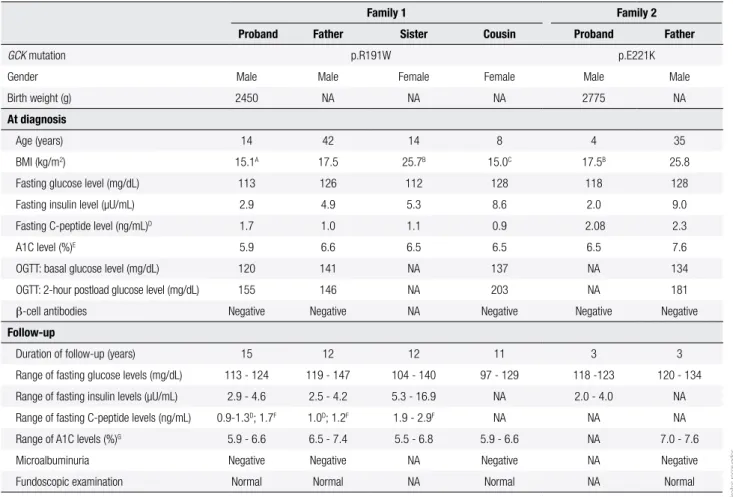
A prepubertal 14-year-old boy with height of 130 cm (-3.5 SD) and weight of 25.5 kg was evaluated for con-stitutional delay of growth and puberty. During follow-up, he started puberty at the age of 16, and his adult height was 161 cm. Laboratory evaluation showed im-paired fasting glucose [113 – 124 mg/dL (6.3 – 6.9 mmol/L)], and increased A1C levels (5.9% – 6.6%). Serum anti-GAD, anti-IA2, anti-IAA were negative. Oral glucose tolerance test showed an increase of 35 mg/dL in glucose level after 2 h (Table 1). His father also had slightly elevated blood glucose levels, as well as two siblings. A total of eighteen family members were screened. Eleven of them had impaired fasting glucose levels. Follow-up evaluations of this patient and some family members (who were enrolled in our outpatient clinic) were conducted over more than a decade after
the initial appointment, and revealed that glycemia have not changed considerably. In addition, screening for retinopathy and nephropathy were negative (Table 1).
Case 2
A 4-year-old boy with 95 cm (-1.5 SD) and 15.8 kg. During follow-up (3 years), he remained in the ifth percentile in the growth chart, and laboratory tests revealed no alterations other than mild hyperglycemia
[118 – 123 mg/dL (6.6 – 6.8 mmol/L)]. β-cell
anti-bodies were negative (Table 1). His father, a paternal aunt, a paternal cousin, and the paternal grandmother also had slightly elevated glycemia, whereas his mother had normal glycemia. The proband and these four fam-ily members with impaired fasting glucose were recruit-ed for genetic evaluation. Follow-up of this patient and his father is shown in table 1, emphasizing glycemia stability.
Table 1. Clinical and laboratory characterization of patients with MODY 2
Family 1 Family 2
Proband Father Sister Cousin Proband Father
GCK mutation p.R191W p.E221K
Gender Male Male Female Female Male Male
Birth weight (g) 2450 NA NA NA 2775 NA
At diagnosis
Age (years) 14 42 14 8 4 35
BMI (kg/m2) 15.1A 17.5 25.7B 15.0C 17.5B 25.8 Fasting glucose level (mg/dL) 113 126 112 128 118 128 Fasting insulin level (µU/mL) 2.9 4.9 5.3 8.6 2.0 9.0
Fasting C-peptide level (ng/mL)D 1.7 1.0 1.1 0.9 2.08 2.3
A1C level (%)E 5.9 6.6 6.5 6.5 6.5 7.6
OGTT: basal glucose level (mg/dL) 120 141 NA 137 NA 134
OGTT: 2-hour postload glucose level (mg/dL) 155 146 NA 203 NA 181
β-cell antibodies Negative Negative NA Negative Negative Negative Follow-up
Duration of follow-up (years) 15 12 12 11 3 3 Range of fasting glucose levels (mg/dL) 113 - 124 119 - 147 104 - 140 97 - 129 118 -123 120 - 134 Range of fasting insulin levels (µU/mL) 2.9 - 4.6 2.5 - 4.2 5.3 - 16.9 NA 2.0 - 4.0 NA
Range of fasting C-peptide levels (ng/mL) 0.9-1.3D; 1.7F 1.0D; 1.2F 1.9 - 2.9F NA NA NA Range of A1C levels (%)G 5.9 - 6.6 6.5 - 7.4 5.5 - 6.8 5.9 - 6.6 NA 7.0 - 7.6 Microalbuminuria Negative Negative NA Negative NA Negative
Fundoscopic examination Normal Normal NA Normal NA Normal
BMI: body mass index; OGTT: oral glucose tolerance test; NA: not available.
β-cell antibodies: glutamic acid decarboxylase (GAD) antibody; tyrosine phosphatase antibody (IA2); insulin antibody (IAA).
BMI Percentile for age and sex: A less than the 5th percentile, B between the 85th and the 95th percentile, C between the 5th and the 50th percentile,
Laboratory normal range (NR): fasting glucose: NR 70 – 99 mg/dL; fasting insulin: NR < 25 µU/mL; 2-hour postload glucose: NR < 140 mg/dL;
D Fasting C-peptide by immunoluorometric assay (NR 0.4 – 3.6 ng/mL); E A1C by boronate afinity chromatography, and ion-capture assay (NR 5.5 – 8.5%); F Fasting C-peptide by
Cop
yright
© ABE&M t
odos os dir
eit
os r
eser
vados
.
SUBJECTS AND METHODS
Patients were selected from the Endocrinology Divi-sion Outpatient Clinic of Sao Paulo Clinical Hospital, Sao Paulo Medical School, Universidade de São Paulo (USP), Brazil.
Laboratory tests were carried out by standard methodology in the clinical laboratory of the hospi-tal. Plasma glucose (fasting and 2-hour postload) was performed using automated colorimetric enzymatic method (fasting plasma glucose: normal range 70 – 99 mg/dL; 2-hour postload glucose level: normal range < 140 mg/dL). HbA1C was initially measured by boronate afinity chromatography, and ion-cap-ture assay (normal range 5.5% – 8.5%); and by high performance liquid chromatography – HPLC (nor-mal range 4.1% – 6%) since 2006; this method is cer-tiied by the National Glycohemoglobin Standard-ization Program – NGSP. Insulin was measured by immunoluorometric assay (fasting normal range < 25 µU/mL). Fasting serum C-peptide was measured initially by immunoluorometric assay (normal range 0.4 – 3.6 ng/mL), and more recently, by electroche-miluminescence (normal range 1.1 – 4.4 ng/mL).
β-cell antibodies were evaluated by
radioimmuno-assay: glutamic acid decarboxylase (GAD) antibody (normal range < 25 U/mL); tyrosine phosphatase (IA2) antibody (normal range < 125 U/mL); insulin (IAA) antibody (normal range < 0.4 U/mL).
Diabetes-related microvascular complications were screened: nephropathy was evaluated by micro-albuminuria, which was measured by immunoneph-elometric assay, and retinopathy was assessed by fun-doscopic examination through a dilated pupil.
Genomic DNA was extracted from peripheral-blood leukocytes, and the entire coding regions, as
well as the exon-intron boundaries of the GCK gene
were ampliied by polymerase chain reaction (PCR). Genotyping was performed using automated se-quencing.
The present study was approved by the Ethics Committee of the hospital. Informed consent was obtained from the patients or their parents.
RESULTS
Molecular GCK sequence analysis of the irst
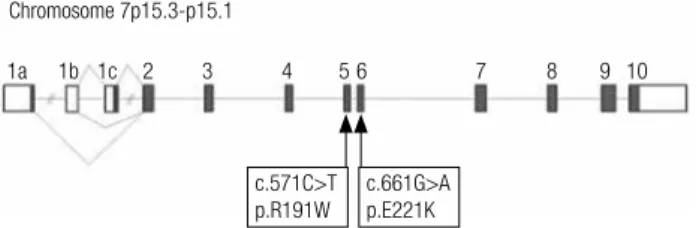
in-dex patient revealed a heterozygous missense muta-tion CGG>TGG in exon 5, nucleotide posimuta-tion 571
(c.571C>T), causing a change of the amino acid ar-ginine to tryptophan (p.Arg191Trp) (Figure 1). The father also harbors this mutation, but not the mother, who does not have hyperglycemia. A total of 18 fam-ily members were screened for p.Arg191Trp mutation, and 11 had the mutation in heterozygous state. All af-fected patients had mild elevated glycemia, and fam-ily members with normal glycemia did not harbor the mutation (Figure 2).
GCK sequencing of the second proband
identi-ied a heterozygous missense mutation GAG>AAG in exon 6, nucleotide position 661 (c.661G>A), changing the amino acid glutamic acid to lysine (p.Glu221Lys) (Figure 1). Molecular analysis of all family members with hyperglycemia revealed the same mutation (Figure 2).
Figure 1. Schematic representation of exons 1 to 10 of glucokinase gene, located in the short arm of chromosome 7. Arrows indicate the mutations identiied in this study (irst report in Brazilian families).
Chromosome 7p15.3-p15.1
1a 1b 1c 2 3 4 5 6 7 8 9 10
c.571C>T p.R191W
c.661G>A p.E221K
Figure 2. (A) Pedigree of Family 1. (B) Pedigree of Family 2. Arrows identify the probands. Squares denote male family members, and circles denote females. Question marks (?) denote family members with unknown glycemic status, and that were not genotyped. Individuals shown in white
had normal glycemia and did not harbor the mutation (wild type GCK), and
those shown in black had hyperglycemia and the GCK mutation (MODY 2).
A
B
?
?
? ?
?
Cop
yright
© ABE&M t
odos os dir
eit
os r
eser
vados
.
be considered in patients with chronic asymptomatic hyperglycemia, early age of onset, family history of
impaired glycemia, and negative β-cell antibodies, as
we observed in the patients described here.
Acknowledgments: this study was supported by grants from Conselho Nacional de Desenvolvimento Cientíico e Tecno-lógico (CNPq) (301477/2009-4 to A.A.L.J) and Universida-de Universida-de São Paulo (Programa Universida-de Apoio aos Novos Docentes – 2010.1.37155.1.8).
Disclosure: no potential conlict of interest relevant to this article was reported.
REFERENCES
1. Centers for Disease Control and Prevention (CDC). Diabetes Public Health Resource. 2011 National Diabetes Fact Sheet [In-ternet]. 2011. Available from: http://www.cdc.gov/diabetes/pubs/ factsheet11.htm
2. Fajans SS, Bell GI, Polonsky KS. Molecular mechanisms and clini-cal pathophysiology of maturity-onset diabetes of the young. N Engl J Med. 2001;345(13):971-80.
3. Reis AF, Velho G. Bases genéticas do diabetes mellitus tipo 2. Arq Bras Endocrinol Metabol. 2002;46(4):426-32.
4. Fajans SS, Bell GI. MODY: history, genetics, pathophysiology, and clinical decision making. Diabetes Care. 2011;34(8):1878-84. 5. Shields BM, Hicks S, Shepherd MH, Colclough K, Hattersley AT,
Ellard S. Maturity-onset diabetes of the young (MODY): how many cases are we missing? Diabetologia. 2010;53(12):2504-8. 6. Oliveira CSV, Furuzawa GK, Reis AF. Diabetes mellitus do tipo
MODY. Arq Bras Endocrinol Metabol. 2002;46(2):186-92. 7. Hattersley AT, Bruining J, Shield J, Njolstad P, Donaghue KC.
ISPAD Consensus – The diagnosis and management of mono-genic diabetes in children and adolescents. Pediatr Diabetes. 2009;10(Suppl12):33-42.
8. Vaxillaire M, Froguel P. Monogenic diabetes in the young, phar-macogenetics and relevance to multifactorial forms of type 2 dia-betes. Endocr Rev. 2008;29(3):254-64.
9. Velho G, Blanché H, Vaxillaire M, Bellanné-Chantelot C, Pardini VC, Timsit J, et al. Identiication of 14 new glucokinase mutations and description of the clinical proile of 42 MODY-2 families. Dia-betologia. 1997;40(2):217-24.
10. Chèvre JC, Hani EH, Boutin P, Vaxillaire M, Blanché H, Vionnet N, et al. Mutation screening in 18 Caucasian families suggest the existence of other MODY genes. Diabetologia. 1998;41(9):1017-23. 11. Frayling TM, Evans JC, Bulman MP, Pearson E, Allen L, Owen K, et al. Beta-cell genes and diabetes – Molecular and clinical characterization of mutations in transcription factors. Diabetes. 2001;50(Suppl1):S94-100.
12. Moises RS, Reis AF, Morel V, Chacra AR, Dib SA, Bellanné-Chan-telot C, et al. Prevalence of maturity-onset diabetes of the young mutations in Brazilian families with autosomal- dominant early-onset type 2 diabetes. Diabetes Care. 2001;24(4):786-8. 13. Maraschin JF, Kannengiesser C, Murussi N, Campagnolo N,
Ca-nani LH, Gross JL, et al. HNF1α mutations are present in half of
clinically deined MODY patients in South-Brazilian individuals. Arq Bras Endocrinol Metabol. 2008;52(8):1326-31.
14. Furuzawa GK, Giuffrida FMA, Oliveira CSV, Chacra AR, Dib SA, Reis AF. Low prevalence of MODY2 and MODY3 mutations in Bra-zilian individuals with clinical MODY phenotype. Diabetes Res Clin Pract. 2008;81(3):e12-4.
DISCUSSION
The two cases reported, which were initially assessed for short stature, had a MODY 2 diagnosis, suspected by persistent mild hyperglycemia and vertical inheri-tance for at least two consecutive generations. The con-dition was conirmed by molecular genetic testing. All
family members with hyperglycemia also had the GCK
mutation.
The variants of GCK gene identiied in our study
did not segregate with short stature, but with hyper-glycemia. Though in our cases short stature was the subject of the initial evaluation, there is no descrip-tion of associadescrip-tion of this disorder of growth with MODY in the literature. Therefore, hyperglycemia in these cases may be regarded as an incidental inding. Although the functional effects of these two mu-tations on GCK enzymatic activity have not been directly studied, the p.Arg191Trp mutation have been identiied in French, Japanese, Norwegian, and Korean patients with the MODY2 phenotype (20,27-29). p.Glu221Lys mutation was associated with MODY 2 in Italian subjects (30). Even though they have already been reported in other ethnicities, these GCK mutations have never been identiied in Brazilian families (12-14).
The irst GCK gene mutations found in Brazilian
individuals (two novel mutations) were reported in a collaborative study that also included French families (9). In publications including only Brazilian
fami-lies, a total of ive GCK variants have been previously
described (12-14): two were novel mutations (14), one was a glucokinase polymorphism (intronic vari-ant that did not co-segregate with diabetes) (12), and another variant that could not be ascertained as a causal mutation (it was not present in a fam-ily member with diabetes) (13). This data could not
cover all GCK mutations found in Brazilian subjects,
as some may have not been published yet, or may be only available in annals of scientiic meetings. The prevalence of MODY 2 cases in the Brazilian popu-lation is not high, although this might be related to patient age at screening, and availability of molecular genetic tests.
Our study draws attention to the importance of
the identiication of GCK mutations in patients with
mild asymptomatic hyperglycemia in the pediatric setting. This approach has crucial implications for the clinical course, patient management, and family
Cop
yright
© ABE&M t
odos os dir
eit
os r
eser
vados
.
15. Stoffel M, Froguel P, Takeda J, Zouali H, Vionnet N, Nishi S, et al. Human glucokinase gene: isolation, characterization, and iden-tiication of two missense mutations linked to early-onset non-insulin-dependent (type 2) diabetes mellitus. Proc Natl Acad Sci USA. 1992;89:7698-702.
16. Froguel P, Vaxillaire M, Sun F, Velho G, Zouali H, Butel MO, et al. Close linkage of glucokinase locus on chromosome 7p to early-onset non-insulin-dependent diabetes mellitus. Nature. 1992;356(6365):162-4.
17. Osbak KK, Colclough K, Saint-Martin C, Beer NL, Bellanné-Chan-telot C, Ellard S, et al. Update on mutations in glucokinase (GCK), which cause maturity-onset diabetes of the young, permanent neonatal diabetes, and hyperinsulinemic hypoglycemia. Hum Mutat. 2009;30(11):1512-26.
18. Matschinsky FM. Glucokinase, glucose homeostasis, and diabe-tes mellitus. Curr Diab Rep. 2005;5:171-6.
19. Hattersley AT, Pearson ER. Minireview: pharmacogenetics and be-yond: the interaction of therapeutic response, beta-cell physiolo-gy, and genetics in diabetes. Endocrinology. 2006;147(6):2657-63. 20. Martin D, Bellanné-Chantelot C, Deschamps I, Froguel P, Robert
JJ, Velho G. Long-term follow-up of oral glucose tolerance test-derived glucose tolerance and insulin secretion and insulin sen-sitivity indexes in subjects with glucokinase mutations (MODY2). Diabetes Care. 2008;31(7):1321-3.
21. Naylor R, Philipson LH. Who should have genetic testing for maturity-onset diabetes of the young? Clin Endocrinol (Oxf). 2011;75(4):422-6.
22. Lorini R, Klersy C, D’Annunzio G, Massa O, Minuto N, Iafusco D, et al. Maturity-onset diabetes of the young in children with
inci-dental hyperglycemia : a multicenter Italian study of 172 families. Diabetes Care. 2009;32(10):1864-6.
23. Stride A, Vaxillaire M, Tuomi T, Barbetti F, Njølstad PR, Hansen T, et al. The genetic abnormality in the beta cell determines the re-sponse to an oral glucose load. Diabetologia. 2002;45(3):427-35. 24. Ellard S, Bellanné-Chantelot C, Hattersley AT. Best practice guide-lines for the molecular genetic diagnosis of maturity-onset diabe-tes of the young. Diabetologia. 2008;51(4):546-53.
25. Murphy R, Ellard S, Hattersley AT. Clinical implications of a mo-lecular genetic classiication of monogenic beta-cell diabetes. Nat Clin Pract Endocrinol Metab. 2008;4(4):200-13.
26. García-Herrero C, Rubio-Cabezas O, Azriel S, Navas M. Functional characterization of MODY2 mutations highlights the importance of the ine-tuning of glucokinase and its role in glucose sensing. PLoS One. 2012;7(1e30518):1-9.
27. Yorifuji T, Fujimaru R, Hosokawa Y, Tamagawa N, Shiozaki M, Aizu K, et al. Comprehensive molecular analysis of Japanese patients with pediatric-onset MODY-type diabetes mellitus. Pediatr Diabe-tes. 2012;13(1):26-32.
28. Sagen JV, Bjørkhaug L, Molnes J, Raeder H, Grevle L, Søvik O, et al. Diagnostic screening of MODY2/GCK mutations in the Norwe-gian MODY Registry. Pediatr Diabetes. 2008;9(5):442-9.