INADEQUATE PRACTICE RELATED OF THE PAPANICOLAOU TEST
AMONG WOMEN
Elainy Fabrícia Galdino Dantas Malta1, Fabiane do Amaral Gubert2, Camila Teixeira Moreira Vasconcelos3, Emília Soares Chaves4, João Marcos Ferreira de Lima Silva5, Eveline Pinheiro Beserra6.
1 Ph.D. in Nursing. Professional Estratégia Saúde da Família of Juazeiro do Norte, Professor Faculdade Leão Sampaio. Juazeiro do Norte, Ceará, Brazil. E-mail: [email protected]
2 Ph.D. in Nursing. Professor Graduação em Enfermagem, Universidade Federal do Ceará (UFC). Fortaleza, Ceará, Brazil. E-mail: [email protected]
3 Ph.D. in Nursing. Professor Graduação em Enfermagem, UFC. Fortaleza, Ceará, Brazil. E-mail: [email protected] 4 Ph.D. in Nursing. Universidade da Integração Internacional da Lusofonia Afro-Brasileira. Fortaleza, Ceará, Brazil. E-mail: emilia@
unilab.edu.br
5 M.Sc. in Physical Education. Professor Faculdade Leão Sampaio. Juazeiro do Norte, Ceará, Brazil. E-mail: [email protected] 6 Ph.D. in Nursing, Professor Graduação em Enfermagem, UFC. Fortaleza, Ceará, Brazil. E-mail: [email protected]
ABSTRACT
Objective: to identify the factors related to inadequate practice of the Papanicolaou test among women in northeastern Brazil.
Method: cross-sectional study using a KNOWLEDGE, ATTITUDE AND PRACTICE inquiry, performed from June to October, 2013, with 240 women aged between 24 and 59 years.
Results: inadequacies were observed, particularly in knowledge, because, despite having information about the examination, it was only used to detect sexually transmitted infections. Regarding the issue of practice, it was noted that single women and those up to 29 years of age were more likely to present inadequate practice than the older and married women, increasing the likelihood of developing cervical cancer. The greater dificulty for performing the examination was the lack of materials (68.1%).
Conclusion: clariication for women regarding the examination requires effective communication between the users and health professionals, as well as guarantees and support for the continuity of care by managers.
DESCRIPTORS: Cervix neoplasms prevention. Women’s health. Papanicolaou test.
PRÁTICA INADEQUADA DE MULHERES ACERCA DO PAPANICOLAOU
RESUMO
Objetivo: identiicar os fatores relacionados à prática inadequada do exame Papanicolaou em mulheres do interior do Nordeste brasileiro. Método: estudo transversal, no qual se utilizou o inquérito conhecimento, atitude e prática, no período de junho e outubro de 2013, com 240 mulheres entre 24 e 59 anos.
Resultados: observaram-se inadequações, principalmente no conhecimento, pois, apesar de possuírem informações sobre o exame, utilizavam-no apenas para detectar doenças sexualmente transmissíveis. No quesito prática, percebeu-se que mulheres solteiras de até 29 anos apresentam maiores chances de prática inadequada do que aquelas com maior idade/casadas, aumentando a probabilidade de desenvolver câncer do colo do útero. A maior diiculdade para a realização do exame foi devido à falta de material (68,1%).
Conclusão: o esclarecimento às mulheres acerca do exame necessita de comunicação efetiva entre usuárias e equipe de saúde, além da
garantia e suporte à continuidade do cuidado dos gestores.
PRÁCTICA INADECUADA DE MUJERES SOBRE LA PRUEBA DE
PAPANICOLAOU
RESUMEM: El objetivo fue identiicar los factores relacionados con la práctica inadecuada de Papanicolaou en mujeres en el interior del noreste de Brasil. Estudio transversal en el cual se utilizó la escala de conocimientos, actitudes y prácticas, en junio y octubre de 2013, con 240 mujeres de entre 24 y 59 años. Se observaron deiciencias en el conocimiento, porque a pesar de tener información sobre el examen, este era practicado sólo para la detección de enfermedades de transmisión sexual. En el ítem práctica, se percibió que las mujeres solteras de hasta 29 años presentaban mayores chances de práctica inadecuada cuando comparadas con aquellas mayores/casadas, lo que aumenta la probabilidad de desarrollar cáncer de cuello uterino. La mayor diicultad para el examen se debió a la falta de materiales (68,1%). Al inal, la explicación a las mujeres sobre el examen requiere de una comunicación efectiva entre los usuarios y los profesionales de la salud, así como la garantía y soporte continuo de la atención por parte de los administradores.
DESCRIPTORES: Prevención de cáncer de cuello uterino. Salud de la mujer. Prueba de Papanicolaou.
INTRODUCTION
Cervical cancer (CC) is considered a public health problem due to high rates of prevalence and mortality in women in the productive phase and, therefore, constitutes a great challenge for the Uniied Health System to implement strategies that promote early diagnosis and adequate treatment.1 In Brazil, CC is the second most common tumor in the female population, behind only breast cancer, and the fourth leading cause of death for women by cancer, with 4,800 fatalities per year.2
The strategy used in recent decades, in several countries, for the early detection of this cancer is the Papanicolaou test, which must be performed in women aged 25 to 64 years who have had sexual activity. The examination should be carried out ev-ery three years, after two consecutive normal tests, performed with an interval of one year, with primary health care being the main gateway to this service.3
In northeastern Brazil, despite progress in the teams of the Family Health Strategy, there has been a reduction of 8% in coverage of cytopathol -ogy examinations. It should also be noted that this region contains the highest percentage of women who have never performed the examination or did it more than three years ago.4-5
Regarding the coverage of the examination in Brazil, there are few studies that show the real-ity of the northeast region, especially of the inner cities, which have, in most cases, human develop-ment indices (HDI) below the national average. The majority of studies show results from large urban centers, as well as from the south and southeastern regions, with the main characteristics observed in women not undergoing the Papanicolaou test being: low socioeconomic status, low education, low fam-ily income and belonging to younger age groups.3
A study conducted in the state of Ceará with 250 women in a primary care service found that older women (>35 years) with more education
(>9 years) showed higher percentages of adequate knowledge and attitude.6
Therefore, this study will help nurses and professionals of the multidisciplinary team working in the area of women’s health in the northeastern region, especially in the inner cities, to relect on the knowledge, attitude and practice of these women re-garding the Papanicolaou test and on more adequate care in the prevention, early diagnosis, treatment and referral to specialized services for users with the greatest potential for developing cervical cancer. Thus, the study aimed to identify the factors related to the inadequate performance of the Papanicolaou test in women of northeastern Brazilian.
METHOD
This cross-sectional, quantitative study was based on a knowledge, attitude and practice (KAP) type household survey, conducted in nine health facilities in the urban area of a large city in the state of Ceará. The area has a HDI of 0.69, which is con -sidered average, according to the United Nations Development Program, and has the lowest indicator of cytopathology examinations of the municipality. The study population consisted of 10,159 women of childbearing age, according to the Pri-mary Healthcare Information System (SIAB), and the sample size was calculated considering an error of 5% and 95% conidence interval, assuring statistical signiicance of the indings. The sample size calculation provided a sample of 240 women. The criteria used for determining the sample were adopted according to another study conducted in a similar situation.6 For sampling of the participants a proportion calculation was used for each of the nine teams of the study.
were awaiting care for themselves or other family members, they were assured that this would not be prejudiced. Thus, the study was carried out be-tween June and October 2013, in which it was pos-sible to attain the required number of subjects for the estimated sample. The inclusion criteria were: to be aged between 24 and 64 years, in agreement with the examination coverage recommendation of the Ministry of Health;3 to be in the unit at the time
of collection, regardless of treatment; and to have initiated sexual life. The exclusion criterion was: to present some physical or cognitive condition that prevented communication at the time of the applica-tion of the instrument.
The data were collected through semi-struc-tured questionnaires, prepared based on another study,7 including questions about sociodemo-graphic, sexual and reproductive variables, as-sessment of knowledge, attitude and practice, as well as dificulty/ease of performing the Papa -nicolaou test in the Family Health Strategy. The questionnaires were applied by the researchers of the study and two undergraduate nursing students after eight hours of training. After this step, a pilot study was conducted with 25 users of another health district, allowing for adjustments to the legibility of the content.
With regard to the CAP, the study used the following adequation criteria:
a) Knowledge: Adequate - when the partici-pant reported having heard about the examination, knew it was to detect cancer in general or specii -cally for cervical cancer, and was able to cite at least two required care actions that should be performed before the examination; Inappropriate - when the participant had never heard of the test or had heard, but did not know its purpose; or when she was unable to name at least two care actions required before the examination.
b) Attitude: Adequate - when the participant considered it necessary to perform the test peri-odically, considering that even though routine, she presented care for her health; Inadequate - when the woman considered it unimportant, unnecessary or had no opinion about the need for the examination and/or had other reasons to go to the health service for the examination other than the prevention of cervical cancer.
c) Practice: Adequate - when the participant had performed her last preventive examination within the previous three years; had returned to re -ceive the last result and/or showed the test results to a health professional; Inadequate - when the woman
was last tested over three years before or had never performed the examination having already initiated sexual activity for more than one year; or did not return to receive the inal examination result and/ or did not show it to a health professional.
The data collected were double entered into an Excel® database. The consistency between the two databases was then checked. When there were inconsistent issues, the original questionnaire was referred to for correction. The database was trans-ported to the Stata, version 12.0, program.
Descriptive statistical analysis was performed through absolute and relative frequency, followed by Pearson’s chi-square test (p<0.05) and odds ra-tio(OR) for the exposure variables for inadequate practice of the Papanicolaou test. The multinomial logistic regression technique was carried out, in-cluding variables with value of at least 20% (p<0.20) in the crude analysis, through the discussion of the inal adjusted model.8-9 The OR was chosen because
in low prevalence outcomes, such as in the case of this study, there is little difference between the OR and prevalence ratio, as noted by other authors who used these measures.10
The standards for research with human sub-jects, of Resolution 466/12 of the National Health Council of Brazil, were followed. The project was registered in Plataforma Brasil and forwarded to the Research Ethics Committee of the Federal Univer-sity of Ceará, being approved under authorization No. 229.552.
RESULTS
The study included 240 women, with the majority aged between 24 and 29 years (32.9%); married/stable union (76.7%); with elementary education (46.2%); catholic (85.8%); not working outside the home (62.5%); and with a family income between 1 and 2 minimum wages (83.3%).
Regarding sexual and reproductive issues, the majority of the participants had a steady part-ner (87.1%); did not use condoms (86.7%) or an -other contraceptive method (73.3%); had children (86.2%); no history of abortion (70%); or sexually transmitted infections (STIs) (98.3%); or uterine problems (83.8%).
Table 1 - Distribution of the participants according to evaluation data of the knowledge, attitude and practice. Ceará, Brazil, 2013. (n=240)
Component Adequate Inadequate
n % n %
Knowledge 65 27.1 175 72.9
Attitude 64 26.7 176 73.3
Practice 146 60.8 94 39.2
Regarding the Papanicolaou test, 72.9% of the subjects had heard of the test, however, only 14.6% knew it was to prevent cervical cancer, with 17.1% saying that it was to prevent cancer, without specify-ing which type. The most commonly cited purpose was to detect STI/HIV (57.5%), and 10.8% did not know the purpose of the examination. When asking about the origin of this knowledge, 75% mentioned that it was from collective or individual educational activities with health professionals.
Considering care actions prior to the examina-tion, 64.6% mentioned two actions and 25.4% did not know any. Among those mentioned, not having sex prior to the examination; trimming pubic hair; hygiene; and cleanliness were the main ones. In relation to the examination schedule, 52.9% said it should be done annually.
Regarding the attitude, 73.3% were considered inadequate. All the subjects said the examination was necessary, however, when the reasons were observed, 65.8% thought it was just routine and only 10% reported seeking it periodically with the aim of preventing cervical cancer.
In relation to the practice, although the ad-equacy of this item of the KAP was higher in relation
to knowledge and attitude, 39.2% of the participants presented inadequate practice. In this group, 86.7% said they had undergone the examination once in their lives, while 13.3% had never performed it. Among those who had performed the examination, 36.5% stated that this was less than one year before. Fear was highlighted as the main reason for not performing it (50%).
Regarding returning for the results of the examination, 92.7% returned to receive these, 6.7% were found to have not shown the test to a health professional, either due to institutional (84.6%) or personal reasons (15.4%).
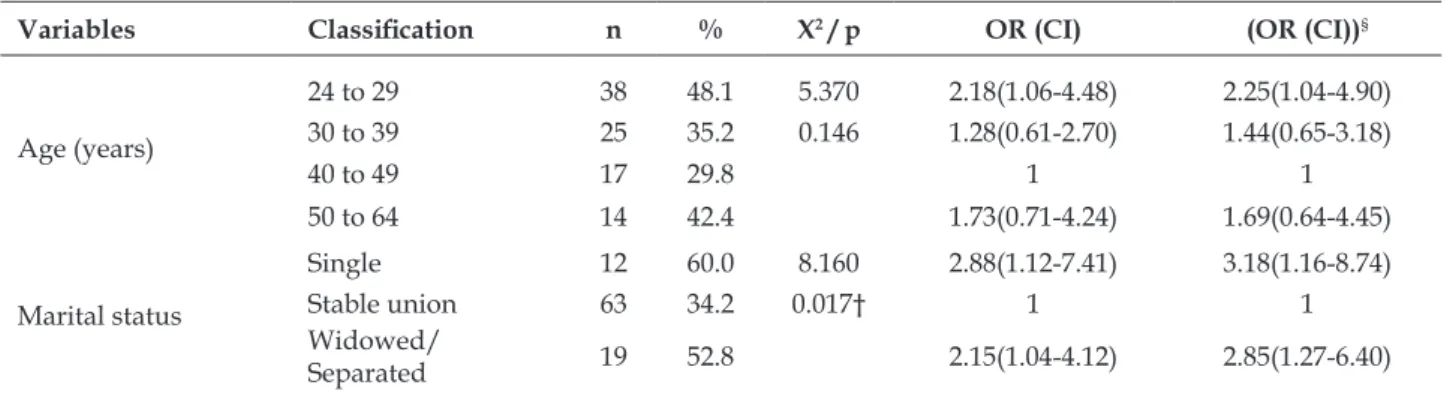
In Table 2 the adjusted odds ratios are present-ed for the most representative variables, showing that age, marital status and inadequate knowledge inluenced the inadequate practice. In the age vari -able, women between 24 and 29 showed the greatest chance (OR: 2.25) of being classiied with inadequate practice compared to those of 50 to 64 (OR: 1.69) and 30 to 39 years (OR: 1.44). Regarding marital status, single women had a greater chance of inadequate practice (OR: 3.18) compared to those widowed/ separated (OR: 2.8). The married women presented minimal risk.
Table 2 – Odds ratio (OR) values for the exposure variables for inadequate practice of the Papanicolaou test. Ceará, Brazil, 2013
Variables Classiication n % X2 / p OR (CI) (OR (CI))§
Age (years)
24 to 29 38 48.1 5.370 2.18(1.06-4.48) 2.25(1.04-4.90)
30 to 39 25 35.2 0.146 1.28(0.61-2.70) 1.44(0.65-3.18)
40 to 49 17 29.8 1 1
50 to 64 14 42.4 1.73(0.71-4.24) 1.69(0.64-4.45)
Marital status
Single 12 60.0 8.160 2.88(1.12-7.41) 3.18(1.16-8.74)
Stable union 63 34.2 0.017† 1 1
Widowed/
Education
Illiterate 4 36.4 0.240 1
-Elementary 42 37.8 0.971 1.06(0.29-3.86)
-High School 36 40.4 1.19(0.32-4.36)
-Higher 12 41.4 1.23(0.17-1.95)
-Steady partner Yes 79 37.8 1.25 1
-No 15 48.4 0.2641 1.54(0.72-3.29)
-Use condoms Yes 24 42.1 0.270 1.17(0.64-2.14)
-No 70 38.3 0.604 1
-Other contraceptive method
Yes 29 45.3 1.37 1.41(0.79-2.53)
-No 65 36.9 0.242 1
-Abortion Yes 30 41.7 0.27 1.16(0.66-2.04)
-No 64 38.1 0.604 1
-History of STI* Yes 1 25.0 0.360 1
-No 93 39.4 0.546 1.95(0.20-19.04)
-Uterine problem Yes 12 30.8 1.410 1
-No 82 40.8 0.234 1.55(0.74-3.24)
-Inadequate knowl-edge
Yes 78 44.6 8.270 2.46(1.30-4.66) 2.90(1.44-5.85)
No 16 24.6 0.004† 1 1
Inadequate attitude Yes 77 43.8 6.040 2.15(1.15-4.04) Removed
‡
No 17 26.6 0.014† 1
-*STI:Sexually transmitted infection;†Statistically signiicant association considering p<0.05; §Model only adjusted by the variables with p<0.200; ‡Removed aiming for a better it of the model.
Dificulties encountered in the realization of the Papanicolaou test in the Family Health Strategy
For 39.2% of the participants that presented inadequate practice, the main reasons for not
per-forming the examination were: embarrassment in front of the professional (27.6%); not liking the professional (20.8%) and lack of materials (68.1%), according to data from Table 3.
Table 3 - Distribution of the participants with inadequate practice of the Papanicolaou test, according to the dificulties encountered in performing this in the Family Health Strategy. Ceará, Brazil, 2013
Reasons given Inadequate practice
n %
There was no space 9 19.1
There was no material 32 68.1
There was no professional to perform the exam 6 12.8
Total 47 100
DISCUSSION
In the study, the participants had low lev-els of education and unfavorable socioeconomic conditions, which characterizes a large part of the Brazilian population, as well as those who present inadequate performance of the examinations. In the study, education inluenced the knowledge of the women regarding the examination, as in other stud-ies, as, not knowing the purpose of the examination or not knowing when to go to the health service to
do it, inluence not performing the screening ex -amination.6 In a study conducted in Bangladesh, a developing country like Brazil, it was found that the low level of education and knowledge generates less screening for cancer through the Papanicolaou test.11
older women usually have less adequate knowl-edge and attitude regarding the examination. In a study carried out in Uberaba/Minas Gerais with 200 women, the lack of knowledge about the Papanicolaou test was relected in inadequate attitudes to the examination.12 This may have be related to the restricted access of these women to healthcare or to the lack of information.
Concerning the practice, a study showed that inadequacy was related to being less than 36 years of age, not having a steady partner, living far from a health unit and performing the examination for the irst time.6 However, in the present study, it appears that the age (24-29 years), marital status (single) and inadequate knowledge variables con-tributed to this reality.
A study with 246 women in Turkey, living in conditions similar to Brazil, found that 93.7% knew about cervical cancer, 68.0% had heard about the Papanicolaou test and 46.1% had undergone an ex -amination at least once or more in their lives.13 The group of the present study showed more positive results because (86.7%) they said they had under -gone the examination at some time in their life, while (13.3%) had never performed it.
Regarding the study profile, 32.9% of the younger women (24-29 years), pointing out that there is greater demand for health services in this age group; however, through the results encoun -tered related to the inadequacy of the practice of this examination, this age group has shown increased vulnerability to cervical cancer, which requires the attention of the teams of the Family Health Strategy, in order to sensitize them and encourage them to perform the examination.
In the Northern region of Brazil, in the city of Manaus, a study with 285 women, with 152 being under 34 years of age, showed that the majority of the female participants (96.8%) received informa -tion about the Papanicolaou test from the health team, referred to as the main source of information about the examination, followed by other media (radio/TV, school, magazine/newspaper, friends/ relatives, church). There was a statistically sig-niicant association between having performed the Papanicolaou test in the previous three years and the source of information about the examination.14 This reinforces the fact that educational activities are needed in primary care to sensitize women to perform the Papanicolaou test.
Regarding the inadequate knowledge vari-able, the women with this classiication showed increased risk for inadequate practice. Thus, the
study participants did not have access to compelling information about the prevention of cervical cancer, causing them, therefore, to take an incorrect decision in relation to the care necessary for their own health. Therefore, health education programs should em-power women in relation to the Papanicolaou test, not only for the increase of knowledge, but also in order to bring about positive change in the attitude of the women toward the examination.15
The findings show that, for the partici-pants, the examination was performed with the aim of detecting sexually transmitted infections, revealing distorted information concerning the Papanicolaou test itself, as well as the modes of transmission and prevention; unlike the indings of another study11 in which 85% of the women
identiied the examination as a procedure for the detection of the precursor lesions of cervical cancer, enabling an early diagnosis.
This scenario shows the need for health edu-cation activities for the population and the broad access of women to clear and consistent information that is culturally appropriate for each region, which should be an initiative of the health services at all levels of care. The staff of the Family Health Strategy need to pay attention to this reality, stimulating, through discussions and guidance on the subject, the initiative of self-care and encouraging women to voluntarily seek health services for the performance of the cytological examination. In this study, despite the setting for data collection being in the scenario of the Family Health Strategy, it was perceived that the women were not seeking the service for perfor-mance of the examination, but accompanying other relatives or for other health care.
The women in this study followed the min-isterial recommendations for the examination, maintaining sexual abstinence. In relation to this issue, according to experts in the ield, this recom -mendation is only justiied when using condoms with lubricants or spermicides, since the presence of sperm does not compromise the microscopy.3
information and only 7.3% carried out the examina -tion in the recommended period, corroborating this study with regard to incorrect frequency.16
A broad survey of 9,194 women aged 18-26 years in 25 countries across Asia, Africa and the Americas, noted that the cervical cancer screening practices were considered inadequate and efforts should be made to develop programs that can in-crease screening for cervical cancer,17 showing that
this issue is wide ranging, requiring speciic actions for change in the health promotion of women.
In relation to the attitude, researchers6 found
that only 10% of women cited the prevention of cer -vical cancer as the reason for the examination; how -ever, a study performed in northeast Brazil7 showed the opposite, since many of the subjects sought the examination with the aim of prevention. Perhaps the divergent results are linked to the variables of the sample at the time of each study, however, there is a need for good interpersonal relationships between users and healthcare professionals, establishing an empathetic relationship based on trust, which may contribute to the awareness of self-care.18
Considering the practice, among those who had never performed the examination, the majority mentioned fear as the main reason. In a study with Hispanic women, who lived along the US border with Mexico, fear of embarrassment, the pelvic examination and lack of access to care services19
were identiied as barriers to screening. This feel -ing20 may be related to unease faced with a real or imaginary danger, for women, as they do not know the examination and imagine that they will feel pain or discover a disease.
In this scenario, to deepen the study of human, especially female, sexuality is one of the require-ments in the formation and practice of primary care nursing professionals so that they can direct their care toward the health needs of the population, in particular the health needs of the woman.21
Furthermore, it was veriied in a study22 that integrality of the care for the woman is needed, con-sidering the importance of good practice, of listening and of the bond in care for women, comprehending their concepts in relation to the Papanicolaou test. Therefore, the need can be perceived to develop studies that aim to construct interventions to con-front this reality, increasing the knowledge of this public so that they increasingly seek actions for the prevention of cervical cancer and the promotion of sexual and reproductive health.23
CONCLUSION
Regarding the factors associated with the realization of the Papanicolaou test in women of Northeast Brazil, inadequacies were mainly observed in the knowledge item because, despite having information about the examination, the majority of the participants highlighted the detec-tion of sexually transmitted diseases as the reason for the examination.
It was observed in the practice aspect that the variables age, marital status and inadequate knowledge inluenced single women and those aged up to 29 years to have more chance of presenting inadequate practice compared to those that were older and married.
It should be noted that, among these reasons, the lack of materials was still highlighted as a dif-iculty, according to the majority of the participants, and this fact in a unit can hide several causes: inad-equate investment in public health, inadinad-equate plan-ning of the health services and inadequate logistics for the distribution of materials, among others.
From the indings, it is necessary to elucidate the factors that inluence these women not to per -form the test or to per-form it for reasons different to its actual application, considering their culture, customs and health practices. Strategies are needed to encourage more young and single women to go to health facilities not only when faced with a sign or symptom, but for a preventive approach, seeking to encourage self-care.
REFERENCES
1. Girianelli VR, Gamarra CJ, Azevedo e Silva G. Os
grandes contrastes na mortalidade por câncer do colo uterino e de mama no Brasil. Rev Saúde Pública. 2014; 48(3):459-67.
2. Instituto Nacional do Câncer. Coordenação
Geral de Ações Estratégicas. Divisão de Apoio à Rede de Atenção Oncológica. Diretrizes brasileiras para o rastreamento do câncer do colo do útero [Internet]. 2011 [cited 2012 Jul 17]. Available from: http://colposcopia.org.br/files/ consensos/6-1144611105.pdf
3. Ministério da Saúde (BR). Secretaria de Atenção à
Saúde, Departamento de Atenção Básica. Controle dos cânceres do colo do útero e da mama. Brasília (DF): Ministério da Saúde; 2013.
5. Conselho Nacional de Secretários de Saúde - Ceará. Caderno de Informações para a gestão estadual do SUS/Conselho Nacional de Secretários de Saúde. Brasília (DF): CONASS; 2011.
6. Vasconcelos CTM, Pinheiro AKB, Castelo ART, Costa
LQ, Oliveira RG. Conhecimento, atitude e prática relacionada ao exame colpocitológico entre usuárias de uma unidade básica de saúde. Rev Latino-Am Enfermagem [Internet]. 2011 [cited 2015 Jul 5]; 19(1):97-105. Available fromhttp://www.scielo.br/scielo. php?pid=S0104-11692011000100014&script=sci_ arttext&tlng=pt
7. Pinheiro MACF, VasconcelosCTM, Vasconcelos
Neto JA, Cunha DFF, Pinheiro AKB. Análise dos exames colpocitológicos não retirados por pacientes entre 2007-2009: estudo documental. Online Braz J Nurs. [Internet]. 2014 [cited 2016 Feb 22] 13(1):[5 p]. Available from: http://www.objnursing.uff.br/ index.php/nursing/article/view/3954/html_85 8. Hamilton LC. Statistics with STATA: version 12.
Boston (us): Brooks/Cole; 2012.
9. Kleinbaum DG, Kupper LL, Nizam A. Applied regression analysis and other multivariable methods. Belmont (us): Thomson Brooks/Cole; 2013.
10. Falcão GB, Ibiapina FLP, Feitosa HN, Feitosa TS, Lacerda PD, Braga JU, et al. Fatores associados à realização de citologia para prevenção de câncer do colo uterino em uma comunidade urbana de baixa renda. Cad Saúde Coletiva. 2014; 22(2):165-72. 11. Ferdous J, Islam S, Marzen T. Attitude and practice
of cervical ancer screening among the women of Bangladesh. Mymensingh Med J. 2014; 23(4):695-702. 12. Mendes LC, Silveira CF, Silva SR. Conhecimento de
mulheres a respeito do exame de papanicolaou e do autoexame das mamas. Rev Enferm Atenção à Saúde. 2013; 2(3):4-17.
13. Onsuz MF, Hidiroglu S, Sarioz A, Metintas S, Karavus M. Knowledge, attitudes and behaviors of women over 20 years old on cervix cancer in Istanbul, Turkey. Asian Pac J Cancer Prev. 2014;15(20):8801-7.
14. Corrêa DAD, Villela WV, Almeida AM. Challenges to the organization of a cervical cancer screening program in Manaus-AM. Texto Contexto Enferm [Internet]. 2012 [cited 2015 Jul 5]; 21(2):395-400. Available
fromhttp://www.scielo.br/scielo.php?pid=S0104-07072012000200018&script=sci_arttext
15. Ranabhat S, Tiwari M, Dhungana G, Shrestha R. Association of knowledge, attitude and demographic variables with cervical Pap smear practice in Nepal. Asian Pac J Cancer Prev. 2014; 15(20):8905-10. 16. Singh M, Ranjan R, Das B, Gupta K. Knowledge,
attitude and practice of cervical cancer screening in women visiting a tertiary care hospital of Delhi. Indian J Cancer 2014; 51:319-23.
17. Pengpid S, Peltzer K. Attitudes and practice of cervical cancer screening among female university students from 25 low, middle income and emerging economy countries. Asian Pac J Cancer Prev. 2014; 15(17):7235-9. 18. Bezerra JRJ, Diógenes MAR, Mendonça FAC, Sampaio LRL, Jorge JR. Exame Papanicolaou: sentimentos relatados por profissionais de enfermagem ao se submeterem a esse exame. Ciênc Saúde Coletiva. 2011; 16(5):2443-51.
19. Penaranda E, Molokwu J, Hernandez I, Salaiz R, Nguyen N, Byrd T, et al. Attitudes toward self-sampling for cervical cancer screening among primary care attendees living on the US-Mexico border. South Med J. 2014; 107(7):426-32.
20. Casarin MR, PiccoliJCE. Educação em saúde para
prevenção do câncer de colo do útero em mulheres do
município de Santo Ângelo/RS. Ciênc Saúde Coletiva.
2011; 16(9):3925-32.
21. Garcia ORZ, Lisboa LCS. Nursing consultation concerning sexuality: an instrument for women’s nursing healthcare at the level of primary healthcare. Texto Contexto Enferm [Internet]. 2012 [cited 2015 Jul 1]; 21(3):708-16. Available fromhttp://www.scielo.br/ scielo.php?pid=S0104-7072012000300028&script=sci_ abstract&tlng=pt
22. Soares MC, Mishima SM, Silva RC, Ribeiro CV, Meinckes SMK, Corrêa ACL. Câncer de colo uterino: atenção integral à mulher nos serviços de saúde. Rev Gaúcha Enferm. 2011; 32(3):502-8.
23. Ribeiro KFC, Moura MSS, Brandão RGC, Nicolau AIO, Aquino PS, Pinheiro AKB. Student nurses’ knowledge, attitude and practice regarding the papanicolaou examination. Texto Contexto Enferm [Internet]. 2013 [cited 2015 Jun 26]; 22(2):460-7. Available fromhttp://www.scielo.br/scielo.php?script=sci_ arttext&pid=S0104-07072013000200023
Correspondence: Fabiane do Amaral Gubert Rua Alexandre Baraúna,1115
60420-670– Rodolfo Teóilo, Fortaleza, CE, Brasil E-mail: [email protected]